Likes
Comments
Share
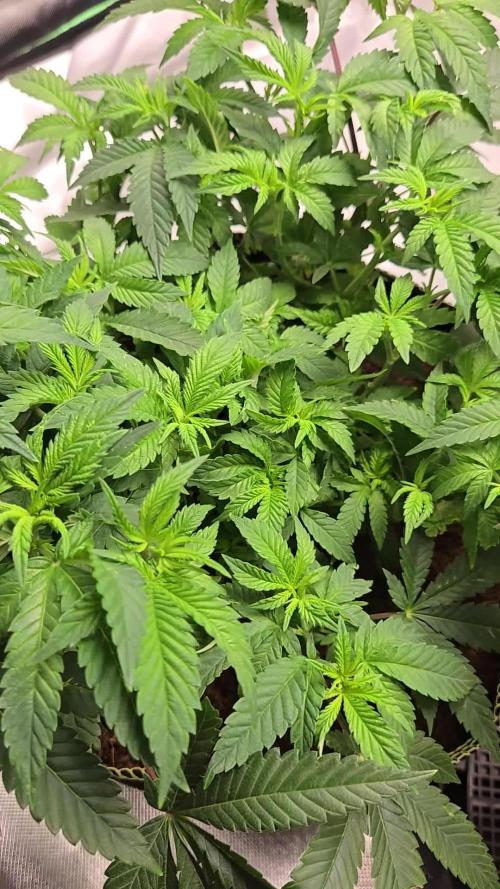
Esta es la segunda semana cambiamos a bases de floraciĂłn y las chicas se vienen comportante exelente ya han sexado todas y no hay machos :D. Peyote purple 2 parece que tiene alguna enfermedad? parece como si poco a poco sus hojas se consumieran solas, serĂĄ intolerancia a los abonos? si alguien me pudiera ayudar estarĂ­a agradecido. Saludos y buena semana colegas
Likes
51
Share
Ladies and gentlemen here we are for a few days away from starting our third week of flower and she is now starting to crown and all of her shoots are starting to shoot up towards the light.. from the beginning I've given this plant a complete beating and she's taking it with stride.. as far as the high stress training and low stress training goes that's all over with and we're just going to let her ride out from here on out... I'm not expecting any massive size buds I'm expecting a whole lot of thumb size buds and I'm okay with that... Thank you Weedseedsexpress for the opportunity to showcase your resilient genetics.. hope all is well and happy growing everyone ✌️😎
Likes
7
Share
The garden is thriving! OG KUSH, Royal Moby, and Cookies Gelato are seriously some of the dankest strains out there—each one bursting with that perfect terpene profile and loaded with resinous THC. These plants are incredible, and the grow is really starting to shine. The nutrients got a little too hot last week, so I dialed the lights back by 15%, but no worries—they’re already bouncing back, just like they always do. Gave them a little Recharge today to boost the microbes, and I’ll be flushing with just water for a couple of days to keep everything balanced. These buds are going to be something special!
Likes
96
Share
💩Alrighty then Growmies We Are Back At it 💩 Well folks we just finished up the last run and so we are bad to do it all over again 😁 So what do you say we have some fun 👈 We got some Z & Z 🚗 🚘 🚗 🚘 👉 From Exotic Seeds Well we are just 63 days and folks shes doing pretty good 👌 She's going to be chopped here in the next day or too 👈 So I am super happy thus far👍 smells awsome 😊 very sweet 😊 FC4800 from MarsHydro Lights being readjusted and chart updated .........👍I've added a UR45 to the mix👈 www.marshydro.ca 👉I am using Agrogardens for nutrients for my grows and welcome anyone to give them a try .👈 👉 www.agrogardens.com 👈 Agrogardens Cal MAG Agrogardens Grow A+B Agrogardens Bloom A+B Agrogardens Bud Booster Agrogardens PK13/14 I GOT MULTIPLE DIARIES ON THE GO 😱 please check them out 😎 👉THANKS FOR TAKING THE TIME TO GO OVER MY DIARIES 👈 Would you like to hang with the growdiary community 👉 https://discord.gg/gr4cHGDpdb 👈
Likes
3
Share
@MADMANk
Follow
Stretch coming on nicely. The SSS is flowering earliest and fastest, 1 Sour D seems to have more genes from the "GPP", but the other is super sativa looking... Hoping its close too the Karmabx3 Sour D genetics! The Strawberry Cola Sherb, is clearly feeling great in the air pot! but in all honesty... ima bottom feeder so it just turns out a lil awkward hand feeding. (Seaweed drench once a week)
Likes
45
Share
6/19 Knowing it was going to be over 100° for the majority of the day I WATERED the garden with 3 1/2 gallons. I went to check around 4 and everything looked amazing. We got some hard rain from a thunderstorm at 4pm but it seems like these girls like it rough and did fine. The take a beating and come back stronger. Knock on wood but I haven't seen any problems on the plant I snapped amd dict taped.. Everything seems to have toughened up and the leaves are an awesome healthy color. They grow observable every day now. Tomorrow is supposed to reach 100 again for most of the day before weather goes back to semi normal. I took a video but it will take way to long to upload. Tons of other pics didn't upload either. 6/20 Another day that's going to be over 100°. Plants seem to love it lol. I can't believe what I'm seeing. Bags still had some heft so I didn't water this morning. I figure I'll check them around noon and then plan on watering tonight if they need it. Hopfully they'll get some rain from thunderstorms. This crop has been through a lot. I think that has helped them significant deal with this unpredictable weather. 6/21 We had a MAJOR thunderstorm with sheet rain yesterday. I missed it but it was intense. I saw some videos. First time dad seemed concerned. Fortunately there was no damage. I was going to water today but I decided to hold off due to the look of the plants and the "praying leaves" at 4pm and feeling some moisture in the soil. Bags seemed to still have some heft. I'll probably water tomorrow. Need to transplant the 1 gals and need to figure out what I want to do for nutes this year. So far I've put in much less effort and I'm still doing great. I just don't have as many plants as usual. 6/22 Rained last night. Not much but the bags were heavy still so I held off watering. Plants looked happy and I can fix under watering much easier. It will rain tomorrow. I'll check throughout the day and update but things are going good. I should transplant those 3 seedlings in 1 gals. 6/23 It Rained last night and is suppised to rain today. It was raining when i went over. Just the kind if rain the plants love. I'll check again before church but I'm eventually going to have to water them. Those thunder storms helped a lot. 6/24 Rained about an inch yesterday. Plants loved it. Bigger everytime I see them. One seedling showed a pistol and I'll transplant it with the rest. It was the only one I was worried about. I've seen a FEW leaf hopper punctures and some other bites that could be anything. Time to get the ipm 6/25 Looks like its gonna be a nice sunny day. 75° at 10am. Plants are doing amazing and growing at a rapid pace. Haven't done anything ipm as of yet but any damage I've seen is localized to "A" leaf on "A" plant. I'll be paying attention and watching for signs of deficiencies. As of now though they LOOK great. I'll try to transplant the 3 seedlings today.
Processing
Likes
5
Share
Very good looking just like her sister, powerful citric and sweet aroma, very good strain, and starting to smell seriously at the start of 2nd week I'm noticing the same thing on both plants! Awesome strain
Likes
2
Share
Short veg 8 weeks flower, good yield killer smoke rock hard buds
Likes
4
Share
0.23v tuned to 7.83Hz Plants exposed to the Schumann resonance often show greater resistance to stress factors such as drought, diseases, and pests. It is possible that these natural electromagnetic waves strengthen plants' immune systems and increase their ability to resist disease. Pretty neat, in the afternoon when the tent hovers around 84F the plants are 🙏, can visually see in time around 10 minutes after I opened the tent the temp had dropped to 76 pressure was lost, she is still chilling but she doesn't quite have that perk anymore. *Salinity3.5% - 100ml H2O=100g The concentration of salt in a solution 3.5%= 3.5g in 100ml. Growing well. Not going to top or do any training, I'll let the plant do its own thing, she is constructing foundations now for what she senses ahead. Smart girl. ✨️ Let her, do her thing, let me do mine. The voltage that is needed for electrolysis to occur is called the decomposition potential. The word "lysis" means to separate or break, so in terms, electrolysis would mean "breakdown via electricity. Green hydrogen is hydrogen produced by the electrolysis of water, using renewable electricity. The production of green hydrogen causes significantly lower greenhouse gas emissions than the production of grey hydrogen, which is derived from fossil fuels without carbon capture. Electrolysis of pure water requires excess energy in the form of overpotential to overcome various activation barriers. Without the excess energy, electrolysis occurs slowly or not at all. This is in part due to the limited self-ionization of water. Pure water has an electrical conductivity of about one hundred thousandths that of seawater. Efficiency is increased through the addition of an electrolyte (such as a salt, acid or base). Photoelectrolysis of water, also known as photoelectrochemical water splitting, occurs in a photoelectrochemical cell when light is used as the energy source for the electrolysis of water, producing dihydrogen . Photoelectrolysis is sometimes known colloquially as the hydrogen holy grail for its potential to yield a viable alternative to petroleum as a source of energy. The PEC cell primarily consists of three components: the photoelectrode the electrolyte and a counter electrode. The semiconductor crucial to this process, absorbs sunlight, initiating electron excitation and subsequent water molecule splitting into hydrogen and oxygen. Water electrolysis requires a minimum potential difference of 1.23 volts, although at that voltage external heat is also required. Typically 1.5 volts is required. Biochar, a by-product of biomass pyrolysis, is typically characterized by high carbon content, aromaticity, porosity, cation exchange capacity, stability, and reactivity. The coupling of biochar oxidation reaction (BOR) with water electrolysis constitutes biochar-assisted water electrolysis (BAWE) for hydrogen production, which has been demonstrated to reduce the electricity consumption of conventional water electrolysis from 1.23v to 0.21v. Biochar particles added to the electrolyte form a two-phase solution, in which the biochar oxidation reaction (BOR) has a lower potential (0.21 V vs. RHE) than OER (1.23 V vs. RHE), reducing the energy consumption for hydrogen production via biochar-assisted water electrolysis (BAWE). BAWE produces H2 under 1 V while eliminating O2 formation: key word "eliminating". Air with a normal oxygen concentration of around 21% is not considered explosive on its own; however, if a flammable gas or vapor is present, increasing the oxygen percentage above 23.5% can significantly increase the risk of ignition and explosion due to the enriched oxygen environment. The addition of ion mediators (Fe3+/Fe2+) significantly increases BOR kinetics. Air: Nitrogen -- N2 -- 78.084% Carbon Dioxide -- CO2 -- 0.04% Hydrogen in homosphere H -- 0.00005% Hydrogen "GAS" H2 in homosphere - 0% "Nitrogen, oxygen, and argon are the three main components of Earth's atmosphere. Water concentration varies but averages around 0.25% of the atmosphere by mass. Carbon dioxide and all of the other elements and compounds are trace gases. Trace gases include the greenhouse gases carbon dioxide, methane, nitrous oxide, and ozone. Except for argon, other noble gases are trace elements (these include neon, helium, krypton, and xenon). Industrial pollutants include chlorine and its compounds, fluorine and its compounds, elemental mercury vapor, sulfur dioxide, and hydrogen sulfide. Other components of Earth's atmosphere include spores, pollen, volcanic ash, and salt from sea spray." Although the CRC table does not list water vapor (H2O), air can contain as much as 5% water vapor, more commonly ranging from 1-3%. The 1-5% range places water vapor as the third most common gas (which alters the other percentages accordingly). Water content varies according to air temperature. Dry air is denser than humid air. However, sometimes humid air contains actual water droplets, which can make it more dense than humid air that only contains water vapor. The homosphere(where you live) is the portion of the atmosphere with a fairly uniform composition due to atmospheric turbulence. In contrast, the heterosphere is the part of the atmosphere where chemical composition varies mainly according to altitude. The lower portion of the heterosphere contains oxygen and nitrogen, but these heavier elements do not occur higher up. The upper heterosphere consists almost entirely of hydrogen, cool. 78%nitrogen as N2, a far too stable bond to be used by organisms. 20%oxygen 0.04%co2 0.00005% hydrogen When lightning strikes, it tears apart the bond in airborne nitrogen molecules. Those free nitrogen atoms N2 nitrites then have the chance to combine with oxygen molecules to form a compound called nitrates N3. Once formed, the nitrates are carried down to the ground becoming usable by organisms. Will it react with the oxygen in the air spontaneously, the answer is no. The mixture is chemically stable indefinitely. A mixture with air near the release point can be ignited, but if this does not happen then when its concentration gets below 4% it will be unable to carry a flame. Taking a small detour into chemistry here, a key concept to understanding the health impact of nitrogen-based compounds is knowing the difference between nitrates and nitrites. What Are Nitrates and Nitrites? A nitrite (NO2) is a nitrogen atom bonded to only two nitrogen atoms. Very strong bond A nitrate (NO3) is a nitrogen atom bonded to three oxygen atoms. Weaker bond The optimal pH for nitrate (NO3-) depends on the process and the type of bacteria involved. Nitrification The optimal pH for nitrification is between 7.5 and 8.6 Nitrification is the process of oxidizing ammonia to nitrate and nitrite Nitrosomonas has an optimal pH between 7.0 and 8.0 Nitrobacter has an optimal pH between 7.5 and 8.0 Nitrification ceases at pH
Likes
Comments
Share
Week 7 – Canopy-Kontrolle & Verdichtung Diese Woche merkt man deutlich: Der Stretch ist vorbei. Jetzt geht es nur noch um Blütenmasse. Die Struktur steht. Jetzt wird verdichtet. ⸻ 🌿 Entwicklung der Sorten Die Early Skunk hat sichtbar aufgeholt und fügt sich jetzt viel harmonischer ins Gesamtbild ein. Die Big Bud bleibt zwar optisch dominant, aber durch aktives Angleichen der Höhe wirkt das Zelt jetzt deutlich homogener. Bei Pure Power Plant und Somango XL habe ich die Töpfe erhöht, um ein gleichmäßiges Canopy zu erreichen. Ergebnis: • bessere Lichtverteilung • weniger Hotspots • gleichmäßigere Bud-Entwicklung • saubere Oberkante SoG zahlt sich jetzt richtig aus. ⸻ 💡 Licht Die Lampe wurde in dieser Woche auf 90 % erhöht. Abstand unverändert. Die Pflanzen reagieren stabil: • keine Lichtverbrennungen • keine Bleaching-Anzeichen • kräftige Blütenbildung Man sieht deutlich, dass die Energie jetzt komplett in die Buds geht. ⸻ 🌸 Blütenstatus • Buds beginnen dichter zu werden • Internodien schließen sich • erste leichte Harzbildung sichtbar • Pistillen weiterhin frisch und weiß Die Big Bud zeigt lange, gestapelte Colas. Die anderen Sorten bauen kompaktere, rundere Blüten auf. ⸻ Klima Die reduzierte Luftfeuchtigkeit zahlt sich aus. Das Blätterdach ist dichter geworden, aber die Luftzirkulation scheint zu passen. Keine Anzeichen von Feuchtigkeitsstress. ⸻ 📊 Fazit Woche 7 • Canopy aktiv ausgeglichen • Licht fast am Maximum • Stretch abgeschlossen • Bud-Stacking läuft • Struktur sauber kontrolliert Ab jetzt geht es in die Phase, wo Gewicht und Harz entscheiden. Man sieht: Das ist kein Zufallsgrow. Das ist Planung + Kontrolle.
Likes
2
Share
Hi Gromie's everything going awesome in the flowering tent, open the tent & its like hitting a wall of smell hard at high speed!!! Harvested the Orange sherbet clone at the front of the tent at week 8 day 56. Considering all that she had been through early on she produced some really nice sized frosty & dense & very sticky buds. The other 2 are getting close as well.
Processing
Likes
6
Share
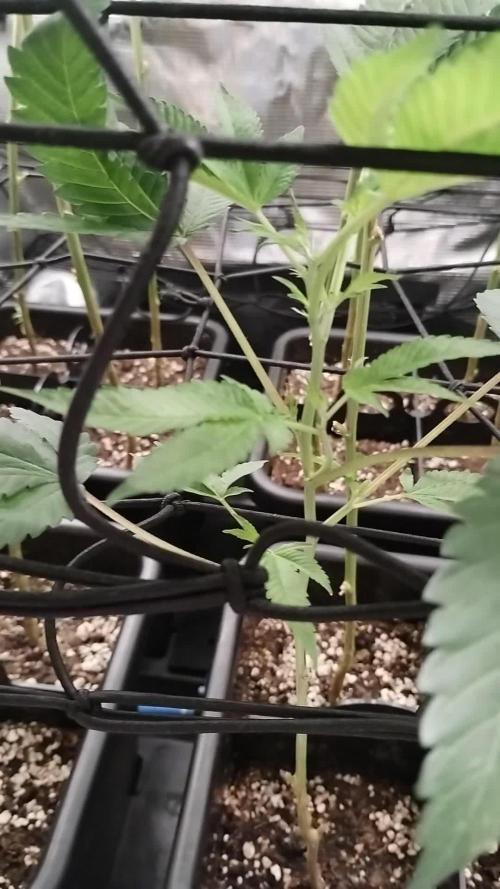
topped previous weeks, this week was spent training plants out to get ready to flip to flowering light cycle next week. left platinum yeti number 4 alone it is smallest weakest growth so i'm doing less to it than the training wise.
Likes
12
Share
@RoyColt
Follow
Day109 19/03 4lt ro water -12ml BloomA -12ml BloomB -8ml Nirvana -4ml FinalPart terra, Total 1000 ppm, ph 6,2 Drain 300ml, 1580 ppm. Day111 21/03 RinseOut Day 5lt ro water -5ml sensi cal mag extra, Total 200 ppm, ph 6,2 Drain First measure 500 ml, 1750 ppm- Second 500 ml, 1440 ppm- Third 500 ml, 1200 ppm. Day113 23/03 RinseOut Day 4 lt ro water -4ml sensi cal mag extra, Total 200 ppm, ph 6,2 Drain First measure 200 ml, 1250 ppm -Second 200 ml, 1150 ppm- Third 300 ml, 950 ppm.👌
Likes
34
Share
Week 6 Flower — Sundae Driver (deep dive) Quick recap — From seed to Week 6 • Germination: Pillbox + water enriched with Aptus Regulator / Start Booster; three seeds, two kept. • Early transplant: Seedlings moved directly into final 11 L fabric pots with a living / amended super-soil (Janeco Light Mix + Aptus line + mycorrhizae, substrate buffer, micro-mix). • Short veg: Minimal veg time (early transplant strategy), light training (leaf-tucking) and one deliberate supercrop to control a “moon-shot” top. • Flower flip: You used an 11/13 light schedule to encourage a firm, fast transition into flower. • Now: Week 6 of flower — plants are large, heavy, and beginning to show clear resin development. ⸻ This week’s snapshot (what you told me) • Solution EC: 0.7 mS/cm (you stopped All-in-One liquid and pulled solution EC down) • Solution pH: ~6.1 • Soil/substrate EC: still comparatively high (you reported earlier numbers around 5–6 mS/cm) — the living soil is doing the heavy lifting. • Feed plan kept: Plagron PowerBuds, Green Sensation, Sugar Royal (all low-dose), plus Aptus Regulator and Aptus CalMag Boost. • Plants: heavy, bulking, obvious frost/trichome production; supercrop site is producing well. ⸻ Why you lowered solution EC and stopped the All-in-One liquid • Letting the soil lead. Your living, richly amended soil already holds lots of available ions. Pulling water-solution EC back to ~0.7 makes the fertigation a light steering input rather than the dominant nutrient source. That reduces the risk of salt buildup while letting the soil biology and reserves feed the plants. • Encouraging ripening, not more vegetative growth. Lowering soluble N input and total EC reduces vegetative vigor and encourages the plant to reallocate energy into flower development and resin production. • Cleaner profile. A lighter solution often helps express terpenes and can reduce harsh residual taste if you choose to flush later. • Risk management. With a high substrate EC you avoid compounding salts, but you must monitor runoff EC/pH to ensure you’re not drifting into deficiency or toxicity. ⸻ Trichomes & white pistils, what you’re seeing and what it means • White pistils (hairs): still plentiful, the plant is mid-flower, still producing new pistils while older ones will start darkening in the coming weeks. A lot of white pistils now is normal at Week 6; they will darken and curl as maturity approaches. • Trichome types & stages: you’re seeing more glandular heads and sticky sugar leaves. Trichomes progress roughly: clear → cloudy/milky → amber. • Clear: immature (not peak potency) • Cloudy/milky: peak cannabinoid expression, usually target harvest for a balanced high • Amber: more degraded THC → more sedative, couch-type effect; some amber is normal depending on desired effect • What heavy trichome coverage now means: the plants have moved into active resin production; enzymes and carbon flux are being directed to terpene and cannabinoid pathways. Continued support (sugars, PK, stable environment) helps maximize resin and terpene development. ⸻ Supercrop update — technical recap & why it worked • Mechanics: you bruised/softened the stem, bent it, and closed the wound so the plant formed a strengthened knuckle. That redirection reduces apical dominance and sends auxin to lateral sites. • Results you observed: rapid curve-up, additional bud sites along the bent branch, and notable fruiting at the knuckle/top area. That’s expected, the wound redirects hormonal flow and the plant compensates by boosting side growth and flowers. • Monitoring: the knuckle strengthens over 3–7 days; watch for any slow-healing splits and keep airflow over the site to prevent moisture pooling. ⸻ Why you kept Plagron + Aptus (what each brings) • Plagron PowerBuds / Green Sensation / Sugar Royal: targeted bloom stimulators (PK, co-factors, carbs/aminos). They help compact flowers, feed terpene pathways, and provide sugars/precursors that support aroma and density. • Plagron Sugar Royal: acts as a carbohydrate/secondary biostimulant — supports microbes and gives a sugar boost that plants and microbes use for energy in resin synthesis. • Aptus Regulator: supports stress resilience, uptake efficiency, cell wall strength — especially valuable under high light/heat. • Aptus CalMag Boost: maintains Ca/Mg balance, essential for cell structure and avoiding tip burn when uptake is rapid. • Strategy: Plagron drives bloom chemistry; Aptus protects physiology and supports clean uptake. With soil heavy on reserves, both are applied as focused steering tools. ⸻ Week 6: What is happening physiologically • The plant transitions from stretch to stacking: calyxes thicken, pistils begin to darken in the coming weeks, and trichome density increases. • Carbohydrate flux is prioritized to the floral sink; you’ll see faster water uptake and increased K demand. • Leaf yellowing in lower leaves often begins around now as N is remobilized to flowers, this is frequently normal in mid-late flower if controlled and not extreme. ⸻ What to expect next (practical timeline & signals) Expect (over the next 1–3 weeks): • Continued calyx swelling and denser flowers. • Trichomes moving from mostly clear → cloudy (you’ll start seeing the ‘frost’ become more opaque). • Stronger terpene aroma as sugars and PK feed resin pathways. • Heavier water uptake and faster EC changes between runs. Don’t expect (yet): • Final resin peak — that typically comes later (weeks 7–10 depending on genetics). • Immediate massive ambering — amber trichomes usually develop later in the finish window. • No surprises — biological systems still can flip; remain monitoring-forward. Watch closely for: • Runoff EC & pH after a couple of waterings — if runoff EC climbs very high, consider a mild runoff correction. • Humidity & bud density: keep RH controlled to avoid botrytis (mid 40–55% during heavy stacking; lower as flowers bulk). • Magnesium / Potassium signs: interveinal yellowing (Mg) or edge cupping/crisping (K) — maintain CalMag and consider K if uptake accelerates. ⸻ Actionable checklist for Week 6 • Continue solution EC ~0.7 and pH ~6.1; treat fertigation as steering. • Measure runoff EC/pH at least once this week — log the results. • Keep Plagron bloom stack + Aptus Regulator & CalMag at light doses. • Keep canopy airflow high; consider lowering RH progressively if buds bulk fast. • Prepare stakes / soft ties or light trellis for heavy colas (supercrop sites may need support). • Microscope checks: start daily/alternate-day inspection of trichomes with 30–60× loupe — photograph if you want a timeline. • Avoid heavy new training; minor tucks/leaf removal to open air/light only. ⸻ A short note on flushing (planning) • Many growers flush with pH-balanced plain water 1–2 weeks before harvest to reduce soluble salts and tighten flavor; opinions vary. If you intend to flush, start planning timing based on trichome stage, not calendar alone. Your living soil and current low-solution EC approach already help keep things cleaner. ⸻ Final reflection — gratitude & community Week 6 is where the plant’s intent becomes visible: form into flower, pack on weight, and build resin. Your measured decision to pull back water EC while continuing Plagron’s bloom stimulants and Aptus support is a smart “steer, don’t force” approach that lets the living soil and the plant do the heavy metabolic work. 📲 Don’t forget to Subscribe and follow me on Instagram and YouTube @DogDoctorOfficial for exclusive content, real-time updates, and behind-the-scenes magic. We’ve got so much more coming, including transplanting and all the amazing techniques that go along with it. You won’t want to miss it. • GrowDiaries Journal: https://growdiaries.com/grower/dogdoctorofficial • Instagram: https://www.instagram.com/dogdoctorofficial/ • YouTube: https://www.youtube.com/@dogdoctorofficial ⸻ Explore the Gear that Powers My Grow If you’re curious about the tech I’m using, check out these links: • Genetics, gear, nutrients, and more – Zamnesia: https://www.zamnesia.com/ • Environmental control & automation – TrolMaster: https://www.trolmaster.eu/ • Advanced LED lighting – Future of Grow: https://www.futureofgrow.com/ • Root and growth nutrition – Aptus Holland: https://aptus-holland.com/ • Nutrient systems & boosters – Plagron: https://plagron.com/en/ • Soil & substrate excellence – PRO-MIX BX: https://www.pthorticulture.com/en-us/products/pro-mix-bx-mycorrhizae • Curing and storage – Grove Bags: https://grovebags.com/ ⸻ We’ve got much more coming as we move through the grow cycles. Trust me, you won’t want to miss the next steps, let’s push the boundaries of indoor horticulture together! As always, this is shared for educational purposes, aiming to spread understanding and appreciation for this plant. Let’s celebrate it responsibly and continue to learn and grow together. With true love comes happiness. Always believe in yourself, and always do things expecting nothing and with an open heart. Be a giver, and the universe will give back in ways you could never imagine. 💚 Growers love to all 💚
Likes
14
Share
@Terpyboyz
Follow
Hi growmies 👌🏻 so we’re on week 3 - day 6 of flowering these big girls 🙌🏻 still having a few slight deficiencies as these girls are Hungryy! It’s what happens when you veg for over 2 month 😂.. all is looking well thou colours are starting to appear on these Zake (perm marker cross kmintz). And these runtz s1 are starting to form up nicely 🕺 The clones are getting flowered on week 4 of flowering once the rooms be fixed. These are starting to come along nicely and I’ve found my keeper cutz of in house genetics stay tuned for some heavy bud formation within the next week or so
Processing
Likes
13
Share
@GrowGuy97
Follow
Start of week 5 today, everything seems to be going great! The Gelato OG is by far the biggest plant of the bunch so far but they all seem to be taking well to LST, HST , Topping & defoliation! Will be going in the flower tent as soon as the other ladies harvest so they will probably have atleast 2 to 3 more weeks of veg!
Processing
Likes
4
Share
Noticed some slight tacoing on leaves, changed to my 18/6 light schedule to help control temps and give some rest. Noticed some nute burning also, will full flush next week.