


Likes
Comments
Share


@Stonerandgrower
Follow
It's kinda sad not having anymore budding plants but thank God I got a break from harvesting it's strawberry cough btw dry weight is 24.9oz

Processing
Likes
7
Share


@RdSkM
Follow
As-alaam alaikum 🖖👽.
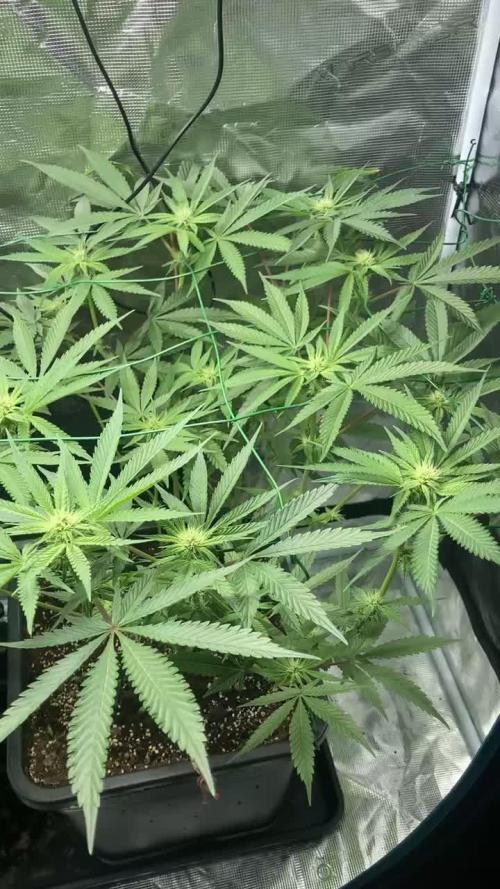
Una nueva semana más. Puse a esta maravilla de criatura a régimen de 48 horas de completa oscuridad y miren como se transformó. Ahora comienza proceso de floración.

Likes
20
Share

@BUZIMAN
Follow
Everything's going well here they drink minimal 1 liter per day almost. I did a light defoliation yesterday. ( I also turn on my dehumidifier I run around 55%rH) I started with Bloombastic, which Atami kindly gave me a few months ago. I hope to be able to participate in the contest with my various journals. I plan to use Bloombastic and a little Rokbaztic for the end on each of my next grows, which I still have left over from an old gift from a grow shop. Top ! 👍😎☮️


Likes
19
Share


@eldruida_lamota
Follow
Que pasa familia, puesto que la compañera y yo estamos bajo mínimos, hemos decidido proceder a un lavado de raíces temprano, y un estrés hídrico para limpiar raíces y estresarla un poco.
Todo va sobre ruedas , puesto que el Covid afecta al confinamiento, decidimos cortar las gorillas estos días siguientes para secar y en nada tener algún bote para subsistir 😂🤣.
-El estrés hídrico es reducir cada riego la cantidad de agua, para que la planta se estrese y escupa tricomas sus últimos días.
Esta variedad de sweet seeds es INCREÍBLE, aun cortándola pronto me parece que los resultados son inmejorables, su olor a melón me encanta y se ve repleta de thc.
Nos vemos en la cosecha fumetillas, y mucho ánimo para todos.

Likes
2
Share


@KEVS_BEST
Follow
Woche 2 - Weiteres Wachstum und Vorbereitung auf das finale Umtopfen
In der zweiten Woche wurde die Wassermenge schrittweise erhöht, um dem wachsenden Bedarf der Pflanzen gerecht zu werden. Ich habe die Bewässerung auf 300 ml alle zwei Tage erhöht, weiterhin ohne Düngerzugabe. Die beiden Sherbzooka Ladies ernährten sich noch vollständig von den in der Biobizz Light Mix Erde vorhandenen Nährstoffen.
Am 20.04.2024 wurde die erste Düngerladung Canna Terra verabreicht, mit einem Verhältnis von 10 ml auf 10 Liter Wasser. Der pH-Wert des Wassers lag bei 5,9 und der EC-Wert betrug 1,0. Die Pflanzen zeigten keinerlei Symptome von Mangel oder Überschuss.
Am 21.04.2024 wurden die Pflanzen abends in ihre finalen 9-Liter-Töpfe umgetopft. Die Pflanzen waren sichtbar gesund, kräftig und zeigten ein starkes Wachstum. Die durchschnittliche Temperatur blieb sehr stabil, und die Luftfeuchtigkeit wurde weiterhin manuell erhöht. Dazu habe ich täglich 500 ml Wasser in tiefen Tellern, verteilt auf vier Teller und fünf Handtücher, verwendet, um die Feuchtigkeit zu regulieren.
Die Beleuchtung war fest eingestellt: Das Licht ging um 06:40 Uhr an und schaltete sich um 00:40 Uhr aus, was den Pflanzen einen stabilen Tag-Nacht-Rhythmus gewährte. Insgesamt verlief die zweite Woche sehr erfolgreich, und die Pflanzen waren bereit, noch weiter zu gedeihen.
ENGLISH
Week 2 - Continued Growth and Preparation for Final Transplant
During the second week, I gradually increased the amount of water to match the plants' growing needs. I raised the watering amount to 300 ml every two days, still without any added nutrients. The two Sherbzooka ladies continued to thrive on the nutrients provided by the Biobizz Light Mix soil.
On April 20th, 2024, the first dose of Canna Terra nutrients was given, with a ratio of 10 ml per 10 liters of water. The pH of the water was 5.9, and the EC level was 1.0. The plants showed no signs of nutrient deficiency or excess.
On the evening of April 21st, 2024, both plants were transplanted into their final 9-liter pots. The plants remained visibly healthy, strong, and showed significant growth. The temperature stayed very stable, and I maintained the humidity manually by placing 500 ml of water daily across four plates and five towels, which helped regulate moisture levels in the room.
Lighting was kept consistent, with lights turning on at 6:40 AM and off at 12:40 AM, providing a steady day-night cycle. Overall, the second week was a great success, with the plants ready to continue thriving.

Likes
13
Share


@DudeGrowsWeed
Follow
White Widow is coming along nicely. Good bud development this week. She still has several weeks to go. My attic (where my grow tent is) is getting pretty hot these days. I'll probably be moving her outside over the next couple of weeks to avoid heat issues in the tent. Hoping for the best! 🙏

Processing
Likes
4
Share


@Mr_nugs_lover_David
Follow
She started to flower on August 3rd I have to force flower giving her total darkness because my house is full surrounded by the street lights and I wanna make sure that she flowers without any risk or problem,always have to do that with Photoperiods outdoors.

Likes
42
Share


@PapaBlob
Follow
13/04 Allez, c'est parti pour un rinçage, et je pense qu'elle passe à la coupe la semaine prochaine. 😁👍
Bien sur, merci à Dutchfem pour ces jolies graines . On en trouvent là: https://www.dutchfem.com/
Likes
11
Share


Likes
3
Share


@Barcelona_Farmers710
Follow
Booom! Ya tenemos los cogollos formandose Farmers!! Ya casi no se nota la falta de magnesio por problema con el humidificador pero en breves ya empiezo lo buenoo!😜 mis favoritas las de Barneys Farms!!! espero que os guste farmers buen comienzo de semana!!💚

Likes
11
Share


@MRTHC
Follow
Well we finally reached the end. The last week was more cruise control. Just trying to remove the big fan leaves that's blocking any flowers. The trichomes looking kinda ready but still acceptable. During the last few days I maintained a daytime Humidity of around 60 and nighttime of 55. Temperatures are between 73 degrees and 67 degrees.
Two days before chop they got 48 hrs of dark and 3 days of no water to add to the stress. After the 48hrs darkness all the ladies Came out extra frosty. Loving the change of hues on the blue gelato. The vanilla Kush is very oily and very very strong smell. Not a strong smell coming off the OrangeGelato though. The green gelato has a creamy smell.
Likes
5
Share


@Stick
Follow
Clones are ready to become monsters, roots are exploring the fabric pots, while tops are growing vertically and creating new nodes everyday. I think it's almost time to trigger the flip, I'm limited with heights and these babies will probably stretch a bit. One more veg week and we'll jump into the flowering stage!

Likes
4
Share


@AustinRon
Follow
OG 4Q24 Flower Week 9
Orangegasm (Fem) [ IRIE Genetics ]
12/12 @ Bolt (Day 21)
Germination: 20 November 2024
#3A Earliest Harvest Date: 9 February 2025
#3B Latest Harvest Date: 19 February 2025
_________________________________________
Start of Week: [Wed Feb 5, 2024 CR2 4Q24 57:F:8:1]
End of Week: [Tue Feb 11, 2024 CR2 4Q24 63:F:8:7]
OrangeGasm Fertigation:
- MAX: EC: [ 2.4, mS] #Ramping Down
- LightIntensity MAX: [ 850, µMol/m2/s]
______________________________________
OBJECTIVES
- Ramp EC from 2.4 - 1.0
- Start rolling off Primer A&B/Silica Skin to Resin Bloom . . .
__
Wed Feb 5, 2025
OG 4Q24 57:F:8:1
EC: 2.3
Notes:
#5 looks like a 60 day plant, if so - consider Saturday Harvest …
Runoff
- [x] Amount: [ 0.125 , gal]
- [x] EC: [ 4.4 , mS/cm]
- [x] EC∆: [ 2.5 , mS/cm] # Fried Yet? ;-}
Harvest Dehu
- [x] Amount: [ 1.5 , g]
__
Thu Feb 6, 2025
OG 4Q24 58:F:8:2
EC: 2.3
Refresh Reservoir
- [x] Amount: [ 2 , g]
- [x] EC: [ 2.3, mS/cm]
- [x] Primer A&B: [ 31, ml]
- [x] Silica Skin: [ 15 , ml]
__
Fri Feb 7, 2025
OG 4Q24 59:F:8:3
EC: 2.3
__
Sat Feb 8, 2025
OG 4Q24 60:F:8:4
- [x] Disassemble, Clean Reservoir and Pumps, Reassemble
Refresh Reservoir
- [ ] Silica Skin: [ 15 , ml]
- Dropping Silica Skin due to (sparse to medium) granular precipitate
- [x] Amount: [ 6 , g]
- [x] EC: [ 2.1, mS/cm]
- [x] Primer A&B: [ 100, ml]
EC: 2.1
@1900 - Clear Manifold Filter. (Mainline should be cleared on 1845 feed
__
Sun Feb 9, 2025
OG 4Q24 61:F:8:5
- [x] Dilute to EC 2.0
- Flooded Tent, 2 Gallons PLUS of Runoff. Happy Plants.
- Shout Out Shop-vac. ;-}
EC: 2.0
__
Mon Feb 10, 2025
OG 4Q24 62:F:8:6
EC: 1.8
HAND APPLICATION
Prepped One Gallon of 12-8-7-5 @ 1.8 mS/cm w/ PhotoSynthesis Plus, SLF-100
Reclaimed Dehu Water, ~2 Gallons
Refreshed Reservoir, 2 Gallons Rooted Leaf Hydro no Silica Skin, EC: 1.8 mS/cm
Reduced watering to 5 min, then 1 - 1 -1 -1 -1 -1 -1 -1
(It’s not like they’ve been under-fertigated)
__
Tue Feb 11, 2025
OG 4Q24 63:F:8:7
EC: 1.7
- [x] EC: [ 1.7, mS/cm2]
- [x] Refresh Reservoir
- [x] amount: [ 2.5, gal]
Runoff
- [x] Amount: [ 0.5, gal]
- [x] EC: [ 3.6, mS/cm2]
- [x] EC∆: [ 0.9, mS/cm2] # Better than 2.5!
PLANT POSITIONS
3 5 1 7
4 2 6 8

Likes
3
Share

@Abendkraut
Follow
3rd time trying to write this diary entry and maybe if grow diaries feels like it you will be able to read this entry... [rant over]
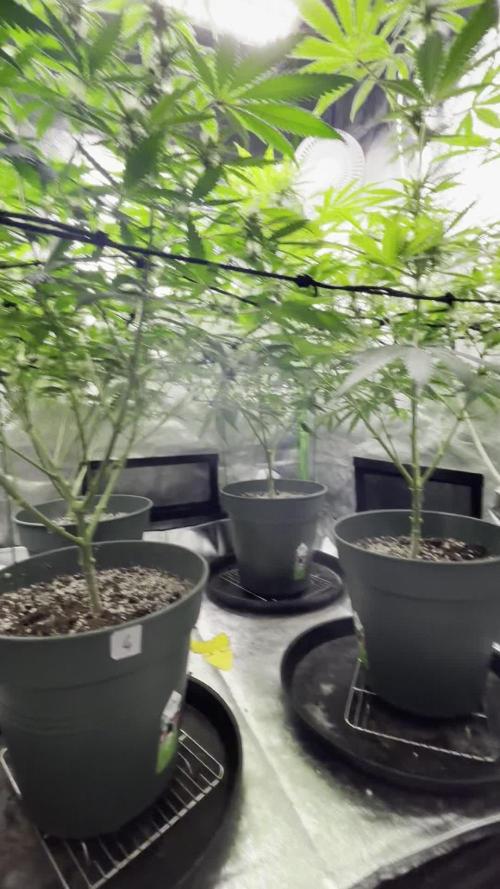
What a great week all 3 skywalkers are growing well, a lot of pistils and the first trichomes are already popping out. No sign of stress after pulling the ScrOG at the start of the week.
I kept an eye for hermies and no sign of it.
To the nutrients Plagron's Green Sensation and Power Buds have been added, I keep it at 1ml/L as recommended. The past week I fed 3times with nutrients and in between about 1L Water/plant.


Likes
20
Share


@Santica_Garden
Follow
So this is how things are looking for the ladies at the end of Week 4 of Flower, I have uploaded a video for you guys with all the information, any questions just ask away 👍🏾🔥😎

Likes
6
Share


@Herbz_Unkraut
Follow
it's harvest time 😀😀😀😀
check www.sr-organics.com for some topnotch 5 in 1 fertilizer!
root, growth, bloom, micro-organisms, enzymes & vitamins all in one!
CODE: "Unkraut10" for 10% Discount! 😊

Likes
4
Share


@BettaMushroom420
Follow
The Mandarine Cream is entering its third week of flowering, and the aroma is becoming increasingly potent. The plant is looking beautiful and vigorous, with the buds showing significant daily growth. The smell is evolving into a strong, citrusy scent, reminiscent of grapefruit.
Environment: This week began with a cold front, bringing temperatures down to a minimum of 5°C and a maximum of 15°C. A light rain has helped increase the humidity, which could boost resin production, although the cooler temperatures may also slow down the flowering process, just as they did during the vegetative stage.
Fertilizing: I've stopped fertilizing as the plant now has everything it needs from the substrate.
Watering: Sparse, around once a week, to maintain the right moisture levels without over-saturating.
Pest Control: Beauveria applications have been reduced to once weekly, and the garden remains completely free of pests, which is a pleasant surprise.
Training: The main cola top remains tied down. I haven't done any further defoliation or additional training. The focus is now on letting the plant continue its natural growth as it transitions deeper into flowering.

Likes
57
Share


@Wastent91
Follow
Eccoci qua all ultima settimana di vegetativa di questa bestia! Penso che le piante crescano davvero meglio con questi casi antispiralizzazione, prima pensavo fossero dicerie, ma sto sperimentando che le ragazze crescono molto di più rispetto rispetto alle sorelle nei vasi normali, questa ad esempio è germinata 10 giorno Circa dopo le sorelle, e sta rapidamente raggiungendo le stesse dimensioni! Anche la sour Apple di anesia ho dovuto spostarla e portarla in fioritura una settimana prima di queste, xke stava diventando troppo grande, ora è a 80 cm di altezza rendetevi conto! Al prossimo giro tutte le mie ragazze avranno un nuovo vestito, ovvero il vaso antispiralizzazione che permette alle radici di avere un accesso maggiore all ossigeno, e ci sono maggiori cicli asciutto/bagnato significa che la pianta respira e cresce meglio, raddoppia la velocità di fotosintesi secondo me! Merito anche dei nutrienti di Terra Aquatica naturalmente sono orgoglioso di fare parte della loro famiglia e utilizzare i loro nutrienti famosi ed orgoglio in tutto il mondo! Un buon 420 a tutti alla prossima settimana 💪😸
Likes
25
Share


@XperencdGmanXG
Follow
These 2 are growing likes beasts. They will both be going outside in the next 2 weeks or so. Just waiting on overnight temps to stay in the double digits and we are GTG.