Likes
Comments
Share


@McGrowin
Follow
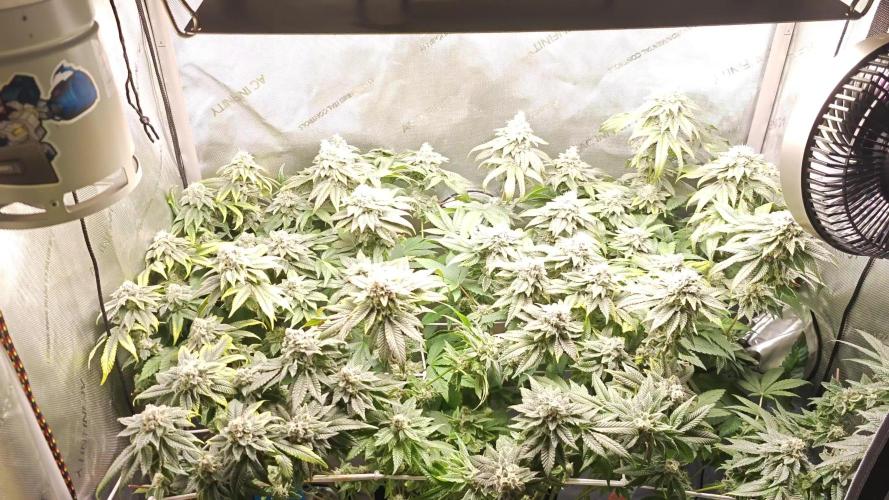
Starting to do extremely light lollipopping only for leaves blocking budsites or budsites that will not get enough light
Day 35: #2 is starting to smell of limonene. #1 and #3 are like 3-5 days behind #2 in terms of flowering. #3 is very slow and the runt of the bunch.
Hoping for 3-5 more weeks of flowering before I cut them down. Will likely cut #2 a few days before the others.

Likes
101
Share

@squalino
Follow
🌿 Journal de Culture : Cherry Cola (Auto)
Date : 13/04/2026
Âge : 81 jours
Phase : Curing (Plante #1) / Maturation intense (Plante #2)
? Plante #1 : Verdict final & Première impression
Résultat : 40 grammes sec (46g avec les branches).
Aspect :
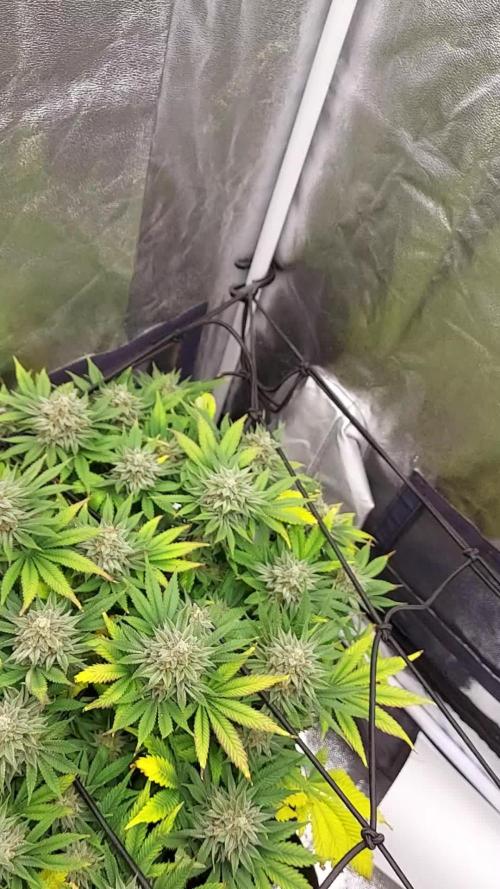
Vert sombre avec des touches rose fuchsia. C'est visuellement très réussi, même si la quantité reste modeste pour le temps investi (Note : 7/10).
Test de goût : * À cru :
Diesel bien marqué.
Allumé : Citronnelle agréable.
Effet : Cérébral puissant.
📏 Plante #2 :
Taille : 35 cm.
Environnement : 25°C / 50% Humidité.
Éclairage : Pure LED à 100%, distance 60 cm.
Nutrition : Reçu 1,5 litre de thé de compost (pH 6,4).
C'est le boost parfait pour nourrir les microbes du sol et donner les derniers nutriments organiques sans risquer le blocage avant la fin.
🔍 Mes observations de cultivateur
L'explosion de givre :
Sur la vidéo de la Plante 2, c'est flagrant : elle est encore plus blanche que la première. La couche de résine est si épaisse qu'elle donne un aspect métallique aux têtes sous la LED.
Structure des buds :
Les têtes semblent effectivement plus massives et mieux formées que sur la n°1 au même stade. On voit encore beaucoup de pistils blancs qui cherchent à capter la lumière, ce qui confirme qu'elle a encore besoin de ses 3 semaines.
Santé foliaire :
Elle est bien verte et vigoureuse. Le thé de compost va l'aider à garder cette vitalité pour que les trichomes passent tranquillement du transparent au laiteux.
L'espoir de la densité :
Contrairement à la n°1 qui s'est "écartée" sur la branche, la n°2 semble plus compacte. Si elle continue sur cette lancée avec le thé de compost, elle pourrait bien nous surprendre et offrir des fleurs plus charnues.
je crois en l'âme des plantes
merci a tous qui me suivent je vous souhaite une bonne journée et de très bonnes cultures.
MUSIQUE DIAPOSITIVE ( FASTBUD NO 2 )
ET MERCI À @Mia_BIOTABS pour le thé compost offert avec le startpack

Likes
Comments
Share
@SpliffDoc
Follow
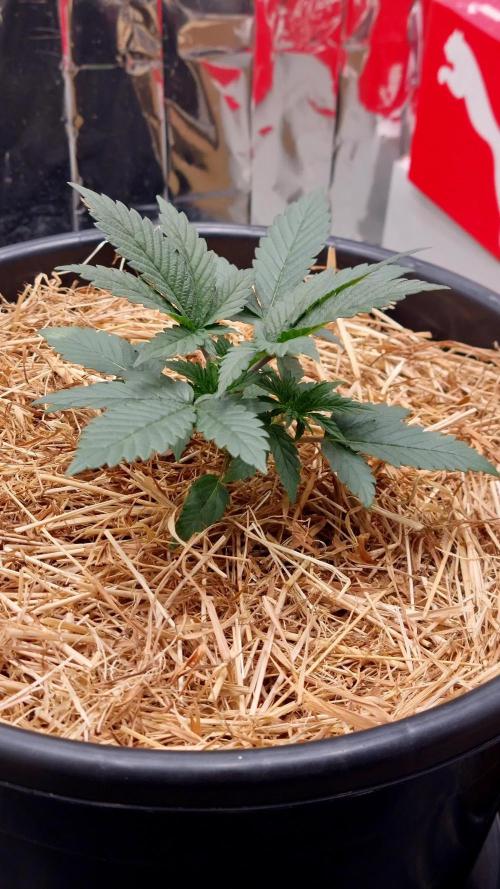
She got topped on day 17 I think🤔 💭😂the day after she's praying like never before, its day 21 now after being topped the new tips have been exposed and she hasn't skipped a beat, first time using these genetics and they seem OK up to now, time will tell. Peace 🏻
Likes
2
Share


@DeadJoke
Follow
No nutrition for this week as i will harvest them at the end of week 8 of flowers as i am seeing 5% ember on Girl Scout Cookies and 30 or 40% on Green Gelato..


Likes
30
Share


@cheetah844
Follow
Growing well. Hoping this is a good all around strain for daytime. I've read great reviews as a medical strain for many ailments, hopefully I'll be able to find out.

Likes
16
Share


@JUNGLE_B4RNS
Follow
Skunk Special, a.k.a. Red Skunk, stems from the infamous Red Skunk clones that conquered the Netherlands in the late eighties/ early nineties. Ferry started working on the Skunk Special in the nineties. The Skunk Special is the result of several S1 lines inbred with a 25% of Automatic. The current line was selected over several generations in order to retain the right and essential Skunk features, yet creating a fast flowering strain.
Showing almost no variety between the individuals, this is among the most stable and homogenous strains since it was selected from a few thousand plants. This Skunk Special is a powerful and strong plant with thick, solid stems, creating massively tight buds during the flowering stage. The Skunk Special has gorgeous looking red pistils that give this plant an amazing bag appeal.
Skunk Special is suitable for indoor, greenhouses and outdoors if grown in temperate and/or the warm Mediterranean climate. It is a massive yielding outdoor behemoth with amazing trichome production.
The smell can be described as extremely pungent and citral with the classic cat-piss smell of the old-school Skunk. It is a very clean smoke. A Skunky and slightly sweet taste that is pleasantly acidic towards at the end. A mildly relaxing body high that causes a tingling sensation combined with a very pleasant head high.


Likes
7
Share


@Abendkraut
Follow
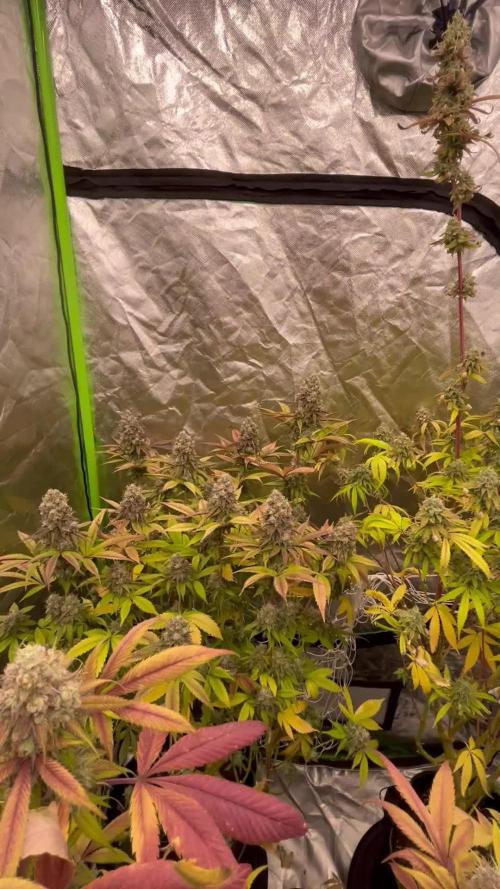
Second week of bloom:
steady growth is visible on both. I incresed the bloom nutrient ratio to 3ml/L Water.
Atm I have to water them everyday with 1L Water, I have the feeling that my dehumidifier is pulling more moisture from the soil that I would have liked.
2nd picture shows that both Exodus have different shades of green although both follow the same schedule and feed plan. I switched positions in the tent, maybe it’s due to the air circulation.
As always I‘ll add more pictures throughout the week.
Now back to Final Fantasy VII Rebirth 😘
Update 05/03:
Took a couple of pictures plants are gaining in height, I added 0.5ml Calmag to the Water once this week. No sign of Cal or Mg deficiency but I added it to prevent during this major height growth phase.



Likes
120
Share


@Kitties_and_Colas
Follow
~_~_~_~_~_~_~_~_~_~_~_~_~_~_~_~_~_~_~_~_~_~_~_~_~_~_~_~_~_~_~_~_~_~_~_~_~_~_~_~_~_~_~_~_~_~_~_~_~_~_~_~_~_~_~_~_~_~_~_~_~_~_~_~_~_~_~_~_~_~_~_~_~_~_~_~_~_~_~_~_~_~_~_
02/13/22
😻These ladies are sooo close! ❤️🌱.. the Peyote Gorilla looks especially sticky (has to be the GG#4) , as far as eye appeal, its definitely my favorite strain in the tent (shhhhh.. don't tell the others 😹).. we're still rocking a lot if clear trichs but the cloudiness is coming on fast, we're about 30%/70% atm..we gave them all their last heavy feeding 2 days ago, we dropped the lights again (app reading approx. 40k LUX at plant tops)...we're only doing water only from here on out, the whole tent should be entirely faded in 2weeks or less and some nice white ash in our future (and some killer tincture for yours truly lol🤘🐱).. thanks for reading if you made it this far and happy harvests everyone!!!! ❤️💡🌱😽💨
~_~_~_~_~_~_~_~_~_~_~_~_~_~_~_~_~_~_~_~_~_~_~_~_~_~_~_~_~_~_~_~_~_~_~_~_~_~_~_~_~_~_~_~_~_~_~_~_~_~_~_~_~_~_~_~_~_~_~_~_~_~_~_~_~_~_~_~_~_~_~_~_~_~_~_~_~_~_~_~_~_~_~_

Likes
21
Share


@JeyGanesha
Follow
Inizio 2 settiman...anche loro stanno venendo su benissimo.da questa 2°settimana inizierò anche dandogli poco Ph perfect ,.........
Oggi 17/10/2024 .queste papaya cookies auto Che mi ha regalato la cara Molly di fastbuds, stanno esplodendo di vita😉💪🙏🤣😂....
Forza belle piantine mie ...
Oggi 18/10/24 sto pensando di toppare una di ogni varietà...tipo 3 le toppo e 3 no e vediamo qual'è che viene meglio
Toppata...,....
Likes
6
Share


@AlienScrOG
Follow
small problem with the ozone management now solved I lost a things Pink Rosa finished hydroponics now again with Dossidos auto... I show in the photos the damage from ozone and and I'm noticing a very developed root system in zkitt .. dream .. and dankness


Likes
14
Share


@Drgreenthumb627
Follow
Mimosa is putting on some serious weight, extremely vigorous. so far i’m feeding it twice a week with a teaspoon of Biocity bloom and nova bloom and a half teaspoon of biocity silica
Processing
Likes
14
Share


@Belverde
Follow
Yo guys ...
Update for our beautiful Peyote Critical (sister of the two that can be seen in the other diary) ...
As the title suggests, she is growing in a super soil, mostly mining rocks, with a 15% of animal derivation (worm / krill) .... The idea is to keep the level of Brix high ... I'm trying ...
I know ', the 11 liter pot is a little bit small for a super soil ... but it does not do badly ...
The other two are also in a pre-mixed soil, so that they have to give them only h20 .. but with a completely different "recipe" (practically only guano kalong in addition to the soil with worm humus, light mix and coconut) ...
Anyway ...
she compared to the other two, she is a few days late ...
The perfume is very good, more delicate than the others, but practically the same ...
Not I can say that it is the composition of the soil that creates differences, because not being clones would not make much sense .....
every seed is still different .....this is also the beauty ....
The plant is excellent from all points of view ...
we'll see the final result ....still little more than ten days, and we will have to say goodbye ....
See you at the next update ....
Let me know if you like ...
And if you have advices don't keep them for you, I'm hungry to know 😉...
Thanks for taking the time🙏 .. Good luck to all ..
Bye ✌️...


Likes
9
Share


@Ronin716
Follow
So with my white widow being a little behind the cream manderin, I could tell that she really wasn’t growing much any more in her 1 gallon pot and though as my first grow, I was going to just run her until finished in there, I could tell that she would really benefit from a larger pot so I grabbed a 5 gallon, laced that bitch up with some mycorrhiza and sent it and guys… She literally bushed right out, stood taller and just got beefy in just days. I’m amazed. They say don’t transplant autos but with risk, comes reward. She took to it so nice and I have zero regrets at this point. Added a net to the whole tent and now we wait boys 🤙🏻🤙🏻


Likes
117
Share


@StarLorr
Follow
Welcome to my autø Møøn Røck 1 Diary.
In this Diary:
Seeds: Sponsored by Ðivine Seeðs
Media: Pro~Mix HP *•ns
Nutrients: Remo Supercharged Kit *•ns
*•not sponsored
___________________________
Feeding:
Wed 30Oct: 2L Remo/Recharge pH'd 6.5
Sat 02Nov: 2L Remo/Recharge pH'd 6.5
___________________________
Trichomes are all whites and no amber yet(no pics):(
Buds are heavy on the branches😋
Almost there!
___________________________
Thanks for stopping by, likes and comments are appreciated!👊🏻😎
Keep on growin!
Keep on tokin!!!
😙💨💨💨💨💨

Likes
12
Share

@StickyFingah420
Follow
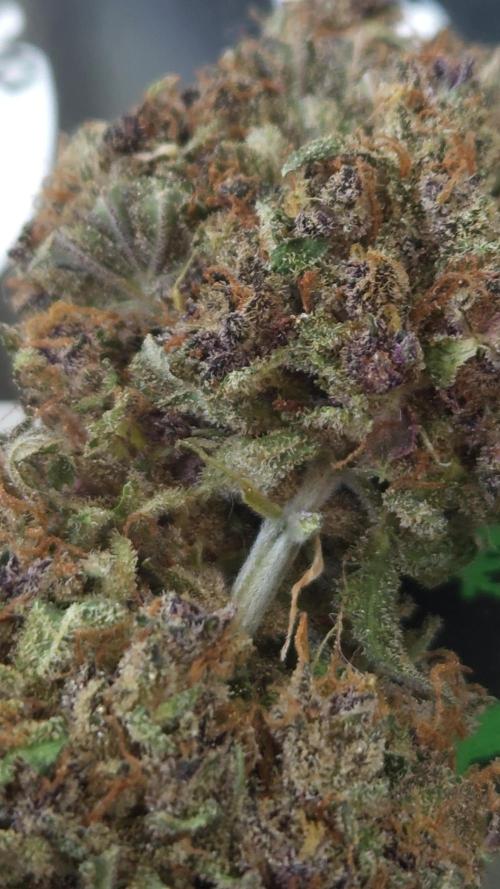
Una planta resistente, de estructura fuerte y densas flores.
Hay que procurar mantener controlados los niveles de humedad debido al gran volumen de sus flores.
En las semanas finales aromas inundarán tu cuarto de cultivo.
Los sabores son intensos y complejos: limón ácido, madera, especias. Es una total delicia.
El efecto fomenta buen ánimo y energía, es ideal para pasar un buen rato con amigos o la familia disfrutando en torno a una parrilla.