





@Nimbus
Volgen
Hello dude's
This week we are switching to 20 lt reservoir. A little training and defoliation. I am very satisfied with the development.
Keep in peace ✌️

shorts_status_processing


@O_ABSOLUTELY
Volgen
Not had the best of weeks hence the lack of updates, one of my lights some how fell and landed on one of my plants but that's another story! Iv also been struggling with low humidity during lights on it gets to 28:% some days, it raises a little when watering but only for a day or 2 max, O and low temps at night(which is actually daytime) due to the cold weather, can only work with what I got so hey Ho, other than that she seems to be doing alright :) wouldn't mind her filling out a little more, few more weeks an we shall see :)


@bypado_farm
Volgen
Day 29:
Watered each plant with 0.75L with nuts
1485 ppm, 3150 us/cm, 3.1 EC
Day 32:
Watered each plant with 0.8L with nuts
Day 35:
Watered each plant with 0.8L with nuts
1616 ppm, 3438 us/cm, 3.4 EC


@The_Doctor_Green
Volgen
Hola a todos amigos! Esta semana la planta ha crecido con normalidad, hemos regado con namaste nutrientes, con TRICO+ y FLORA BOOSTER, 0.5 GR x litro de agua de trico más y 4 ml x litro de agua de florabooster, midiendo el ph notamos que estaba en 6.3.
También seguimos combatiendo los trips, con aceite de neem.


@Ultraviolet
Volgen
Voltage, also known as electric pressure, electric tension, or (electric) potential difference, is the difference in electric potential between two points. In a static electric field, it corresponds to the work needed per unit of charge to move a test charge between the two points. In the International System of Units (SI), the derived unit for voltage is named volt.
The voltage between points can be caused by the build-up of electric charge (e.g., a capacitor), and from an electromotive force (e.g., electromagnetic induction in generators, inductors, and transformers). On a macroscopic scale, a potential difference can be caused by electrochemical processes (e.g., cells and batteries), the pressure-induced piezoelectric effect, and the thermoelectric effect. Since it is the difference in electric potential, it is a physical scalar quantity.
A voltmeter can be used to measure the voltage between two points in a system. Often a common reference potential such as the ground of the system is used as one of the points. A voltage can represent either a source of energy or the loss, dissipation, or storage of energy.
Dropping the temps will slightly raise the humidity, air holds less % water the colder it is. Lights on 25-35rh% the same water content will spike to 50rh% + at night just by dropping the temps.
At night all the juice photosynthesis has been storing up is mashed and mixed up to make all the goodies we need for bud, water is used to transport all these things everywhere, like little solvent transport devices, once a nutrient/protein has been delivered to destination the plant needs to get rid of all this excess water molecules it was using to transport. The only solution at night is to spit it back out into the air at night. During the peak of flower, this can catch a grower unaware, with a 4x4 full tent it can be a challenge to control all that moisture exhaust overnight especially if you're really pushing the limits.
We live in a water world, above or below, our misconception is we live on dry land, we don't live in less watery conditions than above or below. We fit into a very narrow band of moisture that just so happens to be full of lots of air and everything else required for life.
Got my first full whiff of the smell of purple lemonade, always surprises me how accurately the smell fits names, the dominant terpenes in the Purple Lemonade weed strain are carene, linalool, limonene, and myrcene. Carene gives this strain its sweet, citrus flavor and some woody notes, whereas the linalool I recognize so well from Granddaddy Purp. Myrcene has been shown to have sedative qualities while bringing musky, earthy elements to the flavor profile.
Trichome production started to ramp up, and the plant that grew taller/closer to UV showed noticeably thicker coatings. The taller plant shows slight yellowing of lower leaves, and the smaller plant is green and lush but the buds are slightly less progressed, interesting.
I super-cropped the main stem of the tall one just over a week ago (clean). I expected it to be the one slightly behind in development.
The plant has roughly 10-15% "Total resources" that it keeps in case emergencies arise. Reserves if you will.
My rationale behind breaking anything goes hand in hand with slowing things down as production is lost due to the time it takes to repair damage.
I recall watching a YouTube video, where a curly hair gentleman would super crop in a manner to damage but not disrupt using a twisting method, using fingers and thumbs placing them close together one goes clockwise other counter clock this varies a lot depending on the thickness of stem but what you wait for is a tiny snap, it may take several rolls to weaken if walls are tough I found. No snapping or bending of the stem, you want just to fracture it but not puncture this way the xylem and phloem channels remain flowing,the damage is repaired almost instantly and the 10-15% is dispatched with very little repair time. Everything in the general vicinity of the stress will now grow stronger so as to prevent further similar damage.
This is why I had expected the tall one to lag behind in development once I had cropped it but low and behold it worked and the tall one has slightly more developed buds.
The effects of birdsong on plant life may at first glance be far-fetched. Nigh on ten years ago an article appeared in Nexus Magazine on the discovery or invention of a method of growing plants using bird sounds. Christopher Bird and Peter Tompkins describe the development of Dan Carlson’s Sonic Bloom in their book The Secret Life of Plants. Many others have, it seems, recognized the role of birdsong in the growth of plants, and influenced or directly helped Carlson to develop his invention.
Dan Carlson’s desire to see that no one need be hungry through shortage of food sought to understand the optimum growth of plants. He discovered that plants also feed from ‘the top down’ as well as the roots. Underneath all leaves are pores called stomata which open to take in nutrients and moisture from the air. Carlson’s observation that the more bird life there is on the farm, the more abundant is plant life, has been echoed by farmers throughout history, except in modern times. Where there is little bird life, plants are stunted, and dwarfed. Nature has the birds sing at dawn and dusk, which dilates the stomata, and so feeds the plants. One can immediately see the importance of trees.
The development of Sonic Bloom was to create birdsong, which is played to the plants, while a foliar nutrient is sprayed onto the plants at the same time as they are being stimulated by the sound, to enhance their growth. This method produced fantastic results in the amount of abundantly nutritious produce from one plant, often in poor soils and in drought conditions. Carlson showed that the breathing leaves of plants are the source of the nutrient intake for growth. This of course is also true for humans—the breath is food. We shall discourse on this on another occasion. Plants transfer nutrients to the soil via this breathing, and Carlson showed that his plants improved the soil and helped earthworms proliferate.
The secret of Sonic Bloom was the development of the music of the same frequency as the dawn chorus of the birds. With the help of a Minneapolis music teacher, Michael Holtz, a cassette was prepared. It seems that both birds and plants found Indian melodies called ragas delightfully suitable. This is actually quite profound, although the American farmers, especially women, who had to endure this music whilst it was played to the plants, found it irritating. Holtz found the “Spring” movement of Vivaldi’s The Four Seasons appropriate and concludes: “I realized that Vivaldi, in his day, must have known all about birdsong, which he tried to imitate in his long violin passages.
Holtz, it is related by the authors Bird and Tompkins, also realized that the violin music dominant in “Spring” reflected Johann Sebastian Bach’s violin sonatas broadcast by the Ottawa University researchers to a wheat field, which had obtained remarkable crops with 66 percent greater yield than average, with larger and heavier seeds. Accordingly, Holtz selected Bach’s E-major concerto for violin for inclusion on the tape. “I chose that particular concerto,” explained Holtz, “because it has many repetitions but varying notes. Bach was such a musical genius he could change his harmonic rhythm at nearly every other beat, with his chords going from E to B to G-sharp and so on, whereas Vivaldi would frequently keep to one chord for as long as four measures. That is why Bach is considered the greatest composer that ever lived. I chose Bach’s string concerto, rather than his more popular organ music, because the timbre of the violin, and its harmonic structure, is far richer than that of the organ.
Birdsong has long been loved but also studied with reference to the musical scale and harmonics. As Holtz deepened his study he said, “I began to feel that God had created the birds for more than just freely flying about and warbling. Their very singing must somehow be intimately linked to the mysteries of seed germination and plant growth.
The spring season down on the farms is much more silent than ever before. DDT killed off many birds and others never seem to have taken their place. Who knows what magical effect a bird like the wood thrush might have on its environment, singing three separate notes all at the same time, warbling two of them and sustaining the others.
Tree and bird life are essential to Earth's existence, which Carlson, Holtz, and others have shown, but indeed others see and feel. “Plants”, says Steiner, “can only be understood when considered in connection with all that is circling, weaving, and living around them. In spring and autumn, when swallows produce vibrations as they flock in a body of air, causing currents with their wing beats, these and birdsong, have a powerful effect on the flowering and fruiting of plants. Remove the winged creatures, Steiner warns, and there would be stunting of vegetation. Nothing more needs to be added here.
It has been said that you cannot hurt the humblest creature or disturb the smallest pebble without your action having a reaction upon something else...You cannot think of an evil thought, no matter how private, without it having an effect upon somebody else. Whatsoever you do in life sets up some form of resonance.
When I say the morning chorus of the birds awakens the earth I mean that the characteristic song of the birds sets in motion a series of vibrations which react upon other forms of life. Remember, the soil of the earth is full of living microorganisms. The plants are also living organisms. You, yourselves, are living organisms. Now, this is the beauty and wonder of it all—when one aspect of nature has been moved into a state of resonance it immediately relays its vibrational motion to something else.
So when I say the dawn chorus awakens the earth I literally mean what I say. I do not suggest that the earth would come to a standstill without the bird song, but I do mean that life on earth would be sluggish and ineffectual without that first instigating outburst of vibrational power poured forth at just the right pitch and tone to set off a chain effect.
I know some of you will say, what happens in those parts of the world where there are no birds? Well, what does happen? Very little, I assure you. The hot deserts and the polar regions where there are few, if any, birds are not renowned for their wonders of nature. It is as though they are asleep. Nothing grows, few things live. Little resonates and there is a great stillness over everything.
You see, that outburst of sound just before dawn is like the little lever that works the bigger lever which turns the wheel which moves the machine…and so on. Never underestimate small things.
Animals are blessed with instantaneous and unthought-out wisdom. They are in direct contact with God and they act and live as though they are fully aware of it. Men are also in contact with God, but most of them act as though they have never heard of God because they are largely veiled from their divine center by their own thinking minds of which they are so proud.


@Weedganja420
Volgen
Esta preciosa cepa ha crecido bastante rápido llegando a ser la más alta del armario, durante la floración ha creado unas increíbles flores llenas de resina que poco a poco se caían del peso de las mismas.
Una locura de genética que todos deberíamos de cultivar al menos una vez.
Espero que os guste estas bonitas fotos.

shorts_status_processing


@Cheesefarmer420
Volgen
This plant has a solid stench of pure ripe lemons. So much aroma and color in every bud, purples, to dark green, to lime green, to solid frost. This one definitely a fun strain to watch grow and tend too for the last few months. She’s definitely a hungry girl, seemed to be the only strain out of the three that accepted and thrived with full feed nutrients. Would definitely recommend this Strain to someone For a nice uplifting day smoke, also seems to do me good for some pain and stress relief.


@DogDoctorOfficial
Volgen
💙 PROJECT BLUE TENT – HARVEST DIARY
🌈 BLUE WAFFLE F1 – PHENO B
✂️ HARVEST, DRYING, TRIMMING & THE FRUITS OF OUR LABOUR!
Hello everyone, and welcome back to another chapter of Project Blue Tent! 💙🌱
First of all, a little apology to everyone following this adventure!
As you may have noticed, we're dividing our harvest documentation into several reports. Unfortunately, the current photo limit doesn't give us enough room to share everything we'd like to include in a single update.
And honestly, after all these weeks of growing, photographing, experimenting, and documenting every little detail, we don't want to leave important parts of the journey out.
We want to share as much of the experience as possible, explain each stage properly, and give every photograph the space it deserves.
So, for anyone joining us here for the first time, or anyone who may have missed the previous chapters, I invite you to take a little trip through the earlier weeks of Project Blue Tent.
There's a whole story behind these flowers!
And now, let's get into it!
🌿✂️ THE HARVEST – TIME TO BRING HER IN!
After all those weeks of watching, documenting, training, observing, and enjoying the development of this beautiful girl, the moment finally arrived.
Blue Waffle F1 Pheno B was ready for her next chapter!
What a journey it has been.
From the first stages of growth to the final flowering weeks, we've followed her individually, documenting her characteristics and watching her develop alongside her sister and the two Pickle Lemon Haze F1 phenotypes.
And now, we finally get to appreciate the fruits of all that work.
The harvest itself was a fantastic opportunity to look at the flowers more closely.
The density, the structure, the colours, and the overall appearance were everything I had hoped to see.
Beautiful, compact flowers, with plenty of character!
But the work wasn't finished yet.
We still had drying, trimming, collecting, sorting, and plenty of photography ahead of us.
So, let's take it one step at a time.
📸 DRYING – TWO METHODS, ONE INTERESTING COMPARISON!
One of the things I really wanted to explore during this project was the difference between conventional drying and the Dryferm Bag system.
And this was the perfect opportunity to make a side-by-side comparison.
We divided Pheno B's harvest into separate portions and placed some of her flowers in the Dryferm Bags, while the others were dried on the rack.
The idea was to compare the final results while keeping the starting material as consistent as possible.
Same plant.
Same genetics.
Same harvest.
Different drying methods.
This doesn't replace laboratory analysis, of course, but it gives us an opportunity to document and compare our own observations.
🌡️ DRYING CONDITIONS
During this stage, temperatures were approximately 18–20°C.
The drying period was roughly in the region of 6–10 days, depending on the material and the drying method.
These are approximate figures from my recollection, rather than exact recorded measurements, so please consider them as a general reference.
Throughout the process, we kept an eye on the flowers and their condition, allowing the drying stage to progress before moving on to trimming.
And now comes one of my favourite parts!
✂️ TRIMMING TIME – HANDS ON!
Once the flowers were ready for trimming, it was time to get everything organized.
For this stage, I brought out some of my favourite tools:
✂️ ZAMNESIA Curved Scissors.
🌱 TRIMBIN Complete Set.
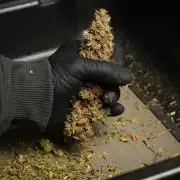
🧤 Gloves and the usual trimming essentials.
Everything was trimmed by hand, taking the time to appreciate each flower and separate the different materials.
And honestly, what a beautiful sight!
Pheno B gave us some incredibly dense, compact flowers, with beautiful structures and plenty of character.
Some lovely colours, fantastic flower formation, and plenty of resin-rich surfaces to admire.
And of course, the TrimBin once again proved why it's one of my favourite tools.
I've been using it for years, and it continues to make the trimming process comfortable and practical.
The screen underneath also allows us to collect the little bits that fall through during trimming.
And you already know what I call that...
GOLD! 💛😂
🍇 THE FRUITS OF OUR LABOUR!
Now, let's appreciate these beauties!
I absolutely love the way Pheno B's flowers turned out.
Beautiful, dense fruits, with a fantastic appearance and plenty of resin.
Some were larger, some smaller, and each one had its own individual shape and structure.
And naturally, we couldn't resist taking plenty of photographs!
The close-ups really show what words sometimes struggle to explain.
The textures, the colours, the density, and all those little details that make every flower unique.
And just like with her sister, the trimming session gave us plenty of opportunities to appreciate the individual flowers up close.
But there was something else worth mentioning...
Sticky fingers!
Oh yes! 😂
By the time we finished handling and trimming everything, the gloves were telling their own story.
And naturally, we couldn't finish this stage without making a little something special from the material collected during the process.
💛 A LITTLE EXTRA GOLD – OUR HASH BALL!
Among all the trimming and collecting, we also managed to put together a beautiful little hash ball.
A lovely little bonus from the work!
It's always interesting to see what can be collected during the trimming process, and this was a particularly satisfying little moment to include in the harvest documentation.
I've included photographs of the result because, well...
Some things deserve their own moment in the spotlight!
😂💛
⚖️ FINAL SORTING & WEIGHING – THE NUMBERS ARE COMING!
After trimming, everything was carefully collected, organized, and weighed.
This is where we finally get to see the numbers behind all those weeks of work.
We checked everything and recorded the final measurements.
However, I'm keeping the complete weight breakdown for the next report.
Why?
Because I want to give the numbers the attention they deserve, together with the final evaluation of Pheno B's harvest.
We'll go through the results properly, including the final weights and our overall assessment.
So, stay tuned!
📦 THE NEXT CHAPTER – GROVE BAGS & TERPLOC TECHNOLOGY!
And what happens after trimming?
Of course, we need to take care of the flowers during the next stage.
For this run, we've decided to store the finished flowers in Grove Bags featuring TerpLoc technology.
This is another part of the post-harvest journey that deserves its own dedicated section.
Rather than rushing through it here, I'd like to explore the bags, their technology, how we're using them, and our experience with the results in the next report.
We've already spent plenty of time comparing drying methods.
Now it's time to document what happens afterwards!
More on Grove Bags and TerpLoc coming very soon.
💚 WHAT'S COMING NEXT?
This is only one part of Pheno B's harvest story.
In the upcoming reports, we'll be going deeper into:
⚖️ Final harvest weights and numbers.
📦 Storage in Grove Bags and our experience with TerpLoc technology.
⏳ The curing journey and our observations.
👃 Aroma development and flavour.
💨 The individual smoke report for Blue Waffle F1 Pheno B.
🌱 And finally, our overall strain review!
We want to keep everything organized, detailed, and easy to follow.
There is simply too much content to squeeze into one report, and we'd rather share the complete story across several chapters than leave important details behind.
💙 FINAL THOUGHTS – ONE MORE CHAPTER COMPLETED!
My friends, what a satisfying stage of Project Blue Tent!
After all the time spent growing and documenting this beautiful phenotype, seeing the finished flowers is incredibly rewarding.
The drying comparison with Dryferm Bags has been particularly interesting, the trimming was a pleasure, and Pheno B's flowers look absolutely beautiful.
We also collected our little bit of gold, made a beautiful hash ball, and carefully weighed and organized everything for the next stage.
But we're not finished yet!
The numbers, storage, curing, flavour, aroma, and smoke experience are still waiting for their own reports.
So please bear with us as we divide the content into smaller chapters.
It's all part of our effort to share the complete journey with you, including the details that might otherwise get lost along the way.
Thank you for being here and following every stage of this adventure.
🙏 A HUGE THANK YOU TO EVERYONE!
A massive thank you to ZAMNESIA for the genetics and the fantastic equipment that has accompanied us throughout this project.
Thank you to PLAGRON for supporting the journey with their nutrient line.
Thank you to MARS HYDRO for the irrigation and drainage equipment.
A special thank you to LUMIFLORA for the under-canopy lighting experiment.
Thank you to DRYFERM for giving us the opportunity to test and document the Dryferm Bag system.
Thank you to GROVE BAGS for being part of our post-harvest journey.
And a big thank you to TRIMBIN for a tool that has been with me for years and continues to perform beautifully.
Thank you to GROWDIARIES for providing the platform where we can share our diaries, photographs, experiments, and experiences.
And finally, to everyone following, commenting, supporting, and sharing this adventure: THANK YOU!
Whether you've been here since the beginning or just joined us, you're part of this journey.
And if you haven't joined our Discord family yet, you're more than welcome!
💙 https://discord.gg/dogdoctorofficial
More adventures, more experiments, more photographs, and plenty more to share!
Until the next chapter...
Keep growing, keep learning, keep documenting, and never lose the passion!
GROWERS LOVE, HAPPY GROWING, AND TAKE CARE, EVERYONE! 🌱💙✂️🍇



@CapybaraProbioticTeam
Volgen
Hablando mas del cultivo en si, coseche al día 64 de floración, es decir, 9 semanas completas. Saque 307g de cogollos grandes y lindos, y además otros 120g mas de popcorns y manicura fina que irán para hacer extracciones. Por lo que el peso final total es de unos 416g aproximadamente.
Para el secado, puse a secar las colas luego de una leve defoliación (solo hojas satelite grandes), en un espacio ventilado, oscuro, a temperatura aproximada 20ºC y humedad 55%. Tardo 10 días en secarse completamente. Si bien en mi opinion las condiciones optimas son 60%H / 15ºC, no cabian los cogollos en el espacio que tengo preparado para mantener esas condiciones.
Para el curado, luego de manicurar los cogollos se pasaron a frascos grandes con termo-higrómetros dentro. Se fueron abriendo en principio 3 veces por día, y a medida que la humedad fue bajando, se fueron abriendo menos, hasta llegar a la humedad deseada, que a mi gusto es 62% de humedad. Siempre se van rotando los frascos para que los cogollos rueden y vayan tomando forma.
Espero que les sirva esta review. Saludos!!😘


@MadeInGermany
Volgen
Info:
Unfortunately, I had to find out that my account is used for fake pages in social media.
I am only active here on growdiaries.
I am not on facebook instagram twitter etc All accounts except this one are fake.
Hi everyone :-) .
The clone is developing well and has beautiful roots.
This week it was poured once because it doesn't need much.
It was also topped once.
Otherwise everything was cleaned and checked.
Have fun and stay healthy 🙏🏻
You can buy this Nutrients at :
https://greenbuzzliquids.com/en/shop/
With the discount code: Made_in_Germany you get a discount of 15% on all products from an order value of 100 euros.
You can buy this Strain at :
https://greenhouseseeds.nl/
☝️🏼☝️🏼☝️🏼☝️🏼☝️🏼☝️🏼☝️🏼☝️🏼☝️🏼☝️🏼☝️🏼☝️🏼
Green House Seeds Company Cup Clone 🏆
Type:
Wonder Pie
☝️🏼
Genetics:
Wedding Cake x OG Kush
👍😍
Vega lamp: 2 x Todogrow Led
Quantum Board 100 W
💡
Flower Lamp : 2 x Todogrow Led
Cxb 3590 COB 3500 K 205 W
💡💡☝️🏼
Earth: Canna Coco Professional +
☝️🏼
Nutrients :
Green Buzz Liquids :
Organic Grow Liquid
Organic Bloom Liquid
Organic more PK
More Roots
Fast Buds
Humic Acid Plus
Growzyme Big Fruits
Clean Fruits
Cal / Mag
Organic Ph - Pulver
☝️🏼🌱
Water: Osmosis water mixed with normal water (24 hours stale that the chlorine evaporates) to 0.2 EC. Add Cal / Mag to 0.4 Ec Ph with Organic Ph - to 5.8


@birdmountain
Volgen
Es war Zeit für die Ernte, im Urlaub hatte sich an der Pflanze im Folientunnel Schimmel an der Hauptcola gebildet und auch etwas an der Pflanze auf der Terrasse. Es hatte in dieser Woche sehr viel geregnet. die Pflanze wurde geschnitten und zum Trocknen aufgehängt.




@CanarianGrow92
Volgen
Last week of flowering for our Ztrawberriez from fastbuds 420
This week only water was given to the girls, as at the end of week we are harvesting the plants!
Very nice smells comes out of the tent, cant wait to try all of the fastbuds strains i have in the tent 🤗🤗🤗


@MadeInGermany
Volgen
Flowering day 12
since time change
to 12/12 h.
Hey everyone ☺️.
Once again a wonderful week goes by 😀.
It has developed so far and is now slowly starting to develop its flowers :-).
As soon as the first forms of buds can be seen (I think in 5-10 days) 2 g GHSC Powder Feeding Bio Bloom per liter of substrate are added.
In the third week, 1 g per liter of substrate is added so that it lasts through to the end :-).
This week it was poured 3 times with 1 liter each 👍.
The entire tent was also cleaned and the electronics checked for functionality.
The humidifier was refilled every day and fresh osmosis water was drained into the tank for the coming week ☺️.
The plants have all been checked for health and pests 👍.
Next week the bamboo sticks are inserted towards the end for support and the lowest shoots are removed so that at the end the energy is not wasted in the lower area 👍.
Otherwise there is nothing more to report this week :-).
I wish you a lot of fun with the update 😎.
Stay healthy and let it grow 🍀.
You can buy this Strain at :
https://sweetseeds.es/de/red-mandarine-f1-fast-version/
Type:
Red Mandarine F1 Fast Version
☝️🏼
Genetics:
Red Poison Auto®️ (SWS39)
X
Tangie (California Orange x Hybrid Skunk)
👍
Vega lamp:
2 x Todogrow Led
Quantum Board 100 W
💡
Bloom Lamp :
2 x Todogrow Led
Cxb 3590 COB 3500 K 205W
💡💡☝️🏼
Soil :
Canna Coco Professional +
☝️🏼
Fertilizer:
Green House Powder Feeding
☝️🏼🌱
Water:
Osmosis water mixed with normal water (24 hours stale that the chlorine evaporates) to 0.2 EC. Add Cal / Mag to 0.4 Ec Ph with Organic Ph - to 5.5 - 5.8 .


@Spliffi
Volgen
Germination 07/09/2022
Hi to all the old and new growers out there. Spring has barely started but I'm so AMPED to start again. My first grow attempt was a disaster. I started to early for the season. I wasted some good seeds and those Blasted 🐌 🐌 snails messed up everything. Got up started again and took it as a learning curve. I had 1 seed left from the previous attempt and this had to be the golden ticket.
The first important thing I learned was getting to the correct pH. Used a 1 liter jug not knowing that the pH down was very concentrated substance. Added 1ml of pH down to tap water with a base of 8.5+ pH and brought it down all the way to less than 4.5 pH. I probably tried like 5 times and realized that a single drop made a difference of about 2 pH. I got the feel of it and had to source a better water supply. I had the option of using tap water but didn't have the time to do a 24 hour airstone run ever time I wanted to water the plants. The local water supply shop was a better option. I got a consistent 6 pH and the price was decent.
The Snail 🐌 Problem... I have a plan
for those F**kers.
We have 2 very nice hydroponic shops in my city. Here's the supply list:
Freedom Farms Seed Starter
GHE pH Up
Kushy pH Down
GHE pH Test kit
Freedom Farms 10 liter fabric pot
Simba Genetics: White Widow auto
🌱🌱🌱🌱🌱🌱🌱🌱🌱🌱🌱🌱🌱🌱🌱
"I find it quite ironic that the most dangerous thing about weed is getting caught with it."
Bill Murray
🌱🌱🌱🌱🌱🌱🌱🌱🌱🌱🌱🌱🌱🌱🌱
Thanks for reading


@Ign33l
Volgen
It was rough waiting and knowing that i did not defoliate and started seeing bud rot almost at the end.
Ended up cleaning everything and throwing half a harvest away, BUT A GOOD WELL PAID LESSON.


@RastaGrow
Volgen
It’s finally here. The last week..! All of my hard work and commitment to these ladies is about to reward me with some super sticky flowers! And lots and lots of them by the looks of it...
These buds look unreal, it looks like amazing quality flowers all over these girls. It’s dense buds that are coated in trichomes and resin.
The flowers came out a bit more dense on this grow compared to my previous soil/HPS run, which I find surprising. This could be due to a variety of improvements within the garden but I’m going to attribute most of it to my increasing horticulture skills.


@eldruida_lamota
Volgen
Que pasa familia, vamos con la segunda semana de floracion de estas Rainbow Melon feminizada de fastbuds.
Vamos al lío, de las 3 plantas, me quede con 2 por espacio, siempre pongo alguna semilla de más por si no abriese alguna por no perder ese hueco del indoor.
También se trasplantaron a su maceta definitiva, en este caso de 7 litros.
Tenían algo de shock por el trasplante pero ya fue solucionado.
El ph se controla en 6.2 , la temperatura la tenemos entre 20/22 grados y la humedad ronda el 50%.
Hasta aquí todo, Buenos humos 💨💨💨


@1Right_Angle
Volgen
Feb 27th
Since the flush, I have had a hard time keeping the humidity in check. The dehumidifier (domestic) just seems to be kicking out way to much heat vs moisture removal. Tent temp spiked to 27, moving dehumidifier outside tent, building tiny duct...
- doors are cracked, room is venting, extra fan aimed at each side of fabric pots, blowing on the fabric/dirt to assist in drying...
- looking at reasonable dehumidifiers that would assist in a 4x4 tent. Any recommendations would be appreciated. Tiny room, heading into a humid Spring environment...
Feb 28
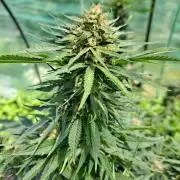
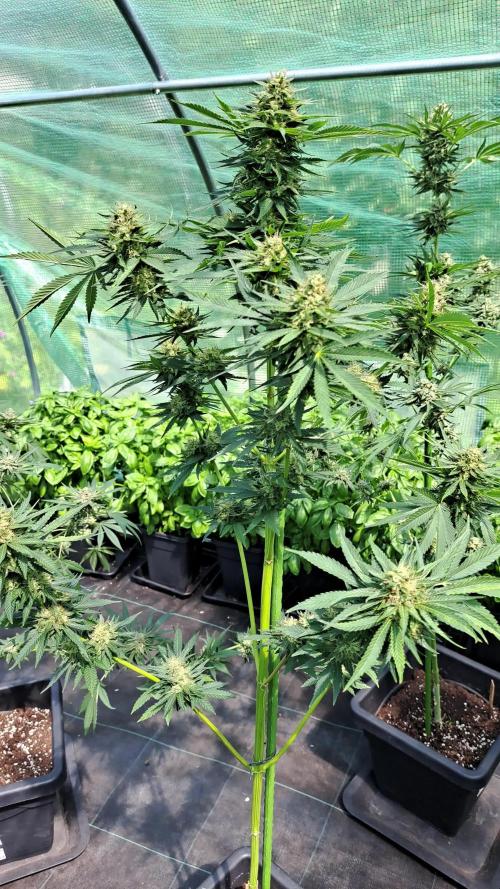
the plants look great though. Resin crystals are piling-up. Calyx's are doubling in size while the buds picks up size and density ! pics tonight
- day 4 since the flush, hoping tonight sees the end of moisture retention
- new A/C / dehumidifier brought into service. target 39% Rh and 23c
- whole tent got shuffled to fit the new gear. go figure.
- Buds look great, they seem to have some sparkle, and definitely, the calyx are still expanding
- with the humidity finally in-check, and it’s day 4 since the flush... the plants are going to get a drink of Molasses tonight. Moisture meter says I’m borderline. Green lite at this stage = 7 L.
- it took a bit to get the balance in the room established, now that everything is under-sized, compared to the A/C Humidifier.
- With the exhaust cranked, it took More fresh-air into the tent, to help steady the climate out
Mar 2nd
-many of the white hairs that were all over the buds, have turned orange/brown and are now wrapping up the buds
- 7th day since the Flush, all seems good
- trichomes are checked daily and the move to Amber seems to be on hold, while most of the others are turning cloudy. Bonus
- humidity is under control. 40-45% now. later this weekend it'll go to >40% for the final week.
Mar 5th
- Buds continue to fill up and the Yellow leaves are climbing higher up the plant.
- found quite a bit of new Amber, so there may only be a day or two left of light.
-leaves are a bit limp, split a gallon of water/Molasses between the plants to get them through the next few days, then it’s 36 hrs of dark
- the Calyx growth has been crazy the last couple of days. Buds are definitely getting phat as the Calyx are popping up everywhere
- smell is sharp and almost dark
- entering week 11 of Flower tomorrow, things seem to be finishing up nicely. Lots of milky Trichomes with a splash of Amber here and there. I’ll give them till Sunday.


@Oyziphar
Volgen
🌞
Lovely summer weather again this week with excellent temperatures 🌡️🌡️🌡️
➡️➡️ The buds have become hard, the smell is strong 👃👃👃 The scent is fabulous
➡️➡️ Plant # 1 is the biggest plant but the buds are not that big
➡️➡️ Plant # 2 is the second biggest plant. Also her buds are not that big
➡️➡️ Plant # 3 is the smallest plant, but she has fat buds
Seventh week of Light Deprivation
👉👉👉👉Every morning at 9:00 am I move the plants to the greenhouse.
👉👉👉👉Every evening at 9:00 pm I move the plants (together with some other strains) inside the growroom (which I don't use in the summer)
👉At the beginning of this week I boost the plants with gift of water enriched with OPF 7:2:3 ; Fulvic 25 ; Yuccah ; Biovin liquid ; Earthworm compost extract. This will be the last time. From now on only water 💧💧💧
⭐Big Thanks to Luc from Plant Health Solutions / Bioplantenvoeding dot nl ⭐
Plant #1 ; height : 147 cm
Plant #2 ; height : 130 cm
Plant #3 ; height : 117 cm