


Likes
Comments
Share


@OilyEliteOrganics
Follow
Growing with alot of flowers all over the plant might get about 2 ounces out of this plant .
Smells a bit pungent I havent added that much ferilizer just the natures organic living soil that cost me about 15 dollars pretty good super soil ill add.
Thought about transplanting into a 2 gallon or 3 though the plant has gotten too tall and is needing backbudding in order for the crown to still get light so i cracked it and bent it in order for it to still stick around and get light.

Likes
119
Share


@Rangaku
Follow
The Pineapple Express is ready to come out soon and has started her flush with crystal clear , it tastes as good as it looks , I’ve pulled a bit more off to smoke ( the last pic ) . She’s got some purple coming out and is absolutely stacked in trichomes and sticky to the touch .
The Gorilla Zkittles is another 2 weeks behind and will love getting the place to herself next week , she’s so stinky it burns your nose but every now and then that fruit orchards smell will come thru , she’s starting to fill out nicely and is standing a bit over 1.2 metres, I’ll spread her out some next week when I have the space and keep feeding her for another two weeks .
For now it’s drier sheets at the exhaust vent and and giving these two a great finish.


Likes
7
Share

@SwabianMadness
Follow
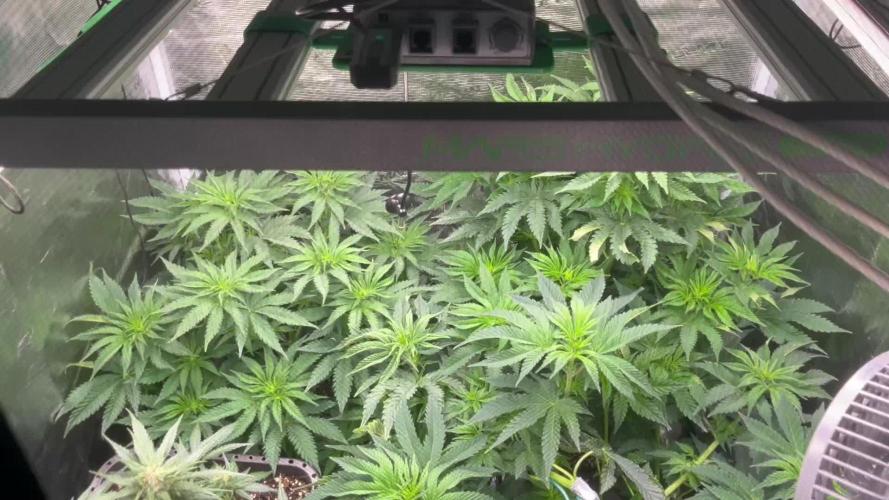
Have to do something against the one which kisses the LED 😂 so i cropped her very hard. But she bounces back with no Problem

Processing
Likes
25
Share


@EelGrows
Follow
Week 6 Summary: First off, Happy New Year!! Ciao 2018, may 2019 be filled with peace, love, joy and dank buds 😄😉
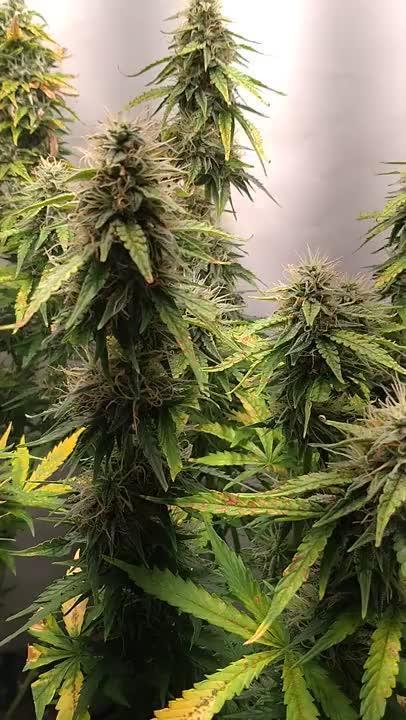
Day 36-39: Started off nice well this week, considering the amount of defoliation I did on day 35. Some more stretching going on here but not too much, except 4AM3 has a central shoot I couldn't find a spot to LST that just started to shoot right up lol. Starting to show some nice frost on Day 36 too. 4AM2 is already starting to plump up a bit, don't think will get much more stretch on that one, seems like it will probably harvest the least. I might have overdone the defoliation on it on Day 35 lol. 4AM2 is the one I decided to top for the hell of it anyway because it had a really wierd growth mutation. Still, with less main tops to produce it might be the best bud of them all 😅
Day 37-42: Day 37 is when I started seeing a deficiency I thought might have been magnesium on 4AM1. Pictures to show up top. Since their next feeding wasn't scheduled until day 42 I waited. Day 38 and it had spread a little on the same plant, and typical calmag deficiencies started slowly showing up on a few other plants(really tiny amounts). I posted on reddit and pretty much confirmed my suspiscion of a calmag deficiency. Since I am watering twice a week, once with calmag ph'd to 6.8-6,9 and once with blume nutes ph'd at 6.3-6,5. The calmag feeding was done on day 42( as scheduled at full strength this time so hopefully the problem will go away. 4AM2 hasn't been watered yet, pot didn't feel completely light yet(plus she had the most runoff last feed), will get her dose tomorrow.
P.S. Really starting to smell like sweet berries! Mmm.. 😍
On to week 7!



Likes
4
Share


@Reaper
Follow
6March: Start flower
first 2 weeks only blooming with 200watt
the purple kush didnt make it it was a bad seed,


Likes
Comments
Share



Likes
58
Share


@Salokin
Follow
Hello Growmies,
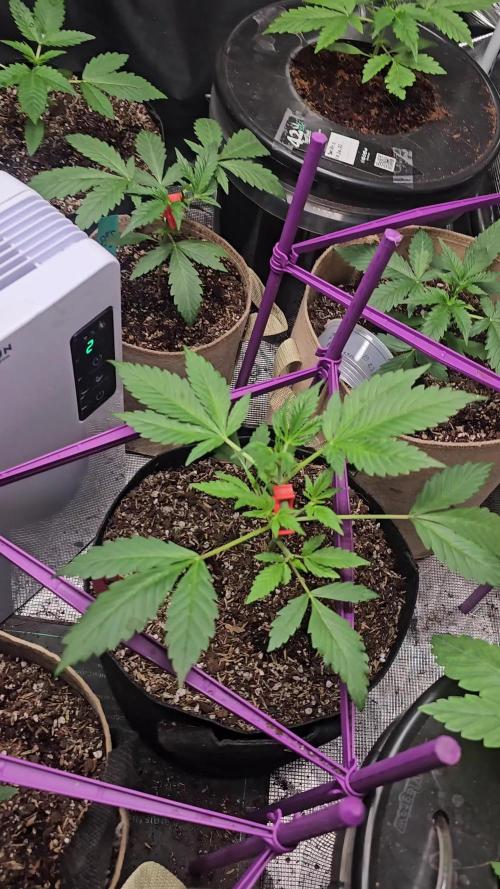
As the curtain falls on our Epic Buzz journey, we are now stepping into the crucial drying phase. Based on the density and size of these magnificent buds, I anticipate this process will take another 4 days to ensure the perfect moisture content for a prime cure.
The end of one project always heralds the beginning of another. Once the drying is complete, and our Epic Buzz is jarred up for curing, the tent won't have time to gather any dust. My next venture for the Super Sativa Seed Club Video Contest is raring to go! The Auto Bruce Lemon Diesel has already sprouted, eager to bask in the tent's vacated space. Their symphony of growth is about to unfold.
You can follow this next exciting chapter at the link below, and join me as I navigate through the life cycle of this promising strain:
https://growdiaries.com/diaries/199311-super-sativa-seed-club-auto-bruce-lemon-diesel-grow-journal-by-salokin
Stay tuned for updates and insights. Until then, stay lifted and keep those green thumbs busy!
Salokin

Likes
10
Share


@Elguacho420
Follow
Buenas a tod@s!!! Curta semana de floración de las lemon cookies kush, la verdad que la variedad va creciendo bien, la veo fuerte más allá alguna caga...da que habré hecho x eso lagunas hojas amarillas y algunos errores más de novato, es mi primer indoor así q pegas, muchas, como x ej el "exceso" de nutrientes q marcan las hojas, como tanbm la "falta de nutrientes" q marcan las hojas( no todas las hojas ni todas las variedades), esty un poco confuso con ese tema, no me excedo en los ml del producto, hay riegos de agua de x medio tanbm 🤷🏻♂️ es obvió que esto me pasaría, pero siempre con la buena onda y con la positiva... 🙌🏻👍🏻 Se las ve fuerte y en nada veremos qué tal sale todo... Buen finde para tod@s y buenos humos a seguir aprendiendo... 💨💨🇦🇷🤝🏻🇪🇦🏻♂️

Likes
60
Share


@Cannibalgardens
Follow
Crazy gain in size on these buds really shocked she is fattening up nicely. High as hell humidity at 68% nightly and 54% daytime but no mold or any issues and she still smells good and those crystals are really starting to show. The hairz are starting to show some gold and orange so she is hetting closer every week now .. Dinafem has some strong and tough genetics this og kush is kicking ass ..

Likes
13
Share


@BigDaddyK
Follow
Watered today ( Monday ) 5L of solution then 3 L of plain water to lower the runoff down from 2.8 to 2.3 (EC) , had a defoliate to open out the branches a bit , smells very naughty...
Thursday - Watered 5 litres of 2 ml per litre Terra bloom caught runoff at 1.8 EC

Likes
14
Share


@Esoteric_growing
Follow
Swelling up and right on track for a good result, still showing signs I pushed them a little hard with the tip burn but nothing I can do about that now
Likes
13
Share


Likes
4
Share


@GeminiCQC
Follow
Hbss is 27in tall
ABxRKO is 38.5in tall
I'm starting to run out of height because of the ABxRKO as it finally flowers. Still slight nute issues with the HBSS, but nothing too tough to handle for now. The smells the HBSS give off are absolutely crazy.
Just letting them grow, and watering every day seems to work. Will upgrade to earth boxes for this tent since a little autonomy is nice
Likes
6
Share


@BasedBuds_89
Follow
This girl is SO FROSTY, unfortunately due to careless mistakes on my part her growth appears to have stunted. Either way I'm very pleased with the phenotypical expression in this plant, definitely good genetics that I will be taking another shot at next grow.
Likes
45
Share


@Ultraviolet
Follow
"Mens Dei"
What can be made to expand, airy and loose, can also be made to contract, dense and tight.
Trichomes do not discriminate, although we like to think of trichomes' primary purpose as being to get us high; they are there to provide photoprotection (sunscreen). Trichomes apply themselves based on area dimensions; the more area = the more trichomes in order to protect. Different from density: Trichomes, the resinous glands on plants, are often produced in response to stress, including high light intensity. This increased production can lead to denser trichome coverage on the plant, stress, stress, stress, stress is the signal. There is a certain beauty in watching the large water-filled buds once swollen to the brim slowly shrink during drying, as the surface areas contract, the trichomes just cluster up to form denser and denser coatings, already dense from high light intensities, UVB exposure, and IPS, and every other stressor I could tweak. Trichomes, the resinous glands on cannabis plants, are often produced in response to various forms of stress. These stresses can be environmental, like excess light(HIL) or UV-B radiation, temperature fluctuations, or drought, or mechanical, such as wind, pruning, or even the weight of the plant's own buds. The plant reacts to these stressors by increasing trichome production as a defensive mechanism to protect itself and its valuable compounds like THC and CBD. In essence, cannabis plants perceive stress as a threat and respond by producing more trichomes as a way to protect themselves and their valuable compounds. Several studies have shown this. Not so much a "master" grower as a master of stress.
Psssst.
Trichomes fill with "antioxidants," including THC.
Ant"ox"idants,
The production of antioxidants in plants is intricately linked to their oxidative apparatus.
The plant has limited oxidative capacity/apparatus. During daytime photosynthesis, a large percentage of that oxidative capacity is tied up in protecting the plant.
During the night, plants alter their metabolic pathways. This leads to a far more focused production of specific antioxidants, like THC. Plants also produce antioxidants during the day to scavenge ROS made from photosynthesis. The differential ROS production by blue and IR light can have significant biological consequences. For example, high levels of ROS induced by blue light can lead to cell damage and death, while lower levels of ROS produced by IR light may be involved in beneficial cellular signaling pathways. Long nights under the IR (very low ROS), the boost in cellular respiration, and the boost in energy production. In a perfect world, I'd give the plant a shock treatment of 60DLI in 4 hours and give her the other 20 hours to perform cellular respiration under IR. The stress of those 4 hours would be rigorous and full of stress abound, 1800-2000ppm CO2 is easy for a couple of hours during daylight, it's maintaining it that's hard, but 4 hours is very doable with nothing but a little extra "carbon sugar" in your medium every other night during the first 4 weeks of flower.
In my opinion, you only need to jack CO2 for those first 4 weeks of flower to see maximal output, after that it's all about trichome preservation, everything else comes second. Without the temps to assist with metabolism, CO2 is reduced to normal levels along with temps 4-5th week of flower.
Buds are primarily composed of water. Developing flower buds, like other plant tissues, require a significant amount of water for growth and turgor pressure, which helps maintain their structure and firmness.
Turgor pressure in plant cells is primarily generated by osmosis, but transpiration plays a crucial role in maintaining it.
The optimal internal leaf surface temperature for photosynthesis at 1800-2000ppm CO2 is likely in the upper range of 97°F, meaning ambient would need to sit at 102°F-ish or thereabout for full metabolic utilization. That's putting your transpirational pulling force x5 x6 maybe x7 of what it would be if she were cruising at 68F.
"My buds won't fatten, what can I do!!"
Crank it. If your purpose was to blow up a balloon as fast as you can, as much as you can, would you use 2x force or x5 Force to do so? Bad analogy, but you get the idea. Kiss.
Optimize photosynthesis & VPD by day, cellular respiration by night.
TECHNICALLY:
"While transpiration and cellular respiration are both ongoing plant processes, they are not neatly separated into day and night. Both processes occur both day and night, though at different rates and with different emphasis. Transpiration, the release of water vapor from plant surfaces, is primarily driven by sunlight and photosynthesis during the day, but it also continues at a lower rate at night. Cellular respiration, which provides energy for the plant, occurs continuously, both day and night. "
A leaf can perform cellular respiration and photosynthesis simultaneously. During daylight hours, plant cells utilize both processes: photosynthesis to produce glucose and oxygen, and cellular respiration to break down glucose and release energy for the cell's needs. The products of photosynthesis (glucose and oxygen) are used as reactants in cellular respiration, while the products of cellular respiration (carbon dioxide and water) can be used in photosynthesis.
The limiting factor is the oxidative capacity; the less a leaf is utilizing photosynthesis, the less oxidative capacity it uses, and the more it can perform cellular respiration.
Even if a leaf is not in an optimal photosynthetic position, it can still utilize respiration to its full capacity during daylight hours. Kinda too much info to explain when some asks if they should defoliate or not, yeah add calmag or some shit.
BUT Only 10% ATP can be processed through photosynthesis and carbon capture.
90% of ATP is processed when the plant's oxidative capacity becomes available (NIGHTTIME). Cellular respiration relies on the process of oxidation to generate energy. Specifically, the final stage of cellular respiration, called oxidative phosphorylation, utilizes oxygen as the final electron acceptor to produce a substantial amount of ATP, the cell's primary energy currency.
Factors such as oxygen concentration, glucose availability and temperature will all impact the amount of aerobic respiration an organism will perform.
See you next grow, *twiddles thumbs*
Likes
9
Share


@Muffinboy92
Follow
Moved them inside last week and then chopped one down. Rot was taking over quickly. Buds hadn’t fully formed underneath but the main colas and tops were ok. Bit disappointing but the weather has just been terrible where I am this autumn 😂 what can you do.
Likes
68
Share


@MOSS_FIGURE
Follow
Week10.. First day flush the plants and check the trichomes everyday.
{Activities}
(Day 64) Flush the plants with water until clean water or ppm equal to water.
(Day 65) n/a
(Day 66) Watered, White wedding trichomes ready for harvest.
(Day 67) Harvest the White wedding. Cherry gar see ya moves to middle and expand fill the area.
(Day 68) CHERRY GAR SEE YA trichomes almost cloudy now.
(Day 69) Watered
(Day 70) Watered
(Hope you like and enjoy my diary)
Thank you so much for checking out my grows. Feel free to leave a comment, push the like or give the follow.

Likes
8
Share


@Big_Worm
Follow
This girl is growing amazingly and she stinks you Thai Mint 😍 She’s definitely my one of favourite strains.
Most of her pistils have receded and once they have all done I’ll start checking her trichomes.
I think it’ll be around 2 weeks before harvest and a bud wash.
Happy growing 🤙🏿
