


Likes
Comments
Share


@Growin_it
Follow
This is my first Amnesia Auto. It has been an easy grow so far. Looking forward to the buds fattening up, which almost goes without saying. But, interested to see how loose or tight they will be.

Likes
10
Share


Likes
15
Share


@Ctsbestsmoke
Follow
This week has been a tough week as my son got into a bad accident so I wasn’t able to be home with the plants. I was away in the hospital for five days. I must say the one time I wasn’t home the system failed me by not draining after one of the feeding. In which caused my plants to get a little bit of a deficiency and bite burn as well. So I was very disappointed in that. Other then that they kept growing at light speed and the topped one is like oooooo watch me watch me and just showing off lol 😆! I don’t have many pictures from my phone only from my camera in the tent. So not the best quality but it’s something right? Well that’s it for now growmies wish everyone a great week and be safe and hold your loved ones as close as possible!!!!

Likes
56
Share


@Aedaone
Follow
The temperatures, humidity, and watering volume(if measured) in grow conditions are all averaged for the week. The pH is soil pH. Any watering done by me is well water which is 7.6 pH The temperatures, humidity, and watering volume(if measured) in grow conditions are all averaged for the week. The pH is soil pH. Any watering done by me is well water which is 7.6 pH and 50° F. Any listed nutrients are ml/gallon of soil.
This soil has nutrients premixed into it. I mixed 320ml Organic Coop Poop 2-4-3, 160ml Espoma blood meal 12-0-0, and 480ml Gaia glacial rock dust per 32 gallon pot. The above listed nutrients will be dry amendments per gallon of soil.
In anticipation of possible heavy rains I filled pots halfway with soil. Half the soil and it dries twice as fast. I will add soil as soon as these get taller and are out of danger from excessive moisture.
These had an excellent start. We had a couple of warm 70°F sunny days to start off their first week. The third seed popped overnight and made it's appearance on day 2 this week. We got more rain on night 1 and some early morning Day 2. More rain on day 5 that continued intermittently through the night and into the morning of day 6. Day 7 we had sunshine in the afternoon.
The wet conditions these seedlings faced are challenging for cannabis. Cannabis especially seedlings don't like wet feet. I've come to appreciate fastbuds genetics for their hardiness to challenging outdoor conditions.
Despite the rainy overcast weather this week was a success. All three of these girls are growing and developing without showing any major stress. We will have cooler days and more next week, but these fastbuds are going to thrive as their roots develop and begin to explode upward.
Processing
Likes
20
Share


@Silverback_Guerilla
Follow
2/10:
I watered today with about 3/4 gallon each, plus cal-mag, signal, bembe, armor si, a little open sesame, and their final dose of endoboost.
The short one is budding up nicely, but the taller one is still stretching. The short one looks to be considerably more indica than the other.
2/11:
Wife home sick today....postponing construction project to raise the lights.
2/12:
Today, I tackled the project to raise my ceiling another foot. In addition to that project, I installed and hooked up my new AC Infinity 6" intake fan. It's pulling in fresh air from the soffit vent on the eave of the attic, and currently feeding the garden with 46f fresh air. I'm able to easily maintain daytime temps in the lower 70f's now. I am able to drive the nighttime temps as low as I want. The only issue is that the outdoor RH varies quite a bit, so I ordered a 30-pint dehumidifier to put in the top of the closet.
I sprayed everybody with boomboom spray to try and mitigate the light burn damage that is likely to ensue.
2/13:
The taller one is still stretching a little bit, but the 2-footer is just budding up.
2/14:
I fed them today with about 3/4 gallon each including grow big, big bloom, tiger bloom, cal-mag, signal, bembe, humic acid, and I switched over from Open Sesame to Beastie Bloomz. Raised the lights another couple of inches. I did some training on them and defo'd a little bit.
2/15:
Installed the new dehumidifier and rigged the continuous drain on it...works great.
2/16:
I rotated the edge plants and removed some old leaves. I added another 22w 3000k 4' bar light under the canopy.
2/17:
I rearranged the garden and defoliated a little bit. That's it for week 8-


Likes
12
Share


@ScrogFreak
Follow
Flipped to 12/12 at the end of Week 7.
The manganese issue seems to have been solved by lowering the pH levels. Ordinarily I'd strip most everything below the net this week, but a friend asked me to leave him some clippings until week 2-3 of flower. I cleaned it up a little underneath the net, continued to tuck new growth, and started to slack back on grow nutes, and slowly introduce flower nutrients.
I was hoping to have a second Aglex 2000 COB LED to add to the tent for flower, but it may be another week or two before I can add it.


Likes
Comments
Share
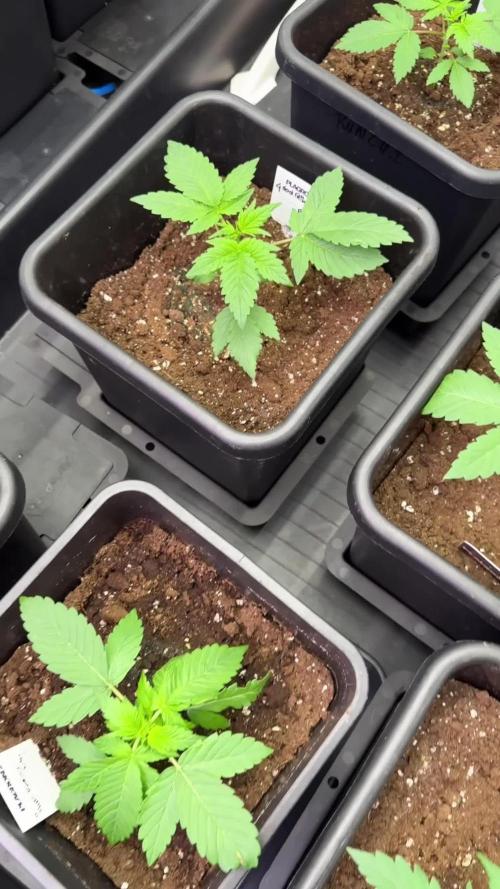

@DogDoctorOfficial
Follow
? Black Diamond – Plant B
Week 3 | Vegetation
8×8 Adventure – 12/12 From Seed
Another exciting week in the 8×8 Adventure! Every plant in this project is being grown using the 12/12 From Seed technique, allowing each phenotype to express its natural structure while remaining compact and efficient. Plant B of Black Diamond is beginning to reveal its own personality, showing strong apical dominance, excellent vigor, and beautiful structural symmetry.
The goal of this project continues to be documenting every phenotype individually, following its complete journey from seed to harvest while using the Plagron nutrient line throughout the entire grow.
⸻
🌱 Grow Conditions
• Week: 3 (Vegetation)
• Height: 17 cm
• Light Schedule: 12/12
• Day Temperature: 27°C
• Night Temperature: 25°C
• Relative Humidity: 55%
• CO₂: 666 ppm
• pH: 6.0
• EC: 1.3
• Solution Temperature: 20°C
• Root Zone Temperature: 21°C
• Pot Size: 15 L
• Daily Water: 1 L
Feeding
* Terra Grow – 1.8 ml/L
* Power Roots – 1 ml/L
* Pure Zym – 1 ml/L
* Sugar Royal – 1 ml/L
* pH Plus / Lemon Kick as required
⸻
🌿 Weekly Development
Plant B continues to impress with its vigorous and balanced development. During this third week, vertical growth accelerated while maintaining short internodal spacing, creating a compact but well-structured plant that looks perfectly suited for the 12/12 method.
The main stem has thickened noticeably and is already showing excellent strength. Side branches are emerging evenly from every node, indicating that this phenotype should build a very uniform flowering structure over the coming weeks.
The newest growth is vibrant lime green, gradually darkening as the leaves mature, while the larger fan leaves remain a rich healthy green with no visible signs of nutrient stress or deficiencies.
⸻
👀 Structural Observations
One characteristic that immediately stands out on Plant B is its strong central leader. Unlike some phenotypes that naturally spread laterally early on, this individual seems determined to build a dominant main cola while simultaneously producing vigorous secondary branches.
Node spacing remains pleasantly tight, giving the plant a compact architecture without becoming overcrowded. As more side shoots develop, the canopy is beginning to fill naturally while maintaining excellent airflow through the interior.
Stem diameter has increased considerably compared to last week, suggesting the root system is becoming well established inside the 15-liter container.
⸻
🍃 Plant Health
Health this week has been excellent.
The leaves remain flat, fully expanded and symmetrical, with strong petioles supporting each fan leaf. New shoots are developing quickly from every node and there are no signs of nutrient burn, deficiencies or environmental stress.
The feeding schedule appears to be matching the plant’s demand very well, supporting vigorous growth while keeping the foliage clean and healthy.
⸻
📸 Photo Notes
This week’s photographs clearly highlight the symmetrical canopy developing from above, while the side profile showcases the increasing stem thickness and vigorous branching beginning at every internode.
Close-up images of the growth tip reveal rapid vegetative expansion and healthy leaf formation, confirming that Plant B is transitioning smoothly toward the next stage of development.
⸻
🔜 Looking Ahead
With the root system now well established and the structural framework taking shape, the coming week should bring a noticeable increase in both vertical growth and lateral branch development.
As flowering approaches under the continuous 12/12 schedule, it will be fascinating to see how Black Diamond Plant B balances stretch with bud site formation. Based on its current architecture, this phenotype has the potential to produce a well-organized canopy with multiple productive flowering sites.
Growers Love and see you all ext week 🙏

Likes
48
Share


@MrHightimes
Follow
Coming into the week strong. the 2 in rain science bags stretched and are some big plants now, and the shorties in the fabric pots are tryin to catch up.
Everything looks good and starting the week with a nice watering gets the girls primed for the week and get the tent nice and humid too! Excited for these ladies!!!
___________________________________
I LST'd the back two no problem but when i attempted the front ones i popped the right one so i quickly backed off till they get a bit bigger. Should be fine


Likes
2
Share


@FEBREZE
Follow
Studio54 – Original DeepEast x WizardTreez Cut aka RS54
Sunset Sherbert x OZ Kush#54
Ein Cut der mich beim letzten Grow überzeugt hat und wieder einziehen durfte. Das Aroma von Sudio54 ist komplex und umfasst süße, fruchtige Noten mit erdigen und würzigen Untertönen. Der Geschmack ist reichhaltig und vielschichtig, mit einem dominanten süßen oder fruchtigen Profil, das durch pikante Akzente ergänzt wird.
Likes
16
Share


@CityFarmer
Follow
Hello everyone,
Not much to say about this girl. This week I started giving her some nutrients so lets see how she turns out now...
See you guys next week.. 🤘🤘👊👊👊

Likes
11
Share


@samuraifroggig
Follow
Moved to a 1000watt HPS, added 350 CFM exhaust fan, lights on at 4am- 10pm, air temp peeks at 3-4pm near 78-80F, Leaf surface temp 80-85, took plant about 23 hours after light switch to adjust (slowed growth seen in time lapse) everything is back to normal now the stretch is real. Smell is strong (no carbon filter) and I can smell it from the exhaust outside. Never used an HPS only LEDs.

Likes
37
Share


@RFarm21
Follow
Boas growmies!
O gráfico representa a nutrição misturada em 2,5L de água da Royal Gorilla 1.
03/08/2021 - Alimentaçao das Royal Cheese's (4L): EC = 0,74mS; pH 6,1
-BioGrow - 5,5ml; BioBloom - 3,5ml; TopMax - 4,5ml; BioHeaven - 5ml; Activera - 2ml; Calmag - 1,2 ml;
Alimentação Royal Gorilla2 (2L): EC = 1mS; pH 6,1
- BioGrow - 2ml; BioBloom - 2ml; TopMax - 1,5ml; BioHeaven - 2,5ml; Activera - 1,5ml; Calmag - 1,5 ml;
---------------------------------------------------------------------------------------------------------------------------
05/08/2021 - Alimentação Royal Gorilla 1 (2,5L): EC = 1,12; pH 6,3
- BioGrow - 3,5ml; BioBloom - 3ml; TopMax - 3ml; BioHeaven - 3,8ml; Activera - 3ml; Calmag - 0.6ml
Alimentação Royal Cheese 1 e 2 (4L): EC= 1,10; pH 6,3
BioGrow - 6ml; BioBloom - 4,5ml; TopMax - 4ml; BioHeaven - 5,5ml; Activera - 5,5ml; calmag - 1ml;
Alimentação Royal Gorilla 2 (2L): EC =0,98; ph = 6,3
-BioGrow - 2ml; BioBloom - 2,5ml; TopMax - 1,5ml; BioHeaven - 2,5ml; Activera - 2,5ml; Calmag - 0,7ml


Likes
20
Share


@Dunk_Junk
Follow
Chopped during the week and drying now............ The first pics are taken just before harvest.
Video is as it is drying out.
Dry weight 140 g!!!!!!!!! Very pleased with this. Nice genetics, I'm excited to do more strains for Barneys Farm.

Likes
12
Share


@smallscaleorganics54
Follow
It's week 8 of flower. The buds are getting fatter and the aroma is more intense now. I can't wait to see the finished flowers.
The buds still have a lot of white pistols, so I hope that the colas will get even fatter. I hope to have a good harvest in a couple of weeks.


Likes
166
Share


@Wicket
Follow
I did get some nasty burns, but as you can see on the last picture they look way better now.
They seem to grow fine. Today on the 22th i watered them for the first time after watering them 11 days ago while putting them in the 2l pots. (500-600ml each plant)
The cripple still is slower but it seems like it also recovered.
On the 22th the Special Queen #1 seed did germinate and on the 23th the root did come out so i did put it in the 2l Pot, but this time without Bio Tabs, i only did use mycotrex (2g), the rest will come with the 11l pot then. I think i over watered it a little bit since the new leaves are hanging a little bit (the first leaves did hang from the beginning so i doubt that is water related with those)
I also noticed today for the first time, when i open my tent it does already smell pretty tasty. Didn't thought it would happen that fast.
Also i already learned a lot. Even tho i tried my best to inform myself from the beginning, i made many mistakes which i will never do again. You can prepare yourself as you want, you will still have some failures and that is fine. So im not ashamed of my little plants by now. I will make them survive and a great final result. Looking forward to the next weeks.
/edit
Last day of the week. There were Roots at the bottom of two pots, so i decided to plant them into the final 11l Pots, i also added biotabs (little bit less since both had some of it from the beginning.
Everything went fine. The next days i will give them slowly more ppfd and next week i think i will top them and also tie them a little bit down.
Likes
19
Share


@proud_to_grow_loud
Follow
I switched my nutrients to Nectar For the Gods because I didn't have the funds in the beginning to do so. I got their spartan regiment with the extras. Photo-plus and SLF-100 which I use separately and not during feeding. Im watering everyday and feeding every other day. Water days I use SLF-100 and the next water day I use tea with Photo plus. my tea I use bloom by cultured biologics organic easy bloom and compost worm castings from my personal vermicomposting bed. alternating water days with the slf and photo plus was a massive growth in buds. They dense' nd up and just started putting on trichomes. brilliant brand- Nectar! OCGFAM for life now. Feeding is a pain but damn its worth it.
Pricy but worth the investment!


Processing
Likes
7
Share

@Silverback_Guerilla
Follow
SUNDAY 5/5:
Rearranged the gardens..have 17 plants in the 4 x 5 now...yowsa!
MONDAY:
Plucked some dead leaves and did a trichrome check on the furthest along.
TUESDAY:
I observed some white spots on a few leaves here and there throughout the garden, so I sprayed them today with Trifecta Crop Cure, a concoction of a bunch of natural plant oils. I already decreased the humidity in the room to 45% with my new 70L dehumidifier, so I think they'll be fine. I'll spray them again tomorrow and the next day, then I'll have to hope that did the trick, because several plants are already in the harvest window.