




Likes
14
Share


@Belverde
Follow
Hi guys ... always Peyote Critical .. like in the diary with the other two sisters ...
this one is following a different diet, practically Vegetarian / almost vegan ..
I have been given the same care of its companies and, in addition to the soils, already awarded for the other two and a super soil created by me, I give them molasses, for about 5ml in 1,5l h2o ..
Later I spoiled it a little with a dessert based on fruit created by macerating peal of organic banana (x 10 days) previously dried ...and today, Friday 27th, I finely chopped a bit of barley malt and I made a top dressing, wetting with water in mix with 3ml topmax for 3l h2o, to increase the malt action ..
for more information on other, I refer you to the diary of the two without this type of SS, where I also wrote a more detailed review on light, etc. all ... "the only "difference lies in the substratum ... this is a super soil mixture, which I have been trying recently, but which worked great with other plants ....
I hope you like it 🙂.... thanks for reading👍 ... the next
....
Bye

Likes
11
Share


@IndoorOrganix
Follow
They've started to grow their first sets of leaves and although temperature was a little higher than I'd liked they're coming along nicely. You can see the difference from just three days growth and then 3 days afer that! Adding a small amount of bio canna vega and molasses.

Likes
8
Share


@RockoCalenberg
Follow
Peaches & Cream – Keimungs-Update
Ich habe auch die Peaches-&-Cream-Samen zwischen feuchte Wattepads gelegt. Nach zwei Tagen waren alle fünf gekeimt, also habe ich sie eingetopft. Zwei Tage später kam der erste Keimling aus der Erde, kurz darauf der zweite.
Damit waren die Peaches & Cream bei der Keimung etwas vitaler als die White Gushers Cake.
Auch hier kann es jetzt losgehen – und die Selektion beginnt! 🌱
🔃
Wir freuen uns sehr, dass die Samen endlich da sind! 🌱
Alle Fünf sind zum Keimen angesetzt – jetzt bin ich gespannt, wie die Keimquote ausfällt und vor allem, wie schnell und gleichmäßig sie kommen. Gerade bei frischen Samen erhoffe ich mir natürlich einen schnellen und möglichst einheitlichen Start ohne große Nachzügler. 🧡
Das Ziel ist, sie möglichst zügig ins Wachstum zu bekommen, damit wir früh mit der Selektion beginnen und schließlich unsere zwei Kandidaten für den Cake Off auswählen können. 1️⃣➕2️⃣
Jetzt heißt es Daumen drücken für einen starken Start – und hoffentlich sind zwei schöne Damen dabei! 🤞🌱
Let the grow begin! 💚
Bake a sweeter tomorrow 🍰✌️

Likes
8
Share


@Marshydrots1000
Follow
Looking good starting to fatten up now. Pistols browning. Still alot of clear trichomes. Start dragon force to help ripen phase for a week. Then flush and hopefully fade her out in good time!

Processing
Likes
42
Share


@Dunk_Junk
Follow
This girl!!! 😂 😍 😍
Look at the bush!! 😂
I may have to hack off a few leaves this coming week, the amount of flower sites that are shaded by leaves is huge.
She is VERY bushy. A lot of flower sites and a lot of leaf sites. Maybe it's a kush thing...
Either way, she is looking good.

Likes
33
Share


@Darksoul
Follow
One more week in vegetatitve. This week I will put the scrog screen.
They are growing well and my LST keep them very small =)
Im really curious to know how they will flower =)
Likes
4
Share

@GothBotanical
Follow
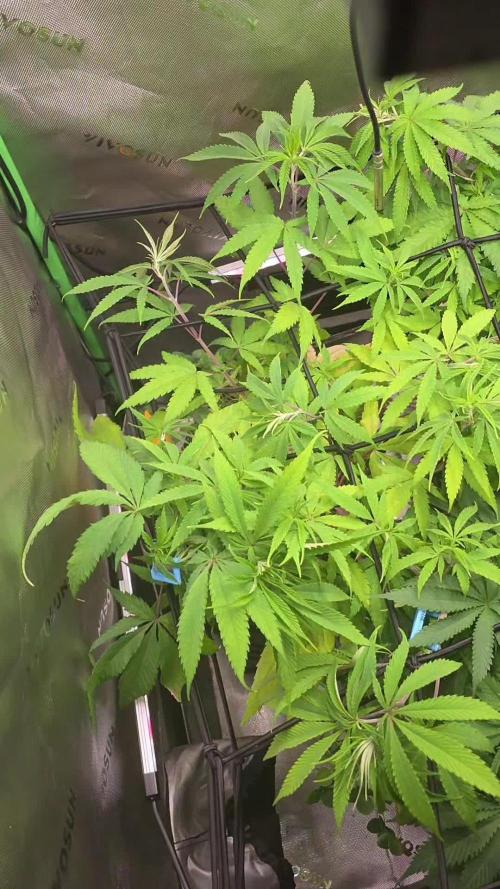
Stayed in veg for all three photoperiods (Oracle OG, Blue Bitch, Strawberry Cola Sherbet). Raised the main light to ~80% on Sept 30; side lighting unchanged. Oracle OG remained on the lighter side but structurally sound with steady new growth; Blue Bitch stayed the tent leader—dense, dark, and vigorous; Strawberry Cola Sherbet held steady, slightly lighter than Blue Bitch but not worsening. No new amendments this week (last top-dress was Sept 17). Environmental focus dominated: tent RH was stubborn around ~60% even with the inline exhaust cranked, and local rain on Oct 3 kept the garage/tent humidity elevated. Overall, a stabilization week: dialing environment, keeping inputs moderate, and queuing a compost tea before any flip.

Likes
6
Share


@gr3g4l
Follow
Hola al mundo mundial.
De nuevo por aquí con nuevo seguimiento de mi humilde cultivo exterior.
Pasado el solsticio de verano.
Semillas en agua de osmosis 46 horas , luego entre servilletas unas 29 horas más y al sustrato, un sustrato light-Mix .
Segundo fué enterrar las semillas en el sustrato con precaución y ponerlo todo bajo unos fluorescentes de 150W 4000K 18/06h.
Antes de pasarlas a exterior me gusta tenerlas unos dias en interior, no muchos , entre 15-20 dias. Me gusta que salgan a ver el mundo ya con cierta madurez.

Likes
Comments
Share

@Growfather1
Follow
Hello everyone!
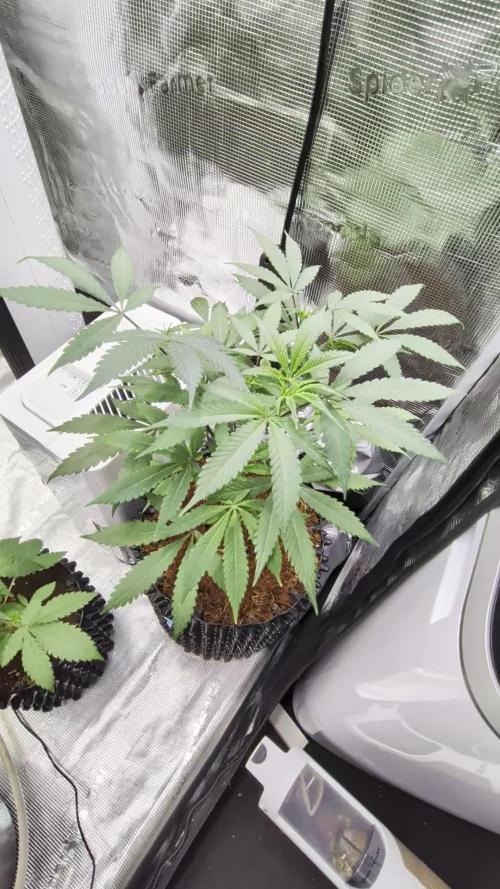
My 2 MAC 1 F1 Hybrid clones are absolutely thriving in their 15L Air-pots.
The environment is staying steady, with temperatures between 20 and 25 degrees Celsius and humidity ranging from 55 to 67 percent.
I've been playing stylist this week, giving them some heavy topping and selectively removing the lazier fan leaves to let the light hit the lower branches. I'll keep working on their shape over the next 2 to 3 days.
And about my last update—I need to issue a quick correction.
I previously mentioned flipping to flower in 10 days, but I miscalculated.
My ladies need a full 21 days, or 3 weeks, to really settle into their new homes after transplantation before we start the bloom cycle. Patience is a virtue, right?
Thank you for stopping by and have a nice day.
Best regards,
Growfather

Likes
16
Share


@Naujas
Follow
She looks beautiful:) I cleaned her leaves, she's not big, I haven't had many photo growths, but those times were faster, but this girl really has a lot of branches,:) which makes me happy:) I'll give her another week 18/6 :) good luck to all:)

Likes
29
Share


@GrownwithLED
Follow
In week 9 my 'Fruity Terp' ladies have grown substantially and filled out the space in my HOMEBOX growtent. Therefore its time to do a round of defoliation. I take out my plants one by one and cut off the lowest branches on the stem (the ones not grown tall enough to get good light) and also the biggest fan-leaves (the ones shading the lower part of the canopy). The defoliation will increase the airflow thru my plants, which will in turn help to avoid mold from a build-up of humidity between the leaves. The light can now also penetrate deeper into the canopy now and therefore lower buds will also get more light and can grow bigger. The SANlight EVO4-120 LEDs are doing a GREAT job, my babies love their spectrum and intensity and grow like hell. The nutrients from BIO NOVA work EXCELLENT, all plants have a nice healthy green color. Since we are further in flowering now, I also add PK 13-14 from BIO NOVA following their 'SOIL-CULTIVATION' schedule.


Likes
5
Share

@Chubbs
Follow
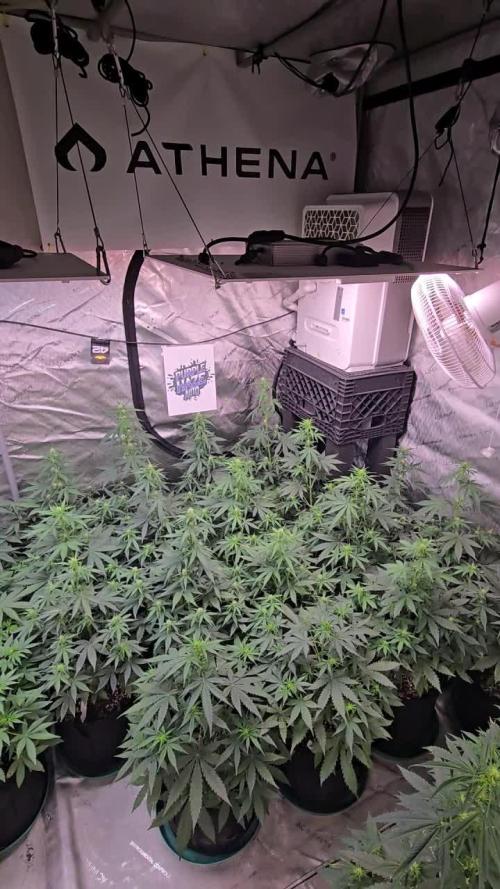
What up Fam. These girls are growing amazing. Now that I can control the temps a little better they've taken off with growth. Starting the flower period which we all no know what that means. The countdown is on. Over all Happy Growing.
Likes
2
Share


@ChitownCannaChica
Follow
The smells on these autos is just insane! Great terps, decent yield for an auto and should have been better but I screwed up the DWC in the transition weeks/- hard with multiple autos in one dwc bucket

Processing
Likes
24
Share


Likes
3
Share

@Earthsower
Follow
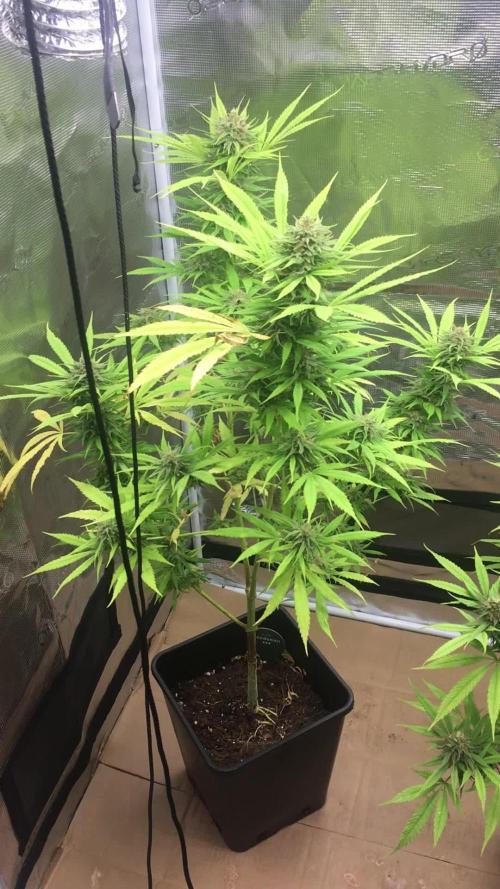
The blue dream is finishing off the bloom cycle. The plants leaves are fading evermore leaves are practically yellow. The stalk is beginning to decay. The aroma emanating from the plant has increased smells like fortified wine with a floral essence. The try chromes have covered all the flowers and are most of them are milky! The hue’s are light green. The calyxes are almost fully swollen and complete! Just waiting for the amber try chromes. The blue dream will be flushed out at the next feed. The lady stands at 93cm ta


Likes
3
Share


@ghost8782
Follow
thanks for the comments guys ! im switching to 20 hour of light tomorrow
Likes
50
Share


@BB_UK
Follow
Been an amazing week! My ultimate favourite strain is lacking on her diamonds 💎 frosted for the world to see the star she is ☺️💚 honestly not has a flavour compete with this one! But they are all thriving! I will defoliate again in a week as I start overdrive and prepare for flush 2 weeks after! I’m literally proving all these nutrients we are told to buy are not necessary. I’m using Dutch pro as my base nutrients and used formulex and moonshine during veg and during bloom using rezin and will use overdrive and flawless finish to aid flush! I’ve been through all advance nutrients except the connoisseur base range! But all other products I’ve used and see no point!! But I’ll define that one day and do a back to back comparison! It’s always been my thing as I was searching for best methods and nutrients and how I’ve come so far with that nearly 4 years later and I’m where I wanted to be! Stay tuned there’s more to come!!


Likes
6
Share


@Back_woods_buds
Follow
I don’t know it’s just me but it doesn’t go out there doing much hopefully they’ll start fattening up