


Likes
9
Share


@CheeRz
Follow
It's early October, and the weather is getting worse. I hope it holds out for another one to two weeks because it's currently raining more frequently. The buds smell sweet and are slowly turning frosty.

Likes
7
Share


@XYZ123
Follow
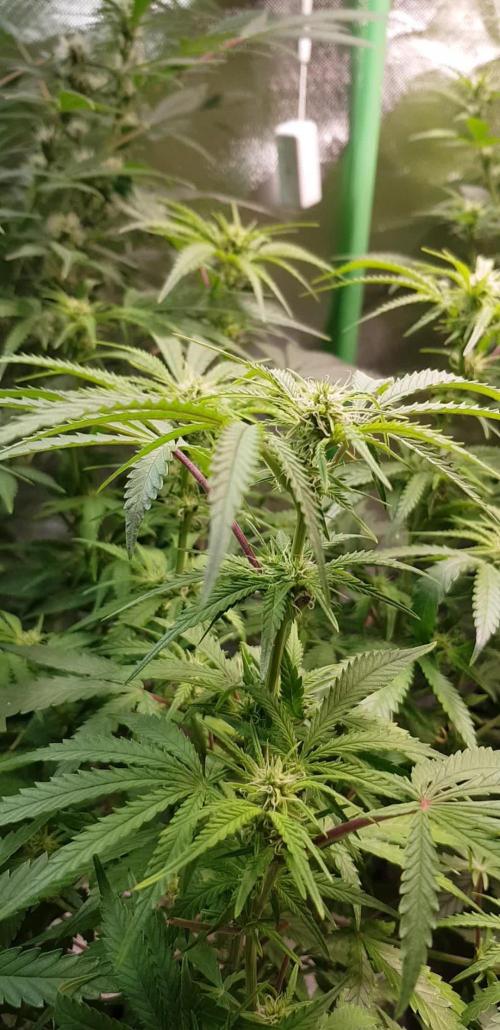
this is the first week of the flowering i hope my plants will get bigger the same I turn off the ventilation and i get +5 cm height
💪


Likes
7
Share


@Northstar_cannabis
Follow
Strawberry Gorilla is my little plant. I'm going to run this one again. I believe it didn't take transplant well, it's been a smaller plant but healthy. It's growing good, leaves look good, in every way it looks healthy, it's just smaller. I have no complaints about the strain, it's looking very good.

Likes
16
Share


@Mrg7667
Follow
Bomb week!! All pictures/ video was takken on day 9 and i gotta say its looking wild. I Didnt expect them both to start growing so crazy. Lst really seemed to help some of these just explode with tops.
I feel like compared to my first indoor run these are like a week ahead, as far flowering goes. Wich is also interesting because Double Ds can go for 9-10 weeks! Cant wait to see how these babies do there thang
One problem actually i found a little bit of aphids nothing crazy but im going to continue using the growsafe insecticide/fungicide/pesticides.

Likes
10
Share


@Northern_Ent
Follow
June 28: it rained a fair bit in June which is good, of course, and it looks like nice warm cannabis weather for the next two weeks. There will be a lot of vegetative growth in the next two weeks.
July 4: she is filling in nicely and will do fine despite having broken a stem. Patched up but it delayed development on that side. Anyway seems pretty even now so it should be good from here.

Likes
21
Share


@DeeDeeKushner
Follow
Day 57 of flower, we’re on the home stretch now. I’ve been flushing them out for the past week or so now. I like to flush for 21 days. IMO, I think the buds taste better and smoke smoother when you flush longer than usually but that’s just me! No specific pics/vids of the white widow but I thought I share my entire garden with you guys. I said I would harvest on day 70 but I might harvest on day 63-65 because I’m seeing more amber trichomes every day. My next update will either be harvesting or I’ll be letting them go for another week. Until next update! 🙏🏾

Likes
2
Share


@High_Grade_Dadli
Follow
So end up losing the first set (guess that's how you know it alive n real) never the less week was great...will do some transplanting nxt week also wanna get some more gelato cuts to get the numbers up but will see how that

Likes
24
Share


@FrostyCloudzz
Follow
Es läuft weiterhin gut die hintere Reihe verhält sich aber besser von dicke der Knospen etc.
Die vorderen sind etwas kleiner als die anderen aber denke sie ziehen noch nach.
Ab Mitte nächster Woche wird nur noch Ph-reguliertes H2O gegeben und auch eventuell einmal geflusht.
Likes
61
Share


@Dunk_Junk
Follow
Only 11cm vertical growth this week. Flowering stretch slowing down and she's bushed out so much!!!

Likes
2
Share

@GERGrowDesigns
Follow
Welcome to Flower Week 3-4 of Divine Seeds Auto Black Opium
I'm excited to share my grow journey with you all as part of the Divine Seeds Autoflowering Competition 2025. It's going to be an incredible ride, full of learning, growing, and connecting with fellow growers from all around the world!
For this competition, I’ve chosen the Feminized Automatic strain: Auto Black Opium
Here’s what I’m working with:
• 🌱 Tent: 120x60x80
• 🧑🌾 Breeder Company: Divine Seeds
• 💧 Humidity Range: 50
• ⏳ Flowering Time: 60-63 Days
• Strain Info: 25%THC
• 🌡️ Temperature: 26
• 🍵 Pot Size: 0.5l
• Nutrient Brand: Narcos
• ⚡ Lights : 200W x 2
A huge thank you to Divine Seeds for allowing me to be a part of this amazing competition and Sponsoring the Strains. Big thanks for supporting the grower community worldwide! Your genetics and passion speak for themselves!
I would truly appreciate every bit of feedback, help, questions, or discussions – and of course, your likes and interactions mean the world to me as I try to stand out in this exciting competition!
Let’s grow together – and don’t forget to stop by again to see the latest updates!
Happy growing!
Stay lifted and stay curious!
Peace & Buds!
Likes
42
Share


@Ukfarmer420
Follow
Hi guys
Within 48 hours all 3 broke the soil, just waiting on the blackberry moonrock to make a appearance.
Not much to say at the moment but ill keep you updated on the blackberry moonrock from tastebud genetics.
Happy growing gang 💚💪👌
Hey guys so the blackberry moonrock from tastebuds has decided to pop out the soil today 😀 so 4 out of 4 the freebie was a late starter lol.
Its ment to be a 33% thc indica so hopefully i can hit the high 20z.
Happy growing guys 💚👌


Likes
56
Share


@Ledbelieve
Follow
2 days into flower still not sure of any males in the mix. Keeping my fingers crossed. The females with the burgundy color show in the first 3 weeks of flower the dark purple veins in the leaves. So hope I get a few of those phenoms.

Likes
62
Share


@Reyden
Follow
La Spider Farmer SF2000 continua a tenere a far crescere le ragazze con un ottima luce e spero di riuscire a vedere qualche colorazione tra non molto…la maggior parte dei problemi nella coltivazione della Cannabis deriva da un terreno poco drenante e da troppa 🚿 acqua quando le diamo da bere…bisogna sempre ricordarsi di alzare i vasi e vedere quanto pesano e se c’è bisogno, smuovere la terra un po’ con le mani attorno alla pianta


Likes
34
Share


@BOMbolenath
Follow
Buds are getting bigger. It's developing well. This strain have a nice structure.

Likes
47
Share


@Ultraviolet
Follow
All content on this diary is for inspirational and educational purposes only. The ideas shared are not a substitute for professional advice. This diary/account is not officially affiliated with Alan Watts or his estate. All materials are used under the principles of fair use. I honor the legacy of Alan Watts by sharing his wisdom respectfully and with the intention of inspiring awareness and self-understanding.
2nd net is up. Early bud formations are promising. holding up to the extremes pretty well, some leaves taking minor damage, but overall, she is holding up, gave her 1 night at 50F see how she would react, stressful. Not advised as it messes with her metabolism, but I want to see if it triggers any anthocyanin response. Love to see her purp up but no signs yet. Remember, For every molecule of glucose produced during photosynthesis, a plant needs to split six molecules of water. This process provides the hydrogen needed for synthesizing glucose and other organic compounds, while oxygen is released as a byproduct.
Homework.
If Rubisco activity is impaired and it cannot properly function or regenerate its substrate, the plant's leaves are likely to turn a pale green or lime green, a condition known as chlorosis. Essentially, Rubisco activity is highly regulated and susceptible to various environmental and metabolic factors that can cause it to become inhibited, leading to an apparent failure in RuBP regeneration due to a lack of consumption.
Rubisco regeneration is intrinsically linked to nitrogen supply because Rubisco is a major sink for nitrogen in plants, typically accounting for 15% to over 25% of total leaf nitrogen. The regeneration phase itself consumes nitrogen through the synthesis of the Rubisco enzyme and associated proteins (like Rubisco activase), and overall nitrogen status heavily influences the efficiency of RuBP regeneration. RuBisCO is a very large enzyme that constitutes a significant proportion (up to 50%) of leaf soluble protein and requires large investments in nitrogen. Insufficient nitrogen supply limits the plant's ability to produce adequate amounts of RuBisCO, thereby limiting the overall capacity for photosynthesis and carbon fixation. Maintaining the optimal, slightly alkaline pH is crucial for the proper function and regeneration of Rubisco. Deviations in either direction (too high or too low) disrupt the enzyme's structure, activation state, and interaction with its substrates, leading to decreased activity and impaired RuBP regeneration. (Lime/yellowing)
Structural Component: Nitrogen is an essential building block for all proteins, and the sheer abundance of the Rubisco protein makes it the single largest storage of nitrogen in the leaf.
Synthesis and Activity: Adequate nitrogen supply is crucial for the synthesis and maintenance of sufficient Rubisco enzyme and Rubisco activase (Rca), the regulatory protein responsible for maintaining Rubisco's active state. Nitrogen deficiency leads to a decrease in the content and activity of both Rubisco and Rca, which in turn limits the maximum carboxylation rate, Vmax, and the rate of RuBP regeneration Jmax, thus reducing overall photosynthetic capacity.
Nitrogen Storage and Remobilization: Rubisco can act as a temporary nitrogen storage protein, which is degraded to remobilize nitrogen to other growing parts of the plant, especially under conditions of nitrogen deficiency or senescence.
Nitrogen Use Efficiency (NUE): The allocation of nitrogen to Rubisco is a key determinant of a plant's photosynthetic nitrogen use efficiency (PNUE). In high-nitrogen conditions, plants may accumulate a surplus of Rubisco, which may not be fully activated, leading to a lower PNUE. Optimizing the amount and activity of Rubisco relative to nitrogen availability is a target for improving crop NUE.
Photorespiration and Nitrogen Metabolism: Nitrogen metabolism is also linked to the photorespiration pathway (which competes with carboxylation at the Rubisco active site), particularly in the reassimilation of ammonia released during the process.
To increase RuBisCO regeneration, which refers to the process of forming the CO2 acceptor molecule Ribulose-1,5-bisphosphate (RuBP) during photosynthesis, the primary methods involve optimizing the levels and activity of Rubisco activase (Rca) and enhancing the performance of other Calvin-Benson-Bassham (CBB) cycle enzymes.
Biochemical and Environmental Approaches:
Optimize Rubisco Activase (Rca) activity: Rca is a crucial chaperone protein that removes inhibitory sugar phosphates, such as CA1P (2-carboxy-D-arabinitol 1-phosphate), from the Rubisco active site, thus maintaining its catalytic competence.
•Ensure optimal light conditions: Rca is light-activated via the chloroplast's redox status. Adequate light intensity ensures Rca can effectively maintain Rubisco in its active, carbamylated state.
•Maintain optimal temperature: Rca is highly temperature-sensitive and can become unstable at moderately high temperatures (e.g., above 35°C/95F° in many C3 plants), which decreases its ability to activate Rubisco. Maintaining temperatures within the optimal range for a specific plant species is important.
•Optimize Mg2+ concentration: Mg2+ is a key cofactor for both Rubisco carbamylation and Rca activity. In the light, Mg2+ concentration in the chloroplast stroma increases, promoting activation.
•Manage ATP/ADP ratio: Rca activity depends on ATP hydrolysis and is inhibited by ADP. Conditions that maintain a high ATP/ADP ratio in the chloroplast stroma favor Rca activity.
Enhance Calvin-Benson-Bassham (CBB) cycle enzyme activity: The overall rate of RuBP regeneration can be limited by other enzymes in the cycle.
•Increase SBPase activity: Sedoheptulose-1,7-bisphosphatase (SBPase) is a key regulatory enzyme in the regeneration pathway, and increasing its activity can enhance RuBP regeneration and overall photosynthesis.
•Optimize other enzymes: Overexpression of other CBB cycle enzymes such as fructose-1,6-bisphosphate aldolase (FBA) and triose phosphate isomerase (TPI) can also help to balance the metabolic flux and improve RuBP regeneration capacity.
Magnesium ions, Mg2+, are specifically required for Rubisco activation because the cation plays a critical structural and chemical role in forming the active site: A specific lysine residue in the active site must be carbamylated by a CO2 molecule to activate the enzyme. The resulting negatively charged carbamyl group then facilitates the binding of the positively charged Mg2+ion. While other divalent metal ions like Mn2+ can bind to Rubisco, they alter the enzyme's substrate specificity and lead to dramatically lower activity or a higher rate of the non-productive oxygenation reaction compared to Mg2+, making them biologically unfavorable in the context of efficient carbon fixation. The concentration of Mg2+ in the chloroplast stroma naturally increases in the light due to ion potential balancing during ATP synthesis, providing a physiological mechanism to ensure the enzyme is activated when photosynthesis is possible. At the center of the porphyrin ring, nestled within its nitrogen atoms, is a Magnesium ion (Mg2+). This magnesium ion is crucial for the function of chlorophyll, and without it, the pigment cannot effectively capture and transfer light energy.
Mg acts as a cofactor: Mg2+ binds to Rubisco after an activator CO2 molecule, forming a catalytically competent complex (Enzyme-CO2-Mg2+). High light + CO2) increases demand: Under high light (60 DLI is a very high intensity, potentially saturating) and high CO2, the plant's capacity for photosynthesis is high, and thus the demand for activated Rubisco and the necessary Mg2+ cofactor increases. Mg deficiency becomes limiting: If Mg2+ is deficient under these conditions, the higher levels of Rubisco and Rubisco activase produced cannot be fully activated, leading to lower photosynthetic rates and potential photo-oxidative damage.
Optimal range: Studies show that adequate Mg2+ application can enhance Rubisco activation and stabilize net photosynthetic rates under stress conditions, but the required concentration is specific to the experimental setup.
Monitoring is key: The most effective approach in a controlled environment is to monitor the plant's physiological responses e.g., leaf Mg2+ concentration, photosynthetic rate, Rubisco activation state, and adjust the nutrient solution/fertilizer to maintain adequate levels, rather than supplementing a fixed "extra" amount.
In practice, this means ensuring that Mg2+ is not a limiting factor in the plant's standard nutrient solution when pushing the limits with high light and CO2.
Applying Mg2+ through foliar spray is beneficial to Rubisco regeneration, particularly in alleviating the negative effects of magnesium (Mg) deficiency and high-temperature stress (HTS). While Mg can be leached from soil, within the plant it is considered a mobile nutrient, particularly in the phloem. Foliar-applied Mg is quickly absorbed by the leaves and can be translocate to other plant parts, including new growth and sink organs.
Foliar application of: NATURES VERY OWN MgSO4 @ 15.0g L-1 in a spray bottle. For those high-intensity workouts when 1 meal a day is just not enough!
Foliar sprays are often recommended as a rapid rescue measure for existing deficiencies or as a supplement during critical growth stages, when demand for Mg is high. Application in the early morning or late evening can improve absorption and prevent leaf burn. The plant was getting a little limey yellow in the centre. Shortly thereafter, she was back in business, green mostly regenerated. The starting point [of creativity] is curiosity: pondering why the default exists in the first place. We’re driven to question defaults when we experience vuja de, the opposite of déjà vu. Déjà vu occurs when we encounter something new, but it feels as if we’ve seen it before. Vuja de is the reverse—we face something familiar, but we see it with a fresh perspective that enables us to gain new insights into old problems.
Confidence is evidence... nothing more. You are confident because you have driven 10,000 times, you are confident because you have spoken 10,000 times. People think confidence is a feeling, but it's not. If you want more confidence, then you need to create evidence, take more shots, collect more data, build more experiences, take more risks; fail, confidence doesn't come first; it is the reward you get for doing the work. no one else wants to do.
Likes
20
Share


@DapperDabber
Follow
The buds are fattening up and I've decided to go without top-dressing. I received a suggestion regarding phosphorus buildup so I'm gonna ride the rest of cycle out and I think I'll do a soil analysis with Logan Labs. This is the 40Gallons 4th cycle so I'm sure it's time for some testing.
I haven't had any issues, but after measuring how much I've been top dressing it's something like 8x the recommended amount. When discussing this phosphorus became an important topic.

Likes
1
Share


@Pestitel
Follow
Amazing experience with the Mix Pack, I will try it again next summer for sure. Love the variety.
Likes
Comments
Share


Likes
7
Share


@SupportiveMango
Follow
Started to flush GG Auto 2 (Grown in 70% Coco & 30% perlite). Since she's getting heavy and falling over I bought a cheap net (the wrong size ofcourse lol), but it does the job. Just waiting for those amber trichomes now!
Hoping to harvest her on day 90.
It's very humid here where I am, so have had the dehumidifier going non stop which is making it much hotter in the tent. Trying my best to keep temperatures below 30c during the day.
First grow so any feedback would be really appreciated!