


Likes
Comments
Share


@kansasscott725
Follow
In a beginner grower pickle... they may look good, and though it seems I may have done everything right through veg, I am almost near sure I messed something up between flower weeks 2-5. They're maturing, but not nearly as much as I thought they would. By now, I imagined they'd have thick bushy white pistils covering at least 6-8 inches of the top of each Cola.
So many mysteries. Is it the node spacing? If so, should have flipped earlier. Is it due to nutrient issues (too many nutes? didn't feed as much base as H&G suggested? Too big of a swing while trying to lower medium EC and PH in medium? Too much pruning on the top?
The only real variable is the Banana Kush. BK is in the far back left and obviously the most difficult to reach and maintain. Initially last week when I flushed, I wasn't able to flush as adequately as other plants nor have I been able to trim, maintain, or LST as much as other two plants. This is the only plant as of right now that does not give off a chemical/nutrient/ammonia smell when I touch the buds, but rather a nice sweet, Banana smell, and it's bushier than the Trainwrexk and G13
Is it because I didn't trim.as much and the buds are feeding off leaf and stem nutrients? Is it because there are fewer bud sites for the light to concentrate on, and thus yield bigger colas? Or is it because I continued to feed this plant has continued to have a high intake of nutrient despite my best efforts of flushing and maintaing?
In any event, I could just be the most impatient person ever, and I hope to be pleasantly surprised in the next week or so, or it's puffy popcorn tops for me.
Day 85 Update: G13 has a ton of fan leaves turning fast. Pretty sure it's a PH issue. Should I wait until they're dead to trim them off or get rid of every fan leaf that is affected more than 50 percent of the leaf?
Something definitely is going on. Could be nutes, could be lights, could be the strains.. who the hell knows but I thought they'd be much bigger and gurthy by now.
They still look good but man I wish they produced more...


Likes
129
Share


@DreamIT
Follow
🎲➕ VLC Critical Plus + by PEV Grow➕🎲 https://pevgrow.com/en/5766-critical-plus-feminized.html
➕22.8 As you can see, it is a really strong and resistant genetics, tomorrow which stabilizes the flush starting with the new fertilizers
➕23.8 The loss of color due to the flush is evident, but today we start again in a big way with the new organic fertilizers, the now very famous Green Buzz Liquids. yeah !!!
➕24.8 What incredible genetics. She recovered in a very short time from the flush and although yesterday she was light green, today she is pretty healthy, and she started again great! the photos don't lie 🤘🤘🦄🦄
➕25.8 great recovery, I fixed the branches and watered again today
➕26.8 now no one stops it anymore, soon it will finally begin to bloom 🤘🤘🦄
➕27.8
➕28.8
__________________________________________
❓ Are you new to the world of cultivation and don't know where to safely buy your seeds?
😮On the Pevgrow site, you can find the best-feminized seeds indoors and outdoors. Achieved through totally natural stress methods and with guaranteed superior quality.
✅http://bit.ly/PevGrow
ℹ️Check out the marijuana dictionary
✅http://bit.ly/CannabisDictionaryPEVGrow
__________________________________________
👀 Are you looking for a good lamp to start with? 👀
🌞Viparspectra has something more than the others, take a look at their site.
⏩ Use "GDVIP" for an extra discount or "ViparDreamIT" for an extra 5 %% discount
👀 Search for it on Amazon
✅Amazon US: https://amzn.to/30xSTVq
✅Amazon Canada: https://amzn.to/38udUVe
✅Viparspectra UE: bit.ly/ViparspectraUE
👀 Watch my ViparSpectra XS1000 unboxing on YouTube, leave a like and write to the channel 🦄
✅http://bit.ly/UnboxingViparSpectraDreamIT
______________________________________________
📷🥇 Follow the best photos on Instagram 🥇📷
https://www.instagram.com/dreamit420/
🔻🔻Leave a comment with your opinion if you pass by here🔻🔻
🤟🦄💚 Thank you and enjoy the growth 💚🦄🤟

Likes
5
Share


@VfB752
Follow
Beleuchtung auf 100%
Düngen bei jedem zweiten gießen
Sind alle 3 die gleichen samen aber die vordere ist gegenüber den anderen zwei sehr dunkel wieso auch immer aber sieht verdammt schön aus 😍

Likes
55
Share


@w33dhawk
Follow
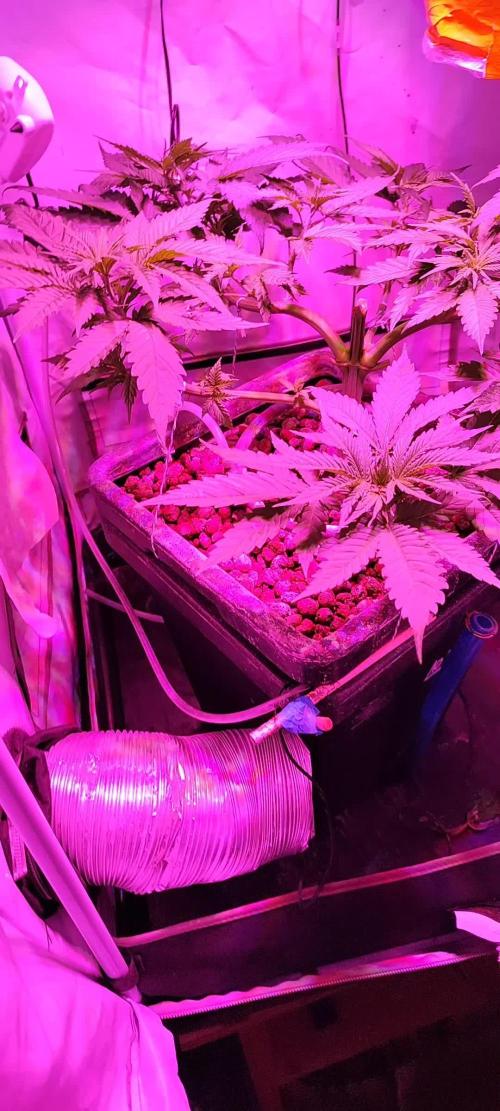
Anfang der 4. Vegi Woche sieht alles gut aus soweit bin zufrieden kann mich nur nicht entscheiden ob ich die untersten Fächer Blätter entfernen sollte oder nicht.....
Edit:12.02.21 habe mich heute morgen dazu entschieden die fächer blätter zu entfernen und hab danach alles nochmal richtig hin gebogen.....
Edit:13.02.21 hab heute mal die Wurzeln kontrolliert u d hab mich danach direkt entschieden die Ladys in die end töpfe zu Pflanzen das ganze hab ich dann mit 1l wasser mit Zusätzen angegossen und beim Nächsten giessen is Dann erst das komplette Medium dran mit durch giessen hab das gefühl das sie sonnst zu lange nass stehen bei der enge an Erde.....



Processing
Likes
36
Share


@MadeInGermany
Follow
Hey everyone ☺️.
This week it has developed really well and has finally taken on color again :-) 👍.
The additional nutrients as described last week have taken off. 1 liter per pot is poured twice this week 🤗.
In about 2 weeks it goes over to the flowering tent 👍.
Otherwise there is not much to report this week.
I wish you lots of fun with the update, stay healthy and let it grow 🍀😊
You can buy this Strain at :
https://sweetseeds.es/de/sweet-skunk-f1-fast-version/
Type:
Sweet Skunk F1 Fast Version
☝️🏼
Genetics:
Sweet Skunk Auto (SWS34)
X
Early Skunk
👍
Vega lamp:
2 x Todogrow Led
Quantum Board 100 W
💡
Bloom Lamp :
2 x Todogrow Led
Cxb 3590 COB 3500 K 205W
💡💡☝️🏼
Soil :
Canna Coco Professional +
☝️🏼
Fertilizer:
Green House Powder Feeding
☝️🏼🌱
Water:
Osmosis water mixed with normal water (24 hours stale that the chlorine evaporates) to 0.2 EC. Add Cal / Mag to 0.4 Ec Ph with Organic Ph - to 5.5 - 5.8 .

Likes
5
Share


@Gropadawan
Follow
Day 46 of Flower, 93 since germination.
Starting to check the trichomes with my new wifi microscope. Looks like Lemon Extract has a scattering of amber trichome heads, but only in bud nearest the light. All other look milky and glassy. I'm thinking Lemon Extract might harvest in one week. The others, maybe two weeks.
Gave the ladies their last feeding today. Just PH balanced water from here til harvest.

Likes
19
Share

@DogDoctorOfficial
Follow
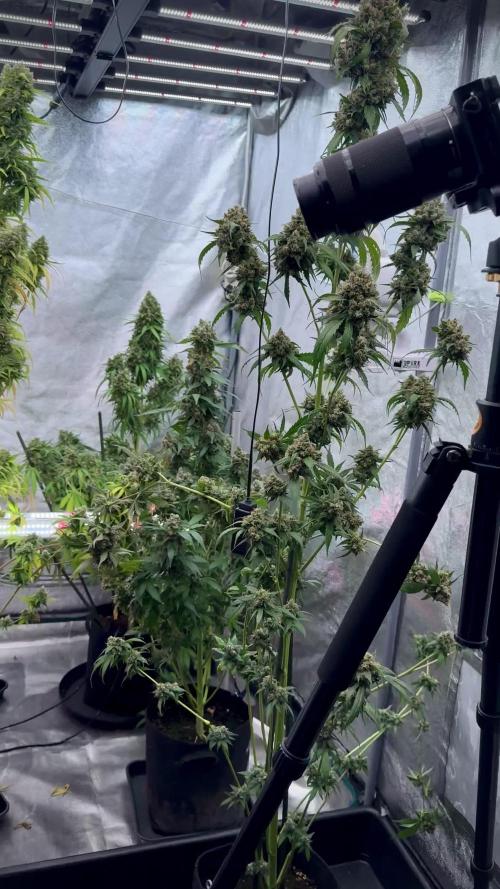
🌸 White Widow — Week 7 Flower (Week 11 from seed)
Status: Full flower, bulking rapidly.
Vibe: Dark foliage, compact form, heavy frost, 90s aroma profile.
Feeding: Aptus + Plagron lineup (Power Buds, Sugar Royal, Green Sensation, Regulator, CalMag, All-in-One)
Photos: Sony a6000 — loyal workhorse for studio shots. 📷
⸻
🧠 Deep dive — Why 12/12-from-seed makes a plant “go hard”
Plants evolved to reproduce. Their primary biological drive is to make seeds. Photoperiod (day length) is one of the most reliable seasonal cues plants use to decide: is it time to flower?
Mechanisms at play (simple → nerdy):
• Photoperiod sensing: Leaves detect day length via phytochrome systems (Pr Pfr). Short days (or the 11/13 rhythm) flip the hormonal cascade toward flowering.
• Florigen & flowering hormones: When the plant senses “short days,” it produces mobile signals (florigen) that travel to the shoot apex and shift gene expression from vegetative growth to reproductive development.
• Carbohydrate reallocation: Energy stops making more leaves/branches and is directed into calyxes, resin synthesis, terpene pathways, and seed/flower tissues.
• Result: A plant that thinks “the season’s ending — reproduce now!” goes all-in: denser flowers, rapid calyx swelling, intense trichome production.
Important point: they don’t know about pollination. The plant can’t tell you whether pollinators exist or whether pollen will land — it simply invests in attractive, resinous flowers to maximize reproductive success. As growers, we exploit that drive to produce potent sensimilla (unpollinated) flowers.
⸻
🔬 Why your White Widow is exploding in quality right now
• Immediate reproductive programming: Starting floral signals early (12/12 from seed) forces the plant to prioritize flower formation rather than vegetative mass. That yields compact, dense colas.
• High PPFD + short day = strong DLI in less time: With fewer hours of light, your lamp intensity is higher in those hours → powerful photosynthesis during the window the plant has chosen.
• Nutrition tuned to flower: the Aptus + Plagron stack feeds the metabolic surge — PK + biostimulators for bulking, sugar stimulators for terpene pathways, Ca/Mg for structural health.
• Genetics: White Widow is resin-happy; give it the right cues and it will frost up like a sugar cookie.
⸻
🌈 Why her colors are going dark (and why that’s beautiful)
Leaf & bud color comes from a balance of chlorophyll + accessory pigments (anthocyanins, carotenoids) and is influenced by:
• Genetic propensity (some phenos are naturally darker)
• Temperature swings (cooler nights often increase anthocyanin expression)
• pH / nutrient balance (some deficits/ratios nudge color pathways)
• Light spectrum intensity (strong red/far-red influence can shift pigment expression)
Dark phenos often correlate with high terpene and anthocyanin expression — visually stunning and often highly aromatic.
⸻
🔁 Quick timeline recap (for newcomers)
• Germination & early mistakes: initial heat-mat loss → restarted, one strong survivor.
• Veg: compact, short internodes under the 11/13/12-12 shuttle → stacked nodes.
• Early flower: slow to show, but once she flipped she committed.
• Now – Week 7 flower (Week 11 from seed): heavy bulking, thick trichomes, deepening color, classic White Widow aroma emerging.
⸻
🔭 What to expect next (this week → next week)
Expect:
• Continued bulking of calyxes and cola weight.
• Explosion of trichome coverage — white, cloudy glands multiply.
• Stronger terpene smell (earthy, spicy, resinous 90s profile).
• Possible color intensification — deeper greens, potential purples depending on phenotype & nights.
Do not expect:
• Major new stretch — she’s committed to flower and will remain compact.
• Immediate harvest — typical White Widow still wants its weeks; plan for patience (mid-late flower bulking happens over several more weeks).
⸻
⚖️ Should you run all seeds 12/12 next cycle? (pros & cons)
You asked if you might run every seed 12/12 — here’s the honest rabbit-hole:
Pros
• Much faster cycle → less time to harvest.
• Compact plants → ideal for small spaces or stealth grows.
• Often denser single-plant yields; less training needed.
• Great for experimentation, multi-strain rapid rotation.
Cons
• Generally lower total biomass per plant vs. long veg runs.
• Some genetics need veg time to express full canopy & branching; yields may be lower for those strains.
• Root systems can remain smaller → may stress under high PPFD if not supported.
• Less flexible for heavy-topping/lst/manipulation strategies.
Bottom line: for strains with good genetics for flowers (like White Widow), 12/12-from-seed can be very rewarding. For sativa-dominant, tall strains you might lose yield without long veg.
⸻
📷 Gear love — Sony a6000 shoutout
I’ve got to echo it: that camera is a workhorse for growers. Compact, responsive, great color fidelity, and perfect for low-light studio shots when paired with proper exposure. The a6000 captures the leaf texture, color depth, and bud gloss in a way phones struggle to match. Long live the loyal shooter. 📸✨
⸻
🙏 Gratitude — the usual and the real
Thank you to:
• Zamnesia — for the genetics & the nostalgia.
• Aptus & Plagron — the chemical & biological push that lets the plant sing.
• ThinkGrow / Future of Grow / TrolMaster — lighting, control, and environment orchestration.
• You — the makers, lovers, critics, curious readers — your energy fuels this diary.
And to our White Widow — for showing up, forgiving mistakes, and giving back in beauty. 💚
⸻
Week 7 flower — Week 11 from seed. Darker colors, heavy frost, the classic 90s scent, and a compact structure that proves 12/12-from-seed can produce absolute fire. We went full-in on Aptus + Plagron, kept the Emerson red-lead sunrise/sunset, and trusted the genetics. Watching her build is pure joy. Come see the series in 4K on YouTube — every detail, every shimmer. 🌿🔥📷 #WhiteWidow #Zamnesia #GrowDiaries #12fromSeed #EmersonEffect #Aptus #Plagron
📲 Don’t forget to Subscribe and follow me on Instagram and YouTube @DogDoctorOfficial for exclusive content, real-time updates, and behind-the-scenes magic. We’ve got so much more coming. You won’t want to miss it.
• GrowDiaries Journal: https://growdiaries.com/grower/dogdoctorofficial
• Instagram: https://www.instagram.com/dogdoctorofficial/
• YouTube: https://www.youtube.com/@dogdoctorofficial
⸻
Explore the Gear that Powers My Grow
If you’re curious about the tech I’m using, check out these links:
• Genetics, gear, nutrients, and more – Zamnesia: https://www.zamnesia.com/
• Environmental control & automation – TrolMaster: https://www.trolmaster.eu/
• Advanced LED lighting – Future of Grow: https://www.futureofgrow.com/
• Root and growth nutrition – Aptus Holland: https://aptus-holland.com/
• Nutrient systems & boosters – Plagron: https://plagron.com/en/
• Soil & substrate excellence – PRO-MIX BX: https://www.pthorticulture.com/en-us/products/pro-mix-bx-mycorrhizae
• Curing and storage – Grove Bags: https://grovebags.com/
⸻
We’ve got much more coming as we move through the grow cycles. Trust me, you won’t want to miss the next steps, let’s push the boundaries of indoor horticulture together!
As always, this is shared for educational purposes, aiming to spread understanding and appreciation for this plant. Let’s celebrate it responsibly and continue to learn and grow together.
Friendly reminder all you see here is pure research and for educational purposes only,
With true love comes happiness. Always believe in yourself, and always do things expecting nothing and with an open heart. Be a giver, and the universe will give back in ways you could never imagine.
💚 Growers love to all
P.S. — Deep dive on DLI (Daily Light Integral) — short, clear, and a little nerdy (in the best way). 🌞🌿
1) What is DLI, simply?
DLI = the total amount of photosynthetic light (photons) a plant receives over one day.
It’s expressed in moles of photons per square metre per day (mol·m⁻²·day⁻¹).
While PPFD (μmol·m⁻²·s⁻¹) tells you instantaneous light intensity, DLI tells you how much light the plant actually used that day.
⸻
2) The formula (how to calculate it)
Use this exact formula:
text{DLI (mol·m}^{-2}text{·day}^{-1}) = frac{text{PPFD (μmol·m}^{-2}text{·s}^{-1}) times text{seconds of light per day}}{1{,}000{,}000}
Where seconds of light per day = hours of light × 3600.
I’ll show worked examples so it’s easy to follow.
⸻
3) Worked examples (digit-by-digit so it’s crystal clear)
Example A — your reported PPFD ≈ 766 μmol·m⁻²·s⁻¹ and 11 hours light
• seconds of light = 11 × 3600 = 39,600 s
• photons per day = 766 × 39,600 = 30,333,600 μmol·m⁻²·day⁻¹
• convert to moles: 30,333,600 ÷ 1,000,000 = 30.3336 mol·m⁻²·day⁻¹
So: 766 μmol·m⁻²·s⁻¹ × 11 h → DLI ≈ 30.3 mol·m⁻²·day⁻¹
Example B — same PPFD but 12 hours
• seconds = 12 × 3600 = 43,200
• photons = 766 × 43,200 = 33,091,200
• DLI = 33,091,200 ÷ 1,000,000 = 33.0912 mol·m⁻²·day⁻¹
Example C — other quick refs
• 700 μmol × 11 h → DLI ≈ 27.72
• 800 μmol × 11 h → DLI ≈ 31.68
• 400 μmol × 11 h → DLI ≈ 15.84
• 1000 μmol × 12 h → DLI ≈ 43.2
(You can plug any PPFD and hours into the formula — those are ready-made reference points.)
⸻
4) What DLI targets are useful for cannabis?
• Vegetative (gentle): ~12–25 mol·m⁻²·day⁻¹
• Flower (typical good range): ~25–40 mol·m⁻²·day⁻¹ — most home/pro growers aim here
• High-intensity/CO₂-enriched commercial: 40–60+ mol·m⁻²·day⁻¹ (needs CO₂, stronger conditioning)
So your example (≈30 mol·m⁻²·day⁻¹ at ~766 PPFD × 11h) sits very nicely in the flower range. That explains the dense bulking + heavy resin you’re seeing — our DLI is right where White Widow loves to convert energy into flowers.
⸻
5) Practical implications — what DLI affects and what to watch
• Higher DLI → higher photosynthesis → more carbohydrate to drive bud bulking and terpene/trichome production.
• Higher DLI requires more water and nutrients. Plants transpire more and pull more minerals; be ready to feed and irrigate appropriately.
• Leaf temperature / heat stress: pushing PPFD up increases canopy energy/heat — keep airflow, VPD, and room temps under control.
• CO₂ matters: if aiming beyond ~40 mol/day, elevated CO₂ (e.g., 800–1200 ppm) becomes productive; otherwise additional light won’t be used efficiently.
• Distribution matters: DLI is an average over the canopy. Hotspots or shaded pockets mean some flowers get too much or too little — even light spread (and PAR mapping) matters.
⸻
6) Actionable tips for your run (based on your 11/13 / 12/12 experiment)
• We’re hitting excellent flower DLI (≈30 mol/day at 766 μmol × 11 h). That’s why buds are dense/frosty — keep the rhythm.
• If you shorten hours (e.g., 11 h) keep PPFD high to maintain target DLI. If you lengthen hours (12 h) you can reduce peak PPFD slightly and still hit the same DLI.
• If you raise PPFD to chase more DLI, ramp slowly (a few μmol/sec per day) to let stomata and roots acclimate — avoid sudden bleaching.
• Watch watering & EC — higher DLI → faster uptake → more frequent but measured feeding.
• If you ever push DLI 40 mol/day consider CO₂ enrichment and perfect VPD control to have that extra light used efficiently.
⸻
7) Quick rules of thumb
• Want to hit ~30 mol/day with 11 hours on the clock → aim for roughly 700–800 μmol·m⁻²·s⁻¹.
• Want ~33 mol/day at 12 hours → ~766 μmol·m⁻²·s⁻¹ matches that nicely.
• If you see leaf cupping/bleaching, you’ve likely exceeded safe PPFD for that canopy or temps are too high — back off, check VPD.


Likes
2
Share


@Mr_nugs_lover_David
Follow
The nuggets are very sticky and compact, they are frosty as hell and the aroma is very strong already. I loved this strain. She's such an amazing autoflowering strain. Very powerful.

Likes
1
Share


@Hash268
Follow
Moving pass the transition a little more this week and slowly switching to bud development. The feeding has been holding up and I've decided to top dress and just let them ride out on what they have available in the medium.
Likes
2
Share


@GhostBlvckPhant0m
Follow
Week 8 and The Wock ladies are doing great. They have been flipped and given flower nutes. Pre flower pistils are just starting to show. I removed some large fan leaves blocking bud sites, not too much. Pheno #1 in the 7 Gal pot is getting huge. She is the closest to the light with no damage to her leaves. Tri-Leaf Mutation has had some much needed defoliation, but not too much. The bud sites on her are ridiculous!


Likes
16
Share


@Marsledgrower
Follow
Plants are definitely Drinking alot. Set up scrog net Kinda late ... As soon as I flowered. Only need net to hold them..not to train them... humidity is in high 60s low 70s. THATS WAY TOO HIGH.. need to get my humidity down to 45%...
My main focus is to get a dehumidifier ..and really soon.......


Likes
77
Share


@SooSan
Follow
Dans l'ordre:
1) Afghan Peach x Blue Monkey
2) Gelato Cake
3) Fast Critical Poison
4) Tropical Fuel
5) Hindu Kush
6) (Blueberry x Black Domina) X (Kosher Kush x Mk-Ultra)
7) Blueberry
8) Herz OG
9) (Blueberry x Black Domina) X (Kosher Kush x Mk-Ultra)


Likes
92
Share


@Hou_Stone
Follow
I changed my tent this week, the lamp and the Mars Hydro extractor convinced me that it was good gear so I took the tent in + 😀
Pulling all the branches with ropes is way too much work... I think I'll just pull the 2 main branches down and add a scrog net next week
-----------------------------------------------------------------------------
-Water: tap water (280ppm). I add 0.7g/L of Grow mineral powder and 0.2g/L of Calcium to reach 820ppm and I adjust the ph to 5.8
-Daytime temperature: 29°C
-Night temperature: 25°C
-Humidity: 45-65%
-Lamp: Mars Hydro FC3000. intensity 60% at 40cm from the top leaves
-Room: Mars Hydro 100x100x180cm
-Extractor: Mars hydro 402 CFM Max. power 2/10
-Substrate : 70% coco, 25% perlite, 5% vermiculite.


Likes
170
Share


@Green_Man_420
Follow
Week 3 is here and again thank you to all you fellow grower’s that have stopped by to show the love 👊🏻✌️ a massive thank you to James @RQS for trusting me with this grow. A link to their website below go check them out 🙌
.
Well we are at the start of week 3. Moving along nice and steady. Starting to really struggle with RH yesterday was down to 40% for most of the day. Managed to get it back to 50%. I think I will top them all towards the end of the week but I need to see more growth before I do this.
Day 17, watered last night. Started to train the first plant. I’m going onto the back one either tonight or tomorrow. Turned the heat Matt off as I think the roots were getting too warm 🤷 we carry on. ✌️👊🏻
Day 18, adjusted the ties on this lady gone in fairly hard so we shall see how she handles it. Topped the other weeding cake today too. Let’s see how they look in a couple days. ✌️🙌
Day 20, watered last night. Slow and steady happy with how they have progressed after training and topping. ✌️
⭐️⭐️⭐️⭐️⭐️⭐️⭐️⭐️⭐️⭐️⭐️⭐️
https://www.royalqueenseeds.com/uk/
Likes
9
Share


@StickyFingah420
Follow
En general la planta se desarrolló en un buen ambiente, agradeciendo con brotes de buena calidad.La planta se forma compacta y en forma de arbusto, con bastantes brazos donde soportará sus flores en forma de bolas de golf alargadas, el aspecto de la planta es bastante vistoso, cubriéndose con una densa capa de resina que expende un fuerte olor a pino, menta y chocolate, realmente recomendada para los amantes de las indicas con sabores dulces/cálidos.
Escribo esto a pocos momentos de haber fumado el último bud de esta planta, realmente fué una buena compañía para este tiempo de cuarentena. //
In general the plant developed in a good environment, thanking with good quality buds. The plant is compact and shrub-shaped, with enough arms where it will support its flowers in the form of elongated golf balls, the appearance of the plant is quite showy, covered with a dense layer of resin that exposes a strong smell of pine, mint and chocolate, really recommended for lovers of the indica with sweet / warm flavors.
I write this a few moments after smoking the last bud of this plant, it was really a good company for this time of quarantine.


Likes
13
Share


@kushman_4
Follow
The girls have entered week 3 and are growing slowly, but steadily. Raised the lights slightly since I felt the internodal space was kinda small. Fed them their first nutes. Will be just watering them for 3 days, and give them their seconds feed after that. Waiting to see how they respond to the feed.
Likes
2
Share

@Colonel
Follow
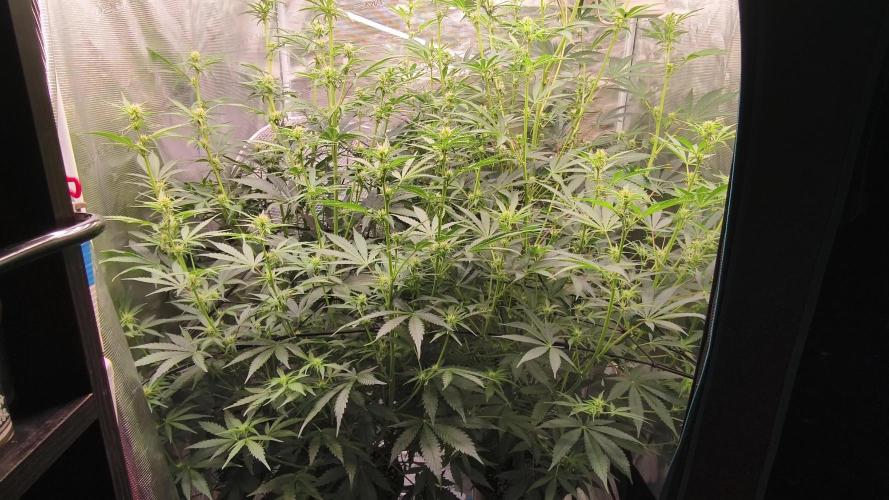
Week 7 flower update
I figured out what was going on with my plants. My tap water actually contains a lot of carbonates, which means there’s already plenty of calcium and magnesium in it. Because of that, I shouldn’t have been adding 0.5 ml of Plagron CalMag, since that product is really intended for soft water.
The extra calcium started pushing the root zone pH locally up to around 6.5. That made nitrogen more available, but at the same time it partially locked out phosphorus. Because of that the flower development slowed down, while cell elongation increased before proper bud growth resumed.
As soon as I realized what was happening, I started dropping the PPM pretty aggressively, step by step, and completely removed CalMag from the feed.
While the plants were recovering from the salt stress, I also cleaned up the lower weak branches (about 10% max) to help redistribute energy to the stronger tops.
Right now I’m focusing on stabilizing the root zone.
Current numbers:
Input: pH 5.5 / 575–600 ppm
Runoff: pH 6.38 / 730–760 ppm
Plants are slowly coming out of the stress. They’re drinking 3 times a day, about 15 liters total (7.5 L per plant).
The flowers have started growing again, after being stalled for about 3–4 days.
Because of the pH imbalance (too much nitrogen and calcium) the plants started stretching like crazy. The branches were growing so fast they were already hitting the lights and the top of the tent.
My tent is 180 cm tall and the pots are about 30 cm, so I basically ran out of vertical space.
I had to bend the branches almost 90 degrees, laying them over each other just to keep the canopy under control. Some of them are literally tucked under the carbon filter, and the rest are tied down with wire to keep them away from the lamps.
Not the prettiest canopy right now, but it keeps everything below the lights and still getting good exposure.