





@3lementa1
Volgen
This is the 8th week. Thursday will be 9 weeks of 12/12. Some trichs are amber. They just added a good bunch of girth over the past few days, but most of the pistils are red now. The rest of them have been dropping leaves consistenly but the canopy remains full so they must be putting out more leaves.
I just flushed to 80% runoff and found out that I had 1200ppm. I just got an ec meter but my last reading said closer to 600 so idk what happened there.
I flushed until I had runoff ppm of about 150. Now they're back in the grow tent. I don't want to keep assaulting them with my microscope. I think they're ready. Just gonna let them settle another day or two to dry out a bit.
I took one small branch off the small Wedding Cake plant on Thursday and I've just been watching it dry on my counter. It's been 5 days and the stem snaps but still leaves a fiber connecting. I put it into a small jar with a 64RH thing. I just want to try it. It already smells amazing.
The leaves on the big CBD Blue Shark plant are going really yellow and some other colours are starting to come out as well.
The buds all fattened up and got more frosty again. I was worried they were foxtailing but they got more calyxes underneath the peaks and have been making more of a pyramid shape. They're really close to peak. Harvest day will be March 17 or 18.
March 17 1023pm chopped and hung after lights off all day. RH was 65% before I chopped and 50% after I closed the window and cut the plants off the saturated pots. I did a wet trim to prevent mold. The buds are sticky af. Gonna hang them to dry for 7-9 days before curing in jars :)
March 18 : checked the RH when I woke up and it's chilling at 45% 😎
March 19 : just checked to see how they were drying. There are seeds in every plant. RIP
I'll update when I put them in jars and again a few weeks later for final review. Overall it was a good grow despite the rocky start and a good introduction to the mainline technique and my new grow space. Next grow I should have everything pretty well dialed in.
March 23
They were hanging for 3 days. Rh was around 45, then spiked to 65 overnight when I forgot to turn the fans back on. Temp was high at around 26.they felt wet after 2 days, and bone dry after 4 days. The stems still didn't snap but I put them in jars anyway. A day later, jar RH was 50%. I burped all the jars and there was a smell from the new jars. I took all the weed out, washed out the jars, and did a dry trim on the weed.
One of the Wedding Cake plants must have gone hermie. I didn't see any bananas and didn't even realize there were seeds until the very end. The seed pods looked just like calyxes while the plants were growing. Many of the nugs are unusable. Under the sugar leaves are just layers and layers of seeds. Some weren't hit that badly. The CBD Blue Shark is much better off but still has some seeds.
I'm trying to stay positive. It's a bit of a shock though. I'm anxious to try the finished product. If the flowers at least taste good and have a good effect, all is not lost.



@DE_BW
Volgen
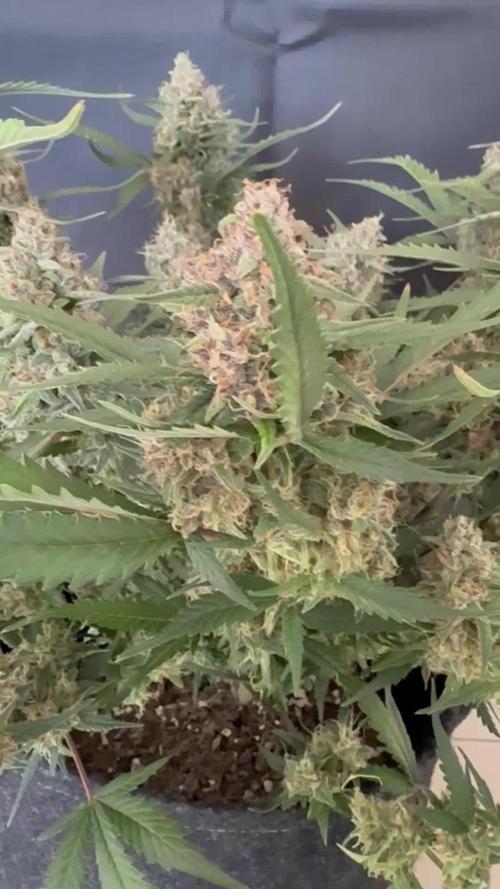
Flowering week 5 and the plant is transitioning into the Overdrive phase, with an estimated 8–9 days remaining until harvest. Buds are stacking quickly and showing a surprisingly strong sweet strawberry-like aroma that fills the room. From above, subtle purple hues are starting to appear, adding a nice visual touch to an already very healthy-looking plant.



@GasoGrow
Volgen
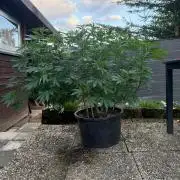
Flowering week 8. The flowers are growing very well; I haven’t found any more mold. The plant just needs to hold on for a maximum of 3 more weeks, then it will be harvested. Over these final weeks, I will check the flowers every day to see if any mold is forming, ensuring that nothing spreads.


@IberianRootcraft
Volgen
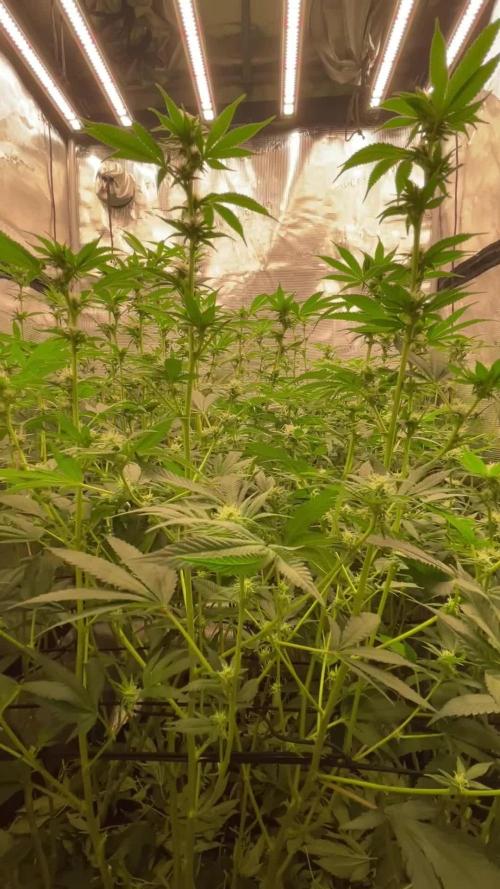
Day 21 is here! Last defoliation done, let’s start to bulk!
37º-40º already outdoor, things getting hard…





@Kirsten
Volgen
26.1.25:
I have had a mistake 😕 i spilt some Fish Mix as I was experimenting with a syphon from some aquarium tubing I have. Unfortunately, I forgot to take the syphon out! Ugh 😣
However, it is fish emulsion and very thick consistency. Therefore, I was able to scrape it up with 2 of my business cards up off the counter. So added this extra into the next 2 ltr solution I mixed.
All plants were watered with at least 1ltr of dechlorinated water PH'd to 6.3.
Containing the following nutrients;-
♡ 3ml Seachem Seaweed
♡ 4ml Biobizz Fish Mix
♡ 4ml Biobizz Bio-Grow
♡ 3ml Biobizz Bloom
♡ 2ml Xpert Nutrients Bloom Booster
♡ 2ml Xpert Nutrients Cal-Mag
♡ .25g Ecothrive Biosys.
♡ 2.5g of Bicarbonate of Soda as PH UP.
Unfortunately I have broken my PH pen too. Accidentally submerged it under water, then the readings went crazy.
I'm leaving it to dry by standing it up but I'm most likely going to need a new one, which is extremely annoying 😑
I'm going start implementing the Scrog net probably some point next week if I let the plants that are in flower to just grow up now, as I do believe that I stunted Watermelon 🍉 by using too strenuous LST.
Hopefully the plants still are able to grow upwards at this stage during flower for all the Purple Punch P1, P2 and P3.
We will soon see!
28.1.25:
My PH pen has packed up 😣
I've got to wait to get another.
It's super annoying 😑 so I'm just judging by memory how to regulate it.
Unfortunately, that's my only choice! I'm also out of the dechlorinator 😕 things are not going very well this week so far 😅
I guess we will have to make do, until I can get replenished.
29.1.25:
I removed all the plants, hoovered, and disinfected the tent.
There were several accidents when watering, causing some debris and splashes.
I decided to just go ahead and get a few other things done. It's crazy how quickly things can become neglected! 😣
So I defoliated moderately on all plants except Gorilla Cookies seedling.
I have absolutely dropped the ball on my lighting situation!
My light was much further away than I thought!
I turned it up to 100% and dropped it down to just under 2 feet away.
After I reset the tent, I set up my scrog net. I removed 80% of all LST pegs. I am planning on letting the scrog net take over the training from here.
I really want to minimise the risk of mould, so I decided to start using my dehumidifier. It has raised up to 73% RH this week, so it's necessary.
Hopefully, I will be able to get my dechlorinator and PH pen soon! That's kind of essential to me.
It's been a little bit of a stressful day in the garden, to be honest 😅
30.1.25:
So I am expecting the arrival of my new PH pen today, as well as my new bottle of Ecothrive neutralise.
It is supposed to measure the TDS and EC in addition to the standard TEMP and PH, which I had previously. Obviously, time will tell if it's any good or not.
I realise, much too late now, that my lighting is very insufficient for this many plants. I need double the watts at least, and coverage is very poor.
I remembered I had an old LED floor lamp, which was in a corner being unused.
I decided to take the stand off, and Zip tied the pole onto the tent pole at the back left corner.
I have no idea what the wattage is, and it's quite pathetic 😅 but I mean, I might as well use it, being as I definitely cannot afford more lights! 😣
Next grow, I will probably only grow 2 plants, max 4, and just use larger 7-10 Gallon pots.
Being as I ran out of dechlorinator, I only watered some plants properly because I only had enough to make 6 litres. When my pen arrives, I will get everything properly watered.
31.1.25:
The leaves of several plants are showing signs of iron deficiency. This is likely due to my PH pen packing up earlier. I now have a new pen.
Due to this, I decided to use my Seachem Prime, which I use for my aquariums. As I wanted to get them watered properly, and my Ecothrive Neutralise hasn't arrived yet.
I watered each plant with 1ltr of dechlorinated water PH'd to 6.0. I added .25g Ecothrive Biosys to the water.
May give them a breather on the nutes and just use the Cal-Mag and Biosys.
Being as I've just topped dressed with rich fertilisers, I'm sure that will be OK for the next several waterings.
Bubble Kush

shorts_status_processing


@Flydope21
Volgen
Seeing a lot of changes since I’ve started the LST. Most of the plants are doing good exept for one that seems to be having a hard time. I will also be adding an xl exhale co2 bag.

shorts_status_processing


@DudeGrowsWeed
Volgen
February 20, 2019 update:
Pretty much just waiting for these girls to be ready for harvest. Everything is moving along nicely at this point. Planning on feeding until the end of February, then starting a 2 week flush - at least with the Cherry and DinaMed, I may let the Critical+ and Cookies & Cream go a little longer.
Fed MegaCrop, Cal+Mag Pro and Mammoth P this week. I've used up the last of my Mammoth P at this point. It will be MegaCro & Cal+Mag Pro only until flush.
All pics were taken with the lights on. I tried color correcting the best I could, but the pics really don't represent the actual colors very well. Usually I try to get some pics with the lights off also, but I was not able to do that last week. I'll make sure to get some better pics next time. 👍


@Ieiogrow94
Volgen
Eccoci qui...
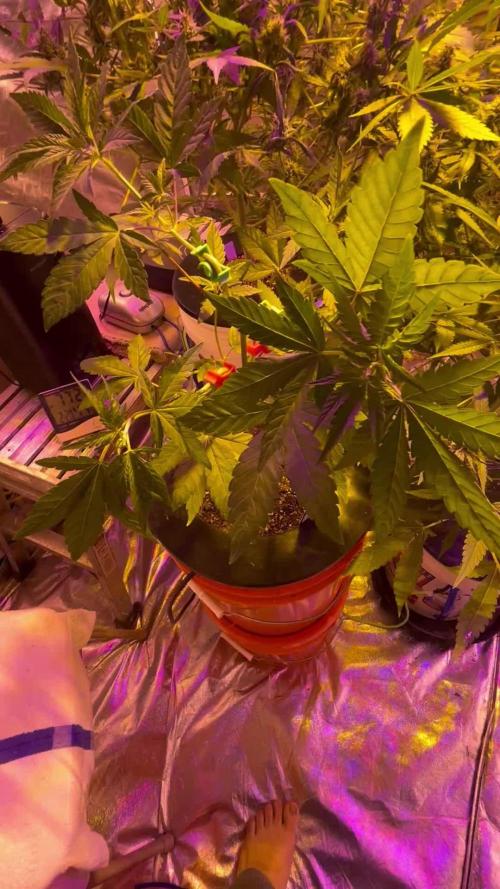
Tutto va per il meglio, questa settimana non ho applicato stress alle piccole, ma ho guardato l'evoluzione che hanno avuto dando i nutrienti.
Ora hanno un odore davvero intenso ed uno strato di resina pauroso, vediamo come si riprendono dalla defogliazione che ho fatto settimana scorsa.
Seguiranno aggiornamenti, grazie a tutti per il supporto🔥🌲❤️



@OlyGrower
Volgen
About day 70:
All growing good, just keeping them fed. Buds getting bigger. Amnesia haze a little on the small side but the others seem fine. I don’t care about yield as long as I get frosty buds.
A few more weeks till the first two get chopped


@xbrico
Volgen
Day 15 - Fresh tank and not much new to report. pH was remaining incredibly stable through last week so skipped a fresh feed week. 300A doing its job keeping the water at a nice 19C.
As noted, girls got topped a couple of days ago. They're rebounding nicely. Will start some LST on the branches now through the week. Will be the usual balance pH at the start of the week and hopefully stabilise quickly.
Using the Botanicare kind ratios (Expert Recipe) if not the same volumes so base to grow is 2 to 3 ratio this week.
Thats about it for now (Will add some pics and last week time lapse in a bit when lights are on).
Happy growing all!!! 💪


@Ieiogrow94
Volgen
Eccoci qui...
Siamo quasi alla fine del cultivo, odore, resina e colore ci sono. Attendiamo solo la maturazione delle cime che richiederà 1/2 settimane....
NON VEDO L'ORAAAA...
Seguiranno aggiornamenti, grazie a tutti per il supporto🔥🌲❤️


@XperencdGmanXG
Volgen
Well, these girls are well on their way into bloom. They are really stacking it on since the addition of the worm castings. I strongly suggest everyone use worm castings in your soil mixes, even if you are using salt-based nutrients.


@Ultraviolet
Volgen
Tried this strain from a dispensary one time, was a very enjoyable daytime strain that I look forward to smoking again, will look to take clones to at some point during veg
Durban Poison—The Legend Unmasked
The name and origin of this invigorating strain lie in Durban, a coastal city in South Africa. The following table breaks down Durban Poison’s basic properties.
Strain: Sativa.
Aroma: Piney, Sweet, Citrusy.
Effect: Energizing, Uplifting, Focusing.
Typical THC Content 18%–20%
Whether you need to tackle a large project, boost your mood, or channel your inner adventurer, Durban Poison is the way to go. It offers a powerful stimulating high with light relaxation to clear your mind. It won’t make you drowsy or sedated, so it’s perfect for daytime use. You should avoid it in the evenings unless you plan on pulling an all-nighter.
Durban Poison has a moderate amount of THC but enough to color your day in vibrant colors. Still, the strain’s cannabinoids are only one piece of this lively puzzle. If you want Durban Poison to shine in its full glory, you should leverage its numerous and potent terpenes.
Take note "peak terpene" is roughly 2 weeks prior to "peak THC" which we use as a guideline for traditional harvest.
Terpenes in Durban Poison
Each Cannabis strain—and every other plant—produces aromatic hydrocarbons that give it a distinct aroma and flavor profile. Terpenes can’t get you high, but Cannabis-derived ones help cannabinoids (THC and CBD) penetrate the blood-brain barrier more easily so they can bind to your endocannabinoid receptors (primarily CB1).
The interplay between the two compounds is called the entourage effect, and it causes a stronger, more accentuated buzz than cannabinoids can induce alone.
Only a tiny portion of all Cannabis terpenes have been researched, but the results are fascinating. Each terpene enriches your experience differently, and Durban Poison has an eclectic mix of these mighty compounds.
Terpinolene
Durban Poison is one of the few strains where terpinolene is a dominant terpene. Cannabis typically produces it in lower quantities, so it usually plays a supporting role. Herbaceous and floral terpinolene offers relaxation and clarity, so it’s partially responsible for the strain’s serene nature.
Myrcene
Myrcene has always been synonymous with sedation and sleepiness, so finding it in such an invigorating strain might seem strange. It makes more sense when you know that these effects occur if the terpene makes for over 0.5% of the plant’s total weight. This isn’t the case with Durban Poison, so myrcene is tamer than in other strains, adding subtle stress-relief properties.
Pinene
Alpha and beta-pinene are among the main terpenes in Cannabis, the former being more common. Besides giving Durban Poison refreshing undertones, pinene isomers offer focus and mental clarity, which is what the strain is all about.
Limonene
Omnipresent in the citrus family, limonene gives plants a sweet-citrusy aroma. When you take a whiff of Durban Poison, you can feel its notes underneath the dominant pine scent. As for effects, limonene plays an antagonist to myrcene and is the embodiment of sativa strains. It increases your energy and lifts your spirits to pump you up for the day.
Valencene
Limonene’s lesser-known sibling, valencene was initially discovered in Valencia oranges. It’s sweeter than limonene and more representative of Durban Poison’s overall aroma. Valencene also has energizing cerebral effects, so its role is essential to the strain.
Ocimene
This is another secondary terpene that most strains—including Durban Poison—don’t have in abundance. Still, ocimene can be a potent stimulant, so its scarcity doesn’t make it any less important.
New garden inspired by MiyaguiOkPolilla
TORUS
What Is The Heart’s Toroidal Field?
The heart is the most powerful source of electromagnetic energy in the human body and the magnetic fields produced by the heart have been shown to be involved in energetic communication (also referred to as cardioelectromagnetic communication).
Research done at HeartMath Institute (HMI) suggests that the heart’s electrical field is approximately 60 times greater in amplitude than the electrical activity created in the brain and is an important carrier of information. More and more studies are finding that the heart may be as complex as the brain is- the heart actually sends more communication to the brain than the brain sends information to the heart!
Our thoughts and emotions affect the heart’s magnetic field, which energetically affects those in our environment, whether we are conscious of it or not.
The heart has approximately 40,000 neurons and has the ability to process, learn and remember. It has its own emotions and in the field of neuro-cardiology, researchers are learning more about the “intuitive” nature of the heart and how we can apply this information to the relationships we have with ourselves and with others all around us. From the inside, your heart emanates an extremely powerful toroidal energetic field and it has been scientifically measured to go out as far as 5 miles from your heart.
This magnetic field is involved in energetic communication, a direct extension from your heart to everyone and everything. In my practice, I like to reference this field as a visual to depict and take in how we are all connected and one and also, individually, whole and complete. I find that once this connection is made, we can easily see how we matter and our choices count and how choosing to live in alignment with our selves can create a robust state of health and expansion- making the fundamentals more impactful, as we move into new moments knowing that we can intentionally empower our ecosystems, with the healing energies of presence-courage-appreciation-compassion, love, etc. which extends from us, by way of our heart, to the world and to each other.
From the inside, your heart emanates an extremely powerful toroidal energetic field and it has been scientifically measured to go out as far as 5 miles from your heart. The heart’s magnetic field is the strongest rhythmic field produced by the human body.
From HMI’s findings, research has shown that the timing between pulses of the heart’s magnetic field is modulated by different emotional states- these studies have also shown that the magnetic signals generated by the heart have the capacity to affect individuals around us. It is also important to note that the heart is not that only source that can emit this type of electromagnetic field- every atom emits the same torus field: people, trees, the earth, the sun, the universe! We can apply this knowledge and use it as an opportunity to go within, connect, quiet the mind, regulate the brain and tap into our heart’s center.
What Does A State Of Coherence Look Like?
According to the HMI Research Director Dr. Rollin McCraty, “Coherence is the state when the heart, mind and emotions are in energetic alignment and cooperation. It is a state that builds resilience.” When parasympathetic and sympathetic systems are out of sync because one is filled with emotions such as anger, anxiety or frustration, this produces an erratic rhythm or what can be referred to as an incoherent state. Positive emotions such as compassion and love generate a harmonious pattern in our heart’s rhythm, leading to coherence and greater emotional regulation. When these harmonious interactions exist among our bodies’ systems, this is referred to as physiological coherence. As this increases, so does the brain’s alpha activity, which in turn supports us.
When we allow our conscious awareness to be in our heart center, we can begin to shift our perspective from what is to what can be and realize what is actually possible. When your torus field is healthy and spinning in all directions with no obstruction, this generate an infinite amount of energy, vitality and life force- creating inner balance and raising our vibration. Your torus field can also act as a form of energetic protection- operating as a “force field” that can shield and dispel any negativity.
A simple visualization exercise can help you become more aware of your torus energy field. Imagine drawing energy upward from the ground (the Earth) through your feet down a central column. Imagine this bright light going up your entire center from your feet and out through the crown of your head. Then, imagine something like a water fountain where this light is pouring out of the crown of your head and all around you, going back down to the Earth and then up again through your feet again. Imagine this upward energy for a couple of minutes or until you feel comfortable. Do you see, sense or feel the energy pouring out around you?
Let Your Heartbeat Be Your Reminder
As we move forward each day, remember that you can always take a moment to place your hands over your heart to recenter, reassure and empower yourself. Here, you can feel your heartbeat, open up and shift accordingly.
This is a new era, where we can write and live a collective, new story- much like a portal in time, where light can be blinding, healing, eye opening, and freeing all at once- and the earth seems to be rearranging itself, as we continue to awaken and reorient- called to remember who, what and where we truly are. Rediscovering the power that has been within, not outside of, ourselves all along.
The idea that power, or even freedom, lies outside of the self is just an illusion that we, as a collective, have made into our reality. Just. Opt. Out.


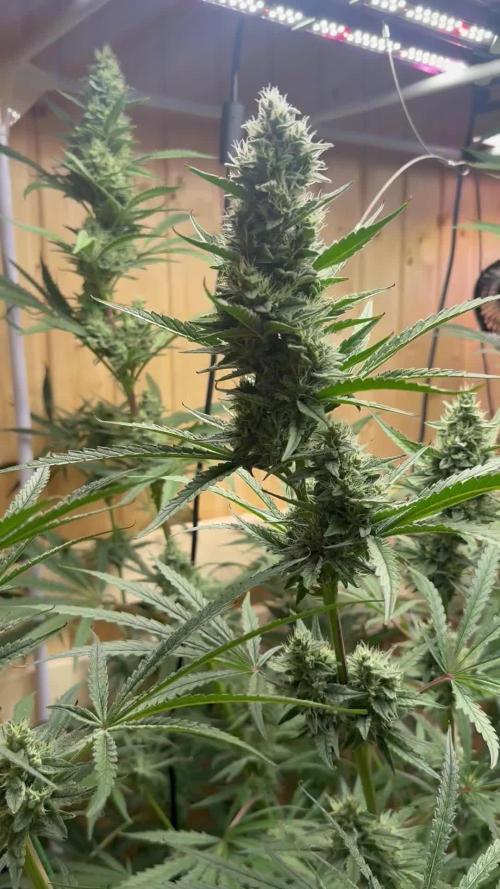

@Thejimmey420
Volgen
Diese Woche haben die Buds wieder einiges an Masse zugelegt die beiden headbuds sind fast so groß wie eine 1,5l pet Flasche mal gucken wo das noch hingeht. In der Woche wurde einmal das Wasser getauscht und Pk wurde wieder aus der Düngermischung entfernt . Ab Mitte der Woche habe ich noch eine sanlight evo 3-60 eingebaut die sind wie folgt gedimmt evo 3-60 hinten links ist bei 60 Prozent die rechts bei 80 die Lumatek Ats300w Pro ist bei 100 Prozent ec wert habe ich auf 1.16 gesenkt da sich sonst die Nährlösung immer weiter erhöhte Ph wurde in einem Bereich zwischen 5,8-6.2 gehalten. Die Tribe wurden mit Pflanzendraht gestützt .



@Cali_Rayy
Volgen
I’m ready for a smoke test 😂 hast the tent smelling like sour berries with some funk. Buds tightening up like a rock ; probably one of my better ones yet🤟


@Big_Rade_SCLA
Volgen
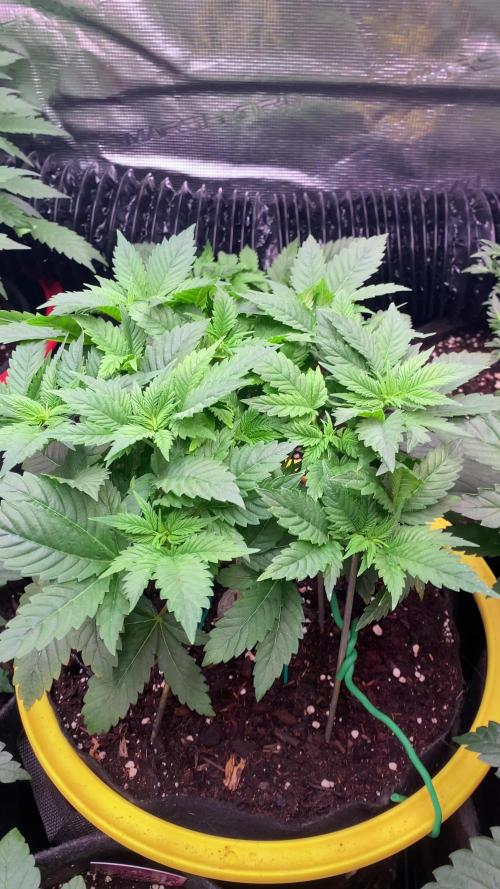
Veg Week 3
The Plants
DAY 22 - Transplanted T.O.5. Not Root Bound, but definitely could see the bright white roots all around the container. The plant started stretching almost immediately. So cool to see plants move.
DAY 26 - Finished Transplanting for this week-- T.O. 2, 4, 5, 6, 7, 13 to ~1 gallon pots.
Watering
Starting watering every day toward the end of the week (Day 26). Days are starting to get warmer. Growing in fabric pots in Southern California typically requires daily watering starting in June. I've learned through the years that the plant just sucks up the water and boosts in size. The more water you can give it without rotting the roots - the bigger the plant. There are still differences in strains - some plants just like to get dry before the next drenching. Couple more weeks until the June solstice (June 20).
Nutrients
Building up the arsenal in my cupboard--Bud Candy + Overdrive from AN, Kelp Meal from Down To Earth. I usually don't add too much stuff because the soil is fairly loaded from the bag.



@Diips
Volgen
shes also is going to become very beautiful i think! nice lush color in the leaves and tops
shes so lush, reminds me of a rosen bush. shes gonna flower real good!


@Salokin
Volgen
Hello Growmies,
I'm back with some more updates from the heart of my garden as we journey through the second week of flowering!
Our star plant is right on track, stretching beautifully as she enters deeper into the flowering stage. It's a delight to see her grow and evolve so perfectly. I've noticed some signs of tip burn, so I'm planning to reduce the nutrient levels even further in the upcoming week. It's all about finding that sweet spot where she's happiest and healthiest.This week saw her go through defoliation twice. Depending on her stretch in the coming days, I might go in for one more round of defoliation. Keeping a close eye on her growth to make sure every leaf and bud gets the light and air it needs. The first little bud-sites are beginning to show, a promising sign of the beautiful blooms to come. It's these small milestones that make the whole process so rewarding.
And here's something for my fellow plant enthusiasts: use the code ZAMMIGD2023 at Zamnesia's online store for a 20% discount. It's a great way to spread some joy and appreciation in our growing community!
Thanks for joining me on this growing adventure. Your support and interest mean a lot, and I can't wait to share more updates with you next week. Here's to more growth and flourishing buds!


@OGOZHigh
Volgen
Leider spielt das Wetter nicht so mit daher langsame Fortschritte.
Update : 21.06
Das Wetter wird besser und die Ladys geben langsam richtig gas 🥦🔥



@DogDoctorOfficial
Volgen
💙 8×8 Adventure – Week 14 🌿
Blueberry Muffin – Pheno A
❤️ Seeing Red Before Bed — Beautiful Flowers, Slow Motion, and a Little Light Science
Welcome back to another chapter of the 8×8 Adventure! 🌱💚
And our little Blueberry Muffin is still doing her thing.
Beautifully.
Slowly.
And, apparently, in absolutely no hurry whatsoever.
😂💙
Seriously, girl...
Could we perhaps pick up the pace a little?
Just a little?
No?
Okay. Fair enough. 😂
The funny thing is that while she may be slow as fuck compared with some of the other girls in this room, I really cannot complain about what I'm seeing.
The colours are beautiful.
The flower structures are beautiful.
The overall development is beautiful.
And she's still evolving.
That's the important part.
We're not seeing a plant that has simply stopped doing anything. We're seeing a plant that continues to develop, but follows a much slower timeline than many of her neighbours.
And it's not just Pheno A.
Both Blueberry Muffin sisters are taking their sweet time compared with much of the 8×8 Adventure.
Same room.
Same general environment.
Same lighting ecosystem.
Same overall nutritional approach.
Yet these girls are clearly following their own clock.
😂💙🌸
So, this week, we're not making dramatic changes.
Actually, we're not changing anything at all in the general setup.
We're continuing to observe, document, and let the plants do their thing.
But we do have something interesting to talk about today:
❤️ Red light at the end of the lighting period.
And, because I love understanding what happens behind the scenes, we'll also have a quick look at the science behind the Emerson effect.
Let's get into it!
────────────────────────
💙 STILL SMALL, STILL BEAUTIFUL, STILL MOVING
Blueberry Muffin Pheno A continues to look beautiful.
And that's what I want to focus on this week.
Not her height.
Not how quickly she's progressing compared with the others.
Not whether she should already be somewhere else in her flowering journey.
Let's look at the actual plant.
The colours.
The flowers.
The structure.
The details.
Because there's plenty to appreciate.
Her flowers continue developing, and the overall structure is looking lovely. There's a visual character to this girl that I really enjoy, and the photographs help show it much better than simply looking at her from across the room.
She's compact.
She's taking her time.
But she's still giving us something beautiful to follow.
💙🌸✨
And honestly, that's what these diaries are about.
We're documenting the plant we have in front of us, not the plant we imagined we'd have when we started.
────────────────────────
🐢 THE BLUEBERRY MUFFIN SISTERS ARE IN SLOW MOTION
Let's be honest for a moment.
😂
These two girls are slow.
Not just a little slower.
Compared with much of the room, they're moving in their own time zone.
While some of the other plants seem to be racing through their flowering development, the Blueberry Muffins are taking the scenic route.
And yet, both are still evolving.
That's an important distinction.
Slow development doesn't automatically mean something is wrong. Different genetics and phenotypes can follow different timelines, and the environment being shared doesn't make every plant develop at the same speed.
That's one of the things this project keeps reminding me.
We can create a shared environment, provide consistent care, and observe the differences.
But we cannot expect every plant to read the same calendar.
😂💙
The Blueberry Muffin sisters clearly didn't get that memo.
And that's fine.
We're watching their actual development rather than trying to force them to match the faster plants.
────────────────────────
🌸 THE COLOURS AND FLOWER STRUCTURE ARE BEAUTIFUL
This is where I really want to give her the spotlight.
Because when I look at this girl, the first things that catch my attention are the colours and the flower formation.
There's something very satisfying about seeing a plant continue to develop while maintaining such a beautiful overall appearance.
The flowers have their own character.
The structure is interesting.
And the photographs capture little details that can easily be overlooked when you're checking the room quickly.
📸💙
This is also why I like keeping individual phenotype diaries.
If we only looked at the room as a whole, it would be easy to focus on the biggest plants or the fastest-moving ones.
But that would mean missing some of the interesting details happening elsewhere.
Blueberry Muffin might not be winning any speed competitions.
😂
But she's still worth looking at.
She's still worth photographing.
And she's absolutely worth documenting.
────────────────────────
🌱 SAME ROOM, SAME CARE, DIFFERENT CLOCK
The 8×8 Adventure continues to demonstrate one of its central ideas.
Different plants can respond differently even when they're sharing the same general growing environment.
We're not creating a separate room or an entirely different program for every phenotype.
We're observing individual plants within a shared setup.
The Blueberry Muffin sisters are a good example of why that matters.
They are moving more slowly than many of their neighbours, but they're still developing.
That difference is part of the story.
And rather than treating it as something that must be corrected, I'm interested in documenting it.
The plants don't have to be identical to make the experiment interesting.
In fact, the differences are precisely what make it interesting.
💙🌿
────────────────────────
💡 THE LIGHTING SETUP — NOTHING NEW THIS WEEK
We're keeping the lighting setup unchanged.
The Future of Grow Black Series LEDs remain the main lighting system in the room, with the two additional Black Series 600W fixtures still contributing to the upgraded setup.
After adding those fixtures, we reduced the output to approximately 59% from the plug rather than simply running everything at maximum.
Our working reference remains around:
☀️ Approximately 1,500 PPFD across the upper canopy.
Actual intensity varies with plant height and position, of course.
And Blueberry Muffin Pheno A continues to share this lighting environment with the rest of the room.
No special lighting arrangement just for her.
No dramatic changes because she's slower.
The setup remains the same, and we're continuing to observe how each plant develops within it.
A huge thank you to Future of Grow for supplying the additional fixtures and giving us the opportunity to explore the capabilities of this lighting setup. 💡🙏
────────────────────────
❤️ RED LIGHT BEFORE BED — A NEW LITTLE DETAIL
Now let's talk about the red lights.
One of the things we're doing at the end of the lighting period is giving the room an additional 15 minutes of red light after the main lighting period.
The idea is to explore how this end-of-day lighting treatment fits into the lighting routine.
And because this is a topic that often gets discussed in growing communities, I want to separate what we know about plant light responses from what we might hope to achieve with a particular setup.
🌱 Plants don't simply experience light as bright or dark.
They respond to different wavelengths, and those wavelengths can influence different physiological processes.
Red and far-red light are particularly relevant to the way plants perceive their light environment and regulate responses associated with the day-night cycle.
But there's an important distinction here:
**Red light and far-red light are not the same thing.**
A red LED treatment isn't automatically equivalent to a far-red treatment, and the exact response depends on the wavelengths involved, the intensity, the duration, and the plant's condition.
So, for our 15-minute red-light finish, I'm treating it as an additional part of the lighting routine that we're exploring, rather than claiming it will automatically produce a specific result.
❤️💡🌱
────────────────────────
🔬 QUICK SCIENCE BREAK — WHAT IS THE EMERSON EFFECT?
Time for a little science!
😂🔬
The Emerson effect comes from research into photosynthesis.
In simplified terms, researchers found that when plants were illuminated with certain combinations of red light and far-red light, photosynthetic activity could be greater than expected from the effects of the two wavelengths used separately.
This helped scientists understand that photosynthesis involves two cooperating photosystems:
🌿 Photosystem II (PSII)
🌿 Photosystem I (PSI)
These systems work together in the photosynthetic electron transport chain.
The classic Emerson enhancement effect is associated with the complementary contribution of different wavelengths to the two photosystems, particularly when red and far-red light are combined under the appropriate conditions.
In other words, the wavelengths can complement each other.
That's the interesting part.
But here's where I want to be careful.
The Emerson effect is **not simply another name for giving plants 15 minutes of red light after the main lights switch off**.
And it doesn't automatically mean that a short red-light treatment at the end of the day will increase growth, improve flower development, or make a plant finish faster.
Those outcomes depend on the actual light spectrum, intensity, timing, and plant response.
The classic effect concerns photosynthetic activity under particular illumination conditions. An end-of-day treatment is a different lighting scenario, and we shouldn't assume the same result without evidence.
So, yes, the science is fascinating.
But we shouldn't stretch the explanation further than the evidence allows.
🔬💡🌱
────────────────────────
❤️ SO, WHAT ARE WE TRYING TO ACHIEVE WITH THOSE 15 MINUTES?
For this run, we're adding a short red-light period after the main lighting period.
The important thing is to be precise about what we're saying.
Red light can influence plant photoreceptors, including phytochromes, which participate in sensing the light environment.
However, the effect of a red-light treatment depends on its spectrum and timing, and red light alone does not guarantee that the plants will interpret the treatment as a signal to enter darkness or "go to sleep."
The transition into the dark period involves a broader set of plant responses.
So I like the idea of exploring an additional end-of-day lighting treatment, but I'm not going to claim that those 15 minutes automatically improve the plants' sleep, boost yields, or trigger the Emerson effect.
That's not how good experimentation works.
We try something.
We understand what it is intended to do.
We keep track of the setup.
And we avoid turning a plausible explanation into a guaranteed result.
💚🔬
That's how I prefer to approach new ideas in the grow room.
Curiosity first.
Evidence always.
And no magic claims.
😂🌱
────────────────────────
🌙 THE LIGHTS GO OUT — AND THE PLANTS CONTINUE THEIR RHYTHM
The plants' dark period remains an important part of the overall lighting cycle.
For our 12/12 setup, the main light schedule continues unchanged.
The additional 15 minutes of red light is a separate finishing period after the main lighting period, not a reason to assume that the plant's normal night-time responses can be reduced to one simple switch.
Plants have internal rhythms and respond to changes in their light environment.
The spectrum matters.
The timing matters.
And the conditions surrounding the treatment matter.
That's why I want to document what we're doing accurately rather than simply repeating something we've heard.
We're experimenting with the lighting routine.
We're observing the plants.
And we're keeping the rest of the setup stable.
That gives us a much clearer picture of the overall run than changing multiple variables at once.
────────────────────────
🌿 SAME NUTRITIONAL PROGRAM — NO CHANGES
And on the nutritional side?
Nothing new this week.
We're keeping the current program unchanged rather than making adjustments simply because the Blueberry Muffin sisters are progressing more slowly than the others.
The current recipe remains:
🌱 Plagron Pure Zym — 1 ml/L
⚗️ Plagron pH Plus — 0.03 ml/L
🍋 Plagron Lemon Kick — 0.03 ml/L
🌸 Plagron Terra Bloom — 2 ml/L
🌱 Plagron Power Buds — 1 ml/L
🍯 Plagron Sugar Royal — 1 ml/L
🌿 Plagron Green Sensation — 1 ml/L
We're keeping the nutritional approach consistent with the current room program.
No sudden changes.
No attempts to force a faster timeline.
And no assuming that a slower phenotype necessarily needs a different recipe.
The plants are still developing, and we're continuing to observe their individual responses.
────────────────────────
🌡️ WEEK 14 — ROOM OVERVIEW
🌸 Flowering: Week 14
💡 Main lighting schedule: 12/12
❤️ Additional end-of-day red-light period: 15 minutes
💡 Lighting system: Future of Grow Black Series LEDs
⚡ Fixture output: approximately 59% from the plug following adjustment
☀️ Upper-canopy PPFD reference: approximately 1,500
🌱 Pot size: 15 L
The overall room setup remains unchanged this week.
We're keeping the environment and general care consistent while observing the differences between the plants.
────────────────────────
😂 THE GROWER IS NOT TRYING TO MAKE HER WIN A RACE
I think this deserves its own section.
Because sometimes it's tempting to look at a slower plant and start wondering what we should change.
Should we do something different?
Should we push harder?
Should we change the environment?
Should we try to make her catch up?
And sometimes, those questions are absolutely worth investigating.
But not every difference means that something needs fixing.
Blueberry Muffin Pheno A is still developing.
Her flowers are beautiful.
Her colours are beautiful.
And she continues to show us her own rhythm.
So I'm not going to change the whole approach just because she's slower than some of the other girls.
She's not competing against them.
She's not trying to win the 8×8 Olympics.
😂💙
She's simply growing.
And we're letting her do that while continuing to observe what happens.
────────────────────────
📸 THE CAMERA STILL HAS A JOB TO DO
One of my favourite parts of this project is looking back through the photographs.
Because individual images capture moments that can be difficult to appreciate when you're standing in the room.
A particular flower.
A change in structure.
A different colour.
A new detail.
And with the Blueberry Muffin sisters, those comparisons are especially interesting because their progress is slower than much of the room.
That gives us a chance to document their development over time rather than rushing toward a conclusion.
I want to see how their flowers continue to change.
I want to see what their individual structures look like as they progress.
And I want to keep those records so that we can compare the actual journey later.
That's what these diaries are for.
Not just the final result.
The whole story.
💙📸🌱
────────────────────────
💙 FINAL THOUGHTS — SLOW AS FUCK, BEAUTIFUL AS EVER
Week 14.
Blueberry Muffin Pheno A.
And she's still doing her thing.
😂💙
We're not changing the setup this week.
We're not changing the general nutritional approach.
We're not trying to force her to catch up.
The Blueberry Muffin sisters are both moving more slowly than much of the room, but they're still evolving.
And the colours?
Beautiful.
The flower structures?
Beautiful.
The development?
Still happening.
So we're going to keep observing.
We're going to keep documenting.
And we're going to let these girls follow their own timeline.
We've also added that 15-minute end-of-day red-light period to the lighting routine, and we've taken a moment to discuss the science behind red light, far-red light, and the Emerson effect.
Because I enjoy exploring these things.
But I also want to be honest about what they mean.
The Emerson effect is a real photosynthesis phenomenon involving complementary contributions from different wavelengths under suitable conditions.
It isn't proof that a short red-light treatment after the main lighting period will automatically improve the plants' performance.
And that's okay.
We don't need to make extraordinary claims to find the science interesting.
We can experiment.
We can observe.
We can learn.
And we can let the results speak for themselves.
💡🔬🌱
As for our little Blueberry Muffin?
She's still slow as fuck.
😂💙
But she's beautiful.
She's developing.
She's giving us something worth documenting.
And she absolutely deserves her spotlight.
So let's keep watching.
Let's keep learning.
Let's keep appreciating the differences.
And let's give this girl the time she needs to finish writing her story.
💙🌸✨
────────────────────────
🙏 THANK YOU
A huge thank you to Zamnesia for the Blueberry Muffin genetics and for giving us the opportunity to follow these individual phenotypes throughout the 8×8 Adventure. 💙🌸
Thank you to Plagron for supporting the nutritional side of the project. 🌱
A big thank you to Future of Grow for the Black Series lighting and for supplying the additional fixtures that have expanded the lighting capability of the room. 💡🙏
Thank you to LumiFlora for helping illuminate the deeper parts of the canopy.
Thank you to TrolMaster for helping keep the environment stable behind the scenes.
And, of course, thank you to everyone following the journey on GrowDiaries.
Every comment, every question, every observation, and every person taking the time to follow these girls means a lot.
And to Blueberry Muffin Pheno A?
Keep doing your thing, little lady.
Keep evolving.
Keep showing us those beautiful colours and flowers.
Take your time.
We're watching. 💙🌸
Growers Love, my friends, and happy growing! 🌱💚💙
See you next week in the 8×8 jungle...
where the faster girls keep moving,
the Blueberry Muffin sisters continue taking the scenic route,
the red lights get their 15 minutes of fame...
😂❤️
and we keep learning something new along the way.
Let's grow, observe, and let every plant tell her own story. 🌱💚💙