


Likes
Comments
Share


@Samuel90
Follow
(Monday)
Trichomes are milky so flush week will commence. I’ll do a week of Florakleen only to get rid of any salts and nutrients in the root base and then just pure ph’d water for final week. Not rushing this as I wasn’t super happy with my last grow of Zkittlez because of my cure.
(Thursday)
Posted a pic of the first “dark and curly” as I like to call the amber trichomes. Smell has really shifted to a sweet, berry scent. The first time I’ve smelt weed like that.

Processing
Likes
14
Share


@DUBDOLLASIGN100
Follow
Patience my friends, patience. At the point monitoring my plants closely for caterpillars or any insect that will effect this stage of flowering.


Processing
Likes
14
Share


@RussianGrower
Follow
Приветствую всех, кто следить за мной. Ваша поддержка очень важна для меня.
На следующий день после того как я обновил прошлую неделю дневника наступило время пересадить растения в более крупное ведро. Я покажу вам как использовать дешовые пивные стаканы для пересадки ваших растений. Вы можете посмотреть это на первом видео.
Когда я пересаживал растения я дополнительно добавил микоризу в большое ведро. Мои АК-47 показывают сативный фенотип, поэтому они были слишком высоки, поэтому я был вынужден поместить стебель растения как можно глубже и заполнить его, чтобы корни начали расти из него позже. Я также срезал первую пару непродуктивных листьев и побегов с них. Если вам интересно следить за приключениями травки в России.

Likes
12
Share


@OGbros
Follow
Only the tropicanna left. In a week/ couple of day I will harvest the lady. I decreased the addition of nutrient and the last 2 days I will change all the water in the pot with pure water (ec 0.4-0.5. The smell is strong and juicy. Tropicanna is at least x2 bigger than the strawberry. If all 2 plants were big as the tropicanna I have had issue with the space in the box. Fortunately is all fine

Likes
10
Share


@Agrocann
Follow
Probably I should wait another week or two, but I decided to harvest tomorrow. I afraid of possible mold due to high humidity and temperatures...
The trichomes become milky and some of them get an amber color.


Likes
7
Share

@Kevs_Best
Follow
DE:
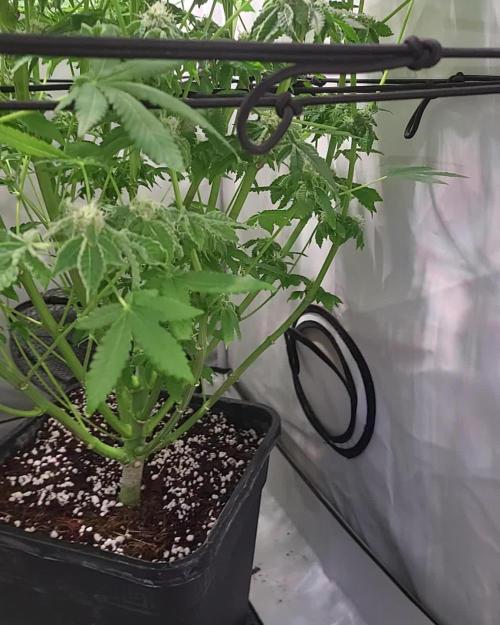
In der sechsten Blütewoche erreichen beide Last Dance-Phänotypen ihren absoluten Höhepunkt – visuell, aromatisch und energetisch. Der erste Phäno zeigt sich in seiner vollen „Black Magic“-Pracht: ultra funky, tief dunkelgrün bis leicht violett schimmernd, mit unglaublich dichten, klebrigen Colas. Das Harzlevel ist enorm – selbst die Fächerblätter glitzern vor Trichomen. Sein Geruch ist intensiv, fast berauschend: eine Mischung aus schwerem Funk, süß-gassigen Noten und einer tiefen, dunklen Würze, die an die Black Magic-Eltern erinnert. Die Struktur ist kräftig und perfekt ausbalanciert, jede Blüte wirkt kompakt und voller Energie.
Der zweite Phänotyp geht klar in die fruchtigere Richtung und zeigt deutliche Einflüsse der Zangria-Eltern. Die Buds sind etwas heller, dafür aber extrem aromatisch – ein süß-tropischer Duft nach Beeren, Trauben und leichter Zitrusfrische steigt bereits beim Vorbeigehen in die Nase. Optisch lässt er sich klar vom ersten Phäno unterscheiden: weniger dunkel, dafür mit leichten pink-lilafarbenen Einschlägen und sehr harmonischer Blütenstruktur. Auch hier ist die Harzproduktion auf Top-Niveau, aber der Gesamteindruck wirkt etwas „leichter“ und verspielter.
Insgesamt ist die sechste Blütewoche ein absolutes Spektakel – der erste Phäno steht für pure Funky-Energie und Tiefe, während der zweite mit fruchtiger, lebendiger Süße glänzt. Beide repräsentieren perfekt die genetische Bandbreite von Last Dance: Power, Charakter und ein unverwechselbarer, komplexer Terpenausdruck.
EN:
In the sixth week of flowering, both Last Dance phenotypes are at their absolute peak – visually, aromatically, and energetically. The first pheno fully embraces its Black Magic heritage: ultra funky, dark green with a slight purple hue, and packed with insanely dense, sticky colas. The resin coverage is off the charts – even the fan leaves sparkle with trichomes. Its aroma is deep and intoxicating: heavy funk, sweet gas, and dark spicy notes that perfectly capture that Black Magic vibe. The structure is strong and balanced, every bud looking compact and full of energy.
The second pheno clearly leans toward the fruitier Zangria side. Its buds are slightly brighter but bursting with aroma – sweet tropical notes of berries, grapes, and a hint of citrus freshness. Visually, it stands apart from the first pheno: less dark, with subtle pinkish-purple tones and a beautifully even flower structure. Resin production is also at its peak, but the overall impression feels lighter, more playful.
Overall, week six is a real show – the first pheno embodies raw funky depth, while the second shines with juicy, fruity sweetness. Together, they capture the full Last Dance spectrum: power, personality, and a truly complex terpene expression.
Likes
17
Share


@Ash4009
Follow
Noticed the purple hues come out more with the use of ice on top of the soil.

Likes
55
Share


@Ultraviolet
Follow
What's in the soil? What's not in the soil would be an easier question to answer. 16-18 DLI @ the minute. +++ as she grows.
Probably not recommended, but to get to where it needs to be, I need to start now.
Vegetative @1400ppm 0.8–1.2 kPa 80–86°F (26.7–30°C) 65–75%, LST Day 10, Fim'd Day 11
CEC (Cation Exchange Capacity):
This is a measure of a soil's ability to hold and exchange positively charged nutrients, like calcium, magnesium, and potassium. Soils with high CEC (more clay and organic matter) have more negative charges that attract and hold these essential nutrients, preventing them from leaching away.
Biochar is highly efficient at increasing cation exchange capacity (CEC) compared to many other amendments. Biochar's high CEC potential stems from its negatively charged functional groups, and studies show it can increase CEC by over 90%. Amendments like compost also increase CEC but are often more prone to rapid biodegradation, which can make biochar's effect more long-lasting. biochar acts as a long-lasting Cation Exchange Capacity (CEC) enhancer because its porous, carbon-rich structure provides sites for nutrients to bind to, effectively improving nutrient retention in soil without relying on the short-term benefits of fresh organic matter like compost or manure. Biochar's stability means these benefits last much longer than those from traditional organic amendments, making it a sustainable way to improve soil fertility, water retention, and structure over time. Needs to be charged first, similar to Coco, or it will immobilize cations, but at a much higher ratio.
a high cation exchange capacity (CEC) results in a high buffer protection, meaning the soil can better resist changes in pH and nutrient availability. This is because a high CEC soil has more negatively charged sites to hold onto essential positively charged nutrients, like calcium and magnesium, and to buffer against acid ions, such as hydrogen.
EC (Electrical Conductivity):
This measures the amount of soluble salts in the soil. High EC levels indicate a high concentration of dissolved salts and can be a sign of potential salinity issues that can harm plants.
The stored cations associated with a medium's cation exchange capacity (CEC) do not directly contribute to a real-time electrical conductivity (EC) reading. A real-time EC measurement reflects only the concentration of free, dissolved salt ions in the water solution within the medium.
98% of a plants nutrients comes directly from the water solution.
2% come directly from soil particles.
CEC is a mediums storage capacity for cations. These stored cations do not contribute to a mediums EC directly.
Electrical Conductivity (EC) does not measure salt ions adsorbed (stored) onto a Cation Exchange Capacity (CEC) site, as EC measures the conductivity of ions in solution within a soil or water sample, not those held on soil particles.
A medium releases stored cations to water by ion exchange, where a new, more desirable ion from the water solution temporarily displaces the stored cation from the medium's surface, a process also seen in plants absorbing nutrients via mass flow. For example, in water softeners, sodium ions are released from resin beads to bond with the medium's surface, displacing calcium and magnesium ions which then enter the water. This same principle applies when plants take up nutrients from the soil solution: the cations are released from the soil particles into the water in response to a concentration equilibrium, and then moved to the root surface via mass flow.
An example of ion exchange within the context of Cation Exchange Capacity (CEC) is a soil particle with a negative charge attracting and holding positively charged nutrient ions, like potassium (K+) or calcium (Ca2+), and then exchanging them for other positive ions present in the soil solution. For instance, a negatively charged clay particle in soil can hold a K+ ion and later release it to a plant's roots when a different cation, such as calcium (Ca2+), is abundant and replaces the potassium. This process of holding and swapping positively charged ions is fundamental to soil fertility, as it provides plants with essential nutrients.
Negative charges on soil particles: Soil particles, particularly clay and organic matter, have negatively charged surfaces due to their chemical structure.
Attraction of cations: These negative charges attract and hold positively charged ions, or cations, such as:
Potassium (K+)
Calcium (Ca2+)
Magnesium (Mg2+)
Sodium (Na+)
Ammonium (NH4+)
Plant roots excrete hydrogen ions (H+) through the action of proton pumps embedded in the root cell membranes, which use ATP (energy) to actively transport H+ ions from inside the root cell into the surrounding soil. This process lowers the pH of the soil, which helps to make certain mineral nutrients, such as iron, more available for uptake by the plant.
Mechanism of H+ Excretion
Proton Pumps: Root cells contain specialized proteins called proton pumps (H+-ATPases) in their cell membranes.
Active Transport: These proton pumps use energy from ATP to actively move H+ ions from the cytoplasm of the root cell into the soil, against their concentration gradient.
Role in pH Regulation: This active excretion of H+ is a major way plants regulate their internal cytoplasmic pH.
Nutrient Availability: The resulting decrease in soil pH makes certain essential mineral nutrients, like iron, more soluble and available for the root cells to absorb.
Ion Exchange: The H+ ions also displace positively charged mineral cations from the soil particles, making them available for uptake.
Iron Uptake: In response to iron deficiency stress, plants enhance H+ excretion and reductant release to lower the pH and convert Fe3+ to the more available form Fe2+. The altered pH can influence the activity and composition of beneficial microbes in the soil. The H+ gradient created by the proton pumps can also be used for other vital cell functions, such as ATP synthesis and the transport of other solutes. The hydrogen ions (H+) excreted during photosynthesis come from the splitting of water molecules. This splitting, called photolysis, occurs in Photosystem II to replace the electrons used in the light-dependent reactions. The released hydrogen ions are then pumped into the thylakoid lumen, creating a proton gradient that drives ATP synthesis.
Plants release hydrogen ions (H+) from their roots into the soil, a process that occurs in conjunction with nutrient uptake and photosynthesis. These H+ ions compete with mineral cations for the negatively charged sites on soil particles, a phenomenon known as cation exchange. By displacing beneficial mineral cations, the excreted H+ ions make these nutrients available for the plant to absorb, which can also lower the soil pH and indirectly affect its Cation Exchange Capacity (CEC) by altering the pool of exchangeable cations in the soil solution.
Plants use proton (H+) exudation, driven by the H+-ATPase enzyme, to release H+ ions into the soil, creating a more acidic rhizosphere, which enhances nutrient availability and influences nutrient cycling processes. This acidification mobilizes insoluble nutrients like iron (Fe) by breaking them down, while also facilitating the activity of beneficial microbes involved in the nutrient cycle. Therefore, H+ exudation is a critical plant strategy for nutrient acquisition and management, allowing plants to improve their access to essential elements from the soil.
A lack of water splitting during photosynthesis can affect iron uptake because the resulting energy imbalance disrupts the plant's ability to produce ATP and NADPH, which are crucial for overall photosynthetic energy conversion and can trigger a deficiency in iron homeostasis pathways. While photosynthesis uses hydrogen ions produced from water splitting for the Calvin cycle, not to create a hydrogen gas deficiency, the overall process is sensitive to nutrient availability, and iron is essential for chloroplast function.
In photosynthesis, water is split to provide electrons to replace those lost in Photosystem II, which is triggered by light absorption. These electrons then travel along a transport chain to generate ATP (energy currency) and NADPH (reducing power). Carbon Fixation: The generated ATP and NADPH are then used to convert carbon dioxide into carbohydrates in the Calvin cycle. Impaired water splitting (via water in or out) breaks the chain reaction of photosynthesis. This leads to an imbalance in ATP and NADPH levels, which disrupts the Calvin cycle and overall energy production in the plant. Plants require a sufficient supply of essential mineral elements like iron for photosynthesis. Iron is vital for chlorophyll formation and plays a crucial role in electron transport within the chloroplasts. The complex relationship between nutrient status and photosynthesis is evident when iron deficiency can be reverted by depleting other micronutrients like manganese. This highlights how nutrient homeostasis influences photosynthetic function. A lack of adequate energy and reducing power from photosynthesis, which is directly linked to water splitting, can trigger complex adaptive responses in the plant's iron uptake and distribution systems.
Plants possess receptors called transceptors that can directly detect specific nutrient concentrations in the soil or within the plant's tissues. These receptors trigger signaling pathways, sometimes involving calcium influx or changes in protein complex activity, that then influence nutrient uptake by the roots. Plants use this information to make long-term adjustments, such as Increasing root biomass to explore more soil for nutrients. Modifying metabolic pathways to make better use of available resources. Adjusting the rate of nutrient transport into the roots. That's why I keep a high EC. Abundance resonates Abundance.
Likes
31
Share


@JeyGanesha
Follow
Gente! Come abbiamo il miele millefiori, mi sono fatto anch'io un estratto setacciato con 20 varietà di ganja differenti..e direi che
HASHISH 1000FLAWER È SPETTACOLARE ,come sapore e, effetto😂🤣😜
Likes
21
Share


@BLAZED
Follow
Week 13 (25-4 to 1-5)
25-4
Temperature: 22.6 degrees (lights on) 18.2 degrees (lights off)
Humidity: 72% (highest) 56% (lowest)
Watering: None.
Strength of the light increased from 80% to 85%.
26-4
Temperature: 23.7 degrees (lights on) 19 degrees (lights off)
Humidity: 70% (highest) 49% (lowest)
Watering: 2000 ml.
No pictures.
27-4
Temperature: 22.9 degrees (lights on) 19.1 degrees (lights off)
Humidity: 70% (highest) 51% (lowest)
Watering: None.
28-4
Temperature: 23.5 degrees (lights on) 20.2 degrees (lights off)
Humidity: 72% (highest) 51% (lowest)
Watering: 1500 ml.
29-4
Temperature: 23.2 degrees (lights on) 19.7 degrees (lights off)
Humidity: 70% (highest) 41% (lowest)
Watering: 1500 ml.
30-4
Temperature: 24.4 degrees (lights on) 19.9 degrees (lights off)
Humidity: 70% (highest) 54% (lowest)
Watering: None.
No pictures.
1-5
Temperature: 25.6 degrees (lights on) 20.9 degrees (lights off)
Humidity: 71% (highest) 49% (lowest)
Watering: None.


Likes
34
Share


@PrairieFrostGrow
Follow
**** Week 12 growth - February 27 to March 5, 2021 - Week 4 Flower *****
These two girls are getting frosty and pheno 1 stacking up beautifully. The second pheno does a funny thing with growing horizontal leaves when happy and not point way up😃
Light intensity increased this week. Pushed up to 525 watts and then to 550 watts at the end of the week. This got the a little hot by the end of the week though. Working with a new light and finding the sweet spots takes a run or two. Learning how the girls grow anyway so the whole run is a lot of learning......its all good😀
Nutrients were pushed a little at the end of last week and the start of this week so backing off a bit more again. Given that they were pushed with light intensity they started showing some signs of nutrient issues. It’s good though as there is reaction time and back off to plain water feed for a couple of days at the end of the week and into week 5. Week 5 is going to be the start of the last stage of flower feed and work with that for two weeks, then stop feeding at the end of week 6........the plan so far anyway. Mimosa is longer strain though so they may get another week.👍
Little more detail.......
Feb 27/21 - Day 22
- big feed day
- all IPP line plus silica @ 1ml, CalMag @ 1ml, Rezin @ 1.5ml, enzymes @ 1.5ml
- 1650ppm and 6.1pH
- 4L for MM1 and 3L for MM2
- MM2 grows some horizontal leaves at the top.
- MM1 is swelling and getting frost now!!💪😎
Feb 28/21 - Day23
- Microbe day but also added some CalMag
- 3L for MM1 and 2L for MM2
- Natures Candy @ 1.5ml, Recharge @ 1/2 tsp/gal, Magnifical @ 1.5ml, Micro @ 1ml, Bloom 1.5ml, Terpinator @ 2ml
- 950 ppm and 6.0pH
- leaf colour almost looks light today.
Mar 1/21 - Day 24
- dry out day.
Mar 2/21 - Day 25
- plain water
- 300ppm and 6.1 pH
- 4L in MM1 and 3L in MM2
- light power pushed up to 550 watts today.
- (too much from 16” to 20”........note!!)
Mar 3/21 - Day 26
- plain water with two suppliiments
- 4L for MM2 and 2.5L for MM2.
- Terpinator @ 3ml, Rezin @ 2ml.
- 525ppm & 6.0pH
- stripped some leaves today......sticky in the middle😃😃👍👍
Mar 4/21 - Day 27
- no water added today
- light power reduced today 450 watts.
- been going too hard with intensity. Seeing leaf curl on other girls in the tent.
- MM2 is showing light stress or Potassium deficiency.....related to CalMag??
- joys of diagnosing cannabis😂
- starting with backing off light and reduce ppm going in but not the ml👍
Mar 5/21 - Day 28
- hit with microbes again to help with stresses.
- recharge @ 1 tsp/gal, Nature’s Candy @ 1.5ml
- 375ppm and 6.0pH
- 3L for MM1 and 2.5L for MM2
Moving right along we are through 4 weeks now and moving past the middle of flower.


Likes
7
Share


@Nikkov
Follow
Well, as it's been 8 full weeks now it's time to change to flora, today the 24th of July 2023 I'm changing the time from vega to flora so they will take 12 hours of light and 12 hours of darkness thus starting the flowering phase, today I should have watered with top bloom from top crop but it ended up that I watered only with water and I'll wait for the next watering I'll already water with top bloom from top crop and let's see what these beautiful girls do, I was going to leave another time in vega another two weeks apparently i'm going to move so i don't know if i'm going to have much time left in this house so i'm going to take advantage of the time i have and already putting them to bloom
Likes
21
Share


@Jungle_James_Grows
Follow
Trichomes all cloudy and very frosty but not any amber's yet
17/1 chopped her today, she has been in the dark for 24 hours.
She smells amazing
Likes
81
Share

@BudVision
Follow
Hi growers,
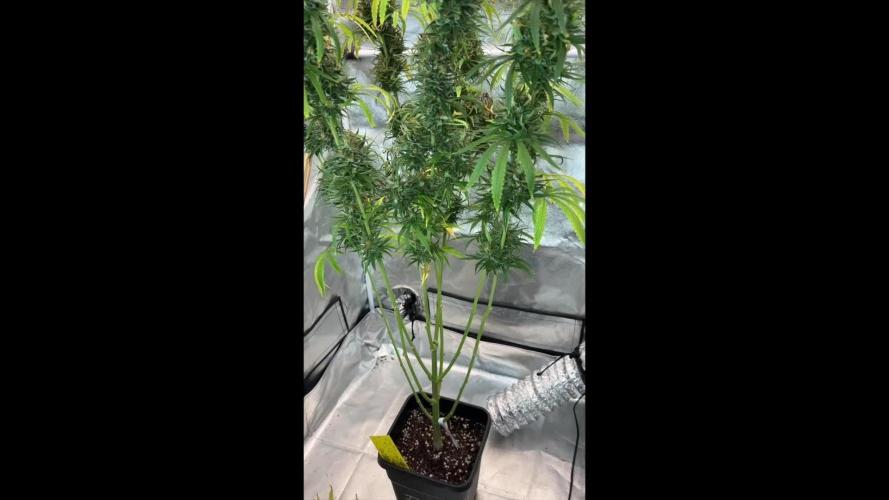
The pistils are slowly turning brown, while the buds continue to swell and pack on size every day.
This week I'll finally take out the microscope and start checking the trichomes to see how close she is to the perfect harvest window. She's still looking great, so now it's all about patience.
------------------------------------------------------------------------------------------------------------------------------------------------
Pestíky pomalu hnědnou a palice se každým dnem dál nalévají a zvětšují.
Tenhle týden konečně vytáhnu mikroskop a začnu kontrolovat trichomy, abych zjistil, jak blízko je ideálnímu termínu sklizně. Rostlina stále vypadá skvěle, takže teď už je to hlavně o trpělivosti.
Peace and happy growing! ✌️

Processing
Likes
29
Share


@Damonkey
Follow
So starting the 3rd week of flower. All but one plant speeding ahead towards dank. The lights below LED continue at a fast pace, I think it’s the most pistils I’ve seen firing out all over place this early. However one of the OS below the HPS isn’t feeling this groove and is developing at a slower rate. The plants that are being hit by both lights are gonna be fat!!!!! The forming buds are coming together quickly and big, they look swollen before they’ve swollen if ya know what I mean.🤔😂 I love week 3 of flower its where I always hit my plants with Hydrotops Triple F. It’s not a new product I’m using however I am using it in conjunction with two of their other products this time which is supposed to be the ideal way to benefit the plants when using Triple F. Development has seemed quicker during this grow especially from the period of switching the light cycle up to now. I’m happy. Temperature still a problem though a bit.
Looking awesome going through week 3. But one plant is so much slower than the rest, I think she stretched a little too much when it was time. It still looks very strong and is covered with flower sites but they’re just not developing at a rate anything like her sisters flowers. The phantom OG in there with them are super fast. Maybe that’s making the Orange seem slower to me too🤔😂 all looking great in there anyway and am loving every moment I get to get in there with my girls.
Very productive 3rd week 3 out of 4 growing at an accelerated rate, the 4th is looking fine too, well looking great actually but a lot slower with flower development.