






Processing
Likes
13
Share


@ifcvv
Follow
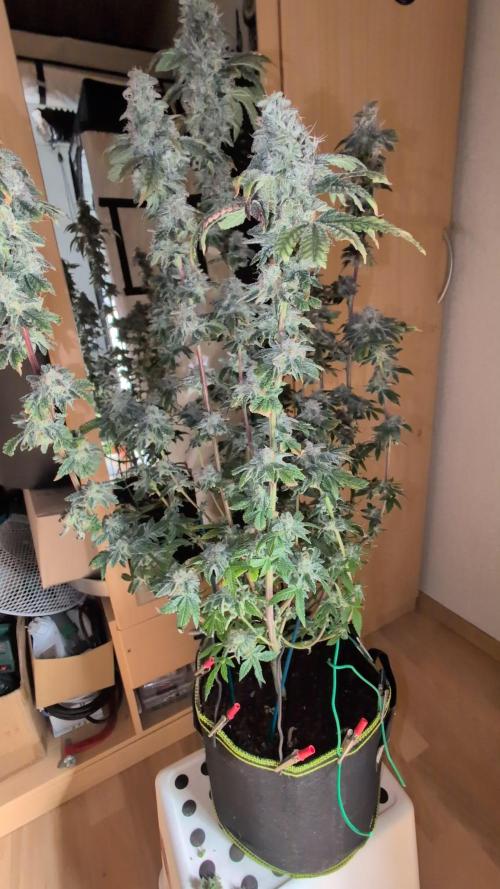
Segunda semana de periodo de floración, aplicando un período de luz de 12-12 horas, esta semana se ha regado con terra max y terra leaves de atami (2.5ml x fert) un fertilizante de floración y otro de crecimiento , cabe destacar que empiezan a estirarse estas bellezas y empezaron a salir pistilos indicios de que están entrando en floración, me ha costado un poquito mantener la humedad baja, ya que últimamente en mi país ha llovido mucho, se nota que se estiraron un poquito y están más grandes y el olor esta aumentando.😄
Me gustaría saber en los comentarios sobre alguna recomendación para bajar la humedad cuando hay ,mucha humedad en la zona
tengo un extractor centrifugo de 790m3/h y un intractor de 200 m3/h

Processing
Likes
3
Share


@Therbalist
Follow
Getting bushy now couple have shown sex. Going quite well just a few caterpillars around the garden occasionally. Hopefully have most in greenhouses before flowering starts properly.
Likes
25
Share


@Ultraviolet
Follow
Started giving the girls 1 hour a night at sub 60. By end of week it's up to 2 but will not exceed this.
Added top dressings of azomite, sea kelp and greensand.
Phi=1.618
The ratio or proportion, determined by Phi (1.618 …) was known to the Greeks as the “dividing a line in the extreme and mean ratio” and to Renaissance artists as the “Divine Proportion” It is also called the Golden Section, Golden Ratio and the Golden Mean.
e = 2.718
The “e” symbol in maths represents Euler’s number which is approximately equal to 2.718 It is considered as one of the most important numbers in mathematics. It is an irrational number and it cannot be represented as a simple fraction.
THORIUM Thorium, at atomic number 90, is one of the rarest elements.
232Th is a primordial nuclide, having existed in its current form for over ten billion years; it was formed during the r-process, which probably occurs in supernovae and neutron star mergers. These violent events scattered it across the galaxy. The letter "r" stands for "rapid neutron capture", and occurs in core-collapse supernovae, where heavy seed nuclei such as 56Fe rapidly capture neutrons, running up against the neutron drip line, as neutrons are captured much faster than the resulting nuclides can beta decay back toward stability. Neutron capture is the only way for stars to synthesize elements beyond iron because of the increased Coulomb barriers that make interactions between charged particles difficult at high atomic numbers and the fact that fusion beyond 56Fe is endothermic. Because of the abrupt loss of stability past 209Bi, the r-process is the only process of stellar nucleosynthesis that can create thorium and uranium; all other processes are too slow and the intermediate nuclei alpha decay before they capture enough neutrons to reach these elements.
Histogram of estimated abundances of the 83 primordial elements in the Solar system
Estimated abundances of the 83 primordial elements in the Solar system, plotted on a logarithmic scale. Thorium, at atomic number 90, is one of the rarest elements.
In the universe, thorium is among the rarest of the primordial elements, because it is one of the two elements that can be produced only in the r-process (the other being uranium).
POTASSIUM
Potassium 40 is a radioisotope that can be found in trace amounts in natural potassium, is at the origin of more than half of the human body activity: undergoing between 4 and 5,000 decays every second for an 80kg man. Along with uranium and thorium, potassium contributes to the natural radioactivity of rocks and hence to the Earth heat.
This isotope makes up one ten-thousandth of the potassium found naturally. In terms of atomic weight, it is located between two more stable and far more abundant isotopes (potassium 39 and potassium 41) that make up 93.25% and 6.73% of the Earth total potassium supply respectively. With a half-life of 1,251 billion years, potassium 40 existed in the remnants of dead stars whose agglomeration has led to the Solar System with its planets. Potassium 40 has the unusual property of decaying into two different nuclei: in 89% of cases beta-negative decay will lead to calcium 40, while 11% of the time argon 40 will be formed by electron capture followed by gamma emission at an energy of 1.46 MeV.
This 1.46 MeV gamma ray is important, as it allows us to identify when potassium 40 decays. The beta electrons leading to calcium, however, are not accompanied by gamma rays, have no characteristic energies and rarely make it out of the rocks or bodies that contain potassium 40.
Beta-minus decay indicates a nucleus with too many neutrons, electron capture a nucleus with too many protons. How can potassium 40 simultaneously have too many of both? The answer reveals one of the peculiarities of the nuclear forces.
Everyone has roughly 140g of potassium = 0.016 grams of Potassium 40 = 5.643ounces
The charge radius is a fundamental property of the atomic nucleus. Although it globally scales with the nuclear mass as A1/3, the nuclear charge radius also exhibits appreciable isotopic variations that are the result of complex interactions between protons and neutrons. Indeed, charge radii reflect various nuclear structure phenomena such as halo structures6, shape staggering7, shape coexistence8, pairing correlations9,10, neutron skins11, and the occurrence of nuclear magic numbers5,12,13. The term ‘magic number’ refers to the number of protons or neutrons corresponding to completely filled shells. In charge radii, a shell closure is observed as a sudden increase in the charge radius of the isotope just beyond magic shell closure, as seen, for example, at the well-known magic numbers N = 28, 50, 82 and 126 (refs. 5,12–14). In the nuclear mass region near potassium, the isotopes with proton number Z ≈ 20 and neutron number N = 32 are proposed to be magic on the basis of an observed sudden decrease in their binding energy beyond N = 32 (refs. 2,3) and the high excitation energy of the first excited state in 52Ca (ref. 1). Therefore, the experimentally observed a strong increase in the charge radii of calcium4 and potassium5 isotopes between N = 28 and N = 32, and in particular the large radius of 51K and 52Ca (both having 32 neutrons), have attracted substantial attention.
https://www.nature.com/articles/s41567-020-01136-5.pdf
“A cat has 9 lives”
“On cloud 9”
“Dressed to the nines”
To go “the whole nine yards”
“A stitch in time saves nine”
“Nine-ness” seems to be synonymous with the maximum, with the furthest extent of what’s possible. With fullness, completion, and when every effort has been exhausted.
In the ancient world (which is, let’s face it, is where numbers and their spiritual power were understood SO much more than they are today) the number 9 resonated with sacred structure, and the furthest limitations of this world, before human experience meets the Divine. Perhaps more than any other, the number nine had an extra special significance, which spread far and wide. It features across pretty much all cultures, worldwide, rippling through culture, mythology, history, law and time.
Nine is the central number in the ancient Celtic tradition.
Nine expresses through the triple Goddess (see Number 3) and in myths of the nine Celtic maidens, or sorceresses. In fact, stories of nine mystical women presiding over nature spread from England, Ireland and Wales, to Scandinavia, Iceland and even as far as Kenya. Even today, it’s tradition for nine groups of nine men to dance around Beltane fires. The limit of winter (which is what Beltane
Almost all of the mythological tales from around the world have patterns of the number 9 weaving throughout.
The Northern European sagas tell of Odin, who rules over the nine Norse worlds. His trial, to win the secrets of wisdom for mankind, was to hang on the Yggdrasil tree for nine days.
Demeter, the Greek Goddess of the Earth searched for nine days for her daughter Persephone (who was in the underworld with Hades). Demeter is often depicted holding nine pieces of corn. Once recovered, Persephone was obliged to spend three months per year below the ground, and nine months above.
Native American, Mayan and Aztec myths tell of a total of nine cosmic levels (and many of the temples comprise 9 stories).
And in ancient China, nine was the most auspicious number of divine power: the Chinese had nine sacred rites, nine social laws, nine classes of officials in the government and built nine-story pagodas.
In astrology, the planet Mars vibrates to the frequency of the nine.
The ninth sign of the Zodiac is Sagittarius (where the Sun sails from November 22nd – December 21st)
In Tarot, card number nine is the Hermit.
In Hinduism, nine is the number of Brahma.
In the Greek Sagas, the city of Troy was under siege for nine years.


Likes
19
Share


@Chubbs
Follow
420 Fastbuds
FBT2306 Week 5
These two have gone into flower absolutely amazing. The flower sites are showing up beautifully. Over all haven't done much on these besides giving another defoliation and lollipoped them taking off the lower nodes. Should allow them plenty of light through flower and air to prevent moisture build up at pot level. All in all Happy Growing

Likes
5
Share


@Smokeitup091191
Follow
Ztrawberries= as you can see from the pic and video these girls are skyrocketing climbing almost an inch a day. Showing good signs of pre flower, very impressed with dominant heads coming through on all these ladies 👌🏽
Tropicana cookies = These girls are just showing off there stretch rate match that of the ztrawberries and it’s and impressive spectacle to watch also showing good signs of pre flower
Cherry Cola = These girls seem a week slower than the rest none of the less they are showing a decent amount of heads just no signs of any stretch.
O.N = Ztrawberries and Tropicana Cookies have had some defoliation not really touched Cherry Cola so I don’t cause any unnecessary stress. EC increased from 1.1 to 1.3. Very happy this week!!
Processing
Likes
17
Share


@kcartel
Follow
For the first time I cut the leaves, for more extensive illumination of the upper part, due to the close location of the light of the plant, the trunk trunk grows and does not stretch upwards, I want to cover the entire area of ??the pot with one layer then start the flowering stage at 6-7 weeks I didn’t cut the leaves, but simply pressed them to the ground, since this is my first experience, I think that everything is going well, the plant eats a lot of nutrient fertilizers and looks good as you can see, the temperature in the box exceeds 27 degrees and it seems to her that temper tsya. in many of the moments, I would like to express a special thanks to such a cool grower like ctm_dzagi! Looking at his works of past cycles, I learned a lot and continue to learn, his technique and approach is great! Well, we are waiting for the fifth week)) Let's go!
Likes
6
Share


@Kendoda
Follow
I’ll be reducing each nutrient by 0.5ml from last weeks total, as there’s nute burn on most leaf Tips.
The funky aroma coming from this girl this evening is just amazing, her layers are sweet and gassy. There’s almost like a sickly rubber smell to her . She’s got it going on. Wow!

Likes
16
Share


@AestheticGenetix
Follow
This strain may be as frosty as my RS11 s1 seed I ran earlier this year. The smell is almost berry like. It's very complex. It's like berrys with pepper and back end sour gas. Bud are pretty dense despite the small size.
Gave her a tea of bloom and bloom booster. Just mixed directly into water and poured on top of soil
She's losing leaves because I didn't feed enough nitrogen in early flower. But at this point there's not much I can do.
Check out my YouTube for more consistent updates with behind the scenes that I can't post on here. Such as cloning tutorials and how I feed and trim etc
YouTube.com @aestheticgenetix

Likes
6
Share

@UnitedStrainsGermany
Follow
Sie tötet nur beim Anschauen richtige Killer genetic WOW und nur in COCO, absolutely nicely!!!!!

Likes
3
Share


@PhinolaGreen
Follow
7. Woche
Es geht voran mit ihr, ich habe vorhin mal den Stamm gemessen, 15mm ist schon ordentlich. Ich habe auch sämtliche Düngerpläne verworfen xD Ich pump die einfach voll, weil scheinbar können die das vertragen. Ich habe schon bei Bekannten immer wieder Methoden wie Crop-Steering gesehen, lässt sich auf Soil natürlich schwer umsetzen aber ich kann zumindest das Intervall anpassen. Statt alle 7 Tage, gibt es jetzt alle 3 Tage, weil die in den Airpots auch einfach so gierig werden hehe 🤤😌
Likes
1
Share


@PalmaGrow
Follow
29 - 4 noviembre
Crecimiento regular sin ninguna poda y libremente
31/10 se realiza riego nutricional con fotohormona y fertilizante orgánico NPK h micro elementos

Likes
31
Share


@AccidentalB
Follow
PAR 450 PPFD
It's all about creating new branches during these weeks of vegetation and LST for me is the best way to achieve that. More branches means more Green Gelato cones at the end of my grow. I try to create about 20 per plant at the end of vegetation.

Likes
31
Share


@MxGrow
Follow
Feliz por como van mis gorilas, todos los días hay cambios y cada semana tengo que aumentar el riego, esta semana utilice en total 18 litros, 4.5 litros para cada planta aproximadamente.
En los primeros 6 litros uso:
▪️︎4ml de Connoisseur A y B por litro de agua.
▪️︎2ml de Rhino por litro de agua.
▪️︎2ml de Bud Candy por litro de agua.
▪️︎2ml de Carboload por litro de agua.
▪️︎2ml de B-52 por litro de agua.
Espero 30 minutos y despues aplico otros 6 litros con los siguientes nutrientes:
▪️︎4ml de Connoisseur A y B por litro de agua.
▪️︎2ml de Nirvana por litro de agua.
▪️︎2ml de Big Bud por litro de agua.
▪️︎2ml de Overdrive por litro de agua.
▪️︎2ml de Voodo Juice por litro de agua.
No tengo medidor de EC, por lo tanto trato de que las mediciones en ml sean exactos con una jeringa.
☆ 1 día a la semana riego las plantas con 6 litros de agua sin nutrientes y con un PH en 6.0, hasta el momento no han presentado carencias pero tengo la duda si tienen exceso de nitrógeno por el color verde intenso de las hojas.


