


Likes
Comments
Share


@SwissKush
Follow
Week 14, Flowering week 9, flush week 2
The ladies are almost ready to harvest! We are going for the long haul here!!
The DWC has about 6 litres of mineral water left in it, will let plant drink all.
Indica phenotype plant is about 10% covered in amber trichomes, the rest are milky white.
Sativa phenotype plant is abput 90% milky and 10% amber also.
The light schedule will remain 12/12, with 48 hours of darkness before harvest.
Harvest will likely happen this week, checking trichomes every morning while dark.
Day 92 - resin explosion from 12/12 lighting
a. I remove a few large fan leaves here and there that are drying up.
b. the plants are eating all the nutrients from the leaves
c. some of the small lower tiny buds I make bain marie qwiso, tastes incredible.
Day 93 - getting very close, they are stinking soooo loudly
a. the trichomes are at 15-20% amber on the Indica Phenotype and 10% on the Sativa phenotype
b. all trichomes are milky, rarely see a clear
Day 94 - need to harvest tomorrow
a. its time, the DWC is nearly empty, the ladies have been in the dark, the hash I make is banging, time to harvest.
Day 95 - Harvest
Will create harvest week when buds are all dry

Likes
13
Share


@KannaGrowing
Follow
Ha llegado la hora de empezar a fertilizar nuestras plantas.
Lo haremos con la gama de productos BIO de JUJU Royal by BioBizz, y siguiendo la guía de dosificaciones.
También trataremos con una solución de Propolix foliar, a modo preventivo de plagas en dosificación 2mlx1L de agua.
Continuamos con la potencia de las dos luminarias al 50% y el control de temperatura y humedad.

Likes
Comments
Share



Likes
62
Share


@BodyByVio
Follow
Easy strain to grow, tolerant a high ppm.
Very good smoke. Buds are not very dense.

Likes
2
Share

@EdwardsBe
Follow
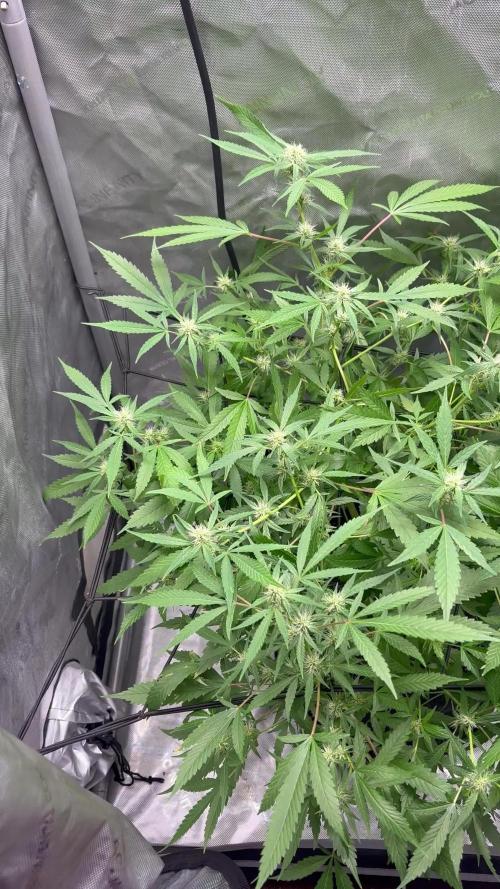
Broke down and purchased a 20 Liter Pelonis Dehumidifier from Menards. Works like a charm and the app allows for control on the go. I had a day that I didn’t make it home and I missed a watering. The lady was not happy. Removed the dead or dying leaves.
Likes
43
Share


@Bones_1986
Follow
Drinking 1.7 liters every 2/3 days like clockwork. Grown 5inch in 3 days. Let the stretching commence
Likes
2
Share

@PhinolaGreen
Follow
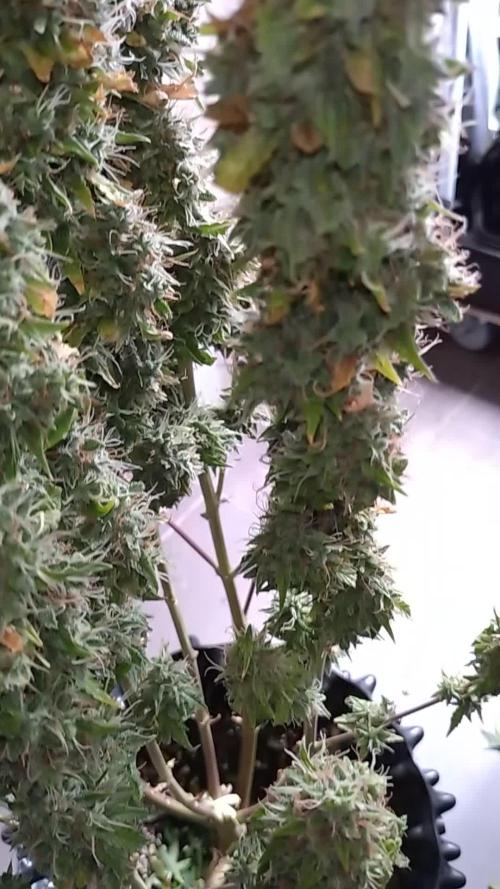
Ich habe mich dazu entschieden sie heute schon zu Ernten. Ich fand der richtige Zeitpunkt wäre gekommen und jetzt hängt sie zum Trocknen 😁

Likes
14
Share


@JUNGLE_B4RNS
Follow
The Sensi Seeds Research breeding project has created eleven cannabis seed varieties.
How? By combining new cannabis cultivars with a selection of strains from their long-established cannabis gene bank. For the first time in thirty-six years, they are opening the doors of the Sensi Seeds Research and Development Department.
Week #4
I have let the plants grown their 4th node and have topped them all at the 3rd node during the week. All the plants responded well and started to grow 2 tops. All the genetics looks good with no shitty weird plants. Every plants are in "V" and excited to grow.
The light coverage of the Mars-Hydro SP250 is good enough to leave them another week without adding more light. Using only 245w for the lightning during 5 weeks is very economic 👍
Last week feeding has been done in time, everyone is green lush. No need to add any nootz this week, just giving plain pH’d water.
(I’m looking for a job in the Cannabis industry as Master Grower, Mineralogist, Quality Control)

Processing
Likes
36
Share


@starke
Follow
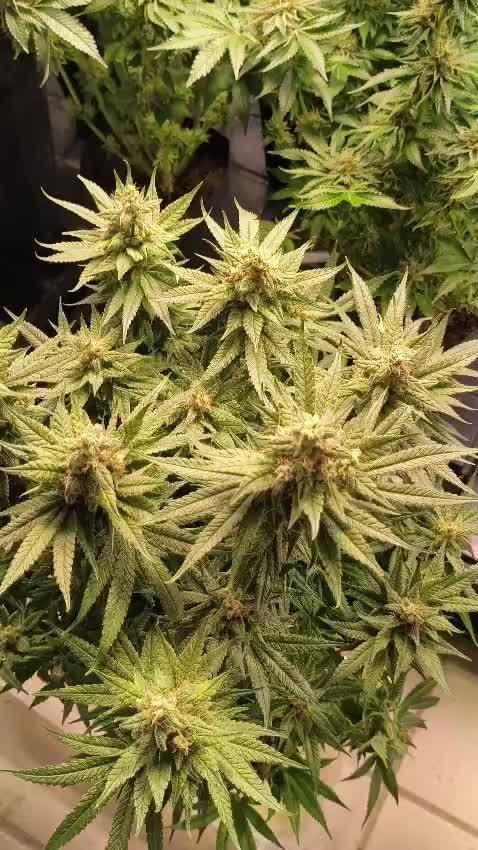
Week 13/4 of Flower and defoliation time yeay ✌️
Day 92/22 watered 2,5l with 2ml grow and 1ml topmax heaven and bloom. looking good. stretching still. supercropping visible yeay. lots of tops. 😍I could not hold myself back and had to defoliate her bushy under growth. So much bottom growth, small popcorn quality, not wanted, bye bye. She is 9 days into proper flower at this point. I didn't think she would stretch too much, no matter the light issue, since she grew rather wide than in height. I'm hopeful all is good.
Day 94/24 all good on the top department, but she seems to have successfully used up all the available soil space. ay, so happy there is always something. I should've known and note to myself: DONT VEG TOO LONG WITH TOO SMALL OF A POT. this could/will lead to more waterings more often. poor thing and me.
Day 96/26 did I water her in last days? dont know... mmh. shes dry. watering 3l with 1ml grow, 2ml bloom, 1ml topmax, 1ml each activera, algamic and heaven. def. some more. removed bigger leaves.
While checking on root growth on both clones, one did not make it, but the other is happy and potted. Took 2 more at defoliation time, this is addicting 😋



Processing
Likes
10
Share


@GloHoodlum
Follow
Missed a day of watering but still looking like they are building proper buds first indoor grow I'd say is going good so far should be starting to flush my mid week on the black domina x Scott's og supposed to be a 7-9 week flowering time but not positive on when to start flush with Coco coir. Remo claims 7 days so I guess we shall see how it looks beginning of week 8.


Likes
11
Share


@DESERT_DANK_FLAVER
Follow
ENDING WEEK 4, THEY SEEM TO BE HAPPY. QUESTION? WHEN SHOULD I TOP THESE GIRLS. ?


Likes
12
Share


@Archieballs
Follow
Honestly this plant is my most exciting one!!! She’s a stunner and sticky and I just love her!!! She’s been super easy to grow and no signs of anything going wrong!!
Likes
3
Share


@TheSloth
Follow
The bud is not too big, i whait if fatte, i think she give much stress from cold weather because there is 14° c in the night
At day 58 i watering for 5 days, about another 5 days watering i harvest the taison Auto

Likes
2
Share


@RFarm21
Follow
18/12 - Harvest Day!
One is very big and the otther is a miniature...i would love to master this One day 🤣

Likes
11
Share


@4_Pro2Bono_0
Follow
Week 3 Veg. These ladies are looking heathy as can be, Very satisfied with the genetics so far!

Likes
23
Share


@BedroomGrower
Follow
March 17, Day 76: As written I collected the last three plants. At the moment I got a partial of 224 grams from the first three plants and I think of doubling with the last three. Among the latter is the plant with the largest bud which obviously becomes my favorite. This time I managed to take photographs of the plants before cutting them.
With these last three plants I got the most productive plant, the one with the largest bud and the one with the longest bud 😉
For a final report on this strain: The Gorilla by RQS is an excellent strain for anyone who loves a high THC content and I particularly recommend it to growers who pass for the first time from photoiperiods to autoflowering. You will grow very large and very productive plants very similar to photoperiodic ones. This strain branches out a lot and must be defoliated and de-branched. You can grow it well with the SCROG technique, but if like me you have no space problems you can also use the Sea Of Green technique.
In conclusion I want to thank all the growers who have followed this my first diary to which I have a happy growth! A big thanks also to GrowDiaries and to the whole team for having created the best social network dedicated to the world of growers 👏💪😉
March 24 Final Report: Hi growers, with this last post I'm going to close my first diary. First I have to say that I am very satisfied with the total harvest, from the last three plants I got 369 grams which added to the 224 of the previous harvest make a total of 593 grams. I started this diary with 8 Gorillas and 2 Cheese. 6 Gorillas completed their cycle in the same time frame, the 2 remaining gorillas showed a photoperiodic genetic predominance, one of them is in an advanced flowering phase while the last one after three months still shows only a few pistils. I'll probably kill her, and move on by putting new seeds in the soil. Unfortunately, where I live is illegal to grow marijuana, otherwise I would have simply moved outdoors, but I can't and must be ruthless. Regarding the two cheeses there is not much left at the end of their cycle and I started to give only water to one of the two plants.
Good and happy growth to all! 😜
Processing
Likes
120
Share


@CBD_Sweden
Follow
Hi all the happy people here in GrowDiaries.
This is my second cultivation ever and it will be fun to try a bigger space than my closet grows
First, I'm just going to say I'm done with the construction of my new growroom.
I put some pictures on the construction here in week one.
The room is 2.14 meters by 1.7 meters and has a ceiling height of 2 meters.
It provides a floor area of 3.6 square meters.
I use a 54 Watt Lightwawe T5 for germination and 2 Pcs 400 Watt HPS lamps.
I have a channel fan that replaces the room air about 40 times an hour to get a comfortable theme in the room, the air enters a fresh air intake from the outside.
The air is purified through a carbon filter to then leave the room to the rest of the basement.
Then I use that heat to heat the rest of the basement.
I will use 8 pcs 15 liter Autopots to grow with and a 100 liter water tank that supplies the pots of water and nutrition.
I will grow completely organically in soil and will watercure my buds to get the best possible medicine for me.
But there are no cultivation rooms to be displayed here, so I continue with what is most important.
Today I have put my seeds in my moisture dome and hope the seeds have germinated within a few days.
I am very excited to see how the new growroom will work and how this CBD Fast Eddy plant from Royal queen seeds will turn out.
CBD Fast Eddy Automatic is combining Cheese x Juanita la Lagrimosa x Ruderalis, Fast Eddy is a rapid growing, flavourful, and CBD-rich auto strain that goes from seed to harvest in 8-9 weeks, produce generous yields, and induce a clear, mellow, and most importantly, functional high.
THC: 9%
CBD: High
Yield Indoor : 400 - 450 gr/m2
Yield Outdoor: 80 - 130 gr/plant
Height Indoor: 60 - 100 cm
Height Outdoor: 80 - 120 cm
Flowering: 6 - 7 weeks
Harvest month: 8-9 weeks after sprouting
Genetic Background: Cheese x Juanita la Lagrimosa x Ruderalis
Type: Sa 50% In 40% Ru 10%
Effect: Clear, Painrelief
Climate: Mild
..............................................................................................................................................................................................................................................................................................................................................
Update 2017-08-15. Both seeds have germinated and planted in small pots inside the humidity dome.
I'm so glad it worked so well and now it's just hoping they'll start growing and become 2 big healthy girls :)
...............................................................................................................................................................................................................................................................................................................................................
Update 2017-08-16. I have mixed my own soil today. Its 40% sieved peat harrow H2-H4 0-30 mm, 45% sieved peat harrow H4-H6 0-30 mm. 5% sand and 10% of compost soil. And i use 15% of perlite and mix it all together.
...............................................................................................................................................................................................................................................................................................................................................
Update 2017-08-20. These girls are much slower to germinate and to start growing than the other 6 girls I started at the same time.
One of the germinated seeds split in half, so I had to take a new seed and germinate it. It took 2 days.
It was just a smal taproots after germination with this strain as opposed to my Fastbuds cbd.
But I hope everything goes well from now and that they live up to their name, Fast Eddy.
................................................................................................................................................................................................................................................................................................................................................
Update 2017-08-21. New pics.
................................................................................................................................................................................................................................................................................................................................................
2017-08-22. Nr1 dident make it and died. Started germinate a new seed to get another Nr1.
..............................................................................................................................................................................................................................................................................................
2017-08-27. Nr 1 is in a small pot in humidity dome and i hope shes going to break the surface soon. Nr 2 is slow but doing fine.
---------------------------------------------------------------------------------------------------------------------------------------------------------------------------------------
2017-08-28. Nr2 is transplanted in 15 liter autopot.
---------------------------------------------------------------------------------------------------------------------------------------------------------------------
2017-08-29. New movie of the girls Nr2. Its no water for 3 days now so the roots develop more and match the plant above the soil. The temp controlled fan is awesome, its easy to set what temp you like to have in the room. Right now its 28 celcius. And humidity is 56%.
-----------------------------------------------------------------------------------------------------------------------------------------------------------------------------------------------
2017-08-29.
Hello to you who read my diary, I just want to say that I am pleased that you have chosen to check in with me and in my diary.
I just want to say that I do this for myself and for a steady flow of my medicine.
Everything you read and see in my diary is 100% honest and I will never distort or beautify anything here.
I document my crops so that I can learn from my mistakes and also to look back at those different crops.
I try to update with pictures every day and with text if something special has happened in the garden.
This is my strainhunt for the best medicine and the beginning of my journey with cannabis and the cultivation of it.
-----------------------------------------------------------------------------------------------------------------------------------------------------------------------
2017-08-30. Cleaned the room this morning, just vacuuming and cleaning with chlorine solution. Im testing the fan to control temp and humidity, it works great.
Added a movie. Everything is looking great right now.
------------------------------------------------------------------------------------------------------------------------------------------------------------------------
2017-08-31. 3 New pics.
------------------------------------------------------------------------------------------------------------------------
2017-09-01. New pics and a video of the grow room from today.
----------------------------------------------------------------------------------------------------------------------
2017-09-04. Week 2 starts now, new pics.
--------------------------------------------------------------------------
2017-09-05. KL 08.00. Cleaned the room this morning, just vacuuming and cleaning with chlorine solution.
KL 12.00. The girl got 2 liters of water with nutes in it, added a video.
-------------------------------------------------------------------------------------
2017-09-06. KL 08.00. The girls woke up after their beauty sleep, the leaves are always a bit down after 6 h of darkness, but they will stretch now when the HPS lamp starts.
Everything looks good and I keep trying to tuck the leaves so they get the maximum amount of light where needed. Added pics and video.
--------------------------------------------------------------------------------------------------------------------------------------------------------------------------------------------
2017-09-07. Day 17 from sprouting. I have never tested PH in my grows, when growing organic in soil iv learned that it adapt PH by it self. But im curious by nature so i had to test.
Kl 10.00 Tested PH in the soil, it was 6.9 and tested my tap water and it was 6.8. Added video of the girl.
Kl 22.30. New pics.
-----------------------------------------------------------------------------------------------------------
2017-09-08 KL 08.00. Good morning, added new video.
2017-09-08. Kl 23.50. Gave every girl 3 liters of water and nutes, added new video.
-----------------------------------------------------------------------------------------
2017-09-09. Kl 21.00. Defoliated a lot and added pics.
------------------------------------------------------------------------------------
2017-09-10. Kl 08.00. Last day of week 2. New video.
2017-09-10. Kl 23.00. 3 new videos.
--------------------------------------------------------------------------------------------------
Likes
4
Share

@AestheticGenetix
Follow
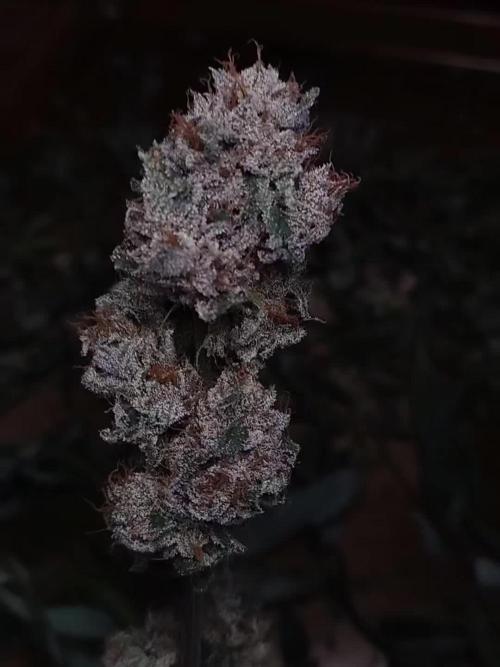
About 4 days of drying as of today. She has a nice grape and kush smell to her
