


Processing
Likes
Comments
Share


@BlumenBot
Follow
1/4 - start of week 5, the broken branch isn't looking good. I installed the 5 arm light which is my biggest light for the veg compartment. 500ppfd right now, drop it 1 inch and I'm just a bit over 600 at canopy level. I'm hoping to get her to recover and ill bend the 2 remaining branches towards each other to fill the gap for a 3 arm lady, still planning to top but now will get 6, 12, and 24 tops...hopefully
1/5 - slight training day, I bound the 3 branches so that they were more uniform and evenly spaced out in the pot. I'll let her take shape a few days with the restraints and the. Top her maybe Friday.
1/7 - she got her topping. I'm leaving 2 nodes on each branch for a total of 12 tops right now. She will get one more topping before its all over for a total of 24 tops, probably 2 weeks out on that. Feeding in the next day or 2.
Update: dropped the fan speed to 2 for temp and humidity testing.
1/9 - RAW Feeding tonight, she is starting to recover well from the topping, I now have 15 or so tops with one of the 3 arms splitting into 7 tops rather than 4. I think I will leave her this way to veg out to the height I need without further topping. I’m planning on training the shoots out to the sides so many more tops may develop as new nodes come through. I’m just really hoping she doesn’t start to flower on me early!!
2L distilled water
3g Grow
2g Kelp
0.57g Cal/Mag
2g Microbes Grow Stage
0.63g Amino Acids
0.14g Enzymes
6.0ph
66.9*F
1060ppm
Also found a new way to mix my RAW nutrients without having them stick to the bottom...small landscaping pond pump! It gets the water moving nicely and I just drop the dry nutes in, mixes it for me and I can easily fine tune PH and test PPM without having to shake and take samples! Huge win.
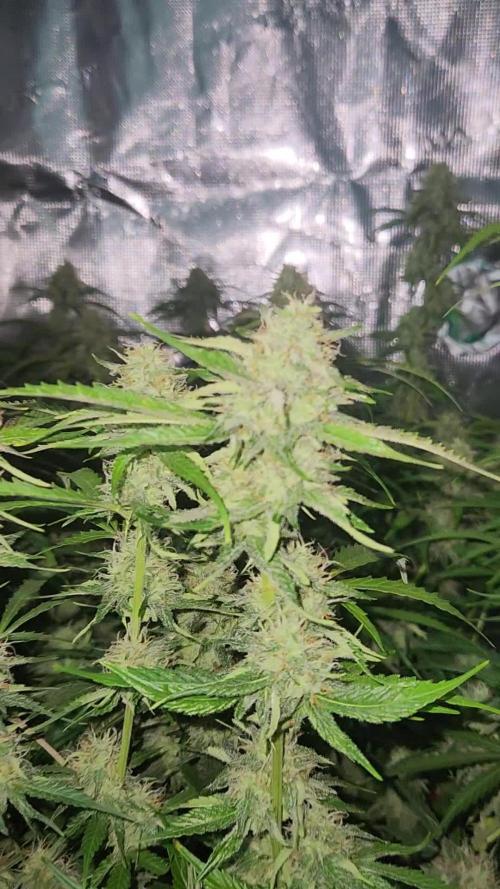
1/10 - Another week in the books. Did some fan leaf tucking so the tops had direct light. I'm still trying to grow her sideways so I'm thinking a solid 3 or 4 more weeks of veg. Things should speed up now though. I dont think I will be topping again but we shall see. Topping again would guarantee 30 tops which according to my math is a bit too many for my grow space.



Likes
22
Share


@Kirsten
Follow
Northern Lights is very close to being finished.
I had phosphorus excess in this grow before, and I think that's what's happened again.
I think the excess of phosphorus has prevented the plant from being able to uptake Calcium, Magnesium and others.
8.5.25:
The plant was watered with 2ltrs of dechlorinated water PH'd to 6.2. I added per litre;
♡ 1/2 TSP Mega Crop Part A
♡ 1/4 TSP Sea K(elp)
PPM: 890
PH: 6.2
I decided to feed each plant separately and mix it up in the 2l jug.
I gave an additional 2l of dechlorinated water PH'd to 6.4 with the following nutrients;
♡ 4ml Ecothrive Trace
♡ 1/4 TSP Ecothrive Biosys
PPM: 636
PH: 6.4.
☆ Xpert Nutrients PH down, up to 1ml.
☆ Ecothrive Neutralise 1 drop per litre from the 1ml pipette, which is attached.
This is my dechlorinator.
She will be taken down once I'm satisfied with the ratio of trichomes. I'm leaving this one a bit longer than I usually would, just to see the difference in effects of a later harvest.
I do need the space in the tent, so I'm hoping it won't take too much longer.
Thanks for following along 😊🍃✌️💚🤞

Likes
27
Share


@TheCannaProphet
Follow
------------------------------------
~SEEDSMAN PEYOTE ZKITTLEZ~
------------------------------------
Description
Peyote Zkittlez is an Indica-dominant hybrid strain bred by pollinating Peyote WiFi with the sweet-tasting Zkittlez. Peyote WiFi is itself a cross of Peyote Purple and the US Indica WiFi strain. Zkittlez is a 3-way cross of Grape Ape, Grapefruit and a third, top secret, strain.
Peyote WiFi is an Indica-dominant strain which is a cross of Peyote Purple, derived from a single purple phenotype which was back-crossed for several generations to cement its qualities, and WiFi, a US Indica strain created by crossing The White with Fire OG. This plant is medium-sized with large, broad leaves and takes around 75 days of flowering before it is ready to harvest producing very generous yields of highly potent weed - up to 650 gr/m2 indoors and 1500 gr/plant when cultivated outdoors. The THC potential of this strain is very high with plants attaining 26 - 28%.
Zkittlez is a sweet-tasting Indica-dominant (80%) cannabis strain which produces high yields boasting high levels of THC. This is a very colorful strain displaying green and purple colors with bright orange pistils.
Zkittlez is a 3-way cross between Granddaddy Purple, Grapefruit and Afghani. It is suitable for growing in all environments and takes between 60 - 65 days to complete flowering indoors. Outdoors it will be ready to harvest during late September in northern latitudes. Yields are very good and vary between 450 - 600 gr/m2.
Zkittlez' scent is very sweet and entices with ripe tropical fruits and candy which also follow through in the taste as well. THC production is in excess of 20%. The effect is very uplifting, especially for an Indica strain. Therapeutically it is used to combat stress, depression and anxiety as well as for those with ADHD.
Peyote Zkittlez will make a superb, highly potent and high-yielding Indica-dominant addition to all seed collections which is certain to become a growers' favorite. Get yours from Seedsman now.
*description credit to Seedsman Seeds
__________________________________________________________________________________________________________________________________________________________________________________________________________________________________________________________________________________________________________________________________________________________________________________________________________________________________________________
BREEDER/BRAND: Seedsman
PRODUCT TYPE: Seeds THC
GENETICS: Peyote WiFi (The White x Fire OG) x Zkittlez
VARIETY: Mostly Indica
FLOWERING TYPE: Photoperiod
SEX: Feminized
THC CONTENT: 20%+
YIELD: Indoors: up to 650 gr/m2; Outdoors: up to 1500 gr/plant
GROWS: Indoors, Outdoors
FLOWERING TIME: 60 days
MEDICAL CONDITIONS: Anxiety, Depression, Stress
MEDICINAL PROPERTIES: Yes
EFFECT: Powerful, Relaxing
__________________________________________________________________________________________________________________________________________________________________________________________________________________________________________________________________________________________________________________________________________________________________________________________________________________________________________________
THE SETUP:
~Planted into Jiffy Peat Pellets that were hydrated with de-chlorinated water with SuperThrive added then ph'd to 6.0 @ 80℉
~Grown 100% organic in 10g fabric pots with Mother Earth 70/30 Coco/Perlite medium amended with 2tbs/g of Down To Earth 4-4-4 / 2 cups/g of Earthworm Castings / 1tbs/g of Dr. Earth Flower Girl 3-9-4, 1tbs/g of Dr. Earth Bat Guano, 3/4 cup of Down To Earth Azomite and 1 tsp/g Down To Earth Fish Bone Meal.
~24hr light cycle during Germination / 19/5 light cycle for Vegetation and 12/12 for Flower
~Straight water ph'd @ 6.2-6.8 when needed and weekly Compost Tea's.
__________________________________________________________________________________________________________________________________________________________________________________________________________________________________________________________________________________________________________________________________________________________________________________________________________________________________________________
WEEKLY UPDATES:
9/20- 💥BOOM!💥 Week Six of flower is here and my girl's in high gear, stacking her flowers and pumping out trichomes!
Today I watered her with 1.5g de-chlorinated water with 5ml/g of Botanicare CalMag+ added, then ph'd to 6.2 @ 72℉. I turned her pot and plucked a couple of yellow shade leaves...the basic daily maintenance.
9/22- I didn't water her yesterday as she looked great and was 'praying' hard. Today she was given 1.5g of de-chlorinated water which was ph'd to 6.2 @ 72℉ which I gave her through her drip pan (bottom chuggin) and I also gave her pot a turn.
She continues to pile on the trichomes and is taking on a exquisite purple hue to her flowers! She is definitely one of the most photogenic cultivar's I've grown, especially with her 'Triple Headed flower', and is looking lovelier by the day! 😍
9/24- We're getting close to wrapping up Week Six of flower in a couple of days, which will put her around two or three more weeks from finishing, with the most exciting weeks yet to come!
I didn't water yesterday and today I went ahead and Top Dressed her with 2 tbsp/g Dr. Earth Flower Girl 3-9-4, 1 tbsp/g Dr. Earth Gold Premium 4-4-4, 1/2 cup Down To Earth Bio-Fish, 1/3 cup Down To Earth High Phosphorus Bat Guano and 2 cups of Worm Castings.
I watered in the Top Dress with 1.5g of de-chlorinated water which was ph'd to 6.2 @ 72℉ and let her enjoy her meal! 😜
9/26- After her heavy watering on the 24th I didn't water yesterday and when I checked her today at 'lights on' and she still had some weight to her pot and her leaves were praying hard so I held off on watering today and will hit her tomorrow with her usual 1.5g watering.
~Thanks for stopping in! Things should be getting a lot more interesting in the coming weeks...Stay lifted and be Blessed! 😎🙏~

Likes
27
Share


@Hydronaut
Follow
Big healthy plant for the most part, but the flowering just won’t kick in! This is the week that says she’s running behind or that she’s going to be on a cocaine diet till the end? Need some bulk, it’s week 8 already. I don’t like my girls fast anyways, so I’ll be a patient gent.
Day 51: Early AM: It seems that the flowers are starting to fatten up at a familiar rate now. Stretch is definitely over to boot. Feels like a week or so behind my other Auto grows, but I am gathering from the peeps on GD that grow times can be all over the place with Autos; even with seeds front the same plant. I won't be a Debbie-downer, but I cant help but think what this thing would have done in a bigger space. I left her alone a couple days ago as her stretch slowed noticeably. A pluck here and there moving forward, but that's about it for the sadistic stuff.
Day 51: Late Afternoon: She's about to take off in the flower it feels. 6 hours passed, and I was like "oh, hello there!" If nothing goes too crazy, I'm hoping she'll be a good one regardless of her 3.8 sf living quarters. I never did move the top shelf, so the light is less than 8 inches from the canopy. I'll keep an eye on the "crispy effect" out of complete laziness and fear of dropping the light on the plant! Tallest branches are around the perimeter and still hitting their DLI. The center/down the plant is getting blasted by the light, so I suspect about 6 or so runners to hit the canopy and hang out with the FIM family in the next week or so?
Day 51: Evening: Bigger bucket = bigger plant in hydro? One heck of a root mass going on in her trough. I tried pushing the roots to the back of the bucket so I could ph without getting roots directly. Nope! That bucket is filled with roots, and its an 8 gallon bucket. I would have never thought an auto would have enough time to grow into an 8 gallon bucket. I was banking on some extra nutrient volume, so I could go out of town for 4-5 days. Hard to say on bucket size though, I have grown 10 foot tomato monsters in 3 gallon Ebb/Flow pots so maybe she would have grown the same in a 5 gallon bucket? I don't think that much root volume could grown in an 5 gallon bucket, so bigger bucket = bigger plant here? Things that make you go "hmmm..."
Day 53: A lot of undesirable undergrowth that blew up during stretch. Like a ton of it, but I’m done messing with her.
Took out the top shelf and reconfigured exhaust. What a pain. I didn’t drop the light but the IP cam took a nose dive on a branch. Now the light is about 12-14” from canary instead of 6-8'. She started to get some light burn so I had to do the deed. Wider IP camera view with added distance so that's a plus! Plant is very happy at 550-575ppm. 600ppm seems to be the number without burning plants? Humidity, temp, and ppm AND light distance in check. Raising the light opened the focal point of this light quite a bit; especially in the center where the PPFD was over 2500 at the center and light less than 8 inches from the canopy. Feeling good. All is in check with some room to grow. She will gain another 2" in height I presume through flower.
Day 54: The jury is out of this light. I hits my dli from veg to harvest with it's fixed position design, but wondering if 50watts more would have been the number. I'm going to keep the light in there to keep the data flow congruent to its original design. I hit my DLI right now from the top of the canopy to about 10-12" down the plant. Lighter specs from my last grow, but its hard to tell what is getting what once you leave top of the canopy. Hopefully it will suffice!
I moved the light a few inches closer as my DLI was getting light in some of the corners/perimeter. She right 10-11" and is about as good as she is going to get given150watts. I am realizing that 200 watt is probably the optimized wattage here if some canopy penetration is desired, but light these dimensions are not plentiful[. 250 watt and that would be max with managing heat and exhaust sound levels. 250 watt would accommodate a fix state design no problem. I hate to change the light variable but I only have the luxury of one-at-a-time grows, so everything counts on some levels.
Been using the PAR meter on and off throughout the day. Penetration needs to be about 25% stronger. Its a perfect light for your average auto grow, but if these results repeat themselves a 250 watt is probably in order. I am making the executive decision to install a 250 watt bar light. I found one with a small footprint at 240watts. Hard find, specs are more than adequate for 4 sf.
Will maybe get down a bit deeper but things are looking really crammed with the bottom half. It is PACKED with bud sites and likely not enough light. Questioning the light change, but will definitly thin some lower stuff and "officially" let her be.
Since in bumped up the CalMag to about 1.5 ml/gal the reservoir has been running ph equilibrium for 6 days now at 600ppm. I’m guessing this deficiency was driving down ph instead of the usual up/equilibrium in week 7. My first auto to eat at 600ppm for a week with no tip burn. She looks fit, I’ll keep her diet here as the max.
I have never cut MicroGro out completely in a grow before. I have been faithful to GH 7 part series since for long time. This grow I took the GH feeding chart and worked backwards to a ppm level I found on the web to be an acceptable range for Autos. These ratios have traditionally been acceptable and without issue. Beautiful plants every time. On the last two runs with this concocted feeding schedule Cal/Magic was very light until week 7, and exactly when I started to see rust spots, etc. in this grow. After a 2ml/gal dose of CaliMagic plus addbacks on watering, that issue disappeared overnight. I mean zero issues with any new or progressing growth. Here's the take away with this. Although CalMag issues are easy to spot and resolve, I did learn is that in both runs they HAD A PERSISTANT DROP IN PH IN MY RESERVOIR in late veg/tranistion. Another wards, if you PH is dropping and your ppm are not doing anything, it very well could be a CalMag deficiency. An indication know before the leaves start getting spotted, etc. I guess if one were perceptive enough, you could resolve this issue as it happens, and never see the effect on the leaves?
On this current run, as soon as I dosed the bucket good with Cal/Mag and kept my add/backs a 1.5/ml/gal the PH locked in big. Going on 7 days at 600ppm, 6.0 and the ph is steadily rising. Maybe another bump in ppm. No sign of tip burn yet, why the heck not!:)
Not really the expected progress this week but she may just need time. I don’t think she’ll really bulk up until the end of week 9 / week 10. New light to arrive Tuesday but not sure a stronger light will get much further down. It’s almost a roadblock to get beyond the main tops and they are getting well more than they can handle light wise. Bigger light may only mean more heat.


Likes
11
Share


@RadDad
Follow
I originally had applied to Green House Seed Co.'s Taste of the USA Contest here on Grow Diaries. Turns out I was ineligible but the good folks at GHS still had the big hearts to send me seeds anyway. So big ups to them for hooking this grower up.
Welcome to the Sea of Fire 🔥
For this grow were using the Dark Phoenix seeds that GHS sent to me to create a Sea of Green. I've got 8 plants in 8 1L pots.
I've decided to use Black Swallow's living soil for this grow so we won't need to add anything but water for the first 3 weeks or so.
Our goal for this grow is to have these girls ready for harvest in about 20 weeks which will bring us to the beginning of November 2021. If all goes according to plan these firey buds should be filling my friends stockings this Christmas.

Likes
18
Share


@thenotillwizard
Follow
Harvested at day 76, after 72h of darkness.
Very good yield!
3.3 pounds of dry buds + 1 pound of trim
The 2 keepers yielded 366 and 342g of premium quality smoke.
Very uplifting and energizing high :) Love it!
Likes
11
Share

@HazeLiebhaber
Follow
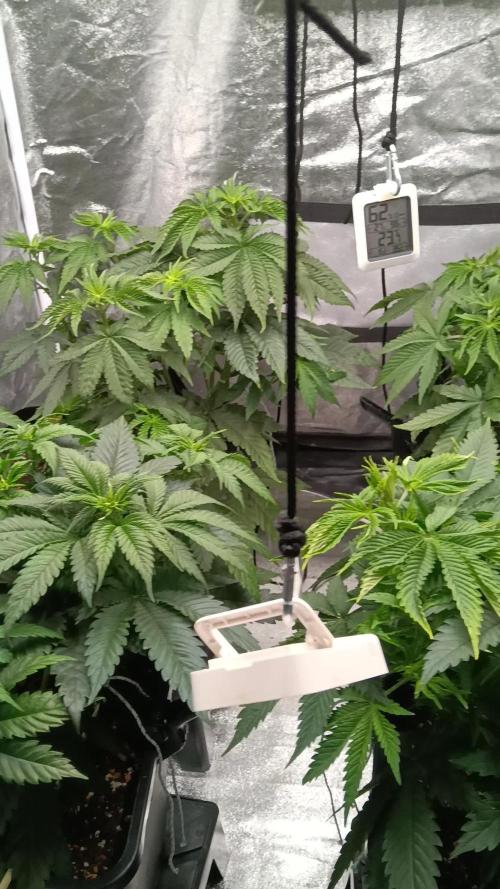
Der KISS ist das Licht wohl etwas zu stark. Die obersten Blätter waren leicht nach oben gerollt und mir zu hell. Auch bei Lemon Orange konnte ich das beobachten, sobald der Abstand zur Lampe weniger als 40cm war. Ansonsten sehen die Ladies gut aus. Sonntag geht es dann wahrscheinlich in die Blüte.


Likes
5
Share


@AustinRon
Follow
RIE Genetics Flower 10
IR1Q Week 14
Cultivars
Purple Heart [5] (Cherry Jelly CBD X Afterglow (Clementine X Arise)
[Fem/Seeds]: PH1Q24, 65 Days
Scarlet Begonias [1] (Haze X William’s Wonder) X Arise)
[Reg/Seeds]: SB1Q24, 70 Days
Lemon Jeffery [2] (Lemon Skunk X Golden Goat)
[Fem/Cut]: LJ124, 70 Days
Environment Plan
Vegetation
- Temp: [ 78,°F]
- RH: [ 63, %]
- VPD: [ 1.2, kPa]
Fertigation Plan
- Flower
- RLA Hydro Week 5: EC: [ 1.6, mS]
Biology: # (One of…)
- Photosynthesis Plus: [ 6, ml, gal]
- King Crab: [ 0.5, ml, gal]
- Mammoth-P: [ 0.6, ml, gal]
Line & Res Maintenance:
- SLF-100 Enzymatic Cleaner: [ 5, ml, gal]
Foliar Feeds
- RLA Foliar Schedule
Start of Week: [ Sun 19 May, 2024, IRIE1Q24 64:F:10:1]
End of Week:
[ Sat 25 May, 2024, IRIE1Q24 70:F:10:7]
Notes:
- Flushing Purple Heart prior to Harvest
- [x] Chop
__
Sun May 19, 2024
IRIE 1Q24 64:F:10:1
PURPLE HEART HARVEST
- 5 Plants - Not Weighed, Branched and Hung
- Temp: TBD
- RH:67%
- AIRFLOW SPEED (1-10): 4
- Harvest Date: 2024.05.29, 9 Weeks Complete
- Bring Fan Speed down to 2 on Tuesday
- Didn’t Weigh Wet - Will weigh Trimmed Flower
Runoff
- [x] RunoffAmt: [ 1.7, ml]
- [x] RunoffEC: [ 1900, mS]
We’ve FINALLY got runoff within 0.3 mS of Input!
__
Mon May 20, 2024
IRIE 1Q24 65:F:10:2
Update Grow Journals Flower Weeks 8 & 9, Harvest (9) Purple Heart
Runoff
- [ ] RunoffAmt: [ , ml]
- [ ] RunoffEC: [ , mS]
Flooded tent, no numbers. Easy cleanup, just a little overflow
__
Tue May 21, 2024
IRIE 1Q24 66:F:10:3
- Dry Chamber to AIRFLOW SPEED: 2
Runoff
- [x] RunoffAmt: [ 3800, ml]
- [x] RunoffEC: [ 2.0, mS]
Drilled 9 holes on remaining drip rings for FED irrigation, not drip. l
__
Wed May 22, 2024
IRIE 1Q24 67:F:10:4
- Dry Chamber Airflow Speed to 1
Runoff
- [ ] RunoffAmt: [ , ml]
- [ ] RunoffEC: [ , mS]
__
Thu May 23, 2024
IRIE 1Q24 68:F:10:5
Runoff
- [ ] RunoffAmt: [3800 , ml]
- [x] RunoffEC: [ 1.7, mS]
Reduced 10 0
min per irrigation
1900 ml less over 40 min
80/min gal
__
Fri May 24, 2024
IRIE 1Q24 69:F:10:6
Runoff
- [x] RunoffAmt: [ 1900, ml]
- [x] RunoffEC: [ 1.6, mS]
__
Sat May 25, 2024
IRIE 1Q24 70:F:10:7
Runoff
- [ ] RunoffEC: [ , mS]
- [x] RunoffAmt: [ 0, ml]
Irrigation Line Blocked - cleared - restored operation.

Likes
44
Share


@Aedaone
Follow
I didn't record the temps this week. I watered these about 3 gallons per pot per day. It was very cool this week. The high temp was averaging upper 50's F. Low temps were upper 30's lower 40's. Day 4 around 6 a.m. the temperature was 26°F and there was heavy frost on the ground. When I check on the plants about 7 a.m. they didn't have frost on them and were fine.
These girls really did well. They didn't require and canopy maintenance. I topped way back and never had to tie up the branches or support in any kind of way. They were exposed to really strong wind that laid other plants over and bent branches that didn't recover. I'd recommend these for outdoors. The powdery mildew was manageable and the only maintenance these required. They did want to eat a lot and my wife was managing this by herself. I think we could have fed more and made bigger colas, but they did well regardless. The smell of these is special. They're very loud and have a watermelon note. 🤤🤤🤤
Likes
4
Share


@GODAXE
Follow
27.08.2024
D48 since cutting,
lady starting to bush like their mother, as i did nt have place for 8 massive bush in the tent i proceed to some pruning and set some bud clip.
overall look
GBC #1
16 inch, flowering
GBC #2
16 inch, flowering
GBC #3
16 inch , still in veg, 😰
GBC #4
18 inch, full bud mod 😍
GBC #5
18 inch , full bud mod 😍
GBC #6
19 inch, flowering
GBC #7
20 inch, start flowering👍
GBC #8
18 inch, flowering
i will not weekly uptade, but keep you tuned

Processing
Likes
4
Share


@CanadianFillmore
Follow
Start of week 7! Week 6 went really well for the Glueberry OG. She has also show some nute deficiency signs, a few rust spots, but otherwise is healthy and the buds are packing on weight. This lady is on an 8 week schedule, removed big bud and added overdrive to the nute lineup.

Likes
37
Share


@Whitey307
Follow
Hi all not much going on this week just feed and kept comfortable hopefully done good enuf job 👍
Wedding cheese cake 2 weeks or so ahead of strawberry banana. Its me first grow though and really knew nothing when I started other than a bit of studying for few weeks never took into consideration about one strain finishing faster and no were to dry it so asked wife can use wardrobe,nearly ended living back with my mammy🤣🤣 I jst taught ill use that tent for everything haha how stupid was I to think different strians different plants all be ready together when I need them to not when they are haha so went out bought another tent small one so not to be tempted to fill that up is well then have to buy another one to dry before you know it I'll have ten tents and still no where to dry 🤣🤣🤣so small marshydro tent for drying and drying only haha then hopefully all be good anyone know the right temps and humidity for best results.I hear many different ones its very confusing.so started flushing wedding cheese cake going to try do at least ten days flush till tent comes with just ph 6.0 water still feeding strawberry banana fir another week or 2 maybe. Thanks for stopping by and having a look keep growing and blazing all.


Likes
7
Share


Likes
11
Share


@902EastCoast
Follow
Ladies are looking awesome! They have a week or more left but will see tomorrow when I check the trichs. They smell so good , mouth watering and they chunked out. I see worms in my organic living soil which is pretty neat.
Likes
10
Share


@russrahl
Follow
End of week 4 and all is great! This girl is beefin up to be a monster! Already got a ton of bud on her an their is still 4-6 weeks to go. loving this Hortilux Eye 1000w bulb. Really bringing the A game. Not so bumbed about spending $ 125 on a bulb now...lol haven’t had to really take any foliage off yet with the exception of the growth under the netting I removed at 1 weeks into flowering. I say “hell no” too popcorn fluff! Lol gotta save that energy for the top buds. Going great so far anyway, I made a DIY light bar for my light rail mover out of an old metal bed frame so that was cool. Saved $50 per tent... I ain’t no sucker gonna pay $50 for an aluminum bar with some bolts. Lol gonna hook up my “water coolers soon too since the summer is approaching and my water temps are begging to creep up again. Lol you may have noticed a computer case sitting in the corner of my grow tents in past videos, they are DIY water chillers made from some thermoelectric coolers and a copper cooling coil. Stay tuned to see them operational soon! I will be posting a DIY video on how to build one yourself out of an old desktop computer and a few other parts off Amazon. Cheers 💨
Likes
25
Share


@Bakeryguy420
Follow
Cresando auto first time growing her and won't be my last. Final product is killer smells so dank. Diesel with some fruits. Can smell the cookies for sure ☺️. Ethos again did a great job making these autos for sure. Will update more as the weeks go by.

Likes
16
Share


@Weedcreator
Follow
I have light from all sides, that's why I didn't do so much lollipopin..
but a lillte bit on the lowest internodes.
🔥🔥

