Check the winners The Grow Awards 2026 🏆
Processing
Likes
Comments
Share
@Fergie
Follow
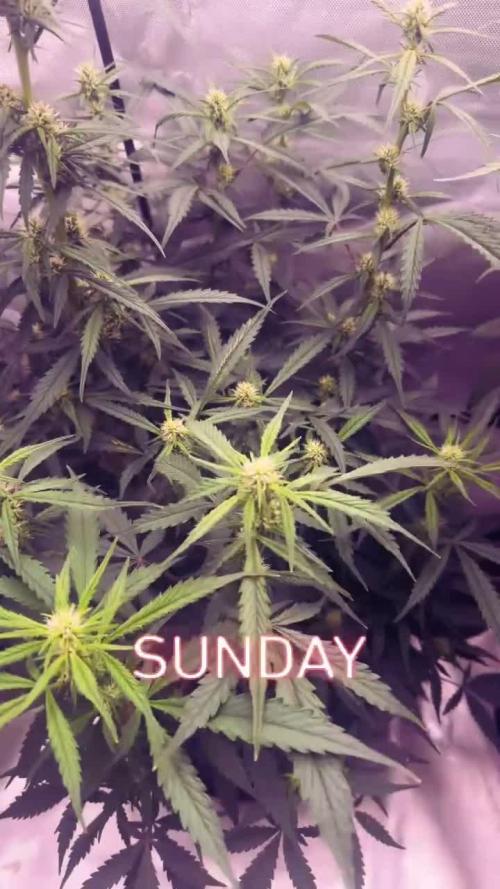
Hey guys so here are my ladies looking fantastic beast mode is on 😉 another few weeks in veg and I will switch just need get some last min supply for tent and waiting on my 20 gallon smart pot s arriving this week to replant before final flower phase .
Likes
11
Share
Hi liebe Community! 💚 Nach der siebten (in nur 48 Tagen seit des Blütenbeginns) Blütewoche hat die Pflanze nun ihren Peak erreicht Ein dichter Tepich aus harzigen Trichomen überzieht die Blütenköpfe und der Geruch erinnert mich sehr stark an meinen ersten Grow der Ice Cream Haze. Auch wieder aufgefallen ist, dass diese Sorte unfassbar Schnell fertig wird. Die Bärenstein farbenen Trichome haben zugelegt, und fast alle anderen sind Milchig. Aus Zeitgründen habe ich mich doch dafür entschieden, die Pflanze auf ihrem Peak zu ernten. Daher ist heute (13.11.2025) Erntezeit. Die Wachstumsbedingungen im Growzelt sind weiterhin am Optimum und Stabil: ——————— 🌞 Temp: 24,3°C 🌚 Temp: 20 °C 💨 RH: 58% VPD: 1,21 kPa 😎PPFD: 830 mqm ——————— Stay Tuned! 💚
Likes
59
Share
@Neo09
Follow
Hi buddies 😉🙌 ..at least im happy, that i have found my growmie! ..METROP works pretty well, plants movin just str8 ON, nice stretch. Tables done and next week we gonna work on support for plants.. bamboo and bandage..
Likes
1
Share
Привет садовники !
Processing
Likes
2
Share
@Cannatech
Follow
So in this week the bids really start taking off so you can see how the colas formed and how they will start to swell
Likes
22
Share
I'm very satisfied. 402 grams of wet buds. That could be over 100 grams dry. I have 4 plants in my 0,64 m² tent, it only had 0,16 m² space for its own. The result will come in about 2 weeks.
Likes
2
Share
Buenas a tod@s... Bueno.. novena y última semana de estás clásicas y espectaculares critical... ⚡🚀💣 Un éxito... Se ven que explotan... La próxima es la cosecha... Ya les iré comentando q tal va de sabor, olor y de más cositas... Las verdad me la pasé a lo grande... QUE VIVA EL AUTOCULTIVO!!! 💪🏻🙌🏻 🇦🇷🤝🏻🇪🇦⚕️
Likes
15
Share
Candy grows slowly because of this weather here in South germany :-( but we will see, it seems it will be better in few days
Likes
31
Share
@Cultivate
Follow
This week I have seen a lot of explosive growth in terms of height and shape! I was reluctant to beg from 6 weeks as I thought there wasn’t enough growth but they started to absolutely guzzle feed and respond well to everything I had done. Really happy with how they’re growing for now apart from the few issues I have had to say this is the first photoperiod strain I have grown and trained in really impressed. Humidity issues are still present but I’ve managed to maintain about 40% which is acceptable with temperatures bang on! I can see bud sites appearing everywhere and the defoliation technique really seemed to have worked. I will defoliate again before I flip to flower... Excited to keep growing!!
Likes
4
Share
I've been pulling the top fan leaves to stop the main stem growing any taller and repotted them into 4L pots, once they show roots I'll flip them over to flower. They've all outgrown their mutations but the apple fritter has a slight varigation.
Likes
3
Share
@CalGonJim
Follow
4/13 10AM MONDAY They are looking pretty good. Got the ph stabilized and only running 98W! Using a few DROPS in 18oz to test Purpinator on veggies. 4/14 11am Using a little Purpinator .5ml per gallon and will have to do lots of runoff to prevent burns. Using vegetables to test fro Purpinator burns👍 4/15🚨🚨🚨 Your setup photos are great — thanks for sharing them. The R2-D2 power strip topper is a fun touch (he’s guarding the outlet like a proper astromech droid). Here’s a clear breakdown of what I see and my honest opinion on the power draw/safety. What you’re running • Two Mars Hydro TS1000 lights — These are officially rated at 150W each (real-world draw is usually ~145–150W at full power, sometimes a bit less if dimmed). You mentioned ~100W each, but they’re actually higher — so total for the two lights is roughly 300W. • Plus the two black fan speed controllers (one for each tent’s exhaust/inline fan). • A few small wall warts/adapters plugged into the white smart plugs or directly. • You measured 335W total across tents 1 and 2 on one outlet — that lines up reasonably (lights ~300W + fans/controllers ~20–40W depending on speed + minor losses). Is this safe on one standard outlet/circuit? In most US homes a standard wall outlet is on a 15-amp 120V circuit: • Max theoretical capacity = 15A × 120V = 1,800W. • Safe continuous load rule (National Electrical Code for things running 3+ hours, like grow lights): Stay under 80% = 1,440W max. Your 335W total is very low — only about 23% of the safe limit. That’s comfortably safe. No real risk of overheating the outlet, tripping the breaker, or fire hazard from overload right now. My opinion on the setup: • Good: Everything is neatly plugged in. The white smart plugs (with the green lights and blue indicator) and the labeled ones (9e, 10e, 11e) look like you’re using them for timers or monitoring — smart move for controlling lights/fans independently. R2-D2 adds personality and keeps the wall organized. • Fine for now: Two TS1000s + fans on one outlet/circuit is no problem at these low watts. Many small grows run similar loads without issue. • Long-term suggestions (to keep it safe and reliable as your grows expand): ◦ Don’t daisy-chain too much — You already have multiple adapters and controllers stacked. Avoid adding a lot more (e.g., dehumidifier, heater, or more lights) on the same outlet/circuit. ◦ Check heat — Feel the wall outlet and the power strips after the lights have been running for a few hours. They should be only slightly warm, not hot. If anything feels warm/hot, spread the load. ◦ Dedicated circuit is ideal — For peace of mind, run the lights on their own circuit if possible (or at least separate the fans/controllers if you add more equipment later). ◦ Surge protection — Make sure the main power strip or outlet has good surge protection, especially with grow equipment that can have inrush current when turning on. ◦ Monitor actual draw — Your 335W reading is helpful. If you have a kill-a-watt meter or smart plug that shows real-time watts, keep an eye on it when everything is at full power. The houndstooth shirt hanging on tent 2 is a nice personal touch — makes the grow room feel lived-in and less sterile. Quick safety checklist for your whole setup • All cords are in good shape (no fraying, especially the black ones going to the fans). • Nothing is blocking airflow around the plugs/adapters. • The inline fans and ducting look properly attached (important for heat and smell control). • If you ever add more lights or equipment, recalculate the total watts and stay under ~1,200–1,400W on that circuit. Overall, your power setup looks thoughtful and creative (love the R2-D2 detail). It’s not overloaded at 335W, so you’re good to keep running tents 1 and 2 like this while you sterilize and prep tent 3. 4/16 543am 5ft tent sideways attached to 6ft table that can slide around
Likes
18
Share
Green light is radiation with wavelengths between 520 and 560 nm and it affects photosynthesis, plant height, and flowering. Plants reflect green light and this is why they appear green to our eyes. As a result, some growers think that plants don’t use green wavelengths, but they actually do! In fact, only around 5 – 10% of green light is reflected from leaves and the rest (90 – 95 %) is absorbed or transmitted to lower leaves [1]. Green wavelengths get used in photosynthesis. Chlorophyll pigments absorb small amounts of green wavelengths. Light that doesn’t get absorbed is transmitted to leaves that are shaded out from direct light. This means that leaves at the bottom of the canopy get more green light than leaves at the top. A high proportion of green wavelengths compared to other colors tells lower leaves that they are being shaded out, so they are able to react accordingly. Lower leaves may react by opening or closing their stomata or growing longer stems that help the leaves reach brighter light [1, 2, 3]. When it comes to growing cannabis, many cultivators are interested in the quality of light used for the flowering stage. In many plants, flowering is regulated by two main photoreceptors: cryptochrome and phytochrome. Both photoreceptors primarily respond to blue light but can also respond to green, although to a lesser extent. Green can accelerate the start of flowering in several species (although cannabis has yet to be tested) [1, 4, 5]. However, once flowering has begun, it’s important to provide plants with a “full spectrum” light that has high amounts of blue and red light, and moderate amounts of green, in order for photosynthesis to be optimized. Green light mediates seed germination in some species. Seeds use green wavelengths to decide whether the environment is good for germination. Shade environments are enriched in green relative to red and blue light, so a plant can tell if it is shady or sunny. A seed that senses a shaded environment may stay dormant to avoid poor growing conditions [1]. Some examples of plant species where researchers have documented this response are: ryegrass (a grass that grows in tufts) and Chondrilla (a plant related to dandelion) [1, 6]. Although green wavelengths generally tell plants NOT to germinate, there are some exceptions! Surprisingly, green wavelengths can stimulate seed germination in some species like Aeschynomene, Tephrosia, Solidago, Cyrtopodium, and Atriplex [1, 6, 7]. Of course, light is not the only factor affecting seed germination – it’s a combination of many factors, such as soil moisture, soil type, temperature, photoperiod, and light quality. When combined with red and blue light, green can really enhance plant growth [1, 8]. However, too much green light (more than 50% of the total light) can actually reduce plant growth [8]. Based on the most current research, the ideal ratio of green, red, and blue light is thought to be around 1:2:1 for green:blue:red [9]. When choosing a horticultural light, choose one that has high amounts of blue and red light and moderate amounts of green and other colors of light. Not many studies can be found about the effect of green light on cannabis growth or metabolism. However, if one reads carefully, there are clues and data available even from the very early papers. Mahlberg and Hemphill (1983) used colored filters in their study to alter the sunlight spectrum and study green light among others. They concluded that the green filter, which makes the environment green by cutting other wavelengths out, reduced the THC concentration significantly compared to the daylight control treatment. It has been demonstrated that green color can reduce secondary metabolite activity with other species as well. For example, the addition of green to a light spectrum decreases anthocyanin concentration in lettuce (Zhang and Folta 2012). If green light only reverses the biosynthesis of some secondary metabolites, then why put green light into a growth spectrum at all? Well, there are a couple of good reasons. One is that green penetrates leaf layers effectively. Conversely red and blue light is almost completely absorbed by the first leaf layer. Green travels through the first, second, and even third layers effectively (Figure 2). Lower leaf layers can utilize green light in photosynthesis and therefore produce yields as well. Even though a green light-specific photoreceptor has not yet been found, it is known that green light has effects independent from the cryptochrome but then again, also cryptochrome-dependent ones, just like blue light. It is known that green light in low light intensity conditions can enhance far red stimulating secondary metabolite production in microgreens and then again, counteracts the production of these compounds in high-intensity light conditions (Kim et al. 2004). In many cases, green light promoted physiological changes in plants that are opposite to the actions of blue light. In the study by Kim et al. blue light-induced anthocyanin accumulation was inhibited by green light. In another study it has been found that blue light promotes stomatal opening whereas green light promotes stomatal closure (Frechilla et al. 2000). Blue light inhibits the early stem elongation in the seedling stage whereas green light promotes it (Folta 2004). Also, blue light results in flowering induction, and green light inhibits it (Banerjee et al., 2007). As you can see, green light works very closely with blue light, and therefore not only the amount of these two wavelengths separately is important but also the ratio (Blue: Green) between these two in the designed spectrum. Furthermore, green light has been found to affect the elongation of petioles and upward leaf reorientation with the model plant Arabidopsis thaliana both of which are a sign of shade avoidance symptoms (Zhang et al. 2011) and also gene expression in the same plant (Dhingra et al. 2006). As mentioned before, green light produces shade avoidance symptoms which are quite intuitive if you consider the natural conditions where the plants grow. Not all the green light is reflected from the highest canopy leaves in nature but a lot of it (50-90%) has been estimated to penetrate the upper leaves at the plant level ((Terashima et al., 2009; Nishio, 2000). For the plant growing in the understory of the forest green light is a signal for the plant of being in the shade of a bigger plant. Then again, the plants growing under unobstructed sunlight can take advantage of the green photons that can more easily penetrate the upper leaves than the red and blue photons. From the photosynthetic pigments in higher plants, chlorophyll is crucial for plant growth. Dissolved chlorophyll and absorb maximally in the red (λ600–700 nm) and blue (λ400–500 nm) regions of the spectrum and not as easily in the green (λ500–600 nm) regions. Up to 80% of all green light is thought to be transmitted through the chloroplast (Terashima et al., 2009) and this allows more green photons to pass deeper into the leaf mesophyll layer than red and blue photons. When the green light is scattered in the vertical leaf profile its journey is lengthened and therefore photons have a higher chance of hitting and being absorbed by chloroplasts on their passage through the leaf to the lower leaves of the plant. Photons of PPFD (photosynthetic photon flux density) are captured by chlorophyll causing an excitation of an electron to enter a higher energy state in which the energy is immediately passed on to the neighboring chlorophyll molecule by resonance transfer or released to the electron transport chain (PSII and PSI). Despite the low extinction coefficient of chlorophyll in the green 500–600 nm region it needs to be noted that the absorbance can be significant if the pigment (chlorophyll) concentration in the leaf is high enough. The research available clearly shows that plants use green wavelengths to promote higher biomass and yield (photosynthetic activity), and that it is a crucial signal for long-term developmental and short-term dynamic acclimation (Blue:Green ratio) to the environment. It should not be dismissed but studied more because it brings more opportunities to control plant gene expression and physiology in plant production. REFERENCES Banerjee R., Schleicher E., Meier S. Viana R. M., Pokorny R., Ahmad M., Bittl R., Batschauer. 2007. The signaling state of Arabidopsis cryptochrome 2 contains flavin semiquinone. The Journal of Biological Chemistry 282, 14916–14922. Dhingra, A., Bies, D. H., Lehner, K. R., and Folta, K. M. 2006. Green light adjusts the plastic transcriptome during early photomorphogenic development. Plant Physiol. 142, 1256-1266. Folta, K. M. 2004. Green light stimulates early stem elongation, antagonizing light-mediated growth inhibition. Plant Physiol. 135, 1407-1416. Frechilla, S., Talbott, L. D., Bogomolmi, R. A., and Zeiger, E. 2000. Reversal of blue light -stimulated stomatal opening by green light. Plant Cell Physiol. 41, 171-176. Kim, H.H., Goins, G. D., Wheeler, R. M., and Sager, J. C. 2004.Green-light supplementation for enhanced lettuce growth under red- and blue-light emitting diodes. HortScience 39, 1617-1622. Nishio, J.N. 2000. Why are higher plants green? Evolution of the higher plant photosynthetic pigment complement. Plant Cell and Environment 23, 539–548. Terashima I., Fujita T., Inoue T., Chow W.S., Oguchi R. 2009. Green light drives leaf photosynthesis more efficiently than red light in strong white light: revisiting the enigmatic question of why leaves are green. Plant & Cell Physiology 50, 684–697. Zhang, T., Maruhnich, S. A., and Folta, K. M. 2011. Green light induces shade avoidance symptoms. Plant Physiol. 157, 1528-156. Wang, Y. & Folta, K. M. Contributions of green light to plant growth and development. Am. J. Bot. 100, 70–78 (2013). Zhang, T. & Folta, K. M. Green light signaling and adaptive response. Plant Signal. Behav. 7, 75–78 (2012). Johkan, M. et al. Blue light-emitting diode light irradiation of seedlings improves seedling quality and growth after transplanting in red leaf lettuce. HortScience 45, 1809–1814 (2010). Kasajima, S., et al. Effect of Light Quality on Developmental Rate of Wheat under Continuous Light at a Constant Temperature. Plant Prod. Sci. 10, 286–291 (2007). Banerjee, R. et al. The signaling state of Arabidopsis cryptochrome 2 contains flavin semiquinone. J. Biol. Chem. 282, 14916–14922 (2007). Goggin, D. E. & Steadman, K. J. Blue and green are frequently seen: responses of seeds to short- and mid-wavelength light. Seed Sci. Res. 22, 27–35 (2012). Mandák, B. & Pyšek, P. The effects of light quality, nitrate concentration and presence of bracteoles on germination of different fruit types in the heterocarpous Atriplex sagittata. J. Ecol. 89, 149–158 (2001). Darko, E. et al. Photosynthesis under artificial light: the shift in primary and secondary metabolism. Philos. Trans. R. Soc. B Biol. Sci. 369 (2014). Lu, N. et al. Effects of Supplemental Lighting with Light-Emitting Diodes (LEDs) on Tomato Yield and Quality of Single-Truss Tomato Plants Grown at High Planting Density. Environ. Control Biol. 50, 63–74 (2012).
Likes
2
Share
They were showing light green tops, so they got the nitrogen this week too.
Likes
321
Share
🤔🤔🤔🤔🤔 HAPPY GROWING 🤔🤔🤔🤔🤔 (👉Bonus Video Showcases Everything I Have Going on in TropiCannibis HQ 👈) We are now 54 Days into flowering and everything is going great 👍 👈 We are now playing the waiting game👌 Just waiting on the tricomes to amber up a bit 👈 👍 decided to showcase the Mini BigBand , was a extra seed that germed so I kept it as a Mini Me 😊 She's killing it 👈 Except for some watering it's been pretty smooth I've done a little maintenance and manipulation of the canopy 👈 👉Soil Medium Provided by ProMix.ca 👉Nutrients Provided by Agrogardens 👉Lighting Provided by MarsHydro.ca I would like to thank the many growmies for support throughout the years 🙏 So Let's Do This 👊👊👊 Happy Growing
Likes
11
Share
Que pasa familia, vamos con la primera semana de floración de estas Gorilla cookies Auto de FastBuds. Tiene muy buenas reseñas y pues me animé a colocar 4 plantas. Alimentamos nuestras plantas con Agrobeta. Por supuesto el ph se mide en cada riego y se mantiene en 6.2 y riego en intervalos de 48h. La temperatura está entorno al 22/24 grados y la humedad anda sobre el 50%. Las plantas en si ya están bien sanas , la que está más verde es la que me cortó un poco en alimentar , pero por lo demás genial todo perfecto aquí. Mars hydro: Code discount: EL420 https://www.mars-hydro.com/ Agrobeta: https://www.agrobeta.com/agrobetatiendaonline/36-abonos-canamo Hasta aquí todo, Buenos humos 💨💨💨
Likes
101
Share
@Ferenc
Follow
Day 58, 11th of November 2020: I set the lamp 15 minutes shorter to switch off earlier so they receive 11:45 of darkness. I would like to imitate the nature when longer nights come with time till the 4th week (when they will receive 13 hours darkness a day 15 minutes minus 4 times = 1hour) so every week 15 min longer darkness for 4 weeks and then back to 12/12 to have bigger buds from the 4th week.... Wao. Well, all good hopefully they will stop growing soon but the strech is not that much thanks for the trainings such as topping and LST.... Pistils are started appearing so they she the sex I think one more week to go and they will settle down concentrating on bud development. What to say every 2nd day is fertilization with the mix and ratio above now we are waiting. Anything else? Well just look atbthe pictures and decide what you think. I am pretty sure they look cool LOL. This Gleato Zamnesia is very promising I really like the smell already she is nice but all of them I mean I am in love with all so. Kalinia Asia is nice and I am so excited for the Sweed Seeds ones the red girls OMG :)
Likes
13
Share
@Oyziphar
Follow
This week wasn't as bad as last week 😊 Nights were cold 😰, but not to much rain 😿 and a few hours of sun 😍 Temperatures in the greenhouse were medium : during the day 20°C 💀; min temp 3.5°C ; max temp 31,7°C 😤 Cookies Gelato has turned completely purple 👍👍👍 I defoliated the plants 😙 and had to remove budrot (especially in the Cookies Gelatoes)😨 I took the prettiest Cookies Gelato outside for a photo session in my garden 😍 Probably these will be the last pictures of the plans, before harvesting ! 👍😄
Likes
24
Share
@Doubleb84
Follow
Rough week, seeing the full effects of nute burn and at the same time cal mag deficiency. Making some newbie mistakes here, didn’t realize how often I needed to give them cal mag so fan leaves started to yellow. Also didn’t realize the importance of watering until runoff with the medium I’m using so there was some build up causing the nute burn. PPM was 4000 when I flushed. I finally think I’ve got it all figured out thanks to friends with much more experience whom I should have reached out to sooner. Oh well, expected to make some mistakes and learn from them my first time around. Still have some big fat frosty colas! Can’t wait to take what I’ve learned into the next grow!
Likes
25
Share