


Likes
Comments
Share


@Growador
Follow
Shoot!!!! They’re beginning to thickening up, i’ve done some lst for 5 days and now they’re pretty good. I’m letting them grow and will begin to tie the other branches when they will be big enough!


Likes
1
Share
@Mars8_8
Follow
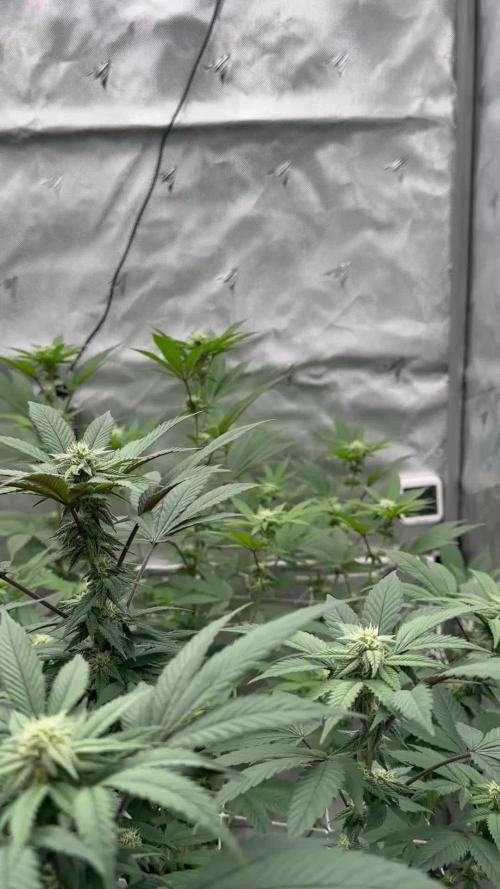
Week 4:Got the new mammoth nova 720W light installed. Trying out the green spectrum. A few reviews said it has the ability to penetrate to the lower nodes because of the green. It’s definitely way hotter than my 300w Evo4 so having to adjust some things to manage heat. Outside temps 68-70 inside temps 75-77. I can get them down lower but have to open doors and keep fans at near max. Have it set at 8/10 at about 24 inches of height and so far adjusting well.
Plants are starting to frost over and smells are mixed. 1/4 has a very skunky pheno the rest are way more pleasant and fruity. Excited to see the colors start to bleed through as the leaves are already showing signs of purple.

Likes
9
Share


@GrowerGaz
Follow
So just been keeping an eye on the ph and ec staying pretty stable. Water temperature is good at 21.3c. ec .03 ppm 277

Likes
3
Share


@ForbiddenBotanist
Follow
Today is the start of week 8. Very nervous about the harvest so im checking it with a microscope daily. Any tips or suggestions appreciated!

Likes
2
Share


@Topshelf_only
Follow
Been a rough week with temperature and humidity as well as starting the flush probably half a week early. Hopefully back to smooth sailing for the final couple of weeks. Just as long as it doesn't get much hotter outside .
Likes
158
Share


@ClubRiot
Follow
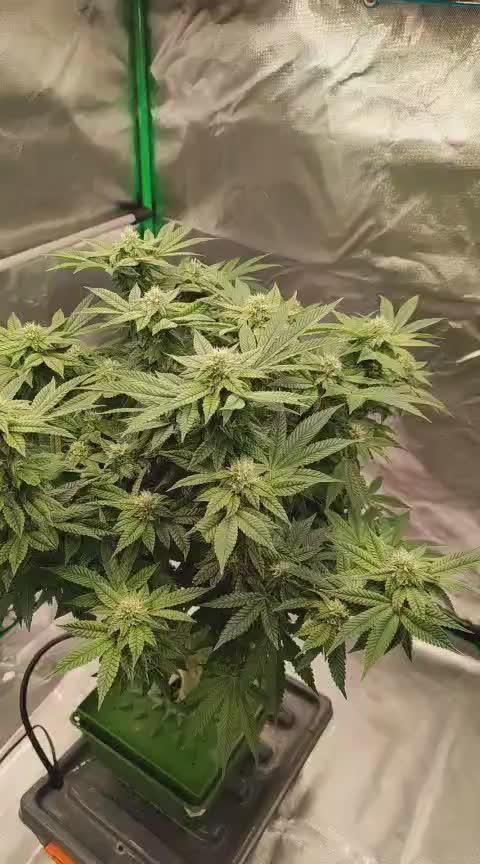
Tropicanna Banana
Week 15
11L Pot
LED: SP250 (245W) for Flow. Stage
Canna COCO
Mineral Nutrients:
👇
Sensi Cal-Mag Xtra: 1 ml/L
Power House Part A: 1.5 ml/L
Calcium Plus Part B: 1.5 ml/L
Stimulus: 1.5 ml/L
Bud Explosion: 1.5 ml//L



Likes
10
Share


@Deniguez
Follow
Ciclo molto soddisfacente. Terps fortissimi e tendenti alle californiane. Super genetica!! In House Genetics una fottuta garanzia!!! Grandi breeders.

Processing
Likes
2
Share


Likes
8
Share


@DogDoctorOfficial
Follow
💙 Project Blue Tent – Week 7
Blue Waffle F1 – Pheno A (Folder 13A)
Welcome back everyone to another week inside Project Blue Tent! 💙🌱
If you're new here, welcome aboard.
This project is all about exploring the incredible Blue Waffle F1 genetics from Zamnesia while putting the complete growing ecosystem through its paces.
Rather than documenting four plants as a single diary, each phenotype receives its own individual journey from seed to harvest. They share the same tent, the same environment, the same nutrition, the same irrigation and the same lighting.
And yet...
They still manage to tell four completely different stories.
As I always like to say:
We're not just growing plants.
We're getting to know them.
────────────────────────
🌿 Week Seven – The Final Cleanup
This week feels like a milestone.
The SCROG has done its job.
The canopy is full.
The plants have established their structure.
And now it's time to prepare everything for the next chapter...
Flowering. 🌸
Plant A is looking absolutely beautiful at the moment.
Her foliage has developed into the rich, healthy green I've been hoping to see, and the overall structure is remarkably balanced. After several weeks of gently guiding branches underneath the SCROG, we've managed to create a canopy that is surprisingly even from one side of the tent to the other.
At approximately 60 cm, she's sitting comfortably within the space we've created for her.
And although she could certainly continue growing vegetatively, I don't want to simply keep filling the tent with more and more foliage.
At some point, you have to stop building the canopy...
...and start preparing it for what comes next.
That's exactly where we are now.
────────────────────────
🕸️ From SCROG to Flower
Over the last couple of weeks, the SCROG has completely changed the way these plants occupy the tent.
Instead of allowing individual branches to dominate vertically, we've been gently guiding them horizontally beneath the screen.
The result is exactly what we were looking for:
A broad, relatively even canopy with many developing tops sharing the available light.
SCROG isn't about forcing a plant into submission.
It's about working with its natural growth and redistributing that growth across the available space.
And looking at the tent now...
I'd say the mission has been accomplished.
The screen is filled.
The plants have claimed their territory.
Now we need to create the best possible starting point for flowering.
Which brings us to this week's main job.
────────────────────────
✂️ Defoliation – Cleaning Today for a Better Tomorrow
This week we're performing a deep, purposeful defoliation across the canopy.
For anyone unfamiliar with the technique, defoliation simply means selectively removing leaves from the plant.
But it's important to understand what defoliation isn't.
It isn't stripping a plant bare.
It isn't removing leaves just because they're in the way.
And it isn't something that should automatically be performed every week.
The purpose is to improve the structure we've already created.
After several weeks of SCROG training, there is now a tremendous amount of foliage packed into a relatively small space. While those leaves are essential during vegetative growth, too much overlapping foliage can eventually create unnecessary congestion inside the canopy.
So we're removing selected leaves that are:
• Blocking developing growth
• Creating unnecessary overlap
• Restricting airflow through the interior
• Shading lower areas that we've decided to retain
• Or simply no longer contributing enough to justify occupying that space
The goal isn't to make the plant look empty.
The goal is to make the plant efficient.
────────────────────────
🌬️ Why Defoliate Before Flower?
Timing is everything.
We're doing this now because the plants are still in vegetative growth and have time to recover before we ask them to transition into flowering.
Defoliation is a form of stress.
Even when performed carefully, removing a significant amount of foliage temporarily changes the plant's balance between its leaves, roots and growing points.
That's why I don't want to perform a major cleanup deep into flowering unless there's a very good reason.
Right now, the plants can take that short period of recovery while they're still operating under an 18/6 light schedule and actively producing new vegetative growth.
After the cleanup, we'll give them time to recover, settle and rebuild their foliage before flipping the lights.
The idea is simple:
Stress now.
Recover now.
Flower later.
Rather than asking the plant to simultaneously deal with a major transition into flowering and a significant amount of pruning, we're separating those events.
One step at a time.
That's especially important in a project like this, where I'm trying to observe the plants rather than simply push them as hard as possible.
────────────────────────
🌿 Plant A – Looking Better Than Ever
Plant A continues to impress me.
The first thing that stands out this week is the colour.
That slightly lighter appearance we saw earlier in the grow has completely disappeared. The foliage is now displaying that rich, healthy green that tells me the current nutritional strategy is working extremely well.
She's vigorous without looking excessive.
Healthy without showing signs of nutritional stress.
And most importantly...
She's balanced.
Her branches have responded beautifully to the SCROG, and the canopy has developed into a very usable structure for flowering.
This is one of those moments where you can look at the plant and realize that the weeks of small adjustments have finally come together.
The topping.
The recovery.
The daily SCROG work.
The irrigation.
The feeding.
The environmental stability.
None of those things created this canopy by themselves.
They're all pieces of the same puzzle.
────────────────────────
💧 The Drip Irrigation System
One of the things I have become particularly impressed with during this project is the automatic drip irrigation system.
It's working beautifully.
With the plants now drinking more consistently and the canopy becoming increasingly demanding, having a reliable irrigation system makes maintaining uniformity across the tent considerably easier.
Each plant is currently receiving approximately 1.2 L per 24 hours, delivered through the drip system.
And the plants are clearly enjoying the consistency.
One of the advantages of automated irrigation isn't simply saving time.
It's repeatability.
Instead of relying on every watering being manually performed at exactly the same interval and volume, the system provides a much more consistent routine for the plants.
That consistency becomes increasingly valuable as the root systems develop and the plants transition toward flowering.
So far...
The system is doing exactly what I wanted it to do.
And honestly, watching four plants respond so uniformly to the same irrigation strategy has been one of the most satisfying parts of this project.
────────────────────────
🥥 Feeding Program
The feeding recipe remains unchanged this week.
And for now, I don't see a reason to interfere with something that is clearly working.
Current nutrition:
• Plagron Hydro A — 1.9 ml/L
• Plagron Hydro B — 1.9 ml/L
• Plagron Hydro Roots — 1 ml/L
Current EC remains approximately:
1.92 mS/cm
with the solution maintained around 18°C and pH at 5.8.
The plants are showing excellent colour, strong growth and healthy leaf development, so I'm perfectly comfortable maintaining the current recipe for now.
We may increase the nutritional strength next week depending on how the plants respond after defoliation and as flowering approaches.
But that's exactly why I don't like changing several variables at once.
First, we observe.
Then we adjust.
The plants will tell us what they need.
────────────────────────
🌡️ Environmental Conditions
The Blue Tent continues to remain remarkably stable.
This week's average conditions were:
• 🌡️ Day Temperature: 28°C
• 🌙 Night Temperature: 27°C
• 💧 Relative Humidity: 65%
• 🥥 Substrate Temperature: 24°C
• 💦 Nutrient Solution: 18°C
• ⚗️ pH: 5.8
• ⚡ EC: 1.92 mS/cm
• 💨 CO₂: approximately 450 ppm
• 💡 Light Schedule: 18/6
• 💧 Irrigation: approximately 1.2 L/plant/24h
• ? Pot Size: 8 L
• 📏 Plant Height: approximately 60 cm
The plants are continuing to respond beautifully to these conditions.
The root-zone temperature remains particularly stable, irrigation is consistent, and the canopy has enough air movement to support vigorous transpiration.
As we move toward flowering, environmental management will become even more important.
The room we've created now needs to support not only vegetative growth...
...but the much denser flowering structure that is coming next.
────────────────────────
🌬️ Why the Cleanup Matters
One of my main objectives with this defoliation isn't simply aesthetics.
It's airflow.
When four vigorous plants completely fill a 100 × 100 × 200 cm tent, the amount of foliage inside that space becomes considerable.
From above, everything can look absolutely perfect.
But underneath that beautiful canopy is another story.
Leaves overlap.
Branches cross.
Interior spaces become crowded.
Air needs to move through all of that.
By selectively removing excess foliage now, we're opening those internal spaces before flowering begins.
That gives us a cleaner structure going forward and makes it much easier to inspect the plants, maintain airflow and monitor the developing flowers.
This is also one reason I'm much happier doing the major cleanup before the flip rather than waiting until the plants are deep into flowering.
Once flowering begins, the priorities change.
I want the plant concentrating its energy on developing flowers rather than repeatedly recovering from major structural work.
So we're preparing the room now.
Clean canopy.
Good airflow.
Healthy structure.
Then...
Flower.
────────────────────────
🧠 Defoliation Isn't About Removing Leaves
One of the biggest misconceptions surrounding defoliation is that more leaves automatically means a worse plant.
That's not true.
Leaves are incredibly important.
They're the plant's solar panels.
They capture light and help drive photosynthesis.
So the objective should never be:
"How many leaves can I remove?"
The better question is:
"Which leaves are no longer contributing enough to justify occupying this space?"
That's the philosophy I'm following here.
We're not trying to weaken the plant.
We're trying to improve the relationship between:
Light → canopy → airflow → growing sites.
And because we've already spent weeks creating the structure with SCROG, this cleanup is simply the final refinement of that work.
────────────────────────
🌱 Plant A's Personality
Every phenotype continues to develop its own personality, even when all four plants are living under almost identical conditions.
Plant A has consistently been one of the more balanced girls in the tent.
She doesn't appear interested in becoming the biggest plant in the room.
Instead, she seems much more interested in becoming an efficient one.
Her growth is structured.
Her canopy is balanced.
Her foliage is beautiful.
And after weeks of training, she has settled into the SCROG extremely well.
Now, after today's cleanup, she looks almost like a different plant.
Less crowded.
More open.
More organized.
And ready for the next chapter.
That's the part of growing I really enjoy.
You spend weeks slowly building something...
Then one day you step back and suddenly realize:
It all came together.
────────────────────────
👀 Looking Ahead
The next few days will be about one thing:
Recovery.
No unnecessary training.
No chasing perfection.
No constantly changing the environment.
Just observation.
The plants have been through topping.
They've been trained beneath the SCROG.
They've filled the canopy.
And now they've received their final major vegetative cleanup.
So we're going to let them breathe.
Let them recover.
Let them continue growing.
And then, assuming everything continues to look as good as it does today...
we flip the Blue Tent into flower. 🌸
This is the point where all those weeks of preparation finally start paying off.
The screen is full.
The structure is ready.
The plants are healthy.
Now we just need to let them do what plants do best.
Grow.
────────────────────────
💙 Thank You
A huge thank you to Zamnesia for making Project Blue Tent possible, from these fantastic Blue Waffle F1 genetics to the complete ecosystem surrounding this grow.
A massive thank you to Plagron for providing the Premium Growbags together with the Hydro nutrient line, which continues delivering excellent results and beautifully healthy growth.
A special thank you to Mars Hydro for the drip irrigation and automatic drainage system. After watching these plants respond to the consistency of automated irrigation week after week, I'm genuinely impressed with how well the system is performing.
Thank you as well to GrowDiaries, for giving growers around the world a place to document their journeys, exchange knowledge and learn from one another.
And finally...
Thank you to everyone following Project Blue Tent.
Every comment, every question, every bit of feedback and every person simply stopping by to see how these four phenotypes are developing means more than you probably realize.
We've spent weeks building this canopy together.
Now the really exciting part is about to begin.
The plants are cleaned.
The SCROG has been filled.
The room is ready.
Flower is next. 🌸💙
Until next week...
Growers Love, happy growing, and take care everyone! 🌱💙
Likes
5
Share


@AestheticGenetix
Follow
Everything is growing great.
Im hesitant to keep weaving through the scrog because I don't want to mess up the mains but I'm just trusting the process and doing the best I can.
I have been heavy defoliating and lollipopping like crazy each day trying to make sense of this mess

Likes
12
Share


@CanadianFillmore
Follow
Week 3 flowering begins! Added B52 to the nute mix this week. Amnesia lemon haze is looking healthy and she stretched a hell of a lot the last week.
Thanks for stopping by 👽🌳💚
Likes
5
Share


@Willy_Balls
Follow
1st week of 12/12 light going beautifully. They are doing really well. Although I still experienced root issues. I think this spot is cursed :P

Likes
2
Share

@Bear_Grows_Green
Follow
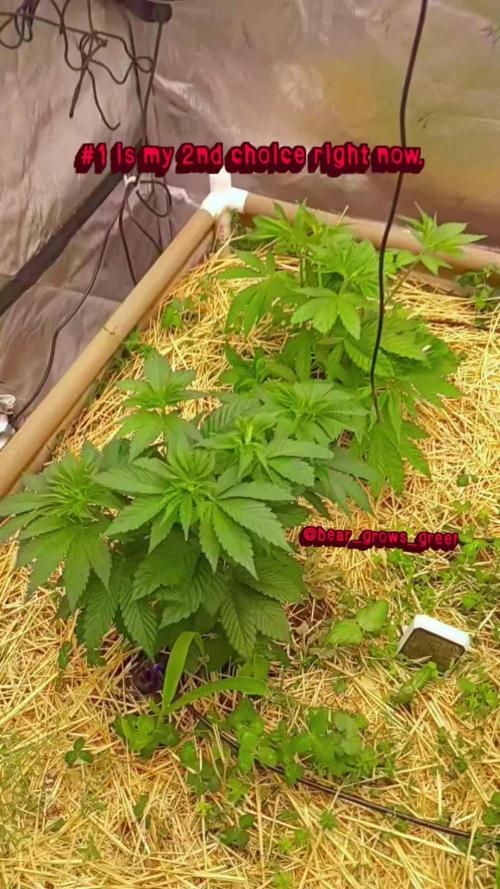
12/18 start of a new week they seem to have really settled into the bed and reacted well to the last feed.
12/21 gave a tea that had worm castings, lobster compost, gnarly barley, craft blend, rolled oats, and molasses 20 hour brew. Added all the goodies to it 3 gallon drench. Defoliated lower leaves touching dirt.
Likes
4
Share


@Puckdodger
Follow
Treated the girls to a new grow light Friday, the ACInfinity EVO4. Set at 18" and 60% to start. So far so good, but OC looked a little droopy Saturday morning. Raised light to about 19" while I had my coffee.
Fed them both 3 litres of water with 2ml per litre of Remo veg schedule Friday evening and topped OC to help keep canopy even. For the second time I had little to no runoff, even after increasing the water by 1 litre. More next time I guess.
My original plan was to flip to 12-12 when the lights come on tonight, but I think I'll give them a few days under this new light to get their groove on and raise the power of the light by 10 each day and drop it a little closer to the 18 " AC Infinity recommends until I'm at 100% and 18" then prune and flip. I think I've got room to stretch.
Plants are at 11-12" tall from the Promix, so I can definitely let them veg for another week. Raised the light back to 24 inches after my coffee, still at 60%.
Saturday morning I fed about a litre of straight RO water to both and Saturday night I cleaned up a dozen or so fan leaves that were shading bud sites. Sunday OC still looks a little droopy, but much better. Sunday morning lowered light to 22" and powered at 70% with a 1 hour sunset sunrise.
Fed them Monday night until runoff and took 6 litres at 2ml/l about a litre and a half came back out. Next time I'll give them 5 litres. Been trying to dial in this new light, plus I've went down the light meter rabbit hole on YouTube.....so according to Photone everything seems to be in check with the light at 70% at 24". AC infinity must have a more light tolerant stain in their test labs because full power at 18" would have my girls chicken fried in no time.
Tuesday morning they both looked great, temps and humidity and light and nutes all seem to be pulling in the same direction. Plants are about 12&13 inches tall
Likely flip them Thursday evening 😁😨😰
Wednesday morning gave them a small haircut of some leaves blocking budsites, and a bit of plant yoga bendiness and gentle restraints to let the light into the heart of the plants. So on page to flip tomorrow evening. Light is averaging 700 micromoles per second.
Likes
3
Share


Likes
12
Share


@balansa
Follow
hey there.
so first of all we have a company as u see in the video above. i do not know exactly but this is some kind of a mite. thisis not a spider mite itsmuch bigger. so never mnd ihopeshe wont bother use any more. i spreyed my baby with neem oil and some some dometic organic pesticide.
second off all i cant believe the to my eyes. look at the trichomes. she will be deffietely the most potent auto plant that i have ever grown. lookatthe video of close up trichomes above.
overally she is very very healthy plant smells wonderfully!!! unbeliavabe plant !!
happy growing mates
Likes
14
Share


@AndrewC
Follow
So this is the Tear Down week. The timing of it makes it so i will need to the harvest flag in a few days when I can weight and test the plants.
I have included the Cleaning, and Cutting and some Root Porn.
I will make the harvest post in about 4-5 days, when I can trim these plants. There is a lot of Plant here. I got way more than I was expecting. I don't have a scale that measure this amount of plant, without taking like 10 measurements and then adding them together. So I will just be posting the dry weight. I will post the wet weight as dry weight * 1.65.
Autopots: Wow, what a great product. I have been blown away by how well and how easy it was to work with them. They really did solve the watering issues. Excellent product. If you are a beginner, start with Autopots.
-= Lessons Learnt =-
- Overdrive the air to your Autopots. In my control plant, I used a small rectangle air stone (instead of a standard air dome). This lead to root rot and some other issues, it also put significantly less air into the water. The root rot, give the material for the Brown Algae to grow. Using a huge Air-disc-Air-Stone would be an excellent combo to mix in with the air dome itself. Something like this: https://www.amazon.ca/Pawfly-Diffuser-Suction-Hydroponics-Aquarium/dp/B01MY3AQ33 at the bottom and the air-dome on top of it, will be what I do with my next experiment.
- Air stone in the reservoir. I had two instances where algae grew into the res. An air stone would have helped. It would have also helped my control plant get less root rot. Given the amount that the air-domes and air sources got engulfed, having the water have more o2 in it would have only been beneficial.
- Don't grow 6 plants in a 4x4. Since my control plant was about 1/8th the size of the others, I think I could have grown 5 in the shape of a 5 (on a 6 sided dice)⚄ This placement would give a much more spaced canopy for airflow and more importantly light. The sides of some of the plants were lighter green and produced larf due to lack of light penetration.
- This tent was on 19-5 schedule. This worked out very well for this strain. After every lights on, they were in the praying position, so this strain was able to recover in that 5hrs off. If I had more seeds, I would run these again, and try 20-4. I think this strain could handle it. All for all, I think I'm going to 19-5 as my default timing. This kept up a solid DLI.
- Staring at .9EC (really .7 EC cause my water here is .2 EC) Then bumping up at .1 a week, until 1.6EC worked out VERY well. I experimented on this crop all the way up to 1.9EC, which burnt the tips of this plant. I think if I did this strain again, I would do 1.6EC until 3-4 weeks left then crank it to 1.9. It did plump them up when I went to 1.9, however it left them looking rough. Bulk was added though.
- Sticking to 6.0PH for all of veg, and 2 weeks into flower worked great. The plant had solid and consistent color and leaf shape . The plant's did get hurt, due to some issues (as noted on the weeks). I switched to 6.5 PH in the last 3-4 weeks and it helped them recover, and plump up noticeably.
-VPD. The #1 thing I focused on was VPD. I keep it .9kpa range, as best as humanly possible. It was honestly, HUGELY noticeable compared to my other grows. I know truly understand the value of properly dialed in VPD. This is the one lesson that will stick with me forever.
- Super-cropping: On the plants I give the chiropractic treatment too, had much thicker stems as much larger channel internally. I did this treatment to 4 of the 6, and the 4 that had it done has larger buds and recovered from defoliation faster.
TLDR; VPD is king. Super-cropping is worth the time. Keeping PH and EC dialed in were all wins. Autopots kick ass.


Likes
7
Share

@For2itous
Follow
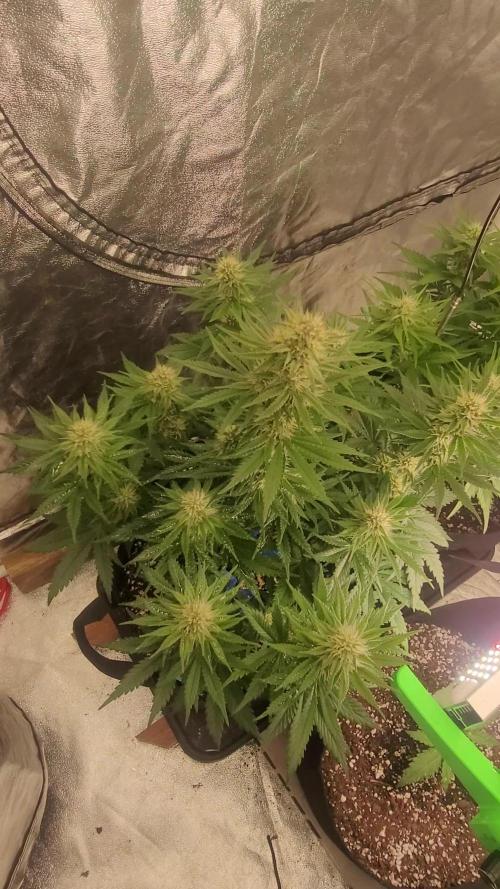
Just bending some branches and taking out a couple leaves. This plant is insanely vigorous its making the other plants jealous 😆 Can't wait to see how big the nugs get definitely some good genetics in these RF3. Happy growing 🌴