


Likes
Comments
Share


@ShowsWorld
Follow
Loving the way this strain is bushy but yet so compact. I plan on vegging her for atleast another month or so before I throw her into flower. I definitely recommend this strain especially if your looking for explosive vegetative growth.

Likes
5
Share


@DaddyPrime2
Follow
5/25 this plant is starting to gain some vigor finally. Has some real nice healthy color and I'm happy with where she is and/or where she will go once flowering commences. I was worried that she wasn't going to grow into much of anything. This seedling has been fighting since day
5/26 top dressed. She's taking off
Also her very main top, keeps branching off weird, it's like 3 at a node almost. Its been having weird mutations like parts of leaves missing and odd shaping of

Likes
7
Share


@Mr_nugs_lover_David
Follow
Beautiful looking seedling, very healthy and developing at a fair pace, let's see what awaits us in this diary!! She's developing super fast each day just like her sisters in this run, let's see how she keeps developing! I only use pure water and watch them grow thanks to the amazing living soil blend that I'm working with called FLO Living soil blend, very recomended to all the organic gardeners out there!! I have Transplanted this big girl after just 17 days since she was planted, she is very well developed and so ai took the decision to transplant her and all her sisters in this run, let's see how she performs! 💚❤️💛👨🌾🔝


Processing
Likes
22
Share


@Silverback_Guerilla
Follow
2/17:
I spent a little time rearranging today. I bought some 32" x 14" plastic ventilated storage shelves and cut the legs down on two of them so I have some different-height platforms for the shorties in the garden. I should also be able to easily flush 6 plants in 5 gallon pots, or 9 plants in 3 gallon pots at a time now, that's a win!👈
2/18:
I debated whether to feed or not, and settled on watering them with about 1/2 gallon each. including bembe, cal-mag, signal, humic acid, and a little beastie bloomz.
The new dehumidifier is pulling about a gallon and a half per day from the air, so I should be able to feed them in a coupe of days.
I've reached the ceiling again with my lights. The Soooperrunt has caught up to the tallest plant in the garden. She's very narrow compared to the rest, but she'll produce 100% more than I ever imagined, so that's a win! These three plants remain very dark green in color compared to all the other varieties.
2/19:
Rainy day outside, so I'm pulling in 99% humidity, plus the pots are still petty saturated, but the new dehumidifier is keeping up. RH is holding at about 45% today.👍
2/20:
Day 31 of flower...a semi-solution occurred to me that allowed me to raise the lights another 3-4 inches! Now I'm truly maxxed out...
2 of them have been slow to flower did a 300% stretch, but the 3rd is budding up nicely and only did a 200% stretch. Soooperrunt has stretched 30" from when I started flowering her...yikes!
I really needed everybody to finish in the same week so I could get my Spring autos going...😶
I'm still hoping that they will get their groove-on and finish by the EHD(3/11), but it's not looking possible at this point...
They're likely to be good producers, so I'm not bitching too loudly..
I took photos and videos of all the plants today since I had to empty the closet and it wasn't a feeding day.
2/21:
I fed them today with about 3/4 gallon each including beastie bloomz, tiger bloom, big bloom, signal, bembe, and cal-mag...no grow big this time.
2/22:
The darkest green plants in the garden. Wonderful structure, stacking up really well. Their top leaves really reach for the sun. My current favorites.👍
2/23:
I ordered some Terpinator because I'm not so sure about Signal's efficacy at this point....I'm usually dealing with odors more by now..😕
That's it for week 9-

Likes
29
Share


@gottagrowsometime
Follow
Welcome to my Tiny/Rare Pot Diary for seedsman contest.
Wk 3. Days 15-21. Plant has picked up this week. Leaving behind her issues from the 2nd week. (Which I now know where caused by the extreme high PH bioenhancer adds to the soil. On normally terms it would be fine. But, as I used a light mix soil.) I found out again the hard way coming into the later stage of this week. More PH issues showing up on the healthy growth. (And it came 2 days after adding the bioenhancer, all I need to do, is treat it as if it was coco and PH the bioenhancer to bring it back down to 5.8 ish.. just until the soil has had time to change itself and have better nutrient uptake. (So anyone using bioenhancer with biobizz light mix soil, pH it as it says to do as if you were using coco)
Other than coming back into PH issues. The plant is doing fine. Locked out of certain things like calmag at this stage. I should of mixed some all mix with it, and I doubt I'd be having any issues at all. But, growth has been good this week. Hopefully this will be the last of my mistakes brought out onto this poor girl. Nodes are growing, and taking a nice shape. For been in a .75ml plastic bottle, I just have to keep her environment, (substrate) in desired levels.
The Bioenhancer is meant to give a PH of 9ish with water. But, shouldn't affect any soil but says with coco, you need to PH..It's just I used light mix, and that's more coco than soil, and takes time to be treated. All my other plants took these feeds just fine, as the soil was mixed with all mix soil + light mix.
The injection of my AIrPump seems to be going well. But, hard to tell, what kinda impact its having.
Thanks for viewing this week. Be sure to drop a like or comment so I can visit your diaries. Either way, thanks for dropping by.
Stay safe my friends.

Likes
7
Share


Likes
12
Share

@Brotanical
Follow
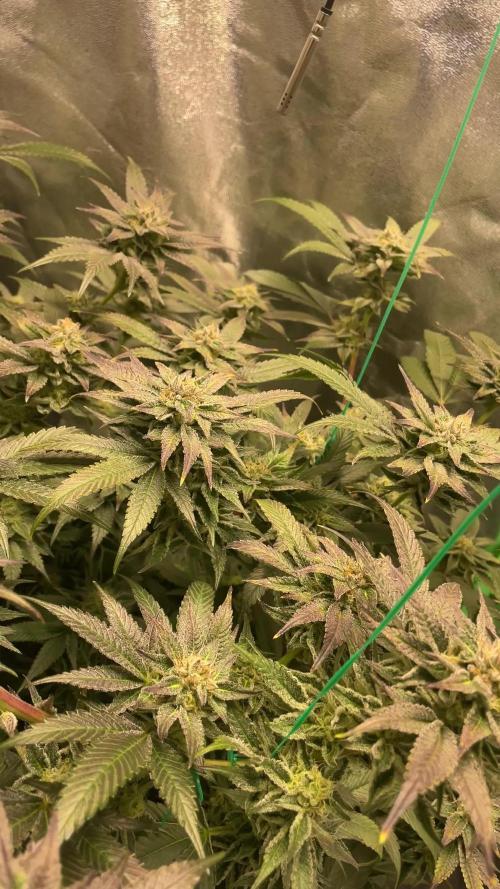
Week 11 Update (Week 6 Flower)
The trichome production on this Bruce Banner #3 is incredible. ❄️
Big thanks to @Hanfgarten – this selected cut of the Dark Horse classic is outstanding. It's extremely resinous, healthy, and stacking up perfectly.
Check out the macros to see the frost!
#DarkHorseGenetics #BruceBanner3 #Hanfgarten #Plagron #ViparSpectra

Likes
Comments
Share


@Unpluggy
Follow
Decided to transplant the ladys because they werde Not so happy in their small cups.
Now they got plants of space in their new 55l pot🍋🍒🍦
Plant in back needs more nitrogen
Likes
17
Share

@pHilosophy420
Follow
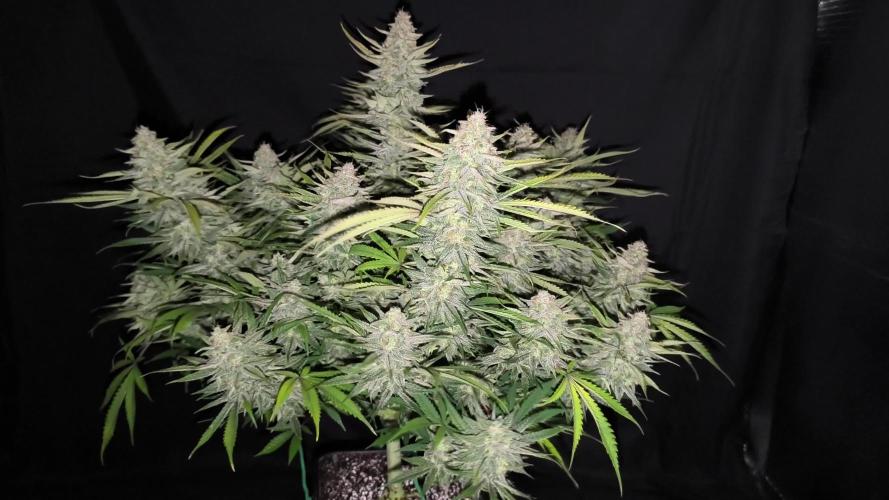
Day 98 - She is almost ready 1 more week and will start flushing and harvest. She smell fruti-citrus very nice and the buds are nicely covered in trichomes

Likes
2
Share


@HighZenBerg
Follow
Start of week 3. Weather conditions got better, less clouds and more sun seem to be good for the plants.
06/13/2020 -day 15- duck #1 still seems to have some problem. She grows but has a lighter greenish-yellowish color compared with her sister. Also the leafs have strange curls. I got a hint to remove the bio tabs and only give water. Maybe that will do the trick
06/16/2020 -day 18- finally a visible progress in growth. Duck #1 got back to a more natural green (thanks to a hint from Fusion 👍). Because of heavy rain, I got enough water for the two ladies
06/19/2020 -day 21- end of week 3, the ladies grew very good and got nice new leafs. So far, it really looks very decent an not like cannabis at all. Although they seem to be small in comparison with other diaries. This weeks weather was often cloudy with a lack of sun. Temperatures were between 25 C at day and 18 C at night. All in all I am happy that they seem to be healthy and growing. Looking forward to the progress in week 4.
Keep in Touch !
Cheers
HighZenBerg


Likes
44
Share


@The_Good_Twin
Follow
24 Oct 2021
Week 16 began yesterday, but the first watering of the week was today. I’m keeping up with the flush, starting the 2nd week today. Hopefully I’ll be able to harvest in a few days.
My Trio is looking really lovely. Their buds are covered in trichomes that glisten under the lights. They are starting to darken in color in some areas like their mother did. They may take on some pinkish/purple hues before it’s all done. Some of their leaves are turning purple as well. The sugar leaves are somewhat dark, but still green. All three of them are very nice to look at, and their smell is super strong! It’s really nice in my grow room!
Yesterday I went out and got some more of those support sticks from the local home store and provided support for all of the branches that needed it. Which was a lot! I got 7 new support sticks and used them all. All of the branches are now supported and flourishing!
Today each of my girls received a gallon of properly pH’ed water, and each had a sufficient amount of runoff from which to gather measurements. The process went as follows:
C1 & C2 had an initial pH of 6.9, and C3’s initial pH was 6.8.
I added .2ml of pH DOWN to each gallon which adjusted the pH to 6.4 for C1, and 6.3 for C2 and C3. TDS going in was 88 ppm for C1, 86 ppm for C2, and 84 ppm for C3.
Runoff measurements were a little weird. The runoff pH for C1 was 5.9. The TDS was (at first) 600 ppm. I thought that was an incredible drop from the other day, so I did it again. It was 603 ppm the second time. Ok, moving along nicely! The runoff for C2 was pH - 5.8, and TDS was 1101 ppm. 😳 That’s a lot more than C1. C3 had a pH of 5.6, and TDS of 1212 ppm. Which is even more; so I measured a little more from C1 again, and the 3rd time it measured 736 ppm. 🤔 That seems weird to me, but I’ll keep an eye on it. If it continues to be that low then I will end up harvesting it before the others which won’t be so terrible. I’ll just have to wait and see.
The temperature in the tent was 81F, and humidity was 47%.
My ladies are looking lovely and growing better than I could have hoped for. This grow has been awesome, but I can’t wait to be done.
Happy growing everyone!
27 Oct 2021
Feeding/flushing time again! I was somewhat perplexed the other day when I got the runoff reading for the TDS in C1. It was 500-600 ppm less than C2 & C3 respectively. Since I was having some issues with the TDS meter I thought that IT may be the cause. I made a note to check on it today, and there seems to be no problem with the TDS meter at all. Keep reading for details.
My plants are still looking as lovely as I could ever have hoped for! C1 has started showing more color changes than the other 2, and the only thing I can say the difference is, is that I defoliated some of C1’s larger fan leaves last week, and wasn’t able to do the same for the other 2. That is the ONLY thing I can think of that has been different between all 3 plants this entire grow. Regardless, all 3 plants are looking wonderful!
Today each of my lovely ladies received a gallon of property pH’ed water with an expected amount of runoff for testing. The preparation went as follows:
C1 & C2 had an initial pH of 6.9, and C3 was at 7.0.
I added 0.2ml’s of pH DOWN to each gallon which adjusted the pH of all 3 gallons to 6.3.
TDS going in for C1 & C2 was 85 ppm, and C3 was 84 ppm.
Runoff levels were different for all three plants. C2’s runoff pH was 5.7, and TDS was 1041 ppm. C3’s pH was 5.6, and TDS was 1059 ppm. Last time C1 was significantly lower than the others, and I thought that maybe it was a TDS meter issue. Evidently it wasn’t. C1’s TDS today was 526 ppm! 😳 still much lower than the others, and pretty much ready for harvest.
The temperature in the tent was 81F, and humidity was 43%.
Although harvest time is much closer, I don’t believe it will be done in time for this month’s grow diary of the month contest. So sad, but that’s life.
Happy growing everyone! See you again soon.
29 Oct 2021
Today is the last day of week 16. I was planning on continuing the flush today, but remembered something that I had forgotten about….
I remembered the branch that had broken off of C1 back on October 10th in week 14. She had held on for well over a week in a can of water, but finally her leaves started to droop. I hung it up all by itself in my small tent to dry. Until today that is!
I took it outside and trimmed it on my deck. Even outside, in a pleasant breeze, the amazing smell of this branch was easily detected. It’s kind of windy, rainy, and chilly here today, but still …. That sweet blueberry muffin smell was there.
Her buds; still covered in the dried, crystallized trichomes were super sticky! I must admit that they are the stickiest buds I have grown to date.
I weighed the dry bud to add to the grand total of C1’s harvest later. Then I ground it up and smoked it.
All I am going to say is that from my reaction to smoking it; I have decided that no additional flushing is needed. After all, what I smoked today broke right before I started flushing, and I could taste nothing other than what I would hope to taste.
So my fellow Growmies; I am ending this week right here. The next report you will see will be the harvest report!!
Stay tuned!

Likes
11
Share

@gukmalgrow
Follow
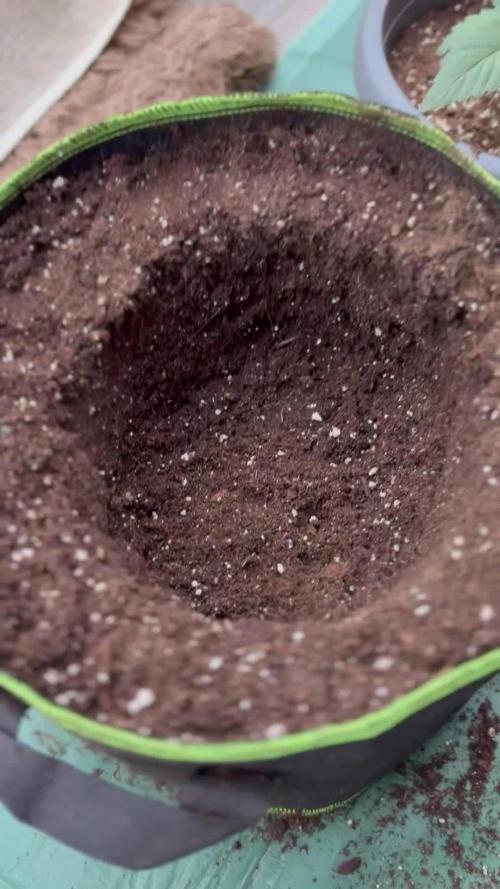
Woche 3 ist endlich vorbei und es geht in die vierte Woche😍Viel passiert ist nicht, eine Dame wurde in ihren Endtopf umgetopft aber streikt 3 Tage später noch und lässt die Blätter ziemlich hängen. In der Woche gab es für Alle auch BioEnhancer. Gießen wurde langsam aufgenommen und sich bis 0,6L gesteigert. Jetzt heißt es warten bis die Dame sich erholt hat und dann geht es in Woche 4 endlich ins Training!! Happy Growing🏻🌱

Likes
6
Share


@BUD_TALK_519
Follow
Noticing a little purple tinge to all plants at top , I’m thinking it’s the led , never had it with hps before

Likes
29
Share


@Ultraviolet
Follow
The number of points on a cannabis leaf is primarily influenced by genetics, the plant's maturity, and environmental factors.
Grape Guava is an Indica Hybrid. Hmmmm
Genetics: The plant's genetics are the most important factor in determining the potential number of leaflets. Sativa-dominant strains are more likely to develop leaves with a high number of leaflets, sometimes producing 13 or more. In contrast, indica strains typically have fewer, broader leaflets, usually between 5 and 9.
Maturity: A cannabis plant's leaves gain more leaflets as it matures.
Seedling stage: The first true leaves after the initial cotyledons emerge with a single leaflet, followed by sets with 3, then 5.
Vegetative growth: Healthy, mature plants will consistently produce leaves with 7 to 9 leaflets, though 11 or 13 is possible.
Fast growth: A mature plant growing quickly in ideal conditions with plenty of light and proper nutrients is more likely to show a higher number of leaflets.
Environmental conditions: Optimal growing conditions can push a plant to express its genetic potential for more leaflets.
High light: A fast-growing plant with ample light is more likely to develop leaves with 9, 11, or 13 leaflets.
Stress: Environmental stresses, such as unusual lighting schedules, can sometimes cause mature plants to produce leaves with fewer leaflets than normal.
Blue light causes stomata, the pores on plant leaves, to open by activating a signaling pathway within the guard cells. This process involves phototropin photoreceptors, which initiate plasma membrane H+-ATPase activation, pumping protons out of the cells. This creates an electrical potential that drives potassium (K+) uptake, causing guard cells to swell and the stomatal pore to open, allowing gas exchange. Foliars applied in strong blue 430nm with 4000hz tone. 20min dose prior to application.
In essence, you're seeing a combination of the infrared light reflected by the plant, which the camera perceives as red, and any residual visible blue light the plant reflects, which results in a purple hue.
DISCLAIMER 01: All ideas expressed on this diary are for entertainment and general information purposes only. There is no advice on what an individual should or should not do. Any response made by anyone after hearing this communication is their interpretation and is their responsibility. Ideas expressed by this diary should not be treated as a substitute for medical advice or professional help. If expert assistance or counselling is needed, the services of a competent professional should be sought.
DISCLAIMER 02: All materials in this video is used for entertainment purposes and fall within the guidelines of fair use. No copyright infringement intended.
DISCLAIMER 03: This website/diary is not officially affiliated with Alan Watts or his estate. The content presented is inspired by Alan Watts' teachings and philosophy, shared with the intent to motivate, inspire, and support personal growth. The voice used is a synthesized voice and does not belong to Alan Watts. The goal is to respectfully share his timeless insights in an inspiring way, with no intention to deceive or misrepresent. All opinions and interpretations expressed are solely those of the creator and do not represent the official views of Alan Watts or his family. For a deeper understanding of his work, please refer to his original writings and recordings.
You can explore more of Alan’s work here:
📚 alanwatts.org
Likes
85
Share


@Tropicannibis_Todd
Follow
Start of day 56 ...... Dec 4 Start of week 8 ........ 30 DAYS INTO FLOWERING
Check out the full grow video on latest weekly update
Super Exceptional Growth Daily
Still adjusting LST when needed and leaf tucking.......
Water Only when needed but its drinking more every otherday and adjusting lights when needed......
Rain Water Only .......
( DAY 26 AND BOTH NL 1 & NL 2 SHOWED PREFLOWERS )
( DAY 49 AND RESIN PRODUCTION HAS STARTED )
( DAY 57 , EQUIPMENT FAILURE , main FAN , over heated😡 tripped breaker , reset light timers , lost a DAY, REPLACED new Main Fan 😁 back up running 👌)
( DAY 60 AND IT SHOWS ZERO DEFICIENCIES ) IM ALSO DOING VERY LITTLE, SLIGHT DEFOLIATION
( DAY 60 AND ALL IS GOOD , THERE FATTING UP )
I hope you enjoy my growlog...

Likes
57
Share


@LockDownGrow
Follow
Ok so the taste test is :
I like this over the girl scout cookies and the BlackBerry for daytime ,
It's a very nice euphoric head high that turns you into a creative genius , you feel like you could do anything you put your mind too, the buzz sticks around for a while too ,
It's really nice indeed , and a few months cure and she will smell fantastic ,


Likes
29
Share

@Sadhus
Follow
**Semaine 6 : Sixième Semaine de Floraison – Phase Bulking (25-31 mars 2026)**
**Note :** Mise à jour hebdomadaire complète. Tout est RAS, les plantes sont en pleine forme et le bulking se passe parfaitement. Données regroupées TrolMaster + GrowOps (semaine 6 / semaine 10 globale).
### Contexte et Objectifs de la Semaine
On est maintenant en plein cœur du **bulking** (gonflement massif des buds). Le stretch est terminé depuis plusieurs semaines, l’énergie de la plante est entièrement redirigée vers le remplissage des calices, la production de résine et la densité florale.
Steering : **végétatif maintenu** (irrigations fréquentes, runoff 20-30 %, dryback modéré 8-12 % la nuit, VWC stable).
Objectifs : maximiser le volume et la densité des buds, booster la résine avec UV 90 min/jour, maintenir une stabilité parfaite des paramètres jusqu’au pic de trichomes (semaines 7-8).
**Petit point éducatif : Pourquoi le bulking est la phase la plus importante en flo ?**
Après le stretch (semaines 1-4), la plante passe en mode « remplissage ». C’est là que l’on gagne le plus en poids final. Le steering végétatif (irrigations fréquentes + VWC plus haut) permet une meilleure absorption des nutriments et une expansion cellulaire maximale dans les buds.
À ce stade, l’ajout de **PK 13/14 + Sugar Royal + Green Sensation + Pure Zym + Silica Force + Cal-Mag Amino** est idéal :
- PK 13/14 → phosphore/potassium pour la formation des fleurs et la résine
- Sugar Royal → sucres et carbohydrates qui augmentent le poids et les terpènes
- Green Sensation + Pure Zym → bio-stimulants + enzymes qui améliorent l’uptake racinaire et la santé microbienne en coco
- Silica Force + Cal-Mag Amino → renforcement cellulaire et prévention des carences classiques en flo (Ca/Mg)
Le tout à EC 2.6 et pH 5.8-6.0 donne un équilibre parfait sans risque de lockout ou de burn.
### Observations des Plantes
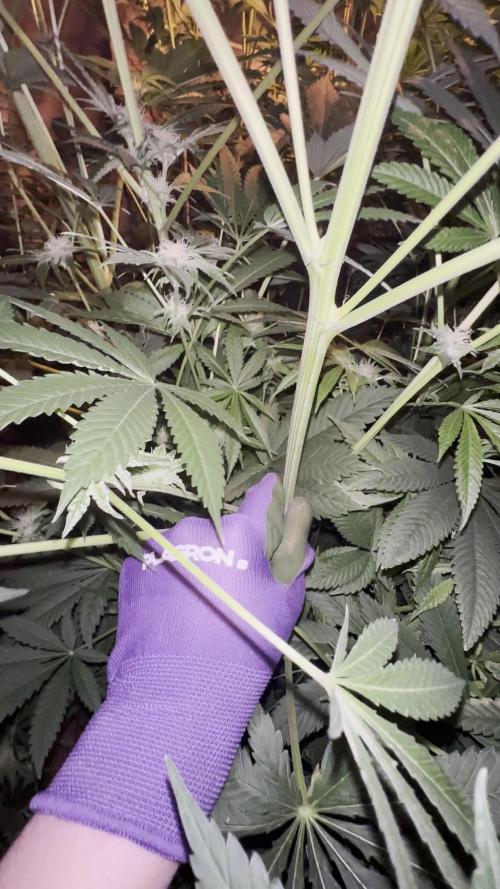
La plante dominante (la plus belle) mesure maintenant **150 cm** de hauteur. Elle a clairement pris le dessus avec une structure énorme, une canopée dense mais bien aérée et une vigueur exceptionnelle. Le stretch est complètement terminé (+10 cm seulement la semaine dernière, stabilisation totale).
Les buds grossissent rapidement, les calices s’épaississent, les trichomes deviennent de plus en plus visibles et brillants sur les sites supérieurs. Pistils encore majoritairement blancs mais commencent à s’enrouler.
Santé générale : excellente, vert profond, aucune feuille jaune ou brûlée, zéro pest, zéro stress, zéro carence ou excès. La plante secondaire suit bien. Clones toujours très vigoureux. Les plantes sont concentrées à 100 % sur le gonflement des fleurs.
### Paramètres Environnementaux (TrolMaster + GrowOps – synthèse semaine 6)
- **Température jour** : 20-23 °C (moyenne live 23.3 °C, cible 24 °C)
- **Température nuit** : 18-20 °C
- **Humidité jour** : 60-70 % (live 58.9 %, cible 62 %)
- **Humidité nuit** : 49-59 %
- **VPD** : 0.8-1.2 kPa (live 0.94 kPa → parfait pour bulking)
- **PPFD moyen** : 750-777 (max 814) → DLI 32 mol/m²/jour (optimal)
- **UV Light** : 90 min/jour (augmenté cette semaine)
- **Far Red Light** : 30 min en fin de cycle (lights-off)
- **CO₂** : setpoint 900 ppm jour (enrichment actif)
- **EC solution** : 2.6 mS/cm (live 1.85-2.95 selon relevés)
- **pH solution** : 5.8-6.0 (live 6.43, runoff 5.8-6.2)
- **Runoff EC** : 4-5 mS/cm
- **Irrigation** : Fréquente (4-5 cycles/jour)
- **Runoff % daily** : 20-30 %
- **Night dryback** : 8-12 %
- **Steering** : Végétatif confirmé
### Nutrition et Irrigation (Soupe actuelle)
**Nutriments utilisés cette semaine (doses par litre) :**
- Cocos A → 1 ml
- Cocos B → 1 ml
- CANNA PK 13/14 → 1 ml
- Green Sensation → 0.1 ml
- Pure Zym → 1 ml
- Sugar Royal → 1 ml
- Cal-Mag Amino → 1 ml
- Silica Force → 1 ml
- pH- → 0.5 ml (pour ajuster à 5.8-6.0)
Eau à ~20 °C, temp solution ~15-18 °C (normale en coco).
Irrigation fréquente avec dryback contrôlé → parfait pour maintenir un VWC stable tout en évitant les excès d’eau en phase bulking.
### Problèmes et Ajustements
**RAS** – Aucune problème, aucune alerte GrowOps, aucune intervention physique nécessaire cette semaine.
Les paramètres sont très stables, le steering végétatif fonctionne parfaitement et les plantes répondent idéalement aux boosters de résine.
### Plans pour la Semaine 7
- Maintenir steering végétatif + EC 2.6 (possible léger pic PK si besoin)
- UV rester à 90 min/jour
- Légère défoliation sélective (seulement les grandes fan leaves qui bloquent vraiment la lumière sur les buds inférieurs)
- Photos rapprochées pour suivre l’évolution des trichomes et du gonflement
- Évaluer les clones pour sélection finale
Ce journal sera mis à jour hebdomadairement.
#GrowLegendary #Zamnesia #Plagron #EternityGrowCup2
Les buds gonflent vraiment bien, les trichomes commencent à briller et la plante dominante à 150 cm est superbe. On sent que le rendement va être excellent ! 🌱✨
