


Likes
Comments
Share


@MrsFunk420
Follow
One of our favorite grows so far. She was east and a great yield.

Likes
8
Share

@D4D3DHOMMIES
Follow
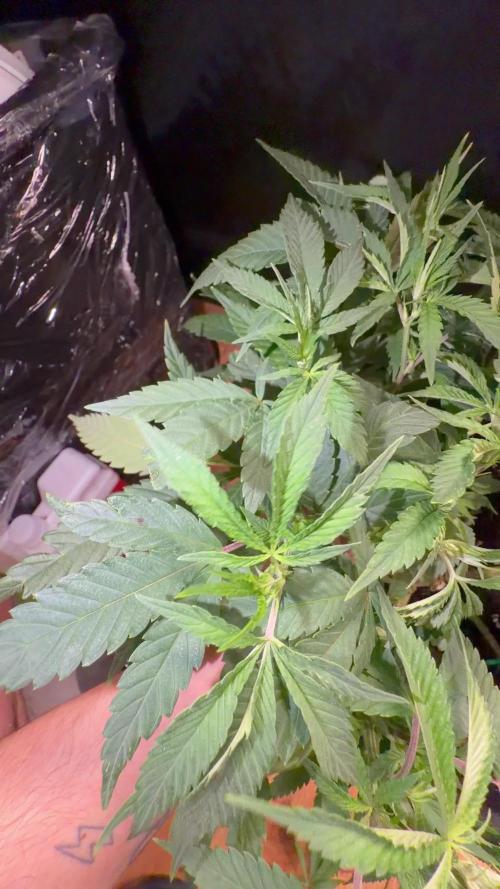
In places like where I live, it's easy to get mold, pests, or powdery mildew (the most common problem). Next week, my 30L adjustable dehumidifier and Spiderfarmer power strip are arriving to better control everything, along with other accessories like CO2, VPD, etc., to have maximum control over the grow at all times. Besides that, even though it's late, I'll add the Spiderfarmer supplemental lights for the recommended and maximum duration. We'll see how it goes; if not, I'll try the Migro lights. And I'll probably do a grow room next time with Migro lights—they're the best value for money. I'll keep you updated on the results with the UV lights. I've had to move twice; my plants are a bit stressed, but if you're careful, you'll never have a problem. Looking forward to seeing my girls in a few weeks!

Likes
12
Share


@Tgrow411
Follow
Hinten Links / Vorne Links-Rechts Purple Queen Auto
Hinten Rechts Quick One Auto.
Komische Genetik dabei aber Hoffnung bleibt.
1,5 L pro Topf alle 3-4 Tage

Likes
12
Share


@Northstar_cannabis
Follow
Pound cake is hopefully full height now, not much vertical space left. No issues, happy plant, super easy to grow.
No change on Nutrients this week.
Half gallon daily seems sufficient.

Likes
105
Share


@Green_Friends_Inc
Follow
Overall a great strain. Would def recommend to just about anyone!


Likes
39
Share


@Hazecat_420
Follow
Aparecieron unas pequeñas manchitas en las hojas más viejas, se realizó el trasplante a maceta de 5 lts y se regaron foliarmente con Knactive por estas hojas amarillas que comenzaron a salir y para que tomaran de buena manera el trasplante. Seguimos ... Pronto se viene la floración
Likes
3
Share


@Out_of_flowers
Follow
Flowering time. To much PK on start. Now not nutrients. 1 week flushing.
Likes
23
Share


@NorthernMonkeyzInc
Follow
1st week of flower, here is the blackberry moonrock by anesia seeds, moonwalker kush by spliff seeds and somango by seedsman seeds


Likes
10
Share


@mojo1985
Follow
unterschiedliche trainings somit unterschiedlicher wuchs... aber alle so wie gewünscht ohne stress oder probleme. später kommen bilder der einzelnen...😄
critical kush auto mit hst und enlauung schöne ud verteilung... riecht streng/schwer...gute trichomen ... stabil und unkomplizierert...


Likes
Comments
Share


@Nofeckingclue79
Follow
This has been a dream to grow the only reason I marked it as neutral and not easy because of it being such a flowery bub.So you just had to keep an eye on the humidity apart from that she stood up to everything even when I was starving her from Calmag 😂🤷
Can't wait to be back with the smoke report
Likes
7
Share

@UncleJono
Follow
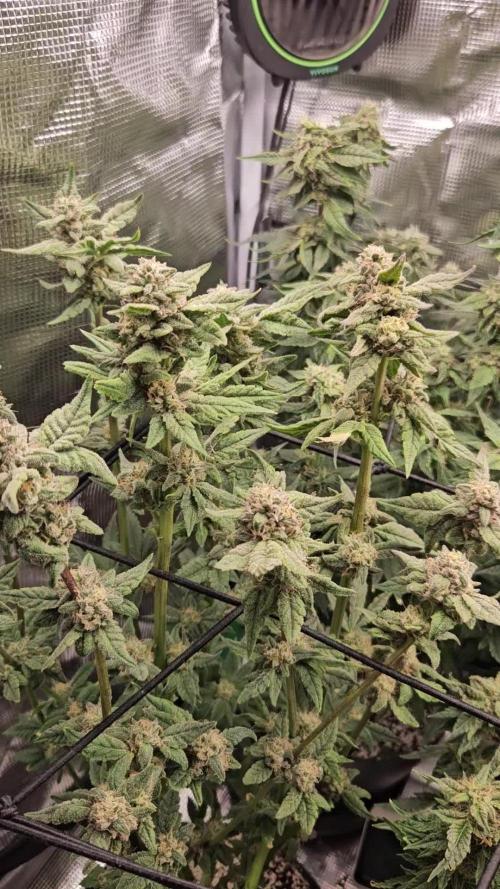
We've made it to the end of week 7!
I am honestly impressed with what I've been able to do during my first grow as an adult. I never imagined some of these plants would look so great! GDP is easily the best looking but most all of my plants look amazing.
As I enter week 8, I will be checking trichomes on 3/4 of the tent. the saliva on the right side of the tent are still very early and have lots of white pistils so im thinking at least two more weeks for them.
I anticipate some chopping will occur between now and next Monday and if not, the days following for sure.
Can't wait to share the next update!
Happy 420

Likes
12
Share


@Daviz_42
Follow
Como podemos ver ya todas están para el corte o casi, en algunas tendré que seleccionar el pheno, ya que hay alguna que me gusto más que la otra, en general un terpeno muy diferente en cada variedad y también la calidad de la resina, en general mucha resina, pero por ejemplo he podido observas que los tricomas de la Gorilla Melon son más grandes y se oxidan de una manera más lenta, ideal para hacer extracciones, en cambio, la Reinbow Melon .... ese terpeno dulce intenso tanto que es hasta abrumador...me muero de ganas ya de probarla... la Lemon Mandarín es exagerado el olor que tiene a mandarina si cierras los ojos y ueles fuere parece que te vayas a comer una buena mandarina y la Paya Sherbet tiene un olor dulce y muy agradable, pero nada que aún pueda relacionad del todo..... un saludo y buenos humos fam.
Likes
7
Share


@XoticGROW666
Follow
I will b running the SHERBCAKE again to dial her in properly took a lot clones of her so I can’t wait to run her again terps of her is dessert and fuely 🍰⛽️ seeds made by k1 kreationz

Likes
15
Share


@valiotoro
Follow
Chapter 6: Massacre at Two Pines🔪
Hello everyone🤩
They are doing very well,growing at fast pace and with a beautiful green colour on the leaves.💥
Have a nice day 😎
Likes
12
Share


@Staffedition
Follow
Привет друзья. Моей растихе сегодня 176 дней
27.12 перестал кормить и начал проливать чистой водой
20.10 перевёл свет в режим 12/12
Начал применять LST технику на 19 дне, а 18 августа добавил ДЕФОЛИЗАЦИЮ
С 20.08 ДЕФОЛИЗАЦИЮ
С 20.08 LST технику
На сегодняшний день влажность 54%
5.09.2023 заметил высокий Ph 7.9
С 48 дня Ph не ниже 5.8
На сегодняшний день Ph 6.0
Начал кормить с 60 дня Canna Terra Vega
PPM 150
Всем мира и добра!
Не забудь поставить лайк❤️, если понравилась как прошла неделя
И читайте наш TELEGRAM: https://t.me/smail_seeds
#Smail_Seeds 😀


Processing
Likes
20
Share


@Easygrower
Follow
Hello growers day 65 with the gorilla glue auto she’s starting to show a lot of bud sites I gave her abit of a trim took afew leafs off I think she put her final stretch in this week her tops are sort of level iv turned my light up to full power so hopefully don’t piss her off to much that’s all this week so be safe and happy growing ✌️🏻

Likes
32
Share


@CraigGrowsOK
Follow
This strain was a lot of fun to grow, Training was easy, it responded well and rolled with the punches, She was CalMag hungry as that as my only noted deficiency.
She was chopped at day 69, would have been 70 but I had mothers day plans with the Ol' lady. The wet weight is everything but the bigger fan leaves (larf galore) I had so much trim. I love the smell I loved growing it, but I do not like how airy the buds turned out, I use quality LEDs and have a white widow in another journal that grew along side it under the same conditions, even the same trainings to the point where there structured extremely similarly, and the White Widow is ROCK SOLID.
BUT with that being said, the trichome production was very nice, the sugar leaves will leave me with a lot of hash (half the buds were considered larf but were so sticky and covered in trichomes) and the smell is very sweet, berries and a hint of lemonaid and must. Keep in mind this is a taste after just a couple days of drying a sample bud and no cure. Overall its definitely smokable ill probably give some out but I would rather keep the airy stuff for me to smoke/process because I love it all.
I am currently taking the week as a T-break so I can give everyone here a proper smoke report, including myself.
Dry bud weight is only 51g BUT all the trim did get me a couple of grams, probably 3 of some incredible hash, The Hash taste like blueberry pie and a glass of lemonaid, the flower is similar but with a bit of a musky punch, the high hit me straight in the head and had me laughing at myself for getting so stoned, literally all i wanted was that pie and lemonaid that's all that I had on my mind. after a bit it mellowed out into a nice relaxing sativa feel, I wasn't nearly as full of energy but I was by no means tired either.

Likes
24
Share


Likes
141
Share


@bioaccessory
Follow
Теперь я начинаю понимать еще одно преимущество выращивания методом ScrOG - по сути больше ничего не нужно делать, все ветки на своих местах. Даже высоту лампы я не корректировал, пока меня всё устраивает. Заметно замедлился рост, и мне уже очевидны мои незначительные ошибки по установке решетки, которые я обязательно перечислю в итоговых выводах.
В начале следующей недели я собираюсь убрать лишние веерные листься, и подчистить низы, тогда мы и увидим финальную структуру кустов.
Характерные сативные листья пока оправдывают мои ожидания, начинается самое интерсное😉
Спасибо, что заглянули, и будьте здоровы! 🙏
Продолжение следует ...😶

Likes
12
Share


@growking123
Follow
Week 8 looking good. Buds have been growing steadily lower leaves turning yellow and dropping off. Using Nutrients to help with bud production. I'm feeding them Flora combo of 2 Litres or until a little flow through. Every two to three days.
Bottom of the pot was really dry gave it a mini flush until a little came out the bottom. 4L per plant.
