






@JensM
Volgen
Heute werden sie das 2. mal mit der STS Lösung behandelt um Männliche Pollen zu produzieren
Pollen Produktion voll im Gange


@MrWigglyJiggly
Volgen
This girl is currently in the darkness to speed up the process a bit. She's been flowering for over 63days already and white pistils dont seem to stop coming out. I think this is before of her strong sativa strain. Anyway, next week will be about her being harvested. I hope to get at least 8oz out of this girl. Let's see if i can do it.


@AlpineGoat
Volgen
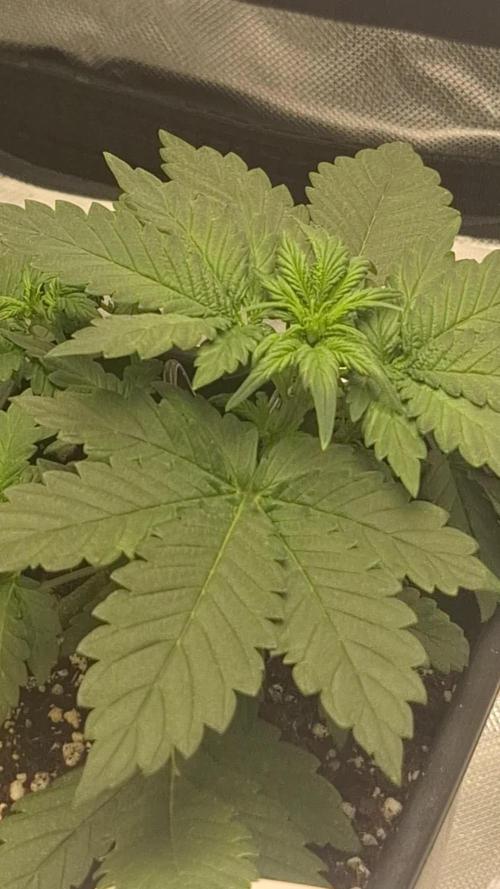
1.12 welcome december!
We’re moving close to the harvest line, in a week and a half I’m gonna start checking the tricromes.. i run one last add of nutritions, from now only water until the last day!
The sweet zz is smelling great, the amnesia is growing strong and dense, the gorilla glue’s scent is pungent, unique, and the blue berry is growing slowly but very well.
I pruned a bit of yellow leaf, now I wait until the harvest, leaving all untouched!
2.12 i added a smol video :3
5.12 they’re maturing very well! Now I’m start monitoring the trichomes! Hoping in a week and a half max I’m gonna dry everything.. soo happy!




@BunnyBud
Volgen
31 Aug. I start the third week of my autoflower. The plant is growing well, but I noticed small yellow spots on the leaf tips, which seem like a mild calcium deficiency. This is probably due to the fact that so far I have been giving water with a slightly low pH, around 6, while the ideal range would be 6.5–7.
At the beginning, to lower the ppm of the tap water (which was around 211 ppm), I mixed it with demineralized water. This brought the ppm down to about 109–140, making it harder for the plant to absorb the available calcium. Additionally, the soil I am using, Biobizz Light Mix, is lightly fertilized but does not contain enough calcium to correct this small initial deficiency.
For this week, I will not add any fertilizers. I simply want to raise the pH to 6.5 and use water with higher ppm, so the plant can better absorb the nutrients already present in the soil.
The lamp is positioned about 35–36 cm from the plant and so far there are no burn issues. Temperatures range between 25 and 30 °C depending on the day, while humidity in the room stays between 40–60%. The humidifier is always on because I keep the window open, but the dehumidifier is not being used, as it is not necessary at the moment.
I also have a new oscillating fan arriving to replace the current fixed one, and I’m waiting for a regulable extractor (90–145 m³/h), which will allow me to control the air perfectly during winter if needed.
This week my main goals are:
Increase the water ppm without overdoing it
Adjust the pH to 6.5
Keep observing the plant without adding any fertilizers
Everything else seems fine and growth is regular. With these corrections, I expect the new leaves to grow healthy and free of spots.
==UPDATE 31/08==
To control the calcium deficiency, I will administer an eggshell solution until I reach 300 ppm (I will boil some eggshells and administer the solution in tap water).
==Update 4 Sept==
By mistake, I adjusted the pH twice, once to 7 and once to 8, and obviously the plant immediately showed symptoms of incorrect pH. At the next watering, I'll give Biobizz Grow with a little Biobizz Bloom since the plant has entered pre-flowering. I'll adjust everything to a pH of 6-7 and a ppm of 450-500.

shorts_status_processing


@Hazecat_420
Volgen
Todo bien, entrando de lleno en la segunda semana. Hasta el momento solo seguimos con micorrizas del colectivo científico y agua semana por medio




@00110001001001111O
Volgen
-
Total days above ground: 35
Lazy update this week. Procrastination mode is on. No individual plant photos this week. I don't even have a plant map, So, I'm not sure what each plant is by location at this moment. I need to do some canopy management tonight, but fuck it. I'll put it off until tomorrow because I like to self-sabotage. They'll get a little less time to recover than normal heading into flower. They are healthy and happy, so I doubt there will be any repercussions.
Second humidifier is still tied up in the drying area, so VPD continues to be less-than-ideal. By the time I flip to flower, the climate will be in a much better place. I'll have to cut some corners and get a little creative to mitigate the effects of a suboptimal vege phase.
Things will turn out fine, but inevitably fall a bit short of expectations. I'll selectively prune lower axilla and top tomorrow but leave a couple opportunities for cuttings. Hopefully, there's enough growth for a proper clone by flip to flower (day 40). A second breeding cycle may or may not happen.


@Untergrownd
Volgen
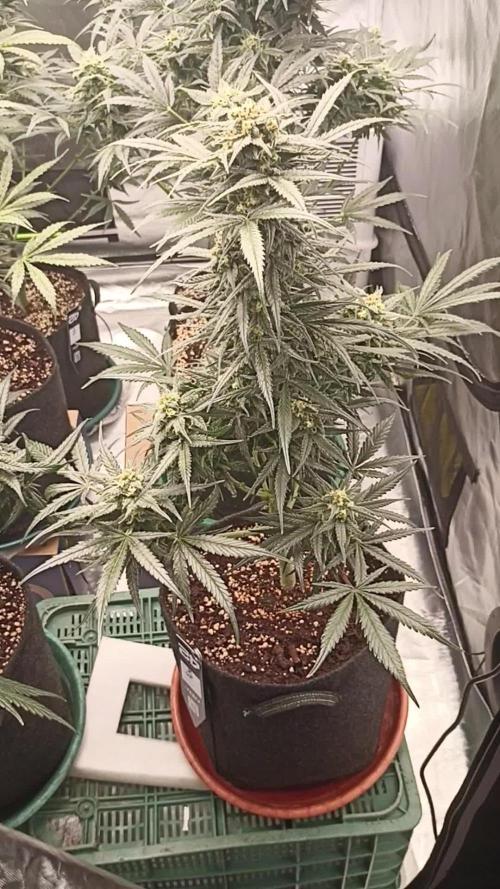
Week Twelve
Flower Week 6 and so far so okay. I got worried about nanas on the sfv, but it turned out it was just new growth. The fungus gnats came back, stronger than before, so I covert the soil with sand to prevent them from laying more eggs.
Alle the plants looking fine, on some days I had to fight high humidity and temps. This will bite me a week later, check week 13 ;)




@Marijuanaut
Volgen
Almost there! 😍
The shorty is going first... the other two might need a couple weeks. 😋
Some signs of Cal deficiency specially on the Banana one 😎
💚💛❤️


@Mr_nugs_lover_David
Volgen
This lady is looking super frosty and the smell it's just very strong, just like all the ladies in my garden, this pheno is smelling very good and I'm enjoying a lot working with her. Let's see how she keeps developing guys! 👨🌾💯💎


shorts_status_processing


@Strife957
Volgen
Things went as normal this week.
I didn't water or feed the girls since i have been sick lately, all I did was push them back under their net.
Sometimes their stems pop/snap but i don't worry anymore, the next day they recover nicely. (its more like an internal pop i hear)
The weather isn't as sunny as I would like yet, but i can't do much about that.
With all the foliage bug hunting has been reel tough, although I found a baby cutworm witch i quickly eliminated.
slow and steady the girls keep climbing
I just manage the light space 4 them. I only go in on the weekends 4 their training and that seems to be good enough.
The girls in the back are just exploding, compared to the others.
I dont know if maybe some good soil back there or just some magic beans.
Maybe because they are closest to their nightlight?





@Greenzfingerz
Volgen
No shit! These aint stardawg!
100% gorilla skittlz had two types ovs gave me wrong ones owell these alryt high thc content. More of fruity pungent smell. More updates to follow!


@420keef
Volgen
I used a macro lens from a fish eye kit you can buy for any phone to make that macro video, i highly recommend them it’s so easy to see when i can harvest , these are also very cheap but you do need a steady hand haha. I smoked some smaller buds about a week after harvest & it already tastes amazing almost like a reaalllyy sweet banana haha & the burn is good also i was suprised it was smokeable so fast. Fat banana is one of my favourite strains from now on! I also had 1 Sour Diesel in the tent but i’m still curing that one


@Bread_n_Buds
Volgen
Our Black Runtz branded Zamnesia has arrived at the moment of truth, it's going very well from the start and the god of Jella has punished me because I'm bragging too much:
I accidentally knocked out the fan that cut a brunch. I'm an asshole, I was very high and I did this damage that I also reported in the photo to make amends and remind myself not to do this bullshit.
Apart from this which is still a disgrace for me, the plant is an excellent beauty, it's doing very well, we only went from 16 buds to 14 buds like this damage that I caused. They know 14 succulent buds, let's hope. If I don't do any more damage.
We did our best, Zamnesia has put superb genetics and at home B&B we are working to show you the plants in all their possible meanings.
This plant like all the other photoperiodic ones has been worked with a topping x16 buds, simply repeating the topping technique without doing anything else than cleaning the leaves from time to time and now the branches that I believe do not give me good flowers at the bottom. After the damage x14 buds
The 14 buds are not perfectly aligned there is something that escapes upwards but it is normal in the economy of a plant i tried to FIM before go in bloom.
We are still using soil, fertilizers and all the additives recommended by Plagron 100% organic.
The plant has been flowering for 3 days, in the diary I leave it indicated as the last week of vegetative but we move on to the fertilizers for flowering.
We have now moved on to the early flowering program which maintains the same additives Power Roots, Sugar Royal, Pure Zym and adds the flowering stimulant Power Buds. Now the base fertilizer is now Alga Bloom with which I get along very very well even more than Alga Grow that sometimes I have to understand well how to dose in some particular cases (
topping). Probably try to prepare the soil with Plagron Super Mix or with the Zamnesia Pellet.
The Green Sensation will arrive as the hero of the end of flowering and at the same time it will be time to remove power roots and a week later the Pure Zym enzymes.
---- Decide on the right soil and calculate your fertilizer card based on the soil on the official website.
-- www.plagron.com
Try a seed of this strain that drives us crazy..
-------- https://www.zamnesia.io/en/11159-zamnesia-seeds-black-runtz.html
Zamnesia Description // Black Runtz comes from a truly legendary genetic pool. Our breeders used three modern classics from the United States to create this strain: Zkittlez, Gelato, and Runtz. With 20% THC and flavors of grapes and berries, Zkittlez passed on her delicious flavors and relaxing effects. Gelato contributed to Black Runtz's immense flavor profile by passing on high concentrations of the terpenes limonene and humulene. Finally, Black Runtz inherited the high potency of the original Runtz, a strain with a respectable 21% THC. The end result of this 3-way cross is a strain with 55% indica genetics and 45% sativa. Black Runtz boasts rapid flowering times, high potency, and contrasting yet balanced terpenes that supports its delicious flavor profile.
All the best that mother nature can offer is on ---- www.zamnesia.com



@DogDoctorOfficial
Volgen
💙 Project Blue Tent – Week 13 💙
🥒 Pickle Lemon Haze F1 – Pheno B
🌸 Same Tent, Different Genetics, One Beautiful Frosty Girl! ❄️💙
Hello everyone, and welcome back to another chapter of Project Blue Tent! 💙🌱
My friends, here we go again!
Another week, another beautiful girl, and another reason to spend far too much time standing in front of the tent with a camera in my hands! 😂📸
LOOK AT HER!
Pickle Lemon Haze F1 Pheno B is looking absolutely beautiful. She's super frosty, the aroma is amazing, and those white pistils are still giving us plenty to look at as she continues towards the finish.
But before we get carried away with the photographs, let's take a moment to explain what's happening inside Project Blue Tent this week.
We have four plants sharing the same tent, the same general environmental conditions, the same lighting setup, the same irrigation system, and the same reservoir.
But we're working with two different cultivars: Blue Waffle F1 and Pickle Lemon Haze F1.
Same room. Same ecosystem. Same passion.
But two different cultivars, different genetics, and plenty of individual characteristics to appreciate!
This week, we're continuing to lower our nutrient concentration, reducing the overhead LED output gradually, and keeping the two LumiFlora under-canopy fixtures running.
We've also stopped using PLAGRON Green Sensation, which is an important correction to the nutritional updates I mentioned in the previous reports.
Power Buds remains in the recipe for now, while Hydro A and Hydro B have both been reduced.
We're moving into the final stage of this journey, and I'm particularly curious to see how the four girls progress from here.
Will they finish together, or will some be ready before the others?
Will we have half the room ready for harvest first, or will the whole room finish around the same time?
I genuinely don't know yet, and that's one of the things I'm looking forward to discovering!
But today, we're giving Pickle Lemon Haze F1 Pheno B her own chapter.
Let's get into it! 💙🌿
🌸 WEEK 13 – ANOTHER BEAUTIFUL GIRL APPROACHING THE FINISH
We're now in Week 13 of flowering, and the entire room is gradually moving towards the final stage.
The structural work has already been completed. The plants have been trained, topped, managed through the stretch, and supported with our SCROG setup.
The second layer of support remains in place, the airflow system is established, and the under-canopy lighting experiment continues.
At this point, we're concentrating on observing the plants, maintaining the environment, and making gradual adjustments where we believe they make sense.
We're not trying to change everything at once.
Instead, we're lowering the nutrient concentration, reducing the overhead lighting output gradually, and bringing the temperatures down as we progress through this final stage.
And meanwhile, the girls are doing what they do best.
Developing their flowers, showing us their individual characteristics, and giving us plenty of reasons to keep the cameras ready!
Pickle Lemon Haze F1 Pheno B is looking fantastic.
She's compact, frosty, and full of character.
And the smell?
Absolutely amazing! 😂💙
🥒 PICKLE LEMON HAZE F1 PHENO B – HER OWN MOMENT IN THE SPOTLIGHT
One of the things I love about keeping separate diaries is that every plant gets her own story.
Although Pheno B shares the room with her Blue Waffle F1 sisters and another Pickle Lemon Haze F1 plant, she's still an individual plant with her own development to document.
We're not simply copying the same description from one diary to another.
We're looking at the individual plant, recording what we see, and following her progress as she moves towards the finish.
Her structure is beautifully established, the flowers are looking impressive, and the frost is one of the first things that catches my attention.
And then we have those white pistils!
They're still very noticeable, giving the flowers a beautiful appearance as the plant continues developing.
She's not finished telling us her story just yet.
And honestly, I'm happy to let her take her time.
We're approaching the final stage, but we'll continue observing the overall development rather than deciding that she's ready based on one characteristic alone.
The flowers, the pistils, the trichomes, and the general condition of the plant all form part of the picture.
For now, Pheno B is looking outstanding, and I'm enjoying every moment of documenting her journey.
❄️ THE FROST – ANOTHER REASON TO GRAB THE CAMERA
You know me by now, my friends.
If there's frost to photograph, there's a good chance you'll find me standing in front of the plants for far longer than I originally intended! 😂📸
And Pheno B is giving me plenty of reasons to do exactly that.
The close-up photographs reveal the intricate details of the flowers and the surrounding sugar leaves.
There's so much to appreciate when we take the time to look closely.
From a distance, we can see the overall structure and the way the flowers are distributed throughout the plant.
But when we move closer, we start noticing all those little details that make macro photography so enjoyable.
The trichomes.
The pistils.
The developing flower structure.
The different textures across the flowers and sugar leaves.
And all those details that are easy to overlook when we're simply looking at the entire canopy.
That's one of the reasons I enjoy focus stacking so much.
It gives us another way to document the plants and share a closer look at what we're seeing inside the tent.
And this girl is certainly making the effort worthwhile!
She's frosty, she's beautiful, and she's giving us another fantastic subject to photograph.
💙❄️🌸
? WHITE PISTILS – SHE'S STILL PROGRESSING
One of the most noticeable characteristics in this week's photographs is the amount of white pistils still showing across the flowers.
And honestly, I love seeing how the plant continues to develop.
The pistils remain prominent, even as we're moving further into the flowering cycle.
This is a useful observation to record, but it's important to remember that the colour of the pistils alone doesn't tell us exactly how mature a plant is.
Different flowers can develop at different rates, and pistils can remain white even as other parts of the plant continue maturing.
That's why we're looking at the whole picture rather than relying on one visual sign.
We're observing the flowers, following the changes in the trichomes, and keeping an eye on the overall development of the plant.
Pheno B is still progressing, and we'll continue documenting her until we have a clearer picture of when she'll be ready.
She's an ace, my friends!
😂💙
And I don't want to rush her just because we're excited to see the finish.
Good things take time, and we're going to give this beautiful girl the attention she deserves.
📸 PHOTO STACKING – FEWER STACKS FOR THIS GIRL, BUT STILL PLENTY TO SEE
Photography continues to be a big part of Project Blue Tent.
This week, we've included several photo stacks, along with a video showing a little more of the focus-stacking process.
Some of the plants have more stacks than others this time around.
That's simply how the photography worked out this week.
Every plant presents slightly different opportunities, and the time available for photographing, processing, and stacking the images isn't unlimited.
Sometimes we manage to produce several stacks of a particular plant, while another gives us fewer finished images.
And that's perfectly fine.
The purpose isn't to make every diary identical.
It's to document each plant as well as we can and share the results with the community.
The video gives you a little glimpse behind the scenes, showing more of the process involved in creating these detailed photographs.
Focus stacking takes patience. We capture multiple images at different focus distances and combine them to produce a final image with a greater depth of field.
When working with small details, that can make a big difference to how much of the subject we can bring into focus.
Of course, the result depends on the source photographs, the conditions during capture, and the stacking process itself.
But I really enjoy experimenting with this technique.
It gives us another way to appreciate the flowers, and it allows us to share details that a single photograph might not capture as clearly.
So, even though Pheno B has fewer stacks than some of the other girls this week, she's still getting her own photographic spotlight.
And I'm happy with that!
A few beautiful stacks, a look behind the scenes, and another chapter in our growing photographic record.
📸💙🌿
🌿 SAME TENT, SAME ECOSYSTEM – BUT TWO DIFFERENT CULTIVARS
This is something worth repeating throughout Project Blue Tent, because it's an important part of what we're documenting.
We have four plants sharing the same tent.
Two Blue Waffle F1 plants.
Two Pickle Lemon Haze F1 plants.
They share the same general environment, the same reservoir, the same irrigation system, and the same lighting arrangement.
But they belong to two different cultivars.
And that's where things become particularly interesting.
Although the growing conditions are shared, we shouldn't expect every plant to develop in exactly the same way.
Different cultivars can have different growth characteristics, flowering patterns, and expressions.
Individual plants can also show their own differences within a cultivar.
That's why we're keeping separate reports rather than treating the entire room as one uniform group of plants.
Pickle Lemon Haze F1 Pheno B deserves her own observations, her own photographs, and her own record of development.
And the same goes for every other girl in this tent.
The shared environment gives us a common starting point for comparison.
The individual reports allow us to document what actually happens.
That's the beauty of this project.
Four plants. Two cultivars. One ecosystem.
And plenty to learn from every one of them! 💙🌱
🌡️ THE ROOM IS GETTING COOLER – PREPARING FOR THE FINAL STAGE
Now let's talk about the room, because the environmental adjustments apply to all four plants.
We're gradually lowering both daytime and nighttime temperatures as we move towards the finish.
Our current daytime air temperature is approximately 25°C.
During the night, when the plants are resting, we're aiming for around 19–20°C.
We've also brought both the solution temperature and substrate temperature down to approximately 21°C.
These changes form part of our approach to the final stage of the grow.
We're interested in maintaining a balanced environment while observing how the plants continue to develop.
Cooler conditions can influence colour expression in some cultivars, but the response depends on the individual genetics and the overall environment.
We're not assuming that every plant will respond identically.
Instead, we're observing each girl separately while keeping the shared room conditions as consistent as possible.
That's particularly interesting now that we're approaching the finish.
We have two cultivars in the same tent, and I'm curious to see whether their finishing timelines will be similar or whether we'll see a more staggered progression.
We'll keep monitoring the plants and let the observations guide us.
💧 HUMIDITY – OUR NORMAL TARGET IS AROUND 55%
Our normal relative humidity is approximately 55%.
You might notice that some photographs show a higher reading when I'm working inside the tent.
That's because the humidity can temporarily rise while I'm moving around, checking the equipment, taking photographs, and breathing inside the room.
Even with the air conditioning running, those temporary changes can show up on the controller.
For the report, we're using approximately 55% as the normal operating humidity.
The goal is to maintain stable conditions while continuing to monitor the plants throughout this stage.
As always, the room readings give us a reference point, but we still need to consider the overall environment and the conditions around the canopy.
💡 OVERHEAD LEDS – GRADUALLY REDUCING THE POWER
We've now reduced the overhead LED output to approximately 90%.
From here, the plan is to continue lowering the power gradually, by around one or two percentage points per day.
We're taking a measured approach rather than making a sudden change.
The objective is to manage the lighting as the plants approach the finish while keeping the wider environment in mind.
We're not chasing maximum output simply because the equipment can deliver it.
We've already established the canopy, and now we're adjusting the lighting gradually while observing how the plants progress.
Light intensity is only one part of the picture.
Temperature, humidity, plant condition, and the overall lighting arrangement all matter too.
So we'll continue making gradual adjustments and observing the results rather than assuming that one setting is automatically best for every situation.
💡 TWO LUMIFLORA FIXTURES – THE UNDER-CANOPY EXPERIMENT CONTINUES
The two LumiFlora 150W full-spectrum under-canopy fixtures remain part of our setup.
They're arranged in an X-cross configuration beneath the canopy, supplementing the primary lighting from above.
For now, we're keeping their output around 90–95%.
We'll continue with this approach through the remaining stage, potentially lowering the output closer to the end.
The reason we're experimenting with supplemental lighting beneath the canopy is to explore how it affects the lower flowering sites and the overall distribution of light throughout the plants.
We're particularly interested in observing how the flowers in different positions develop as the plants progress.
Could this lighting arrangement help the different parts of the canopy develop more uniformly?
That's one of the questions we're exploring.
But we're not going to claim a result before we've documented it.
We're keeping the setup consistent, observing the plants, and recording what happens.
That's what makes this project interesting.
It's not simply about adding more equipment.
It's about understanding how the different parts of the environment work together and learning from what we observe.
💧 IRRIGATION AND DRAINAGE – KEEPING THE SYSTEM RUNNING
The automatic irrigation and drainage system continues supporting all four plants.
They're sharing the same reservoir, which helps us maintain a consistent nutritional approach across the room.
The recorded watering volume is approximately 1.6 litres per plant over 24 hours.
That's our recorded figure, while actual water demand can still vary depending on the plant and the conditions.
We continue observing the system and making sure everything is operating as expected.
At this stage, we don't need to make unnecessary changes to a system that's working well.
We want to maintain consistency, monitor the plants, and concentrate on documenting their progress.
Sometimes the best thing an irrigation system can do is keep working quietly in the background while we enjoy looking at the flowers!
😂💧🌿
🌱 NUTRITION UPDATE – LOWER EC AND NO MORE GREEN SENSATION
Now, this is an important update, and I also want to correct something from the previous reports.
We've now stopped using PLAGRON Green Sensation.
We've also reduced both Hydro A and Hydro B, bringing the overall nutrient concentration down.
The reason for the lower EC is therefore not simply the reduction in Hydro A and B. We've also removed Green Sensation from the current recipe.
At this late stage, I've decided that we don't need to continue adding the PK product to the reservoir.
Power Buds remains in the recipe for now, while we continue reducing the overall nutrient concentration.
The current recorded recipe is:
PLAGRON Hydro A – 1.8 ml/L
PLAGRON Hydro B – 1.8 ml/L
PLAGRON Power Buds – 1 ml/L
PLAGRON Green Sensation – discontinued
PLAGRON pH Plus and pH Minus – used as required for pH adjustment
The pH shown in the current diary screenshot is approximately 5.98, and the EC is around 1.86 mS/cm.
Those readings are consistent with the lower nutrient concentration we're now running.
Our target is to keep the pH close to 6, allowing for small variations above or below that point.
We don't want to spend the entire day chasing a perfectly fixed number when the reading is already within our intended range.
We monitor it, make adjustments when necessary, and avoid unnecessary interference.
The nutrient changes are being applied across the shared reservoir, so Pickle Lemon Haze F1 Pheno B is receiving the same general solution as the other girls.
This is also an important correction to the earlier reports.
I mentioned Green Sensation in the previous nutritional descriptions, but we have now stopped using it, and the current recipe needs to reflect that change.
From this week onward, the reports will document the updated recipe accurately.
Consistency in the grow matters.
Accuracy in the diary matters too.
And that's exactly what we're aiming for! 💙🌱
🌸 THE HARVEST QUESTION – WILL THEY FINISH TOGETHER?
This is something I'm particularly curious about now.
We have four plants sharing the same room, but two different cultivars.
And even though they're progressing together, there's no guarantee that every plant will be ready at precisely the same time.
The differences between the cultivars, along with individual plant development, could mean that we end up with a staggered finish.
Perhaps some of the girls will be ready before the others.
Perhaps the whole room will progress towards harvest together.
At this stage, I genuinely don't know.
And that's part of the excitement!
I'm looking forward to observing how each plant develops from here, comparing their individual progress, and deciding when each one is actually ready.
I'm not going to force the decision simply because one plant appears further along than another.
We'll continue looking at the flowers, monitoring the trichomes, and considering the overall maturity of each plant.
The aim is to make the decision based on the individual plants rather than the calendar alone.
Will we harvest half the room first?
Will we have a full-room harvest?
Let's see!
I'm very curious to find out, and I'm sure the coming weeks will give us plenty to talk about.
💙🌿
🔭 WHAT I'M WATCHING NEXT
As we move closer to the finish, I'll be keeping a close eye on several things.
I'm watching the development of the flowers and the changing appearance of the pistils.
I'm monitoring the trichomes and the overall maturity of the plant.
I'm interested in how the flowers continue developing under our gradually reduced overhead lighting and the supplemental under-canopy fixtures.
I'm also watching how the plants respond to the cooler temperatures and the lower nutrient concentration.
And, of course, I'm comparing the progress of our two Pickle Lemon Haze F1 plants with the two Blue Waffle F1 girls.
Will the different cultivars finish at similar times?
Will one group be ready before the other?
Will individual plants within the same cultivar also show differences in timing?
Those are the questions we'll continue exploring.
For now, we're keeping the system stable, making gradual adjustments, and giving each plant the time she needs.
No unnecessary rushing.
No assumptions.
Just observation, documentation, and a little excitement about what's coming next! 😂💙
💙 FINAL THOUGHTS – SAME PASSION, SAME LOVE, ANOTHER BEAUTIFUL GIRL
My friends, Pickle Lemon Haze F1 Pheno B is looking absolutely outstanding.
She's super frosty, she's beautiful, and the aroma is incredible.
The white pistils are still very noticeable, and we're continuing to watch her as she progresses towards the final stage.
The room is moving into a different phase now.
We've lowered Hydro A and Hydro B, stopped using Green Sensation, and kept Power Buds in the recipe for the moment.
The EC has come down, the overhead LED output is now around 90%, and we're gradually reducing it further.
The two LumiFlora under-canopy fixtures remain part of our experiment, while the temperatures are being lowered for the final stage.
The irrigation system continues running, and the four girls are sharing the same general environmental conditions.
But even in this shared environment, each plant has her own story.
Pickle Lemon Haze F1 Pheno B is giving us plenty of reasons to smile.
The flowers are beautiful, the frost is impressive, and the aroma makes spending time in the room an absolute pleasure.
And now I'm genuinely curious to see how the harvest timing develops.
Will we have half the room ready first, or will all four plants finish together?
Only time will tell.
We'll continue observing, documenting, and making decisions based on what the plants show us.
That's the way I want to finish this project.
With the same passion.
The same love.
The same curiosity.
And the same appreciation for every individual plant that has brought us this far.
Four plants. Two cultivars. One beautiful ecosystem.
And another week closer to discovering how this story ends.
Let's keep the cameras ready, my friends!
😂💙🌸❄️
💬 COME JOIN THE DOGDOCTOROFFICIAL DISCORD COMMUNITY!
Before we finish, I want to invite everyone to join our Discord community!
If you're already there, you know how much fun we have together.
And if you haven't joined yet, you're more than welcome!
We've built a beautiful community where growers can share their experiences, exchange ideas, show their gardens, ask questions, and enjoy the hobby together.
No level required.
No need to be an expert.
Everyone is welcome, and we want people to feel comfortable joining the conversation.
We also organize giveaways and photo championships, with prizes for the winners!
It's a fantastic place to meet other growers, share photographs, learn from one another, and become part of a community that feels like family.
So come and say hello!
💙 DogDoctorOfficial Discord:
https://discord.gg/dogdoctorofficial
Join us, introduce yourself, share your garden, and become part of the fun.
Everybody is welcome!
🙏 A HUGE THANK YOU
A huge thank you to Zamnesia for making Project Blue Tent possible and giving us the opportunity to document these beautiful Blue Waffle F1 and Pickle Lemon Haze F1 plants individually.
Thank you to PLAGRON for the Hydro nutrient line supporting this project, including the products we've been using throughout the journey.
A massive thank you to Zamnesia for the Phytonaut LED lighting, curved scissors, and clip fans that have become important parts of this ecosystem.
Thank you to Mars Hydro for the irrigation and drainage equipment helping us maintain consistency throughout the tent.
And a special thank you to LumiFlora for the 150W full-spectrum under-canopy fixtures that we're using to explore supplemental lighting beneath the canopy.
Thank you to GrowDiaries for providing the platform where we can document the plants, share our photographs, record our experiments, and learn from the entire process.
And, of course, thank you to everyone following Project Blue Tent!
Your support makes sharing these individual reports even more enjoyable.
We're getting closer to the finish, but there's still plenty to observe, document, and appreciate.
Until next week, my friends...
More flowers.
More frost.
More photographs.
More observations.
And hopefully, a clearer idea of which girls will be ready first!
Growers Love, happy growing, and take care everyone! 🌱💙🥒🌸❄️

shorts_status_processing


@MadeInGermany
Volgen
Hey everyone 😃.
This week they have become more and more beautiful 🤗.
The smell that wafts through the room is very sweet and delicious 😍.
They absorb their food very well 👍😎.
This week you will get the full power of flower fertilizer again.
I now had to start supporting them so that the shoots would not bend 😃.
Have a nice week, stay healthy 🙏🏻, and let it grow
You can buy this Strain at :
www.Zamnesia.com
Type:
Runtz
☝️🏼
Genetics:
Zkittlez x Gelato
👍
Vega lamp: 2 x Todogrow Led
Quantum Board 100 W
💡
Bloom Lamp : 2 x Todogrow Led
Cxb 3590 COB 3500 K 205 W
💡💡☝️🏼
Soil : Canna Bio
☝️🏼
Nutrients : Canna Bio
☝️🏼🌱
Water: Osmosis water mixed with normal water (24 hours stale that the chlorine evaporates) to 0.2 EC. Add Cal / Mag to 0.4 Ec Ph with Organic Ph - to 6.0 - 6.3


@EduP0812
Volgen
Tanto Shinning Silver Haze como White Widow han tenido un crecimiento estable y sano, se hizo trasplante de recipiente de 0,3 litros a maceta negra de 7 litros aplicando micorrizas, posteriormente se regó con Bio-Grow de Biobizz, a razón de 2 ml/L.