


Likes
Comments
Share


@DogDoctorOfficial
Follow
💙 Project Blue Tent – Week 13 💙
🥒 Pickle Lemon Haze F1 – Pheno B
🌸 Same Tent, Different Genetics, One Beautiful Frosty Girl! ❄️💙
Hello everyone, and welcome back to another chapter of Project Blue Tent! 💙🌱
My friends, here we go again!
Another week, another beautiful girl, and another reason to spend far too much time standing in front of the tent with a camera in my hands! 😂📸
LOOK AT HER!
Pickle Lemon Haze F1 Pheno B is looking absolutely beautiful. She's super frosty, the aroma is amazing, and those white pistils are still giving us plenty to look at as she continues towards the finish.
But before we get carried away with the photographs, let's take a moment to explain what's happening inside Project Blue Tent this week.
We have four plants sharing the same tent, the same general environmental conditions, the same lighting setup, the same irrigation system, and the same reservoir.
But we're working with two different cultivars: Blue Waffle F1 and Pickle Lemon Haze F1.
Same room. Same ecosystem. Same passion.
But two different cultivars, different genetics, and plenty of individual characteristics to appreciate!
This week, we're continuing to lower our nutrient concentration, reducing the overhead LED output gradually, and keeping the two LumiFlora under-canopy fixtures running.
We've also stopped using PLAGRON Green Sensation, which is an important correction to the nutritional updates I mentioned in the previous reports.
Power Buds remains in the recipe for now, while Hydro A and Hydro B have both been reduced.
We're moving into the final stage of this journey, and I'm particularly curious to see how the four girls progress from here.
Will they finish together, or will some be ready before the others?
Will we have half the room ready for harvest first, or will the whole room finish around the same time?
I genuinely don't know yet, and that's one of the things I'm looking forward to discovering!
But today, we're giving Pickle Lemon Haze F1 Pheno B her own chapter.
Let's get into it! 💙🌿
🌸 WEEK 13 – ANOTHER BEAUTIFUL GIRL APPROACHING THE FINISH
We're now in Week 13 of flowering, and the entire room is gradually moving towards the final stage.
The structural work has already been completed. The plants have been trained, topped, managed through the stretch, and supported with our SCROG setup.
The second layer of support remains in place, the airflow system is established, and the under-canopy lighting experiment continues.
At this point, we're concentrating on observing the plants, maintaining the environment, and making gradual adjustments where we believe they make sense.
We're not trying to change everything at once.
Instead, we're lowering the nutrient concentration, reducing the overhead lighting output gradually, and bringing the temperatures down as we progress through this final stage.
And meanwhile, the girls are doing what they do best.
Developing their flowers, showing us their individual characteristics, and giving us plenty of reasons to keep the cameras ready!
Pickle Lemon Haze F1 Pheno B is looking fantastic.
She's compact, frosty, and full of character.
And the smell?
Absolutely amazing! 😂💙
🥒 PICKLE LEMON HAZE F1 PHENO B – HER OWN MOMENT IN THE SPOTLIGHT
One of the things I love about keeping separate diaries is that every plant gets her own story.
Although Pheno B shares the room with her Blue Waffle F1 sisters and another Pickle Lemon Haze F1 plant, she's still an individual plant with her own development to document.
We're not simply copying the same description from one diary to another.
We're looking at the individual plant, recording what we see, and following her progress as she moves towards the finish.
Her structure is beautifully established, the flowers are looking impressive, and the frost is one of the first things that catches my attention.
And then we have those white pistils!
They're still very noticeable, giving the flowers a beautiful appearance as the plant continues developing.
She's not finished telling us her story just yet.
And honestly, I'm happy to let her take her time.
We're approaching the final stage, but we'll continue observing the overall development rather than deciding that she's ready based on one characteristic alone.
The flowers, the pistils, the trichomes, and the general condition of the plant all form part of the picture.
For now, Pheno B is looking outstanding, and I'm enjoying every moment of documenting her journey.
❄️ THE FROST – ANOTHER REASON TO GRAB THE CAMERA
You know me by now, my friends.
If there's frost to photograph, there's a good chance you'll find me standing in front of the plants for far longer than I originally intended! 😂📸
And Pheno B is giving me plenty of reasons to do exactly that.
The close-up photographs reveal the intricate details of the flowers and the surrounding sugar leaves.
There's so much to appreciate when we take the time to look closely.
From a distance, we can see the overall structure and the way the flowers are distributed throughout the plant.
But when we move closer, we start noticing all those little details that make macro photography so enjoyable.
The trichomes.
The pistils.
The developing flower structure.
The different textures across the flowers and sugar leaves.
And all those details that are easy to overlook when we're simply looking at the entire canopy.
That's one of the reasons I enjoy focus stacking so much.
It gives us another way to document the plants and share a closer look at what we're seeing inside the tent.
And this girl is certainly making the effort worthwhile!
She's frosty, she's beautiful, and she's giving us another fantastic subject to photograph.
💙❄️🌸
? WHITE PISTILS – SHE'S STILL PROGRESSING
One of the most noticeable characteristics in this week's photographs is the amount of white pistils still showing across the flowers.
And honestly, I love seeing how the plant continues to develop.
The pistils remain prominent, even as we're moving further into the flowering cycle.
This is a useful observation to record, but it's important to remember that the colour of the pistils alone doesn't tell us exactly how mature a plant is.
Different flowers can develop at different rates, and pistils can remain white even as other parts of the plant continue maturing.
That's why we're looking at the whole picture rather than relying on one visual sign.
We're observing the flowers, following the changes in the trichomes, and keeping an eye on the overall development of the plant.
Pheno B is still progressing, and we'll continue documenting her until we have a clearer picture of when she'll be ready.
She's an ace, my friends!
😂💙
And I don't want to rush her just because we're excited to see the finish.
Good things take time, and we're going to give this beautiful girl the attention she deserves.
📸 PHOTO STACKING – FEWER STACKS FOR THIS GIRL, BUT STILL PLENTY TO SEE
Photography continues to be a big part of Project Blue Tent.
This week, we've included several photo stacks, along with a video showing a little more of the focus-stacking process.
Some of the plants have more stacks than others this time around.
That's simply how the photography worked out this week.
Every plant presents slightly different opportunities, and the time available for photographing, processing, and stacking the images isn't unlimited.
Sometimes we manage to produce several stacks of a particular plant, while another gives us fewer finished images.
And that's perfectly fine.
The purpose isn't to make every diary identical.
It's to document each plant as well as we can and share the results with the community.
The video gives you a little glimpse behind the scenes, showing more of the process involved in creating these detailed photographs.
Focus stacking takes patience. We capture multiple images at different focus distances and combine them to produce a final image with a greater depth of field.
When working with small details, that can make a big difference to how much of the subject we can bring into focus.
Of course, the result depends on the source photographs, the conditions during capture, and the stacking process itself.
But I really enjoy experimenting with this technique.
It gives us another way to appreciate the flowers, and it allows us to share details that a single photograph might not capture as clearly.
So, even though Pheno B has fewer stacks than some of the other girls this week, she's still getting her own photographic spotlight.
And I'm happy with that!
A few beautiful stacks, a look behind the scenes, and another chapter in our growing photographic record.
📸💙🌿
🌿 SAME TENT, SAME ECOSYSTEM – BUT TWO DIFFERENT CULTIVARS
This is something worth repeating throughout Project Blue Tent, because it's an important part of what we're documenting.
We have four plants sharing the same tent.
Two Blue Waffle F1 plants.
Two Pickle Lemon Haze F1 plants.
They share the same general environment, the same reservoir, the same irrigation system, and the same lighting arrangement.
But they belong to two different cultivars.
And that's where things become particularly interesting.
Although the growing conditions are shared, we shouldn't expect every plant to develop in exactly the same way.
Different cultivars can have different growth characteristics, flowering patterns, and expressions.
Individual plants can also show their own differences within a cultivar.
That's why we're keeping separate reports rather than treating the entire room as one uniform group of plants.
Pickle Lemon Haze F1 Pheno B deserves her own observations, her own photographs, and her own record of development.
And the same goes for every other girl in this tent.
The shared environment gives us a common starting point for comparison.
The individual reports allow us to document what actually happens.
That's the beauty of this project.
Four plants. Two cultivars. One ecosystem.
And plenty to learn from every one of them! 💙🌱
🌡️ THE ROOM IS GETTING COOLER – PREPARING FOR THE FINAL STAGE
Now let's talk about the room, because the environmental adjustments apply to all four plants.
We're gradually lowering both daytime and nighttime temperatures as we move towards the finish.
Our current daytime air temperature is approximately 25°C.
During the night, when the plants are resting, we're aiming for around 19–20°C.
We've also brought both the solution temperature and substrate temperature down to approximately 21°C.
These changes form part of our approach to the final stage of the grow.
We're interested in maintaining a balanced environment while observing how the plants continue to develop.
Cooler conditions can influence colour expression in some cultivars, but the response depends on the individual genetics and the overall environment.
We're not assuming that every plant will respond identically.
Instead, we're observing each girl separately while keeping the shared room conditions as consistent as possible.
That's particularly interesting now that we're approaching the finish.
We have two cultivars in the same tent, and I'm curious to see whether their finishing timelines will be similar or whether we'll see a more staggered progression.
We'll keep monitoring the plants and let the observations guide us.
💧 HUMIDITY – OUR NORMAL TARGET IS AROUND 55%
Our normal relative humidity is approximately 55%.
You might notice that some photographs show a higher reading when I'm working inside the tent.
That's because the humidity can temporarily rise while I'm moving around, checking the equipment, taking photographs, and breathing inside the room.
Even with the air conditioning running, those temporary changes can show up on the controller.
For the report, we're using approximately 55% as the normal operating humidity.
The goal is to maintain stable conditions while continuing to monitor the plants throughout this stage.
As always, the room readings give us a reference point, but we still need to consider the overall environment and the conditions around the canopy.
💡 OVERHEAD LEDS – GRADUALLY REDUCING THE POWER
We've now reduced the overhead LED output to approximately 90%.
From here, the plan is to continue lowering the power gradually, by around one or two percentage points per day.
We're taking a measured approach rather than making a sudden change.
The objective is to manage the lighting as the plants approach the finish while keeping the wider environment in mind.
We're not chasing maximum output simply because the equipment can deliver it.
We've already established the canopy, and now we're adjusting the lighting gradually while observing how the plants progress.
Light intensity is only one part of the picture.
Temperature, humidity, plant condition, and the overall lighting arrangement all matter too.
So we'll continue making gradual adjustments and observing the results rather than assuming that one setting is automatically best for every situation.
💡 TWO LUMIFLORA FIXTURES – THE UNDER-CANOPY EXPERIMENT CONTINUES
The two LumiFlora 150W full-spectrum under-canopy fixtures remain part of our setup.
They're arranged in an X-cross configuration beneath the canopy, supplementing the primary lighting from above.
For now, we're keeping their output around 90–95%.
We'll continue with this approach through the remaining stage, potentially lowering the output closer to the end.
The reason we're experimenting with supplemental lighting beneath the canopy is to explore how it affects the lower flowering sites and the overall distribution of light throughout the plants.
We're particularly interested in observing how the flowers in different positions develop as the plants progress.
Could this lighting arrangement help the different parts of the canopy develop more uniformly?
That's one of the questions we're exploring.
But we're not going to claim a result before we've documented it.
We're keeping the setup consistent, observing the plants, and recording what happens.
That's what makes this project interesting.
It's not simply about adding more equipment.
It's about understanding how the different parts of the environment work together and learning from what we observe.
💧 IRRIGATION AND DRAINAGE – KEEPING THE SYSTEM RUNNING
The automatic irrigation and drainage system continues supporting all four plants.
They're sharing the same reservoir, which helps us maintain a consistent nutritional approach across the room.
The recorded watering volume is approximately 1.6 litres per plant over 24 hours.
That's our recorded figure, while actual water demand can still vary depending on the plant and the conditions.
We continue observing the system and making sure everything is operating as expected.
At this stage, we don't need to make unnecessary changes to a system that's working well.
We want to maintain consistency, monitor the plants, and concentrate on documenting their progress.
Sometimes the best thing an irrigation system can do is keep working quietly in the background while we enjoy looking at the flowers!
😂💧🌿
🌱 NUTRITION UPDATE – LOWER EC AND NO MORE GREEN SENSATION
Now, this is an important update, and I also want to correct something from the previous reports.
We've now stopped using PLAGRON Green Sensation.
We've also reduced both Hydro A and Hydro B, bringing the overall nutrient concentration down.
The reason for the lower EC is therefore not simply the reduction in Hydro A and B. We've also removed Green Sensation from the current recipe.
At this late stage, I've decided that we don't need to continue adding the PK product to the reservoir.
Power Buds remains in the recipe for now, while we continue reducing the overall nutrient concentration.
The current recorded recipe is:
PLAGRON Hydro A – 1.8 ml/L
PLAGRON Hydro B – 1.8 ml/L
PLAGRON Power Buds – 1 ml/L
PLAGRON Green Sensation – discontinued
PLAGRON pH Plus and pH Minus – used as required for pH adjustment
The pH shown in the current diary screenshot is approximately 5.98, and the EC is around 1.86 mS/cm.
Those readings are consistent with the lower nutrient concentration we're now running.
Our target is to keep the pH close to 6, allowing for small variations above or below that point.
We don't want to spend the entire day chasing a perfectly fixed number when the reading is already within our intended range.
We monitor it, make adjustments when necessary, and avoid unnecessary interference.
The nutrient changes are being applied across the shared reservoir, so Pickle Lemon Haze F1 Pheno B is receiving the same general solution as the other girls.
This is also an important correction to the earlier reports.
I mentioned Green Sensation in the previous nutritional descriptions, but we have now stopped using it, and the current recipe needs to reflect that change.
From this week onward, the reports will document the updated recipe accurately.
Consistency in the grow matters.
Accuracy in the diary matters too.
And that's exactly what we're aiming for! 💙🌱
🌸 THE HARVEST QUESTION – WILL THEY FINISH TOGETHER?
This is something I'm particularly curious about now.
We have four plants sharing the same room, but two different cultivars.
And even though they're progressing together, there's no guarantee that every plant will be ready at precisely the same time.
The differences between the cultivars, along with individual plant development, could mean that we end up with a staggered finish.
Perhaps some of the girls will be ready before the others.
Perhaps the whole room will progress towards harvest together.
At this stage, I genuinely don't know.
And that's part of the excitement!
I'm looking forward to observing how each plant develops from here, comparing their individual progress, and deciding when each one is actually ready.
I'm not going to force the decision simply because one plant appears further along than another.
We'll continue looking at the flowers, monitoring the trichomes, and considering the overall maturity of each plant.
The aim is to make the decision based on the individual plants rather than the calendar alone.
Will we harvest half the room first?
Will we have a full-room harvest?
Let's see!
I'm very curious to find out, and I'm sure the coming weeks will give us plenty to talk about.
💙🌿
🔭 WHAT I'M WATCHING NEXT
As we move closer to the finish, I'll be keeping a close eye on several things.
I'm watching the development of the flowers and the changing appearance of the pistils.
I'm monitoring the trichomes and the overall maturity of the plant.
I'm interested in how the flowers continue developing under our gradually reduced overhead lighting and the supplemental under-canopy fixtures.
I'm also watching how the plants respond to the cooler temperatures and the lower nutrient concentration.
And, of course, I'm comparing the progress of our two Pickle Lemon Haze F1 plants with the two Blue Waffle F1 girls.
Will the different cultivars finish at similar times?
Will one group be ready before the other?
Will individual plants within the same cultivar also show differences in timing?
Those are the questions we'll continue exploring.
For now, we're keeping the system stable, making gradual adjustments, and giving each plant the time she needs.
No unnecessary rushing.
No assumptions.
Just observation, documentation, and a little excitement about what's coming next! 😂💙
💙 FINAL THOUGHTS – SAME PASSION, SAME LOVE, ANOTHER BEAUTIFUL GIRL
My friends, Pickle Lemon Haze F1 Pheno B is looking absolutely outstanding.
She's super frosty, she's beautiful, and the aroma is incredible.
The white pistils are still very noticeable, and we're continuing to watch her as she progresses towards the final stage.
The room is moving into a different phase now.
We've lowered Hydro A and Hydro B, stopped using Green Sensation, and kept Power Buds in the recipe for the moment.
The EC has come down, the overhead LED output is now around 90%, and we're gradually reducing it further.
The two LumiFlora under-canopy fixtures remain part of our experiment, while the temperatures are being lowered for the final stage.
The irrigation system continues running, and the four girls are sharing the same general environmental conditions.
But even in this shared environment, each plant has her own story.
Pickle Lemon Haze F1 Pheno B is giving us plenty of reasons to smile.
The flowers are beautiful, the frost is impressive, and the aroma makes spending time in the room an absolute pleasure.
And now I'm genuinely curious to see how the harvest timing develops.
Will we have half the room ready first, or will all four plants finish together?
Only time will tell.
We'll continue observing, documenting, and making decisions based on what the plants show us.
That's the way I want to finish this project.
With the same passion.
The same love.
The same curiosity.
And the same appreciation for every individual plant that has brought us this far.
Four plants. Two cultivars. One beautiful ecosystem.
And another week closer to discovering how this story ends.
Let's keep the cameras ready, my friends!
😂💙🌸❄️
💬 COME JOIN THE DOGDOCTOROFFICIAL DISCORD COMMUNITY!
Before we finish, I want to invite everyone to join our Discord community!
If you're already there, you know how much fun we have together.
And if you haven't joined yet, you're more than welcome!
We've built a beautiful community where growers can share their experiences, exchange ideas, show their gardens, ask questions, and enjoy the hobby together.
No level required.
No need to be an expert.
Everyone is welcome, and we want people to feel comfortable joining the conversation.
We also organize giveaways and photo championships, with prizes for the winners!
It's a fantastic place to meet other growers, share photographs, learn from one another, and become part of a community that feels like family.
So come and say hello!
💙 DogDoctorOfficial Discord:
https://discord.gg/dogdoctorofficial
Join us, introduce yourself, share your garden, and become part of the fun.
Everybody is welcome!
🙏 A HUGE THANK YOU
A huge thank you to Zamnesia for making Project Blue Tent possible and giving us the opportunity to document these beautiful Blue Waffle F1 and Pickle Lemon Haze F1 plants individually.
Thank you to PLAGRON for the Hydro nutrient line supporting this project, including the products we've been using throughout the journey.
A massive thank you to Zamnesia for the Phytonaut LED lighting, curved scissors, and clip fans that have become important parts of this ecosystem.
Thank you to Mars Hydro for the irrigation and drainage equipment helping us maintain consistency throughout the tent.
And a special thank you to LumiFlora for the 150W full-spectrum under-canopy fixtures that we're using to explore supplemental lighting beneath the canopy.
Thank you to GrowDiaries for providing the platform where we can document the plants, share our photographs, record our experiments, and learn from the entire process.
And, of course, thank you to everyone following Project Blue Tent!
Your support makes sharing these individual reports even more enjoyable.
We're getting closer to the finish, but there's still plenty to observe, document, and appreciate.
Until next week, my friends...
More flowers.
More frost.
More photographs.
More observations.
And hopefully, a clearer idea of which girls will be ready first!
Growers Love, happy growing, and take care everyone! 🌱💙🥒🌸❄️

Likes
4
Share


@OrganicCannabisConnoisseur
Follow
The beginning of her tenth week! Wow, this has been a long one, but we figured that we want to get the best yield that we can from this plant and for grow scheduling, we don't mind letting this one veg out a little longer anyways. We really wanted to see what we could do with this plant and if we could in any way, reverse the stunted growth, but it seems to be a mixture of stress/genetics. We aren't fussing though, it has definitely been an interesting learning experience as we have gone along. Much earlier in the plants life, after topping, one of the nodes had been accidentally broken off and the plant seemed stressed out by that, as well as a transplant to a larger pot, only to find out it was too large for what we wanted to grow. At the end of the day though it has all been a fun learning experience and this is definitely a seed we would like to try and grow again. We have another Ice Wreck plant currently vegging (about two weeks) and if we like the pheno, we plan to keep it as a mother plant.
Feb 26 - Ice wreck has shown some decent growth over the last few days so we figure that its time to stop vegging this one out, after 10 long weeks, and this sunday, at the beginning of her 11th week, we will be throwing her in the flower tent, to start the next part of her journey. We can't wait to watch this plant stretch during flower and see just what she is fully capable of. We expect a decent amount of growth, but nothing too crazy as she is a small plant to begin with.
Processing
Likes
13
Share


@BigNoob
Follow
End of week 4 in the books. They are starting to stack, especially the Taquitz OG. The Fire OG is full of bud sites that im hoping will turn into colas. Tropicana cookies is starting to express more purple notes along with her blingbling of trichomes. Still battling humidity, between 45-65%. Hoping to grab a bigger humidifier, i have 2 small $40 ones, but its not cutting it.

Likes
38
Share


@Green_Mountains
Follow
I took the tiny plant out of the tent due to state laws. She is happily sitting in a window... we'll see what happens with her!
Massive growth for both plants this week! They both doubled in size! I don't know whether to call my plants vegging, pre-flowering or flowering. I figured this was the last week of veg and next week is full on flowering!!
They both stink! Gassy for sure! I'll need to turn start using my carbon filter soon... I caught a few cool time lapse videos this week. Especially after feeding them last night!!
I fed them twice this week. The first time was at a third recommended dose and I jumped it to half yesterday. The leaves are clawing at the top of the plants... I think it is a lack of phosphorus due to me only watering them the last 2 weeks. Any thoughts out there?
I'd love advice about defoliating... I have a couple massive fan leaves I could remove to open the canopy for flowers... I just don't want to stunt the plant or rob the main cola of a major energy source... Thoughts are definitely welcome!
I tried my hand at LST... I think a few are working and a few aren't doing the job... Definitely need to figure this out! Again advice is welcome!
If you've made it this far... thanks!! Cheers!


Likes
Comments
Share

@HellenicGenetics
Follow
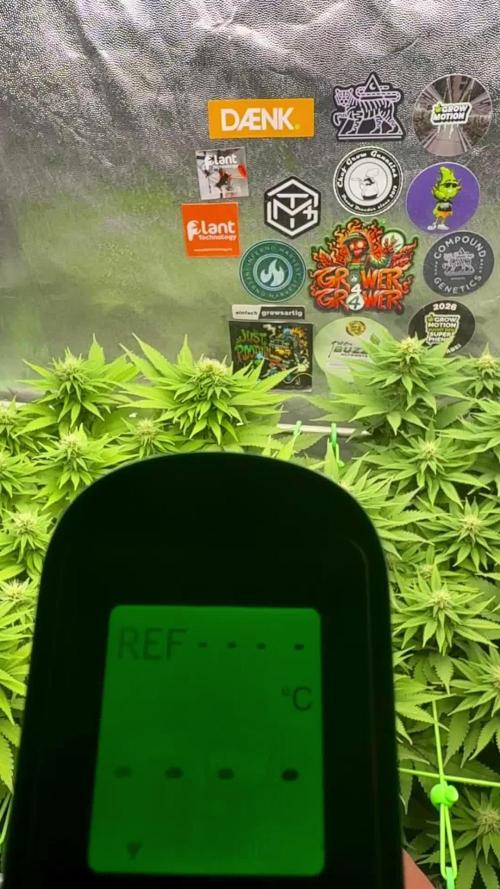
Defo/lollipopping done
The Mutation bud is forming a crazy „V“

Likes
2
Share


@dubby_m
Follow
D101: harvested the plant! Very happy with the grow :) Wettrimmed all the buds and hung them for drying. i will report after drying and curing!


Likes
19
Share


@n1mbu5
Follow
OK guys I'm starting at the beginning of week 5 so this one is only a few days after my last addition the the diary.
I noticed the very first pistils so now we are in week 1 of flower.
Punch 2 has dark greeb, curled down edges, maybe a nitrogen toxicity? I don't think I'm over watering, they didn't have water for 6 days when I noticed these symptoms.
Punch 1 doesn't have the dark green edged fan leaves or the curling down, but there are some pale white spots and smudges at the ends of the fan leaves.
Any ideas guys? I'm new to this so not 100% what is going on or how to fix. Any suggestions would be greatly appreciated. Thanks guys🎄
Likes
2
Share


@Ninjabuds
Follow
It's a nice change of pace to have these warmer temperatures, even if it's not quite spring yet. Low 40s during the day is a lot more comfortable than what we've been dealing with lately. Hopefully, this is a sign that spring's around
Those Bubble OG's are looking fantastic! It's awesome how two of them are starting to get that purple color – they look so cool. The third one might look a little different, but that just adds to the fun of growing them.

Likes
84
Share


@Coopmc
Follow
Start week 3 for seed bearing plants week 4 for the Pollen Donor she full of BALL’s rinced the STS spray bottle out with water gave her last watered down spritz there about to open any day I got a pollen screen to seperat my flower room
Structure on the SVF sure reminds me of AfGoo or Mazar!!
Think we have signs of Pollination some pistols top 1/3 starting to shrink back
Looking so dam good!!
All Kind of pollen and she barley started!!
SFV looks so much like a Affgoo
Likes
31
Share


@The_Doctor_Green
Follow
Esta semana ha llovido mucho(desde lunes a jueves) mucha humedad mucha agua, tengo miedo que aparezcan hongos, asique solo la regue con tricodermas para intentar combatir esos futuros hongos.
La próxima semana subiré fotos de las otras macetas también, ya que no hice tiempo para hacerlo hoy.
Likes
165
Share


@Tropicannibis_Todd
Follow
💩Holy Crap Growmies We Are Back💩
So what do you say we have some fun 👈 We got some EXOTIC SEEDS 👉 👻👻👻MONSTERMASH👻👻👻 😛
Well my friends we are just at the 21 day mark and as you can see the righty won 🏆👈
👉 So now i felt i need to start training her over to maximize her growth by doing some LST 👈
Lights being readjusted and chart updated .........👍
👉I used NutriNPK for nutrients for my grows and welcome anyone to give them a try .👈
👉 www.nutrinpk.com 👈
NutriNPK Cal MAG 14-0-14
NutriNPK Grow 28-14-14
NutriNPK Bloom 8-20-30
NutriNPK Bloom Booster 0-52-34
I GOT MULTIPLE DIARIES ON THE GO 😱 please check them out 😎
👉THANKS FOR TAKING THE TIME TO GO OVER MY DIARIES 👈

Likes
12
Share


@Luke_Lee
Follow
-08.08.2024
The seventh week begins.
The Mango Smile is doing great, the Skywalker is a bit small.
the light intensity has been adjusted again, the values:
PPFd=1200 DLi=70
both plants were watered with 1 liter of water per plant
(2ml BioGrow, 2ml BioBloom, 2ml TopMax - 1L Water)
-09.08.2024
Visual Control
-10.08.2024
Visual Control
Soll felt pretty dry, Both plants were watered with 1L water per plant
(2ml BioGrow, 3ml BioBloom, 3ml TopMax - 1L Water)
-11.08.2024
Visual Control
The soil has settled well after a few weeks and today the pots of both plants were filled with some new fresh soil.
Both plants were then watered with 500 ml of water per plant
-12.08.2024
Did nothing
-13.08.2024
Visual Control
Soil was dry, 1L Water per Plant
The Mango Smile develops yellow leaf tips. For now, just water and observe
-14.08.2024
Visual Control

Likes
Comments
Share

@dinosdarko
Follow
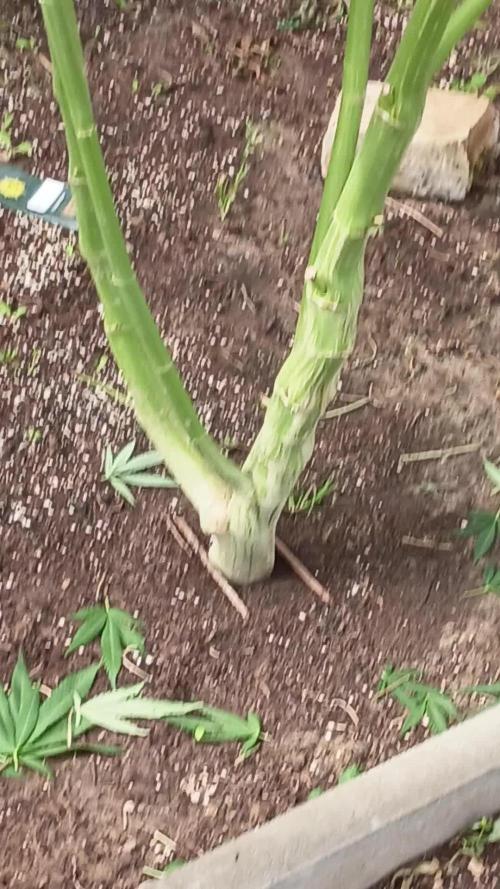
🌿 Gewächshaus-Monster - Update Papaya Frosting (Barney's Farm) 🌿Überblick & Wachstum:Wir sind offiziell am Ende der 3. Blütewoche angekommen und meine Papaya Frosting von Barney's Farm mutiert zu einem absoluten Baum! Der hormonelle Wachstumsschub (Stretch) ist glücklicherweise schnell vorbei, was auch Zeit wurde – die Dame hat eine gewaltige Show abgeliefert und steht aktuell bei einer beeindruckenden Höhe von 2,40 Metern. Gebogen.Training & Struktur: Ich habe sehr viel Arbeit in die Selektion und das Training in der frühen Phase gesteckt. Ich habe die Pflanze auf 5 Hauptbeine selektiert (Main-Lining) und die Haupttriebe kontinuierlich von links nach rechts gezogen. Das Ergebnis? Ein absolut verrückter Kronendurchmesser von knapp 3 Metern von allen Seiten! Der gewaltige Hauptstamm verholzt extrem stark und misst an der Basis bereits stolze knapp 7 cm im Durchmesser. Um diese enorme Masse an Pflanzenspitzen abzufangen, nutze ich ein Doppel-Netz-Setup. Das erste Scrog-Netz sitzt bei 1,40 m und das zweite, obere Netz ist fest bei 2,50 m montiert. Aktuell haben die höchsten Spitzen noch genau 10 cm Platz, bis sie das zweite Netz erreichen. Da der Stretch durch ist, wird sie in den nächsten Tagen perfekt in das obere Netz einrasten. Das wird ihr genau die physikalische Stabilität geben, die sie für die schwere Blütenproduktion in den nächsten Wochen braucht. Der Abstand zwischen den Knotenpunkten (Internodien) beträgt ca. 2,5 cm super kompakt und gesund.Entlaubung & Umgebung:Diese Woche steht eine radikale Pflegeeinheit auf dem Programm. Bei einem Durchmesser von 3 Metern bildet sich verdammt schnell ein undurchdringlicher Dschungel. Ich habe ein gründliches Lollipopping durchgeführt und das untere Drittel der Pflanze komplett freigeputzt. Alle schattigen, winzigen Blütenansätze und großen Fächerblätter unten sind weg. So wird 100 % der Energie aus dem dicken Stamm direkt in die oberen Hauptbuds geleitet. Außerdem verbessert es die Luftzirkulation am Boden massiv, wie man auf den Bildern am freigelegten Stamm gut sehen kann.Zur Umgebung: Mein Gewächshaus ist 4 m breit, 8 m lang, 3 m hoch und steht auf einem tiefen Fundament. Ich habe das große Glück, alle großen Fenster (1,70 m x 1,20 m) und die große Haupttür rund um die Uhr (24/7) komplett offen lassen zu können, da das Gewächshaus in einem gesicherten Garten steht. Zusammen mit einem durchgehenden, 3 cm breiten Luftschlitz im Dach funktioniert der Kamineffekt perfekt, um Feuchtigkeit sofort abzuführen und Kondenswasser zu verhindern.Bewässerung & Düngung:Dieses Monster hat einen gewaltigen Stoffwechsel und bekommt alle 4 bis 5 Tage Durst. Ich gieße immer erst dann, wenn die oberen 2–3 cm der Erde trocken sind, damit das organische Bodenleben in den tieferen Wurzelzonen aktiv und glücklich bleibt.Klares Wasser hinterher: Direkt im Anschluss gieße ich massiv 40 bis 50 Liter normales Leitungswasser nach. Das spült die Nährstoffe tief ins Erdreich, wo das riesige Wurzelsystem sie perfekt aufnehmen kann. Die Pflanze liebt diesen Rhythmus und zeigt keinerlei Mängel oder Überdüngungszeichen. Die ersten wunderschönen weißen Härchen (Stigmen) ploppen überall auf und stapeln sich dicht an dicht. Da es sich um die extrem harzreiche Papaya Frosting handelt, zeigen sich jetzt schon die ersten glitzernden Trichome an den jungen Blüten. Auf in Woche 4 für das echte Anschwellen der Buds und den berühmten Cali-Frost! 🚀

Likes
3
Share


@DarbGrowDiaries
Follow
Hope I can keep it short, will try to train it a bit so it fills the small space,
Looking very beautiful and a very fast pace

Likes
4
Share


@Soskar69
Follow
Hello!!
Too bad I only found this site now and didn't take too many photos during the first month.
About the plant, it was the smallest of my plants at first, but then it grew very weel and now is the biggest of my girls. She entered in flowering a week later than expected, but beacuse of that she could grow more than the others. I've done only some LST and the plant just loved it, now i have like 11-12 main stems. Today I also have done some lollipopping but very cautiously because it was my first time doing it, and I didn't want to mess up.
Likes
49
Share


@Roberts
Follow
I switched her to ph water yesterday. She has a good cloudy trichromes with just a few amber started. So in roughly a week she should be right about where I want to try it at. She still has some flower, even though I messed her up in vegging. I have been having issues across the board here, and there on different plants. Beside that she smells good, and good trichrome layer. I am just letting her finish up, and will harvest on next update. Thank you Medic Grow, Athena, and Fast Buds. 🤜🏻🤛🏻🌱❄️🌱
Thank you grow diaries community for the 👇likes👇, follows, comments, and subscriptions on my YouTube channel👇. ❄️🌱🍻
Happy Growing 🌱🌱🌱
https://youtube.com/channel/UCAhN7yRzWLpcaRHhMIQ7X4g
If anyone needs to purchase fastbuds here is a link for my affiliate program
https://myfastbuds.com/?a_aid=60910eaff2419
Likes
89
Share


@XII_XII_EarlyRaver
Follow
Happy days my friends 😏
I'm going into the flush periode so I'm thinking one liter with 1 ml flawless finish after 5 or 10 minutes another clear 4 liter water and repeating this every day. I'm really curious what is the best finish, so how is your opinion about that ???
And yea she had a beatifull week and the buds are nice and fat 😶🌫️🤤 so lets finish her up ✌️👽🤤🤤
Likes
10
Share

@Bncgrower
Follow
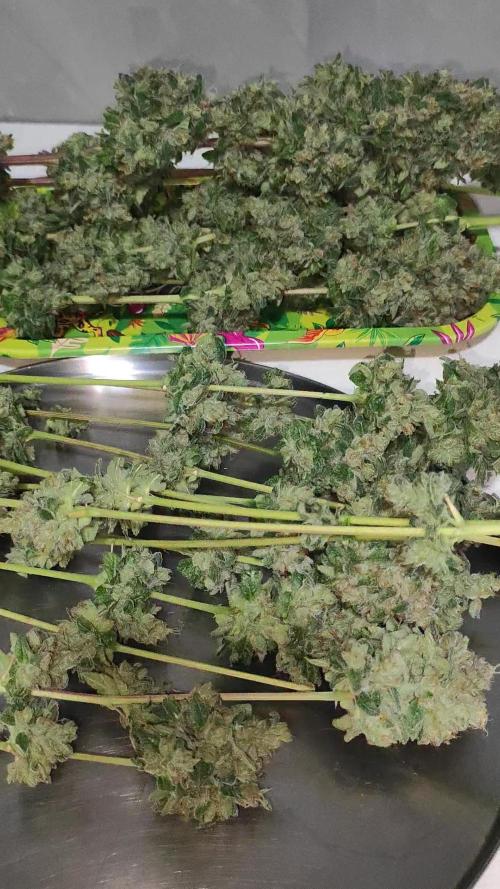
Another successful grow! This strain has a wonderful aroma and generous, resinous buds. This will definitely always be my go-to strain. 💪🥦
Likes
22
Share


@Bigdreams
Follow
It's been hot and humid all week, so I had to open tent and run big fan to keep temp from going passed 83. Also used only water a few times to try to get some nitrogen out of system it is a bit to green. Hopefully stretching is complete up to 34 inches now from just 12 inches right before flip so this is nearly triple in size. Continued trimming fan leaves on lower 3/4 left as many as I could that were not blocking light which is always so few. Altogether going well.