


Likes
Comments
Share


@DogDoctorOfficial
Follow
🍬🌿 8×8 Adventure – Week 14
Candy Rain Auto by Zamnesia
The Solo Survivor Is Getting Closer… But She's Not Fooling the Microscope! 😂🔬🌸💚
Welcome back to another chapter of the 8×8 Adventure! 🌱💚
And oh my goodness…
OUR CANDY RAIN! 🍬😂🌸
This girl just keeps giving us something to talk about.
She's still beautiful.
She's still developing.
She's still showing us those lovely flowers.
And she's getting closer to the end of her journey.
But, of course…
She wouldn't be Candy Rain if she didn't give us a little surprise along the way.
😂😂😂
Because just when you start thinking that a plant is approaching the finish line, she decides to throw fresh white hairs all over the place.
Everywhere!
🌸?🌸?🌸
And naturally, the first thought is:
"Girl… are you starting another round?"
😂😂😂
Not so fast!
Because although those fresh white pistils might make her look like she's trying to start something new, the trichomes are telling a different story under the microscope.
And that's precisely why we don't judge a plant's readiness by one visual clue alone.
Candy Rain is getting close.
Very close, I believe.
My current feeling is that this could be her final week, but that's an expectation, not a promise.
We'll keep looking, keep observing, and let the plant tell us when she's ready.
No rushing.
No guessing based on white hairs alone.
And definitely no letting Candy Rain fool us just because she's decided to grow a fresh set of little white flags!
😂🍬👑
So let's give our beautiful solo survivor the spotlight she deserves.
────────────────────────
🍬 WEEK 14 – THE FINISH LINE IS GETTING CLOSER
If you've been following Candy Rain from the beginning, you already know that this girl has developed her own personality throughout the 8×8 Adventure.
Our solo survivor.
Our beautiful green girl.
Our plant that seems determined to fill herself with flowers.
And now, here we are, approaching what may be the final chapter of her flowering journey.
She's still beautiful.
She's still carrying those developing flowers.
And she's still giving us new details to observe.
The most noticeable thing this week?
Those fresh white pistils.
?🌸
They're appearing across the plant, and if we were judging solely by the pistils, we might be tempted to think she still has a long way to go.
But that's exactly why I don't want to make that assumption.
Different cultivars can behave differently as they approach maturity. Some continue producing fresh pistils late in flowering, and that alone doesn't necessarily mean the entire plant has restarted its flowering journey.
We need to look at the whole picture.
The flowers.
The overall development.
The trichomes.
And how everything is progressing together.
Candy Rain is getting closer, and the microscope is helping us understand where she actually stands.
She's not quite ready yet.
But I have a feeling we're approaching the final stretch.
🍬🌿🔬
────────────────────────
? WHITE PISTILS EVERYWHERE – WHAT IS SHE TRYING TO TELL US?
Honestly, Candy Rain…
What are you doing?
😂😂😂
We're trying to work out whether you're approaching the finish line, and you decide to throw fresh white hairs all over your flowers.
?🌸?🌸?
I find this fascinating because I've seen this behaviour in some cultivars before.
As flowering progresses, certain plants continue producing new pistils even when other signs suggest they're getting close to maturity.
That doesn't automatically mean something is wrong.
It also doesn't automatically mean the plant needs several more weeks.
Fresh pistils are one observation, not the entire verdict.
And this is where experience, patience, and looking at several indicators become important.
I don't want to pretend that every cultivar follows the same visual script.
They don't.
Some plants give you a fairly straightforward progression.
Others keep surprising you.
And Candy Rain?
Well…
She's clearly decided to keep us guessing.
😂🍬👑
The white hairs are part of the story, but they're not the whole story.
────────────────────────
🔬 THE MICROSCOPE TELLS A DIFFERENT STORY
This is where things get interesting.
When I look at the trichomes under the microscope, the picture isn't quite the same as the one suggested by all those fresh white pistils.
She's not ready yet.
And that's an important distinction.
I don't want to call harvest simply because the plant looks close, because the pistils have changed, or because I'm getting impatient to finish another chapter of the 8×8 Adventure.
😂🌱
The trichomes give us another useful piece of information about flower maturity, and they need to be considered alongside the overall condition and development of the plant.
They don't magically tell the entire story on their own, either, but they help us make a much more informed assessment than judging by pistil colour alone.
So, for now, Candy Rain stays where she is.
We're observing.
We're checking.
We're comparing what we see with the progression from previous weeks.
And we're letting the evidence guide us.
My feeling is that this may be her final week.
But if she needs more time, she gets more time.
The calendar doesn't decide when a plant is ready.
The plant does.
🔬🍬🌸
────────────────────────
⏳ MY GUESS? POSSIBLY THE FINAL WEEK!
I'm going to put my expectation out there.
I think this could be Candy Rain's final week.
There.
I've said it.
😂🍬👑
But please underline the word "could" in your mind.
This isn't a fixed harvest date.
It's my current impression based on what I'm seeing as I follow her development.
The fresh pistils are one part of the picture.
The trichomes are another.
The overall progression is another.
And when I put all those observations together, I feel we're getting very close.
But we'll see.
Time will tell.
And if Candy Rain decides she needs a little more time, then we'll keep watching her.
I'm not interested in forcing a finish just because I've made a prediction in a diary.
😂
I would much rather be patient and document what actually happens than pretend I knew the exact day in advance.
That's the beauty of keeping weekly records.
We can share our expectations while staying honest about the uncertainty.
So, Candy Rain…
If this is your final week, let's make it a beautiful one.
And if you need a little longer?
We'll be here.
🍬💚🌿
────────────────────────
💚 STILL OUR BEAUTIFUL GREEN GIRL
One thing that hasn't changed is how much I enjoy looking at this plant.
She's still beautiful.
She's still got that lovely green presence.
And her flowers continue to catch my attention.
There is something satisfying about following a plant for weeks and seeing how the small changes gradually add up.
At first, you're watching the plant establish herself.
Then the structure develops.
The flowers appear.
The flowers become more substantial.
The details become more interesting.
And eventually, you reach this stage where every new observation makes you wonder how close she is to the next chapter.
That's where Candy Rain has brought us.
She's not just a photograph from Week 14.
She's the result of everything that happened before it.
And I love being able to look back at those earlier updates and compare them with what we're seeing now.
🍬🌿💚
────────────────────────
🍬 OUR SOLO SURVIVOR HAS COME A LONG WAY
Let's not forget where this story started.
Candy Rain has been our solo survivor throughout this part of the 8×8 Adventure.
And she has certainly made the most of her place in the room.
She's developed her own flowering structure.
She's filled herself with beautiful flowers.
She's shown us her own rhythm.
And she's continued to surprise me throughout the journey.
I originally called her our solo survivor because she was the one standing there on her own in this particular genetic group.
But sometimes I look at her and think she doesn't seem particularly interested in the word "solo."
😂😂😂
She's one plant, yes.
But she's given us plenty to photograph, plenty to discuss, and plenty to observe.
And now she's approaching the final stretch.
Whatever happens next, she's already given us a beautiful story to follow.
────────────────────────
💡 SAME ROOM – SAME PHOTONS – HER OWN RESPONSE
And once again, let's return to one of the foundations of the 8×8 Adventure.
Candy Rain is sharing the room with the other plants.
The same general environment.
The same 12/12 light schedule.
The same overall nutritional approach.
The same expanded lighting setup.
And yet, she continues to express herself in her own way.
🍬☀️🌿
The two additional Future of Grow Black Series 600W fixtures remain part of the room's expanded lighting setup.
We're using that additional capability with controlled output rather than simply running everything at maximum.
Our recent target has been around 1,500 PPFD across the upper canopy, with the actual intensity varying according to canopy height and position.
Lumiflora also contributes additional light deeper in the canopy.
And Candy Rain is receiving those same general lighting conditions as the rest of the room.
But her response is her own.
That's one of the things that continues to make this project interesting.
The room provides the shared stage.
The genetics provide the individual performance.
Some plants stretch.
Some stay compact.
Some develop at one pace, while others follow a different rhythm.
And even when they appear to be approaching the same stage, they can show different signs along the way.
Candy Rain is giving us another example of that.
Same room.
Same photons.
Different story.
────────────────────────
🔴 FAR-RED, DEEP-RED & OUR 15-MINUTE LIGHT ROUTINE
Now, let's talk about another part of the room's lighting routine.
We've been using far-red and deep-red lighting as part of our end-of-day approach, including a 15-minute red-light period after the main lights go off.
The idea behind this routine is to influence the plants' light signalling at the transition into the dark period and help create a consistent end-of-day transition.
But there's an important distinction here.
Red light, deep-red light, and far-red light aren't interchangeable terms.
They're different parts of the light spectrum, and plants can respond to them differently.
Red light is commonly associated with photosynthetic activity and plant light signalling.
Far-red light is particularly relevant to phytochrome signalling, which helps plants interpret changes in light conditions and the transition between day and night.
The response depends on the spectrum, intensity, duration, and the plant's wider environment.
So when we talk about our 15-minute period, we're talking about a deliberate lighting routine we're testing and using in this room.
We're not claiming that fifteen minutes is a universal magic number, or that every plant will respond in exactly the same way.
As always, we observe the plants and consider the whole environment.
🌿🔴🌙
────────────────────────
🌙 HELPING THE PLANTS TRANSITION INTO NIGHT
One of the reasons people experiment with end-of-day far-red is the way plants use light signals to interpret their surroundings.
Plants don't simply know that it's nighttime because somebody switched off a lamp.
They respond to changes in the spectrum and intensity of light, and those signals can influence different aspects of plant development.
Far-red light can shift the balance of phytochrome states, helping plants interpret the transition from light to darkness.
That's the scientific idea behind using far-red as part of an end-of-day routine.
In our setup, we're using a 15-minute period after the main lights go off as part of that transition.
I like experimenting with the lighting environment, but I also want to keep the claims realistic.
The response isn't identical across all cultivars, and the effects depend on the conditions and how the light is delivered.
So this is part of our approach and observation, not a guarantee that a particular result will happen.
And Candy Rain is still following her own path within that shared environment.
🍬🌙🌿
────────────────────────
☀️ THE EMERSON EFFECT – WHEN RED AND FAR-RED WORK TOGETHER
Now, let's bring in a fascinating piece of plant science: the Emerson effect.
The Emerson effect describes how photosynthesis can become more efficient when red light and far-red light are supplied together than would be expected from their individual effects alone under certain experimental conditions.
Why?
Because photosynthesis involves two cooperating photosystems, known as Photosystem II and Photosystem I.
They absorb light most effectively in different, overlapping parts of the spectrum.
When suitable red and far-red wavelengths are provided together, they can help balance the activity of these two photosystems.
In simple terms, they can work together more effectively than either wavelength would suggest on its own.
That's the fascinating part.
Plants don't respond to light as if every photon operates in isolation. The spectrum matters, and different wavelengths can interact with the plant's photosynthetic machinery in different ways.
☀️🔴🌿
However, we should keep the science precise.
The Emerson effect is a specific phenomenon demonstrated in photosynthesis research. It doesn't mean that adding any red or far-red light automatically increases yield, improves flower quality, or guarantees a faster finish.
The result depends on the spectrum, intensity, duration, and wider growing conditions.
And the 15-minute end-of-day routine we're using is a separate practical lighting choice. We shouldn't assume that it directly reproduces every condition used to demonstrate the Emerson effect.
I find the science fascinating, and it's one more reason I enjoy experimenting with lighting rather than thinking of every LED as simply a bright lamp.
Different wavelengths can have different roles.
The way we combine them matters.
And the plants' responses are worth observing.
💡🌿🔬
────────────────────────
💡 MORE THAN JUST SWITCHING THE LIGHTS ON
This is what I enjoy about the lighting side of the 8×8 Adventure.
We can talk about the main fixtures.
We can talk about PPFD.
We can talk about canopy position.
We can talk about red and far-red wavelengths.
We can talk about the transition between light and darkness.
And we can look at the plants and ask how they are developing under the overall conditions.
But I don't want to credit every little change to one specific light or one particular setting.
The plant is responding to the whole environment.
Genetics.
Light.
Nutrition.
Temperature.
Humidity.
Water availability.
And the way all those factors come together.
Candy Rain's fresh pistils are interesting, but I wouldn't automatically attribute them to the red-light routine.
We don't have enough evidence to make that claim.
Instead, we keep documenting what we see and avoid turning a coincidence into a conclusion.
That's how I want to approach these experiments.
Curiosity first.
Observation second.
Conclusions only when the evidence supports them.
💚🔬🌿
────────────────────────
⚗️ NUTRITION – THE SAME FOUNDATION CONTINUES
Candy Rain remains part of the same overall nutritional approach used in the room during this stage.
The recent feeding notes were:
🌱 Plagron Terra Bloom – approximately 2.3 ml/L
🌱 Power Buds – 1 ml/L
🌱 Green Sensation – 1 ml/L
🌱 Sugar Royal – 1 ml/L
⚗️ pH adjusted as required
The recent solution readings were around pH 6.02 and EC 2.14 mS/cm, although the exact values can vary with the latest mix.
These are the room's recent reference values rather than a claim that every reading has remained identical throughout the week.
As Candy Rain gets closer to the end, the important thing for this diary is to keep documenting her actual condition rather than assuming that all plants need the same final timeline.
She's her own plant.
She's shown us her own behaviour.
And we're continuing to observe her accordingly.
🍬🌿💚
────────────────────────
🌡️ RECENT ROOM CONDITIONS
For context, the room's recent reference conditions have been approximately:
🌡️ Day air temperature: 26.5°C
🌙 Night air temperature: 26°C
💧 Relative humidity: 61%
🌱 Substrate temperature: 25°C
💦 Nutrient solution temperature: 25°C
⚗️ pH: approximately 6.02
⚡ EC: approximately 2.14 mS/cm
💨 CO₂: approximately 693 ppm
💡 Light schedule: 12/12
? Pot size: 15 litres
💧 Watering: approximately 1.4–1.45 litres per plant per 24 hours
These are the recent room figures, not a claim that every parameter has been measured at exactly the same value during every moment of Week 14.
The overall environment remains shared with the other plants still in the room.
And while Candy Rain approaches her finish, the rest of the 8×8 Adventure continues.
Same room.
Different plants.
Different timelines.
🌿🍬💚
────────────────────────
👀 WHAT I'M WATCHING NOW
At this stage, I'm keeping an eye on the overall progression rather than allowing one feature to dictate the entire decision.
? The fresh white pistils.
🔬 The trichomes under the microscope.
🌸 The development and appearance of the flowers.
🌿 The overall condition of the plant.
📸 The changes compared with previous weekly photographs.
All these observations help build a more complete picture.
The fresh pistils are certainly interesting, but they don't automatically mean she has restarted flowering or that she's far from maturity.
The microscope currently suggests she's not quite ready.
And my feeling is that she's getting very close.
That's where we stand today.
No drama.
No premature conclusions.
Just watching Candy Rain as she approaches the next chapter.
────────────────────────
🔮 WHAT COMES NEXT?
My guess is that we may be looking at Candy Rain's final flowering week.
But, as always, we'll let time tell us whether that expectation is correct.
If she is ready, we'll document the next stage.
If she needs longer, we'll continue observing.
Either way, there's no reason to force a date simply because I made a prediction.
😂🍬
And while Candy Rain is approaching the finish line, the rest of the room is still doing its thing.
The 8×8 Adventure continues.
Each plant gets her own diary.
Each phenotype gets her own spotlight.
And each one gets to show us how her story unfolds.
────────────────────────
💭 FINAL THOUGHTS – CANDY RAIN, DON'T LET THOSE WHITE HAIRS FOOL US!
Week 14.
Candy Rain Auto by Zamnesia.
🍬👑🌸💚
Still beautiful.
Still developing.
Still getting closer.
And still finding ways to keep me guessing.
😂😂😂
Those fresh white pistils are appearing all over the place, but the microscope is giving us a different perspective.
She's not ready just yet.
And although I suspect this could be her final week, I'm not going to pretend that I know for certain.
The plant gets the final say.
That's the rule.
We've also been continuing our lighting experiments, including the 15-minute red-light period after the main lights go off, with far-red and deep-red wavelengths forming part of our wider lighting approach.
The science behind plant light responses is fascinating, especially when we look at phytochrome signalling and the Emerson effect.
But we're keeping our observations separate from our assumptions.
We're not claiming that the lighting routine caused her fresh pistils, nor that it guarantees a particular harvest outcome.
We're simply documenting the environment, watching the plants, and learning as we go.
And that's what the 8×8 Adventure is all about.
Twelve plants.
One shared room.
Different genetics.
Different expressions.
And individual stories that never stop being interesting.
🍬🌿💚
So, Candy Rain…
Keep doing your thing, girl.
We'll keep watching those trichomes.
We'll keep admiring those flowers.
We'll keep taking our photographs.
And we'll wait until the evidence tells us you're ready.
You might be approaching the finish line.
You might need a little more time.
Either way, you're still beautiful, and you still deserve the spotlight.
🍬?🌸🔬
Let's give our solo survivor the love she deserves.
Let's appreciate the journey.
Let's stay curious.
And let's see what next week brings.
────────────────────────
🙏 THANK YOU
As always, a massive thank you to everyone following the 8×8 Adventure. 💚🌱
Thank you to GrowDiaries for giving us the space to document these individual plant journeys and share our observations with growers around the world.
Thank you to Zamnesia for the Candy Rain genetics and for giving us this beautiful solo survivor to follow.
Thank you to Plagron for supporting the room with the growing media and nutrition used throughout this adventure.
A huge thank you to Future of Grow for supplying the additional Black Series 600W fixtures and giving us the opportunity to explore this expanded lighting setup. 💡☀️🌿
Thank you to Lumiflora for helping bring additional light into the deeper areas of the canopy.
Thank you to TrolMaster for helping us monitor and manage the room environment behind the scenes.
And thank you to everyone who reads, comments, asks questions, shares experiences, and follows these girls week after week.
It genuinely means a lot. 💚
If you'd like to join our growing community, you're more than welcome to come and say hello on Discord:
https://discord.gg/dogdoctorofficial
We have growers with different levels of experience, conversations about all kinds of growing topics, competitions, prizes, giveaways, and community discount codes.
But above all, we're building a place where people can feel welcome.
You don't need to be an expert.
You don't need to have a huge garden.
You don't need to speak every technical language.
You can ask questions, share your experience, join the conversation, or simply hang out and listen.
There's no level you need to reach before you're welcome.
Respect, curiosity, and a willingness to learn are more than enough.
We love talking about this plant, sharing what we know, learning from one another, and enjoying the journey together.
It's becoming a beautiful community, and we'd love to have you with us.
💚🌱🤝
Growers Love, my friends. 💚🌱
See you next week in the 8×8 jungle…
where the photons keep flying, the plants keep surprising us, and Candy Rain is still throwing fresh white hairs around like she hasn't heard that we're getting close to the end.
😂🍬?🌸
Keep shining, girl.
We'll let the microscope have the final word.
💚🔬✨

Likes
11
Share


@Canadian
Follow
I allow 36 hours for the plants to eat up all nutrients after the Flash and now it's time for Harvest.
Thank you for reading and have a happy grow


Likes
2
Share
@DogDoctorOfficial
Follow
🌱 Week 3 | Purple Haze Photo | Folder 6A | Building the Foundation
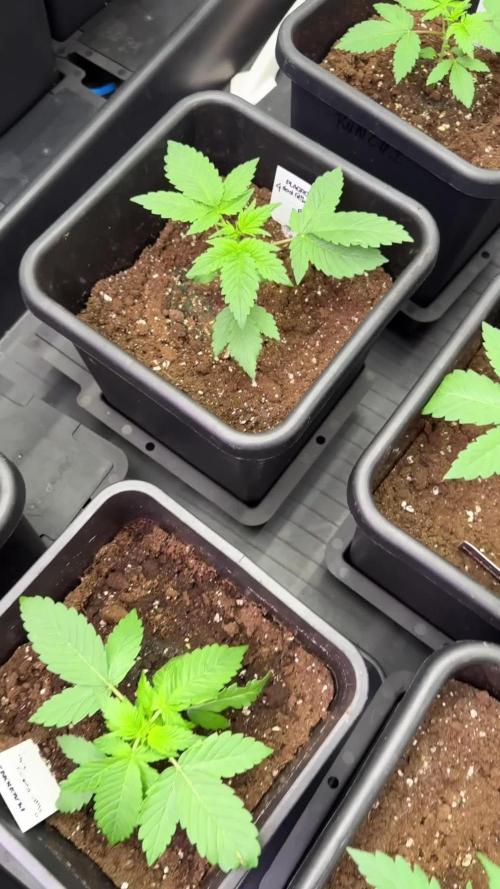
Every phenotype tells its own story, and this Purple Haze is beginning to reveal exactly the kind of structure I was hoping to see. Looking back at the photographs from the beginning of the week and comparing them to where she stands today, the progress has been remarkable. The increase in leaf size, stem thickness, and lateral branch development shows that the plant has settled comfortably into her environment and is now entering a period of rapid vegetative growth.
This diary is part of my Project Blue series, where every plant receives its own individual journal. Although they all share the same environment, nutrition, and cultivation method, documenting each phenotype separately allows me to observe the subtle differences that make every plant unique. Two seeds from the same pack can behave very differently, and that’s exactly what makes growing from seed so fascinating.
Like every plant in this project, Purple Haze is being grown using the 12/12 From Seed method. Instead of giving the traditional vegetative light schedule, the plants receive a flowering photoperiod from the moment they emerge. This technique keeps the plants compact while still allowing them enough time to develop a strong structure before flowering naturally takes over. It’s an approach I enjoy because it produces efficient, manageable plants while still allowing each phenotype to express its personality.
Throughout the week the environment remained extremely stable, providing the consistency young plants need to thrive.
Environmental Conditions
• Day temperature: 27°C
• Night temperature: 25°C
• Relative Humidity: 55%
• Root Zone Temperature: 21°C
• Nutrient Solution Temperature: 20°C
• pH: 6.0
• EC: 1.3
• CO₂: approximately 666 ppm
• Light Schedule: 12/12
• Average PPFD: 600–700
Maintaining these parameters allows the plants to dedicate their energy to healthy growth rather than constantly adapting to environmental fluctuations.
Feeding Schedule
This week the nutrition remained focused on root establishment and balanced vegetative growth using the Plagron Terra line:
• Terra Grow — 1.8 ml/L
• Power Roots — 1 ml/L
• Pure Zym — 1 ml/L
• Sugar Royal — 1 ml/L
The goal isn’t to push maximum growth as quickly as possible but to encourage strong, healthy development while building a vigorous root system capable of supporting heavy flowering later in the cycle.
A Beautiful Structural Evolution
The difference between the first photographs of the week and the last ones is immediately noticeable.
The stem has thickened considerably, becoming sturdy enough to support future flower production without any assistance. Internodal spacing remains tight, creating a compact plant with multiple future flowering sites already beginning to establish themselves.
The leaves are broad, flat and richly coloured, showing no signs of nutrient deficiencies or environmental stress. New growth emerges with a healthy lighter green before maturing into the darker foliage characteristic of vigorous vegetative development.
Perhaps the most exciting change is the development of the secondary branches. Each node is now pushing strong lateral shoots, giving the plant a naturally symmetrical structure that should translate into an even canopy during flowering.
Why I’m Using Leaf Tucking Instead of Defoliation
One of the techniques I’ve been using throughout the week is leaf tucking.
Rather than removing healthy fan leaves, I simply tuck them underneath neighboring branches to expose the developing shoots hidden beneath the canopy.
This offers several advantages:
* More light reaches the lower branches.
* Airflow improves naturally.
* The plant keeps all of its solar panels, allowing maximum photosynthesis.
* No recovery time is required because nothing is removed.
Young plants need every healthy leaf they can keep. Fan leaves are the engines that drive growth, so whenever possible I prefer repositioning them instead of cutting them away. Defoliation can always come later if it becomes necessary, but at this stage gentle canopy management is more than enough.
Looking Ahead
Purple Haze is quickly becoming one of the strongest structured plants in the room. She has responded beautifully to the stable environment, balanced nutrition and simple canopy management. Every day she’s producing more side branches, larger leaves and a noticeably thicker main stem.
If she continues at this pace over the coming weeks, she should enter flowering with an excellent framework capable of producing an even canopy and plenty of well-positioned bud sites.
Sometimes the best training isn’t about bending, topping or cutting—it’s simply about giving the plant everything it needs and then getting out of its way.
A huge thank you to Plagron, Zamnesia, GrowDiaries, and everyone following this Project Blue adventure. Mr. Baggy made his usual inspection this week and left with a big smile. According to him, Purple Haze has officially entered her “future forest” phase, and judging by the way she’s growing, it’s hard to disagree.
Growers Love 🌱🛍️


Likes
24
Share


@Richard_Harrow
Follow
Hello everyone! I'm a little late but it does not work))) As you can see, do small exercises and we are entering the flowering phase, it is a very strong and tolerant variety, I hope it will be very beautiful in flowering🌺🔥🚀🔥💚

Processing
Likes
24
Share


@Cogollo_eu
Follow
**Encontrarás la traducción a español al final de la descripción**
From/Desde: 07/10/19 || To/Hasta: 13/10/19
From day/Desde día: 77 || To day/Hasta día: 83
If you like this week, please hit a like, it costs you nothing! 👊. Thanks in advance 😉!
-----WEEK SUMMARY-----
The colas have already begun to be well defined this week, as it can be seen. It does not seem that the buds are going to cover from the bottom to the top because there is much space between the middle nodes. I really don't know what this may be due to, probably because of lack of light or by using nutrients in the wrong way. The same happened to me with the Gorillas and Money Makers in my last diary and in that case I attributed it to the failed defoliation I made.
This week I begin to detect a deficiency of magnesium in one of the large leaves (or so I think), even so within 2 weeks I do not take precautions because until then it was not obvious to me (serious error).
On the other hand this week I started to go hard with the E.C. in the irrigations, I trusted that I was not feeling so bad E.C. sings on Alice and the problems came all at once within 2 weeks.
-----WATERING CALENDAR-----
08/10/19 DAY 78 - 3 l with BudCandy, BigBud, Bloom Nutrition & Stimulator, RhinoSkin, B52, Nirvana, Sensyzim & PKBooster @ (2.3 EC | PH 6.4 | 24.8ºc)
11/10/19 DAY 81 - 4 l with Megabud (1 g/l), SilicaPower, Budcandy, BudFactorX, BloomStimulator & (BigBud & BloomNutrition) half dosed @ (2.1 EC | PH 6.3 | 24.5ºc)
*****ESPAÑOL*****
Por favor, si te gusta esta semana dale un like, no te cuesta nada 👊. ¡Gracias por adelantado 😉!
-----SUMARIO SEMANAL-----
Esta semana ya se han empezado a definir bien las colas, como se puede observar no parece que los cogollos vayan a cubrir de la parte inferior a la superior pues hay bastante espacio entre los nodos medios. Realmente no se a que puede ser debido esto, probablemente por falta de luz o por estar usando los nutrientes de forma equivocada. Esto mismo me ocurrió con las Gorilas y Money Makers de mi último diario y en ese caso to lo achaqué a la fallida defoliación que realicé.
Esta semana empiezo a detectar una deficiencia de magnesio en una de las hojas grandes (o eso creo), aún así hasta dentro de 2 semanas no tomo precauciones pues hasta entonces no se hizo obvio para mí (grave error).
Por otro lado esta semana se me empezó a ir la mano con la E.C. en los riegos, me confié en que no la estaba sentando mal tanta E.C. y los problemas vinieron todos de golpe dentro de 2 semanas.
-----CALENDARIO DE RIEGO-----
08/10/19 DÍA 78 - 3 l with BudCandy, BigBud, Bloom Nutrition & Stimulator, RhinoSkin, B52, Nirvana, Sensyzim & PKBooster @ (2,3 EC | PH 6,4 | 24,8ºc)
11/10/19 DÍA 81 - 4 l with Megabud (1 g/l), SilicaPower, Budcandy, BudFactorX, BloomStimulator & (BigBud & BloomNutrition) half dosed @ (2,1 EC | PH 6,3 | 24,5ºc)

Likes
63
Share


@MeaCulpa
Follow
Those were the last ones. So I'm done with my second grow.
I should have left out the two Hulk Berries here completely. I had this space problem anyway and, as I said, they were seeds from a hermaphrodite/crossed grow.
They have the most seeds. I think I'll make oil out of this. Let's see.
My conclusion: a great pleasure to be here. Many thanks to everyone for help, encouragement and criticism. I'll bother you some more. Nice weekend @all

Likes
44
Share


@RakonGrow
Follow
Note: jegliches Equipment findet ihr in der Germinations Woche .
Day 22:
PPFD 410 * 20h = DLI 29.52
Day 23:
Day 24:
+ Dünger
+ + 0.5 Flaschenwasser
+ + + Rhizotonic
+ + + Terra Vega
+ + 0.6 Leitungswasser
+ final PH 6.5
Day 25:
Day 26:
Day 27:
+ Flaschenwasser 2.5 L (PH 7.2 EC 0.26)
+ + CanaCym
+ Final PH 6.1
= Drain : EC 1.325
Sieht bissel danach aus als hab ich etwas zuviel Urgesteinsmehr in die Erde eingearbeitet :)) Muss ich halt bissel spaarsamer mit der Düngung umgehen .
Day 28:
Das Wetter und die liebe Luftfeuchtigkeit :(( Manchmal denk ich das ich Outdoor growe :))
Im Video sieht man schön wie der kleine Zwerk sich selber mit seinen riesen Blättern SCROG mäßig den Wuchs in die Breite erzwingt :)) Die Blütentriebe müssen halt den Weg zum Licht mit aller Anstrengung erreichen .
Likes
10
Share


@Master_weeda
Follow
Bonjour à tous les padawans et maîtres jedis
Tout d'abord merci à @pyramidseeds de me permettre de faire cette culture en m'offrant les graines
Merci aussi à @lientec_led de m'offrir l'opportunité de tester sa toute nouvelle lampe Roccit 240w ainsi que organic nutrients pour l'engrais
MATÉRIEL CONFIGURATION
Box 80×80×160
Lampe led Lientec Roccit 240w
Ventilateur à pince 15 watts
Xiaomi Deerma humidificateurs 5L
Hygrometre thermomètre
Extracteur PROFAN 107 m3/h - 100
Prise programmable électronique ×2
1 pot carré noir 11 litres
Engrais organic nutrients
Substrat biobizz ligthmix
Fil de fer et pince coupante
Microscope
Petite balance de précision
CULTURE ÉTAPE PAR ÉTAPE
J'ai tout dabord fais germé ma graine avec le easy start de Royal queen seed et je suis agréablement surpris car franchement le taux de réussite est très élevé (18 graines sur 20) simple d'utilisation et très efficace.
Une fois la plantule sortie et d'une hauteur de 2 ou 3 centimètres je la prend délicatement et la place directement dans son pot définitif. Je préconise des pots allant entre 10 litres et 15 litres pour des autofloraisons cultivées en intérieur.
Le pot aura été préalablement préparé avec 80 grammes de big plant de organic nutrients que je mélange avec les 11 litres de substrat
Je dépose la plantule dans son pot définitif je recouvre un peu de avec de la terre je tasse légèrement et j'arrose pour garder le substrat humide pas plus
Je place ma lampe led 300watts à environ 90 centimètres de la plantule avec un cycle de lumière de 20/4 grace a un programmateur car c'est pour moi le cycle de lumière qui offre le meilleur rendement pour une autofloraison.
Jour 1 préparation du substrat
Avant transplantation définitive je mélange 80 grammes de bio stimulant bib plant de organic nutrients et j'arrose avec 2 litres d'eau ph6.3 à laquelle j'ajoute 0.7 gramme de enhancer feeding greenhouse par litre d'eau

Likes
12
Share


@Hydronaut
Follow
Left town for a few days and remote managed the grow flawlessly and to spec. Looking better than ever - and I wasn’t even around.
She’s a late stretcher. Last 4 days, 1+ inch vertically a day. Praying that she stays short at 20ish inches.

Likes
3
Share


@123Grow
Follow
This bean is during me CRAZY 🤣🤣🤣 I had some slow growth with my RuntZ, but they are on the go. This strain —- I gotta get the conditions right for it. It seems to prefer less water and more heat?? I am not flowering this strain until I can take 5-6 Clone’s off of it.
It’s been feed SST, LABS, bacteria, fungi, rain dances. Just isn’t responding like I assumed, but I am taking responsibility for the issues, NOT the cultivar.
11-3 And……we are back in the game!!! The inputs began showing the effectiveness. Leaves are larger, no stretching. The bean just took a second to “kick” in gear with some added help.
This is going to be a very long VEG…we are talking 4-5 months before I flower this. I want multiple clones off this strain so my summer grow outdoor is going to be SICK ( 6 ft tall ladies).
Likes
10
Share


@Xabii
Follow
Still small but I'll let it go, my smallest plant so far.
Added a sprinkler to raise RH in the tube.
Values are average of the day.
DATE - EC(us/cm)
20250510 1746
20250511 1801
20250512 1864
20250513 1878
20250514 1872
20250515 1652
20250516 1744
DATE - PH
20250510 6.16
20250511 6.17
20250512 6.19
20250513 6.18
20250514 6.17
20250515 6.13
20250516 6.09
DATE - ORP (mV)
20250510 267
20250511 258
20250512 239
20250513 229
20250514 212
20250515 208
20250516 233
DATE - °C - RH% (Tent Temp/RH)
20250510 24.2 39
20250511 25.3 38
20250512 26.4 37
20250513 25.8 31
20250514 25.6 33
20250515 25.1 36
20250516 24.8 38
DATE - °C (Reservoir)
20250510 19.7
20250511 20.3
20250512 21.1
20250513 20.4
20250514 20.3
20250515 20.1
20250516 19.8
DATE - CF
20250510 17.46
20250511 18.01
20250512 18.64
20250513 18.78
20250514 18.72
20250515 16.52
20250516 17.44
Likes
11
Share


@NoProbation4Weed
Follow
Great Terps on this plant.
looks like a good washer as it is covered in trichomes up to the big leaves.
Definetly has a Grape/Lime Soda Taste to it.

Likes
19
Share

@Oldwied
Follow
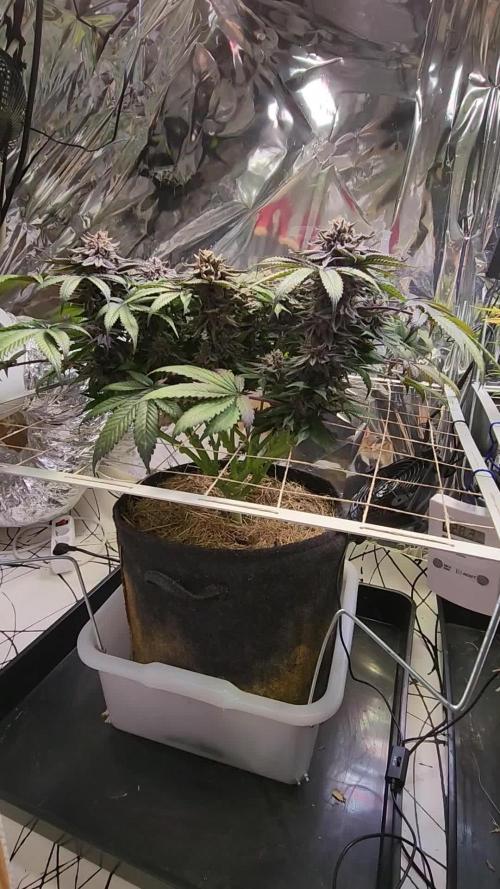
The last week under the sun. Now there will be three days of darkness. Then it’s time to harvest.
The flowers give off a sweet, fruity, berry-like scent with a hint of skunk.
This plant has grown into a beautiful purple blossom. It would have needed another 1–2 weeks to reach perfection. However, since I’ll be away for two weeks and the plant also produced 2–3 male flowers, I’m harvesting it now to get the most out of it.
Light Power: 92%
Day 114
Flower #63
Photoshooting
Likes
76
Share


@Canna96
Follow
Hey now, this week went pretty good, the buds are about done bulking up, and just waiting on the trichomes, I was really hoping she would be about ready, but I think she needs another week to week and a half total. The buds are rock hard, and super sticky. I have no clue what she will yield because the colas are not that thick, but there are definitely alot of them. I plan to squeeze her into rosin, and hopefully I can break the 25% mark for the first time with her, but we will see. Thanks for stopping by, I hope you enjoy the videos, Happy Memorial Day Family, Stay Safe and Blaze On!!!
Likes
19
Share


@Alice_in_Wonderland
Follow
Day 8 - First official day of veg and both ladies are right on time for a small adjustment in lighting, PH and nutrients. 10ml of Hydro A & Hydro B were added to both buckets (10L of water in each bucket) and the Milwaukee PH controller was set to work. Starting at a PH of around 7.8, it slowly worked down to a perfect 6.0 over about 50minutes. The lights were readjusted to be 60cm from the seedlings who are all between 8-10cm tall and the intensity of the lights increased to about 70% brightness.
Day 9 - Cheech is taking nicely to the adjustment in light and nutrients, but CG 1 is looking a little bit too perky. Going to give her 24 hours to adjust.
Day 10 - We have finally renamed CG 1. Fellow enthusiasts, meet Venezia.
Day 12 - The root systems are clearly visible in the ladies today
Day 13 - The ladies are looking well today. Venezia seems to be showing some light signs of heat stress with slight curling of the leaves. The lights are due to be adjusted tomorrow to account for the seedlings growth over the last week.
Likes
18
Share


@MonkeeHaze
Follow
Starting the scrog net, gonna let her stay in veg state till 120 days.😎

Likes
21
Share


@Hazeberg
Follow
Day 43: I pulled the LED to the most possible height and she keeps stretching, thus I had to bend the main branch with LST clips to keep some distance to the LED to avoid light stress.
Day 44: Today was cleaning day of the reservoir and a new set of nutrients are applied. I'm quite curious how they support her. I also removed some foliage.
Day 45: I noticed some tip burn at the leafs of the main bud. So I checked the PH in the reservoir and noticed, that it is off and adjusted it. I hope this supports her. Also, it might be a bit of light stress, as she is pretty close to the light (~ 25 cm). Nothing else to do today.
Day 46: I refilled the reservoir today. As I noticed, that the PH was off the last time, I lower now the PH from 6.4 to 5.6. This should also support her to consume the nutrients, as I use 50% coco.
Day 47: Nothing to do, today.
Day 48: I removed some fan leafs.
Day 49: Last day of the week. She is really thirsty now. I decided to lower the humidity to 65% to get a VPD of around 1 kPa. Let's see, how this will work out in the next week.
--------------------------------------------------------------
You also like to get some seeds from Fast Buds?
You like a 15% discount?
Just use the following code on your next order: CSYIJC
Happy growing
--------------------------------------------------------------
🙏 Thanks for visiting and follow for daily updates 🌱
Likes
4
Share

@Flavors
Follow
🌱 Sticky Broccoli – Grow Diary 🌱
Week 9 | Late Vegetative Stage | Coco + Perlite
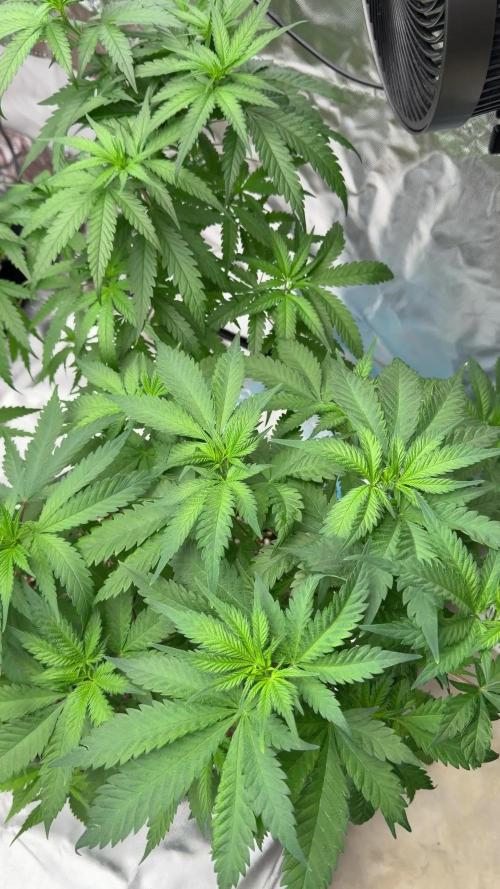
This week included topping, lollipopping, and continued LST ✂️🌿
Final structural work is coming together as the plant nears flower transition.
Topping has created multiple strong main colas 🚀
Lower growth was lollipopped to focus energy on the upper canopy.
LST continues to spread the plant evenly under the future canopy 🌐
Light penetration has improved significantly.
Canopy is now wide, flat, and well-organized.
Airflow through the plant has increased 🌬️
Foliage remains healthy green with no deficiencies 💪
Plant is handling training with minimal stress.
Roots fully established and supporting vigorous growth ?
Watering steady with slight runoff 💧
📈 Focus next week: finalize canopy, install/adjust SCROG, and prepare for flip to flower 🌸🔥
Likes
8
Share


@LokalGrenz
Follow
Week5
March 1st day 30
I transplanted one( the one with no broken branch) inti the 7gal today watered and did some LST I really hope it adapts to its new home I’ve never transplanted before I used extreme garden MYCOS hope it works also moved the light up a bit and plan on going 100% once I transplant the other one
March 2nd transplanted the other one (broken branch one) my shop didn’t have 3.0😔😔😔😔😔😔😔 so i used DNC Great Lakes water only soil hopefully this works and I mixed some 3.0 I had left from the other pot cross fingers for nice transition to its new home
March 5 been three days since transplant can’t really tell if they adapted to there new homes yet some sings of stretching since transplant I’ve never transplanted before and I’m not sure if they need water or not so imma chill let them go for couple more days then I’ll water scared to over water them right now since I transplanted them don’t want to over stress them other one in 3.0 seems little droopy to me compared to the one in Great Lakes but Great Lakes soil seems bit dry sooooo idk I’m going keep an eye on them
