


Likes
Comments
Share

@DogDoctorOfficial
Follow
? 8×8 Adventure – Week 10
Blueberry Muffin – Pheno A
A Quiet Girl Starting to Show Her Character 💚🌸
Hello everyone, and welcome back to another chapter of the 8×8 Adventure! 🌱💚
If you've been following this grow, you already know that Blueberry Muffin has never really been the girl trying to steal the spotlight.
She's compact.
She's controlled.
She's not particularly tall.
And compared with some of the more aggressive plants in the room, she has always had a slightly slower, quieter rhythm.
But that's exactly what makes watching her so interesting.
Because while some plants seem to scream:
"LOOK AT ME!"
Blueberry Muffin has always been more like:
"Don't worry. I'm getting there." 😂?
And this week...
She's still getting there.
Beautifully.
────────────────────────
🌸 Week 10 – Keeping Things Steady
We're not making any dramatic changes this week.
Actually, quite the opposite.
At this stage, consistency is becoming one of the most important tools we have.
We're keeping the environment as close as possible to where it was last week, maintaining the same general lighting, irrigation and feeding strategy while allowing the plant to continue developing at her own pace.
Of course...
It's summer. ☀️
And summer has other plans.
Keeping temperatures absolutely identical day after day isn't realistic.
We see a degree up.
A degree down.
A small fluctuation here.
Another one there.
And that's perfectly normal.
What matters is that we're keeping those variations controlled rather than allowing the environment to swing wildly.
The things we can keep stable...
We're keeping stable.
The nutrient solution.
The watering.
The root-zone conditions.
The light schedule.
The general humidity.
The lighting intensity.
And most importantly...
The routine.
────────────────────────
? Blueberry Muffin – Still the Compact One
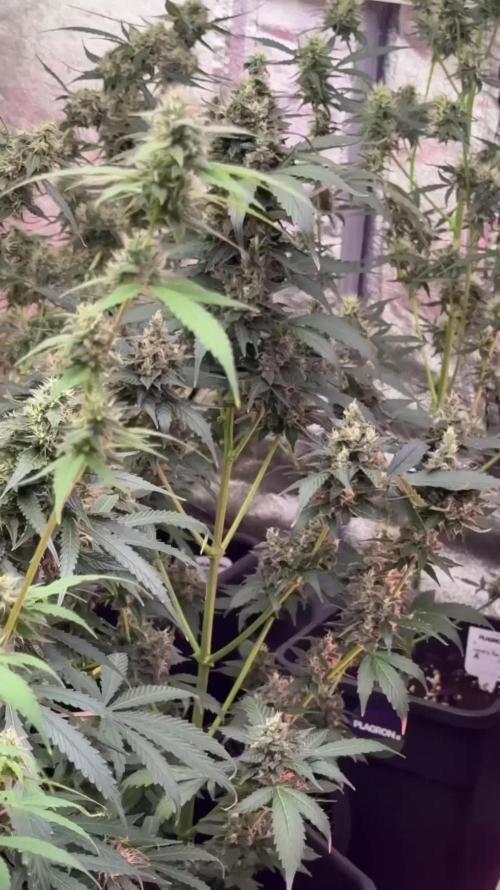
Blueberry Muffin is currently around 75 cm, and that hasn't changed dramatically.
And honestly?
I'm perfectly happy with that.
Not every plant needs to become a giant.
Not every phenotype needs to stretch aggressively.
This girl has been telling us from the beginning that she prefers a more compact architecture.
She's building flowers.
She's maintaining beautiful foliage.
She's producing healthy new growth.
She's simply doing it in her own time.
And looking at the photographs this week, that's becoming increasingly obvious.
The plant may be compact...
But she is certainly not lacking in flowers.
The developing buds are becoming more pronounced throughout the canopy, with plenty of pistils and increasingly defined floral structures.
She's quietly stacking.
And that's what I want to see.
────────────────────────
🌿 Slow Doesn't Mean Stagnant
This is something I think is worth mentioning.
When we say Blueberry Muffin is slower than some of her neighbours, that doesn't mean she's sitting still.
Far from it.
She's changing every week.
The flowers are developing.
The branches are carrying more weight.
The plant is gradually shifting from producing new vegetative structure toward putting more emphasis on the flowers already established.
It's just happening without the explosive vertical growth we've seen from some of the other plants.
And honestly...
That can be a beautiful trait.
A compact plant can sometimes make canopy management much easier.
There's less vertical drama.
Less fighting for height.
Less chasing branches.
And more time to simply watch the flowers develop.
────────────────────────
💡 The Lights – Where the Photons Go
One of the things I'm particularly enjoying at this stage is watching how the lighting strategy interacts with this plant.
We're not simply throwing light at the top of the canopy and hoping for the best.
The Future of Grow LEDs are providing the main lighting foundation above the plants, delivering the primary photon supply that drives photosynthesis across the canopy.
And then we have Lumiflora contributing additional light into areas that would otherwise naturally receive less illumination.
That's an important distinction.
Plants don't experience light as:
"Top light."
They experience photons arriving from different directions and at different intensities.
Our job is to make as many of those useful photons available to productive foliage and developing flowers as practical.
And Blueberry Muffin's compact structure makes this particularly interesting.
Because she's not extremely tall, we're able to maintain a relatively controlled relationship between the light and the canopy.
The upper flowers receive strong illumination.
The inner structure receives additional support.
And the lower portions aren't simply forgotten.
We're trying to create a more complete light environment rather than relying entirely on what happens at the very top.
────────────────────────
☀️ Photons Are the Currency
I've said this many times throughout the 8×8 Adventure, but flowering is really where the relationship between light and plant structure becomes fascinating.
Every photon that reaches a photosynthetic surface has the potential to contribute to the plant's energy production.
But that doesn't mean:
More light = automatically better.
The plant still has to process that light.
Temperature matters.
Humidity matters.
CO₂ matters.
Leaf health matters.
Root health matters.
Water availability matters.
Nutrition matters.
Everything is connected.
And that's why I like having the Future of Grow and Lumiflora lighting working as part of the overall system rather than simply increasing intensity without thinking about the rest of the environment.
We're trying to give the plant useful light while maintaining the conditions necessary for her to actually make use of it.
And Blueberry Muffin seems very happy with the arrangement.
────────────────────────
🌸 Flowers, Flowers Everywhere
The most rewarding part of this week's photographs is, without question, the flowers.
They're becoming more obvious.
More structured.
More numerous.
And increasingly confident.
The pistils are still bright and prominent, but the buds themselves are starting to develop that unmistakable flowering architecture.
This is the stage where the plant begins to transition visually from:
"I have flowering sites."
to:
"I am building flowers."
And Blueberry Muffin is doing exactly that.
She's not rushing.
She's not exploding upward.
She's simply stacking one little piece onto another.
Week by week.
Photograph by photograph.
And eventually we'll look back and wonder where all that floral mass came from.
────────────────────────
💧 Stability Where We Can Control It
One thing we're being particularly careful about this week is keeping irrigation and the root environment consistent.
The current setup remains around:
💧 1.3 L per plant / 24 hours
with the nutrient solution sitting around:
🌡️ 25°C
and the substrate/root-zone temperature also around:
🌡️ 25°C
These are the variables we can control much more directly than the outside summer temperature.
So that's where the focus goes.
If the room temperature moves a little because summer decides to remind us who's boss...
Fine.
We'll work with it.
But there's no reason for the root zone, irrigation routine and nutrient delivery to become unstable at the same time.
The more variables we can keep consistent, the easier it becomes to understand what the plants are actually telling us.
────────────────────────
🥥 Feeding – Don't Fix What Isn't Broken
The feeding strategy also remains steady.
We're not changing things simply because another week has passed.
The plant is healthy.
The foliage is beautifully green.
The flowers are developing.
There are no obvious signs telling me that she needs a dramatic intervention.
So we're continuing with the established flowering nutrition:
• Terra Bloom — 2.2 ml/L
• Pure Zym — 1 ml/L
• Power Buds — 1 ml/L
• Sugar Royal — 1 ml/L
• pH Plus / Lemon Kick — as required
The goal isn't to chase numbers.
The goal is to support the plant's current development and let her continue doing what she's already doing well.
Sometimes the smartest adjustment...
is making no adjustment at all.
────────────────────────
🌡️ The Summer Challenge
Our environmental target remains as close as possible to last week's conditions.
We're currently around:
• 🌡️ Day temperature: ~29.9°C
• 🌙 Night temperature: ~26°C
• 💧 RH: ~60%
• 🥥 Substrate temperature: ~25°C
• 💦 Solution temperature: ~25°C
• ⚗️ pH: ~6.0
• ⚡ EC: ~2.0 mS/cm
• 💨 CO₂: ~693 ppm
• 💡 Light schedule: 12/12
• 💧 Watering: ~1.3 L/plant/24h
• ? Pot: 15 L
• 📏 Height: ~75 cm
Summer makes absolute precision difficult.
One day gives us a little more heat.
Another day gives us slightly less.
The important thing is avoiding unnecessary swings and keeping the things we can control as consistent as possible.
And so far...
Blueberry Muffin is handling it beautifully.
────────────────────────
🌬️ A Compact Plant Has Its Advantages
There's another reason I'm enjoying watching this phenotype.
Her compact structure means she isn't creating the same vertical management challenges as some of the more vigorous plants in the room.
She's occupying her space efficiently.
The flowers are distributed across the plant.
The canopy remains manageable.
And because we're not dealing with an enormous stretch, it's easier to keep the lighting relationship consistent.
This is one of those situations where different doesn't necessarily mean better or worse.
It's simply...
different.
And that's exactly what the 8×8 Adventure is supposed to reveal.
Twelve genetics.
Twelve personalities.
Twelve different ways of responding to essentially the same growing environment.
Blueberry Muffin's personality continues to be:
Compact. Calm. Slow and steady.
But increasingly floral.
?🌸
────────────────────────
✨ Future of Grow + Lumiflora – Lighting the Way
I also want to give another little spotlight to the lighting team this week.
The Future of Grow LEDs continue doing their job above the canopy, providing the main source of light for this flowering room.
And Lumiflora continues contributing additional photons where the canopy naturally becomes less exposed.
I really enjoy seeing the difference this kind of layered lighting strategy can make.
Instead of thinking about the plant as a flat surface...
We're thinking in three dimensions.
Top.
Middle.
Inside.
Lower canopy.
Every part has a different relationship with light.
And while we can't make every flower receive identical intensity, we can certainly improve how photons are distributed throughout the plant.
That's the goal.
Not simply:
"More light."
But:
"Better use of the light we have."
And when I look at Blueberry Muffin's developing flowers...
I think she's making very good use of it.
────────────────────────
🧠 Observation Is Still the Most Important Tool
At this stage, I don't feel the need to constantly interfere.
We've built the plant.
We've trained her.
We've shaped the canopy.
We've managed the foliage.
We've established the lighting.
We've established irrigation.
We've established nutrition.
Now we're watching.
And that's sometimes the hardest part.
Doing nothing can feel like you're not doing enough.
But plants don't need us to touch them every day.
Sometimes they just need:
Good light.
Water.
Nutrition.
Roots that can breathe.
A stable environment.
And time.
Blueberry Muffin seems perfectly happy with that arrangement.
────────────────────────
🔮 Looking Ahead
The next few weeks should become increasingly interesting.
The plant remains compact, but the flowers are continuing to develop.
The canopy is holding together beautifully.
The lighting system is providing a strong and layered photon environment.
The irrigation remains consistent.
The nutrient programme remains stable.
And we're simply going to continue watching.
Summer may give us a degree here and there.
That's okay.
We'll do our best to keep everything else steady.
Because the objective isn't to create a laboratory where nothing ever changes.
The objective is to create an environment where the changes are small enough that we can understand them.
And Blueberry Muffin?
She's giving us a very clear message.
She's not in a hurry.
She's building.
Slowly.
Compactly.
Beautifully.
?🌸
────────────────────────
💚 Final Thoughts – Let Her Be Herself
I think that's probably the biggest lesson Blueberry Muffin is teaching me right now.
Not every plant needs to be pushed.
Not every phenotype needs to behave the same way.
And not every slow-growing plant is a problem waiting to be solved.
Sometimes...
slow is simply slow.
She's healthy.
She's green.
She's flowering.
She's stacking.
She's compact.
And she's doing it all while the rest of the room is sometimes trying to run away from us. 😂
So we're going to respect her personality.
We're going to keep the environment as stable as summer allows.
We're going to keep the irrigation and root zone consistent.
We're going to keep the nutrition steady.
And we're going to continue giving her access to plenty of quality photons from the Future of Grow and Lumiflora lighting systems.
Then we'll step back...
and watch.
Because eventually, that quiet little Blueberry Muffin is going to have her moment.
And I think she's going to deserve every bit of the spotlight.
────────────────────────
🙏 Thank You
A huge thank you to Zamnesia for giving us the opportunity to explore these Blueberry Muffin genetics and document this beautiful phenotype throughout the journey.
A heartfelt thank you to Plagron for the nutrition supporting the plants through this flowering cycle.
A massive thank you to Future of Grow for providing the main LED lighting powering this room and giving these plants the photons they need to keep building.
And a special thank you to Lumiflora for bringing additional light deeper into the canopy and helping us think about lighting in three dimensions rather than simply from above.
Thank you as well to everyone following the 8×8 Adventure on GrowDiaries.
Every week brings another little observation.
Another comparison.
Another lesson.
And another reason to keep documenting.
Blueberry Muffin may be one of the quieter girls in the room...
But she's still writing her own story.
And this week?
She's doing it beautifully.
Slow.
Compact.
Green.
And increasingly covered in flowers. ?🌸💚
Until next week...
Growers Love, happy growing, and take care everyone! 🌱💚
Likes
15
Share


@SweetheartOG
Follow
Started the girls with some LST to see how they all coped and they bounced back well.

Likes
4
Share





Likes
2
Share


@EtnoGrow
Follow
Everything is still fine, the oldest moved to the largest pot of 11 liters or 3 gallons and the one that grew more than the others in the pot of 2 gallons or 7 liters approx, they began to look for pots for the others later. apical pruning will be done to several practicing, as well as LST or something like that experimenting haha
Likes
2
Share


@Islandbuds420
Follow
I found this strain very easy to grow and responded very well given the hot/humid weather we have here on the island. This strain held up very well to pest and mold/mildew
Likes
17
Share


@VACADELUNA
Follow
Week 18 of life and day 40 of flower. Tricomes look nice, buds are swelling and still lots of white. We are probably 3-4 weeks away from harvest.

Likes
37
Share


@DaddyPrime2
Follow
4/22/2024
Day 29 showing plenty pistils, still in the transition to flower stage. Training may help the plant grow bigger/ longer stems. They can be semi bushy when spread out. Switched nutes to flower bloom from Gaia green
4/26 day 33? Last half of week 5 there has been more of a stretch than there was previous to this. These plants have been mad with a bit of over water and chlorine issues and maybe cal mag
4/27 day 34 end of week 5
The plants both stretched. The one I didn’t train,I can see a visible growth of about double the height, just over this last week.
For it being just a pre flower stretch/transition phase for the auto flowers, I am surprised at how many pistils are on the flower sights. The end of last week, I didn’t feel like there were enough pistils to consider it the beginning of flower, and now at the end of this week, it looks like this should be the end of week 1 flower, but they were still stretching.
Likes
6
Share


@ChewiestEndZa
Follow
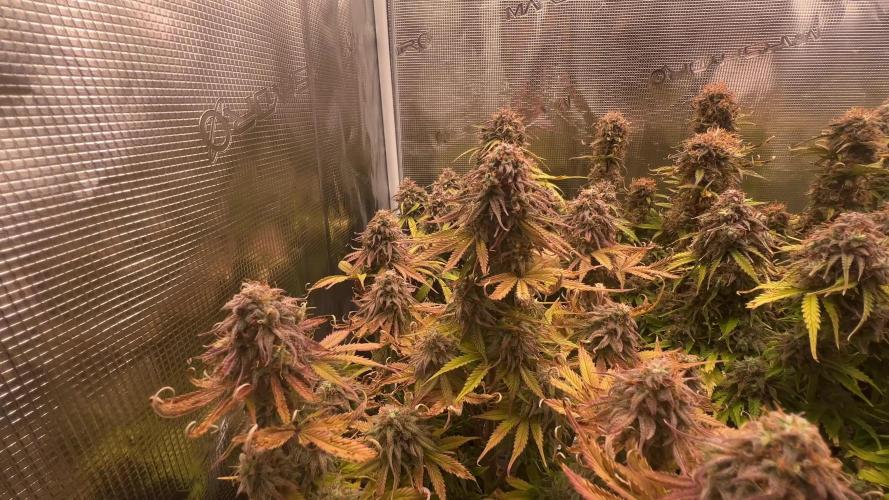
Had to spray some medicine again as there was a few bite marks from spidermites. May not get rid of em but can keep them at a lower number until harvest otherwise I would love to get rid of em but don't know the likelihood of that happening.
Currently in the tent at 12/12 light schedule and have the lights running at night so cold of the night doesn't stunt any growth.





Likes
98
Share


@DogDoctorOfficial
Follow
I love growing its a big passion of mine , and the fact that GD exists makes everything so much better, one can interact with others and enjoy and learn from each others. Thank you all growers love and keep them green <3 <3 <3

Likes
22
Share


@BCbuds76
Follow
West coast og is turning into a beast. Buds are filling out nicely . Some of the pistils are starting to change colour. I will start her on straight water soon . The mites are still hanging around so the leaves aren’t looking too healthy . I should still get a decent harvest by the looks of it
Likes
34
Share


@RFarm21
Follow
REGAS: 21 e 25 janeiro so com agua.
À espera que o solo seque para colher.
Likes
4
Share


@ObloTheGrower
Follow
All fastbuds autos are in pots. The weather is really good, humudity is around 55. Their area is sunny from 08.00 til 19.00
Likes
Comments
Share

@ellioschka
Follow
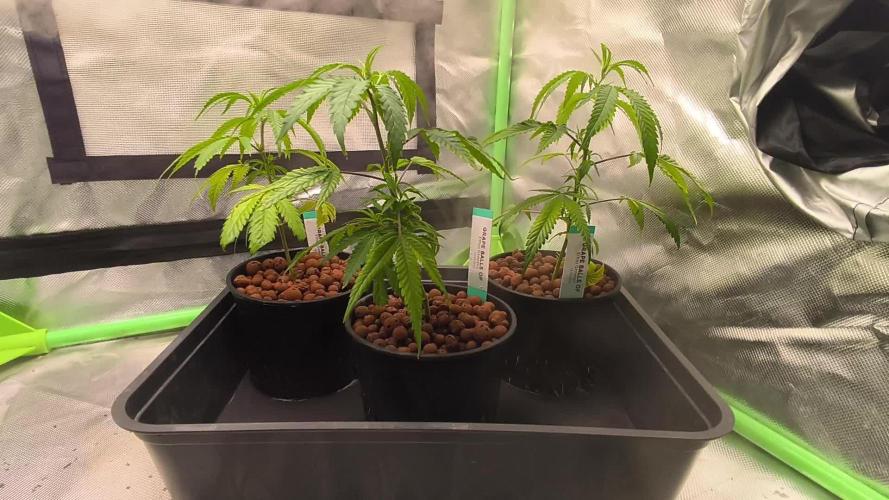
Die Grape Balls of Fire RBX Pflanzen sind relativ langsam mit ihren Wurzeln und waren mit den Lemon Zkittle die mit dem höchsten Magnesiumbedarf.😏
Die Wurzeln wachsen, statt an den Seiten der Töpfe auszutreten, lieber nach unten und sammeln sich dort. Genau wie für alle anderen Pflanzen wurde die Düngergabe nach leichtem Mg Mangel angehoben. Das Besprühen wurde komplett eingestellt und der VPD auf den Bereich 0,8-1,0 erhöht. Nächste Woche gehts ins große Zelt. 👍

Likes
19
Share


@sirstickyfingers
Follow
Start of Week 2 day 2 of flower!! These girls are stretching and starting to stack bud sites.
My little sour diesel is doing her best to reach that canopy with the others, she aint showing alot of sites at the moment but im hoping after stretch and defoliation I can get more to pop.
I decided to upgrade my light and now have a SE4500 450w on the way. From what I had researched Id like to be getting 1000ppfd in the center and then around 600-700 on edges
I picked up some stashblend and real growers recharge and added it to my water as a compost tea today and will be implementing that in the watering per the plant needs .
My biggest fear doing organics is getting behind on the food for these girls. I plan to top dress with worm castings, gaia green all purpose 4-4-4 and power bloom 2-8-4 every 3 weeks during flower, and then about the 4 week of flower I will be using more power bloom than all purpose to avoid too much nitrogen.
My biggest thing I been going back and forth on is when to defoliate. I dont wanna start removing abunch of leaves and force my plant to recover during the stretch rather than making bud sites. I figure once it is done stretching completely I am going to lollipop and remove all branches/larf and leaves under the canopy.
feel free to comment, provide tips, suggestions im open to all as im still new and learning
Thanks for looking and happy growing!!


Likes
14
Share


@Dieselnutz
Follow
Just started 3rd week of flowering. Everything is goin smooth, plants stacking nice and drinking almost a gallon a day.