


Likes
Comments
Share
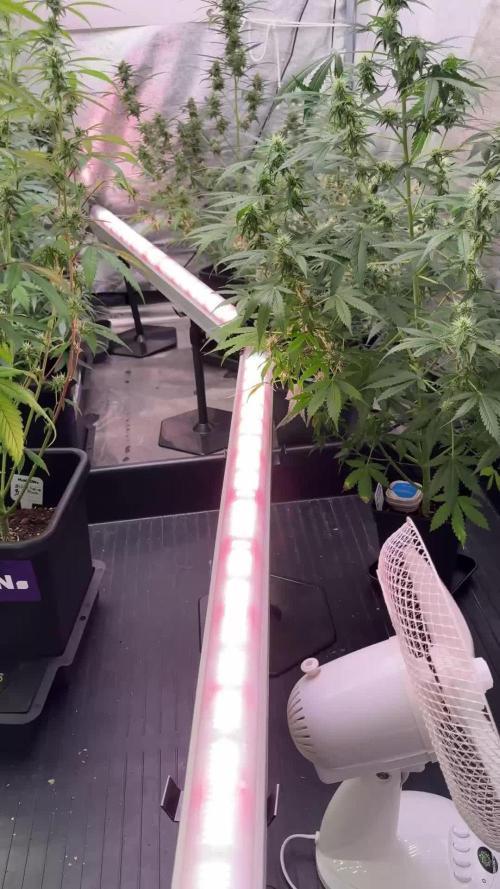

@DogDoctorOfficial
Follow
? Blueberry Muffin – Pheno B
Week 9 | Same Genetics. Completely Her Own Story. 🌿🔥
Welcome back to another week of the 8×8 Adventure! 💚🌱
If you've been following these individual phenotype diaries, you already know that I absolutely love this part of the project.
Because sometimes you can take two plants from the same cultivar...
Give them the same environment.
The same light.
The same irrigation.
The same nutrition.
The same room.
And still end up with two plants that look like they were given completely different instructions.
That's exactly what we're seeing with these two Blueberry Muffins.
And this girl?
She's writing her own story.
She's compact.
She's lush.
She's beautifully structured.
And she's becoming increasingly interesting as flowering progresses.
This week was another step toward giving her the space she needs to turn all that beautiful structure into flowers.
So let's have a look at what our little Blueberry Muffin Pheno B has been doing. ?🌸
🌱 Week 9 – The Compact Sister
Blueberry Muffin Pheno B has never been interested in becoming the tallest girl in the room.
And honestly?
I don't think she cares.
She's approximately 75 cm tall, but height doesn't really tell the story with this phenotype.
Her personality is in her density.
She's compact.
She's leafy.
She's got a strong central structure with flowering sites distributed throughout the plant.
And as flowering has progressed, that compact architecture has become even more obvious.
This is where growing multiple phenotypes becomes so much fun.
Her sister has her own architecture.
This girl has hers.
Neither one is trying to imitate the other.
They're simply expressing what they have genetically programmed inside them.
And I absolutely love it.
🌸 Flowering Development – She's Filling the Space
The flowers are now becoming much more established throughout the plant.
The fresh white pistils are everywhere, and the individual flowering sites are becoming increasingly recognizable.
What I particularly like about Pheno B is how much flower development she's carrying inside such a relatively compact structure.
She's not using a huge amount of vertical space.
She's using the space efficiently.
Branches are filling in.
Flowering sites are developing.
The canopy is becoming increasingly dense.
And this is where our job as growers changes slightly.
Earlier in the grow, density was simply beautiful.
Now that we're moving deeper into flower, we have to think about what that density means for:
💨 Air movement
💡 Light penetration
🌡️ Microclimate
💧 Humidity management
🌸 Flower development
And that's exactly what we're doing this week.
✂️ Cleaning the Canopy – Making Room
Like her sister, Pheno B also received some selective defoliation this week.
But there's an important distinction.
We're not cleaning her because she's doing something wrong.
We're cleaning her because she's doing too much of a good thing. 😄
She's naturally compact and very leafy.
And as the flowers develop, some areas can become quite crowded.
So we're opening her up a little.
Removing selected leaves that are overlapping.
Removing foliage that isn't contributing much anymore.
Creating some breathing room around developing flowers.
And generally making the architecture easier to manage.
This isn't about stripping the plant.
Far from it.
She's still beautifully green.
She's still carrying plenty of healthy foliage.
We're simply creating a little more space between everything.
Sometimes the best canopy is not the one with the most leaves.
It's the one where every remaining leaf has room to work.
💨 Airflow – Especially Important for This Girl
This is probably even more relevant with Pheno B than it is with her sister.
Because this girl is compact.
And compact plants naturally create more areas where leaves and flowers can sit close together.
That can be beautiful.
But as flowers become denser, I don't want stagnant little pockets developing inside the canopy.
Good airflow is one of those things you don't really notice when everything is working properly.
And that's exactly how I like it.
Air moving through the plant.
Humidity being managed.
No unnecessary congestion.
No little hidden corners where moisture can sit.
We're not trying to create a sterile plant.
We're simply trying to make the environment less friendly to problems such as mildew or mould as flowering progresses.
Prevention is always easier than dealing with a problem later.
💡 She's Compact – So Let's Use the Photons
This is another reason I like opening her up a little.
At around 75 cm, she's not particularly tall.
And that's perfectly fine.
But when you have a compact flowering plant, I want to make sure the available photons can actually reach the places where they're useful.
She already benefits from the additional light strategy we're running in the room, including the inner and under-canopy lighting.
That's a huge advantage.
But even with additional lighting, there's no reason to let unnecessary layers of foliage block one another if we can naturally improve the canopy.
We're not trying to expose every flower directly to the light.
We're simply creating pathways.
Light pathways.
Air pathways.
And observation pathways.
That's what this little cleanup is about.
🌿 Still One of the Lushest Girls in the Room
And after the cleanup...
Look at her.
She's still lush.
She's still green.
She's still compact.
And she's still unmistakably Pheno B.
This is something I really wanted to preserve.
I don't want to turn her into a completely different plant just because we removed some leaves.
The phenotype is the phenotype.
Our job isn't to erase that.
Our job is to help her express it as efficiently as possible.
And I think we're getting a really nice balance now.
Enough foliage to power the plant.
Enough space to let the canopy breathe.
Enough structure to support the developing flowers.
And enough visibility for us to actually see what's happening.
That's a pretty good combination.
? Two Sisters – Two Personalities
This comparison is becoming one of my favourite parts of the entire 8×8 Adventure.
Because if you put Pheno A and Pheno B side by side, you can immediately see that they're related...
but they're not identical.
Pheno A has developed her own open architecture.
Pheno B is the compact, lush sister.
Pheno A has been a little more demanding in some areas.
Pheno B has generally looked extremely comfortable with the current environment.
And yet both plants are producing their own beautiful version of Blueberry Muffin.
This is exactly why I don't like forcing every plant into the same training schedule.
If I had tried to make these two plants behave identically, I'd have removed some of the most interesting information this grow is giving us.
Instead, we're allowing the differences to remain visible.
Same genetics.
Different phenotype.
Different personality.
Different expression.
And that's the story.
⚗️ Nutrition – No Need to Fix What Isn't Broken
The feeding programme remains unchanged this week.
We're continuing with:
Terra Bloom – 2.2 ml/L
Pure Zym – 1 ml/L
Sugar Royal – 1 ml/L
Power Buds – 1 ml/L
pH adjustment as required
Current solution is around:
pH 6.0
EC ~2.0 mS/cm
And Pheno B continues looking very comfortable with it.
She's maintaining that beautiful green colour.
She's developing flowers.
She's growing normally.
And there are no obvious reasons to start changing the recipe simply for the sake of changing it.
That's one of the things I've learned during this project.
When the plant is happy...
sometimes the smartest thing you can do is leave it alone.
🌡️ The Room – Small Changes, Same Stability
The environment has changed slightly compared with some of our earlier updates, but we're still maintaining a very stable room.
Current conditions are approximately:
🌡️ Day temperature – 29°C
🌙 Night temperature – 25°C
💧 Relative humidity – 60%
⚗️ pH – 6.0
⚡ EC – ~2.0 mS/cm
💨 CO₂ – ~693 ppm
💦 Watering – ~1.3 L/plant/24h
🌡️ Solution temperature – 25.2°C
🌡️ Substrate temperature – 25.6°C
💡 Light schedule – 12/12
? Pot size – 15 L
So we're sitting around a 4°C day/night temperature difference.
And again, I don't look at any one number in isolation.
Temperature interacts with humidity.
Humidity interacts with transpiration.
Light affects plant demand.
Root-zone conditions affect water and nutrient uptake.
Everything is connected.
And at this point in flower, I'm particularly interested in keeping the relationship between those factors stable rather than chasing some theoretical perfect number.
💨 Opening the Canopy Helps the Whole Room
There's another reason I'm happy we cleaned her up this week.
It's not just about Pheno B.
When you've got a room full of flowering plants, every canopy contributes to the overall environment.
More open foliage means air can move through more easily.
More airflow means fewer stagnant pockets.
And better movement through the room helps the environmental system do its job.
Again, defoliation isn't a replacement for proper ventilation or environmental control.
But good canopy architecture and good environmental management work together.
And that's exactly what we're trying to achieve.
🔬 A Plant That's Becoming Easier to Read
One thing I really appreciate about Pheno B is that she's becoming easier and easier to understand.
At the beginning, we didn't know what she was going to become.
Now we do.
She's telling us:
"I'm compact."
"I'm vigorous."
"I'm leafy."
"I'm going to build my flowers inside this structure."
And our response is simply:
"Okay. Let's work with that."
That's what I mean when I say grow with the plant, not against it.
We're not trying to make her taller.
We're not trying to make her look like Pheno A.
We're not trying to turn her into something she's not.
We're simply giving this particular phenotype the conditions and space she needs to perform.
📸 The Camera Doesn't Lie
The photographs this week really show how much she's changed.
The close-ups reveal those developing flowers and their increasingly defined structure.
The wider photographs show just how much vegetation she's carrying around those flowers.
And then there are the little details.
The colour.
The leaf posture.
The branching.
The way the flowers are distributed.
Those details are why I love documenting individual phenotypes.
A single photograph can show what the plant looks like.
But a series of photographs over several weeks shows who the plant is becoming.
And Pheno B is becoming a very beautiful little flowering plant.
🔮 Looking Ahead
From here, I'm not looking to make any dramatic changes.
The major framework is already there.
The selective cleaning has given her some additional breathing room.
The environment is stable.
The feeding is stable.
The flowers are developing.
Now comes the part where patience becomes increasingly important.
Over the coming week, I'll be watching for:
🌸 Continued flower development
🌿 Increasing density around the flowering sites
💎 Early resin development
💨 Continued airflow through the canopy
💧 Stable water demand
🌡️ A stable flowering environment
And most importantly...
I'll be watching the plant.
If she tells me she needs something, we'll respond.
If she doesn't...
we let her work.
💭 Final Thoughts – Her Own Little World
There's something really satisfying about this plant.
She isn't dramatic.
She doesn't need to be.
She's just beautiful.
Compact.
Lush.
Healthy.
And increasingly covered with developing flowers.
And what's especially fascinating is that her sister is doing something completely different while receiving essentially the same treatment.
That's the magic of phenotype hunting.
You don't know exactly what you're going to get.
You give the genetics the same opportunity.
Then you watch.
And eventually...
they introduce themselves.
Pheno B has introduced herself as the compact, lush, elegant sister.
And I really like her.
This week wasn't about changing her.
It was about giving her a little more room to breathe.
A little more room for photons to move through.
A little more room for air.
A little more room for those flowers to develop.
And now...
she's ready.
The canopy is cleaner.
The flowers are becoming more defined.
The environment is stable.
The nutrition is steady.
And this beautiful little Blueberry Muffin is heading deeper into flower.
Let's make her shine.
Let's give her the spotlight she deserves.
Because she may be the compact sister...
but she's certainly not a small personality. ?🌸🔥
🙏 Thank You
As always, a huge thank you to everyone following the 8×8 Adventure.
Thank you to Zamnesia for these beautiful Blueberry Muffin genetics and for giving us the opportunity to explore just how differently two phenotypes from the same cultivar can express themselves.
Thank you to Plagron for supporting the plants with the growing media and nutrition throughout the journey.
Thank you to Future of Grow for providing the lighting that allows these twelve different genetics to perform under the same artificial sun.
Thank you to Lumiflora for helping us bring additional light into the inner and lower parts of the canopy.
Thank you to TrolMaster for helping keep the environment stable.
And, of course, thank you to everyone in the GrowDiaries community.
Every comment.
Every question.
Every observation.
Every person simply stopping by to see how the girls are doing.
It all makes this adventure more enjoyable.
Two Blueberry Muffins.
Two phenotypes.
Two personalities.
And we're nowhere near finished discovering what they can do.
Until next week...
Growers Love and happy growing! 🌱💚?
See you next week with Blueberry Muffin Pheno B. 🌸🔥
Likes
69
Share


@nonick123
Follow
Día 51 (22/07) Las plantas han reaccionado bien al 2º topping! 💥 Algunas de ellas ya empiezan a formar los nuevos brotes justo debajo del nudo cortado!
Hoy NO necesitan riego, tras regar ayer con 1 Litro de Té Vegetativo de Lurpe! 💨😁
Día 52 (23/07) Las plantas empiezan a formar rápidamente nuevas ramas tras el topping! 😍
A pesar del alto calor (35 - 38 ºC), gracias al sombreado y el mulch se mantienen frescas y con la tierra húmeda, ¡perfecto para los microorganismos del living soil!
Día 53 (24/07) No es necesario regar
Día 54 (25/07) Los nuevas ramas se lanzan al cielo! 💥
Me encanta ver como los nuevos brotes de un color verde pálido (casi radiactivo) nacen entre el intenso verde oscuro de las hojas de abanico ya formadas
Hace un día nublado y con 29 ºC de máxima. No es necesario regar!
Día 55 (26/07) Riego con 500 ml H2O pH 6,5
Día 56 (27/07) Retiro los ajustes de LST a la mayoría de las plantas, para que crezcan libres ahora que se acerca el stretch
No es necesario regar
Día 57 (28/07) Riego con 1 Litro H2O pH 6,5 con 25 ml/L de Humus de Lombriz Liquido
Aplicación foliar Kelp hidrolizado de Lurpe Solutions a 0,25 ml/l
💦Nutrients by Lurpe Solutions - www.lurpenaturalsolutions.com
🌱Substrate PRO-MIX HP BACILLUS + MYCORRHIZAE - www.pthorticulture.com/en/products/pro-mix-hp-biostimulant-plus-mycorrhizae

Likes
13
Share


@DeepRootsGrowTrees
Follow
PABLO ESCOBAR / DIVINE SEEDS
WEEK #20 OVERALL
WEEK #8 FLOWER
This week another good week for this lady she's got long buds forming on her stems that getting frosty!! Stay Growing!!
Thank you for stopping by and taking a look!!
THANK YOU DIVINE SEEDS!!
PABLO ESCOBAR / DIVINE SEEDS

Likes
Comments
Share


@LuBaldi
Follow
Never ever put an autoflower and a photoperiod in the same grow box. The harvest was fantastic despite my mistake. I have to admit that the Sativa gave me a lot more pleasure than the Skunk as well as a superior final yield. 100% satisfied. Thanks Sensi Seeds.

Likes
44
Share


@Ukfarmer420
Follow
So this week i harvested the orangesherbert so sticky and stinks of orange, 50grams dry of 🔥 bud.
Curing in a big jar at 21 degrees and humidity of 60% dark cool cupboard.
Watermelon zkitles is bouncing back, the runts is doing amazing with the lst and leaf tucking.
I had to kill the purplelemonade due to it herming on me I dont have space for that so I'm going to run a ethos genetics seed in its place.


Likes
7
Share


@Jays_Not_Here_Man
Follow
Girls are on cruise control, gave them another big feed of the Cronk Nutrients. The info says this strain is 70-75 days, we’re at day 63 and they are still putting on weight. I’m thinking around the 22-25 of September is when I’ll start checking the trichomes more often. Checked today, most are cloudy, still quite a few clear though. I want to harvest my two strains together and as long as they stick to the timeline they say (give it take) we should be good 😊 Happy Gardening 🇨🇦❤️🌱😎💨


Likes
24
Share


@GWSD82
Follow
*** RESULTS ARE IN ***
Final results are in! Updated with pics of dry-trim and weigh-in :)
Total yield was 228g of bud + 45g trim to be used for tincture. Total weight 273g / 9.75oz
This was way beyond what I was expecting! Was hoping to get around 6oz from this grow, so the final result has absolutely blown my mind.
But more importantly, it's a !!REALLY!! good smoke :) I've taken half oz off the top and put the rest into mason jars for curing, but even without a cure, the taste is good - sweet and creamy. The smell has come on LOTS through the drying process. When I chopped, the smell was fragrant, but not too strong. Now, you can smell it across the house and no mistake.
It packs a punch too, very potent high - Can't wait to share with a few friends :)
**********
Well, this has been an awesome experience for my first grow. Thankfully, these girls were super strong - they took a LOT of abuse in terms of high temps (up to 38C some days) and survived me being an idiot in the early days and not really knowing what I was doing. But here we are!
Almost didn't want to chop them down..... but I got over that pretty quick. Total wet weight from both was 1339g (47.8 oz), of which about 150g is popcorn / larf. Super impressed with the yield :) My aim is to be self sufficient, in terms of yield being able to last long enough for another grow cycle to complete. With a rough estimate of 3 months per cycle, and based on my current usage of approx half oz a week, I would need this to result in about 6oz when dried, and I think this could be achievable. I will update the dry weight in due course.
Can't speak to the quality yet. As tempting as it is to quick dry a test nug for a cheeky toke, I'll wait for it to dry properly, so I can really appreciate it. I've waited this long to harvest, another couple of weeks won't kill me. Also, I still have some of my current stash (hopefully the last weed I'll ever have to buy!). It's really difficult to be patient though, because DAMN it looks good. I'll give the buds a good manicure and dry trim when they're ready.
It smells really good too! The smell is not overly powerful, it doesn't slap you in the face like some weed does, but it's delicious! Fresh, bursting oranges, with just an undertone of that unmistakable weed smell......It's like The Man from Del Monte is stood behind you in a queue, and he has an eighth of dank in his pocket that he doesn't think anyone else can smell.
If I had to say I've learned anything along this journey, it's that it's better to be prepared. Research things that COULD happen and have necessary stuff on hand when you need it. Don't wait until that deficiency shows before ordering what you need and finding out it'll take 2 weeks to ship (fuck you, covid-19).
And there we have it.... will report back once dried for the final weigh-in and smoke report.
Stay safe, stay high :)
Likes
20
Share


@Ghostknife78
Follow
Starting to see pistils and definitely stretching. Everything seems to be going smooth. I'm defoliating slowly, just a couple fan leaves a day. I have a mini dehumidifier coming tomorrow to handle my humidity issues.
I recommend anyone using Maxibloom as a nute to buy a magnetic stirrer to fully dissolve it.

Likes
5
Share


@Radagast_
Follow
02.11.'24
After 5 days of drying, this little girl who was a little bigger than a meter gave 950 grams and a little bit of popcorn...this picking was 870 and a little bit of popcorn, and 4-5 weeks ago during a storm, one branch broke, which yielded about 100, but let's say 80 for sure, a total of 950 grams of beautiful, huge, potent buds


Likes
9
Share


@TheWeedaltor
Follow
She took her first (and maybe only) natural sun before going direct under the HPS hell 😂🤙
Likes
20
Share


@Chubbs
Follow
420Fastbuds
FBT2304 Week 9
Hello everyone from far and wide on this beautiful planet. Weekly update for these twins. Both seem to be in mid flower on cruise control with no big issues present. I'll most likely stop feeding nutes this week and just go with ph'd water after that till harvest. All the colas on both are super chunky so it'll be exciting to see how the next week or two turn out. All in all Happy Growing
Likes
29
Share

@Kushycat
Follow
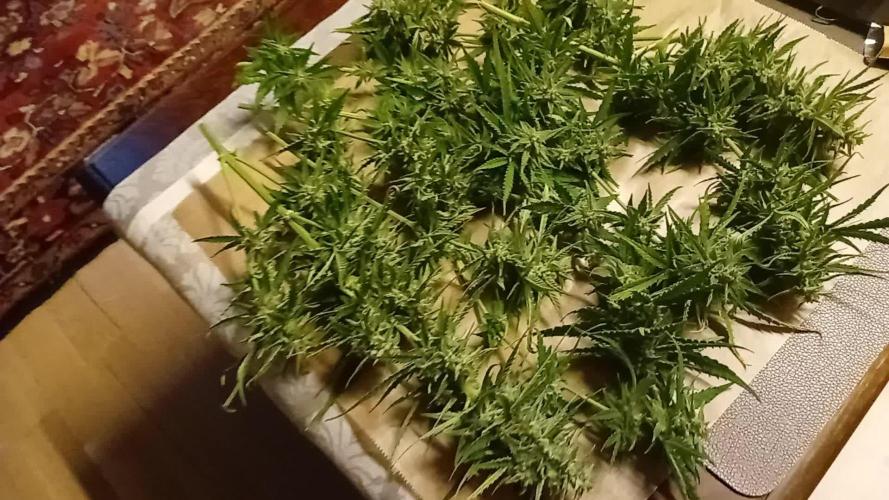
Snip, snip!
Under good conditions, they could have stayed in the ground for at least another 7–14 days so that the tubers could become firm.
I didn't want to take any risks, as some of the Medusa flowers ended up in the trash can due to rot, so I decided to harvest the Sweet ZZ earlier as well. Fortunately, it proved to be very resistant to rot, and I was able to hang up the entire harvest to dry.
I can therefore absolutely recommend it for outdoor use, even under very poor conditions or rainy summers.
I did not weigh the flowers when wet.

Likes
10
Share


@w33dhawk
Follow
Moin moin,und ein knackiges High5 in die Runde es gibt nicht viel zu sagen 2x die Woche giessen mit ca 330 ml pro Pflanze nur Wasser Ph Ein gestellt auf 6,5 mit Green Buzz Nutrients organischem Ph pulver ansonsten entspannt zurück lehnen und den Ladys zu schauen beim wachsen, selbstverständlich die Lampen Abstände regelmäßig anpassen euch ne schöne rest woche

Likes
40
Share


@BLAZED
Follow
Week 16 (Harvest)
1-2 Drying day 1
Temperature: 24.5 to 19.5 degrees
Humidity: 65% to 50%
The girls are ready to be harvested!
Before chopping them down, i took a lot of pictures.
I was able to remove most of the soil from the Biscotti #2 to see the rootball.
I hang the plants as a whole to have a slow dry.
The exhaust fan is on setting 4.
2-2 Drying day 2
Temperature: 19.1 to 17.5 degrees
Humidity: 62% to 57%
I changed the exhaust fan to setting 2 because setting 4 was a bit high in my opinion.
3-2 Drying day 3
Temperature: 19.9 to 18 degrees
Humidity: 62% to 59%
Today i checked up on the drying plants, and i see there are some buds touching other buds, so i chopped the plants in half.
The buds are still to the main stem for a slow dry, but are hanging more spreaded out to prevent any budrot issues.
I changed the exhaust fan to setting 1, as someone told me that it was enough air movement for drying.
4-2 Drying day 4
Temperature: 19.8 to 18.5 degrees
Humidity: 62% to 59%
5-2 Drying day 5
Temperature: 19.9 to 18.8 degrees
Humidity: 62% to 59%
Today i checked on the drying plants and the buds are shrinking a bit, they are getting a little bit crispy on the outside aswell,
I hope they wont dry as fast, and i aim for a 12/14 day dry.
For the next grow i already germinated 2x Chemdog (GreenHouseSeeds) 2x Gorilla Kush (GanjaFarmerSeeds) and 1x Deep Candy CBD (GreenHouseSeeds)
And I have some upgrades planned aswell!
I bought a autopot kit with 4 15L pots, this way the plants will have water and air 24/7 whenever they need it. I have seen alot of great results using autopots so i am very exited to try it out!
And I bought a small camera so i can shoot some weekly timelapses!
Feel free to Follow me if you like to get notified for the upcoming diaries!
Thanks for checking out this diary, peace!
(More harvest updates coming in the next couple of days!)
Huge thank you to Zamnesia for the seeds, and Plagron for the collection of nutrients, and the opportunity to participate in the POWERBUDS contest!
It was a fun and learningful adventure!
Likes
7
Share


@Jeromearound
Follow
Coming along nicely, I will chop in a few weeks I think. I love fast buds seeds they never let me down! Ever! Mimosa cake has been a fun grow and it’s not as smelly as purple punch


Likes
16
Share


@eldruida_lamota
Follow
Vamos familia, aquí os traigo la 3 semana de crecimiento de estas Royal Gorilla de RoyalQueenSeeds.
Vaya color, y van con buen ritmo, ya se realizó el trasplante a maceta definitiva.
Hasta aquí estoy bastante satisfecho
Añadimos flash root, tucan ,gold Joker y la base de crecimiento de Agrobeta , (Blue line).
Aparte aplique tetra 9 de Agrobeta de manera foliar.
Agrobeta:
https://www.agrobeta.com/agrobetatiendaonline/36-abonos-canamo
Mars hydro:
Code discount: EL420
https://www.mars-hydro.com/
Hasta aquí es todo , espero que lo disfrutéis, buenos humos 💨💨
Likes
2
Share

@PapaTerps
Follow
Black Beretta - Cipher Genetics
Week 5 Bloom
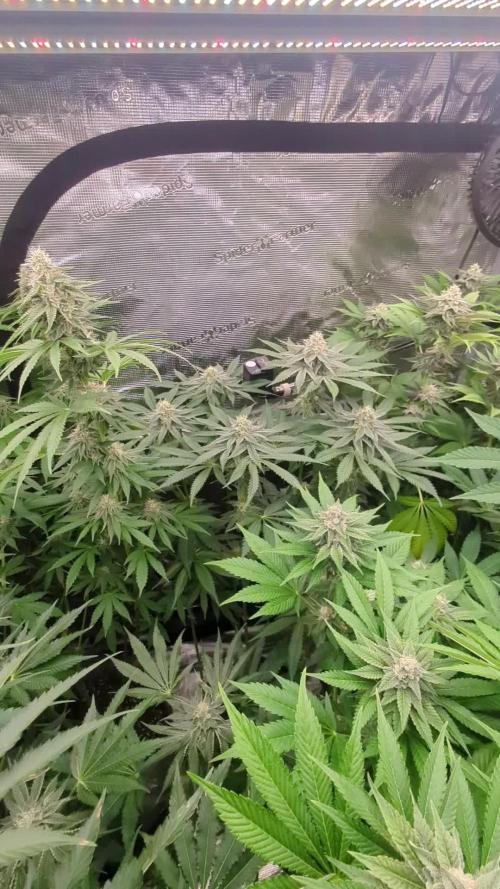
🌸 Great week for her, she has bulked up a huge amount and is absolutely covered in trichomes - she hasn't grown any pollen sacs since the first week in flower so I'm confident we got away with that 👍🏻 Her flower is beautiful and has already started to show signs of maturity, with many of her pistils starting to turn - she might also finish in 8-9 weeks 🙌🏻 Her scent is blackberries with a sweet finish, and it has a punch, one of the strongest smells in the tent!
✂️ No work this week, she hasn't shown any more herming and she has great airflow and light penetration 👌🏻
💧 Watered every three days with 4L of RO water - nutrients were mixed individually, in order and then finally pH'd to 6.3. I've increased her nutrients again to keep up with her flower production.
💡 PPFD: ~900
♒ VPD: 1.53kPa
🌱 Days from seed: 95
🌸 Days in Bloom: 34
Likes
37
Share


@nerdz
Follow
Day 50 to 56 Tuesday
Day 50
Still on the half bloom from yesterday. Almost done stretch.
Balanced the canopy. Lights are 12-14" from the lights at 450w which is ~700 umol.
Seeing little rust spots. I think it's Cal def? Added magnifical up to 920ppm.
D51:
I believe I have been hitting too hard with nutes :) added water to res and back down to 720ppm.
Got advice that I'm probably dealing with PK overdose and it adds up.
D52
Problem is no longer progressing as quickly, however still some signs.
D53
Res nearly empty. Added water down to 350ppm till empty.
D54
Problem appears to be better but still feeding slow. 🤑.
D55
Flushed the solo cup. Refed at 500ppm full bloom.
Fed rest at 500ppm full bloom.
D56
Another quick day at 500ppm and tomorrow I'll bump to 650ppm.