


Likes
Comments
Share

@DogDoctorOfficial
Follow
🌸 Week 9 – Opening the Door for the Flowers
Blueberry Muffin has always had an interesting personality in this tent.
She's not the tallest plant.
She's not the largest plant.
But she's been quietly building herself into a compact flowering machine.
And that's exactly why I decided that a little selective defoliation was appropriate this week.
We're not trying to strip her.
We're not trying to make her naked.
We're simply opening some space.
A few leaves here.
A little overlap there.
Removing foliage that is no longer helping the structure we're trying to maintain.
The goal is simple:
More breathing room.
Better light movement.
Better airflow.
Less unnecessary congestion.
And when you have twelve different plants sharing the same room, sometimes opening one plant slightly also helps the environment around her.
That's the beauty of working with the whole garden rather than looking at each plant in isolation.
✂️ Defoliation – It's About Purpose, Not Punishment
I've talked about this before, but this week is a perfect opportunity to repeat it.
Defoliation isn't about removing leaves because leaves are somehow "bad."
They're not.
Healthy leaves are incredibly valuable.
They're photosynthetic organs.
They're producing the energy the plant uses to grow and develop.
So when I remove a leaf, I want to have a reason.
Maybe it's heavily overlapping another leaf.
Maybe it's sitting inside an increasingly congested section of the canopy.
Maybe it's shading a developing flower while contributing relatively little to the structure.
Maybe removing it creates a much better pathway for air.
And sometimes...
it's simply part of cleaning the plant.
That's the approach we're taking with Blueberry Muffin.
Selective. Intentional. Moderate.
We're not trying to win a defoliation competition.
We're trying to create a healthier, more manageable flowering plant.
💨 Airflow Becomes More Important as Flowers Develop
This is where the timing becomes particularly interesting.
As the plant gets deeper into flower, the canopy naturally becomes more complicated.
Flowers get larger.
Leaves overlap.
Branches carry more biomass.
And spaces that were wide open earlier in the grow can gradually become pockets of dense vegetation.
That's not automatically a problem.
But it's something worth managing.
One of the reasons I wanted to open Blueberry Muffin a little more this week was simply to maintain air movement through the plant.
Good airflow doesn't mean blasting the flowers with a hurricane.
It means avoiding stagnant pockets of humid air trapped inside dense vegetation.
And as we move further into flowering, that's increasingly important.
Because nobody wants to discover a problem after flowers have already become dense.
Prevention is much easier than trying to fix a problem later.
💧 Helping the Room Breathe
There's another interesting side effect to opening the canopy.
The plants are collectively producing and moving a lot of moisture through transpiration.
When twelve plants are sharing a relatively enclosed environment, the canopy itself becomes a major part of the room's microclimate.
Opening congested areas gives moving air more pathways through the plants.
That can help reduce pockets of trapped humidity around the foliage.
And when the canopy breathes better, the whole room benefits.
Again, this isn't about expecting defoliation to magically control room humidity.
The ventilation system is still doing the heavy lifting.
But good canopy management can make the environment easier to manage.
And that's exactly what we're looking for.
💡 Every Photon Has Somewhere to Go
Blueberry Muffin is also at an interesting size.
She's approximately 75 cm tall.
That's not a huge plant.
And because she's relatively compact, I want to make sure the available light isn't unnecessarily intercepted by layers of foliage sitting on top of other foliage.
Yes, she has support from the under-canopy and inner-canopy lighting strategy.
And that's fantastic.
But additional lighting doesn't mean we should deliberately create unnecessary barriers between the light and the flowers.
If we can open a section naturally and allow more photons to travel through the canopy, why not?
We're not trying to expose every square centimetre of the plant.
We're simply making the canopy a little more efficient.
Sometimes the best lighting upgrade is simply...
removing something that doesn't need to be in the way.
🌸 The Flowers Are Taking Over Now
And this is where the photographs become particularly exciting.
The flowers are becoming increasingly obvious throughout the plant.
The white pistils are still doing a lot of the visual talking, but the individual flowering sites are gaining structure and substance.
She's moving away from that early-flower appearance where everything is basically a collection of little pistil-covered points.
Now we're beginning to see the plant building actual floral mass.
The branches are carrying their flowers with confidence.
The canopy has become more compact.
And the whole plant feels like she's entering another chapter.
This is the stage where I stop being interested in how much she's going to stretch...
and become much more interested in how much she's going to stack.
? The Blueberry Muffin Personality
One thing I really appreciate about this phenotype is how different she looks when compared with some of the other genetics in the tent.
She's not trying to dominate.
She isn't the tallest.
She doesn't have the most dramatic structure.
But she's developing her own little architecture.
And that's what this entire 8×8 Adventure is about.
Twelve genetics.
One room.
One general environment.
And twelve completely different answers.
Blueberry Muffin's answer seems to be:
"Give me some time."
And now she's starting to show us why.
💚 Nutrition – Staying the Course
There's no reason to reinvent the feeding programme this week.
We're keeping nutrition essentially unchanged.
Current feeding remains:
Terra Bloom — 2.2 ml/L
Pure Zym — 1 ml/L
Power Buds — 1 ml/L
Sugar Royal — 1 ml/L
pH Plus / Lemon Kick — as required
The plant continues receiving the same flowering nutrition rather than reacting to every small visual change with another adjustment.
That's important.
We made a structural intervention this week.
We don't need to simultaneously start changing everything else.
One change at a time makes the plant much easier to read.
🌡️ The Room Has Changed
And this week we do have a small but interesting environmental change.
The daytime temperature remains around:
29°C
But the night temperature is now approximately:
26°C
Last week we were around 25.6°C, so the difference isn't dramatic, but the overall night temperature is slightly warmer.
That means our day/night temperature differential is now smaller.
We're also sitting around:
RH: 60%
Solution temperature: 25°C
Root-zone/substrate temperature: 25°C
CO₂: ~693 ppm
Light schedule: 12/12
Watering: ~1.3 L per plant / 24h
Container: 15 L
And I actually like observing these little changes.
The room doesn't have to remain frozen in time.
What matters is understanding what changed and watching how the plants respond.
At this stage, with flowers getting denser, keeping the canopy open and maintaining good air movement becomes even more valuable.
🌙 Day vs Night – The Difference Matters
One of the things I enjoy about documenting these numbers is that they tell us more than a single temperature reading.
We're running approximately:
29°C during the day → 26°C at night.
That's only about a 3°C difference.
Earlier in the run, the difference was a little larger.
As the room changes, so does the relationship between temperature, humidity, transpiration and plant development.
And this is why I don't like looking at temperature or humidity as isolated numbers.
The plant doesn't experience "29°C."
It experiences:
temperature + humidity + light + airflow + root-zone conditions + CO₂ + time of day.
Everything interacts.
And right now, I'm happy with what the room is showing us.
We're watching it.
We're measuring it.
And we're adjusting when necessary rather than reacting to every little fluctuation.
🔬 One More Reason I Like This Defoliation
There's something else happening here that I think is easy to overlook.
Cleaning the plant isn't only about what remains.
It's also about what we can see afterward.
Once some of the unnecessary foliage is removed, I can see the flowering structure much more clearly.
I can see which branches are developing strongly.
I can see where flowers are stacking.
I can see where the canopy remains dense.
And I can see what might need attention later.
In other words...
defoliation also improves observation.
And for this project, observation is half the fun.
🔮 Looking Ahead
From here, I want to keep things relatively simple.
No unnecessary training.
No dramatic interventions.
No chasing numbers just because they're numbers.
We'll continue watching the flowers develop, monitoring the canopy and paying attention to how she responds to the cleanup.
The next stage should increasingly be about:
🌸 flower stacking
🌸 calyx development
🌸 increasing resin production
🌸 increasing flower density
🌸 maintaining airflow
🌸 keeping the environment stable
The framework is already there.
Now we're entering the part of the journey where patience becomes more important than intervention.
We've done our job.
Now...
let Blueberry Muffin do hers.
💭 Final Thoughts – Making Space for What's Coming
I think this week is a really good example of how I like to grow.
We didn't defoliate because someone told us:
"Week 9 means defoliation."
We did it because the plant changed.
She's becoming more compact.
She's developing more flowers.
The canopy is getting denser.
She isn't a particularly tall plant, so making the available photons work efficiently matters.
And with twelve plants sharing the same room, keeping air moving through the garden matters too.
So we opened her up.
Not dramatically.
Not aggressively.
Just enough.
And now she looks cleaner, more open and easier to read.
That's what I wanted.
Not a naked plant.
A better-organised plant.
And honestly...
she looks fantastic.
Blueberry Muffin may not have started this journey as the plant that immediately grabbed everyone's attention.
But she's slowly becoming one of those phenotypes where you look back at the earlier photographs and think:
"Oh... now I see what she was doing."
She's been building toward this.
And now she's starting to show it.
?🌸🔥
🙏 Thank You
A huge thank you once again to Zamnesia for giving us the opportunity to explore these genetics, Plagron for supporting the garden throughout the journey, Future of Grow for providing the light that powers this experiment, Lumiflora for bringing additional light into the inner and lower canopy, TrolMaster for helping maintain environmental stability, and of course everyone following this 8×8 Adventure on GrowDiaries.
Every week gives us another little lesson.
Sometimes it's about nutrition.
Sometimes it's about environment.
Sometimes it's about genetics.
And sometimes...
it's simply about knowing when to take a few leaves away and give the plant a little more room to breathe.
Blueberry Muffin is entering another chapter now.
The canopy is open.
The flowers are developing.
The room is stable.
And there's still plenty of story left to write.
Until next week...
Growers Love and happy growing! 🌱💚?


Likes
15
Share


@420DeepGrow
Follow
Gracias al equipo de Seedsman y XpertNutrients sin ellos esto no sería posible.
💐🍁 Alaskan Do-Si-Dos:
Alaskan Do-Si-Dos ha sido desarrollada por expertos como una versión mejorada de la siempre popular variedad Alaskan Purple de Seedsman. La introducción de la genética Do-Si-Dos en la Alaskan Purple ha creado un híbrido índica/sativa que aumenta la potencia y el rendimiento al mismo tiempo que mejora el perfil de sabor y sigue siendo versátil en lo que respecta al cultivo en exterior.
La Alaskan Do-Si-Dos está destinada principalmente al cultivo al aire libre y en invernaderos. Las plantas crecen altas y prosperan en climas fríos, templados, cálidos y secos, al mismo tiempo que se desempeñan bien en altitud. Esto no impide que se cultive en interior, pero estas plantas grandes necesitarán mucho espacio. Las plantas muestran una resistencia moderada al moho pero, si se cultivan en interiores, hay que tener en cuenta que son RUIDOSAS, por lo que se beneficiará del uso de filtros de aire de carbón. En exterior, en latitudes septentrionales, la cosecha está prevista para finales de septiembre, mientras que en interior las plantas tardarán entre 8 y 10 semanas en completar la floración. Los rendimientos en exterior son muy altos y pueden superar fácilmente los 750gr/planta, mientras que en interior los rendimientos son elevados, hasta 600gr/m2. Los cogollos maduros tienen una densidad media y mantienen un color verde medio.
🌻🚀 Consigue aqui tus semillas:
https://www.seedsman.com/eu-es/alaskan-do-si-dos-feminised-seeds-sman-aldsd-fem
🍣🍦🌴 Xpert Nutrients es una empresa especializada en la producción y comercialización de fertilizantes líquidos y tierras, que garantizan excelentes cosechas y un crecimiento activo para sus plantas durante todas las fases de cultivo.
Consigue aqui tus Nutrientes:
https://xpertnutrients.com/es/shop/
📆 Semana 4:
Aparecieron un monton de erizos esta semana, el temporal ha hecho algo de mella en la carpa al bajar las temperaturas aunque todo sigue correcto.
Continuamos con las dosis de nutrientes recomendadas por el fabricante.

Processing
Likes
1
Share


@Lifted
Follow
I did a heavy defoliation last week,so majority of this week was about getting my plant back to a healthy phase. I did alot more LST as you can tell in the video to start more of an even canopy. I also raised my light by 4 inches to provide a little more stretch in each branch so I'd be able to manipulate it more with LST next week.

Likes
6
Share

@Northern_Ent
Follow
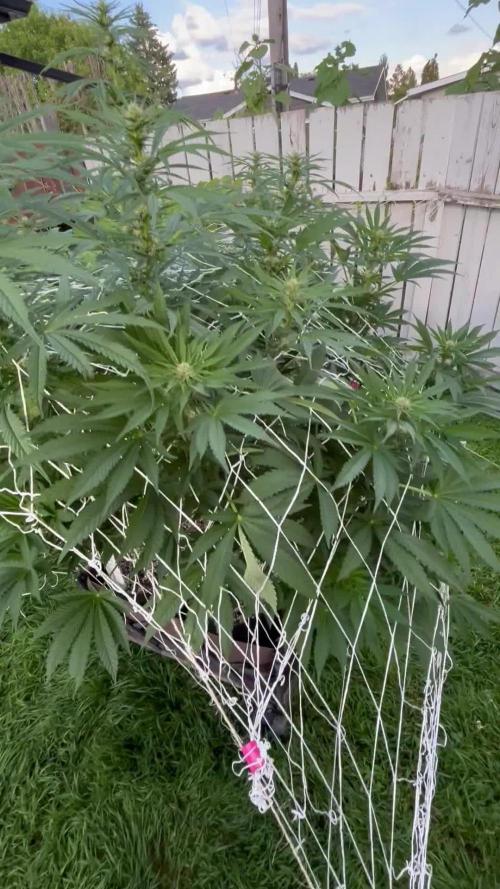
Aug 8: she had a late start and lost a couple of colas to hail a few weeks ago.
Aug 9: defoliated lower limbs.Layered another scrog net on the top and clipped to to the twine.
Aug 10: adding Green Sensation to the rotation and removing molasses. Molasses are great for growing but it needs to be stopped 4-6 weeks before harvest so you don’t have to smoke sugar along with your weed. ‘Molasses are for growing, not for smoking.’
Aug 13: mostly overcast and a bit of rain again today but some good sun.

Likes
88
Share


@JuanHaze_Arg
Follow
Esperando ansiosamente que aparezcan los primeros tricomas de color ambars para cosecharla, por el momento se riega con agua de osmosis inversa con ec:0.0 + detox para lavar el suelo, cada vez está mas amarilla y toma menos agua. Ya es una planta sin alimento. Sin nutrientes agregados, solo consume lo que quedo entre el sustrato. El agua de osmosis inversa sin minerales es fabulosa
Likes
16
Share


@Lickey
Follow
I will be chopping the blueberry og.
So Removed BBxOG from the scrog two days into this week. Was a lot of work and accidental chopped off a giant top. Oh well. Will try to get drying space tonight
Likes
7
Share


@BAMA_251
Follow
I think she might go for another week I’m just loving how the purple is coming out and I haven’t seen anyone else grow this strain like mines

Likes
6
Share


@GreatDaneCannabis
Follow
1 Strain, same breeder, same tent and conditions but 3 different agendas. Molly is just over 42”, Meredith is 30” and Marissa only 16”. I think Molly’s stretch is over and the other 2 have a ways to go. This week I defoliated all 3 again to open up the bases and thin the canopies a little. I’m no expert but I’m learning and the ladies are looking great. Added some more coco to make up for the sinking and while I’ve been trying to keep this as simple as possible just using Advanced Nutrients and CalMag, after doing lots of reading I ordered some Big Bud for Coco and will be starting that when it arrives. Haven’t run the humidifier this week at all or the dehumidifier. Just letting it stay 45-55 on its own. Figured out how to gain almost 6” in the tent without sacrificing ventilation so got Molly back under the light fully, then she grew another 6” out of spite…lol. Great week! I love opening the tent and having the humidity and smell hit me in the face.
Processing
Likes
5
Share


@Ganjagrandaddy
Follow
Day 28: Happy days folks. hope we are all well and sane still.
This week has been a good week for node stacking and starting her frost making it seems. She is a great size to work with now and has responded well to the stripping out of the lower larf and leaf. The airflow is perfect below decks now and allows air to move through the whole canopy and also light to make it through. Her buds are showing her Gelato 41 genetics with their appearance and are identical to the white flame like pistils. She is giving a slight terpene of sweetness and a little diesel too. Her stripping out had my fingers feeling a nice tacky , oily feel to them so she is certainly starting to nurture the budlets. Their golfball appearance is swelling daily and seeing how lose they are to joining up already , holds hope for some long chunky colas. She is approx 3ft now and a good circumference to her too. It is a safe assumption to think she will go the full 11 weeks flowering based on her parentage. The cross of these two strains is so far producing a perfect sized plant for my room and has given me the confidence to dabble in this area in the future I think. Gorilla Zkittelz/Blue Gelato41 is a good X and I know from another seed popped by a friend that Gelato41/Hulkberry creates a 5ft cola'ed monster plant. ( pic in my photos) and I still have crosses of Gelato41 and Cookie Kush , Gelato41 and Phantom O.g , Gelato41 and Orange Sherbet to run !!. I am fortunate to have a lot of these new beans now but I also have some amazing sponsored genetics running and some exciting testers still to do ( 9 more fast flowering strains to put through the wringer and try to identify !.lol) . Well that's another week down and only 7 to go for her. !!!!!!! she has a lot of big stacking buds growing time left. WATCH THIS SPACE !!!!!.
Be safe people.
Processing
Likes
5
Share


@KratkyGrow
Follow
Some of the bottom leaves are starting to yellow a bit on the larger plant.
It looks like trichomes are starting to push through on some of the leaves.
Likes
13
Share


@FlavorzChaser
Follow
Grapefruit week 7 biobizz bloom increased to 3ml week 2 of bigbud I've started adding pk13/14 large shade leafs are beginning to yellow and all bud sights are starting to put on weight with the purple running through the stem its definitely gonna look really nice when is finished its already smelling pretty strong got the carbon filter on 6 times in a 24hr period 15mins each time seems to work well smell and humidity wise as in decreasing humidity and keeping it down to 51% sometimes I can get it in the 40% and its stable even with this ever changing uk weather.
Likes
7
Share


@Ieiogrow94
Follow
Eccoci di nuovo qui!!!
Super eccitato per questa nuova collab con Anesia Seeds, team davvero al top, che mi ha dato l’opportunità di testare questa nuova genetica e di condividere i progressi con tutti voi!!!
Come sempre partiamo nei bicchieri per poi travasare.. Questa volta verrà svolto tutto sotto la Lumatek Zeus 465 ProC, mi aspetto molto da questo ciclo!!
Purtroppo ho perso i file delle scorse settimane e dovrò reiniziare il report da ora scusate per il disagio
Grazie a tutti per il supporto ❤️🍀🔥


Likes
7
Share


Likes
12
Share


@PedroAndHisPlants
Follow
Day 22:
Hey everyone!
Update on the second grow: the plants are looking very healthy and seem to be growing much faster than the first batch. 🌿 I feel like we've already done a lot better with these plants compared to the first grow.
What do you all think? Any thoughts or suggestions?
Day 26 (Second Grow):
Hey everyone!
Exciting news: the plants in our second grow have names now too! 🌿 This will make it easier to identify and keep track of each one, especially if they get moved around. It should also help you all follow along more easily with the pictures we post.
We've built a SCROG (Screen of Green) net for the plants in both grows. For those who don’t know, a SCROG net helps to train the plants to grow horizontally, which maximizes light exposure to all parts of the plant and promotes more even growth. We're using it to ensure all plants get plenty of light and develop a uniform canopy.
Additionally, we've placed a hygrometer among the plants to measure the humidity between the leaves. We've noticed that the humidity sometimes exceeds 70% in those areas.
We're considering whether we need more fans, an intake ventilation system, or if a dehumidifier would be a better option. We're leaning towards adding more fans to improve air circulation, but we'd love to hear your thoughts and suggestions!
Stay tuned for more updates as we continue to watch both grows progress!

Likes
11
Share


@TooMedicatedToThinkOfOne
Follow
So this week isnt over yet, i just wanted to say that im pretty certain she is starting to show her sex! I dont have any pictures yet as they are really really really tiny but i think this will be my last week that i give her veg nutes and next feeding will be with tiger bloom and probably still likely big bloom too. I cant wait to show you guys the progress is been so exciting! The branch i accidentally almost took off because i pressed down too hard is doing well it isnt fully healed yet but we have time so im not too worried and none of the leaves are wilting or looking like they are dying so i think and hope it will hold out and be healthy and strong by flowering time so it can hold its weight! P.S. it wouldnt let me post without a picture so heres the first frame for this weeks time lapse before its done for the week!
Alright guys week 4 has officially ended and im putting the edited time lapse up for you all to see, week 4 was phenomenal and the growth alone has been starting to get crazy big i cant believe it! So i was 100% correct about earlier in the week and she is currently showing signs of pistils starting to form on some branches so this will mark my last week giving her veg nutes and next feeding cycle will be with some flowering nutes. I decided to defoliate her today to try and get rid of any ugly leaves as well as fan leaves that werent needed. it really spaced out the plant some more for good lighting to penetrate it all hopefully. The branch that i accidentally injured is doing good still healing up i think but i do believe that in time it will be 100% of what i can be given the circumstances. im just happy and it hasnt seemed to stunt the growth of that branch at all either its getting really big. Thanks for all the love and support guys i cant wait to get her to harvest and to be able to say im smoking my own weed after dry and cure! I gave her some Cal-Mag too to help with possible deficiencies later on in the flower cycle but not a ton because i dont want to over do it!

Likes
25
Share


@Tetiana_Riz
Follow
Hi growers!
It's been 5 weeks since we entered the flowering stage, and our plants are in full bloom! The branches have become thick, the leaves remain green, and the buds are getting fuller by the day.
We continue to feed our plants with Xpert Nutrients flowering fertilizer, and the results are simply amazing! Our girl clearly loves this fertilizer, and we couldn't be happier with its effectiveness.
A big thank you to Xpert Nutrients for such an amazing fertilizer! We're continuing our exciting journey and looking forward to new successes and beautiful harvests!


Processing
Likes
4
Share

