


Likes
Comments
Share

@JVKdopegrow
Follow
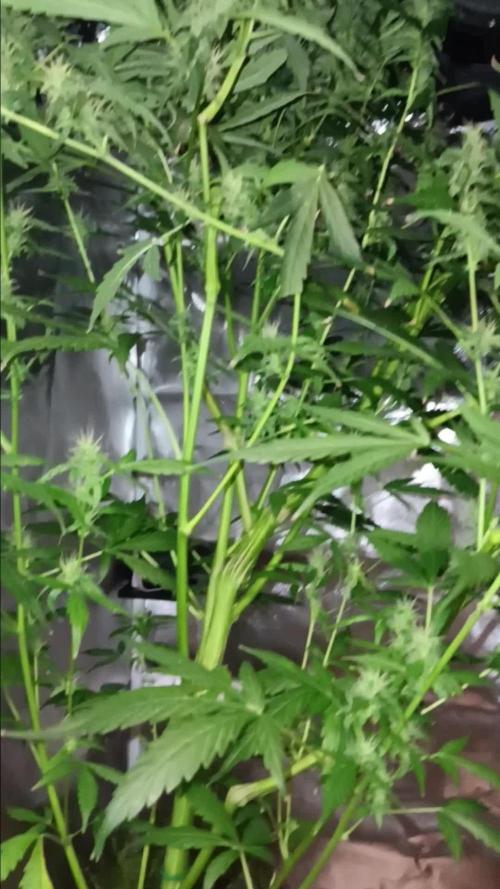
She is the energizer bunny of weed plants. Continues to get larger. Buds finally stacking and smelling so sweet. I am tiring of this grow as she takes up the entire tent and I can't even see the back side.

Likes
3
Share


@Cardiffgrown
Follow
Led on 75% things seem to by flying at the moment I have taken off 1 leaf and tied her down with a peg looking a little bit stressed hoping she bounces back
Likes
12
Share


@StonedandSteady
Follow
#AutoBlueberry Total Dry Yield, DIY Dry Box, Full Garden Update and Smoke Sesh: Super Cropped with Low stress Training for Big Bushes and Bulbous Budz! Big Girls getting Flipped to Flower on 9-24-21
AutoBlueberry 14th w/ 9th W/ Flower breed by #DivineSeeds #DivineSeedsSquad #DivineSeedsBreedingCompany
No 6th feed of #NukeHeads Nutrients #PlutoniumBloom this week, I Flushed her out for the last 5 days of her life w/ 2 gallons a day w/ some Cold Declorinated Tap water and Checked her Tricks every few days till she was Ready for Steady! Lol These Lush Ladies and those Awesomely Purple Budz with Trippy Trichomes Growing on! I made and/or converted one of my Budz into a Polyploid (Bigger and More Bulbous Bud) This AB is Flowering out and her Smells are Super Strong of Gasy and Candied Blueberries! I recently Trained down her branches to expose more Bud sites and Removed the Biggest fan leaves to expose the Bud site's to this Glorious #BloomPlusBP1500w #GrowStarQB1000w #OsreeQB1000w Full Spectrum Grow Lights! I've also Super Cropped, Topped um, Defoliated, Leaf tucked, and Implement the 3D's method like my Broski #TigerfishOrganics to remove the Dead, Dying and Diseased leaves!
Origin:Afghani/Thai
Type:50% Indica/ 40% Sativa/ 10% Ruderalis
Flowering:56 days
THC:22%
Harvest:400-550 g/m2
Height:110-150 cm
They were Growing under the #Growatt600w and in my #TopoLite 24×24×48 Grow Tent but I've Upgraded and Updated it to my #OsreeQB100W I'm also using #TNBNaturals #TheEnhancer Co2 Despersal Canister and using thier Ph⬆️⬇️ for my Decolinated Tap Water!
Green and Growing Up Great! She's Growing into her 9th week of Flower! She's Growing in my special blend of ProMix potting mix, a 1/2 bag of Earthworm castings and 2 light handfuls of Diatomaceous Earth mixed Up well for before transplanted! Diatomaceous Earth: Diatomaceous earth is made from the fossilized remains of tiny, aquatic organisms called diatoms. Their skeletons are made of a natural substance called silica. WHAT IS DIATOMACEOUS EARTH?
In a nutshell, DE comes from the fossilised remains of small marine organisms called diatoms. Over a 30 million year period, these hard-shelled algae collected on the bottom of bodies of water, eventually forming into a type of sedimentary rock. Fast forwarding, it wasn’t until around 1836 that a German peasant Peter Kasten discovered the ivory-coloured, powdery substance while drilling a well in northern Germany. Ever since, the usefulness of DE for multiple purposes, including industrial and horticultural applications, has been well-reported. Just sprinkle some diatomaceous earth on top of your soil and watch mother nature's secret weapon work its magic.CONDITIONS THE SOIL
When it comes to growing cannabis, everyone strives to provide the best soil to grow the best plants—but there’s always a way to make it even better. Making the soil a better medium is called soil conditioning, which is exactly what diatomaceous earth does. It works by improving the retention of moisture in your potting soil, holding a large amount of fluid and drying at a rate that’s much slower. This natural soil additive also helps to retain nutrients and allows for better oxygenation of the substrate. NATURALLY CONTROLS PESTS
DE is an all-natural, safe-to-use substance that doesn’t harm the cannabis plant with toxic chemicals. The nature of diatomaceous earth makes it useful against most types of insect infestation you might be experiencing; and unlike chemical insecticides, insects can’t develop a resistance to the effects of DE. So once they’re gone, they’re gone for good. DE is an abrasive. and when used as an insecticide, it gradually scrapes away an insect’s exoskeleton, absorbs the fluids, and dehydrates insects and other critters to eventual death. IMPROVES PLANT STABILITY
When using DE in your soil, it can be especially beneficial as it frees up nutrients so that they are made available to the plants as needed. This works via the silica content of DE being absorbed into the plant tissue, which helps improve the plant’s ability to respond and receive more nutrients as DE activates. This in turn results in greater yields and better stability under small pH fluctuations!
https://divineseeds.net/
https://instagram.com/divine.seeds?igshid=osxe2v7en33v https://divineseeds.net/
Thanks Again to All my Friends, Family's, Teams, Sponsors, Followers and Subscribers!!! Your Genetics are Merry Magnificent, Mega Marvelous and Mighty Medical! Love um!!! I really Can't stress enough how Thankful and Grateful I am of All of you and what you've Shared with Us! Means the World!!! It's definitely a Pleasure being able to Grow with these Phenomenal Grow Lights! Please Enjoy! BudBrothers4-Life! Cheers Famz!!! Much Props and Much Topz!💯🔥 #BloomPlus #Osree #GrowStar #Growatt #TNBNaturals #TNBTeam #GrowYourOwn #Bliss
https://instagram.com/bloom.plus?utm_medium=copy_link
https://instagram.com/growstarstore?utm_medium=copy_link
https://instagram.com/osree.light?utm_medium=copy_link
https://instagram.com/as420.ca?igshid=1f116alw054wp
The Grow Bags: https://www.as420
https://instagram.com/tigerfish_organics?utm_medium=copy_link
TN Tonny Dual headed Clip on Fan Amazon Link: https://www.amazon.com/dp/B07PJH8CDT/ref=cm_sw_r_cp_awdb_imm_6E4BCKYN6HTAASNQDJSM?_encoding=UTF8&psc=1


Likes
11
Share

@Bncgrower
Follow
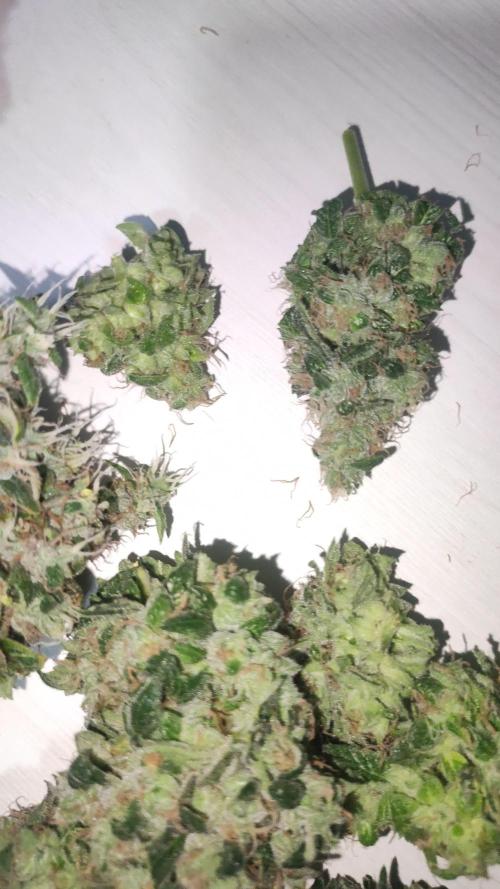
Great harvest, I was impressed with the quality of this strain. After the drying and curing process, I'll give my feedback! 💪

Likes
12
Share


@Green_wannabe93
Follow
3 de 4 plantas ya están florenciendo y la más avanzada está lista para recibir su primera dosis de PK 13-14 La Painkiller XL alta y delgada aún no muestra sus primeros pistilos. Tal vez la planta está esperando al engrosamiento de sus tallos para desarrollar flores y poder sostenerlas
Likes
26
Share


@pifflestikkz
Follow
Day 106
14/10/24 Monday
Their colours are really coming through now 🤩
Nearing their end now, possibly another week after this ✌️💚
Picture and video update 📸💚
Day 108
16/10/24 Wednesday
Another run through of de-chlorinated tap water and flawless finish all to pH 6.3.
Giving 0.3L again daily as there not drinking half as much now.
Picture and video update 📸💚
Day 110
18/10/24 Friday
Divine Seeds Overdose has been Harvested. Check her own diary on my page for full results.
I moved the others into my now cleaned down 1.2m x 80cm under 660w hps to finish off.
Day 111
19/10/24 Saturday
De-chlorinated tap water and flawless finish at pH 6 today.300ml
Day 112
20/10/24 Sunday
De-chlorinated tap water and flawless finish at pH 6 again 300ml.
I have had an extremely busy week. I'll upload videos and pictures tomorrow on a fresh week... Wait and see the colours 😋💚

Likes
19
Share


@proud_to_grow_loud
Follow
More and more colors this week, trying to get the best pictures. I gotta cut it down because the trichomes are there. Gotta prep it for that with a little defoliation.


Likes
4
Share

@CWolcott1991
Follow
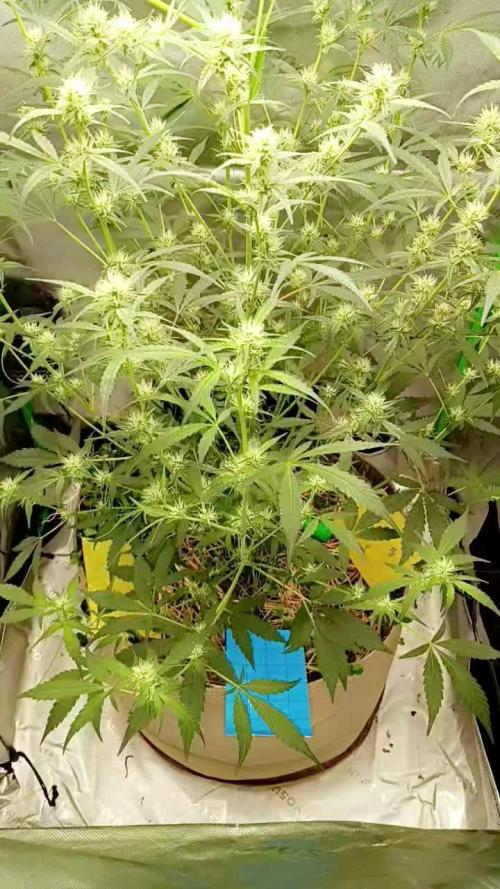
11/12 start of week 3 of flower hoping she is done stretching cus I'm out of room when it comes to height. Gave all the goodies plus added Fulpower and molasses
11/15 stretching seems to have stopped. Dropped humidity and raised vpd to stay around 1.5 and raised light intensity so it's 1000 ppfd at top of plant super cropped the main top to match the height of the side branches.
11/16 watered her with some wdg3000 and saps.

Likes
114
Share


@TheFoxFarmer
Follow
Week 8 Flower
The last week of flush for these two. They were taken down on Day 56, after a 16 Day flush. I think Twin2 could have finished at 7 weeks, but of course I hadn't planned for this, or I would have flushed sooner. So she was taken to the originally planned 8 weeks. Twin2 has also foxtailed quite a bit, from only slightly higher temps and also because she's having a last attempt at catching any pollen in order to reproduce. Although the pots were slightly damp still when I harvested, it is best to take them down when they're dry. The only reason I didn't, was because I knew I'd be too busy the next day, and there were plants in veg that were desperate to be thrown into the flower tent! The pics do make them look wetter than they were though.
Their fan leaves were taken off and they were each hung in seperate boxes, where they'll dry as slowly as possible for between 6-10 days. I dont suffer with very high humidity, so I'm able to do this without any issues. When I feel it is too humid, I simply burp the box for the first day or 2 once a day.
The slower the dry the better the buds will taste/smell. Once she's dry enough she'll be trimmed and jarred for curing.
It's going to be a pretty tough one for keeper pheno! They both have similar but very different smells. By that I mean, they both smell very floral and sweet, but T2 smells extra sweet (although definitely not as dense). That doesn't mean T1 doesn't smell just as nice. Hers buds are thicker and more dense, so even though I've favourited T2 in the pics, I think I'm leaning towards T1 still. But in all honesty it's still down to dry weight and the taste test! This can all be looked forward to in the harvest update!
It's been a seriously fun diary with these two twins. I'm definitely glad I separated them. Do you think you'll attempt to separate them after seeing my experience? Please let me know!
Thanks for following and happy growing! 🐺

Likes
9
Share


@RunWithIt
Follow
And the first week of flower begins!
I started this week off by defoliating any and all large fan leaves blocking lower nodes. Also did a little supercropping on BL to get her to spread just a bit more. I raised the light up to 45cm and this will be the final height.
They've been drinking really fast by this point. Definitely going to be very diligent with waterings/feedings until harvest.
Cheers all! This is my most painless grow to date, praying for a nice and smooth wrap-up to this cycle as well.

Likes
23
Share


@adam_pawloski87
Follow
This week went very well! One will be getting cut an hung to dry while the rest finish up with one more week of flush ! These ladies are smelling so lovely I hope you all enjoy! Stay tuned for next week! Cheers 😤💨💨💨💨💨



Likes
17
Share


@StoneyMelony
Follow
Overview of my grow:
Tent: Secret Jardin DS120 4 x 4 (120 cm by 120 cm)
Lights: 2 x 120 Watt CTlite c4 clusterled
Climat: Trotec Dehumidifyer 240 watt- 10L/24h
Filter: Prima Klima carbon filter PK2600
fan: 2 x Secret Jardin 20watt osc. fan
Pots: Gronest 4 x 11 liter airpots
Water : automated water system
PH: bluelab
Nutrients: Plagron cocos A + B
Plagron PK 13/14
ATA cal/mag
Epsom salt
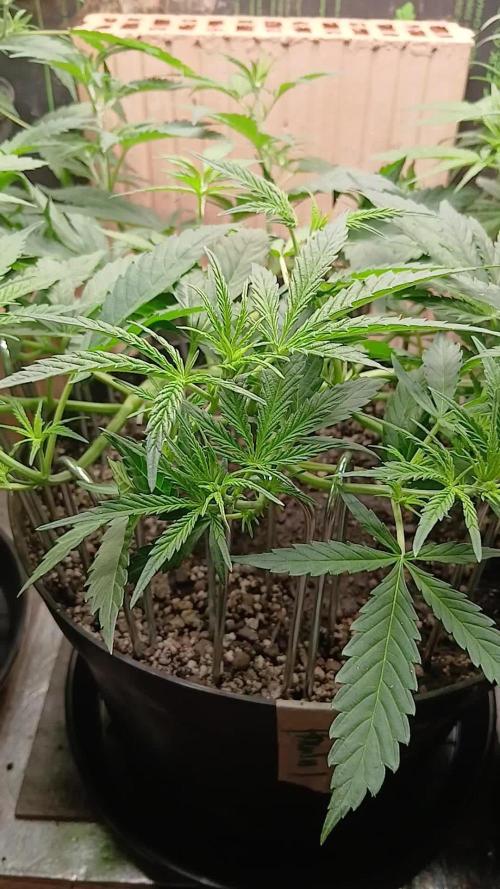
Week 10 She is turned out great, she is so frosty and smells the whole place up. even the buds very low on the plant are dense and the stems are bending by the weight. Very nice 😋
Likes
6
Share

@Jardineiro_Br
Follow
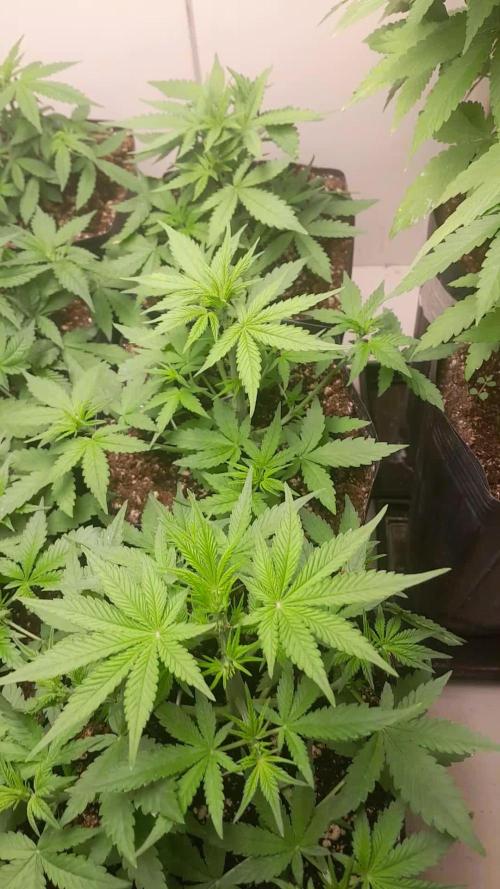
Comecei a semana realizando o treinamento de baixo estresse e uma desfoliação. Nao fiz poda top, não acho que seja adequado para plantas rápidas.
VVamos ver como vai ser o resultado . Nao pretendo mais fazer intervenções no crescimento .
Likes
68
Share

@Ultraviolet
Follow
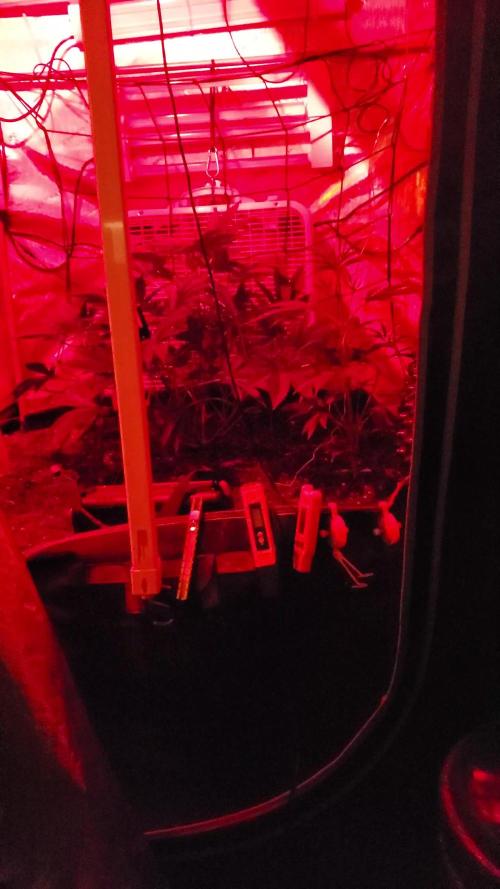
Removed autoflower and put her in her own pot outside the tent.
Foliars applied in strong blue 430nm with 4000Hz tone. 20-minute dose prior to application.
In essence, you're seeing a combination of the infrared light reflected by the plant, which the camera perceives as red, and any residual visible blue light the plant reflects, which results in a purple hue.
I was doing more stretching of the stems, adjusting weights, just a little too much, and it snapped almost clean. I got a little lucky in that it was still connected, wrapped her almost instantly while holding her in place with yoyo's. The core framework is now in place.
If your soil has a high pH, it's not ideal; you want a pH of 6.4, 6.5, or 6.6, which is ideal. If you are over a pH of 7, you have no hydrogen on the clay colloid. If you want your pH down, add Carbon. If you keep the pH below 7, you will unlock hydrogen, a whole host of new microbes become active and begin working, the plant will now be able to make more sugar because she has microbes giving off carbon dioxide, and the carbon you added hangs onto water. Everything has electricity in it. When you get the microbes eating carbon, breathing oxygen, giving off CO2, those aerobic soil microbes will carry about 0.5V of electricity that makes up the EC. The microorganisms will take a metal-based mineral and a non-metal-based mineral with about 1000 different combinations, and they will create an organic salt! That doesn't kill them, that the plant loves, that the plant enjoys. This creates an environment that is conducive to growing its own food.
Metal-based: Could include elements like iron, manganese, copper, or zinc, which are essential nutrients for plants but can exist in forms not readily accessible.
Non-metal-based: Examples like calcium carbonate, phosphate, or sulfur are also important for plant growth and potentially serve as building blocks for the organic salt.
Chelation in a plant medium is a chemical process where a chelating agent, a negatively charged organic compound, binds to positively charged metal ions, like iron, zinc, and manganese. This forms a stable, soluble complex that protects the micronutrient from becoming unavailable to the plant in the soil or solution. The chelate complex is then more easily absorbed by the plant's roots, preventing nutrient deficiency, improving nutrient uptake, and enhancing plant growth. Chelation is similar to how microorganisms create organic salts, as both involve using organic molecules to bind with metal ions, but chelation specifically forms ring-like structures, or chelates, while the "organic salts" of microorganisms primarily refer to metal-complexed low molecular weight organic acids like gluconic acid. Microorganisms use this process to solubilize soil phosphates by chelating cations such as iron (Fe) and calcium (Ca), increasing their availability.
Added sugars stimulate soil microbial activity, but directly applying sugar, especially in viscous form, can be tricky to dilute. Adding to the soil is generally not a beneficial practice for the plant itself and is not a substitute for fertilizer. While beneficial microbes can be encouraged by the sugar, harmful ones may also be stimulated, and the added sugar is a poor source of essential plant nutrients. Sugar in soil acts as a food source for microbes, but its effects on plants vary significantly with the sugar's form and concentration: simple sugars like glucose can quickly boost microbial activity and nutrient release. But scavenge A LOT of oxygen in the process, precious oxygen. Overly high concentrations of any sugar can attract pests, cause root rot by disrupting osmotic balance, and lead to detrimental fungal growth. If you are one who likes warm tropical high rh, dead already. Beneficial, absolutely, but only to those who don't run out of oxygen. Blackstrap is mostly glucose, iirc regular molasses is mostly sucrose. Sugars, especially sucrose, act as signaling molecules that interact with plant hormones and regulate gene expression, which are critical for triggering the floral transition. When sucrose is added to the growth medium significantly influences its effect on floral transition.
Probably wouldn't bother with blackstrap given its higher glucose content. Microbes in the soil consume the sugar and, in the process, draw nitrogen from the soil, which is the same nutrient the plant needs. Glucose is not an oxygen scavenger itself, but it acts as a substrate for the glucose oxidase (GOx) enzyme, effectively removing oxygen from a system. Regular molasses (powdered if you can), as soon as she flips to flower or a week before, the wrong form of sugar can delay flower, or worse. Wrong quantity, not great either. The timing of sucrose application is crucial. It was more complicated than I gave it credit for, that's for sure. When a medium's carbon-to-nitrogen (C:N) ratio reaches 24:1, it signifies an optimal balance for soil microbes to thrive, leading to efficient decomposition and nutrient cycling. At this ratio, soil microorganisms have enough nitrogen for their metabolic needs, allowing them to break down organic matter and release vital nutrients like phosphorus and zinc for plants. Exceeding this ratio results in slower decomposition and nitrogen immobilization, while a ratio below 24:1 leads to faster breakdown and excess nitrogen availability.
Carbon and nitrogen are two elements in soils and are required by most biology for energy. Carbon and nitrogen occur in the soil as both organic and inorganic forms. The inorganic carbon in the soil has minimal effect on soil biochemical activity, whereas the organic forms of carbon are essential for biological activity. Inorganic carbon in the soil is primarily present as carbonates, whereas organic carbon is present in many forms, including live and dead plant materials and microorganisms; some are more labile and therefore can be easily decomposed, such as sugars, amino acids, and root exudates, while others are more recalcitrant, such as lignin, humin, and humic acids. Soil nitrogen is mostly present in organic forms (usually more than 95 % of the total soil nitrogen), but also in inorganic forms, such as nitrate and ammonium. Soil biology prefers a certain ratio of carbon to nitrogen (C:N). Amino acids make up proteins and are one of the nitrogen-containing compounds in the soil that are essential for biological energy. The C:N ratio of soil microbes is about 10:1, whereas the preferred C:N ratio of their food is 24:1 (USDA Natural Resource Conservation Service 2011). Soil bacteria (3-10:1 C:N ratio) generally have a lower C:N ratio than soil fungi (4-18:1 C:N ratio) (Hoorman & Islam 2010; Zhang and Elser 2017). It is also important to mention that the ratio of carbon to other nutrients, such as sulfur (S) and phosphorous (P) also are relevant to determine net mineralization/immobilization. For example, plant material with C:S ratio smaller than 200:1 will promote mineralization of sulfate, while C:S ratio higher than 400:1 will promote immobilization (Scherer 2001).
In soil science and microbiology, the C:S ratio helps determine whether sulfur will be released (mineralized) or tied up (immobilized) by microorganisms.
A carbon-to-sulfur (C:S) ratio smaller than 200:1 promotes the mineralization of sulfate, when the C:S ratio is low, it indicates that the organic matter decomposing in the soil is rich in sulfur relative to carbon. Microorganisms require both carbon and sulfur for their metabolic processes. With an excess of sulfur, microbes take what they need and release the surplus sulfur into the soil as plant-available sulfate
A carbon-to-sulfur (C:S) ratio higher than 400:1 will promote the immobilization of sulfur from the soil. This occurs because when high-carbon, low-sulfur materials (like sawdust) are added to soil, microbes consume the carbon and pull sulfur from the soil to meet their nutritional needs, temporarily making it unavailable to plants.
200:1 C:S 400:1: In this range, both mineralization and immobilization can occur simultaneously, making the net availability of sulfur less predictable.
This dynamic is similar to how the carbon-to-nitrogen (C:N) ratio regulates the availability of nitrogen in soil. Just as microbes need a certain amount of nitrogen to process carbon, they also require a balanced amount of sulfur. Both mineralization and immobilization are driven by the metabolic needs of the soil's microbial population.
Sulfur is crucial for protein synthesis. A balanced ratio is particularly important in relation to nitrogen (N), as plants need adequate sulfur to efficiently use nitrogen. A severely imbalanced C:S ratio can hinder the efficient use of nitrogen, as seen in trials where adding nitrogen without balancing sulfur levels actually lowered crop yields.
Maintaining a balanced carbon-to-sulfur (C:S) ratio is highly beneficial for plant growth, but this happens indirectly by regulating soil microbial activity. Unlike the C:N ratio, which is widely discussed for its direct effect on nutrient availability, the C:S ratio determines whether sulfur in the soil's organic matter is released (mineralized) or temporarily locked up (immobilized).
Applied 3-day drought stress.
Glucose will hinder oxygenation more than sucrose in a solution because glucose is consumed faster and has a higher oxygen demand, leading to a more rapid decrease in oxygen levels. When cells respire, they use oxygen to break down glucose, and this process requires more oxygen for glucose than for sucrose because sucrose must first be broken down into glucose and fructose before it can be metabolized.
In a growth medium, glucose is a more immediate and universal signaling molecule for unicellular and multicellular organisms because it is directly used for energy and triggers a rapid gene expression response. In contrast, sucrose primarily acts as a signaling molecule in plants to regulate specific developmental processes by being transported or broken down, which can be a more complex and slower signaling process.
Critical stuff.
During wakefulness (DC electric current) life can not entangle electrons and protons. During the daytime, the light is sensed as multiple color frequencies in sunlight. Coherence requires monochromatic light. Therefore, at night, IR light dominates cell biology. This is another reason why the DC electric current disappears during the night. The coherence of water is maintained by using its density changes imparted by infrared light released from mitochondria in the absence of light. This density change can be examined by NMR analysis, and water is found to be in its icosahedral molecular form. This is the state that water should be in at night. This is when a light frequency is lowest and when the wave part of the photoelectric effect is in maximum use.
3600
Likes
12
Share


@Zootedshroomer
Follow
Very easy to taie care of.Smelling so good at the moment and been since last week!Very satisfied with how good these girls react to stress! Growing great for going 3-4 days without water and light due to things happening in my life haha but got it going.If you are a newbie these are a good strain and brand to go for! Thank you fast buds for this opportunity again and i knew i wouldn’t regret this as i love every strain y’all make!