


Likes
Comments
Share

@DogDoctorOfficial
Follow
🍮 Chem Brûlée – Pheno A
Week 5 | Giant Leaves, Big Dreams
Welcome back to another chapter of the 8×8 Adventure!
If you’ve been following this project from the beginning, you’ll know that every phenotype is writing its own story. Although they all share the same room, the same environment, the same lighting schedule, and very similar nutrition, each plant continues to express herself in completely unique ways.
That’s exactly why I love phenotype hunts.
This project follows every plant individually using the 12/12 From Seed method, allowing each lady to decide for herself when she’s ready to leave vegetative growth behind and begin flowering.
This week…
Chem Brûlée Pheno A left absolutely no doubt.
Flowering has officially begun.
⸻
🌼 The First Flowers
One of the most exciting moments during any grow is seeing those first bright white pistils appear.
These delicate hairs are the female reproductive organs of the plant and mark the true beginning of flower production.
During these first weeks, the plant is shifting priorities.
Instead of investing all her energy into producing stems and leaves, she now begins building the framework that will eventually become dense, resin-coated flowers.
Every new white hair is another small step toward harvest.
It’s always an exciting stage to witness.
⸻
🍃 Those Incredible Fan Leaves
The first thing anyone notices about this phenotype…
Those leaves.
They’re absolutely enormous.
Some of these fan leaves are nearly twice the size of my own hands—and I definitely don’t have tiny hands!
Large fan leaves often indicate a plant that is photosynthesizing efficiently, capturing as much light energy as possible to fuel rapid development.
They’re essentially giant solar panels.
As long as they’re healthy, standing proudly, and maintaining a rich green colour, they’re doing exactly what nature designed them to do.
At this stage I prefer to let them work.
Every healthy leaf is another energy factory helping build the flowers that are only just beginning to form.
⸻
🌱 Gentle Training
Training continues to remain incredibly simple.
No aggressive bending.
No topping.
No heavy defoliation.
Instead, we’re relying mainly on gentle leaf tucking and subtle low-stress training to improve light penetration while allowing the plant to maintain her natural structure.
Sometimes the best training isn’t forcing a plant into shape.
Sometimes it’s simply helping her reveal the shape she already wanted to grow.
So far…
She’s rewarding that patience beautifully.
⸻
💧 AutoPot Life
Chem Brûlée Pheno A is growing on the AutoPot irrigation system.
Once the root system becomes established, the AquaValve automatically delivers nutrient solution from below whenever the plant drinks enough to lower the water level inside the tray.
There’s no timer.
No electricity controlling irrigation.
No daily watering routine.
The plant simply feeds herself whenever she needs it.
It’s a remarkably elegant system that encourages consistent moisture levels while reducing stress caused by repeated drying cycles.
This week I’ve also included photos comparing the nutrient solution used in the AutoPot reservoir with the hand-feeding mix used for the non-AutoPot plants.
Although the recipes are very similar, the EC differs slightly because plants growing on AutoPots receive a constant supply of nutrients, allowing for a more stable feeding strategy.
Every cultivation method has its own rhythm.
Learning those rhythms is part of becoming a better grower.
⸻
🍽️ Feeding Strategy
This week we adjusted the nutrition slightly to support the transition into flowering.
The bloom nutrients are now beginning to take over while still providing enough support for the final stretch before flower production accelerates.
As always, every adjustment is based on observation rather than routine.
Healthy plants tell you what they need.
You simply have to learn how to listen.
⸻
🌡️ Environmental Conditions
The room continues running beautifully.
Average conditions this week included:
• Day temperature: 31°C
• Night temperature: 25°C
• Relative humidity: 67%
• Nutrient solution: 21.6°C
• Root zone: 21°C
• CO₂: 639 ppm
Humidity remains slightly higher during this transitional phase because the plants are still producing large amounts of fresh vegetative growth while stretching into flower.
Over the coming weeks, humidity will gradually be reduced as flowers begin gaining density.
The room itself is really starting to come alive now.
Every day the canopy looks fuller, healthier, and more vibrant than the day before.
Watching an entire room evolve together never gets old.
⸻
📸 Capturing the Journey
This week’s update includes bird’s-eye views, side profiles, close-ups, and room shots to document every stage of Chem Brûlée A’s development.
One of my favourite details is simply seeing those giant fan leaves from different angles.
Months from now they’ll be part of the story, reminding us where this beautiful lady began before her canopy disappears beneath a forest of flowers.
That’s why I enjoy documenting everything.
Not just the destination…
But every step that leads there.
⸻
🔮 Looking Ahead
Next week I expect Chem Brûlée A to continue stretching while producing many more pistils across the canopy.
Bud sites should become more clearly defined, and the first signs of flower stacking will begin to appear.
Training will remain minimal, allowing her natural structure to continue developing while we simply guide her when necessary.
Sometimes the biggest changes happen quietly.
This feels like one of those moments.
⸻
💚 Thank You
A huge thank you to everyone following this 8×8 Adventure.
Whether you’re here to learn, compare phenotypes, improve your own garden, or simply enjoy watching these incredible plants grow, I’m grateful you’re sharing this journey with me.
Special thanks to:
💚 GrowDiaries for giving growers around the world a place to learn, document, and inspire one another.
Zamnesia for providing the genetics that make this phenotype hunt possible.
🌱 Plagron for the nutrition supporting every stage of this grow.
💡 Future of Grow LED for delivering the light that powers every day of development.
🌿 TrolMaster for helping maintain a stable environment around the clock.
And finally…
Thank you to every grower, follower, supporter, silent reader, friend, and even the occasional critic. Every visit, every comment, every bit of encouragement helps make these diaries something truly special.
I’ll see you all next week, where Chem Brûlée Pheno A will continue transforming those giant solar panels into the energy needed to build what promises to be some truly beautiful flowers.
Until then…
Growers Love and happy growing, everyone. 🌱🍮💚

Likes
57
Share


@GreenISR
Follow
First of all the plant is so strong after I have LST her all the way and tops and main line like wtf 🤪🤪
My trim of the buds gose fan leafs in the side and sweet leafs in the side and cut a litel for secend trim ( took me some time around 3 - 4 hours .
P
So I had some issue in the beging becuse I try to grow it in 24 h cycle light in the start it have made the plant dense but it slow down the growing for 2 - 3 weeks .
In the end the results are amazing with the flux method ( I hope I did it right ) .
Grate seed bank !
That color in the end just wow and even the lower buds get a pink color .
Wet wight around 1.2 - 1.5 ( Human scale Lol ..) will update soon with more pic's .
Roots are full its amazing ! And I 0did a good job .
After the dry out ill do so aging .
So came out with 200 grams in the end I have learn that the size is dosent metter 🤣
Becuse of 3 liter pot I made 180 but still it weird becuse in 10 liter I came out 300 .
So the flux project went intresting and my last time im doing this grow flux..

Likes
89
Share


@Gunnen
Follow
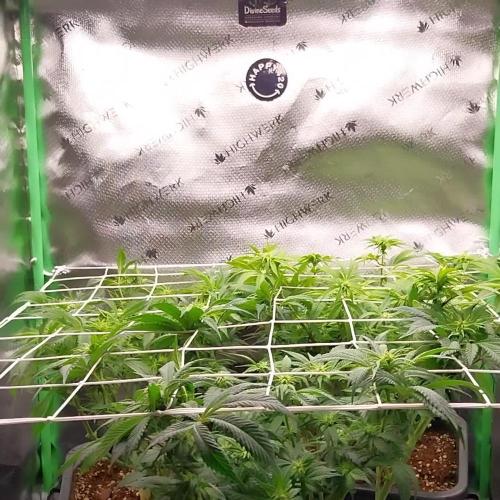
Week 6 was smooth. Especially after correcting the signs of deficiency. The plants have bounced back quickly after being fed and are thriving in the environment. New growth shows no new signs of deficiencies, and old growth did not get any worse. Luckily it was caught early enough and corrected. At the end of week 6 I continued to tie down shoots and continue the LST throughout the canopy. Light defoliation was also done around prime bud spots, and the lower skirt near soil. Technically also removing lower growth that won't amount to much, aka "lollipoping." Plan for week 7 is to continue to water when dry to a PH of 6.2-6.6 and LST with light defoliation where needed. Monitoring the environment and running dehumidifier to 45% RH. Fans are blowing and these seem like they will be big girls. These are some of the bigger autos I have seen personally.
*UPDATE* One plant is showing nitrogen toxicity. Leaves are curling bad at top. I took her out and flushed her, as I may have built up too much with run off when fixing the phosphorus issue. Continue to monitor and hope it recovers quickly. But have also seen a lot of other grows with similar leaf traits with downward curls, might be genetics. None the less, will let dry and water thoroughly all plants next time with PH 6.2-6.5 water.
*UPDATE 2.0"
So the girls soil was not good. Turns out my calibration was off on pH meter and was flushing with around 7 pH water. Read the soils and one plant, that had the claw and dark leaves, was above 7.0 soil pH. Others were below but still a bit high. Have been adjusting pH of water to about 5.8-6.2 pH for next few to help lower it. One girl is not happy. We will get the train back on the rail though.

Likes
10
Share




Likes
8
Share

@bkickstand
Follow
Grow Diary Entry: July 17, 2026
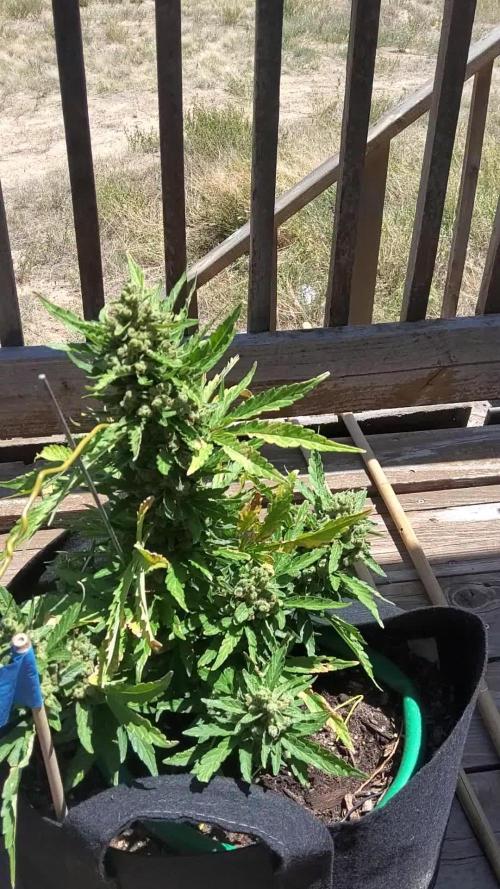
We have entered the flush phase of flowering. Plain well water at a PPM of about 550 and a pH of 7.2.
Charlotte (Week 8 of Flower):
She is looking fantastic and has developed a beautiful, dense structure.
The buds are maturing well, and it is rewarding to see the results of the consistent care and trainingrovided throughout the season.
Makayla (Week 6 of Flower):
She is filling out nicely, showing healthy, vibrant growth across her canopy.
Her low-profile shape is working perfectly, allowing for good light penetration and steady bud development.
General Observations:
The use of PVC risers continues to be an effective setup, keeping the bags elevated and well-drained.
Both plants are benefiting from the natural, outdoor environment, and it is a pleasure to watch them move closer to harvest.
It’s been a rewarding season tracking these two, and they are clearly responding well to the cultivation techniques.
Update 07.19.26: Under the microscope, we've hit that cloudy/milky point on Charlotte's trichomes. I'm waiting for 5-10% amber trichomes

Likes
6
Share


@Ninjabuds
Follow
My permanent marker plants are looking really interesting! The short and stocky one with the purple leaves is super vibrant. I love that pop of color against the green of the other plants. It's a little different from the taller plant, which has this really cool stacked-up look to it. I'm curious to see if those stacked-up leaves will change color too.
The past few weeks have been so beautiful, watching the plants grow and change. It's amazing how something so small and fragile can turn into something so strong and vibrant. Now that they're getting ready to bloom, it feels a little bittersweet. I'm so excited to see the finished product, but I'll definitely miss having them around while they're growing.

Likes
2
Share

@Nillenium
Follow
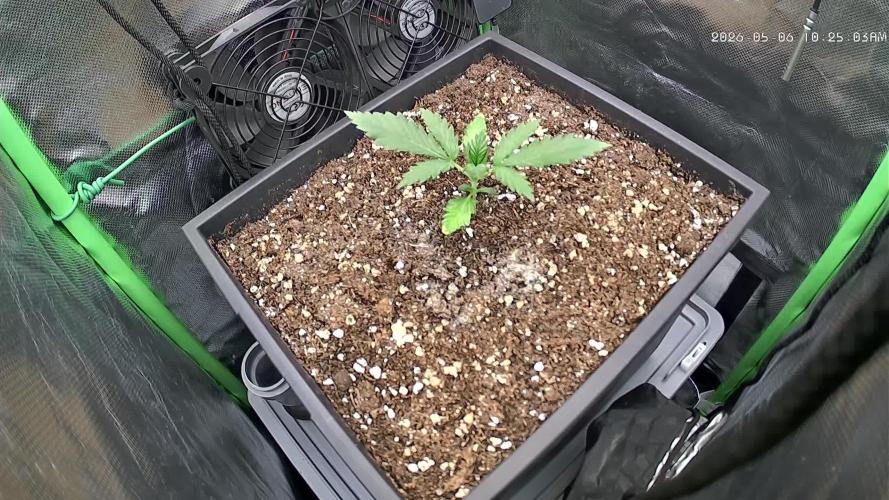
Woche 3
Dieses mal habe ich die Pflanze getoppt.
Ein bißchen LST gab es auch zum Ende der Woche und der Tank wurde komplett aufgefüllt.
Nun muss die gute 10 Tage alleine auskommen.

Likes
55
Share


@Ultraviolet
Follow
What's in the soil? What's not in the soil would be an easier question to answer. 16-18 DLI @ the minute. +++ as she grows.
Probably not recommended, but to get to where it needs to be, I need to start now.
Vegetative @1400ppm 0.8–1.2 kPa 80–86°F (26.7–30°C) 65–75%, LST Day 10, Fim'd Day 11
CEC (Cation Exchange Capacity):
This is a measure of a soil's ability to hold and exchange positively charged nutrients, like calcium, magnesium, and potassium. Soils with high CEC (more clay and organic matter) have more negative charges that attract and hold these essential nutrients, preventing them from leaching away.
Biochar is highly efficient at increasing cation exchange capacity (CEC) compared to many other amendments. Biochar's high CEC potential stems from its negatively charged functional groups, and studies show it can increase CEC by over 90%. Amendments like compost also increase CEC but are often more prone to rapid biodegradation, which can make biochar's effect more long-lasting. biochar acts as a long-lasting Cation Exchange Capacity (CEC) enhancer because its porous, carbon-rich structure provides sites for nutrients to bind to, effectively improving nutrient retention in soil without relying on the short-term benefits of fresh organic matter like compost or manure. Biochar's stability means these benefits last much longer than those from traditional organic amendments, making it a sustainable way to improve soil fertility, water retention, and structure over time. Needs to be charged first, similar to Coco, or it will immobilize cations, but at a much higher ratio.
a high cation exchange capacity (CEC) results in a high buffer protection, meaning the soil can better resist changes in pH and nutrient availability. This is because a high CEC soil has more negatively charged sites to hold onto essential positively charged nutrients, like calcium and magnesium, and to buffer against acid ions, such as hydrogen.
EC (Electrical Conductivity):
This measures the amount of soluble salts in the soil. High EC levels indicate a high concentration of dissolved salts and can be a sign of potential salinity issues that can harm plants.
The stored cations associated with a medium's cation exchange capacity (CEC) do not directly contribute to a real-time electrical conductivity (EC) reading. A real-time EC measurement reflects only the concentration of free, dissolved salt ions in the water solution within the medium.
98% of a plants nutrients comes directly from the water solution.
2% come directly from soil particles.
CEC is a mediums storage capacity for cations. These stored cations do not contribute to a mediums EC directly.
Electrical Conductivity (EC) does not measure salt ions adsorbed (stored) onto a Cation Exchange Capacity (CEC) site, as EC measures the conductivity of ions in solution within a soil or water sample, not those held on soil particles.
A medium releases stored cations to water by ion exchange, where a new, more desirable ion from the water solution temporarily displaces the stored cation from the medium's surface, a process also seen in plants absorbing nutrients via mass flow. For example, in water softeners, sodium ions are released from resin beads to bond with the medium's surface, displacing calcium and magnesium ions which then enter the water. This same principle applies when plants take up nutrients from the soil solution: the cations are released from the soil particles into the water in response to a concentration equilibrium, and then moved to the root surface via mass flow.
An example of ion exchange within the context of Cation Exchange Capacity (CEC) is a soil particle with a negative charge attracting and holding positively charged nutrient ions, like potassium (K+) or calcium (Ca2+), and then exchanging them for other positive ions present in the soil solution. For instance, a negatively charged clay particle in soil can hold a K+ ion and later release it to a plant's roots when a different cation, such as calcium (Ca2+), is abundant and replaces the potassium. This process of holding and swapping positively charged ions is fundamental to soil fertility, as it provides plants with essential nutrients.
Negative charges on soil particles: Soil particles, particularly clay and organic matter, have negatively charged surfaces due to their chemical structure.
Attraction of cations: These negative charges attract and hold positively charged ions, or cations, such as:
Potassium (K+)
Calcium (Ca2+)
Magnesium (Mg2+)
Sodium (Na+)
Ammonium (NH4+)
Plant roots excrete hydrogen ions (H+) through the action of proton pumps embedded in the root cell membranes, which use ATP (energy) to actively transport H+ ions from inside the root cell into the surrounding soil. This process lowers the pH of the soil, which helps to make certain mineral nutrients, such as iron, more available for uptake by the plant.
Mechanism of H+ Excretion
Proton Pumps: Root cells contain specialized proteins called proton pumps (H+-ATPases) in their cell membranes.
Active Transport: These proton pumps use energy from ATP to actively move H+ ions from the cytoplasm of the root cell into the soil, against their concentration gradient.
Role in pH Regulation: This active excretion of H+ is a major way plants regulate their internal cytoplasmic pH.
Nutrient Availability: The resulting decrease in soil pH makes certain essential mineral nutrients, like iron, more soluble and available for the root cells to absorb.
Ion Exchange: The H+ ions also displace positively charged mineral cations from the soil particles, making them available for uptake.
Iron Uptake: In response to iron deficiency stress, plants enhance H+ excretion and reductant release to lower the pH and convert Fe3+ to the more available form Fe2+. The altered pH can influence the activity and composition of beneficial microbes in the soil. The H+ gradient created by the proton pumps can also be used for other vital cell functions, such as ATP synthesis and the transport of other solutes. The hydrogen ions (H+) excreted during photosynthesis come from the splitting of water molecules. This splitting, called photolysis, occurs in Photosystem II to replace the electrons used in the light-dependent reactions. The released hydrogen ions are then pumped into the thylakoid lumen, creating a proton gradient that drives ATP synthesis.
Plants release hydrogen ions (H+) from their roots into the soil, a process that occurs in conjunction with nutrient uptake and photosynthesis. These H+ ions compete with mineral cations for the negatively charged sites on soil particles, a phenomenon known as cation exchange. By displacing beneficial mineral cations, the excreted H+ ions make these nutrients available for the plant to absorb, which can also lower the soil pH and indirectly affect its Cation Exchange Capacity (CEC) by altering the pool of exchangeable cations in the soil solution.
Plants use proton (H+) exudation, driven by the H+-ATPase enzyme, to release H+ ions into the soil, creating a more acidic rhizosphere, which enhances nutrient availability and influences nutrient cycling processes. This acidification mobilizes insoluble nutrients like iron (Fe) by breaking them down, while also facilitating the activity of beneficial microbes involved in the nutrient cycle. Therefore, H+ exudation is a critical plant strategy for nutrient acquisition and management, allowing plants to improve their access to essential elements from the soil.
A lack of water splitting during photosynthesis can affect iron uptake because the resulting energy imbalance disrupts the plant's ability to produce ATP and NADPH, which are crucial for overall photosynthetic energy conversion and can trigger a deficiency in iron homeostasis pathways. While photosynthesis uses hydrogen ions produced from water splitting for the Calvin cycle, not to create a hydrogen gas deficiency, the overall process is sensitive to nutrient availability, and iron is essential for chloroplast function.
In photosynthesis, water is split to provide electrons to replace those lost in Photosystem II, which is triggered by light absorption. These electrons then travel along a transport chain to generate ATP (energy currency) and NADPH (reducing power). Carbon Fixation: The generated ATP and NADPH are then used to convert carbon dioxide into carbohydrates in the Calvin cycle. Impaired water splitting (via water in or out) breaks the chain reaction of photosynthesis. This leads to an imbalance in ATP and NADPH levels, which disrupts the Calvin cycle and overall energy production in the plant. Plants require a sufficient supply of essential mineral elements like iron for photosynthesis. Iron is vital for chlorophyll formation and plays a crucial role in electron transport within the chloroplasts. The complex relationship between nutrient status and photosynthesis is evident when iron deficiency can be reverted by depleting other micronutrients like manganese. This highlights how nutrient homeostasis influences photosynthetic function. A lack of adequate energy and reducing power from photosynthesis, which is directly linked to water splitting, can trigger complex adaptive responses in the plant's iron uptake and distribution systems.
Plants possess receptors called transceptors that can directly detect specific nutrient concentrations in the soil or within the plant's tissues. These receptors trigger signaling pathways, sometimes involving calcium influx or changes in protein complex activity, that then influence nutrient uptake by the roots. Plants use this information to make long-term adjustments, such as Increasing root biomass to explore more soil for nutrients. Modifying metabolic pathways to make better use of available resources. Adjusting the rate of nutrient transport into the roots. That's why I keep a high EC. Abundance resonates Abundance.
Likes
202
Share


@Sour_D
Follow
This girl took a little longer to trim up. Me and two grow buddies got her done in about 4 hours. Boy is she a sticky one! And stinky. 😁 There were plenty of scissor hash hits, which slowed us down a bit. The buds seem dense and tight and should dry and cure up nicely. I can't wait to dive head-first into this one. It's like I want it to take it's time hanging and drying, but at the same time, hurry the hell up! 😉 All in all, I'm very happy with how this grow went. 💪
SMOKE REPORT
This girl was a pleasure to grow, she had no issues start to finish. And even better, she produced a very nice yield of 5.6 ounces of very nice, potent, flavorful buds. The buds have a nice earthy flavor, which is my favorite type. They're nice and dense too. It's not quite as couch-lock as the Opium I grew from Divine, but it's still a night time smoke. Overall, great stuff! 😎

Likes
6
Share
@Chrisandweed
Follow
Bueno, ayer hice el ultimo riego, mas cantidad de lo habitual, y ya cuando seque, se corta, supongo que actualizaré fotos, conforme avance la semana, del corte y posterior proceso ya que dado que hubo araña y ciertos problemas, voy a hacer el budwashing que habitualmente hago.
En el video se ve algún cogollo con telaraña de araña roja, de ahí el budwashing. Dentro de lo malo, no son todos los cocos los que la tienen pero bueno, un buen lavado no jode nada.
Edit 12-02-2026: CORTADA! ya puesta a secar en el tendedero xD dado que en el armario había algo de araña aunque no habia afectado a todas las plantas, he decidido hacerles budwashing a todas no sin un petique que me centre y buena música 😁. Normalmente subía fotos del proceso, en esta ocasión, aunque sea un poco mas tedioso, he subido un video del proceso.
Cuando seque finalizaré el diario y subiré las fotos de los cogollos manicurados.
Aclaro, la he puesto a secar en el tendedero pero metido al armario ya sin luces y tal XD solo ventilador oscilante y extractor con el filtro, que solo con el corte la he liado en la calle 😅😂😂😂
Pues la vd es que ha salido mas de lo que pensaba, como la tenía ahí esquinada, era la mas inaccesible, me costaba mas verla bien. Algunos cogollos están cubiertos de telarañas y los enfoco en el video para que se vea, pero otros no, por lo que entiendo que pese a mis fallos, la resistencia es mas media, ya que otras o han sufrido mas, o casi no lo han sufrido, pero en definitiva, siento que muy buena variedad pero no para cultivarla como yo he hecho, esta tiene pinta de ser una de esas que pones en exterior y tira a los 3 metros. Buuueno, pa'so stánnn pa probaah y exsusperimentar xD


Likes
32
Share


@Chucky324
Follow
Hello All. I took a lot of pictures. Hope you don't mine, but I had fun. I think everyone likes to see large harvest pictures.
It all started back in early January when I took clones of my favorite plants. It was a cold winter here this year, for these parts. So it was mid March when I got the plants out in the greenhouse. The spring was damp and cold too. I found powdery mildew in the garden about 2 weeks before I found it in the greenhouse. I got it on the Skunkberry and the Burmberry, But not on either Amnesia Lemon or the Sister Amnesia Lemon. I was very pleased about that :) I found some spider mites in the last week and a half. I decided to turn up the fans instead of spray. Yes they still spread but very slowly when they can't spin their webs. I didn't find many when I harvested.
Everything else went well this season. I found a male Dr. Atomic Northern Lights that I liked. So I'll try to make some seeds with the Amnesia Lemon, Skunkberry and the Burmberry. I'm trying to fatten up the Burmberry. I'm interested to see if the Amnesia Lemon gets fatter buds and carries the P.M. resistance to the seeds, I'm hoping.
The tall Sister Amnesia lemon in the middle did cause a drop of production from the plants on either side of it. They were in more shade. Something to work on for next year :)
The Skunkberry had the most P.M. I used a new produce that I'm pleased with, it's White Wash frequency altered water. Knocks the P.M. right out. I found that if you put a large tray under where you are spraying you can catch the run off. I could use it a couple of times with no change in effectiveness. It must be the Scottish in me. I try to reuse or recycle as much as possible. Cuts costs, and help make me feel like I'm doing good and helping the planet.
My feeding schedule was: I had a 15 gallon half barrel and pump with hoses and nozzles. I filled the barrel with nutrient solution and watered by minuets, 15 for clod days and 25 or 30 minuets on hot days.
After 3 or4 days I added water when the solution got low. Mixed new solution once a week, and cleaned the barrel and pump. I also took the hose in the greenhouse and soaked them till run off once a week and measured the ph. I saw a few fungus gnats, but the spiders and nematodes (from my compost I added when I mixed soil) sure help to keep the numbers down.
I like to put my buds in a paper bag to dry and cure. Inside I hang the buds for 3 days before putting the buds in paper bags. But it was so hot in the green house that 2 days was more that enough before putting the buds in the paper bags. The bags sat in the greenhouse for 3 days and then went in to the basement to finish. The old hippies told me that they use to put their buds to cure in the middle of a bushel of straw. I seems that the drying buds gives off a gas, that when trapped around the buds helps to take away the bitterness and raunchiness' of the uncured buds. The bags also help in wicking away the moisture of the drying buds, just like the straw did. After a week I check to see if it is dry enough. If the buds are dense the bag might need to be rehung for a few days to finish. I prefer a dryer bud. I like to hear a light crunch when I put a bud in my pipe. I like to hear a light crunch when I put the bud in a grinder.
> Amnesia Lemon- Plant #1 North plant=343 g.
>Amnesia Lemon - Plant #2 South plant=397 g.
> Sister Amnesia Lemon - Middle Tall Plant=401 g. Winner :)
> Skunkberry - Southern Middle Plant=316 g.
> Burmberry - Plant #1 North Plant=239 g.
> Burmberry - Plant #2 South Plant=294 g.
> Total= 1990 g. or 71 oz. or 4.4 lbs.
In Conclusion: This was my best grow ever! Big thanks to Barneys farm, for great seeds. I've got LSD started and I will try that in the greenhouse next year, 5/5 for mold and pest resistance. I'm very happy with the results. I was concerned because I have 2 rental houses behind me and one of them had a big backyard party at my week 5 of flowering. You could smell the grow by then and I was hoping I wasn't going to get ripped off. I looked through the fence a few days later and saw about 12 large plant pots, growing cannabis. I'm very happy. Cheers Chuck.
> November 3 Added pictures of the seeds I made this summer.


Likes
101
Share

@squalino
Follow
🌿 Journal de Culture : Cherry Cola (Auto)
Date : 13/04/2026
Âge : 81 jours
Phase : Curing (Plante #1) / Maturation intense (Plante #2)
? Plante #1 : Verdict final & Première impression
Résultat : 40 grammes sec (46g avec les branches).
Aspect :
Vert sombre avec des touches rose fuchsia. C'est visuellement très réussi, même si la quantité reste modeste pour le temps investi (Note : 7/10).
Test de goût : * À cru :
Diesel bien marqué.
Allumé : Citronnelle agréable.
Effet : Cérébral puissant.
📏 Plante #2 :
Taille : 35 cm.
Environnement : 25°C / 50% Humidité.
Éclairage : Pure LED à 100%, distance 60 cm.
Nutrition : Reçu 1,5 litre de thé de compost (pH 6,4).
C'est le boost parfait pour nourrir les microbes du sol et donner les derniers nutriments organiques sans risquer le blocage avant la fin.
🔍 Mes observations de cultivateur
L'explosion de givre :
Sur la vidéo de la Plante 2, c'est flagrant : elle est encore plus blanche que la première. La couche de résine est si épaisse qu'elle donne un aspect métallique aux têtes sous la LED.
Structure des buds :
Les têtes semblent effectivement plus massives et mieux formées que sur la n°1 au même stade. On voit encore beaucoup de pistils blancs qui cherchent à capter la lumière, ce qui confirme qu'elle a encore besoin de ses 3 semaines.
Santé foliaire :
Elle est bien verte et vigoureuse. Le thé de compost va l'aider à garder cette vitalité pour que les trichomes passent tranquillement du transparent au laiteux.
L'espoir de la densité :
Contrairement à la n°1 qui s'est "écartée" sur la branche, la n°2 semble plus compacte. Si elle continue sur cette lancée avec le thé de compost, elle pourrait bien nous surprendre et offrir des fleurs plus charnues.
je crois en l'âme des plantes
merci a tous qui me suivent je vous souhaite une bonne journée et de très bonnes cultures.
MUSIQUE DIAPOSITIVE ( FASTBUD NO 2 )
ET MERCI À @Mia_BIOTABS pour le thé compost offert avec le startpack
Likes
27
Share


@GODSGIFT_2005_JM
Follow
Grow tent⛺️ check out MARSHYDRO
💡 GROW LAMPS 💡 check out:
VIPARSPECTRA PS2000 (200W) & XS2000 (240w)
MARSHYDRO ts1000 (150w) &
fc3000 (300w)
NUTRIENTS: GREENHOUSE FEEDING BIO LINE —-ORGANIC STYLE GROWING
Likes
9
Share


@DaddyPrime2
Follow
chopped #1 on 1/21/25
started curing today 1/27/25
chopped #5 on 1/23/25
still hanging and drying.
will update with weights and smoke reports and more pictures when dried and cured
#1 33 grams. nice big nugs. i really like how the mainline turned out with the final product
#5 32 grams smaller buds overall but the yeild is very similar.
these are weights after trimming. i did a fairly heavy trim on thesr 2 plants.
this diary started with 5 plants but because of my perpetual flowering set up, i have had 3 other diaries for the flowering stages of the other 3.
The flowering stage of this diary are only plant #1 and plant #5
Likes
8
Share


@PoppaJoe
Follow
Only adding water at a Ph of between 5.5 and 7…still No extra nutrients…switched placement of the plants because the Big Bang was starting to cone and figured the mist from the humidifier was giving too much extra moisture (Not sure how much sense that makes but it healed after the move so I guess🤷♂️🏾) Other than that everything was fine.

Likes
12
Share


@GREENPHOENIX6262
Follow
*Week 4 Flower 09/24*
Both Mimosa girls appear to be running fine with Mimosa (1) running a little behind but is catching up accordingly. Small oversight in early growth resulted in a minor stunt but she is improving dramatically.
Water Feed has increased by half a gallon ( 1gallon clean - .5 gallon nute feed)
*Week 4 Flower 09/28 - Mid week update*
Both plants are flowering accordingly - Mimosa (1) is a bit taller then Mimosa (2)
Buds are becoming dense and covered in trichomes.
No deficiencies - No areas of concern - Potassium and Phosphate feeds continue
*Week 5 Flower end of week recap - 09/30*
Both Mimosa's are flowering nicely - Budsites covered in frosty trichomes.
Mimosa (2) looks shorter but that is because her COLA was tied down to expose bottom budsites.
Likes
21
Share


@BruWeed
Follow
Esta planta estuvo dos semanas en etapa de enraizamiento, tres en crecimiento y ocho semanas en floración.
No tuvo ningún problema con nada, me resultó de fácil cultivo.
En esta cosecha obtuve ciento cuarenta y siete g en total.
Utilice una maceta Root House de 10L.
El sustracto que utilice fue de Nube Verde, en su composición se incluye turba de categoría, perlita, humus, compost, tierra, dolomita y vermiculita.
Sin duda volvería a probar esta genética otra vez, supero mis expectativas.

Likes
2
Share


@Manchu
Follow
Mi experiencia con esta variedad, fue realmente buena. una semilla con mucho vigor, muy resistente a plagas, y con sabores y olores exquisitos