


Likes
Comments
Share

@DogDoctorOfficial
Follow
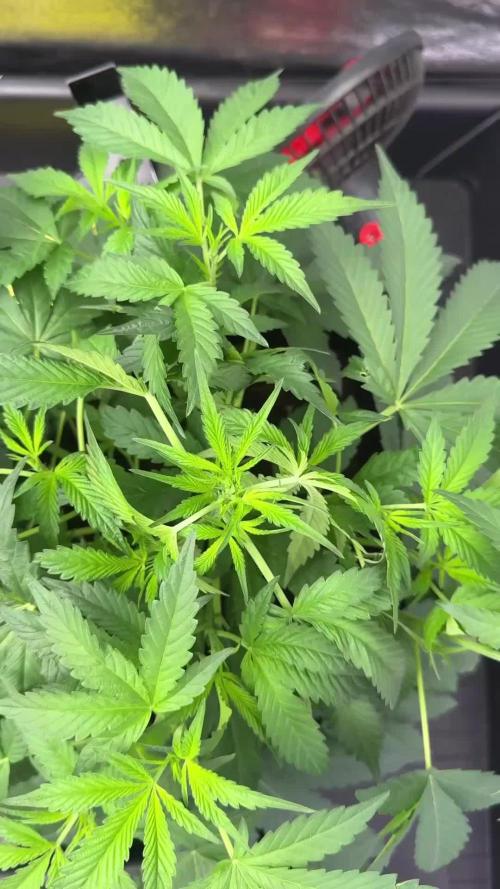
🍃 Purple Haze Photo A — Week 4 | Preparing for Gravity-Fed Growth
Every grow has one plant that quietly starts telling you a story before flowering even begins.
Purple Haze A is becoming exactly that.
Growing under the same Future of Grow LED, receiving the same PPFD, sharing the exact nutrient recipe, environmental conditions and care as every other plant inside the tent, she has decided to express herself in a completely different way.
Instead of remaining compact, she has embraced her sativa heritage and is already showing the elegant structure Purple Haze is famous for.
Longer internodes.
Large healthy fan leaves.
Fast vertical growth.
Strong side branching.
Exactly the characteristics we hoped to see.
This diary is part of my ongoing 12/12 From Seed Challenge, documenting every step exactly as it happens. No shortcuts, no hidden techniques—just honest observations from a home grower enjoying the journey one day at a time.
⸻
🌱 Week 4 Development
This week was all about preparing for the next big milestone.
Purple Haze continued building an exceptionally strong root system while producing vigorous new shoots across every node.
The leaves are deep green, beautifully flat and reaching toward the light, showing excellent nutrient uptake and a very healthy metabolism.
Stem thickness has increased noticeably, giving plenty of confidence that she’ll easily support future flower production.
The spacing between branches also makes her an excellent candidate for training later, allowing light to penetrate naturally through the canopy.
Sometimes you can already tell a plant has personality long before flowers appear.
This one certainly does.
⸻
🚿 Time for AutoPot
This week also marks another exciting step.
Purple Haze A will soon become one of the plants running on my AutoPot system.
Since every plant in this project receives identical lighting, nutrients and environmental conditions, this creates a great opportunity to observe one important variable:
Top watering versus gravity-fed irrigation.
Rather than trying to prove one method is universally better, I simply enjoy comparing different growing styles under the same conditions and documenting the results honestly.
That is one of the things I love most about this hobby.
Every grow teaches something new.
⸻
💧 What is an AutoPot?
For anyone discovering these diaries for the first time, AutoPots are a completely passive irrigation system.
There are:
❌ No pumps
❌ No electricity
❌ No timers
Instead, everything works using gravity.
A nutrient reservoir sits slightly higher than the pots, allowing the solution to flow naturally through the tubing.
Inside each tray sits the heart of the system:
The AquaValve
The AquaValve is an ingenious little mechanical valve.
When the tray becomes empty, the valve opens and allows fresh nutrient solution to flow in.
Once the tray reaches the correct water level, the valve automatically closes.
The plant then drinks exactly what it wants.
Only after the tray is empty again does the cycle repeat.
Because the substrate experiences a natural wet-dry rhythm while always having nutrients available when needed, roots tend to develop extremely well.
Healthy roots often translate into healthier plants.
At least, that has been my experience.
⸻
🌿 Why I Enjoy Growing with AutoPots
Every grower eventually finds methods that simply fit their style.
For me, AutoPots offer several advantages:
• Consistent moisture around the root zone
• Reduced daily watering workload
• Excellent oxygen availability inside the substrate
• Stable nutrient delivery
• Very vigorous vegetative growth
Perhaps most importantly…
They let me spend more time observing the plants instead of carrying watering cans every day.
And honestly, watching the AquaValve quietly doing its job never gets old.
⸻
📊 Week 4 Environment
• Week 4 — Vegetation
• Height: 25 cm
• EC: 1.35
• pH: 6.1
• Temperature: 33°C Day / 25°C Night
• RH: 63%
• CO₂: 639 ppm
• Light Schedule: 12/12
• Water consumption: approximately 1.1 L per plant every 24 hours
⸻
🌿 Feeding Schedule
This week the nutrition remained simple and balanced using the Plagron Terra line.
• Terra Grow – 1.8 ml/L
• Power Roots – 1 ml/L
• Pure Zym – 1 ml/L
• Sugar Royal – 1 ml/L
• pH Plus – 0.03 ml/L
• Lemon Kick – 0.03 ml/L
The plant responded beautifully with rich green foliage, vigorous growth and absolutely no signs of nutrient stress.
Exactly the kind of consistency every grower hopes for.
⸻
💚 Final Thoughts
Week 4 feels like the beginning of something special for Purple Haze A.
She has developed into a vigorous, healthy young plant with beautiful structure, outstanding leaf health and plenty of energy heading toward the flowering stretch.
Now the AutoPot system enters the picture, adding another interesting chapter to this diary.
Whether gravity feeding produces bigger plants or simply makes life easier, we’ll discover together over the coming weeks.
That’s the beauty of documenting everything honestly.
Every plant becomes its own little experiment.
⸻
🙏 Thank You
A huge thank you to everyone following this journey and supporting home growing around the world.
Special thanks to all the amazing companies helping make this project possible:
🌱 Zamnesia Seeds — for the incredible Purple Haze genetics.
? Plagron — for providing the complete Terra nutrient line and outstanding growing media.
💡 Future of Grow LED — for delivering consistent full-spectrum lighting throughout the entire grow.
🌿 GrowDiaries — for bringing together growers from every corner of the world and giving us a place to learn from one another.
And finally…
Thank you for taking the time to follow this adventure. Your comments, advice, questions and encouragement make these diaries far more enjoyable to create.
Growers Love and see you next week, where Purple Haze A begins her AutoPot journey in earnest. 🌱💜

Likes
Comments
Share

@Lord_Ninnyhammer
Follow
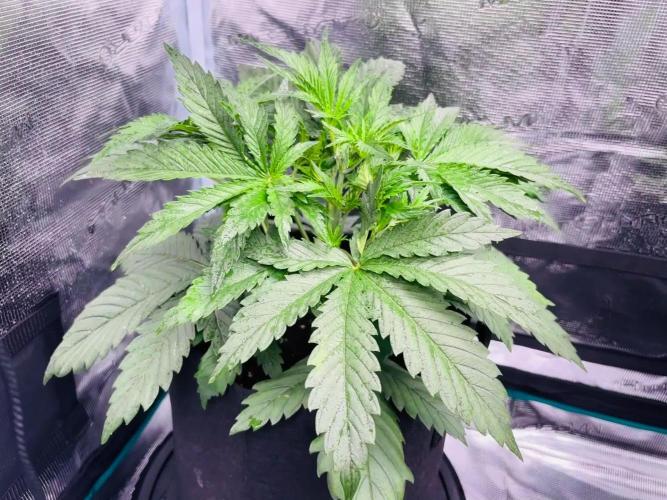
Growth has been steadier, and I’m particularly pleased with the new watering system. It didn’t take long at all for the root system to attach to the ropes


Likes
5
Share


@TerpNoobster
Follow
Week 2
Some buds are forming, need to defoliate and lollipop shortly. Starting to smell. Had to supercrop a few of them, they recovered over night. Still stretching but it's manageable now. Back 2 on the left are a lot lighter in color almost yellow, not sure what's going on there, different strains but still. ..there still praying in the morning don't look sick but still something is off.. gonna check runoff on next watering. Any advise questions or concerns would be much appreciated.

Likes
6
Share


@Elpicor
Follow
Mi aspetto molta dolcezza da queste due piantine😇 se viene come la prima sarò molto contento!
Likes
6
Share


@Kinary
Follow
After germination i putted into a 200 ml plastic cup and watered only with water, 20 ml/day.
Day 1 = 20ml water
Day 2 = 20ml water
Day 3 = 20ml water
Day 4 = 20ml water
Day 5 = 20ml water
Day 6 = 20ml water
Day 7 = 20ml water

Likes
23
Share


@MrHyde
Follow
Stopped training this week. The mains are around 6 inches above the screen. I was shooting for around 10-12 inches above the screen so I think I’m right on track to get there
Likes
68
Share


@Prototype0181
Follow
I gave the lady's a litle haircut at the start of the week, and started using Bud ignitor on the Canna feed Cherry's to speed things up a bit😉 I also Switched the lady's to 12/12 on the 10th of november.
Rock on Growmies 🌱
Likes
Comments
Share


@BudBrewerz
Follow
She packing up buds pretty good
She is still on same diet and looks to be doing great
If she thickens up she will become muy bien 🙌😎


Likes
7
Share


@gablmo
Follow
Another busy week with the vege. I gave it microbes, a HID lamp at 400 watts, sprayed for bugs and also covered the media with plastic wrap to get rid of 3 or 4 gnarts and of course a had another flood with the GoGro water system and I took one plant out of the garden because she is frozen in time. I still don't know why. The trellis is doing good. Lots of work.

Likes
17
Share


@Matriosky
Follow
13/6: the light change worked incredibly well!! Switching from 75W(drawn 35W) to 1000W(drawn 120W) helped the flowers develop incredibly well in the past 7 days, now I can call them proper BUDS!!!
Now, technically next week (Wednesday) is supposed to be harvest day from my original plan, but I worry that the 2-ish weeks that the plant stayed stunned may increase this period, I'll keep a close eye on the colour of the thrychomes, if they don't start turning amber this week I might push it another two.
Now that humidity is correct and the flowers are growing, the plant started drinking WAY more, and now the usual 1L every two/three days just isn't enough, so I switched to 2L of PHd water at a 6.3/6.5 range every 48 hours, and I have a feeling that in the next week I may have to start water it every day as it keeps increasing its flowers.
VERY excited for the next 14 days, can't believe its been almost a 4 months journey, I really want to see those buds fatten up :)

Likes
24
Share


@Ultraviolet
Follow
Paramahansa Yogananda taught us how to heal anxiety and depression with these three powerful affirmations from his book back in 1924:
"I relax and cast aside all mental burdens, allowing god to express through me his perfect love, peace, and wisdom."
"I will, with my own will, which flows from the divine will, be calm and patient under all circumstances."
"I am submerged in eternal light; it permeates every particle of my being. I am living in that light, the divine spirit fills me within and without."
Most of what has ever been invented was first observed. The critical role of observation in the innovation process is where natural phenomena, patterns, or accidents provide the foundational idea for a new creation. Many foundational technologies were derived from direct observation of nature or physical processes.
Wave-particle duality is a fundamental concept in quantum mechanics, stating that all entities—including light (waves) and matter (particles)—exhibit both wave-like and particle-like properties depending on the experimental setup.
The Heisenberg observer effect describes how the act of measuring or observing a quantum system inevitably disturbs it, altering its state. The observer effect is often misconstrued to mean that human "consciousness" affects reality; however, in physics, it refers to the physical interaction of measurement tools (detectors) with the system. It is often confused with the, but distinct from, the Heisenberg Uncertainty Principle.
The Heisenberg Uncertainty Principle applied to electromagnetism dictates that the electric (E) and magnetic (H) fields cannot be simultaneously measured with absolute precision, with an uncertainty relation of for a spatial volume. This fundamental limit means electromagnetic waves possess intrinsic quantum, non-classical, and fluctuating natures.
The K radiation and quantum mystery of potassium refers to the fascinating, naturally occurring radioactivity of Potassium-40 (K) and the, until recently, poorly understood, rare quantum decay mechanisms that make it a significant, quiet, and sometimes mysterious participant in both biological and geological processes.
The Radiation: Potassium-K40
While potassium is essential for life, a tiny fraction of all natural potassium (0.017%) of all pottasium is the radioactive isotope K40. With a half-life of 1.25 billion years, it is a "primordial" radionuclide (present since the Earth's formation). Because potassium is abundant in the human body (muscles), we are all walking sources of weak radiation, often measured by "banana equivalent dose."
K is unique because it decays via three distinct routes, creating a "triple" radioactive mystery:
Beta Decay (89.6%): Decays into Calcium-40 (Ca), releasing a fast electron (beta particle).
Electron Capture (EC) (10.3%): Decays into Argon-40, emitting a high-energy 1.46 MeV Gamma Ray.
Positron Emission (0.001%): Decays into Argon-40 (Ar), emitting a positron (antimatter).
The mystery of potassium isn't just that it is radioactive; it's how it decays and what that implies for the universe.
The Missing Decay Pathway (KDK Experiment).
Until very recently, one specific path—electron capture directly to the ground state of Argon-40—had never been directly measured, making it an "unknown background" in dark matter searches.
The KDK Collaboration (Potassium Decay): Experiments at Oak Ridge National Laboratory (2017-2023) finally measured this, helping scientists refine the age of the Earth and improving precision for detector simulations in particle physics.
The "Spin-Forbidden" Long Life K has a surprisingly long half-life (billion years) for a positron emitter.
The "Mysterious" Heat Source For decades.
Quantum Biology/Biology Mystery.
Ultracold Potassium and Quantum Gases.
In short, the potassium 40 isotope is a tiny, ancient, quantum-mechanical time (nuclear)bomb, slowly releasing energy from the birth of the solar system, making it essential for geological dating, a nuisance for dark-matter hunters, and a subtle factor in our own biology.
All things exist as energy. We are vessels that utilize chemical energy and experience it through our senses. We are biologically electrically charged, and fueled by ATP (adenosine triphosphate). Emotions, e-motion, energy in motion, where you apply your thoughts, words, and action, is where you apply your energy, where focus goes, energy flows.


Likes
51
Share


@BudBoutique
Follow
Welcome to Bud Boutique Grow Diary - really appreciate all your love and support :)
Dont forget to check out my other current grows!
🗓️ This Week:
- Day 38: stacking up has started
- Day 41: praying up as always
Thank you for still staying with me 💚
___________________________________________
--- 🌱 Strain (Sponsor) 🌱 ---
🏷️ Big Band by Kannabia Seed Company
https://www.kannabia.com/en/feminized-cannabis-seeds/big-band
--- 🥗 Nutrients and Feeding (sponsored by APTUS: APTUS Ambassador) ---
🍸 APTUS: full nutrient schedule extreme
-- Regulator, N-Boost, P-Boost, CaMg-Boost, K-Boost, Allin1 Liquid, Startbooster, Topbooster, Enzym+ every feeding
-- Fulvic-Blast, NutriSpray as Foliar each once a week
🔗 https://aptus-holland.com/
--- ♻️ Grow Control (Sponsor) ---
TROLMASTER: TENT-X + LM14 Light Adapter to dim/sunrise/sunset lights + Temp & rH Sensor all remote on App
🔗 https://www.trolmaster.eu/
--- 🚿 PetraGrow (Sponsor) ---
CannaFogger Foliar Spray
🔗 https://www.petratools.com/product/petragrow-cannafogger-atomizer-new-mini-fogger
--- 🏭 Grow Setup ---
💡LUMATEK Zeus Pro 600
* 🏠🌿 Indoor: Homebox 120x120x200cm (4x4)
* 📐🌀 PrimaKlima exhausting Fan 1180m3/h (running on 60-80%)
* 🌀 Can Light Filter 800m3/h & 1x Fanbox 1x Dyson fan for Air circulation
🔗 https://lumatek-lighting.com/zeus-600w-pro-29/
🔗 https://primaklima.com/de/shop/ventilatoren-de/ec-ventilatoren/pk160ec-tc/
🔗 https://canfilters.com/products/filters/
All Likes and comments are highly appreciated!!!
👨🌾 don't forget to check out my Instagram for daily educational content: budboutiquee
- Bud Boutique

Likes
97
Share


@Anonymous_2022
Follow
Thanks for stopping by.. Please hit the like button if you like what you see and ill be sure to check you out too Growmies 🌱
First of all would like to give a BIG shout out to my sponsors for providing me with the necessary items for this grow 👍
🌟🌟🌟🌟Mars Hydro FC4800🌟🌟🌟🌟
Powered By Samsung LM301B Diodes: The Mars Hydro FC 4800 480-watt LED grow light is installed with high-performance Samsung LM301B chips, the top-bin horticultural diodes, to provide a high Photosynthetic photon efficacy efficiency of 2.85 μmol/j and a long-lasting color rendering capability, supporting indoor plants to grow and thrive.
High PPF Output and Uniform Light Distribution: FC4800 provides a high PPF of 1,366 μmol/S. The multi-light bar design and the dense diode layout facilitate an even distribution of grow lighting making PPFD optimized for Photosynthesis to achieve consistent growth in every part of the coverage range.
Exclusive Recipe Of Full Spectrum Lighting: The full spectrum is enhanced with blue and red light, in which the blue light stimulates plant growth and promotes the accumulation of plant-based phytochemicals; the abundant red light improves the maturing process and flower quality of the plants.
🌟🌟🌟 Kannabia - Monkey Grease ⭐️ ⭐️⭐️
At Kannabia Seeds we have put all our effort into bringing out our own feminized Monkey Grease, a cross between Monkey Grease x White Widow, focusing above all on giving it its own personality in flavor and aroma (frankly unmistakable) and, of course, in Highly demanded characteristics, such as high resistance to diseases and pests, and adaptability to all types of growing conditions, making it close and easy to grow to the widest possible range of growers. The result is a really powerful and versatile indica-sativa marijuana seed, with a powerful relaxing effect, ideal for those moments when you want to disconnect from the madding crowd.
——————————————————————————————
👊👊👊👊Down to Business 👊👊👊👊
Week 4 from seed .. shes happy and doing her thing ideally would of liked another week of veg but pushed for time so she will be starting flower very shortly 😎
Happy with her and looking forward to seeing how she stretches 🤙
Growers love to all 💚
Processing
Likes
42
Share


@MadeInGermany
Follow
Hey everyone 🤗.
A lot has happened this week ☺️.
Not surprised that the plants look so extremely dark, is that because I sprayed them with neem oil as a preventive measure , because I discovered a very young trip on a plant.
This annoys me extremely, because the attachment room is very clean and neither shoes nor dirty clothes come in when you enter the room 😩.
But since I had the problem in most cases years ago, I am very confident that I will get the problem under control very quickly 😃.
Otherwise, everything is developing very well as usual 👌.
I wish you a lot of fun with the new update, stay healthy 🙏🏻 and let it grow 😃.
You can buy this Strain at :
https://sweetseeds.es/de/cream-caramel/
Type:
Cream Caramel
☝️🏼
Genetics:
Blue Black
x
Maple Leaf Indica
x
White Rhino
👍
Vega lamp:
2 x Todogrow Led
Quantum Board 100 W
💡
Bloom Lamp :
2 x Todogrow Led
Cxb 3590 COB 3500 K 205W
💡💡☝️🏼
Soil :
Canna Coco Professional +
☝️🏼
Fertilizer:
Green House Powder Feeding
☝️🏼🌱
Water:
Osmosis water mixed with normal water (24 hours stale that the chlorine evaporates) to 0.2 EC. Add Cal / Mag to 0.4 Ec Ph with Organic Ph - to 5.5 - 5.8 .
Likes
3
Share


@weedelicious
Follow
Hey ihr Grower, sind am Tag 79 angekommen. Den Mädels gehts super! Blüten werden immer größer. Temperatur noch bei 23C und die LF habe ich etwas runtergedreht und auf 45% gestellt. 2.5L Wasser mit Hesi Bio-Bloom bekommen sie alle 3 Tage, mit einem Ph-Wert Zwischen 5.5-6.0. Die Lumatek 200W Pro ist nun 30cm entfernt und auf 100% gedimmt.
------
Tag 80 angekommen. Nachtbilder. Den Mädels gehts super! Blüten werden immer größer. Temperatur noch bei 23C und die LF habe ich etwas runtergedreht und auf 45% gestellt. 2.5L Wasser mit Hesi Bio-Bloom bekommen sie alle 3 Tage, mit einem Ph-Wert Zwischen 5.5-6.0. Die Lumatek 200W Pro ist nun 30cm entfernt und auf 100% gedimmt.
---------
Wir sind an Tag 82 angekommen. Den Girls gehts bestens! Blüten werden immer noch größer. Temperatur bei 23C und die LF ist auf 45% gestellt. Der Heizer von Spider Farmer macht eine super Arbeit - Temp. und LF noch konstanter. DDD bei 1.5.
2.5L Wasser mit Hesi Bio-Bloom bekommen sie alle 3 Tage, mit einem Ph-Wert Zwischen 5.5-6.0. Die Lumatek 200W Pro ist nun 30cm entfernt und auf 100% gedimmt.


Likes
1
Share


@BLAZED
Follow
Week 3 (27-11 to 3-12)
What's good everyone?
We started this week off topping the lady and removing the 2 bottom shoots.
The next day Santa came early 😁 Got 2 new clip fans and the AC5 Power strip from Spider Farmer.
The power strip has 5 outlets you can control in the app, they can be turned on based on a time cycle, humidity or temps.
It comes with a sensor that monitors light, temperature, and humidity.
And a soil sensor that monitors soil moisture (VWC), temperature, and electrical conductivity (EC).
It also has a light adapter to connect 2 lights, that can be controlled in the app aswell.
The app shows the current VPD, i try to keep this around 1.0.
In the middle of this week we increased the light intensity from 30% to 35%.
LUX: 13.000/13.500 to LUX: 15.000/15.500
This week's growing conditions were 17.9°C to 22.4°C with a humidity of 55.5% to 67.6% and watered 2 times with 0.5L.
See you next week!

Likes
16
Share


@willertex
Follow
📅 D77 - 16/01
📜 Almost ready, Waiting for final flush
✍️ 1.5 EC
♒ 9 pH
🌊 10 L
📏 90 cm
📅 D80 - 19/01
📜 Final flush started
✍️ 1.5 EC
♒ 9 pH
🌊 10 L
📏 90 cm
📅 D83- 22/01
📜 Not yet ready - 3-4 days more I think. Suggestion accepted ;)
✍️ 1.5 EC
♒ 9 pH
🌊 10 L
📏 90 cm


Likes
11
Share


@RoyColt
Follow
Day38
2lt ro water
2ml sensi cal mag extra
Total 250 ppm pH6.1
Drain 150 ml 1330 ppm
Day40
3lt ro water
3ml sensi cal mag extra
Total 200 ppm pH6.1
Drain 1500 ml 950 ppm
Day43
2lt ro water
4ml growA
4ml growB
Total 1050 ppm pH6.1
Drain 0 ml ? ppm
