


Likes
Comments
Share

@3rnest
Follow
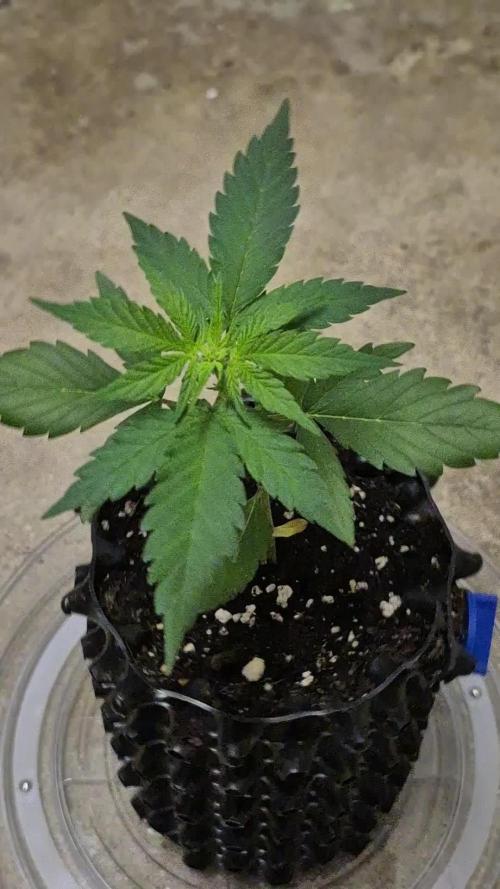
Draußen ist es nachts noch zu kalt, aber es wird wärmer und die Tage länger.

Likes
65
Share


@Jayvo
Follow
Stretching has officially stopped as I haven’t seen any vertical growth the past few days, so all growth must be going into buds therefore I did some super cropping to even out the canopy.
I have some yellow marks on the leaves which I’m guessing it’s a nitrogen deficiency due to giving the girls only 700PPM throughout flower, I’m happy with the growth although I think the trichomes are less sticky compared to my last grow, I can only blame myself as I should have given her 1100PPM from Day 1 of flower.
Overall though there are bud sites everywhere, so many that I decided to buy a new light as I don’t think these buds will fulfil their full potential with mars hydro, with this new light my tent light spread is completely even so I have high hopes for this grow.
Some other phenos are purple at this stage so I will most definitely be buying more runtz muffin seeds until I find the purple pheno that I can clone.
Still currently feeding the girls 2 litres in the morning and 2 litres before the lights turn off. Considering adding molasses as a third feeding depending on how the growth goes.

Processing
Likes
14
Share


@Mr_Og_GreenThumb
Follow
Today 7/30/19, day 57 and the start of week 9. I'm still continuing to alternate between days with my pesticide treatment (especially after finding that bug living on one of hulkberries fan leaf) and thrive alive green daily foliage spray as a prophylactic solution against any possible pests or mold going into these last few dog days of veg. I will flush them with distilled ph'd water for two days this weekend in preparation for flower. Then I'll start them on some "flower fuel" bloom booster on top of my secret for success flower recipe at 1/4 of the recommended strength.
Outside of that still no adverse issue to report for the end of the 8th week. After my last trim, they both have responded very nicely, I was kind of worried about fat banana stalled growth. But one thing I noticed when I topped her at the 6th node, yes the main stem stopped growing but it developed many bud sites up and down every stem. Whereas hulkberry was topped at the 8th node, she has mainly focused on developing long stems and only 2 or 3 bud sites along her stems. Even though hulkberry in structure, is much bigger than fat banana and has a way bigger root system. Fat banana is bushier and has developed way more bud sites than hulkberry. I can't tell which strain will yield the most at this point only time will tell!
Also, a big shout out to "J"@RQS, thank you for the excellent customer service. Another reason why Royal Queen Seeds is top 3 in breeding!!
Likes
16
Share


@Esjey
Follow
Hello everyone.
This week i started app nutriens for my girls.
Growing extra fast and look fresh. Stalk is heavy... this all 4 girls are season indoor, all people say wait for 3 to 5 layers of leaves and this can be 30 days of growing... but my have +-15 days and have 5 layers leaves. Happy day for all, peace.
Best regards from Polish Smoker
Edit: 28.01 i do it trening for my girls
Blue zushi - fiming
Biscotti & Fresh Pressed Runtz - topping
I must wait for Triple G and she got FIM


Likes
16
Share


@DWCGreenGrower
Follow
Still looking good. I'm going to start flowing next Monday. I'm posting a video let me know if you have suggestions or concerns thanks

Likes
11
Share


Likes
6
Share


@Green2Gold
Follow
Quarta e ultima semana de Vega assim eu espero, quanto a nutrientes vou continuar com os mesmos, planejo mudar apenas na floração.
Iniciei meu treinamento LST com arame e auxílio de palitos para afastar as folhas leque e dar espaço e luz para as gemas.
No meio da quarta semana ela entrou na flora
Nós vídeos a girl scout Cookies é a planta do fundo

Likes
7
Share

@420DeepGrow
Follow
📆 Semana 8
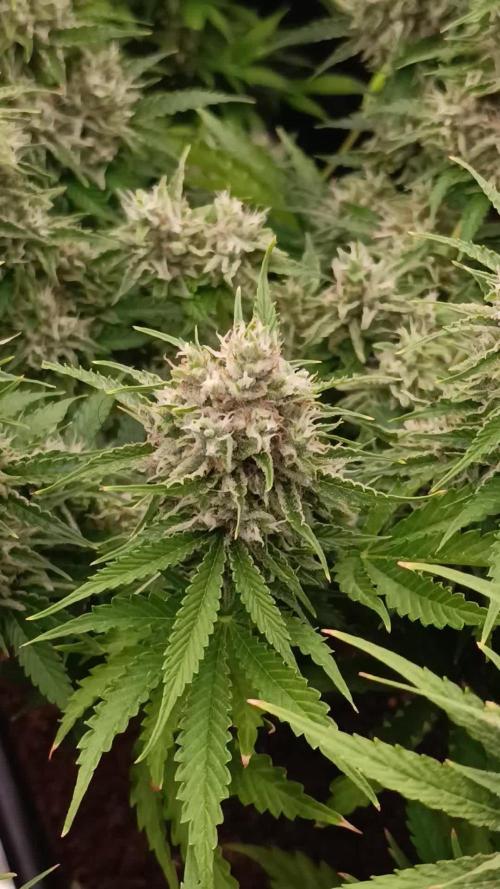
Las plantas entran en la fase final de maduración, centrando toda su energía en el engorde y compactación de los cogollos. Los cálices se hinchan, la resina aumenta y los aromas se vuelven más intensos y profundos.
Empiezan a verse más pistilos oxidados, aunque aún quedan algunos blancos, señal de que siguen trabajando en este cierre progresivo.
La absorción se ralentiza ligeramente y la planta comienza a mostrar el inicio del final del ciclo.
Seguimos creciendo fuerte 💪!

Likes
19
Share


@SirBudAlotts
Follow
Week 2 and looks like she loves it outside 😍..
The wind was abit hectic so had to stake her down for extra leverage..
Plain water feeding no nutes whatsoever..

Processing
Likes
52
Share


@CBD_Sweden
Follow
2017-09-11. Kl 12.00. Week 3 starts. I have cleaned the whole room for the new week and gave the girls water and nutes. Added videos and pics. Girl is 10 cm high.
--------------------------------------------------------------------------------------------------------------------
2017-09-12. Kl 10.00. New pic and video.
---------------------------------------------------------------------------
2017-09-13. Kl 22.00. Added new video.
---------------------------------------------------------------------------------------
2017-09-15. KL 10.00. New pics and video. The girl is 14 cm high.
---------------------------------------------------------------------------
2017-09-16. Kl 10.00. The girl is starting to grow little better now and i hope she is picking up the pace. Added new videos.

Likes
24
Share


@JaeMack
Follow
Gave it a ice water flush and 48 hours of darkness. Then chopped on 10/24.


Likes
34
Share


@JonnyKush
Follow
Day 38
I am very happy with how they are growing. finally begins to flourish, the LST seems to have paid off. from last week I started giving green sensation 1ml / l without adding anything else.
thanks for viewing it is my first growth if you see errors comment and correct me.
hit like and follow me for updates.
happy day and good luck with your growth 🌱💚
Likes
43
Share


@GODSGIFT_2005_JM
Follow
🍼Greenhouse Feeding BioGrow & Bio Enhancer
⛺️MARSHYDRO
The ⛺️ has a small door 🚪 on the sides which is useful for mid section groom room work. 🤩
☀️ MARSHYDRO FC 3000 LED 300W
☀️Also special thanks to VIPERSPECTRA P2000 (200W) & XS2000(240w) LED growlights
🌱 FastBuds 420
Likes
11
Share


@Loud_Jazz_de_Cavolo
Follow
Their first Neem oil leaf drench massage. Their first fertigation or watering.
For the Og kush the third week Biobizz nutrient dose was followed. The only addition to the third week All Mix dosology was the inclusion of Alg a mic. At the above rate + Great white + bactrex. The above list of nutrients correspond to the OG KUSH Allmix schedule and doses.
Fot the amnesia haze the watering had only Bactrex, White sark and Pro symbiotic at the doses listed above. No pH was adjusted nor measured and no EC either.
*03/29 UPDATE*
Since no option given for "breaking down" each strain individually ragarding the Nutrients section I ll update the irrigation/fertigation/nutrient regimen for each week in this section. Each time something changes on the Nutrients section it ll always be the last used doses of nutrients only for the OG Kush strain. For the Amnesia only CalMag treated water will be given in alternate irrigations along with a twice a week bacteria introduction to the system. So, today
both plants got 1.8 lts of RODI CalMag treated water to .340EC with a controlled pH of 6.3. The Amnesia had a significantly higher runoff which I didn't anticipate nor understand but I'll find out why for sure.
Some light LST directional guiding was given to the plants for forming purposes and future canopy levelling.
In the Grow Hut since day one the plants are continuously enjoying the company of Pandit Hariprasad Chaurasia s music. They love it!
*03/30 UPDATE*
The best possible outcome regarding live phytoprotection by beneficial insects for pest control.
As of yesterday I have two unidentified tiny sliders, possibly common garden ones and as of today a Coccinellidae sp. larvae running around the canopy (check the video) Hope for many more of them sweet protectors. Neem oil along with DE has successfully helped in deterring some Gnat "congregation".
*03/31 UPDATE*
Plants are growing strong and vigorous. Some LST done and their new canopy hairdo can be seen in the pics.
Likes
10
Share


@MadeInGermany
Follow
Flowering day 34
since time change
to 12/12 h.
Hey guys :-)
The buds have developed incredibly nicely this week.
The smell is getting more and more extreme :-) .
The growth has slowly stopped as the full energy goes into the production of the buds.
Watering was done twice this week, each time with 1.2 l (nutrients see table above)
They were individually inspected and checked for their health.
Osmosis water for the coming week was refilled in a 100 l tank 👍.
Have fun reading the diary and stay healthy 💚🙏🏻
👇🏼👇🏼👇🏼👇🏼👇🏼👇🏼👇🏼👇🏼👇🏼👇🏼👇🏼👇🏼
You can buy this Nutrients at :
https://greenbuzzliquids.com/en/shop/
With the discount code: Made_in_Germany you get a discount of 15% on all products from an order value of 100 euros.
👇🏼👇🏼👇🏼👇🏼👇🏼👇🏼👇🏼👇🏼👇🏼👇🏼👇🏼👇🏼
You can buy this strain at :
https://www.exoticseed.eu/
Water 💧 💧💧
Osmosis water mixed with normal water (24 hours stale that the chlorine evaporates) to 0.2 EC. Add Cal / Mag to 0.4 Ec Ph with Organic Ph - to 5.8 - 6.5
MadeInGermany

Likes
36
Share


@pifflestikkz
Follow
Day 172
21/10/24 Monday
I had 1.5 Litres of feed left, and she was top dry this morning so she finished that off today.
Picture update 😎💚
I'll get one later with lights off 🙌
Day 174
23/10/24 Wednesday
De-chlorinated tap water pH 6 only today.
Finally update pictures and videos 📸 💚
She is developing awsome colours, and buds are now starting to stack weight 💪🙌
Day 177
26/10/24 Saturday
De-chlorinated tap water pH 6 only today, noticed a few tips burning.
She is stacking !! This week she has developed a really floral aroma is sweet and tantalising like a perfume almost.
She is glistening with trichomes, and buds are taking the dark 🌑 colour with purple/pink calyx tips.
Super duper sticky!!

Likes
115
Share


@DogDoctorOfficial
Follow
Greetings, fellow cultivators! We've officially crossed into the much-anticipated flowering stage with our beloved Cherry Cola Auto, and let me tell you, it's nothing short of a horticultural fiesta! The transformation over the past week has been nothing short of magical, with our once lush bush evolving into a budding beauty.
Last week was a game-changer as I bid farewell to the training supports that have guided our Cherry Cola through her bushy phase. Now, she's free to express herself, growing wild and embracing her natural beauty. The transition from veg to flower has been seamless, and I'm witnessing a symphony of bud formation that's simply breathtaking.
One of the marvels of autoflowers is their ability to veg and preflower simultaneously. It's like witnessing two acts of a play at the same time – the plant is reaching for the stars while also gearing up for the grand flowering spectacle. Cherry Cola's growth rate is nothing short of impressive, and I find myself in awe of this dynamic phase.
With the shift into flowering, I've made some adjustments to our nutrient regimen. The Start Booster has gracefully bowed out, making way for two new players on the stage – P-Boost and Topbooster. P-Boost, a phosphorus booster, is a soluble wonder that not only enhances blooming but also contributes to improved water pH. It's like giving our Cherry Cola a backstage pass to a nutrient orchestra.
Meet the New Stars: P-Boost and Topbooster:
P-Boost, with its organic acids and phosphorus punch, is playing a vital role in stimulating protein, hormone, and vitamin production. It's a symphony conductor orchestrating the blooming processes. Meanwhile, Topbooster, the dynamic duo partner, is enhancing the flowering response, producing larger fruits with more fibers, resins, and sugars. It's like a magical potion for quality and flavor enhancement.
Oh, did I mention that our Cherry Cola looks perfect to my eyes? She's a vision of green excellence, and I'm captivated by the flawless symmetry of her growth. Every day, she inches taller, embracing the flower formation with grace and poise.
As we wrap up this Week 1 Flower report, I'm left in amazing of the beauty unfolding before us. Cherry Cola Auto, with her wild growth and budding allure, is a testament to the marvels of cultivation. Stay tuned, green enthusiasts, for the next thrilling installment as the floral overture continues!
Genetics Cherry Cola Auto @Fast_Buds @fastbuds_genetics_official @fastbuds_official @fastbuds_espana
Nutrition: @aptusholland @aptus_world @aptus_
Love, Care, and Attention: @dogdoctorofficial
As always, thank you all for joining me on this journey, for your love, and for it all. My horticultural odyssey would never be the same without you. Your love and support are cherished, and I feel both honored and blessed to have you in my life <3 <3 <3
#aptus #aptusplanttech #aptusgang #aptusfamily #aptustrueplantscience #inbalancewithnature #trueplantscience #dogdoctorofficial #growerslove #fastbuds #specialplants #homegrown #fastbuds #cherrycola #CultivatingBeauty #NatureArtistry #HomegrownMagic #GreenPassion #JourneyWithPlants
With true love comes happiness. Always believe in yourself and always do things expecting nothing in return, with an open heart. Be a giver, and the universe will respond in ways you can't even dream off.
Friendly reminder: all you see here is pure research and for educational purposes only.
Growers Love to you all <3 <3 <3
Likes
18
Share

@BLAZED
Follow
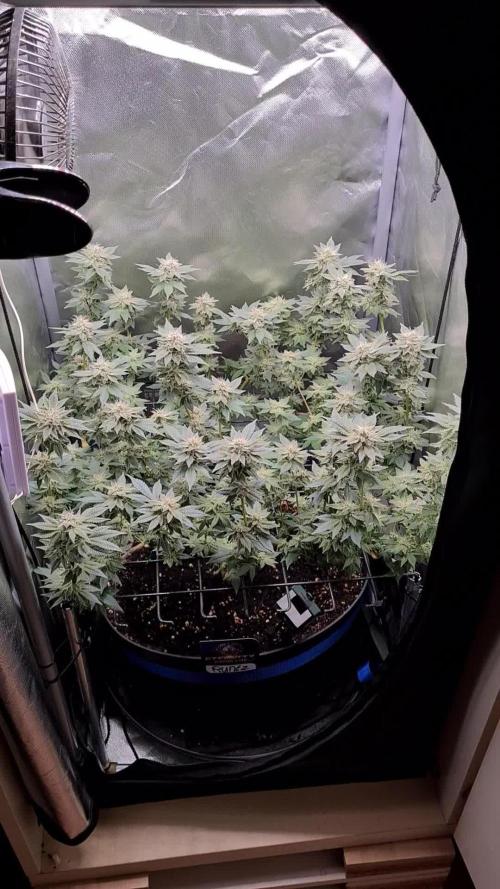
Week 15 (5-5 to 11-5)
5-5
Temps: 18.5 to 23.5 degrees
Humidity: 43% to 61%
Watering: 1000 ml. 1.6 6.2
6-5
Temps: 18.2 to 23.5 degrees
Humidity: 43% to 64%
Watering: 1000 ml. 0.4 6.3
7-5
Temps: 18.6 to 23.6 degrees
Humidity: 45% to 64%
Watering: 1000 ml. 1.6 6.2
8-5
Temps: 18.7 to 23.6 degrees
Humidity: 42% to 60%
Watering: 1000 ml. 0.4 6.3
9-5
Temps: 19.3 to 24.2 degrees
Humidity: 43% to 53%
10-5
Temps: 17.7 to 24.3 degrees
Humidity: 40% to 58%
Watering: 1000 ml. 1.6 6.2
11-5
Temps: 18.5 to 24.9 degrees
Humidity: 40% to 56%
Watering: 2000 ml. 0.4 6.3

Likes
2
Share


@Ultraviolet_
Follow
We become aware at such times of man's wonderful ability to bring seemingly unrelated elements into harmonic balance, and receive a glimpse into a world where everything exists in conscious sympathetic attunement to everything else. When we listen to a piece of music that seems to strike a beautiful chord somewhere inside us, or view a painting that simply glows with harmonic awareness well executed, we probably do not spare much time to contemplate the wonderfully intricate combination of vibrations that our sensors make it possible for us to perceive. We tend to appreciate the relationship between the parts of something by an awareness of the harmony or dissonance of the whole. This ability enables us to say "what a beautiful house!" instead of "analysis has proven that this collection of building materials exhibits certain elements of harmonic proportion." While this ability to instinctively appreciate the beauty of true harmony has an important role to play in evolution, a more analytical understanding of the laws involved can be most useful. This is especially so if we wish to create works of art where each part exists in true harmony, not only with the other part of that particular whole, but with the universe within which the creator and the created exist.
Everything vibrates. From the most dense matter to the most subtle cosmic rays, everything which our senses allow our thoughts to become aware of, can be specified in terms of wavelength or frequency of vibration. These two terms define the same thing, but from different points of view.
The following are the approximate wavelengths of various energy carriers:
Cosmic rays 0.000,000,001 mm
Gamma rays 0.000,000,1 mm
X rays 0.000,500 mm
Ultraviolet rays 0.003 mm
Visible light 0.006 mm
Infrared 0.01 mm
Sound waves 1 meter
Radio waves 300 meters
Violet light 400 nm to 450 nm
Blue light 450 nm to 500 nm
Green light 500 nm to 570 nm
Yellow light 570 nm to 590 nm
Orange light 590 nm to 610 nm
Red light 610 to 700 nm
1 nanometer (nm) = 0.000,000,1 cm = 1/10,000,000 cm
If a guitar string is plucked and we hear a sound, it is not too difficult for the human mind to associate this sound with the vibration of the guitar string. With color it is quite different. It is difficult for us to conceive that the color of a substance is not an inherent property of the substance itself, but an indication picked up by our senses of that substance's ability to absorb or reflect the light which happens to be shining on it at that moment. Neither the matter nor the light is colored. What happens is that the brain learns to differentiate between the frequencies reflected or transmitted by the substance the eyes are focused on. The same thing happens with sound. When we say "Oh! Listen, they're playing my favorite song," what we really mean is: "My brain has stored within it a particular pattern of frequencies. I have compared the new information being received with this stored pattern and have deduced the answer that the two patterns are similar within certain specified tolerances." The 'pleasure' involved could have something to do with our running the pre-recorded pattern at the same time, in 'sympathy' with the new pattern as it is received.
The word sympathy describes very well our ability to appreciate color and sound. It also describes the reason behind certain elements of harmony. For instance, if a substance vibrating at 100 cycles per second (tone 1) is in the proximity of another substance vibrating at 200 cycles per second (tone 2), we could perceive, if we had the right equipment, a certain sympathetic relationship between the two.
We will see from this that there is a uniform doubling of the first tone seen in the second. At various points along the waves, the two are the same in amplitude. At other points, they are at opposite poles to each other. This doubled frequency has more points of similarity to the original than any other frequency except the original itself. If the equipment we had available for measuring these two frequencies was a soundboard amplifier and a pair of ears, then we would hear what would sound to us like one tone. If we had the opportunity to hear one at a time, we would hear that although they sound the same, one is higher in pitch than the other. This characteristic of 'the same but different in pitch', musicians have called the octave. Any two tones produced where one has exactly doubled the frequency of the other is called an octave. Speaking in ratios, an octave would appear then as the ratio 2:1 or 1:2, depending on whether we are talking of an octave up or down.
A single note produced by almost any instrument will contain more than one wavelength or frequency. It will have a dominant frequency, the wavelength of which we would call the note's 'fundamental' or 1st harmonic. It will also have a varying number of upper harmonics, gradually fading in intensity into infinity or silence.
Natural harmonics always have the same pattern of intervals between them. The interval between the 1st and 2nd harmonic is a perfect octave; between the 2nd and 3rd a perfect fifth; between the 3rd and 4th a perfect 4th; and so on, the intervals becoming smaller and smaller until they lose any relationship with the western 12 tone scale as it exists at the moment. Just as an octave has certain elements of sympathy with its fundamental, so some intervals have been noted to be more perfectly in sympathy with the fundamental than others. The ratio of the 'perfect 5th' or interval of 7 semitones, as it occurs in the harmonic series, is 3:2 or 2:3, while that of the 'perfect fourth" is 4:3 or 3:4. All the tones in the western 12 tone scale can be expressed in terms of the ratio between the upper tone and its fundamental. This would seem to be an ideal way of generating a scale from any given fundamental and several attempts have been made to do this, the Pythagorean system being probably the most well known. Although when working with a single tone instrument playing on its own, the Pythagorean formula works wonderfully well, if we had several instruments tuned this way together and asked them to play almost any western music, we would find that at times they sounded quite out of tune to each other.
The lack of flexibility of the various scale systems based on the harmonic series has led to what is known as the 'tempered' scale. This uses as its primary unit of interval the ratio of the octave or 2:1. It then proceeds to divide the interval between any fundamental and its upper octave into 12 smaller intervals by applying the ratio: two to the one-twelfth power, to one (21/12:1). This equals 1.059463094, so by multiplying any frequency by this number, we will obtain the tempered semitone next up from our fundamental. We will also find that any tone twelve semitones up from any other tone, in a scale generated in this way, will have exactly double the frequency.
If we took the note middle C on a piano and halved the wavelength, we would have the note C one octave above. If we halved this, we would have the C above, and so on. However, within about 6 octaves, we would find that although a 'sound' was being produced, no human ear could perceive it. If we kept on going, halving and producing upper octaves of our fundamental C, we would proceed through the infrared band, into the visible light spectrum. If we happened to be outside during the day, we would, for one octave only, see the note C with our eyes. The next octave above would already be in the ultraviolet band, and outside the eye's sensitivity range. If we can think of color as being an indication of a substance's vibratory rate or wavelength, we may begin to see a relationship that could exist between the color and sound spectrums.
The logical extension of what has so far been said is that there exists a scale in the color spectrum that corresponds exactly to the scale in the sound spectrum, each color tone being an octave of the equivalent note in the sound range.
This is not the end of the story but only the beginning. If we can for the moment accept that any wavelength in one band has upper and lower octave stretching out to infinity, then the next question is 'fine, but what shall we use as our fundamental? A particular color? A particular sound frequency?' The musicians among us will probably say 'A 440'. This means that the note A should vibrate at 440 Hertz, or 440 times per second. They would tell us that this is standard pitch has been adopted by most orchestras around the world; pianos are tuned to it, instruments are constructed to formulas based on it, and so to them it would probably seem the most appropriate place to begin. Some of these musicians may know of the battle that is still raging with regards to this being the standard, but few would know why A = 440 Hz was chosen except that it worked when it was set to be a suitable compromise between the many different pitches in use at the time.
432 Hz is said to be mathematically consistent with the patterns of the universe. Studies reveal that 432 Hz tuning vibrates with the universe’s golden mean PHI and unifies the properties of light, time, space, matter, gravity, and magnetism with biology, the DNA code, and consciousness. When our atoms and DNA start to resonate in harmony with the spiraling pattern of nature, our sense of connection to nature is said to be magnified.
Another interesting factor to consider is that the A=432 Hz tuning correlates with the color spectrum, while the A=440 Hz is off. Audiophiles have also stated that A = 432 Hz music seems to be non-local and can fill an entire room, whereas A=440 Hz can be perceived as directional or linear in sound propagation.
Once you adopt the idea that sound (or vibration in general) can have an equalizing and harmonizing effect (as well as a disturbing effect), the science of harmony can be applied to bring greater harmony into one's life or tune to specific energies. There is a form of absolute and relative harmony. Absolute harmony can, for example, be determined by the tuning of an instrument. The ancients tuned their instruments at an A of 432 Hz instead of 440 Hz - and for a good reason. There are plenty of music examples on the internet that you can listen to in order to establish the difference for yourself.
Attuning the instrument to 432 Hz results in a more relaxing sound, while 440 Hz slightly tenses up the body. This is because 440 Hz is out of tune with both macro and micro cosmos. On the contrary, 432 Hz is in tune. To give an example of how this is manifested microcosmically: our breath (0,3 Hz) and our pulse (1,2 Hz) relate to the frequency of the lower octave of an A of 432 Hz (108 Hz) as 1:360 and 1:90.
It is interesting to note that 432 Hz was the standard pitch of many old instruments and that it was only recently (19th and 20th century) the standard pitch was increased. This was done in order to be able to play for bigger audiences. Bigger audiences (more bodies) absorb more of the lower frequencies, so the higher pitch was more likely to “cut through”. One of the oldest instruments of the world is the bell ensemble of Yi Zeng (dated 423 BC), tuned to a standard F4 of 345 Hz, which gives an A= 432 Hz. The frequency of 345 Hz is that of the platonic year! Similarly, many old organs are tuned in A=432 as well; for example, St. Peter’s Capella Gregoriana, St. Peter’s Capella Giulia, S. Maria Maggiore in Rome.
Maria Renold’s book “Intervals Scales Tones and the Concert Pitch C=128 Hz” claims conclusive evidence that 440 Hz and raising concert pitch above scientific “C” Prime=128 Hz (Concert A=432 Hz) disassociates the connection of consciousness to the body and creates anti-social conditions in humanity.
The difference between concert pitch A=440 Hz and Concert A=432 Hz is only 8 cycles per second, but it is a perceptible difference of awareness in the human consciousness experience of the dream we share called existence.
Likes
23
Share


@elementhc
Follow
The Ethos photos have been flipped to flower a week or so ago. Took 12 clones.
Gsc Auto will be ready to harvest this week. Others still have a few weeks.


