

@eldruida_lamota
Volgen
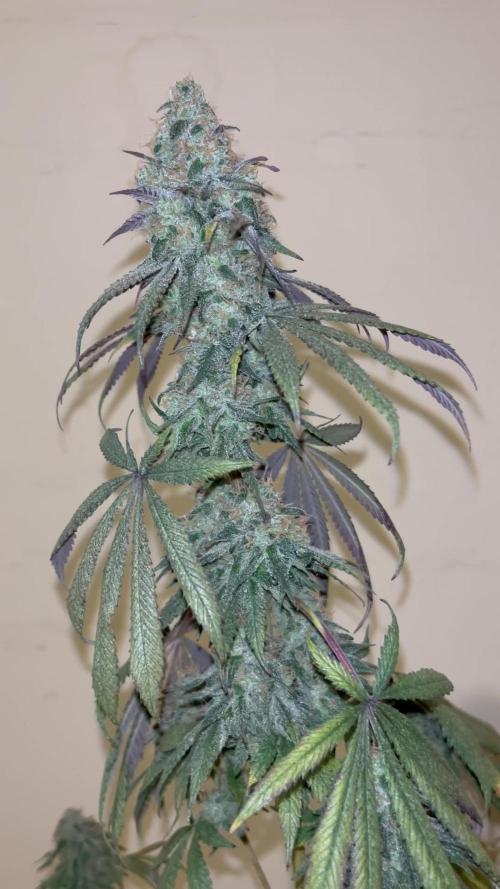
Venga familia que ya viene la cosecha de estas F.U.H. de Seedstockers, que ganas que tenia ya de darles tijeretazo.
Que variedad , me encantó cultivarla , sacaron unas flores bien resinosas y alucinantes.
Las flores aparte son muy pegajosas.
a sido una genética con la que disfruté bastante, fue muy fácil cultivarla. Y a la vez es medio resistente, teniendo trips desde la 4/5 semana incontrolable salieron bastante bien.
Agrobeta:
https://www.agrobeta.com/agrobetatiendaonline/36-abonos-canamo
Mars hydro:
Code discount: Eldruida
https://www.mars-hydro.com/
Hasta aquí es todo , espero que lo disfrutéis, buenos humos 💨💨.


@TGriner420
Volgen
This week went by quickly. They're doin their Pre-Flower stretch and getting big quickly!! I added my Pre-Flower mix to them this week. My Nutrient Pre-Flower Mix consists of H20, Coconut, Bananas, Pineapple, Sweet Potatoes, Kelp, Alfalfa Meal, All Organic Non-Pasturized Whole Milk, Epsom Salts, Black Strap Molasses, and L.A.B. or Lactic Acid Bacteria. First, I boiled the coconut, pineapple, sweet potatoes, the bananas, and left the skins on as well except the coconut of course! That I had to split in half and make sure to keep the water inside to add to the boil. After boiling everything I then let it cool and then added it to a blender to blend little by little. After blending I left separate and placed into the fridge. Then I took 1 Tbsp of Alfalfa Meal and 2 Tbsp of Kelp, 500mL of the milk, 2 Tbsp of Epsom Salts, and mixed them in a 750 mL bottle. Then I took 1L of the mix and added 2 Tbsp of L.A.B. and 2 Tbsp of Black Strap Molasses and then shook the bottle well! Then I took the 750mL bottle and the 1L bottle and fed that to the plants adding 250 mL of pH H2O to the plant as well to flush the ingredients all into the plant with the H20. I wanted to also note that I choose to slowly defoliate so that the plant doesn't go into shock and also fan leaves collect light in all spectrums so taking too many off at a time could hurt or slow the growth of your plant! The amount of light your plant takes in daily is called DLI or Daily Light Index. Overall, they're really growing and have a ton of us sites developing!


@DogDoctorOfficial
Volgen
And it looks like they didn't mind that much going to the hairdresser as they keeps on drinking the same and evolving at the same pass. They are all becoming beautiful beast ladies and im loving them all in diferent ways , so far the mor advanced one is the somango followed by the water melon followed by the no idea what it is seed and in the end e have bruce banned, im loving t he fact that they all started same time and that they all are going to finished different, this means i will be trying me second harvest plant smoking my pervious one 😝 .
They are all drinking using the autopot system but the no idea what seed is not so im Daly giving her 2,5 liters from the autopot reservoir ,it sucks but its ok at the same time hehe eit is what it is and im not thinking on leaving anywhere, so i can easy do that every single day hehehe kind a lovit any way but dont tell anyone, its our little secret 🤫 😆💚🙏🙏🙏
As always thank you all for reading and checking out my diaries, im humbled by it all, much love to you all 💚💚💚🙏🙏🙏💚💚💚🙏
Thank you APTUSHOLLAND for having faith in my love for growing and for always being there wen my gardens need 🙏🙏🙏
Genetics :
- watermelon candy - Zamnezia Seeds https://www.zamnesia.com/
-Somango Glue - Advanced seeds https://advancedseeds.com/web/
- ?- buddah Seeds
- Bruce Banner - Fast Buds https://2fast4buds.com/
Grow tent - 4x8, but using 4x4 for this Auto Test
Ligth - LUMATEK ZEUS 465 COMPACT PRO
Food - HAPTUS HOLLAND
Filter - vanguard hydroponics Falcon Filters
Extraction - vanguard hydroponics 560 m3h
control - Trolmaster
All i grow is medicine for myself, for me and for my best friend with is me 😆 nothing to sell, so don’t even ask 😅💚💚💚
All info and full product details can be find in can find @
https://aptus-holland.com/
https://autopot.co.uk/
https://lumatek-lighting.com/
#aptus #aptusplantteck #aptusgang #aptusfamily #aptustrueplantscience #inbalancewithnature #trueplantscience #growerslove
With true love comes happiness 💚🙏 Always believe in your self and always do things expecting nothing in return and with an open heart , be a giver and the universe will give back to you in ways you could not even imagine so 💚💚💚
More info and updates @
https://growdiaries.com/grower/dogdoctor
https://instagram.com/dogdoctorofficial
https://youtube.com/channel/UCR7ta4DKLFMg2xxTMr2cpIg
💚💚💚Growers love to you all 💚💚💚


shorts_status_processing


@BigBudWolf
Volgen
FASTBERRY (Fastbuds)
28 days from sprout.
Easy nutrient feed at about quarter strength recommended dose.
Tried some leaf tucking and pony tailing. She seems to respond well.


@BushDoctor740
Volgen
These girls are blowing up and have filled the 3x3 tent no problem.They are in 3 gal fabric pots so I’m hoping to keep them short as possible with scrog net along with some training and defoliation this week.I can see this grow producing lots of buds and I’m debating on adding a second sf1000 to the tent to give them another 100 watts.


@leliantu
Volgen
Ultima semana de fertilización, a partir de hoy solo riegos con enzimas o con flush, creo que voy a dejarla unas dos semanas con este régimen. Me sorprendió esta auto, de gran aroma, se desarrollo muy bien y muy rápido, lastima que no sepa que variedad es.


@cookingwithninja
Volgen
Day 21 video and screenshots from the video. Final bit of supercropping, one branch in particular super cropped on 3 internodals to keep it from physical light touch.
Day 22 started to collect pollen
Day24 2nd day of pollination. I see successful pollination. So I’m happy about that. Pollination is 4-6 days earlier than last time so hopefully chop week 9 but 10 is the limit.


@midEastern
Volgen
stems are wounded in the middle
as mentioned when they started flowering,my white table has fallen on parts of the plants and damaged
the main stem and a few branches.
i tied and bandaged the main stem and supported with sticks.
They flowered almost as if nothing happened except for a few small branches that stopped getting nutes and died
in the pics you can see how the main stems got severely broken in the middle.
in the last 2 weeks there has been a few weather changes such as storm,heat,and colder climate during night time,
i was ready for storm with a plastic roof on top-they were perfectly protected from water and winds and stayed healthy during 2 days of winter.got a perfect color due to colder nights and today decided they are ripe.trichs are cloudy mostly


@field_nigga
Volgen
So I started LST and the girls seem to be responding well to the method. It has now been 4 weeks since the sprout and am I very excited. Might continue veg until it's eighth week and then switch to flowering.



shorts_status_processing




@DomForester
Volgen
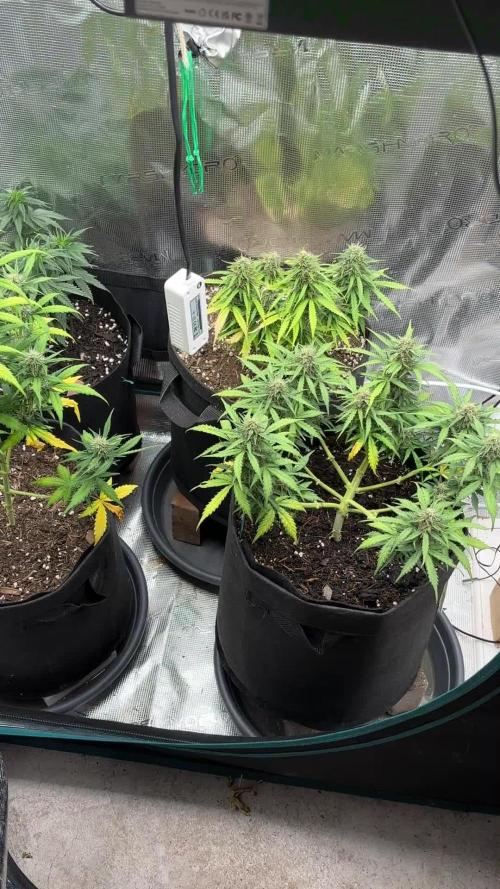
Weird. I’m seeing a few amber but mostly clear trichomes on Cindy1. No milky ones. Will double check tomorrow but does anyone know what that might be about?
Also, whats up with Cindy3’s leaves (the tall one)? That doesnt look like normal senescence during mid flower…


@MistaOC
Volgen
**************
13.03. Day 1
**************
🤞🏼😎
I have new cuttings. Sour Frootz from Karma Genetics. I planted the cuttings in 0.2 L pots. I only applied fertilizer to the large pot.
So Let’s grow again 💚💯
*******************************************
18.03. Day 6
sprinkled with bactrex and transferred into the large pots
*******************************************


@Wizardgreen317
Volgen
Well there looking really good the smell fairly skunky with a little orange peel smell so yeah the got even bigger they have stopped frowning well some of them but yeah there awesome plant but just doesn’t provide me with enough bud lol so yeah if you want more for this plant veg is where it’s at lol so what I mean is veg for a longer time if you have the space cause these plants grow really squat



@Ultraviolet_
Volgen
We become aware at such times of man's wonderful ability to bring seemingly unrelated elements into harmonic balance, and receive a glimpse into a world where everything exists in conscious sympathetic attunement to everything else. When we listen to a piece of music that seems to strike a beautiful chord somewhere inside us, or view a painting that simply glows with harmonic awareness well executed, we probably do not spare much time to contemplate the wonderfully intricate combination of vibrations that our sensors make it possible for us to perceive. We tend to appreciate the relationship between the parts of something by an awareness of the harmony or dissonance of the whole. This ability enables us to say "what a beautiful house!" instead of "analysis has proven that this collection of building materials exhibits certain elements of harmonic proportion." While this ability to instinctively appreciate the beauty of true harmony has an important role to play in evolution, a more analytical understanding of the laws involved can be most useful. This is especially so if we wish to create works of art where each part exists in true harmony, not only with the other part of that particular whole, but with the universe within which the creator and the created exist.
Everything vibrates. From the most dense matter to the most subtle cosmic rays, everything which our senses allow our thoughts to become aware of, can be specified in terms of wavelength or frequency of vibration. These two terms define the same thing, but from different points of view.
The following are the approximate wavelengths of various energy carriers:
Cosmic rays 0.000,000,001 mm
Gamma rays 0.000,000,1 mm
X rays 0.000,500 mm
Ultraviolet rays 0.003 mm
Visible light 0.006 mm
Infrared 0.01 mm
Sound waves 1 meter
Radio waves 300 meters
Violet light 400 nm to 450 nm
Blue light 450 nm to 500 nm
Green light 500 nm to 570 nm
Yellow light 570 nm to 590 nm
Orange light 590 nm to 610 nm
Red light 610 to 700 nm
1 nanometer (nm) = 0.000,000,1 cm = 1/10,000,000 cm
If a guitar string is plucked and we hear a sound, it is not too difficult for the human mind to associate this sound with the vibration of the guitar string. With color it is quite different. It is difficult for us to conceive that the color of a substance is not an inherent property of the substance itself, but an indication picked up by our senses of that substance's ability to absorb or reflect the light which happens to be shining on it at that moment. Neither the matter nor the light is colored. What happens is that the brain learns to differentiate between the frequencies reflected or transmitted by the substance the eyes are focused on. The same thing happens with sound. When we say "Oh! Listen, they're playing my favorite song," what we really mean is: "My brain has stored within it a particular pattern of frequencies. I have compared the new information being received with this stored pattern and have deduced the answer that the two patterns are similar within certain specified tolerances." The 'pleasure' involved could have something to do with our running the pre-recorded pattern at the same time, in 'sympathy' with the new pattern as it is received.
The word sympathy describes very well our ability to appreciate color and sound. It also describes the reason behind certain elements of harmony. For instance, if a substance vibrating at 100 cycles per second (tone 1) is in the proximity of another substance vibrating at 200 cycles per second (tone 2), we could perceive, if we had the right equipment, a certain sympathetic relationship between the two.
We will see from this that there is a uniform doubling of the first tone seen in the second. At various points along the waves, the two are the same in amplitude. At other points, they are at opposite poles to each other. This doubled frequency has more points of similarity to the original than any other frequency except the original itself. If the equipment we had available for measuring these two frequencies was a soundboard amplifier and a pair of ears, then we would hear what would sound to us like one tone. If we had the opportunity to hear one at a time, we would hear that although they sound the same, one is higher in pitch than the other. This characteristic of 'the same but different in pitch', musicians have called the octave. Any two tones produced where one has exactly doubled the frequency of the other is called an octave. Speaking in ratios, an octave would appear then as the ratio 2:1 or 1:2, depending on whether we are talking of an octave up or down.
A single note produced by almost any instrument will contain more than one wavelength or frequency. It will have a dominant frequency, the wavelength of which we would call the note's 'fundamental' or 1st harmonic. It will also have a varying number of upper harmonics, gradually fading in intensity into infinity or silence.
Natural harmonics always have the same pattern of intervals between them. The interval between the 1st and 2nd harmonic is a perfect octave; between the 2nd and 3rd a perfect fifth; between the 3rd and 4th a perfect 4th; and so on, the intervals becoming smaller and smaller until they lose any relationship with the western 12 tone scale as it exists at the moment. Just as an octave has certain elements of sympathy with its fundamental, so some intervals have been noted to be more perfectly in sympathy with the fundamental than others. The ratio of the 'perfect 5th' or interval of 7 semitones, as it occurs in the harmonic series, is 3:2 or 2:3, while that of the 'perfect fourth" is 4:3 or 3:4. All the tones in the western 12 tone scale can be expressed in terms of the ratio between the upper tone and its fundamental. This would seem to be an ideal way of generating a scale from any given fundamental and several attempts have been made to do this, the Pythagorean system being probably the most well known. Although when working with a single tone instrument playing on its own, the Pythagorean formula works wonderfully well, if we had several instruments tuned this way together and asked them to play almost any western music, we would find that at times they sounded quite out of tune to each other.
The lack of flexibility of the various scale systems based on the harmonic series has led to what is known as the 'tempered' scale. This uses as its primary unit of interval the ratio of the octave or 2:1. It then proceeds to divide the interval between any fundamental and its upper octave into 12 smaller intervals by applying the ratio: two to the one-twelfth power, to one (21/12:1). This equals 1.059463094, so by multiplying any frequency by this number, we will obtain the tempered semitone next up from our fundamental. We will also find that any tone twelve semitones up from any other tone, in a scale generated in this way, will have exactly double the frequency.
If we took the note middle C on a piano and halved the wavelength, we would have the note C one octave above. If we halved this, we would have the C above, and so on. However, within about 6 octaves, we would find that although a 'sound' was being produced, no human ear could perceive it. If we kept on going, halving and producing upper octaves of our fundamental C, we would proceed through the infrared band, into the visible light spectrum. If we happened to be outside during the day, we would, for one octave only, see the note C with our eyes. The next octave above would already be in the ultraviolet band, and outside the eye's sensitivity range. If we can think of color as being an indication of a substance's vibratory rate or wavelength, we may begin to see a relationship that could exist between the color and sound spectrums.
The logical extension of what has so far been said is that there exists a scale in the color spectrum that corresponds exactly to the scale in the sound spectrum, each color tone being an octave of the equivalent note in the sound range.
This is not the end of the story but only the beginning. If we can for the moment accept that any wavelength in one band has upper and lower octave stretching out to infinity, then the next question is 'fine, but what shall we use as our fundamental? A particular color? A particular sound frequency?' The musicians among us will probably say 'A 440'. This means that the note A should vibrate at 440 Hertz, or 440 times per second. They would tell us that this is standard pitch has been adopted by most orchestras around the world; pianos are tuned to it, instruments are constructed to formulas based on it, and so to them it would probably seem the most appropriate place to begin. Some of these musicians may know of the battle that is still raging with regards to this being the standard, but few would know why A = 440 Hz was chosen except that it worked when it was set to be a suitable compromise between the many different pitches in use at the time.
432 Hz is said to be mathematically consistent with the patterns of the universe. Studies reveal that 432 Hz tuning vibrates with the universe’s golden mean PHI and unifies the properties of light, time, space, matter, gravity, and magnetism with biology, the DNA code, and consciousness. When our atoms and DNA start to resonate in harmony with the spiraling pattern of nature, our sense of connection to nature is said to be magnified.
Another interesting factor to consider is that the A=432 Hz tuning correlates with the color spectrum, while the A=440 Hz is off. Audiophiles have also stated that A = 432 Hz music seems to be non-local and can fill an entire room, whereas A=440 Hz can be perceived as directional or linear in sound propagation.
Once you adopt the idea that sound (or vibration in general) can have an equalizing and harmonizing effect (as well as a disturbing effect), the science of harmony can be applied to bring greater harmony into one's life or tune to specific energies. There is a form of absolute and relative harmony. Absolute harmony can, for example, be determined by the tuning of an instrument. The ancients tuned their instruments at an A of 432 Hz instead of 440 Hz - and for a good reason. There are plenty of music examples on the internet that you can listen to in order to establish the difference for yourself.
Attuning the instrument to 432 Hz results in a more relaxing sound, while 440 Hz slightly tenses up the body. This is because 440 Hz is out of tune with both macro and micro cosmos. On the contrary, 432 Hz is in tune. To give an example of how this is manifested microcosmically: our breath (0,3 Hz) and our pulse (1,2 Hz) relate to the frequency of the lower octave of an A of 432 Hz (108 Hz) as 1:360 and 1:90.
It is interesting to note that 432 Hz was the standard pitch of many old instruments and that it was only recently (19th and 20th century) the standard pitch was increased. This was done in order to be able to play for bigger audiences. Bigger audiences (more bodies) absorb more of the lower frequencies, so the higher pitch was more likely to “cut through”. One of the oldest instruments of the world is the bell ensemble of Yi Zeng (dated 423 BC), tuned to a standard F4 of 345 Hz, which gives an A= 432 Hz. The frequency of 345 Hz is that of the platonic year! Similarly, many old organs are tuned in A=432 as well; for example, St. Peter’s Capella Gregoriana, St. Peter’s Capella Giulia, S. Maria Maggiore in Rome.
Maria Renold’s book “Intervals Scales Tones and the Concert Pitch C=128 Hz” claims conclusive evidence that 440 Hz and raising concert pitch above scientific “C” Prime=128 Hz (Concert A=432 Hz) disassociates the connection of consciousness to the body and creates anti-social conditions in humanity.
The difference between concert pitch A=440 Hz and Concert A=432 Hz is only 8 cycles per second, but it is a perceptible difference of awareness in the human consciousness experience of the dream we share called existence.
shorts_status_processing


@LittleBigTrees
Volgen
Plucked a few more leaves but other than that just feed them this week including bloom.
Also gave them some rice starch (from boiled rice water collection) on day 42 as a boost for the microbes 👍
Turned the IR off now and turned up to 34000lux


@0xcrlt
Volgen
- July 1 - Day 22 - Today she was pruned; some leaves were removed, and possibly some branches were cut
- July 4 - Day 25 - LST readjusted.
- July 6 - Day 27 - only checked humidity and temperature


@Hempface86
Volgen
Day 85 all looks good. Got a new phone, so the pictures are definitely now doing her justice... As you can see, she has amazing bag appeal and she smells as good as she looks.. Zamnesia Seeds thank you so much for the opportunity to grow this strain using your awesome genetics.. As you guys can see, she is absolutely beautiful 😍.. i wish all my bud grew looking like this.. I hope everyone is doing well, this girl will the down in a few days.. Hope all's doing well God bless and happy growing 😎✌️.
As you can see I have cannabis guttation which is that bubble of sap that you see in the close up this sab just exudes from the plant, it has no thc. Or any cannabinoids or terpens in it, it's something that happens at night, and if I didn't have this new phone I wouldn't have noticed it.. W phone .. it's no big deal at all. It's kinda cool to see as it's somewhat rare.. No big deal.. Kinda cool, there's a first for everything for us new growers ..


@THcHunteR23
Volgen
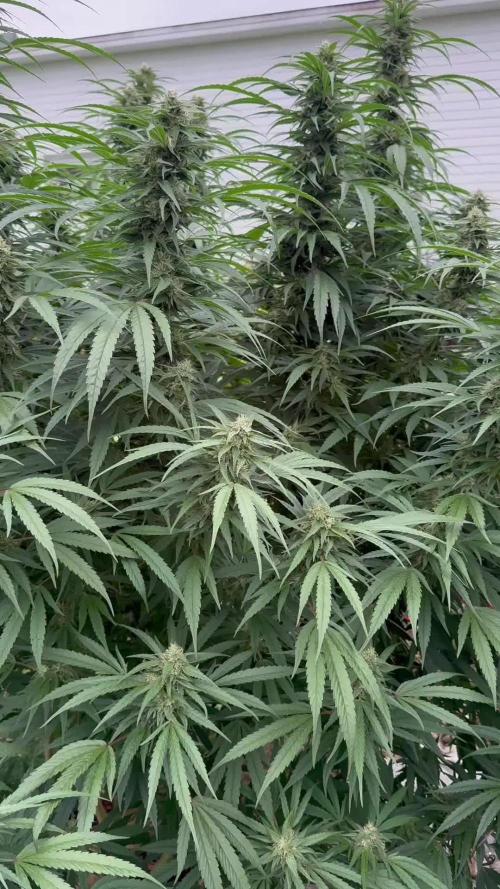
Presque la fin j’essaie de rincer la terre au maximum maintenant je remarque clairement une odeur comme si vous allez dans une verger et qui il y avait beaucoup de pomme écrasée par terre elle porte bien son nom Super fruité , surette avec légère touche crémeuse!