


Likes
Comments
Share

@H0BBYGAERTNER
Follow
#WEEK 14 — HEAVY CUT
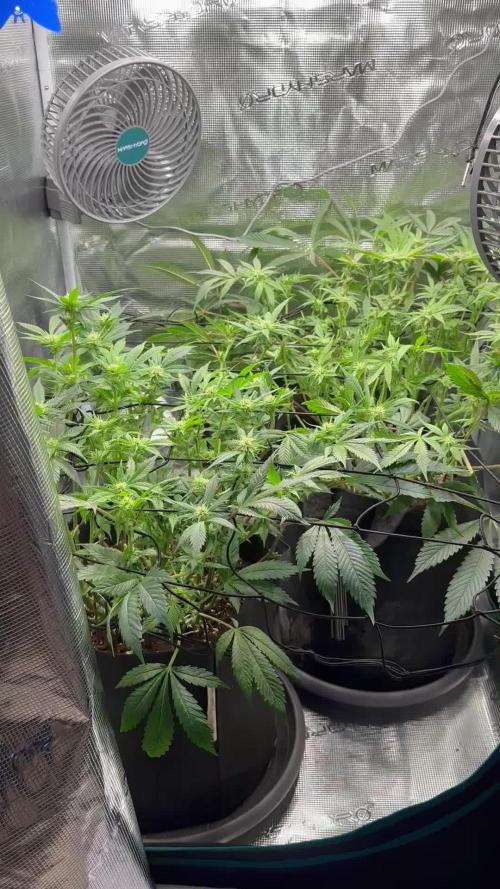
Well, well well. Id recommend a bigger tent for these kind of Experiments, 70x70cm too smallz for even two plants, it seems.
Finally, i hope they reached their almost final height and so i had the courage to ✂️. A Bit Late, i think. I had sticky Fingers after 🙄. And so, so many leaves and light-green/-yellowish, very long shoots - what a waste. I think it took 60-90 minutes for both plant, and do they look rough now. Hope they will recover soon.
Because then, i suppose, i will have a fine sea of sweet colas.
But Finally enough room for airflow, enough exposure to light, and for the view of the massive stems. 😍
Some shoots broke out, canopy is Not very even at the Moment. I guess that will Make it possible to chop these parts first later.
Also looks like Slush Mint Cake is about to purple (bottom side of some leaves). However, temperatures starting to rise outside, so we will see (the saying is cold temperatures trigger the purple colors, no?).
Smell: there‘s something, but still very faint, not very distinct and rather weird / not so tempting (thats how i would put it) at the moment (yet). According to a lot of other diaries Slush will become very massive - fingers crossed.
Make a wish: tents that Open on the backside or both adjacent outer sides as well. Was a slog / grind / drudgery that way.

Likes
7
Share


@Organic473
Follow
This will be her last 4 months in veg. So far she looks promising no complaints.

Likes
4
Share


@420rollweek
Follow
Seeds directly In coco jiffy
Bruce banner seed spend more time then other 2 to get out...

Likes
7
Share


@Stickygreens420
Follow
3/6/2023 - Day 8 Flower: Not a lot to report. The girls are definitely stretching. Grew about 10 inches in the last week. Did a light foliar today with some Pure Protein Dry. Figured with the significant growth they could use a little extra nitrogen. Even with the recent stretch, I've been real pleased with the node spacing. Looking like they are going to stack real nice. They a drinking much faster now too. They will need to be watered again tomorrow, so they are drinking about 8 gallons a week. Other than some very minimal tip yellowing of a few leaves, thay look healthy as can be.
3/7/2023 - Day 9: watered with 4 gallons of 6.5 ph water. Added Jay Plantspeaker Quillaja as a wetting agent, then added Rootwise Enzyme Elixer, and Bio-Phos, BuildASoil Big 6, BuildABloom, Coconut Powder, Fermented Comfrey and Fermented Peach. I skipped the Pure Protein Dry this time, since I just foliar fed them with it yesterday.
3/9/2023 - Day 11: Added the second layer of trellis netting. I may need to lower it, but I want to wait and see how much more they stretch. Otherwise, everything else looks great.
3/10/2023 - Day 12: lowered the trellis net today and lolipopped the girls. Also watered 6 gallons today, mixing in Jay Plantspeaker Quillaja as a wetting agent, then added TeaCo Super Tea Blend, Recharge, Rootwise Enzyme Elixer, BuildASoil Big 6, BuildABloom, Coconut Powder, Yah-Whey Thrive, and Pure Protein Dry. Today was the first sign of some preflower.
3/12/2023 - Day 14 Flower: the plants did not like something about the last watering. The newest growth is having some severe curling and I discoloring. I'm thinking it has to be either the TeaCo or Recharge, but I've never had problems with either of those before. They were the only thing different about my last watering. They will need to be watered again tomorrow, so I plan to ease up on the nutrients, and definitely will not be adding anymore TeaCo or Recharge. Hopefully they can grow out of this and it doesn't get worse!

Likes
7
Share


@uktuk
Follow
Plants are quite taller than I would have liked. I've been busy and haven't been able to train them as I usually would.
Gave them a defoliation and tried supercropping a few of the really tall branches
Sat 24:
Defoliated more and supercropped a few more branches. Moved the net up and tried to tame down the height. hopefully it stops stretching soon i don't have much more vertical space.
Other than that issue the plants are doing great. It looks like no issues with deficiencies or anything, The autopot is doing great.


Likes
18
Share


@Spliffing_Around
Follow
I feed up to 1300 now , try to mix properly at least and water 2-3 times a day. But handwatering half of them became hard. What do you think , I’m good to transplant ? I see the root from some pots already.


Likes
4
Share

@Marihuahnma
Follow
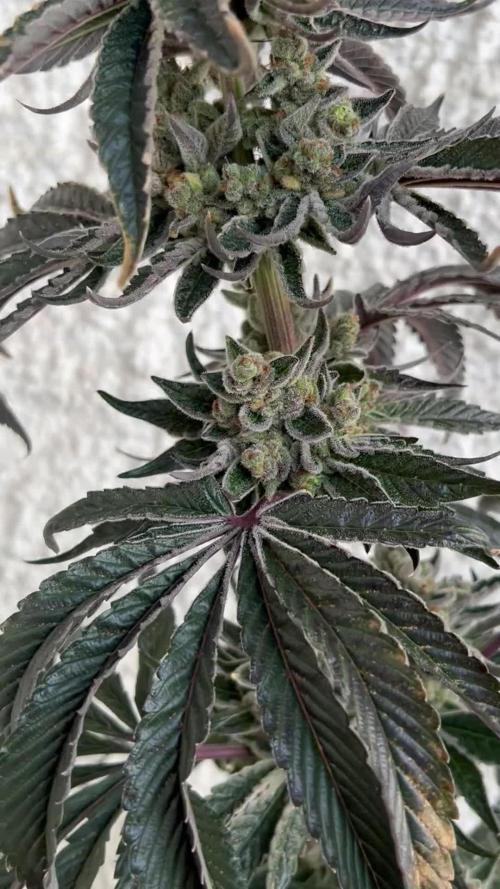
Erfolgreicher Grow/ernte.
Würde die Melonade Runtz jeder Zeit wieder machen.
Einfach zu growender Strain der wunderschön aussieht!
Likes
113
Share


@Skunky
Follow
DAY 2
She's oh so slow to finish. Still more clear and cloudy than amber so i'll need to wait some more... I actually prefer the more amber type of high... I can wait... :)
Maybe I'll need to feed her plain ph'd water one more time but let's see...
Merry X-MAS to ALL! 👻
DAY 5
Wow... that was fast. She kinda turned amber in 2 days. The buds in the middle are now like a bit over-ripe, a lot of amber and the ones outside are just a little under-ripe. I'm done. No more waiting now. I thought about harversting only parts but I'm really done with this one. I'll leave her in the dark for 1 more day and then I'll chop her down. Luckily she's about to dry out completely so the drying process will work just fine... FINALLYYYYYYYYYY!!!!!!!!!!!!! 26 WEEKS MUAHAHA.... Next: back to autoflower... LOL!


Likes
48
Share


@Igrowneil
Follow
SPONSERED BY VIPARSPECTRA AND ZAMNESIA SEEDS .
The week as all seedling wasn't quite special but I did notice alot of girls starting to display pistles very early on , which isn't a bad sign at all just hopfully they achieve a good size 30inch
to 40 inch I would prefer .
Watering I've got under control already with the LEDs .
Temps are a different story they have been a nitemare to keep under control , two heaters full power and the LEDS are only keeping the room about 20oC at best sometimes ...
So gonna buy some insulation and seal the room up some more and hopfully keep some heat trapped inside the room and hopfully the heating bill reduces by some as this run will cost appox 900£ gbp 1200$ appox 1000€ appox
Thoe come this years summer run my temps will be ideal without even using a heater at all which will reduce power to 1kw/h from 2kw/h .
Plants day 14 review
Girl scout cookie's ZAMNESIA
These little women has been displaying the best vigour ans size in the room , hinting towards a big yeilder , there's some nice purpling of the stems and some leaves 🍃 looks like I might have got a purple pheno cookies 🍪 time will certainly tell
Do si dos RQS
These girls are smaller than most in the tent but this looks to be more genicitis than anything as there all displaying a smaller size compared to the other pots and not as much vigour but all in sync showing the gentics are solid but might be just a slow start for these girls
Gorilla glue ZAMNESIA
Hoping the funny gorilla girl pulls through as I was looking forwards to having some glue the other two plants are on par with the GSC and doing quite well in size and also structure is also like the GCS very thick stems for such small plants. I think these @VIPARSPECTRA lights are playing a good part in allowing these girls to use what light is needed for a healthy structure
Runtz ZAMNESIA
Girls are looking like there genicitis has lots of potential for a very vigorous plant , the last runtz I grew was very big plants hoping for the same type of growth . One does appear to acquire some molding on the frist true leaves but seems not to have slowed any growth or reduced vigorous growth so if you spot this I'm not worried , very vigorous strain
Lemon haze - ETS
look like they could be bigger plants hopfully they make for a nice grow and don't get out of control making me think should I top my haze ?
Blueberry Headbang- ETS
This has been the hardest Germination of any seeds and I only got 1 decent seed pop up this one plant I'm taking super good care of as I wanna try Blueberry headbang
Headlight kush - ETS
a few of these have come up in good old fashion no visible problems and look to grow pretty good I think where gonna have a couple of headlights kush . Seem to be solid and all in sync to whatever part of growth there meant to be at .
All plants are doing amazing 👏 they where showing great vigorous growth and some steady growth . Planning on keeping as many girls as possible alothough 16 might be the upper limit if these girls get big as this is the frist time I've used LEDs Im not sure what to expect . The same as hps ? Definitely no the growth from the LEDs is alot better than HPS and I haven't even dailed the temps to stay super steady
Going to introduce my GHE flora line at low dosage to not shock the little girls and not to stun any growth . Will closely monitor for any sign of defenices
Processing
Likes
24
Share


@MadeInGermany
Follow
Hi everyone 🤗.
They continued to develop well this week 👍.
Slowly they stop growing and put their energy into flower production.
So that this energy is not wasted, the lowest shoots on which only popcorn buds grow anyway have been removed.
Next week the new update will follow as usual, stay healthy 🙏🏻 and let it grow 🌱
You can buy this Strain at :
www.Zamnesia.com
Type:
Runtz
☝️🏼
Genetics:
Zkittlez x Gelato
👍
Vega lamp: 2 x Todogrow Led
Quantum Board 100 W
💡
Bloom Lamp : 2 x Todogrow Led
Cxb 3590 COB 3500 K 205 W
💡💡☝️🏼
Soil : Canna Bio
☝️🏼
Nutrients : Canna Bio
☝️🏼🌱
Water: Osmosis water mixed with normal water (24 hours stale that the chlorine evaporates) to 0.2 EC. Add Cal / Mag to 0.4 Ec Ph with Organic Ph - to 6.0 - 6.3
Likes
7
Share


@Purrple_Haze
Follow
Week 2 Bloom (…or is it? 🤔🌱)
Alright, here we are—officially week 2 of bloom, at least that’s the plan!
But I’ve got to admit… I’m starting to wonder if I might’ve accidentally grabbed one of my Red Hot Cookies photoperiod seeds instead of an autoflower. 😅 She’s looking great, growing steadily, but so far, no clear signs of budding, which is a bit strange for this point.
If nothing pops up in the next few days, I’ll move her into the tent with my Red Hot girl and start manual light deprivation—if my work schedule allows. Gotta stay flexible! 💡🌒
🕷️ Spider mites update:
I’ve been on patrol—manually removed quite a few and today, the predatory mites finally arrived! Hoping they clean house and keep things in check. Thanks to regular compost tea and bi-weekly silica foliar sprays, the plants are holding up strong and showing good resilience.
💧 Feeding routine this week:
BioBizz Grow + Bloom + TopMax
Compost tea (as always, brewed with love)
Silica spray twice for that natural armor 🌿🛡️
So even if the timeline feels a little mysterious, she’s thriving and stacking energy for what’s next. Let’s see what this week reveals—auto or photo, she’s growing like a champ. 👀🌞🌸
Stay tuned—this story’s far from over!

Likes
8
Share


@Rko41
Follow
Stretch de 7cm temperature variable 14-28degres le stretch n’est pas fini !! La Flo avance tout doucement je sent que sa va être un monstre 🤞
Likes
14
Share


@DeeColorado
Follow
Great week put them on bloom food at around 40% strength, calmag at 25% strength and pk boost at 50% they had 1 feeding of formula at 1litre per plant the bud sights are exposed too light after the defoiliation at around day 29 plant was fed just water with the transition too bloom feed at Day 34 lights are at full spectrum so red light has been introduced at Day 29 . All plants are a nice size 1 still slacking but catching up hear we go full on flower mode :)oh PH in range 6.2-6.5 threw out the
5weeKs grow.
Likes
12
Share


@Zer0xKira
Follow
Growing well . It is slightly bigger than the cinderella jack I am growing in soil in the same tent. It's definitley growing faster. I am seeing a calcium deficiency that I missed earlier on . I ordered some cal mag . I am expecting a full recovery. Also I had to add a bit of great white mycorhizzae to the mix because I was seeing alot of brown spots on my roots. It is starting to clear up. I also bought a better air stone to increase oxygen levels
Likes
88
Share


@NAS_Garden
Follow
🌸🌿 Week 3: Blooms Unleashed! 😁
The stretch has gracefully come to an end, and now, the buds are making their grand entrance! 😁 Standing tall, our Lemon Orange proves to be a formidable presence, prompting the need for some strategic topping and ScrOG to keep its height in check.
Growth Management:
Given its impressive stature, a little intervention with topping and ScrOG is in order to ensure the plant stays within bounds. It's all about orchestrating the dance of growth.
Aromas in Bloom:
As the buds unfurl, so do the enchanting aromas. A symphony of citrus notes fills the air, signaling the flourishing flower stage. The pace is exhilarating, promising a delightful harvest in the making.
Nutrient Nurturing:
In the spirit of balance, I've opted for a mindful approach, utilizing only 80% of the recommended nutrients by Terra Aquatica. It's a careful dance to provide just what our Lemon Oranges needs for optimal growth and flavor development.
The stage is set, and our Lemon Orange beauties are gearing up for a floral spectacle. With each passing week, the anticipation for the harvest grows, and the journey unfolds in a crescendo of green and citrusy bliss! 🌼🍊🌿
Likes
4
Share


@Sadom
Follow
15.08.: Die zweite Blütewoche hat begonnen und beide Pflanzen haben sich seit der Umstellung gut entwickelt. Da ich vermute, dass die G41 noch weiter wachsen wird, habe ich ein zweites Netz zur späteren Stabilisierung installiert. Das zweite Netz hängt jetzt auf einer Höhe von 1,30m, sodass die oberen Spitzen der G41 bereits durchgucken. Damit die Pflanzen ihre Energie auf die wichtigen Bereiche konzentriert, habe ich bei beiden Pflanzen ein Lollipopping durchgeführt. Dabei hab ich alle Blätter, Seitentriebe und Blütenansätze unterhalb des ersten Netzes entfernt. Diese Blütenansätze liegen so weit unten, dass hier kaum Licht ankommt und sie am Ende stark unterentwickelt sein werden. Idealerweise hätte ich damit noch ein wenig gewartet, aber da ich die kommenden 9 Tage im Urlaub bin wollte ich es vorher noch erledigt haben, das gleiche gilt für das Netz. Updates werden in der Zeit auch eher schwierig, aber vielleicht bekomme ich ein paar Fotos zugeschickt.
18.08.: Ich habe Fotos zugeschickt bekommen. Anscheinend steckt die G41 immer noch in ihrer Stretchphase, da sie das 2. Netz auch schon ein gutes Stück überwachsen hat.
20.08.: Heute kamen nochmal ein kleines Video und ein Foto von der G41. Der Wachstum wird langsam weniger und man sieht, dass sich der Stretch dem Ende neigt. Am Ende der 2. Blütewoche hat die G41 die PBB in Sachen Höhe komplett abgehängt. So wie ich vermutet hab, war der Stretch von der PBB nicht mehr allzu dolle, sodass sie wesentlich kleiner als die G41 geblieben ist. Das ist eins der Probleme, wenn man kein Monocrop anbaut. Außerdem ist der Wasserbedarf der Pflanzen gesunken, sodass die Bewässerung aktuell 10min läuft, wenn das Licht angeht. Nächste Woche bin ich wieder zuhause, dann überlege ich mir, wie ich das Problem löse, entweder mit einer Zusatzbeleuchtung, einem 3. Netz mit dem ich die G41 noch etwas runterbiege oder beides. Da mein Mitbewohner heute vor Beginn von Blütewoche 3 ebenfalls wegfährt, hat er mir gestern noch die aktuellen Daten der Pflanzen zugeschickt. Daher passt es nicht ganz mit dem Diary, ich denke aber, dass es der beste Kompromiss ist.


Likes
19
Share


@CanabisLoverHobbyGrower
Follow
Explosive growth this last week,.. especially gorilla cookies but all really,.. looking healthy,... roll on next week 👌
Likes
2
Share


Likes
20
Share


@ukterpdoc
Follow
Hi friends I've jumped forward to the week of harvest.
The next week will show you some dried trimmed beautiful flowers 😀
