


Likes
Comments
Share

@Daddy_farmer
Follow
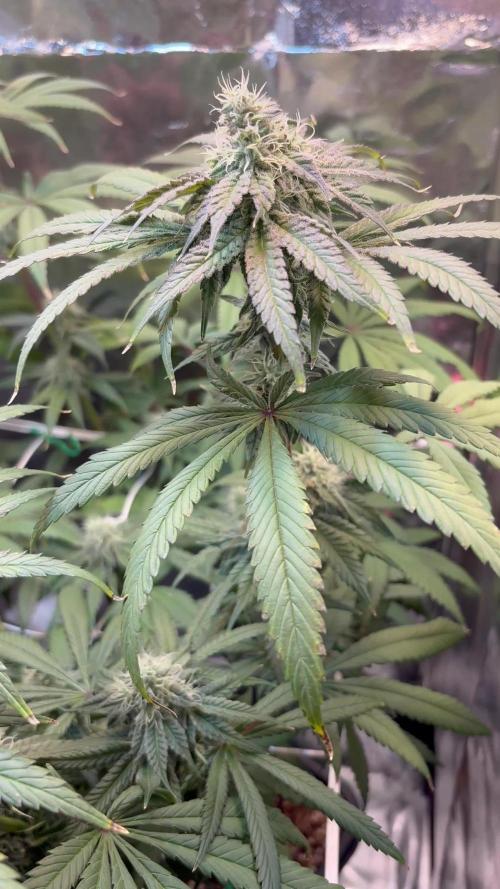
5 week, day 4 on bloom mode. Been a while since I had to disappear for a while. Last couple of days was totally desert down there, but nothing happened visually.
Now water in tray is filling properly. Tomorrow bactrex with a bit of orgatrex are planned for breakfast.


Likes
27
Share


@420DeepGrow
Follow
Gracias al equipo de Zamnesia Marshydro XpertNutrients y Trolmaster sin ellos esto no sería posible.
💐🍜 Cosmic Noodles:
Orgullosa descendiente de Alien OG y Rollercoaster Haze, la Cosmic Noodles ofrece cosechas excelentes y una experiencia de fumar fragante. Esta variedad es muy potente, tiene un 25% de THC y produce efectos intensos y duraderos. Edificante y relajante, fumar Cosmic Noodles catalizará un colocón cerebral energizante que luego disminuirá hasta convertirse en un relajante colocón corporal.
Aquí se pueden detectar las influencias de ambas cepas parentales y las flores son notablemente cítricas, con la lima en primer plano. También disfrutarás de notas especiadas y terrosas con delicados matices florales.
🌻🚀 Consigue aqui tus semillas:
https://www.zamnesia.com/10777-zamnesia-seeds-cosmic-noodles.html
Código Descuento 20%: ZAMMIGD2023
💡TS-3000 + TS-1000: se usaran dos de las lámparas de la serie TS de Marshydro, para cubrir todas las necesidades de las plantas durante el ciclo de cultivo, uso las dos lámparas en floracion para llegar a toda la carpa de 1.50 x 1.50 x 1.80.
https://marshydro.eu/products/mars-hydro-ts-3000-led-grow-light/
🏠 : Marshydro 1.50 x 1.50 x 1.80, carpa 100% estanca con ventanas laterales para llegar a todos los lugares durante el grow
https://marshydro.eu/products/diy-150x150x200cm-grow-tent-kit
🌬️💨 Marshydro 6inch + filtro carbon para evitar olores indeseables.
https://marshydro.eu/products/ifresh-smart-6inch-filter-kits/
💻 Trolmaster Tent-X TCS-1 como controlador de luz, optimiza tu cultivo con la última tecnología del mercado, desde donde puedes controlar todos los parametros.
https://www.trolmaster.com/Products/Details/TCS-1
📆 Semana 2:
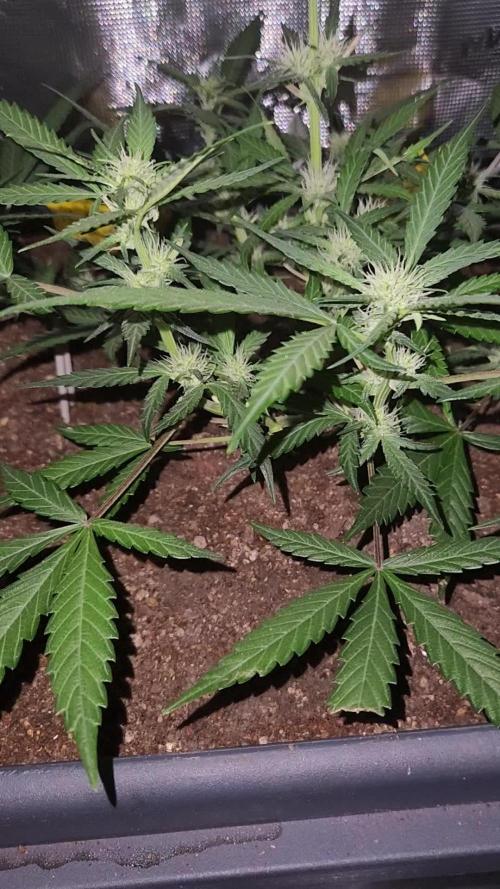
Fantástica semana, estan creciendo de una forma espectacular gracias a la ayuda de @marshydro, @xpertnutrients y @trolmaster.
Se puede apreciar un tercer nudo aunque la aplicación de cola de caballo y el estar en una maceta pequeña ha influido en el tamaño de ella, se recupera muy rápido 😁.
Esta semana espero trasplantar a la maceta definitiva.
Potencia de la lámpara: 50%


Likes
11
Share


@Rob691
Follow
Today, after 78 days for the lemon kix auto and the Young Pinapple Express, and after 145 days for the old rescued Pinapple Express, I turned off the light. 48h blackout for the 3 girls. Harvest on saturday.
Likes
8
Share


@Rich2083
Follow
Fade has fully set in now, just keeping an eye on the trichromes for harvest time. Plants are nice and frosty and smells very sweet. Was getting worried about harvest time and drying / curing as I go away for 2 weeks November 6th. Invested in some Grove bags for the cure so this has reduced my anxiety about leaving my harvest for so long during the beginning of cure. Heard good things about them, interested in your opinion drop a comment.

Likes
11
Share


@Cockneycultivar
Follow
This week she has grown so tall. I am so regretful for not scrog’in her or done any low stress training.
Although I do have a nice size tent with the grow light on adjustable rope so it’s not that much of a problem.
Although when I flip her to 12/12 into flower I know she’s gonna stretch even more.
The size of her leafs are impressive.
I read that your not meant to use biobizz grow and fish mix at the same time but I went against it and she’s showing no signs of stress or nutrition problems.
I even have an 11 fingered leaf now!!
She is beginning to smell very nice too, so all good so far. Can’t wait till she packs on some bud now.

Likes
20
Share


@Mazgoth
Follow
With the water I was going from 50/100ml slow to the 400/500,so I'm changing time to time my water until they are big enough and then I only feed 1/1,5L water,That's how it goes every time I'm growing the water cycle





Likes
20
Share

@tsf_homegrow
Follow
🇩🇪
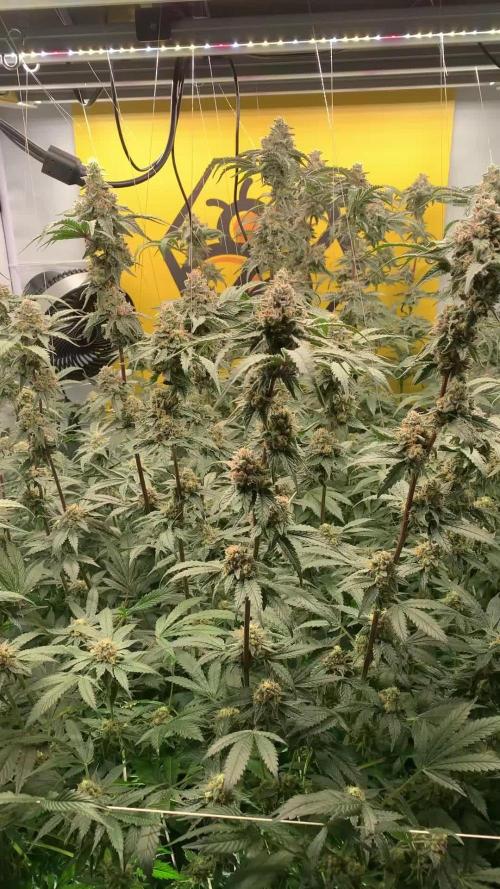
22.2. Tank war leer also neu aufgefüllt wir haben beginnen mit Fade und dem spülen der ladies.
18.2. die Endphase läuft, Blüte Dünger weiter reduziert und nochmal PK erhöht.
🇬🇧
2.22. The tank was empty, so we refilled it and started with the fade and flush the Ladys.
2.18. the final phase is underway, flowering fertilizer further reduced and PK increased again.
Likes
11
Share


@PanGrower
Follow
The bush has been moving for 2 weeks now and I have no opportunity to take detailed photos. The grow report is being supplemented after 3 months.
Likes
2
Share


@KyGrow42
Follow
I tied her down had to be real careful cause the stalk is so thick it’s crazy you cant really see much in the photos cause she’s so bushy she loves the nutrients been watering about every 3 days getting real close to flowering I think until next time happy growing
Likes
12
Share


Likes
24
Share


@AsNoriu
Follow
Day 86. Almost no sugar leaves, most of trim went to bin, part left for bubble hash. Kind off hoped a bit more from this strain, maybe smoke will bright me up ;)
Day 96. 77 g. went for curing. Smallest from all.
Two month later. Made some bubble hash. Great strain, waiting for sunny day and will make smoke review. Not a lot of bubble, but it was great !
Happy Growing !

Processing
Likes
Comments
Share


Likes
37
Share


@RFarm21
Follow
Boas growmies! Esta semana apareceram mais folhas amarelas mas penso que seja normal, penso eu, visto que já estão caminho da 10ª semana.
O cheiro delas é fantástico!
17 Agosto - O gráfico representa a nutrição misturada em 2,5L de água da Royal Gorilla 1. EC = 1,55; pH 6,4
17 Agosto - Alimentaçao da Royal Cheese (2L): CE = 1,5mS; pH 6,3
-BioGrow - 3ml; BioBloom - 4ml; TopMax - 2ml; BioHeaven - 5ml; Activera - 5ml; Calmag - 1ml
17 Agosto - Alimentação Royal Gorilla2 e royal cheese 2 = Só água . ph 6.3)
-----------------------------------------------------------------------------------------------------------------------------------------------------------
21/08 - Alimentação Royal Gorilla #1 (2,5L): CE = 1,64; pH = 6,3
-BioGrow - 4ml; BioBloom - 6ml; TopMax - 2,5ml; BioHeaven - 7ml; Activera - 6ml; Calmag - 1,5ml
21/08 - Alimentação Royal Gorilla #2 (2,5L): CE = 1,33; pH = 6,1
-BioGrow - 3ml; BioBloom - 5,5ml; TopMax - 2ml; BioHeaven - 5ml; Activera - 5ml; Calmag - 1,5ml
21/08 - Alimentação Royal Cheese #1 (2L): CE = 1,36; pH = 6,1
-BioGrow - 3ml; BioBloom - 5ml; TopMax - 2ml; BioHeaven - 6ml; Activera - 5ml; Calmag - 1ml
21/08 - Alimentação Royal Cheese #2 (2L) - EC = 1,38; pH = 6,3
-BioGrow - 3ml; BioBloom - 4ml; TopMax - 2ml; BioHeaven - 5ml; Activera - 5ml; Calmag - 1ml

Likes
2
Share


@Ultraviolet_
Follow
"You will know them by their fruits"
46-47 days from germination, she fills the canopy herself, and the apical dominance is broken.
It's not all about the amount of light, but the ratio too, as this will dictate growth through the ratio of phytohormones. In order for correct bud development, there needs to be a correct ratio of RGB. Different wavelengths have different penetration depths. When one grows using top-down lighting, only the entire canopy is limited to 2-3 layers of leaf, meaning there will only be correct bud development in those layers, regardless of getting 45DLI.
The biomass potential of a plant is linked to root mass. Generally, when a plant reaches its maximum biomass, you can help to chop off parts of the plant that are in less than efficient areas of the plant (low light). So that it can create new biomass growing towards the light.
Strength is the maximum potential, and power is the rate of conversion. You can have the biggest veg period of 18 weeks, and it means nothing, as soon as you start flower, the chronological clock starts ticking, the only metric that matters to bud size is how much energy you convert each cycle, not by how long it took you to build the framework.
Each leaf is like a satellite receiver attached to an antenna called a stem; each leaf removed lowers the energetic potential of conversion.
Not saying you cannot defoliate for a reason, only that you should have one, and at the right time. Don't defoliate 30+% on autoflowers or 4 weeks into the flower period and expect an increase in yields; it doesn't work like that. There is certainly room for dictating growth patterns and clearing out overcrowded nodes, but it needs to be done in veg because once that timer starts and buds start growing, it's all just energy conversion. Most grows I barely defoliate at all in a 4x4 because with side lighting, turning a 2d canopy penetration into a 3d, even lower buds are 90% the quality and density of top ones. The rate of photosynthesis and the ultimate density of lower buds aren't just about the sheer number of photons PPFD. The specific ratio of R:G:B dictates canopy penetration and drives different photochemical reactions. The Electron Transport Rate (ETR) measures the speed at which electrons are driven through Photosystem II (PSII) during photosynthesis. The ratio of Red, Green, and Blue (RGB) light heavily dictates this rate.
Plant leaves continuously perform cellular respiration regardless of the time of day, using energy and oxygen to fuel essential metabolic maintenance. If you over-defoliate, the remaining canopy may be unable to produce enough net sugars during the day to offset the constant respiratory demands of the plant. Must balance fixation with assimilation; there's no point in capturing 45 DLI if you only convert 20% every cycle due to an extreme lack of respiratory capacity to perform cellular oxidative phosphorylation.
A crinkle-cut French fry has more surface area. When it cooks, it has a higher capacity for energy transfer/conversion, which is what makes it slightly crispier than a regular straight-cut French fry when it comes out of the oven.
You can have a 4x4 canopy or a 4x4x4 canopy. Oversimplified, but you get the idea, yes, we know that side lights are not as effective at absorption from the sides or underneath, but it's not about DLI, it's never been just about efficiency, it's about the penetration ratios of RGB that drive ETR of/photosynthesis and trigger correct bud development. The size of each bud is its own ability to perform the ETR required for its own personal growth, and bud development is dictated by the ratio of RGB. It drives localized growth and acts as a regulatory switch for that development. Turgor pressure is another very important factor in understanding if you want big buds, for it is the "steam engine" that dictates the rate of bud expansion. Simply, never going to happen playing it safe metabolically at ambient 75F.
Because buds have less chlorophyll, they do not suffer from the same photosynthetic shutdown that over-exposed, light-stressed leaves do. They can soak up direct light energy to swell in density and size. Their tolerance to intense light is heavily limited by the temperature and humidity, but if you can control those temps and keep the rot away, buds have a much, much higher tolerance to high light than leaves. Beneficial to hammer with high light before trichomes appear. Balancing this with trichome maturity is key for rich terpene and flavonoid profiles, want it just right, somewhere in the middle, not too much, not too little. Find cannabis plants can defoliate themselves come harvest, given the right signals. Every last ounce of potential is recycled into buds by the plant itself (senseceance), given you can keep the level of conversion high enough to prompt a need to do so.
Get the canopy @ optimal PPFD range, 45-55DLI, then let the plant "stretch" the stems into a "PPFD range much higher, one that leaves don't like to grow in, but buds thrive in. What is optimal for a bud is different than what is optimal for a leaf photosynthetically. Genes provide the blueprint, but the environment dictates how, when, and if those genes are expressed. Must first signal the condition to increase the expression you want to exist through stress and response, cause and effect. A well-buffered CEC medium prevents extreme nutrient swings, allowing plants to maximize their dedicated genetic expression.
A plant is either genetically expressing "growing" or "recycling" genes based on its nutrient starvation level in the medium. Constantly toggling between "growing" and "recycling" hormonal states creates a futile cycle that wastes valuable metabolic energy. Plants rely on sophisticated biochemical switches to manage this trade-off, and prevent rapid fluctuations that disrupt that balance.
This energy inefficiency is a recognized biological challenge. Plants avoid this costly "flip-flopping" by using hierarchical master regulators (like the TOR and SnRK1 protein kinases) that act as strict molecular switches. These networks enforce cellular commitment to either growth or survival, preventing mixed signals.
This is something that was missing from previous grows.
Under nutrient-rich conditions, TOR promotes protein synthesis, cell division, and structural expansion.
Under starvation, TOR is inhibited and SnRK1 is activated. This triggers autophagy—where the plant breaks down old macromolecules and organelles to scavenge and reallocate essential nutrients to critical sinks.
"What's the point in flushing?"
The core idea behind a PK booster is to deliver a massive, concentrated surge of P&K exactly when buds are swelling in conjunction with a N starvation. Because these are short, targeted windows, the nutrients must be highly bioavailable so the plant can process them immediately. As soon as you go "organic," that's out the window. Much slower release, uncontrolled, very difficult to "spike". to cause the ratio that will initiate a response.
High-volume PK spikes rely strictly on the immediate uptake capabilities of mineral fertilisers. Making it far less efficient in organic/living soil setups.
When you use organic nutrients, it changes the dynamic with which the plant delivers and trades its nutrients; organic is always releasing new nutrients into the immediate EC. This prevents a lot of autophagic responses from occurring due to a constant stream of new nutrients into the immediate medium's EC. This can prevent nutrient starvation signalling.
PK boost is essentially just N starvation, triggering an autophagic response. Concentrated ratio of P&K while tapering off the Nitrogen base. To the plant, the sudden drop in Nitrogen registers as a severe environmental stressor—essentially, the beginning of starvation protocols. She aggressively strips nutrients and proteins from older leaves and vegetative structures and shuttles them directly to the developing flowers and fruit. Ta daaa. Call it a PK booster and sell it. Nothing to do with the P and K itself, it's the ratio immediately available in the medium triggering a nutrient recycling mechanism within the plant itself; all the "booster" sells is the trigger to the signal.
Very difficult to initiate a response when organic nutes are doing their thing. It takes 4x5x more water significantly to leach or wash ammonia out than it does nitrates. This alone will prevent flushing from having its normal impact.
I'll be manipulating the C:N ratio in the medium instead. One autophagic response has multiple potential signal triggers. Nutrient starvation is not an option. Well, it is, just it's going to be manipulated Nitrogen starvation through Excess Carbon, instead of starving the medium entirely(EC).

Likes
12
Share


@Elemental
Follow
======NOV 4 | DAY 22======
She is a bit different of predominat sativas, leaves are bigger.
Today I increase some humus and some peat.
======NOV 5 | DAY 23======
LST her today
======NOV 8 | DAY 26======
2 more LST HOOKS
======NOV 10 | DAY 28======
I hid some leaves below the main branches
