


Likes
Comments
Share

@Thebeardserkers
Follow
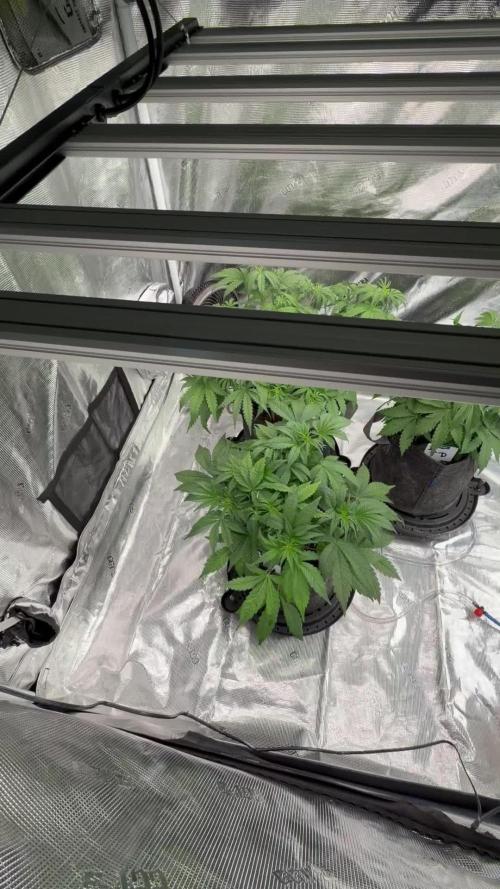
Nous entrons dans la semaine 5 avec une run qui se déroule très bien dans l’ensemble. La tente 4x8 Gorilla abrite 7 plantes en 100% coco sous deux lampes 500w, dont l’AC Infinity IronForge IF500 comme lumière principale, avec un système AutoPot 4 pots AQUAValve 5.0 actif depuis le jour 17, complété par 3 plantes en bases AC Infinity arrosées manuellement via la valve de saignée du réseau.
La Gorilla Cookies est la première à entrer en floraison confirmée dès la fin de la semaine 4, avec des pistils blancs bien visibles sur plusieurs sites. Les Toof Decay devraient suivre dans les prochains jours. Les Mephisto’s Wedding et Hubbabubbasmelloscope sont encore en vég avancée mais la transition est imminente.
On a noté des carences légères en calcium et magnésium sur le Hubbabubbasmelloscope et la Gorilla Cookies, corrigées par des applications manuelles de Cal/Mag directement sur les pots et par une hausse de la dose dans le réservoir à 2 ml/L. Le réservoir tourne actuellement à 545 ppm avec Bud Ignitor, Voodoo Juice, Grow/Micro/Bloom en ratio 1:1:1 et Cal/Mag renforcé.
L’environnement est stable et performant : température 24-25°C, RH 62-64%, VPD 1.17-1.21 kPa, score 100/100 en continu. La consommation du réservoir a atteint 10L par 24h, signe que les racines sont bien établies et que la demande hydrique monte avec la floraison qui s’amorce.
Objectif semaine 5 : surveiller la transition florale des autres génétiques, maintenir le Cal/Mag, et préparer la bascule de la recette vers floraison dès que 3-4 plantes seront en fleurs.


Likes
8
Share


@Fa5Venom
Follow
End of 4th week soil had dry out so wasn’t taking any waters? Plants droopy like crazy had to soak them in the sink to get soil wet. Good after that gave them a little nutrients since it’s day 37 and they are doing really good. Took some leaves of that were blocking bud sites and little lst to stretch this branchesw




Likes
33
Share


@Viridios
Follow
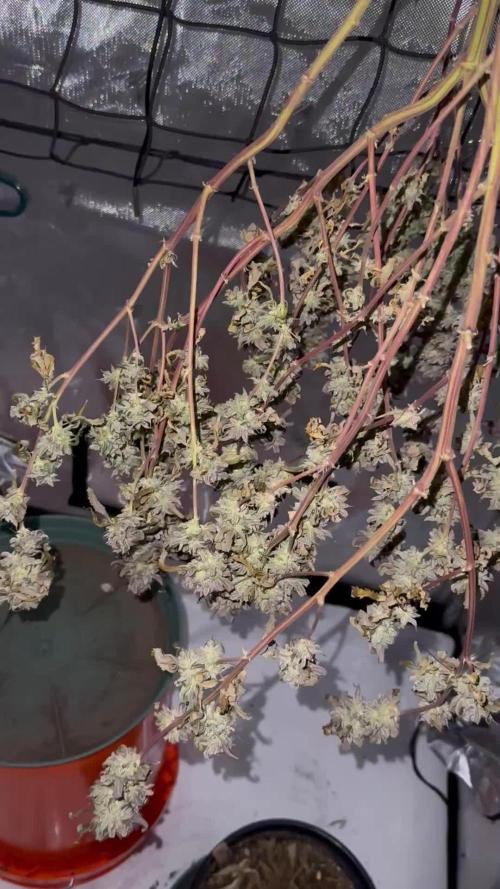
Very excited..plants are looking super healthy, streatching nicely. These genetics are sutch a pleasure to grow. The next couple weeks are gona be epic..😁😁.



Likes
102
Share


@Zurban_Poison
Follow
Hi people!
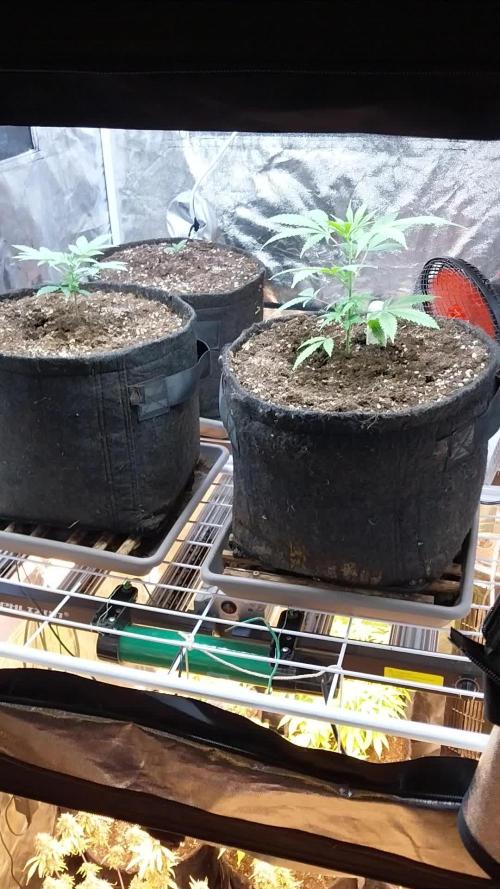
Well, after the last LST, she certainly didn’t pinpoint her final shape ..
she almost covers 1 square meter .. there are very, very, very many buds!
the smell of vanilla baking) is very pleasant and sweet! trichomes slowly begin to shower buds))
maybe it seems to me! but according to my observations the products of Barney Farm always give the highest result!
both during growth and during flowering! at all stages! and most importantly, the resulting buds always blow away the head of any inveterate smoker !!!
Barney You are the coolest !!!
Processing
Likes
13
Share


@Cheesefarmer420
Follow
This plant has a solid stench of pure ripe lemons. So much aroma and color in every bud, purples, to dark green, to lime green, to solid frost. This one definitely a fun strain to watch grow and tend too for the last few months. She’s definitely a hungry girl, seemed to be the only strain out of the three that accepted and thrived with full feed nutrients. Would definitely recommend this Strain to someone For a nice uplifting day smoke, also seems to do me good for some pain and stress relief.
Likes
2
Share


@Dsant
Follow
D33 - 19/02
Haven’t changed the reservoir this week yet.
A few burnt tips on Northern Lights #2, will probably go a little lighter on nutes next feed - she’s definitely more sensitive to them than the other ones.
Overall great looking girls and nice growth.
The #2’s are higher than the #1’s, nodes developing nicely and the scrog is definitely helping with lateral growth as well.
—
D35
Mixed a new reservoir with roughly 19L, at around 70% strength.
pH 6.0 and EC 1.1
Humidity has risen a bit, so I installed the dehumidifier again.
Apparently the tip burning has stopped, or at least slowed, which is good.
#1’s are at around 25cm height, while #2’s are around 40cm height.
—
D36
Did another defoliation session as the girls really needed it. Cleaned a lot of the big fan leaves, airflow and light penetration is way better now.
A few hours after and they’re super happy again.

Likes
10
Share


@Dendegrow
Follow
Blue Sunset Sherbert – Week 5 of Flowering
The Blue Sunset Sherbert ladies are thriving! 🌿✨ Now at 4 weeks of flowering, they are developing beautifully. I noticed a slight nutrient deficiency in one of the plants, so I added a bit of Greenhouse Feeding Booster to balance things out. It seems to have worked well, and everything looks back on track.
From now on, I’ll cut back on chemical boosters and switch to a more natural approach. Starting tomorrow, I'll be using my homemade calcium booster made from eggshells and vinegar to keep everything in balance. 🌱🔬
Exciting times ahead—stay tuned and don’t forget to follow for more updates! 😎
---
Blue Sunset Sherbert – Blüte Woche 5
Die Blue Sunset Sherbert-Ladies machen sich prächtig! 🌿✨ Jetzt, nach 4 Wochen Blüte, entwickeln sie sich wunderschön. Ich habe einen leichten Nährstoffmangel bei einer Pflanze bemerkt, also gab es ein wenig Greenhouse Feeding Booster, um das auszugleichen. Das scheint gut funktioniert zu haben, alles sieht wieder top aus.
Ab jetzt werde ich die chemischen Booster zurückfahren und auf eine natürlichere Methode setzen. Ab morgen kommt mein selbstgemachter Calcium-Booster aus Eierschalen und Essig zum Einsatz, um das Ganze weiter zu stabilisieren. 🌱🔬
Spannende Zeiten stehen bevor—bleibt dran und vergesst nicht zu folgen für mehr Updates! 😎
Likes
92
Share


@DogDoctorOfficial
Follow
Harvest Notes ✂️
• Harvest Timing: Papaya Zoap was harvested at day 63, with select buds taken earlier at day 56 due to mold concerns.
• Drying: After careful trimming, the buds were dried for 12 days. The quality and aroma during drying hinted at the stellar smoke to come.
• Density & Yield: Buds were rock-solid, delivering an excellent yield with perfect density for storage and enjoyment.
Terpene Profile & Aromas 🍋
• Primary Aromas: A tropical explosion with sweet papaya upfront, complemented by creamy, soapy undertones that make her truly unique.
• Complexity: As the buds cure, a hint of citrus zest and exotic fruit emerges, creating a full-bodied terpene profile that’s simply irresistible.
Cultivation Experience 💡
• Highlights: Her uniform growth, heavy trichome production, and response to super cropping made her a delight to grow. She thrived under careful spectrum adjustments and defoliation, showcasing her adaptability and vigor.
• Challenges: The dense bud structure made her more prone to mold, especially in a high-humidity environment. However, proactive monitoring and swift action mitigated the spread.
Verdict: 🌟🌟🌟🌟🌟🌟🌟🌟🌟🌟 (9.8/10)
Papaya Zoap is a strain that commands attention with her beauty, aroma, and unstoppable growth. While her susceptibility to mold required extra care, her overall performance, yield, and quality were nothing short of exceptional. A grower’s dream and a frosty masterpiece!
Stay tuned for their individual harvest reports, smoke reviews, and more as we wrap up this epic series!
Discount Codes so you can save big on your next check out 💚💚💚
Kannabia - DOGDOCTOR 30% off
SeedsmanSeeds - DOGDOCTOR 10% off
CannaKan- DOGDOCTOR 15% off
terpyz.eu - DOCTOR 15% off
The Neutralizer - PORKIT5-DOG 15% off
Fast Buds - DOGDOCT 15% off
As always thank you all for stopping by, for the love and for it all , this journey of mine wold just not be the same without you guys, the love and support is very much appreciated and i fell honored and so joyful with you all in my life 🙏
With true love comes happiness 💚🙏 Always believe in your self and always do things expecting nothing and with an open heart , be a giver and the universe will give back to you in ways you could not even imagine so 💚
Friendly reminder all you see here is pure research and for educational purposes only
Growers Love to you all 💚💚💚


Likes
4
Share


@sunnykuyall
Follow
04 - 07 May 2023 - Germination Week
08 - 14 May 2023 - Veg week 1
15 - 21 May 2023 - Veg week 2
22 - 28 May 2023 - Veg week 3
29 - 04 June 2023 - Veg week 4
05 - 11 June 2023 - Veg week 5
12 - 18 June 2023 - Flower weel 1


Processing
Likes
11
Share


Likes
4
Share


@Ieiogrow94
Follow
Eccoci qui...
Tutto va per il meglio, questa settimana ho eseguito Lollipopping e Defoliation per far si che le cime principali sprigionino al meglio il loro vigore.
Siamo verso la fine del progetto ora bisogna solo aspettare la fine...
Grazie a tutti per il supporto🔥🌲❤️

Likes
82
Share


@BigBadLion
Follow
Hey guys!
Sorry for the big delay since my previous grow! Right now I'm growing some babies from Royal Queen Seeds! Kali Dog! 😃
The first week was calm! The babies broke out from their shells rather fast and two babies grew out of their jiffy pods rather fast! Also, since the strain is Kali Dog I decided to name each of the plants with a different dog name! I'm still unsure about the names but the first two are called Roko and Max!
For the first time I also noticed the first buds looked... different? You'll be able to see them in the photos tho... and once again two of my babies are suffering from helmet head 😰 But eh, I'm used to it. Gladly it's an easy error to fix.
I'll try to make a longer timelapse (these were bad!) but I didn't know my camera battery wasn't enough for long sessions 😝
Anyway, thanks for reading! See you all next week! 👋
Likes
2
Share


@GrowPassionItalyChris
Follow
Sono nate tutte e già sono pronte per crescere in maniera abbondante. Dopo una settimana già sono dieci centimetri alte e tranquillamente si stanno adattando al caldo estivo italiano. È stata una germinazione perfetta e sono felice di avere scelto queste magnifiche banche dei semi mondiali. I cloni invece hanno preso bene e sono già posizionati a terra all'aperto e posizionati in penombra. Alcuni cloni non c'è l'hanno fatta ma più di nove cloni sono in perfetta salute e hanno iniziato a radicare. La pianta madre dei cloni è una Orange Bud raccolta indoor in gennaio e poi trasferita in outdoor per farla rigenerare e ad inizio aprile ha iniziato una seconda fase vegetativa abbastanza mostruosa perché sta formando centinaia di diramazioni biforcute e sta prendendo la classifica forma di cespuglio grezzo. Ne vedremo delle belle con queste varietà coltivate biologicamente. Un abbraccio a tutti.

Likes
2
Share


@Almo420
Follow
Really stoked with the outcome of this grow, I was aiming for a good 60g, so i outdid myself some bit.
On to the next one!
Likes
10
Share


@L_Choppa
Follow
Topped from the top node gone to the let the pot dry out a bit been over doing it with the water I have to do some pest control I have it under control just a few nats