




Likes
1
Share


@JoExotic
Follow
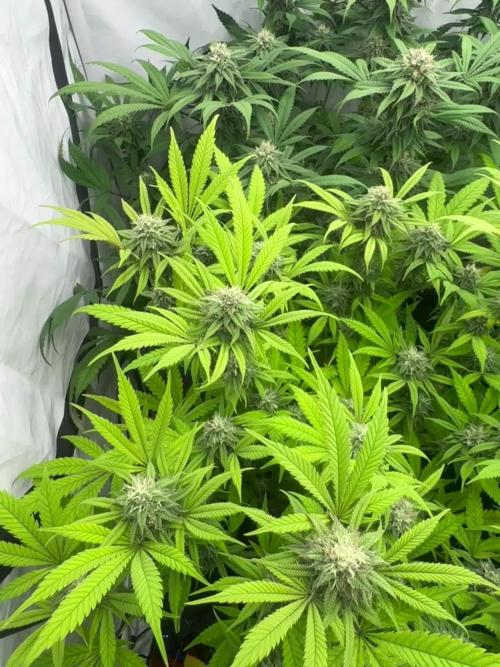
Week 5 I’m extremely impressed these should turn out amazing as expected ! Only using Calmag and Tiger bloom


Likes
2
Share


@LittleBigTrees
Follow
Feeding max recomended strength H&G soil A&B and they are loving it. Buds are swelling now and trichomes are more visable .
This plant is growing fast .

Likes
29
Share


@Gilgamesh15
Follow
-Godetevi il video della presentazione del locale di coltivazione!!!!
-Problema calo PH in stabilizzazione.
-Continua problema di ingiallimento foglie a ventaglio!?!
-Mainlining e manifold in crescita.
-Il controller CO2 Evolution della Etechnics funziona male (fa svuotare la bombola).

Likes
4
Share


@Soskar69
Follow
Nothing much to say. She'd reasy! She has a fantastic aroma and some beautiful colas. The leaves are becoming purple so in few days I will harvest her. I'm very excited because I think she is the most beautiful of the all plants I have.


Likes
10
Share


@KcKush
Follow
*Soil PH looks like it increased from 6.1 to 6.3 or maybe it’s the feeding will check the following day.
*Nothing crazy happening yet.
*increased PPM To 450

Likes
22
Share


@eldruida_lamota
Follow
Que hay fumetillas, que ya estoy de nuevo por aquí actualizando otra vez estas critical a granel. Que nunca fallan enserio.
Variedad indica con floración rapida que ya es muy conocida en este sector. Quien no fumo Critical?
Pues ya vamos entrando en sus últimas semanas del proceso, y vemos lo bien que andan tricomando, pronto volveré a disfrutar entre humos con esta gran variedad.
.
La humedad esta al 45% la temperatura está entre 21/27 grados , y como siempre el ph , ya que es de lo más importante,está en 5,8/6,0.
.
AgroBeta:
1 ml x L Flowering black line , vía radicular.
0,2 ml x L Beta shark, vía radicular.
0.5 gr x L mega PK , vía radicular.
0,8 ml x L Terminator, vía radicular.
0,5 gr x L Engordacogollos, vía radicular.
0,3 ml x L Tucán , vía radicular.
0,1 ml x L Betazyme, vía radicular.
0,3 ml x L Tricoma, vía radicular.
0,05 ml x L Gold Joker, vía radicular.
0,2 ml x L Silver, vía radicular.
.
Hasta aquí todo familia 🕸️ , un saludo y buenos humos fumetillas💨💨💨.



Likes
2
Share


@R_atata
Follow
Beleuchtung auf 80% gestellt. Die Pflanzen kriegen ab jetzt 13 Stunden Licht. Die Dos Si Dos entwickelt sich super und fängt an zu duften. Die Lemon Haze wächst schön luftig. Mit dem Wuchs der Euforia bin ich nicht so zufrieden. Ich habe einige Blätter und bei der Dos Si Dos kleinere Blütenansätze weg geschnitten.

Likes
1
Share

@Ketamine
Follow
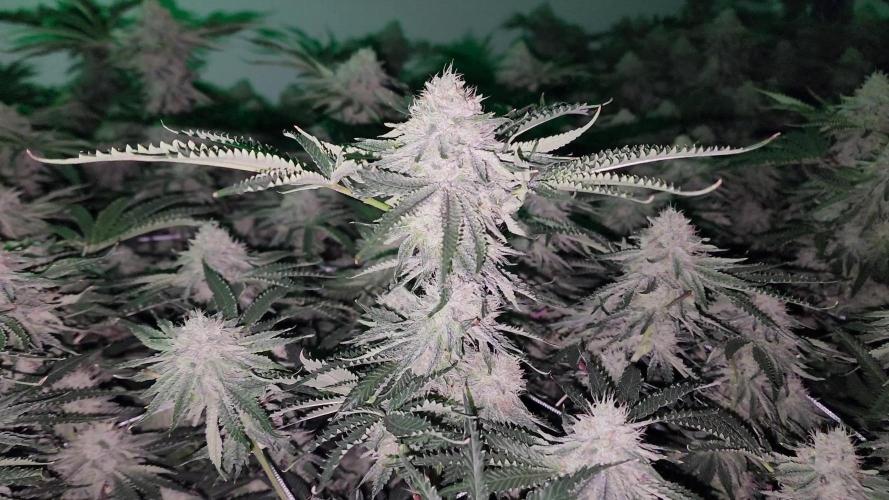
These ladies are coming along quite nicely. Will be harvesting likely in 2 more weeks.
Likes
93
Share


@Ferenc
Follow
Week 10, so from today I stopped watering the Gelato Cookie D'ohpe and on Saturday no more light as well. Sunday is harvest day finally. Not much changed, I raised up the water with 25ml so the Purple Punch gets 200ml 2 x a day. That's all, since last week I started giving 13 hours darkness and 11 hours light and from Monday will be 12/12 after I harvested the Gelato Cookie D'ohpe and I can use the tent only for her. Fertilization will happen on the same days. Sunday fun day, Gelato Cookie D'ohpe is harvested. Purple Punch left alone. From tomorrow I will switch the light schedule 12/12. End of the week Purple Punch is 43 cm.


Likes
469
Share


@love_2_grow
Follow
D22 - Today was the start of the fourth week of veg, and it was time to transplant the girls into their final pots. I got the largest pots that I could find that still would fit in my small tent: 25-liter square pots. I prepared each pot with mycorrhiza before transplanting. I picked #2 and #3 to transplant since they are the most similar in structure, even though #1 and #2 are more similar in size.
I adjusted the light to 300 PPFD at the canopy level. Finally, I gave each girl one liter of water @ pH 6.6.
D24 -The girls love their new homes and have grown quite a bit in a couple of days.
I've added a bunch of sensors to the pots to monitor the soil moisture better, one Flower Care sensor and one Blumat Digital in each pot.
The Flower Care sensors aren't all that reliable in larger pots, so I temporarily added the Blumat sensors from my other tent to get a feel for how the FC sensors work in these pots and dial in the Blumat watering system.
However, I haven't turned on the system yet, as the soil moisture remains relatively high after the transplant.
D25 - It looks like the transplant was a success and that I avoided stunting either girl. They are looking more vigorous with each day. Yay!
I'll give them one more day to chill and settle in before starting LST tomorrow.
D26 - Started LST today.
D27 - Tightened the LST wires and increased the light dimmer to around 400 PPFD at canopy level.
D28 - The end of the fourth week of veg and all is well in the tent. I did a soil slurry test to check the pH since this is the first time using this soil blend. The test showed a pH of 7.0 so all good.
Likes
4
Share


@DatGuyGrows
Follow
Grown out this week and got them ready for the early flower growth. Trimmed heavy and wired all branches away from each other. LST in full effect. Hoping it’s not too much trauma for them.. they proved me wrong. Bounced back with vigor and bright excitement! Eager to see these buds start forming 👀

Likes
51
Share


@DogDoctorOfficial
Follow
The freak keeps growing and getting taller, i think she might be having some trouble dealing with to much N for her needs, i hope she corrects that now that she is entering flower.
She still looks amazing lets see how the week goes.
And she is getting so tall, in fact she is becoming the biggest of them all, despise her freaking freak curved leafs , she is a non stop mode , very curious to see were she is going to be next week, i mean look at her and the speed she as put on her grown
Them room is getting so full need to clean this up asap
As always thank you all for stoping by for the love and support and for it all, i truly appreciate it all <3 <3 <3
Genetics - Fast Buds Tester 2308
Ligth - LUMATEK ZEUS 465 COMPACT PRO
Food - APTUS HOLLAND
#aptus #aptusplanttech #aptusgang #aptusfamily #aptustrueplantscience #inbalancewithnature #trueplantscience #fastbuds #dogdoctorofficial #growerslove
With true love comes happiness <3 <3 <3 Always believe in your self and always do things expecting nothing and with an open heart , be a giver and the universe will give back to you in ways you could not even imagine so <3 <3 <3
All info and full product details can be find in can find @
https://2fast4buds.com/ wen released
https://aptus-holland.com/
https://autopot.co.uk/
https://lumatek-lighting.com/
Have a few good more diaries going on fell free to drop by and say hi <3 <3 <3
<3 <3 <3 Growers love to you all <3 <3 <3
Likes
16
Share


@Ultraviolet
Follow
Seedling managing 93F 30%RH, around 20 DLI. Vpd is in the 3's. No I don't recommend.
Signum Magnum.
"A great sign appeared in the sky
a woman clothed with the sun
with the moon under her feet
and on her head a crown of twelve stars.
Sing ye to the Lord a new canticle:
because He has done wonderful things.
Glory to the Father, and to the Son, and to the Holy Spirit
As it was in the beginning, and now, and ever shall be, world without end."
The plant nutrient nitrogen exists in forms with both positive and negative charges. Ammonium (NH4+)(immobile in soil)(Cation) has a positive charge, while nitrate (NO3-) (highly mobile in soil)(Anion)has a negative charge. Nitrogen is unique among plant nutrients in that it can exist in both positively charged (ammonium, NH₄⁺) and negatively charged (nitrate, NO₃⁻) forms in the soil. This makes it a special nutrient. In that it is responsible for providing balance for reactionary trade offs when it comes to ph. Because ph itself in the medium will always slowly drift towards acidicity, such is nature. 80% of nitrogen should be nitrate and no more than 20% ammoniacal nitrogen.
Ca, mg, and K are the big 3 cations related to soil composition, pH & base saturation.
When nitrogen is in the form of ammonium, it can compete with calcium, magnesium, and potassium for absorption sites in the plant root. This competition can lead to a reduction in the uptake of these other essential nutrients. Nitrogen, particularly in its nitrate form (NO3-), can increase soil acidity, which can also affect the availability of calcium, magnesium, and potassium. The form of nitrogen applied (ammonium vs. nitrate) can influence its interactions with other nutrients. Ammonium nitrogen can have a more pronounced negative effect on the uptake of calcium, magnesium, and potassium compared to nitrate nitrogen.
Common forms of ammonium nitrogen include ammonium ion (NH4+), urea, and ammonium compounds like ammonium nitrate, ammonium sulfate, and ammonium phosphate.
Common forms of nitrate nitrogen include potassium nitrate (KNO3), sodium nitrate (NaNO3), calcium nitrate (Ca(NO3)2), and ammonium nitrate (NH4NO3).
Phosphorus is an essential plant nutrient, and its availability in the soil is strongly linked to the presence of oxygen. Plants primarily absorb phosphorus as phosphate (PO4), and oxygen is a key component of this molecule. Furthermore, the availability of phosphorus in the soil can be impacted by factors like soil aeration and temperature, which in turn affect the oxygen supply to the roots.
Phosphorus uptake in plants is most critical during the early stages of growth, particularly within the first few weeks of plant development.
Young plants actively growing tissues have a high demand for phosphorus. They may absorb up to 75% of their total phosphorus requirements within the first few weeks of vegetative growth, with up to 51% of uptake happening overnight, primarily in the first few hours or early nightfall.
⑨Anaerobic root respiration, or respiration without oxygen, is detrimental to plants because it's less efficient and produces toxic byproducts, leading to reduced energy production, nutrient uptake issues, and ultimately, root damage and plant stress.
⑨Anaerobic respiration, unlike aerobic respiration, doesn't utilize oxygen as the final electron acceptor in the electron transport chain. This results in a significant drop in the amount of energy (ATP) produced, which is necessary for various plant functions, including growth, nutrient uptake, and maintenance of cellular processes.
⑨In the absence of oxygen, plants produce byproducts like ethanol and lactic acid during anaerobic fermentation. These byproducts can be toxic to the roots and inhibit their function,
⑨When oxygen is depleted in a medium, the pH tends to decrease (become more acidic) due to the production of metabolic byproducts. This is particularly relevant in biological systems where aerobic respiration relies on oxygen as the final electron acceptor.
⑨When oxygen is scarce, plants may switch to anaerobic respiration. This process produces carbon dioxide (CO2) as a byproduct.
⑨CO2 dissolves in water to form carbonic acid (H2CO3). This acid lowers the pH of the medium, making it more acidic.
⑨Anaerobic conditions can impair a plant's ability to regulate its internal pH, leading to a drop in cytoplasmic pH and potentially cellular acidosis.
⑨The change in pH can also affect the availability of certain nutrients to the plant, as pH influences the solubility of micronutrients like iron, manganese, zinc, copper, and boron.
⑨The lack of oxygen in the plant medium leads to a decrease in pH due to the production of carbon dioxide during anaerobic respiration and impaired pH regulation within the plant.
In plant cells, cellular acidosis, a drop in the internal pH of the cytosol, is a significant stress response, particularly during conditions like flooding or hypoxia. This acidification can be triggered by a decrease in oxygen levels, leading to the production of metabolic byproducts like lactic acid and CO2. The plant's ability to tolerate and recover from these conditions depends on its cellular mechanisms to regulate pH and mitigate the effects of acidosis. When plants are subjected to low oxygen environments, such as those experienced during flooding, anaerobic metabolism, which produces lactic acid and ethanol, becomes the primary source of energy. This can lead to a build-up of these acidic metabolites in the cytosol, causing a drop in pH.
OXYGEN
Atomic oxygen (single oxygen atom, O) is the lightest form of oxygen, as it has the lowest mass of the oxygen molecules. Oxygen also exists as a diatomic molecule (O2) and an allotrope called ozone (O3), which have higher masses due to the number of oxygen atoms combined.
Atomic Oxygen (O):
This refers to a single oxygen atom, which is the most fundamental form of oxygen.
Molecular Oxygen (O2):
This is the common form of oxygen we breathe, consisting of two oxygen atoms bonded together.
Ozone (O3):
This is an allotrope of oxygen, meaning it's a different form of the same element, consisting of three oxygen atoms bonded together.
Since atomic oxygen has the fewest oxygen atoms, it naturally has the lowest mass compared to O2 or O3.
Ozone (O3) Lifespan:
Ozone has a relatively long lifespan in the stratosphere, particularly at lower altitudes. For example, at 32 km in the middle latitudes during spring, ozone has a lifetime of about 2 months.
Oxygen (O) Lifespan:
Atomic oxygen, on the other hand, has a much shorter lifespan. At the same altitude, its lifetime is about 4/100ths of a second.
Ozone-Oxygen Cycle:
The ozone-oxygen cycle involves the rapid exchange between atomic oxygen (O) and ozone (O3). UV radiation can split molecular oxygen (O2) into atomic oxygen (O), which then reacts with O2 to form ozone (O3). Ozone can also be photolyzed by UV radiation, creating atomic oxygen again, which can then react with O3 to reform O2.
Dominant Form:
The partitioning of odd oxygen (Ox) between ozone and atomic oxygen favors ozone in the lower stratosphere. This means that a much larger proportion of odd oxygen exists as ozone than as atomic oxygen, especially in the lower stratosphere.
Recombination:
Atomic oxygen has a high energy and reactivity. When it encounters another oxygen atom, they can combine to form O2. This process releases energy, contributing to the heating of the atmosphere.
Ozone Formation:
Atomic oxygen can also react with molecular oxygen (O2) to form ozone (O3). Ozone plays a significant role in absorbing harmful UV radiation.
Other Reactions:
Atomic oxygen can react with various other molecules in the atmosphere, like nitrogen (N2), water (H2O), and carbon dioxide (CO2), forming different compounds.
UV light below 240nm (peak 185nm) creates ozone (O₃) through a process called photolysis, where UV light breaks down dioxygen molecules (O₂) into single atomic oxygen atoms (O). These single oxygen atoms then react with other oxygen molecules to form ozone (O₃). Specifically, UV-C light with wavelengths shorter than 240 nm can cause this photolysis.
UV light with wavelengths between 240-280 nm, (peak 254 nm) breaks down ozone (O₃) into dioxygen molecules (O₂) and atomic oxygen atoms (O). 280nm does not have the energy potential to break apart the stable bond of (O₂) into enough (O) to make (O₃)
At ground level, atomic oxygen (single oxygen atoms) has a very short lifespan. This is because it's highly reactive and quickly combines with other molecules to form stable diatomic oxygen (O2) or other compounds. While the exact timeframe varies depending on the specific circumstances, its lifespan is typically measured in nanoseconds or picoseconds.
Likes
11
Share


@Guaxi
Follow
White Widow survived! She started growing all the leaves at the same time. There is some fractal shit going on with the leaves, which is very visually appealling for me. I discovered that I like taking care of the plants, make me calm, and is a new nice and healthy hobby. The plants are listening to classical music and "582hz music" 18 hours a day! :)

Likes
67
Share


@AwfulBuddy
Follow
Hi all buddies!
First crop from hydro nft growth.
Growth went well, I had some management problems in changing nutrients from veg to bloom which delayed the harvest for a week or two.
Sensi Seeds' Skunk # 1F is incredibly resistant to mold and insect attacks, very close internodes ensure low height and compact buds.
Unfortunately I chose the mother phenotype wrong, I found the lowest as I wanted but I lost the fatness of the buds present in other phenotypes, but the game was worth the same and I am very proud of it!
I collected after 94 days of flowering, the last 72h 20kg ice cubes in the tank and total darkness which the last 24h without irrigation.
After cutting I hung the whole plants in the tent for 24 / 48h 19 ° C 55% HR.
Two days of wet trim to 8 girls and I hung their colas in the tent to continue drying.
With a girl i tried dry trim but i will avoid next time.
After a week in the tent I cleaned the colas and removed all the sticks, I placed everything in airtight bags in the refrigerator for 5 days 12 ° C 65% HR (daily check).
Now dark storage room at a temperature of 18 ° C 65% HR.
At the last weighing a few days ago it was more than 500g, from now it does not lose any more weight.
Next week I will take pictures of the weigher and the finished harvest🍀🍀🍀
target!!🍀500g dry/cured🔥
Thank you GD community you are precious for everything, criticism, advice, curiosity, thanks 💚🌱✊🏼
Awesome people here on GD🔥🔥🔥
