



Likes
5
Share

@RakonGrow
Follow
+
Day 23:
+ watering : 2.5L bottle water EC 0.355 , PH 7.5 . Final EC 1.143 PH 5.98
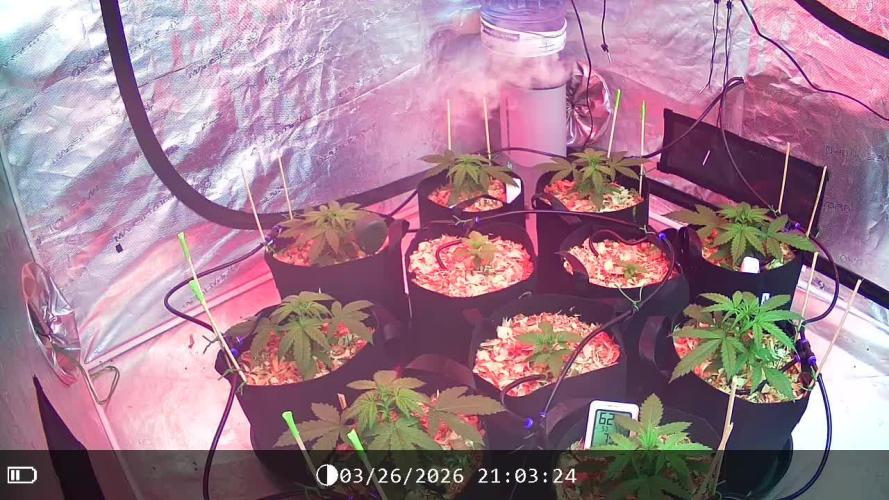
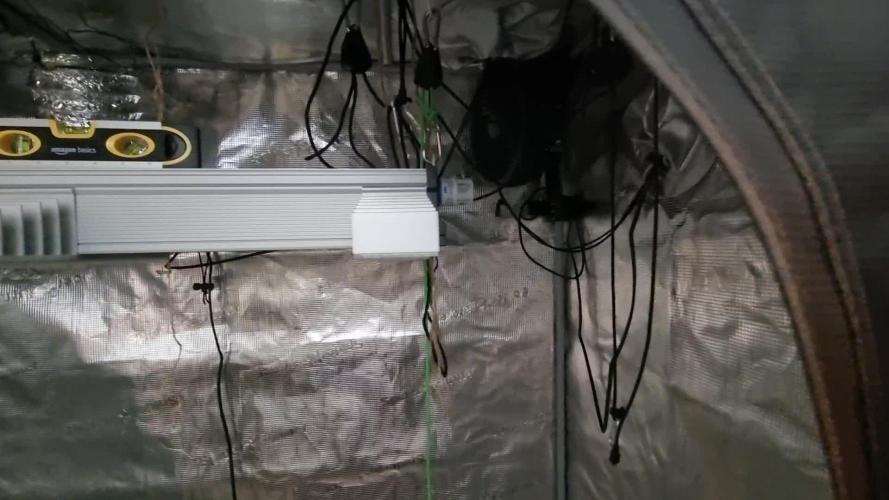
New Light Evo 3-100 (200W) (80cm) in a 140x70cm tent . (Old : 3-60 (200W) (40cm)The two ladies are getting more space to grow!
+


Likes
2
Share


@pedraverd
Follow
14 days since sprout.
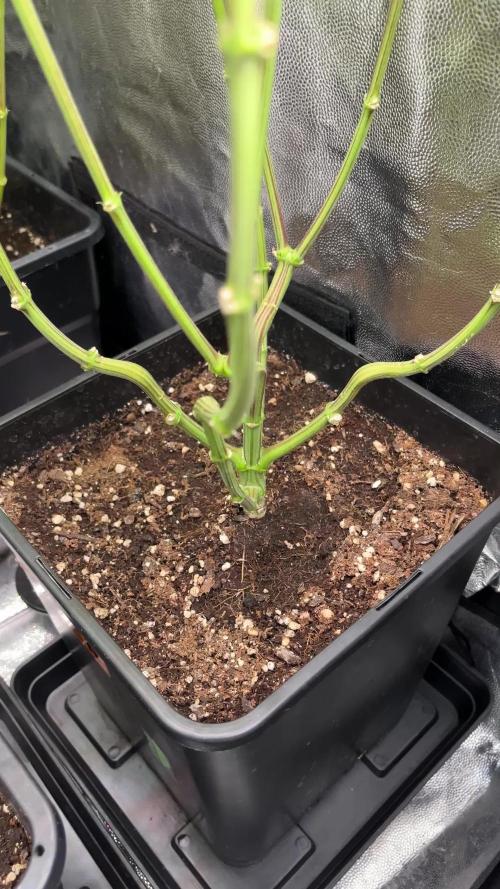
They became too leggy and I had to put more soil but they look great, the leafes are 2cm in number 1 and number 2, number 3 doesnt seem to be doing so good but thats it for this week


Likes
3
Share

@Jardin33ro
Follow
Me encanta esta genetica, y son levemente distintas estos fenotipos. Una tiene mas marcado su color violeta y tiene pistilos mucho mas largos. La otra es mas verde y no tiene tantos pistilos. En cuanto a resina las dos estas muy bien y ya estan quedando blanquecinas justo en el punto que me gusta. De catalogo
Likes
13
Share


@XanHalen
Follow
Apr 20:
They hanging out at 65% rh and 65F..
Going for 7-10 day dry…
No wet trim, cut plants in half and hung…
Very happy with density and resin production…
Can’t wait to jar and test in 2-3 weeks…
I feel comfortable with this strain, I think it’s time to move on…
Really wanna run some Mephisto seeds….

Likes
22
Share

@MrGrowDiarie
Follow
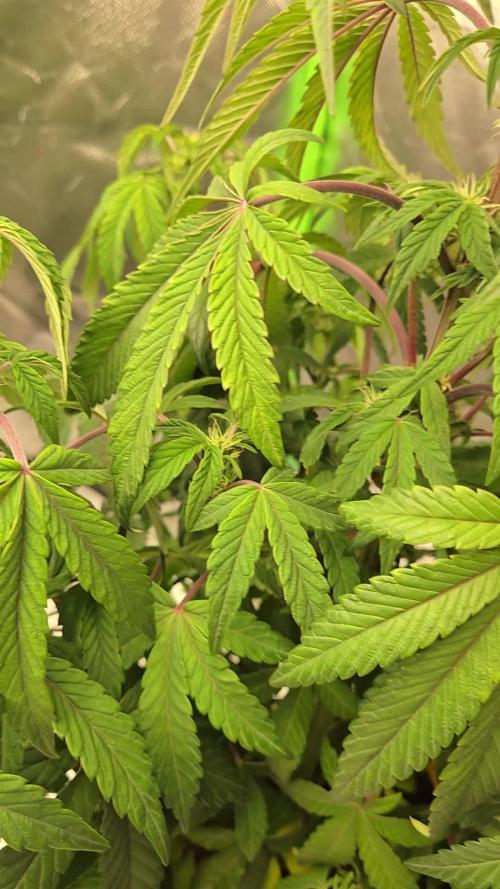
Day 56
The plant appears noticeably droopy, with many of its leaves hanging downward rather than extending outward. The foliage is mostly green, but some leaves show slight curling and a softer structure, giving the plant a tired or stressed appearance. Several stems display a purplish tint, which stands out against the green leaves. The upper growth looks slightly twisted, and the developing flower sites are visible but not yet dense. Overall, the plant shows a less upright and vigorous stance compared to the others, displaying a mix of healthy green areas and parts that appear weakened or drooping

Likes
Comments
Share


Processing
Likes
5
Share


@PETEROG
Follow
Hey everyone at week 4 know and wow have these girls grown early this week I applied some LST and all took really well to say it was my first time trying this
Likes
15
Share


@dank604
Follow
Thelma (2 gal) has a massive fade setting in, only a handful of ambers though. I start her flush this week and will chop in 2 weeks, assuming the number of ambers has multiplied bigtime by then.
Louise (3 gal) is looking nice and healthy and I'm looking forward to compare harvests between both, she's a week younger.
So close!!

Processing
Likes
20
Share


@Stash074
Follow
No complaints this week. All 4 of the ladies are flowering well, pistils are all over the plants. Bruce banner will be a very frosty plant judging by how she was the 1st to start producing tricomes on her leaves. They went from drinking every 2 days to at least once a day. Im excited to see how well the buds produce and swell up over the next 2 weeks..ill make sure to continue to do everything on part to stay dialed in on the ladies. Will keep yall updated in my next upload😎✌️🏽
Likes
7
Share


@SoulGrownBotanicals
Follow
Another great week. She stacked up her buds and should be getting the chop in the coming days. The frost on her is amazing. I also sampled a test nug and just dam. It's some quality bud lol.
Likes
15
Share


@Kurow
Follow
Had a bad humidity (spots on leave are wet spots that got handled ASAP) scare last week so got a dehumidifier up in there comfortably. Still smooth sailing.

Likes
21
Share


@Ultraviolet
Follow
Heyoka.
12x12=144, A dodecahedron is a polyhedron with 12 faces, and in coordination chemistry, it refers to a geometry where ligands surround a central metal atom (in this case, Magnesium) in a specific, 8-coordinate arrangement. Dodecahedrane is a hydrocarbon, meaning it's composed solely of carbon and hydrogen atoms. The carbon atoms are arranged at the corners of a dodecahedron, a 3D shape with 12 pentagonal faces. The water molecules in the dodecahedron form hydrogen bonds that are individually slightly weaker than in either the dimer or the tetramer. However, because three-quarters of the O -H groups in the dodecahedron form hydrogen bonds, it has a more negative energy per molecule than has either the dimer or the tetramer. Magnesium (Mg2+) is the essential, central metal ion in the chlorophyll molecule, crucial for photosynthesis by enabling light absorption and energy transfer. It is chelated by four nitrogen atoms within the porphyrin (or chlorin) ring structure. Chlorophyll appears green because it reflects light in the green region of the visible spectrum, specifically between 490 and 570 nm. The main resonance electronic frequency of a neutral Magnesium (Mg) atom corresponds to the transition from the ground state to the first excited state. Resonance Line Wavelength of Mg2+: 285.1nm (UVB light). The central atom of the chlorophyll molecule is Magnesium (Mg2+), which is coordinated within a porphyrin ring. The electronic "resonance frequency" of this central atom—meaning the frequency at which its electrons absorb energy—is primarily driven by the electronic transitions (ETR) of the surrounding conjugated chlorin ring structure, rather than a discrete atomic transition of the Magnesium atom itself. The resonant electronic frequencies of the chlorophyll porphyrin (technically, a chlorin) ring are determined by the energy required to promote π-electrons within its conjugated system, primarily appearing in the blue and red regions of the visible spectrum.
In standard physics, Chloryphyll b has peak absorption at 460nm (Blue). If we take the peak wavelength 460nm and a UV-B, UVR8 peak absorption wavelength 285nm Tryptophan-285 (W285) Sensing protein. 460/285=1.618 Φ, "natural harmony" and the "structure of light". The cryptochrome photoreceptor (CRY) is a UV-A/blue light receptor that shares this dual sensitivity with several other biological structures and functions, including significant sequence similarity and a common evolutionary ancestor with DNA photolyase enzymes. These are light-activated enzymes that use blue/UV-A light to repair DNA damage caused by UV-B radiation in plants.
Dodecahedrane (C20H20) is a hydrocarbon with a cage-like structure where carbon atoms form 12 pentagonal faces (a regular dodecahedron). It is highly symmetric (icosahedral), contains no delocalized electrons (no aromaticity), and has minimal angle strain, but significant torsional strain. Water Dodecahedron (H2O) forms hydrogen-bonded cages. While individual hydrogen bonds in this structure are weaker than in the linear dimer or tetramer, it has a more negative total energy per molecule. This is because three-quarters (75%) of the groups are involved in hydrogen bonding, creating a very stable, closed-shell configuration. a 3D carbon hydrocarbon (C20H20) to stable water clusters in hydrate, while the Magnesium ion acts as the central activator within a conjugated ring in biological systems, with its electronic absorption dominated by the ring, not the atom itself.
Effective quantum efficiency of photosystem II, often denoted as ΦPSII
In horticultural lighting, adding 730 nm (far-red) LEDs alongside standard red/blue lights has been shown to increase canopy photosynthesis by 20–30% in several crops by acting synergistically with shorter wavelengths. However, the limitation is that excessive, pure IR/Far-red light (without accompanying red light) can trigger the "shade avoidance response," causing plants to grow tall, weak, and spindly rather than robust. Knowing is half the battle however, engineering or utilizing infrared light (specifically the 700-750 nm far-red range) is a viable method to boost photosynthetic efficiency. It acts as a bridge to allow PSII to utilize a broader spectrum of light, breaking the traditional 700 nm barrier.
Extend, then multiply.
UVR8-mediated signaling (often in conjunction with CRY proteins) triggers protective mechanisms that maintain the stability of the photosynthetic apparatus (including LHCII and reaction center proteins), thus ensuring that the efficiency of Photosystem II remains higher in UV-B-exposed plants compared to plants lacking this receptor. ΦPSII indictates the rate of electron transfer from water to plastoquinone, which drives the production of ATP and NADPH. There is a close link between ΦPSII and the true rate of CO2 fixation (Φ*co2), particularly in C4 plants.
Effective quantum efficiency of photosystem II, often denoted as ΦPSII, represents the proportion of light absorbed by Photosystem II (ΦPSII) that is actually used in photosynthetic electron transport. It is a key indicator of how efficiently a plant is using light for photosynthesis, as opposed to losing it as heat or fluorescence. ΦPSII (effective quantum yield of photosystem II) functions primarily as a "multiplier" (a coefficient of efficiency) rather than an additive factor when estimating the overall photosynthetic electron transport rate (ETR). Multipliers are considered far more beneficial than additions because they generate exponential growth, leverage existing resources to their full potential, and create sustainable, self-multiplying capacity, rather than just incremental, linear increases.
Humans, and most other mammals, rely on other mechanisms, such as nucleotide excision repair, to manage and repair UV-induced DNA damage. As such, humans do not have the direct, light-driven repair mechanism that photolyase offers in plants.


Likes
7
Share


@CrowMaster
Follow
Room full of clones that I’ve ran before no surprises…1000w x6 room, 6 plants per light…stripped the big fan leaves of hung whole plants up. After the 7 day dry gonna bring in the crew of trimmers and get this done in one day…I hate trimming and I need room empty again so I can plant clones I have rdy to go in so it’s faster just to pay trimmers…I’ll report back with yield…I can already say it’s gonna be 12-15 packs I’m always hitting 2+ a light with these strains….I don’t weigh it wet it wold take too long and wet weight don’t matter none unless you running some fresh frozen and need to do math on yields


Likes
14
Share


@ConspiracyFly
Follow
Gorilla Glue #4 Week 12
Changing the lighting schedule to 12 12
Some leaves and branches were damaged due to the limited space


Likes
25
Share


@GERGrowDesigns
Follow
🥦 Vegetative Week 4 Structural Consolidation Phase
Eternity Grow Cup 2026 Sticky Broccoli Feminized
Stage: Vegetative Phase Week 4
Day:~Day 28
🌡️Environmental Control:
-Temperature: ~26°C consistent
-Humidity: balanced for vegetative growth
-Light Schedule:18/6
-Airflow: optimized for stem strength and canopy health
No major adjustments were required, indicating a established grow environment.
🌿 Plant Development
Observations:
-Strong vertical expansion
-Noticeable thickening of main stems
-Excellent development of lower and inner branches
-Deep, vibrant green coloration
-No visible deficiencies or stress symptoms
Overall health can be described as robust and highly stable of all 4 Plants .
🍵 Nutrient Strategy till Flower , Hy-Pro Program:
-Hy-Pro Terra (Growth/Bloom combination)
-Hy-Pro Terra Rootstimulator
-Hy-Pro Spraymix applied once daily as foliar support
The plant’s deep green coloration and upright leaf posture suggest strong nutrient uptake and efficient root function.
🥦Strain Observation Sticky Broccoli:
-Strong vegetative energy
-Excellent stress tolerance
-Dense node stacking
-Promising canopy architecture
Lower branch development is becoming increasingly strong, indicating high potential for productive flowering sites.
📸 Weekly Summary
Vegetative Week 4 was a controlled and strategic growth phase.
With no additional stress introduced, the plant was able to fully express its natural vigor and structural potential.
The foundation is now firmly established one final vegetative week stands between this stage and the flowering transition.
See you in Veg Week 5 Final Prep Before Flower 🌿✨