








@MadeInGermany
Volgen
Info:
Unfortunately, I had to find out that my account is used for fake pages in social media.
I am only active here on growdiaries.
I am not on facebook instagram twitter etc All accounts except this one are fake.
Harvest day 67
since time change
to 12/12 hrs.
Hey everyone Finally it was time for the lady to be harvested :-).
The buds smell very tasty and look very good so I'm really excited.
The trichomes are 70% milky and 30% amber.
As always, it came to the darkroom 48 hours before harvest :-).
There it will now remain after harvesting at 62% humidity for 8-12 days before it is put into the jars for fermentation with 62% boveda packs :-).
As usual, the last update will come after the fermentation.
Until then, I wish you all the best and stay healthy 🙏🏻
You can buy this Strain at
https://www.barneysfarm.com/blue-cheese-34
Type:
Blue Cheese
☝️🏼
Genetics:
Blueberry
X
Original Cheese
👍
Vega lamp:
2 x Todogrow Led
Quantum Board 100 W
💡
Bloom Lamp :
2 x Todogrow Led
Cxb 3590 COB 3500 K 205W
💡💡☝️🏼
Soil :
Bio Bizz Coco
☝️🏼
Fertilizer:
Green House Powder Feeding
☝️🏼🌱
Water:
Osmosis water mixed with normal water (24 hours stale that the chlorine evaporates) to 0.2 EC. Add Cal / Mag to 0.4 Ec Ph with Organic Ph - to 5.5 - 5.8


@donovanliam
Volgen
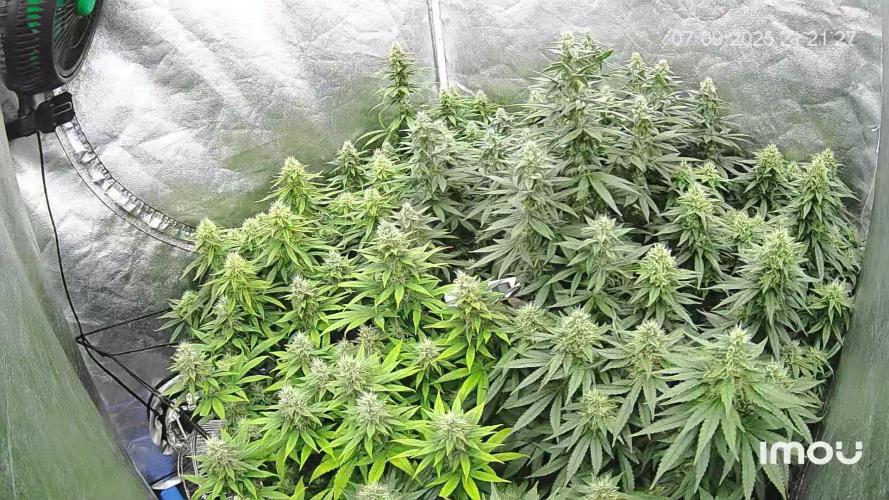
I have a new light with a bloom setting hopefully that will make a nice flowering. Got a new fan for air circulation. The new light has cooling fans. Haven't noticed any burns so im happy with my order. If you look at the last few pictures my tent is home made and cheap very cheap. The lights not an expensive one but I think its fine for now.


@I_roll_my_own_420
Volgen
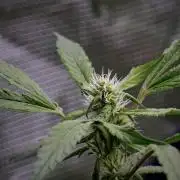
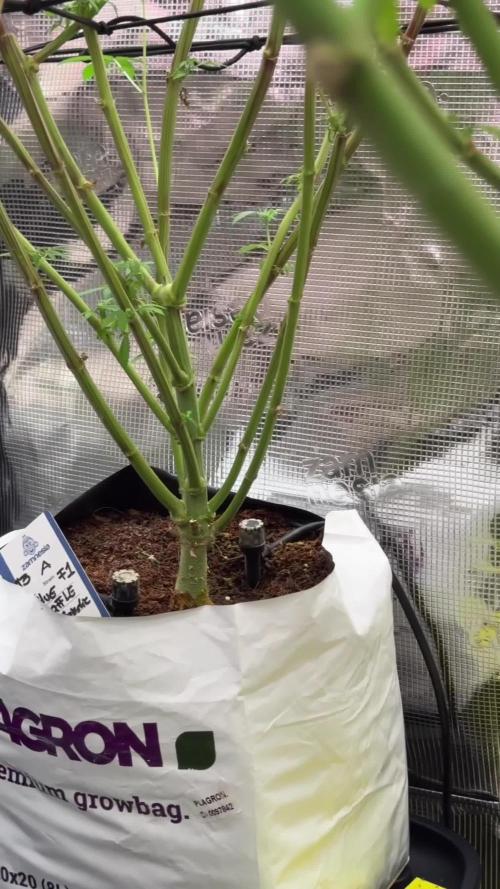
I have changed nutrients to Advanced Nutrients.
Plants are watered automaticly 2x a day. 0.5L each watering. Humidity is around 41%.



@DogDoctorOfficial
Volgen
💙 Project Blue Tent – Week 11
💙 Blue Waffle F1 – Pheno B
🌸 Same Room. Same Conditions. Another Beautiful Expression.
Hello everyone, and welcome back to another chapter inside Project Blue Tent! 💙🌱
And once again...
I'm looking at these girls and thinking:
How can four plants look this similar?
😂💙
If you've been following Project Blue Tent, you'll know that we're documenting four individual plants from seed to harvest, each with her own dedicated diary.
All four share the same tent.
The same lighting.
The same irrigation.
The same reservoir.
The same nutrition.
The same environmental conditions.
The same cultivation philosophy.
And yet...
each one gets her own chapter.
Today it's time to give the spotlight to Blue Waffle F1 – Pheno B.
And honestly?
She's looking absolutely beautiful.
🌿 PHENO B – LET HER SHINE
Pheno B has reached approximately 145 cm and has developed a fantastic flowering structure.
At this stage, there isn't really a lot I want to change.
And that's actually a good thing.
The big work has already been done.
The long vegetative period gave us the structure.
The topping and training shaped the plant.
The first SCROG organized the canopy.
The aggressive flowering stretch forced us to rethink the vertical space.
The major defoliation opened the plant.
The second SCROG gave the flowering branches additional support.
The ventilation system was moved outside the tent.
The LEDs were raised.
The airflow was improved.
And now...
we're watching all of those decisions come together.
The plant is doing exactly what we wanted her to do.
Grow.
Flower.
Develop.
And increasingly...
FROST.
😂💙🌸
🌸 THE FROST IS GETTING SERIOUS
I have to say this because the photographs really don't need much explanation.
The frost levels are beautiful.
The flowers are becoming increasingly covered in trichomes, and every week the close-up photographs seem to reveal more.
This is the part of the grow where you start looking at the plants differently.
Earlier, we were looking at structure.
Now we're looking at flowers.
And those flowers are beginning to tell us their own story.
The density.
The development.
The resin production.
The structure.
The way the flowers are forming along the branches.
Everything is becoming much more interesting.
And Pheno B is absolutely shining.
💙🌸
🌿 THE TOPPING AND STRUCTURE – LOOK AT THAT OPENING
Another thing I'm really happy with this week is the structure created by the topping and training.
When you look closely at Pheno B, you can really see how the plant opened up.
The main structure divided beautifully.
The branches spread through the available space.
And the flowering sites are now positioned throughout that structure rather than all trying to occupy the exact same vertical point.
This is one of those things that can be difficult to appreciate when you're doing the training weeks earlier.
At the time, you're making cuts.
Moving branches.
Supporting growth.
Trying to imagine what the plant will eventually become.
Then several weeks later...
you look at the flowering plant and suddenly understand why you did it.
And that's exactly what I'm seeing now.
The structure is there.
The opening is there.
The flowering sites are there.
And the plant is filling that framework beautifully.
🕸️ THE X-CROSS – KEEPING THE STRUCTURE WORKING
The support system is also doing exactly what we wanted.
The second SCROG remains in place, helping organize and support the upper flowering structure.
And with the way we've arranged the support through the canopy, we've created that X-cross structure that helps distribute and organize the flowering branches.
The idea isn't to keep forcing the plant into a new shape.
That stage is behind us.
Now the structure simply needs to support what the plant has already built.
And looking at Pheno B...
I'd say it's doing a damn good job.
😂💙
The branches are supported.
The flowers have room.
The canopy is organized.
And we can actually see through the plant.
That's exactly where I want to be at this stage.
💡 UNDER-CANOPY LIGHTING – NOW PART OF THE SYSTEM
The LumiFlora under-canopy lighting is also now fully integrated into the room.
We're using the 150W full-spectrum LumiFlora fixtures underneath the canopy to provide supplemental light to the lower flowering structure.
The main LEDs continue doing the primary work from above.
The LumiFlora units are simply giving the lower portions of these very tall plants another source of light.
And with plants reaching approximately 145 cm, this makes a lot of sense to me.
The canopy is no longer a flat surface.
It's a three-dimensional structure.
There are upper flowers.
Middle flowers.
Lower flowers.
Interior branches.
And naturally, not all of those areas receive the same amount of light from above.
So instead of constantly removing more foliage to chase light penetration...
we're experimenting with bringing light into the lower part of the plant.
And now?
We watch.
That's the fun part.
😂💡🌸
🌿 TWO LIGHT SOURCES. ONE VERY LARGE CANOPY.
The interesting thing about this setup is that we're effectively looking at the plant from both directions.
The main fixtures illuminate from above.
The LumiFlora fixtures supplement from below.
And the plant sits right between those two lighting environments.
I'm particularly interested in seeing how the lower flowering sites continue developing as we move deeper into flowering.
We're not making any promises about what the additional lighting will achieve.
We're documenting it.
We're watching.
We're comparing.
And we're letting the plants tell us what happens.
That's the whole point of Project Blue Tent.
🔬 SAME ROOM – SAME CONDITIONS – DIFFERENT DIARY
And this brings me to something I've been thinking about a lot during this project.
People often use the word "genetics" when talking about individual plants.
And obviously, genetics are involved in every plant.
But I personally like using the word:
"Cultivar."
Why?
Because we're looking at cultivated plant varieties.
We're not simply talking about an abstract collection of genes.
We're talking about plants that have been selected, developed and cultivated as a particular variety.
And here we're working with Blue Waffle F1 cultivars.
So throughout these diaries, when I talk about Pheno A, Pheno B and the other girls as individual cultivars, that's what I'm referring to.
And honestly...
the uniformity we're seeing makes this distinction particularly interesting.
Because look at them.
😂💙
Same environment.
Same reservoir.
Same feeding.
Same irrigation.
Same lighting.
Same training philosophy.
And yet we're getting remarkably similar expressions.
That's one of the things that makes these F1 plants so fascinating to observe.
And if you already know all of this...
beautiful.
You know.
😂
If you didn't...
hopefully you learned something today.
And that's never a bad thing.
I love learning.
So I don't think there's ever too much useful information.
🌸 F1 UNIFORMITY – THEY REALLY DO LOOK LIKE SISTERS
This is probably one of the most impressive things about this whole project.
The plants are beginning to look almost like copies of one another.
Different individual plants.
Different diaries.
But under the same conditions...
the similarities are incredible.
Similar height.
Similar flowering structure.
Similar development.
Similar response to the training.
Similar response to the defoliation.
And now...
similar frost.
😂💙🌸
Of course, we're still documenting them individually because the subtle differences are exactly what become interesting over time.
Maybe those differences will become more obvious as flowering progresses.
Maybe one will develop a slightly different structure.
Maybe one will finish earlier.
Maybe one will produce a different flower shape.
Maybe the differences will become much more obvious closer to harvest.
Or maybe...
they'll continue looking like sisters all the way to the end.
That's what we're here to discover.
🌬️ AIRFLOW – THE SYSTEM IS WORKING
The airflow arrangement remains unchanged.
We've got movement above and below the canopy, keeping the air circulating throughout this large flowering structure.
And that's particularly important now that the canopy is so developed.
The previous defoliation opened the plant.
The additional airflow helps take advantage of that space.
The lower portion of the plant isn't being ignored.
And the under-canopy lighting is working inside that same environment.
Everything has a role.
Light.
Air.
Structure.
Irrigation.
Nutrition.
And observation.
Nothing needs to be dramatic.
It simply needs to work.
💧 THEY'RE DRINKING BEAUTIFULLY
Another thing I'm very happy with is how these girls are drinking.
They're consuming well.
The irrigation is keeping up.
And the plants are showing us that they're comfortable with the current setup.
The reservoir remains shared.
The feeding remains shared.
The irrigation remains shared.
And yet Pheno B continues developing beautifully.
This is exactly why having a consistent system is so valuable for this experiment.
When all four plants receive the same inputs, we get a much more interesting opportunity to observe how the individual cultivars respond.
⚗️ SAME RESERVOIR – SAME NUTRITION
The nutrition remains unchanged.
We're continuing with:
PLAGRON Hydro A — 2.2 ml/L
PLAGRON Hydro B — 2.2 ml/L
PLAGRON Hydro Roots — 1 ml/L
PLAGRON Power Buds — 1 ml/L
pH adjustment as required
No need to start changing things simply because another week has arrived.
The plants are happy.
They're drinking.
They're flowering.
They're producing frost.
So we continue.
Consistency is part of the experiment too.
And honestly...
when the plants look this good, I'm not interested in fixing something that isn't broken.
😂💙
🌸 THE PREVIOUS DEFOILATION IS NOW A DISTANT MEMORY
It's also interesting to look at Pheno B now and remember what she looked like immediately after the major defoliation.
At the time, there was a dramatic difference.
A lot of foliage had been removed.
The structure became much more open.
And then we had to wait.
That's the difficult part.
You make the decision.
You do the work.
And then...
you leave the plant alone.
Now we're seeing the result.
The plant has continued growing.
The flowers have developed.
The structure has filled out.
And the flowering sites are clearly visible.
The plant didn't need us to keep interfering.
She simply needed time.
🌿 SOMETIMES DOING NOTHING IS DOING SOMETHING
This is probably one of the biggest lessons from this stage of Project Blue Tent.
There's a temptation in cultivation to constantly do something.
Adjust something.
Move something.
Change something.
Feed something.
Cut something.
Measure something.
😂
But sometimes...
the plants don't need another intervention.
They need stability.
They need time.
They need the environment to remain consistent.
And they need us to have enough discipline to leave them alone.
That's where we are now.
The structure is built.
The support is installed.
The lighting is established.
The airflow is working.
The irrigation is working.
The nutrition is stable.
So...
let her do her thing.
🌸 CURRENT GROW CONDITIONS
🌸 Flowering: Week 11
📏 Height: approximately 145 cm
💡 Light schedule: 12/12
☀️ Day temperature: 28°C
🌙 Night temperature: 27°C
💧 Relative humidity: 63%
⚗️ pH: 6.01
⚡ EC: approximately 2.24 mS/cm
🌡️ Solution temperature: 24.9°C
🌱 Substrate temperature: 24°C
🌬️ CO₂: approximately 666 ppm
💦 Watering: approximately 1.6 L per plant / 24h
? Pot size: 8 L
NUTRIENT RECIPE
PLAGRON Hydro A — 2.2 ml/L
PLAGRON Hydro B — 2.2 ml/L
PLAGRON Hydro Roots — 1 ml/L
PLAGRON Power Buds — 1 ml/L
PLAGRON pH Plus — 0.03 ml/L
PLAGRON pH Minus — 0.03 ml/L
💡 UNDER-CANOPY LIGHTING
2 × LumiFlora 150W Full Spectrum
🌸 THE FLOWERS ARE TAKING OVER
This is where the story becomes really exciting.
For weeks, we were talking about the plant.
Now we're talking about the flowers.
And Pheno B is giving us plenty to talk about.
The flowering sites are developing beautifully throughout the structure.
The branches are carrying them well.
The frost is becoming increasingly obvious.
And the entire plant has that unmistakable look of a flowering plant entering a very interesting stage.
The close-up photographs really show it.
The trichomes are becoming more visible.
The flowers are becoming more defined.
And the whole plant is starting to sparkle.
💙🌸
🔭 WHAT I'M WATCHING NOW
At this point, my list is actually pretty simple.
I'm watching the flowers.
I'm watching the frost.
I'm watching the lower canopy under the LumiFlora lighting.
I'm watching the structure.
I'm watching how the second SCROG continues supporting the branches.
I'm watching how much the plants continue to drink.
And I'm watching the four cultivars develop under exactly the same conditions.
That's it.
No major intervention.
No unnecessary changes.
Just observation.
Because right now...
the plants are doing exactly what we want.
🌿 WHAT WILL THE FUTURE BRING?
And this is the part where I honestly don't know.
We have a beautiful flowering structure.
We have impressive uniformity.
We have increasing frost.
We have healthy development.
We have stable environmental conditions.
And we have four incredibly interesting F1 cultivars sharing the same environment.
But what happens next?
That's the exciting part.
Will the flowers continue stacking at this rate?
Will the frost become even heavier?
Will the subtle differences between the cultivars become more obvious?
Will the lower flowering sites respond noticeably to the supplemental lighting?
And what will Pheno B look like when she reaches maturity?
I have no idea.
😂💙
And I absolutely love that.
Because if we already knew the ending...
what would be the fun of documenting the journey?
💙 FINAL THOUGHTS – SAME ROOM, BEAUTIFUL RESULT
So...
Week 11.
Same tent.
Same room.
Same reservoir.
Same irrigation.
Same nutrition.
Same lighting from above.
Same environmental conditions.
And yet...
another beautiful individual story.
Blue Waffle F1 Pheno B is looking fantastic.
She's approximately 145 cm tall.
Her structure is beautifully opened from the topping and training.
The flowering branches are supported by the second SCROG.
The canopy is receiving airflow from above and below.
The LumiFlora under-canopy lighting is now helping illuminate the lower flowering structure.
She's drinking beautifully.
She's flowering beautifully.
And the frost...
Oh my God.
😂💙🌸
The frost is becoming ridiculous.
And that's exactly the kind of problem I like having.
😂
The most interesting part for me, though, is seeing how similar these F1 cultivars are behaving.
Four individual plants.
One controlled environment.
And remarkably consistent results.
That doesn't mean every plant will finish identically.
It doesn't mean there aren't individual differences.
That's exactly why we're documenting them separately.
But right now...
they're giving us a fascinating look at just how uniform these plants can be under consistent conditions.
And that's something I want to keep watching.
We're not going to force the story.
We're not going to chase numbers.
We're not going to keep changing things just so we have something to write about.
We're going to let the plants write the next chapter.
And Pheno B?
She's writing a beautiful one.
💙🌸🌿
The structure is ready.
The support is ready.
The lighting is ready.
The airflow is ready.
The irrigation is ready.
The nutrition is ready.
Now...
we wait.
We watch.
We learn.
And we enjoy the show.
Let's see what the future has waiting for this beautiful girl.
Because if she keeps going like this...
I have a feeling we're going to have some very special flowers to photograph.
😂💙🌸
🙏 A HUGE THANK YOU
A huge thank you once again to Zamnesia for making Project Blue Tent possible and for giving us the opportunity to explore these beautiful Blue Waffle F1 cultivars individually.
Thank you to PLAGRON for the Hydro nutrient line supporting these girls throughout this vigorous flowering cycle.
A massive thank you to Mars Hydro for the irrigation and drainage system that continues keeping this entire ecosystem supplied and running beautifully.
Thank you to Zamnesia for the Phytonaut LED lighting, the curved scissors and the clip fans that have become such important parts of this project.
And a huge thank you to LumiFlora for the 150W full-spectrum under-canopy lighting that we're now using to explore supplemental lighting throughout this very large flowering structure.
And of course...
thank you to GrowDiaries for giving us the platform to document every part of this journey.
The good.
The unexpected.
The experiments.
The mistakes.
The lessons.
And now...
the frost.
😂💙🌸
Most importantly, thank you to everyone following Project Blue Tent.
Four individual cultivars.
One room.
One environment.
One reservoir.
One cultivation philosophy.
And four girls showing us just how beautifully consistent these F1 plants can be.
But we're not at the finish line yet.
There's still a lot of flower development ahead.
There's still a lot of frost to watch.
There's still a lot to learn.
And Pheno B has plenty more story left to tell.
Until next week...
Same room.
Same conditions.
Same beautiful girl.
More flowers.
More frost.
More observation.
And hopefully...
even more reasons to smile when we open that tent.
💙🌸🌿
Growers Love, happy growing, and take care everyone! 🌱💙


@BudXs
Volgen
Things are taking shape. VPD in check, girls are just praying and loving their home. A constant 78 with lights on and a small drop at night. Top feeding twice daily for 90 seconds per feed. This is enough time for the hempy hole to overflow.
These girls were topped a few days ago and recovering nicely. A few weeks of veg and this room is going in to flower! And thats when the fun begins
Follow my son Budxless on his first grow


@RakonGrow
Volgen
Tag 82:
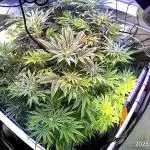
Hab mich nun doch entschieden , da die Trichome wirklich zu 90% Milchig sind , die Dame am Stamm abzuhacken . (Extra ein kleines Beil gekauft (scherz)) . Dann im Stück einfach Kopfüber . Abluft ist an , Ventilator unter der Spitze . Jetzt noch 4-5 Tage warten (je nach Temp und Feuchte) . Und dann schauen wir mal was es wird .Für mich wichtig , viel Feuchtigkeit im Raum , ich will das sie auch nach dem Trocknen noch kleben . Ergo hab ich den Stoftopf drinne stehen gelassen .
Tag 82-88:
Kopfübertrocknung
+ Temperatur : 21°C - 23°C)
+ Lüftfeuchtigkeit : 52%rH-60%rH
+ VPD kleiner gleich 1.2
+ 4 bis 5 Tage
Ich versuche maximal einen VPD von 1.2 zu halten für ca 4-5 Tage.
Tag 85:
Ein Video hinzugefühgt wo ihr das Trockenzelt sehen könnt. Die LED hab ich genau unter der Abluft angebracht damit kein einseitiger Luftzug entsteht, dafür mit mehr Power .
Tag 86:
Video von der Kopfüberhängenden hinzugefühgt.
Tag 88:
5 Tage lang getrocknet , Blüten vom Stiel getrennt und in Schalen in den Weinkühlschrank mit Silikatgel für die Feuchteregelung.
Tag 90:
Trichome aufgenommen.
CureBoxen geschlossen nach 2 Tagen im Weinkühler
Next Step:
Bouveda 58% , Sauerstoffabsorbierer


@Ultraviolet
Volgen
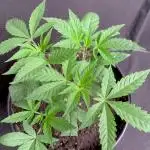
Gave her a cocktail to help with stress. Added 1st net for lateral support, not so much now, but for later. Blue light is absorbed by photoreceptor proteins called phototropins, which trigger a hormonal response that causes cells on the shaded side to elongate, making the plant bend toward the light. Try and fill this side a little. She is quite big already, just needs to find her stride again after the undue torture.
The mind is constantly working and producing, just like a factory. It's not just a passive recipient of information but an active producer of ideas, attitudes, and beliefs. The "ingredients" in this factory are the information you consume, such as books, conversations, and the media you engage with. The "products" are your thoughts, beliefs, and actions. The quality of the ingredients directly influences the quality of the output.
5 apex stems with 20-30 mini cola, let them develop a little, with the apical dominance shattered, all those 20-30 will all compete with each other as soon as that stretch is initiated. Key to a good stretch is making sure the plant is cycling efficiently, with large ATP conversions occurring lights out.
For now, keeping light intensity high. A plant will slow its vertical growth in very high light intensities, leading to a more compact form with thicker stems and leaves. This response is a protective mechanism against light stress, which can damage the photosynthetic apparatus and lead to symptoms like leaf scorching, yellowing, and brittleness. Instead of growing taller, the plant invests its energy into creating a more robust, stress-tolerant structure.
Providing plants with necessary antioxidants helps protect the photosynthetic apparatus by scavenging reactive oxygen species (ROS) that cause damage from excess light.
UV light exposure can impact the xanthophyll cycle by either enhancing its photoprotective role or causing damage, depending on the intensity and type of UV radiation. UV exposure can trigger the synthesis of more xanthophyll cycle pigments to increase the plant's capacity to dissipate excess energy, but it can also cause direct damage, particularly to Photosystem II, and may lead to a decrease in the de-epoxidation state (DEPS ratio) which indicates a reduced capacity to dissipate excess energy.
Plants can respond to UV stress by increasing the synthesis of xanthophyll cycle pigments, such as violaxanthin and zeaxanthin, to improve their photoprotective capacity. UV-induced changes in xanthophyll cycle pigments can be linked to a plant's overall tolerance to high radiation stress. The xanthophyll cycle helps protect against photoinhibition, which is especially important when the plant is exposed to high levels of both UV and visible light. High doses of UV radiation can directly damage photosynthetic components, including the proteins, lipids, and pigments in the thylakoid membranes. Exposure to UV radiation can have a mixed effect on the de-epoxidation state (DEPS ratio) of the xanthophyll cycle pigments. In some cases, UV can inhibit the conversion of violaxanthin to zeaxanthin, resulting in a lower DEPS ratio and a reduced capacity for energy dissipation. However, the total pool of xanthophyll cycle pigments may increase, and this enhanced pool size could provide a greater potential for photoprotection despite a lower DEPS ratio.
The xanthophyll cycle works alongside other mechanisms, such as the accumulation of flavonoids (UV screens), to protect the plant from UV-induced damage.
Blue light repairs 100% UV-induced damage in plants through a process called photoreactivation, which uses a light-dependent enzyme called photolyase. This enzyme uses energy from blue and UV-A light to directly reverse the damaging pyrimidine dimers in the DNA caused by UV-B radiation, a key mechanism for maintaining the plant's genetic integrity.
After carbon, light, water, temperature, and nutrients, the limiting factor of a plant's growth is often its own internal factors or the amount of a key ingredient. Chlorophyll concentration is one such factor, as the amount of this pigment limits how much light can be captured for photosynthesis. Other factors include chloroplast number, respiration rate, and the concentration of carbon dioxide in the atmosphere, as plants are often in a CO2-deficient condition.
60x60x18=64800seconds x 700 = 45,360,000moles. 45DLI
Exposure to 165 µW/cm² of ultraviolet-B (UV-B) light for 3600 seconds = 1 hour, a extremely high, acute dose triggering stress responses and protective mechanisms.
.
The plant's photoreceptor protein, UVR8, senses the UV-B radiation. This triggers a signaling cascade that activates specific genes to protect the plant from damage. In response to the UV-B signal, the plant ramps up the biosynthesis of protective compounds like flavonoids, phenolic acids, and anthocyanins. These compounds absorb UV radiation and accumulate in the epidermal layers of leaves to shield inner photosynthetic tissues. The plant may increase leaf thickness or deposit more cuticular wax, creating a physical barrier to the radiation. The plant will produce more enzymatic and non-enzymatic antioxidants to neutralize the reactive oxygen species (ROS) produced by the UV-B radiation. The plant activates enzymes, including photolyases, to repair DNA damage caused by the UV-B. These repair mechanisms are critical for preventing permanent genetic mutations.
While protective measures are activated, a high dose delivered over a short period can cause stress that overwhelms the plant's defenses.
Photosynthesis is highly sensitive to UV-B. A high dose can inactivate Photosystem II (PSII), damage thylakoid membranes within the chloroplasts, and reduce chlorophyll content, which lowers the plant's overall photosynthetic capacity. Despite repair mechanisms, high UV-B doses can inflict persistent damage on the plant's DNA. The overproduction of reactive oxygen species can cause oxidative stress, leading to the oxidation of lipids and proteins and disrupting cellular function.
I am playing in the enchanted forest. A shift in perspective is what changes perception over time. By deliberately considering a situation from another point of view (perspective), you can challenge your initial, knee-jerk interpretation (perception). This is a valuable skill in both personal and professional life for fostering empathy, improving problem-solving, and making more informed decisions.
Move the mind off perception into perspective.
Thank you.


@Ninjabuds
Volgen
The purple kush has been the smallest seedling from the start. It has finally started to actually grow for like 2 weeks or so it looked exactly the same but it’s on its way
This past week was smooth sailing I topped all the plants


@Hempface86
Volgen
Today is day 28th so we are at the end of week 4 and as you can see she is showing sex so I imagine next week will be the start of flower.. I've added one picture along with the video and I'm hoping and praying that the video uploads if for some reason it doesn't I'll be back to add more pictures.. I will say Zamnesia Seeds has some great genetics and the people over there are amazing.. hope everyone is having a great week and their plans you're doing great and if you need some seeds in the future check out Zamnesia Seeds for all your seeds head shop and mushroom needs.. happy growing everyone ✌️😎💨
https://www.zamnesia.com/us/authentication?SubmitCreate=1&ref=j1up85x0
day 32 I added a couple pictures and another video to show just how good she's doing.. I hope everyone's doing well as you can see this girl is.. have a great day a great week God bless and happy growing ✌️


@BearBuds
Volgen
This week is going well. They had.a BIG stretch this week that has been difficult to handle. Ended up having to sueprcrop 3 different branches in this tent. They also may be slightly under-watered. The Pineapple Express and MelonSickly are DRINKING. BG 41 and ZK are drinking a little less overall. Light is almost at the top of the tent now. I hope the stretch is over now that they have started to put on some pistils. They went through 1 heavy defoliation at the beginning of this week and it just 6 days later it doesn't even seem like I did one lol. I will have to give them another haircut around day 20. For now I am happy with the progress of this tent.


@ZanderZone777
Volgen
What a successful experiment! People said you couldn't grow and flower good weed in an Aerogarden so I had to prove them wrong. When I first started this grow experiment I would have been happy with a quality oz of bud. I never imagined pulling more than 2 oz's from 1 gallon of soil and only 45 Watts of light. That's 1.4 grams per watt! Already have a second Aerogarden going. This time it's Bud Bud Bling-Tingz✨ Give it a look!


@Cannabeast40
Volgen
Welcome back to yet another short update☺️
Transplanted and filled with tender care and love 🤗 A bit colder temperatures then inside the veg tent , but I’m not worried at all🤩
Videos show the process, hope you enjoy 💯💚
See you next week🤩
------------------------------------------------------------------------------------------
Light source:
Medicgrow SpectrumX
880W LED
Build in PPFD
4 controllable spectrums V1, F1, VS, FS
Visit https://medicgrow.com/ for more informaton.
Light measurement:
Apogee MQ-610 & Apogee DLI-600.
Fertiliser:
Organics Nutrients
https://www.organicsnutrients.com/en/
Green Buzz Nutrients
Discount Code: GD42025
Grants 25% with a minimum Order value at 75 Euro.
https://greenbuzzliquids.com/en/shop/


@Portnugs
Volgen
Resin is increasing and looks like bud sites are ready to start putting on some bulk. Issue with low ph drift reaching 5.2 so I decreased 50ppm with distilled water without calmag to soften the water and counter the drift.
After decreasing ppm, ph drift continues, so I flushed for 2 days with distilled water and added back nutrients at half strength to increase to 800 ppm over time.


@Rumbleleaf
Volgen
Chopped her down after 2 days of darkness before a slow dry for 1-2 weeks
Keeping humidity at 58-63 and temperature in mid to low 60s.


@Roberts
Volgen
Auto Northern Dragon Fuel is doing well. She just got her first feeding today. Coco ph is a little high, but still in range. I am gonna work on dropping it over the week. Everything is looking good so far. Thank you Medic Grow, and Super Sativa Seed Club. 🤜🏻🤛🏻🌱🌱🌱
Thank you grow diaries community for the 👇likes👇, follows, comments, and subscriptions on my YouTube channel👇. ❄️🌱🍻
Happy Growing 🌱🌱🌱
https://youtube.com/channel/UCAhN7yRzWLpcaRHhMIQ7X4g


@Alejangrow
Volgen
Removed a few fan leaves.✂️🌿
Changed the nutrient solution. 🌊💉
Very happy with this strain so far. 😁👍