


Likes
Comments
Share

@poloq
Follow
_Training
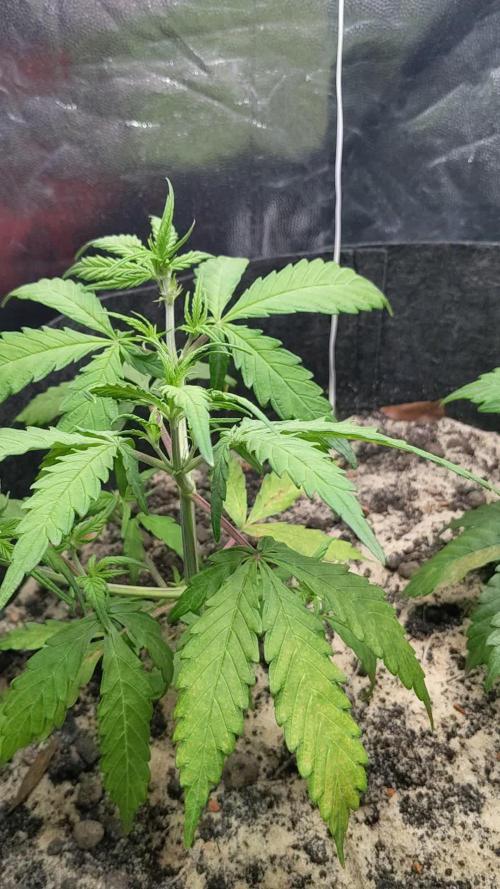
This week was the start of the LST and, with that, a continuous gentle defoliation to ensure that the new shoots are getting a lot of direct light. Leaves (especially sun sails) growing over new shoots are either pressed down or, if necessary, removed. When LSTing, I always focus on gently bending the branches in the desired direction every day, without disregarding the natural structure of the plant. Once they reach a length of about 5 cm, I start to secure them with training stakes(*1). This way, the risk of damage (as well as overall stress for the plant) is kept to a minimum.
_Setup
The lamp is now at max. intensity and min. distance (35 cm) at around 650 - 700 PPFD.
(*1) I built the training stakes myself to match my needs (enough length, natural material, no sharp edges, slightly downward facing angle).
_Pests + Living Soil + Environment
The combination of nematodes and sand seemed to work immediately, because the number of Sciaridae quickly dropped to about 2 - 3 adult flies per day. Still, on day 40 (8 days after adding the sand) I removed it again, because:
1. It was rather intended to support the nematodes (fewer new larvae),
2. The Sciaridae had fallen to a level that seemed acceptable,
3. It would keep the soil too anaerobic and moist in the long term.
The decision also had a positive effect on the RH(*2) (approx. 10% increase).
(*2) Relative humidity fluctuated slightly from day to day, but generally remained around 50%. Although removing the sand (at the end) of this week increased the RH, I only evaluated this ‘new average' RH from the following week onwards.
_Environment + Plants
The stabilization of the environmental conditions and the increase in light, have allowed the plants to grow intensively this week. In the beginning, the relative humidity was still a little lower than I would like, but acceptable since the plants were still quite small and didn't need to be watered as often. [Large amount of substrate with corresponding buffering effect to keep the plants healthy.]
During the seedling phase, I observed slight deficiency symptoms that at first glance looked like a nutrient problem (potassium, calcium, ...?). Since I cannot control the nutrient content as precisely as I could with a hydroponic system e.g., and the damage was manageable and occurred during a phase in which I also stressed the plants by allowing them to become too dry, I simply ignored it in hope that the system will stabilize itself.
*Gorilla Z Auto was 20 cm tall, Mimosa Cake Auto 12 cm.
_(Pre-)Flower
In the middle of this week I have also been able to observe pre-flowering in Gorilla Z, which is consistent with my other observations - especially the fact that my plants grow slower than what would be typical. [Autoflowering genetics in particular do most of their growing during the preflowering phase, which should last just under two weeks, roughly starting from week 3 - 5.]

Likes
12
Share


@Ieiogrow94
Follow
Eccoci qui!!!
Tutto procede per il meglio, i pistilli sono usciti e ora si va dritti dritti alla maturazione, NE VEDREMO DELLE BELLE!!!
Eccola!!! E' lei ora speriamo che in maturazione mantenga questi colori e che diventi sempre più rossa!!!
Sono veramente contento di questo progetto, ora devo solo aspettare per vedere i frutti.
Grazie a tutti per il supporto ❤️🔥🌲

Likes
1
Share

@all_about_420
Follow
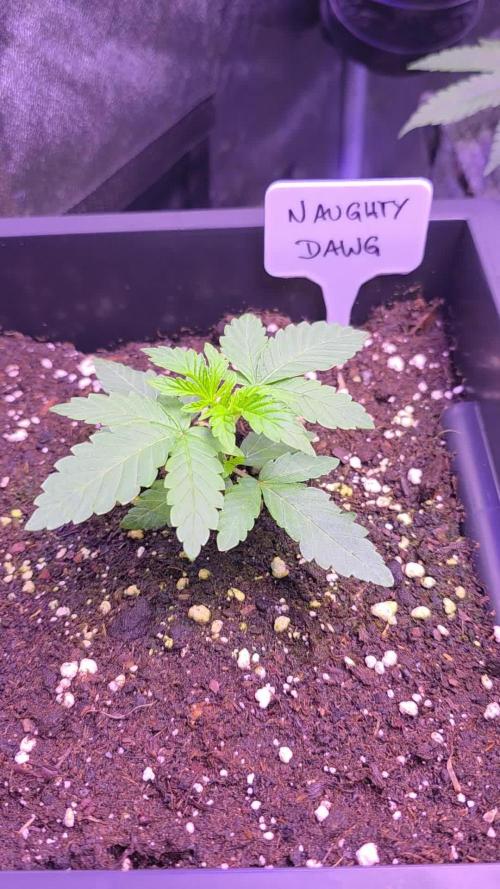
Zum Abschluss der zweiten Vegetationswoche zeigt die Naughty Dawg eine beeindruckende Struktur und ungebremste Vitalität: Zwischendurch ging es bereits in eines der neuen Topfsysteme – ein echter Gamechanger, bei dem künftig kein stressiges Umtopfen mehr nötig ist, sondern zu gegebener Zeit einfach die Trennwand herausgezogen wird, um ihr das volle Erdvolumen bereitzustellen. Den Wechsel hat die Dame völlig nahtlos weggesteckt; sie wächst wunderbar gedrungen mit extrem engen Internodienabständen, während sich bereits die dritte Nodie zügig entfaltet. Die Fächerblätter haben massiv an Fläche zugelegt, präsentieren ein makelloses, kräftiges Blattgrün und der Haupttrieb schiebt im Zentrum kraftvoll mit frischem Wuchs nach. Dank des optimal erschlossenen Wurzelraums steht sie kerngesund da – kompakt, vital und in perfekter Ausgangslage für kommende Trainingstechniken.
Processing
Likes
7
Share


@Kushizlez
Follow
(Days 15-21)
(Day 21) Everything is looking really good this week. I got my MH hooked up and dimmed to 250w. Plants are responding very well. Not a single sign of yellowing and plants are all a nice healthy green. I covered up the transparent solo cups with some newspaper as the roots are starting to pool around the bottom of the cups. I’m going to transplant everything into 2gal pots with my inoculated 50/50 coco blend sometime next week. There is a nice layer of mycorrhizal fungi starting to coat the surface now.
Blackberry breath #1 is still looking oddly deformed still but I am concluding it’s genetic.
Going to be trying this ‘Boogie Brew’ tea stuff in the next few days as well.
I’m pretty sure the leaf discoloring I saw that one day was from using unstable RO water. I am making sure to stabilize all water with rain/snow/brita before watering. It seems to have cleared up in a just a few days of proper water.
I didn’t get around to getting a c02 canister this week but I will grab it at the same time I get those 2gal nursery pots.
I’m shocked at how well the air pump is helping the bbb#2. It is always the perkiest plant in the tent and despite being a runt, it’s already outpacing most of the others in terms of new growth. I guess air is an often overlooked factor when growing. Hopefully the coco blend will help get things a little more aerated when I transplant.
Been thinking I’m going to just veg until they all show sex and then flip them.
(Day 17) I gave my first pest/mold prevention spray today. I then raised the light all the way up to the top of the tent for a few hours. Plants responded well and no spots, burn ect.
I’m also going to give my first top dressing today. I’m using my new organic dry amendments scratched into the surface of the solo cups with some added promix as a layer of mulch. I don’t want to see any yellowing at all in veg this run. I fucked up hard last time so I’m going to make sure it doesn’t happen again.

Likes
20
Share


@Robin87
Follow
So, like i said the 🍋🍒🍪 all ready for ✂️, it’s been a pleasure to grow these, will deffo be growing these again, maybe just after Xmas!🤔, now to dry them and cure them with the attention they deserve… gorilla cookies looking💥 won’t be long at all untill there ready, maybe 2 weeks max.. untill next time!👊🏻
Likes
2
Share


@Reggetable
Follow
5/3 - topped between 5th and 6th node, removed first node, pinned branches out flat, removed 2 big fan leaves blocking the lower branches, watered and fed, gave a bit over one quart. She's showing pistils already!
5/5 - repositioned the training wires and removed the top 2 large fan leaves. One of the lower branches reached the side of the container, so I topped it there.
Likes
12
Share


@Vegetoo420
Follow
Hey hey ! Trying to limit the stretch and it’s good !
Flowers started to show them faces !
Likes
17
Share


@HowtoBubatz
Follow
Week 6 of flowering, and things are heating up—literally with the scent! 🌬️💨
Both plants have significantly increased their aroma, and every time I open the grow box, I’m greeted with a strong and delightful smell that fills the space.
The non-LST plant is much further along in its development. Its buds have progressed beautifully in color, and I’ve already noticed the first amber trichomes appearing. 🍂✨
This, along with its overall appearance, is signaling that it’s nearing maturity. Because of this, I’ve started flushing the plant with clear water to prepare it for harvest.
Speaking of the LST plant, it’s about a week behind. 🌱
While it’s not as far along, it’s still thriving with strong trichome production and a stunning Lemon Haze aroma that’s sharper every day. 🍋💚
Both plants are doing great, and the differences in their timelines make this grow even more interesting. I’m excited to see how the LST variant catches up in the coming weeks! 😊🌟
Likes
6
Share


@Santi_nf
Follow
Ya está empezando a verse diferente poco a poco muchacho

Tutti Candy · Zmoothiez

Critical Widow · Pev Seeds

Sweet Skunk Fast Version® · Sweet Seeds
Skywalker OG Runtz XL Auto · Sweet Seeds

Cheese Berry · 00seeds

Hard Diesel · Gea Seeds

Scrambler Haze · Blimburn Seeds
AK · Gea Seeds
Cachalote · Gea Seeds
Gealato Kush · Gea Seeds
Gorilla Glue #4 · Gea Seeds
Somango · Gea Seeds
Likes
9
Share


@Hashsmokinslasher
Follow
Continued vegetative growth, preparing for topping, increased watering a bit more frequently to almost daily (just as needed.)
Nothing crazy just maintaining conditions.
Likes
8
Share


@MrAutogrow
Follow
Got an ounce from her. Not too much as far as yield but the dense bud structure and purple hues made it all worth while. Pressing it for rosin and it is perfect.

Likes
32
Share


@Dunk_Junk
Follow
20cm vertical growth this week!!
Things going well. Probably entering flowering in the next week.
Likes
70
Share


@MrJones
Follow
Sky Walker
~~~~~INDOOR~~~~~
DAY 148 Above Dirt
💬SATURDAY 01.20.24 - The girls are starting to hum again after last week's harsh defoliation, today will be using Real Growers Recharge for their weekly Tea Feeding, will be top dressing again next week, and this may carry the girls until the end of thier grow cycle.
💬 MONDAY 01.22.24 - 6 solid weeks into flower and these ladies are starting to fatten up their buds, they are already becoming hard as rocks, I don't think they liked the heavy defoliation I put them through and may have to be content with smaller flowers, or, maybe not, we will see. The smells are amazing with a dank and earthy fragrance also some prominent citrus and fruity notes.
📝 REAL GROWERS RECHARGE -is a mix-and-pour soil microbe superpack. It works like an instant compost tea. The soil microbes in Recharge go out and grab the nutrients in your soil, help break them down, and bring them back to your plant's root zone.
~~~~~~~~~~~~~~~
🌱Sky Walker
👨🌾Sativa Jones
🌤️@Medicgrow420
📝SeedBank Seeds
📝@gaiagreenorganics
📝Bokashi Biochar
📝Real Growers Recharge
📝 ProMix-HP
~~~~~~~~~~~~~~~
📝 Skywalker OG Strain is a top-shelf Indica dominant hybrid. It is a cross of Original Amsterdam Blueberry, OG Kush, and the indica strain Mazar from Afghanistan, and is best known for its super potent effects and sky-high THC levels.
Likes
5
Share


@MrFriday
Follow
22.09.2025
DAY 27/DAY 8VEG
RH DAY 60-63%
RH NIGHT 60-63%
Room temperature day 26-27C
Room temperature night 23-25C
EC 490
pH 5.9
Water temperature 18.5-19.5
PPFD 420
Light cicle 20/4
VPD 1.2-1.3
I'm increasing the EC to 0.48 by the Athena feeding program. A little bit of defoliation in order for the side branches to reach better light. I usually don't go in to a heavy deforestation I just occasionally remove some of the big fan leaves in order to have better light penetration. So far the roots are going great not even a slight sign of bacteria or problems in the root zone. We have nice white roots and so far is all going great. Ill probably move them in a separate buckets in week 4. I'm not sure that I'll even have 4 weeks of vegetation becose some of them are starting to show the gender signs, so probably it will be like 3 weeks veg at maximum.
DAY 28/DAY 9VEG
RH DAY 60-63%
RH NIGHT 60-63%
Room temperature day 26-27C
Room temperature night 23-25C
EC 520
pH 5.8
Water temperature 18.5-19.5
PPFD 420
Light cicle 20/4
VPD 1.2-1.3
I sense a little bit of deficiency maybe is Mn or Fe not sure but I added a little bit of CaMg and a bit more Grow A+B in order to fight it. I have heard that Athena usually are thirsty for CaMg so basically you have to add more. Plus I lower the pH to 5.8 and now the game is ON. I'll see in a couple of days but if I'm not satisfied probably I'll raise the EC to 600 with a little bit of higher CaMg for base.
DAY 29/ DAY 10VEG
RH DAY 60-63%
RH NIGHT 60-63%
Room temperature day 26-27C
Room temperature night 23-25C
EC 485
pH 6.1
Water temperature 18.5-19.5
PPFD 420
Light cicle 20/4
VPD 1.2-1.3
I realized they this problem with the leaf burn is from the Foliar feeding. NEVER PH YPUT FOLIAR FEEDING AND NEVER LEFT THE FAN WORKING🤣🤣🤣 Anyway it's all good now besides the few burned leafs. This strain is branching a lot, so basically I don't plan to use LST. I don't even think that is possible to use LST effectively becose my plants are hard and woody and only possible way for me to deal with them is through scrogging.
DAY 30/ DAY 11VEG
RH DAY 60-63%
RH NIGHT 60-63%
Room temperature day 26-27C
Room temperature night 23-25C
EC 450
pH 6.1
Water temperature 18.5-19.5
PPFD 550
Light cicle 20/4
VPD 1.3-1.4
So far I decided to use the full spectrum. The idea of the first few weeks under cold White was to preserve them a little bit and keep them short but since today we have full spectrum plus far red. Lets see what is going to happen tomorrow. I'm a little bit afraid of the temperature swing becose this will Spike higher temperature, but whatever I'll deap with it.
DAY 31/DAY 12 VEG
RH DAY 60-63%
RH NIGHT 60-63%
Room temperature day 26-27C
Room temperature night 23-25C
EC 380
pH 5.8
Water temperature 18.5-19.5
PPFD 550
Light cicle 20/4
VPD 1.3-1.4
Brutal development only for one night. I know it's hard to be seen on a picture but on live it looks amazing. The little ladies have during pretty much 2 liters of water and so far the AC is going down straight forward so they eat a lot. I had to put a little bit more of fertilizer just to keep them well fed. The Voyager is crushing it and it's only 40% on Chanel 1 and Chanel 2. In fact im not going to experiment with cold light anymore full spectrum is the deal. So far I'm not touching the EC I'm waiting for the week to pass and to jump on even higher.
DAY 32/DAY 13 VEG
RH DAY 60-63%
RH NIGHT 60-63%
Room temperature day 24-25C
Room temperature night 21-24C
EC 500
pH 5.8
Water temperature 18.5-19.5
PPFD 550
Light cicle 24/0
VPD 1.0-1.2
I couldn't wait more time for the new week to come and to increase the AC. My current AC for today was 300 and I have started to see manganese deficiency so I had to add nutrients. Tomorrow is the last day of the week after that I'll rise the EC to 670. Somehow and in my opinion Athena needs a little bit more EC Dan the recommend dose in the manual. So far that's the first fertilizer I see that needs more dan the recommendation on the label 🤣🤣🤣 Interesting fact is that now I can clearly see the reproductive organs of the plant. It's female but it's still in week two VEG. I'm curious em I going to see more dan 3 weeks VEG before we go in to Flowering ☠️😜
DAY 33/DAY 14VEG
RH DAY 65-67%
RH NIGHT 65-67%
Room temperature day 24-25C
Room temperature night 21-24C
EC 350
pH 6.1
Water temperature 18.5-19.5
PPFD 350
Light cicle 24/0
VPD 1.0-1.1
Finally I solve the problem with the leaves. It turned out that my clip fan was blowing the humidifier mist toward my flowers. I notisec that only two of the plants have this types of burbs and those are the once right next to the fan. I have changed the fan position and the dehumidifier positions and now I hope all will be fine. I have defoliated a little bit of big fan leaves and I hope in the end of the next week I'll have time to move the RDWC buckets becose I'm a little bit busy does days. I have lower the PPFD becose it seems that this is a bit to much for the flowers.


Likes
3
Share


@Bear_Grows_Green
Follow
04/11 Another week. I'm not doing good at keeping up on this this time lol watered in full volume with goodies got Blumat dialed in
04/17 watered in full supplentalnfeed with extra will add in later. same stuff I always use at same rates.ntopped off all res will be out of town for 3 days see how they do. did raise vpd a bit and light. 8 days from flip

Likes
1
Share


@FrostyLeafs
Follow
"The 3rd day in flowering. I give 2.2 liters of water every 2 days. I'm still experimenting with how long the timer needs to run to give enough water.
😎✌️
BT6
The stretch is strong and i have no space left 👀
5weeks Vegi was to long

Likes
1
Share


@Grow_miss
Follow
The effect was very Indica-heavy, but I also harvested it with a relatively high amount of amber trichomes.
W
Likes
11
Share


@BLAZED
Follow
Week 6 (3-3 to 9-3)
3-3
Temps: 17.9 to 22 degrees
Humidity: 58% to 74%
4-3
Temps: 17.8 to 21.9 degrees
Humidity: 61% to 72%
5-3
Temps: 17.8 to 21.5 degrees
Humidity: 55% to 79%
Watering: Both 1000 ml. (Only calcium)
6-3
Temps: 17.8 to 21.7 degrees
Humidity: 66% to 82%
7-3
Temps: 17.6 to 21.7 degrees
Humidity: 68% to 82%
8-3
Temps: 17.7 to 21.7 degrees
Humidity: 70% to 88%
Watering #1: 1000 ml.
9-3
Temps: 17.3 to 21.5 degrees
Humidity: 63% to 87%
Installed the dehumidifier, as the humidity is getting high at lights off.

Likes
25
Share


@Chubbs
Follow
This girl is refusing to stop growing absolutely phenomenal. It's stacking and swelling into a monster of a plant. Drinking a gallon a day and not slowing down. The flowers are progressing nice and starting to develop. The sour smell already is super strong and it'd be an understatement if I said I wasn't excited for these to finish but still looks like a couple more weeks. Happy