


Likes
Comments
Share


@Bread_n_Buds
Follow
Our Monster Dwarf Automatic #2 is the most resin-producing monster of this autoflowering season, bursting with energy from every stomata, trichome, and the fantastic microcosm I photographed for you.
The buds are firm, truly of high quality, especially in terms of resin.
Maturity - The resin content is excellent. The trichomes are amber, with some very beautiful red heads when ripe (about 60%), with some white/cloudy ones (20%), and a few transparent ones (20%). There are quite a few beautiful red-headed trichomes, as mentioned. The pistils are almost all red (about 85%). Remember, the plant should be harvested according to your tastes. Since it's an indica-dominant plant, I want to make the most of the relaxing side, and I let this plant mature quite a bit longer than usual for me. Remember: Amber is a sign of THC oxidation, so don't overdo it!
The overall shape of the plant is truly splendid.
Techniques chosen: As mentioned, we performed a not-too-intensive LST here, followed by just pruning, lollipopping, and defoliation. Essentially, we cleaned the lower parts, which, as mentioned, helps us achieve better results on the surface.
We're 100% organic and 1000% Plagron, as always.
The soil we chose is the recently launched Plagron Bio LightMix, which will allow us to start with smoother and more reliable watering, without the sudden changes that liquid fertilizers can cause. A week's worth of soil is sufficient, so don't overdo it.
Choose your preferred style and calculate your results on the website:
www.plagron.com
Visit the new Growshop area on the Zamnesia website:
Z - https://www.zamnesia.io/it/531-growshop
A fantastic strain, a heavenly scent,
above-average resin production!
Z - https://www.zamnesia.io/en/4330-zamnesia-monster-dwarf-auto-feminized-seeds.html
Z - Monster Dwarf Auto is a new addition to the Zamnesia range. Extremely compact, it's the size of a bonsai tree. This autoflowering strain boasts numerous qualities. To create this hybrid, Zamnesia combined some of the best autoflowering strains with an exceptional Skunk female, preserving all of its autoflowering characteristics.
Its name should already give you an idea of what to expect from this plant. Monster Dwarf Auto is small and mighty! It maintains a very compact structure, never exceeding 40-60 cm in height, proudly displaying a large quantity of compact, elongated buds towards the end of flowering. This strain is suitable for small grow spaces. It performs equally well in larger grows, both indoors and outdoors, and requires no special growing skills to achieve excellent results in about 8-9 weeks. Given its autoflowering nature, even less experienced growers can easily achieve excellent yields of 60 grams per plant, without requiring any special attention. Thanks to its Skunk genetics, it's no surprise that Monster Dwarf Auto is capable of releasing very intense aromas and developing beautiful, compact buds completely covered in resin. Its Skunk lineage is also evident when smoking it: the effects are worthy of an incredible Skunk hybrid, full-bodied and very relaxing, yet capable of keeping you sociable without being excessively heavy.
Monster Dwarf Auto is a small, fast, and easy-to-grow plant. Despite its small size, it stands out from other autoflowering cannabis strains!
You know it, but I recommend it. Here you will find many wonderful things, essentially "the best that nature has to offer."
Z - www.zamnesia.com
Music //
www.radionula.com
+ Feng Shui Music
+ 432 Hz Frequencies

Likes
3
Share


@Deda_Lebeda
Follow
The BlackBerry Gum Auto didn't fit anymore, I had to bend it - 170 cm :)
AutoXtreme blooms beautifully - 150cm
Sorry for my English...


Likes
10
Share


@HideAndFly420
Follow
Day 57 this little lady last weekend showed up with some burning on the leaves but I’m. Not really sure it was an excess of nutrient, signals of a deficiency of K and P are also visible. So I just gave oh controlled water with regulator and enzym+ and some calmag, now everything looks fine and i ‘ m sure I t will be great this week.
Tomorrow, feeding day!
Day 59 lady si farting up every day, I’ve been feeding her the last two days. The yellow on the leaves is just because of a water deficiency from the last week, I wanted my lady to absorb everything I gave. On day 57 I gave 1 lt but it was too dry, so on day 58 I gave her another lt and she took it all with PH 6,2 and PPM 1000z
I think I’ve got 20/25 day max left so this will be the last week of fertilising from
Day 70 I’ll start mi flush.
Day 62 today feeding day I finally get my p-boost and k-boost from aptus. She drunk 1 lt with
ph 6,1 and ppm 1090
Let’s see🌱🌱🌱🔥🔥

Likes
91
Share


@CANNASIM
Follow
RQS . STRESS KILLER AUTO CONCLUSION BEFORE HARVEST.
Harvest time is here, choose to do a final post with how the girl looks after the final flush, so enjoy.
If you are looking for a super resistant strain and easy to grow functional medical strain this is the one.
She was given tap water, and used flawless finish for 6 hours then flush again, 2-3 times in this two weeks, expecting top shelf from her.

Processing
Likes
4
Share


@Barcelona_Farmers710
Follow
Booom! Ya tenemos los cogollos formandose Farmers!! Ya casi no se nota la falta de magnesio por problema con el humidificador pero en breves ya empiezo lo buenoo!😜 espero que os guste farmers buen comienzo de semana!!💚
Likes
3
Share


@GardenxManxJames
Follow
Heavy feeding really don’t give it plain water the uva light are helping . But did some defoliation.

Likes
Comments
Share


@all_about_420
Follow
Ein schier unendlicher Stretch prägt das Bild im Hintergrund des Gartens, wo die beiden Junkies mittlerweile zu beachtlicher Größe herangewachsen sind und den oberen Raum des Setups imposant einnehmen. Während die dritte Blütewoche voranschreitet, hat die Blütenbildung nun voll eingesetzt und zeigt überall an den langgezogenen Trieben eine wunderschöne, dichte Ansammlung von ersten, schneeweißen Blütenhaaren. Trotz des enormen Höhenflugs stehen beide Exemplare perfekt im Saft, zeigen tiefgrüne, vitale Fächerblätter und nutzen die Lichtenergie meisterhaft aus. Die Struktur hat sich hervorragend geöffnet, wodurch die entstehenden Buds perfekt ausgeleuchtet werden und die Basis für eine extrem vielversprechende Harzproduktion gelegt ist. Es ist eine wahre Freude zu sehen, mit welcher Kraft und Stabilität diese Genetik von Brothers Grimm Seeds abliefert, während die ersten echten Blütencluster jetzt von Tag zu Tag sichtlich an Masse zulegen.


Likes
6
Share


Likes
13
Share


@YOUNGSTERBR
Follow
exagerei na rega até o meio da semana, deixei 4 dias sem rega e recuperaram, umas pelo estresse começaram mostrar défice de fósforo, fiz uma cobertura com torta de mamona, farinha de ossos, esterco de aves, humus de minhoca e calcário.
Qual foto colocariam de capa dessa semana?

Likes
47
Share


@blazin_skywalker
Follow
Day 64 - I've been patiently waiting for the time to come, and it's finally here! Changed the lights over to 12/12 to send the tent into flower. Current light settings R99 W99 B50 as suggested by California Lightworks.
I did a full reservoir change - switching over to bloom nutes. I also added some Si28 and P31 Microbes to the reservoir to test out this new product that I was fortunate enough to receive samples of. I've seen the results of others with crazy booming root growth.... Let's see what happens!
Day 65 - I swear, it's like she's been waiting for me to flip the light cycle. I kicked one plant out of the tent so now there's even more room for improved air circulation and light distribution.
This plant is a serious beast!
Day 67/ Day 3 of Flower - Last massive round of defoliation before I sit back and let her do her thang. ✌️

Likes
9
Share

@Mimi420
Follow
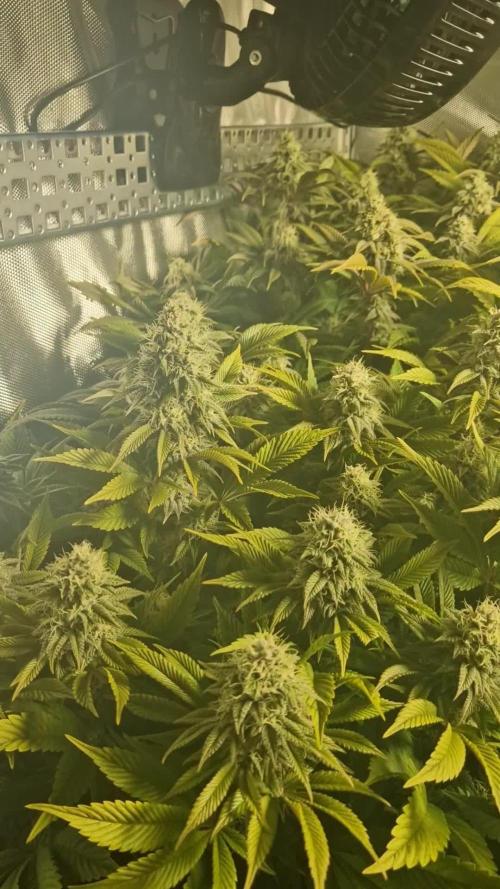
Day 42 — FLO | Mixed SCROG (120×80) Box smells unreal — sticky as hell. Buds are packing weight and the trichs are starting to turn milky in spots, but most are still crystal-clear so I’m letting them cook a bit longer. Canopy is fat, structure solid; loads of resin on every cola — fingers already gluey from checking. Night temps and RH still a pain (cold garage), so I’m watching for any mold hotspots and keeping airflow moving. Overall super happy with how this mixed run turned out so far.
Quick state:
Lights: 400W HPS + 300W LED (4000K) — plenty of punch.
Media: 20 L smart pots, BioBizz soil + myco, organic feeds (BioBloom, TopMax, Green Sensation).
Training: SCROG, LST/HST done, minimal tweaks now — mostly letting the flowers fatten.
Trichomes: pockets of milky, majority still clear — not chop-ready yet, keep peeping with scope every 2–3 days.
Plant-by-plant notes (position → short ID + what I see)
Back-left — Wedding Cake (Portland)
Very frosty, main colas are dense and sugary. Pistils starting to darken a bit, buds showing early signs of swelling. Trichome coverage is heavy — this one will likely be a resin monster. Watch for the classic sweet/creamy aroma to deepen.
Back-center — Kush Crasher
Properly turning purple and looking gorgeous. Leaves are showing that cool kush coloration and the colas are chunky and stout. Very sticky, strong nose developing (earthy / diesel kush). Keep temps stable so the purple stays and you don’t stress it too hard.
Back-right — AK-47
Shorter, compact nodes but stacking nice little cola clusters. Classic AK structure — not the frostiest but reliable bud density and a punchy terp profile expected. Nice even development under the HPS.
Front-left — Double Krush
Buds forming tight clusters — a little leaner than the gassier strains but foxtailing less and stacking nicely. Shows vigour and is filling in under the canopy. Good candidate for chunky colas if you let it finish a touch longer.
Front-center — Wappa
Main cola is a beast — this one’s the show-stealer for bulk. Fat, chunky top cola, already showing awesome density and slight color shift. Expect a heavy, compact cola at chop. Loving how the Wappa is responding to your SCROG.
Front-right — Detroit Runtz
Longer, slightly looser colas compared to the others but super resinous. Shows those fruity/runts vibes — buds are coating in trichomes and the structure looks promising for aroma/density trade-off. Might finish a touch sooner or later depending on phenotype, keep an eye on the trichs.
What I’d do next (short checklist):
Keep scope-checking trichs — pockets of milk = start of the final swell. Most still clear → not ready yet.
Hold off major defol or HST now; only small tidy-up if airflow spot is tight.
Watch RH closely at night — lower if I can (dehumidifier or heater + intake trick). Mold is the enemy at this point.
Last heavy feed flush plan: stay conservative — these look on the edge of finishing, so taper nutrients as trichs go 30–50% milky and pistils darken.


Likes
7
Share


Likes
3
Share


@LittleBigTrees
Follow
Defoliated and in its flowering pot, switched to 12/12 on day 35 she's stretching out nice.
Will start feeding from week 7.
Likes
8
Share


@DogDoctorOfficial
Follow
# 💙 Project Blue Tent – Week 12 💙
## 🥒 Pickle Lemon Haze F1 – Pheno A
### 🌸 Same Tent. Same Ecosystem. Another Ridiculously Frosty Girl! ❄️😂
Hello everyone, and welcome back to another chapter of Project Blue Tent! 💙🌱
And here we go again...
ANOTHER GIRL LOOKING ABSOLUTELY OUTSTANDING! 😂❄️
Seriously, my friends, what is happening inside this tent?
Every time I think the flowers can't look any frostier, I take another look at the plants, grab the camera, and end up spending far too much time staring at the photographs.
And Pickle Lemon Haze F1 Pheno A?
She's giving us plenty of reasons to do exactly that!
Welcome to Week 12 of our journey, where the major structural work is behind us, the ecosystem is running beautifully, and our attention is increasingly focused on the flowers themselves.
The plants are stacking. The buds are developing. The trichomes are becoming increasingly visible, and the entire tent is looking absolutely beautiful.
This week, we decided to keep the photography more focused rather than taking endless individual pictures. But that doesn't mean we spent less time behind the camera!
Quite the opposite.
We created three separate photo stacks, combining a total of 1,452 photographs.
Yes, you read that correctly.
ONE THOUSAND FOUR HUNDRED AND FIFTY-TWO PHOTOGRAPHS!
😂📸❄️
But we'll get to that in a moment.
First, let's give this beautiful girl her own chapter.
## 🌸 WEEK 12 – PICKLE LEMON HAZE IS SHINING
Pickle Lemon Haze F1 Pheno A is approximately 145 cm tall, and the structure we've worked so hard to establish is now supporting the developing flowers beautifully.
The long vegetative period gave us the framework.
The topping and training helped us distribute the growth.
The first SCROG helped organize the canopy, while the second SCROG provided additional support as the plants progressed through the flowering stretch.
We also performed the major defoliation, improved the airflow arrangement, and made room for the under-canopy lighting.
All those decisions happened over several weeks.
Now we're looking at the result.
And honestly, this is one of my favourite stages of the project.
Not because we're doing more.
Because we finally have the opportunity to step back and appreciate what we've built.
The structure is established. The support is in place. The irrigation and drainage systems are working beautifully, and the plants are continuing to develop.
So we're not looking for unnecessary interventions.
We're watching the flowers, monitoring the environment, and allowing the plants to continue their journey.
And Pheno A?
She's looking absolutely fantastic!
💙🥒🌸
## ❄️ THE FROST – I DON'T EVEN KNOW WHAT TO SAY ANYMORE!
Let's be honest.
The photographs speak for themselves.
Look at those flowers!
The close-ups reveal an incredible amount of detail across the developing buds and surrounding sugar leaves.
The trichomes are clearly visible, the pistils remain prominent, and the flowering sites are continuing to develop.
This is the stage where the details become increasingly fascinating.
From a distance, we can appreciate the overall structure and how evenly the flowers are distributed throughout the canopy.
But when we get closer, there's a completely different world waiting for us.
Individual trichomes. Delicate pistils. Resin-covered sugar leaves. The intricate structure of the developing flowers.
And that's why I love macro photography so much.
It allows us to appreciate details that can easily go unnoticed when we're simply looking at the entire plant.
And this week, Pheno A gave us some absolutely beautiful subjects to work with.
She's frosty.
Her sisters are frosty.
And honestly, the whole tent is becoming a photographer's dream!
😂💙❄️
## 📸 THREE PHOTO STACKS – 1,452 PHOTOGRAPHS COMBINED!
Now, let's talk about the photography, because this week's report has something special to show.
We decided not to take quite as many individual photographs this time. Instead, we concentrated on creating three detailed photo stacks.
Here's what we produced:
- One photo stack combining 666 photographs.
- A second photo stack combining 393 photographs.
- A third photo stack combining another 393 photographs.
That's a total of 1,452 photographs combined into three final images!
And yes, this takes considerably more time than simply taking a few pictures and choosing the best ones.
😂📸
Each stack requires patience, attention, and time behind the camera and at the computer.
But I think the results are worth sharing.
These stacks allow us to explore the flowers in much greater detail and give everyone following Project Blue Tent a closer look at the development we're documenting.
We're not simply trying to produce attractive photographs.
We're also trying to preserve a visual record of the plants as they progress through flowering.
And when you look at the finished stacks, you can really appreciate the intricate details across the flowers and the surrounding sugar leaves.
That's what makes this kind of photography so rewarding.
You start with hundreds of individual frames, work through the stacking process, and eventually produce a single image that reveals a remarkable amount of detail.
Three stacks.
Three opportunities to look closer.
And one very photogenic Pickle Lemon Haze F1 Pheno A!
## 🔬 WHY PHOTO STACKING IS WORTH THE EXTRA WORK
For anyone unfamiliar with the process, focus stacking involves combining multiple photographs taken at different focus distances to produce a final image with a greater depth of field.
In macro photography, the depth of field can be extremely shallow.
You can have one part of a flower beautifully in focus while another part, only a short distance away, falls outside that narrow focus plane.
By combining multiple frames, we can bring more of those details into focus in the final image.
Of course, stacking hundreds of photographs takes time, and the result depends on the source images and how well the stacking process handles them.
But when everything comes together, it can be a fantastic way to document small details.
And that's precisely what we wanted to achieve here.
Rather than filling the diary with endless individual pictures, we concentrated on three detailed stacks that allow everyone to appreciate the flowers from a different perspective.
I'm genuinely happy with the results.
And I hope you enjoy looking at them as much as I enjoyed creating them!
📸💙
## 🌿 SAME TENT. SAME ECOSYSTEM. SAME CULTIVATION APPROACH.
One of the most interesting aspects of Project Blue Tent is that we're documenting individual plants while keeping the shared environment consistent.
The plants share the same tent, lighting environment, irrigation system, reservoir, and nutritional program.
That gives us an interesting opportunity to observe their development side by side.
And when I look at Pickle Lemon Haze F1 Pheno A alongside her sisters, I continue to be impressed by the similarities we're seeing.
The overall structure is remarkably consistent.
The flowering development is progressing beautifully.
And the visible frost across the plants is becoming increasingly impressive.
Of course, we're still documenting each plant separately because individual differences remain interesting, even when the plants look remarkably similar.
The subtle details matter.
Flower shape, development, structure, and the way each plant progresses over time are all worth observing.
That's the beauty of keeping individual diaries.
We can appreciate the similarities without losing sight of each plant's own story.
And today, Pheno A gets the spotlight.
She's earned it!
💙🥒🌸
## 💡 UNDER-CANOPY LIGHTING – COMPLEMENTING THE MAIN LIGHTS
Our two LumiFlora 150W full-spectrum under-canopy fixtures remain part of the setup.
The main LEDs provide the primary lighting from above, while the LumiFlora fixtures supplement the lower portions of the canopy.
With plants reaching approximately 145 cm, the canopy has developed into a substantial three-dimensional structure.
Naturally, different parts of the plant receive different amounts of light depending on their position.
That's why we've been interested in exploring supplemental lighting beneath the canopy.
Rather than treating the overhead lights as the only source of illumination, we're experimenting with adding light to the lower portions of the plants.
And now we have another interesting question to follow throughout the coming weeks.
How will the lower flowering sites continue developing under this arrangement?
We're not going to promise a particular result before we have the observations to support it.
We're documenting the setup and watching what happens.
That's the whole point of this project.
Introduce an idea. Keep the other conditions as consistent as possible. Observe the plants. Record the results.
And learn something along the way.
💡🌿
## 🕸️ THE STRUCTURE IS ESTABLISHED – LET HER DO HER THING
Remember how much work went into getting these plants to this stage?
The topping.
The training.
The first SCROG.
The flowering stretch.
The major defoliation.
The second SCROG.
The airflow adjustments.
All those steps helped us establish the structure we see today.
And now, we're not trying to reshape the plant every week.
The branches are supported, the canopy is established, and the flowering sites are developing throughout the plant.
There is always something we could do.
We could move something, adjust something, cut something, or change something simply because the opportunity exists.
But that doesn't mean we should.
At this stage, stability and observation are just as important as the earlier structural work.
The plant doesn't need us to keep proving that we own scissors.
😂✂️
Sometimes the best decision is to leave things alone.
And that's exactly the approach we're taking with Pheno A this week.
## 🌬️ AIRFLOW – KEEPING THE WHOLE CANOPY IN MIND
The airflow arrangement remains part of the established system.
With a substantial canopy, we want to maintain air movement throughout the upper, middle, and lower portions of the plants.
The earlier defoliation helped open the structure, and the airflow system helps keep air circulating through the available space.
This is particularly relevant when we're working with supplemental lighting beneath the canopy.
Light is one part of the environment, but it doesn't exist in isolation.
Air movement, temperature, humidity, irrigation, and nutrition all contribute to the overall conditions the plants experience.
So we continue paying attention to the entire ecosystem rather than focusing on one piece of equipment in isolation.
The goal isn't to make constant adjustments.
It's to maintain a balanced environment and respond when there's a genuine reason to do so.
## 💧 IRRIGATION AND DRAINAGE – KEEPING THE SYSTEM CONSISTENT
The irrigation and drainage system continues to be an important part of Project Blue Tent.
All four plants share the reservoir, allowing us to maintain a consistent nutritional approach across the tent.
The recorded watering volume is approximately 1.6 litres per plant over 24 hours.
As always, that figure is a recorded value rather than a guarantee that every plant consumes exactly the same amount under every condition.
Plant demand can vary, and our observations remain important.
The key point for this week's report is that we're maintaining the established system while observing the plants.
No unnecessary changes.
No need to complicate something that is already working.
Keep monitoring, keep recording, and let the plants show us how they're progressing.
💧🌱
## ⚗️ NUTRITION – GREEN SENSATION IS PART OF THE RECIPE
Now, let's make sure we document the nutrient program correctly.
We're continuing with the PLAGRON Hydro line, and **Green Sensation is included in the current recipe**.
We are not using Hydro Roots in this recipe.
There is also a small documentation correction underway across the earlier Project Blue Tent reports. Some previous entries listed Hydro Roots where Green Sensation should have been recorded.
Those reports will be corrected to reflect the actual nutrient program. The exact week Green Sensation was introduced will be checked against the original records rather than guessed.
For this week's report, we're recording the current recipe as shown in the diary.
### Current nutrient recipe
- PLAGRON Hydro A — 2.2 ml/L
- PLAGRON Hydro B — 2.2 ml/L
- PLAGRON Power Buds — 1 ml/L
- PLAGRON Green Sensation — 1 ml/L
- PLAGRON pH Plus — 0.03 ml/L, as recorded
- PLAGRON pH Minus — 0.03 ml/L, as recorded
The recipe remains unchanged this week.
The recorded pH is 6.01, and the recorded EC is 2.24 mS/cm.
This also explains why the previous discussion about the EC changing alongside a supposed nutrient substitution was misleading: the report had the wrong product listed. We were already using Green Sensation, not Hydro Roots.
That's an important distinction when documenting a grow.
The written report needs to reflect what was actually being used, not simply repeat an incorrect entry from the previous week.
We'll correct the earlier reports as needed, and from here onward, we'll keep the recipe accurate.
Consistency in the reservoir is one thing.
Consistency in the documentation is another.
Both matter!
## 🌡️ CURRENT BLUE TENT CONDITIONS
- Cultivar: Pickle Lemon Haze F1
- Phenotype: Pheno A
- Flowering: Week 12
- Height: Approximately 145 cm
- Light schedule: 12/12
- Day air temperature: 27°C, last recorded
- Night air temperature: 27°C, last recorded
- Relative humidity: 59%, last recorded
- pH: 6.01, last recorded
- EC: 2.24 mS/cm, last recorded
- Solution temperature: 25°C, last recorded
- Substrate temperature: 24°C, last recorded
- CO₂: Approximately 666 ppm, last recorded
- Pot size: 8 litres
- Watering volume: Approximately 1.6 litres per plant per 24 hours, recorded value
- Under-canopy lighting: 2 × LumiFlora 150W full-spectrum fixtures
- Nutrient line: PLAGRON Hydro
- Green Sensation: 1 ml/L
- Hydro Roots: Not included in the current recipe
The temperature and humidity were adjusted slightly as part of the ongoing environmental management. The values above are the last recorded readings, so any newer measurements should replace them when available.
## 🔭 WHAT I'M WATCHING NEXT
At this stage, my attention is on the flowers and how they continue to develop.
I'm watching the bud formation.
I'm watching the visible trichomes.
I'm watching the lower flowering sites and the areas receiving supplemental light.
I'm watching how the plants continue developing under the established environmental conditions.
And, of course, I'm looking forward to creating more detailed photographs as the journey progresses.
These three stacks have given us a beautiful look at Pheno A, but they're only one moment in a much longer story.
There's still plenty to document.
And I'm particularly interested in seeing how the flowers change as flowering progresses.
We're not going to predict the ending before we get there.
We're going to keep observing and let the plants show us what comes next.
That's what makes this journey worthwhile.
## 💙 FINAL THOUGHTS – PICKLE LEMON HAZE IS LOOKING OUTSTANDING!
My friends, Week 12 has been another beautiful chapter inside Project Blue Tent.
Pickle Lemon Haze F1 Pheno A is looking fantastic.
The structure is established, the flowers are developing beautifully, and the visible frost is absolutely impressive.
The irrigation and drainage system remain part of our consistent setup, the under-canopy lighting continues to supplement the main lights, and the nutrient recipe remains unchanged.
We've also put a considerable amount of time into the photography, producing three stacks from a combined 1,452 photographs.
And honestly, I'm delighted with the results.
The stacks allow us to appreciate details across the flowers that a single photograph might not capture as clearly.
That's one of the things I enjoy about documenting these plants.
There is always another detail to discover, another photograph to create, or another observation to record.
And when I look across this tent, I'm reminded of why we started Project Blue Tent in the first place.
Four individual plants.
Two cultivars.
One shared environment.
And a chance to follow their development separately while keeping the growing conditions consistent.
The similarities are fascinating, the flowers are beautiful, and Pheno A is giving us plenty of reasons to keep the cameras ready.
So, for now, we're keeping things steady.
We're observing.
We're documenting.
We're learning.
And we're enjoying the show.
Because sometimes the best part of cultivation isn't doing more.
It's seeing what happens when you've done the work, established the system, and given the plants the time they need.
And this beautiful girl?
She's making that wait worthwhile.
💙🥒🌸❄️
## 🙏 A HUGE THANK YOU
A huge thank you to Zamnesia for making Project Blue Tent possible and giving us the opportunity to document these beautiful Pickle Lemon Haze F1 cultivars individually.
Thank you to PLAGRON for the Hydro nutrient line supporting the project, including Green Sensation as part of our current recipe.
Thank you to Mars Hydro for the irrigation and drainage equipment helping us maintain consistency throughout the tent.
A massive thank you to Zamnesia for the Phytonaut LED lighting, curved scissors, and clip fans that have become important parts of this ecosystem.
And a special thank you to LumiFlora for the 150W full-spectrum under-canopy fixtures that we're using to explore supplemental lighting beneath the canopy.
Thank you to GrowDiaries for giving us a platform to document the journey, share the photographs, and keep a record of the experiments and lessons along the way.
And, of course, thank you to everyone following Project Blue Tent!
Your support makes sharing every individual chapter even more enjoyable.
We're still learning. We're still observing. We're still finding new details to appreciate.
And Pheno A has given us another beautiful week to document.
Until next week...
Same tent. Same ecosystem. Another beautiful girl.
More flowers, more frost, and more reasons to pick up the camera.
Growers Love, happy growing, and take care everyone! 🌱💙🥒❄️


Likes
7
Share


@NCgrower252
Follow
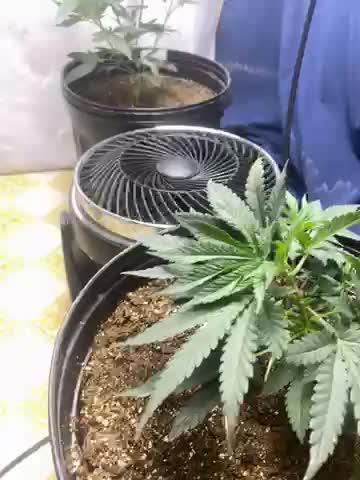
The plants are doing great! Nice, strong aroma. Having a hard time keeping the humidity down due to the outside temperature. We’ve had a lot of rain and humid weather lately. Each strain is growing at its own pace. Almost ready to start Harvesting the Colombian Gold plants.

Likes
13
Share


@Sadhus
Follow
Sa a bien stretch partout, tout est sain , rien a signaler, sa commence a fleurir
On y va molo sur l'engrais, belle plante , on voit que les boutures se plaisent en hydro , et les mamans se portent bien en terre 100% organic , sa annonce du beau tout sa , un phénotype sur 4 sort du lot par son stretch 2 fois plus prononcé que les autres,mais dans l'ensemble tout ce porte a merveille j'ai hâte de voir les buds
#madamegrow
#trolmaster
Likes
81
Share


@XII_XII_MrGreen
Follow
I'm gonna jump right in..👨🌾
The high stress technique I have used a couple days ago called super cropping, I (tried more or less) to keep the canopy under control and more even. This also allow lower bud sites to rise to the top and slow down the 'stretching'.
🌲🌲🌲🌲🌞🌞🌞🌞
The trade in doing it at this stage, is that the plant is also focusing more on healing the stems instead of total focus on the buds. But I'm probably early enough in the flower stage they will make it up by having more strong stems in the end. That's because the points they are broken now are gonna heal back more strong.💪💪💪
I've added some nutrients to help them heal.
Aptus is working great with my organic soil👍😎💚 🌊💦
🌞🌞🌞🌞🌞🌞🌞🌞🌞
As you maybe have seen I've added some extra lights. This are Mars Hydro's new Adlite's.
Here is some info about them in my own words.👨🌾
-IR 15,
is a infrared light that is promoting extra photosynthesis.
Basically long wave length of lights that will penetrate leaves and hit the stems, so the idea is stems will be more strong and be able to carry bigger buds.
-UV 30,
is a ultraviolet light that will try to mimic the radiation that comes of the sun.
A little explanation about what this does to the plant in nature is that the plant will make it's own sunblock oil in the form of trichomes. So by adding this light the idea is that the plant is gonna work more to block this 'radiation'.
-Deep Red 30,
is like the title maybe already explained a red light booster.
In nature the spectrum of the sun changes with the season, so it's easy to explain the sun will get more intense and contains more red in the summer. The wavelength of red is also pretty long like the 'infrared' these will sometimes penetrate leaves and hit stems and lower buds.
The idea is more photosynthesis.


Likes
5
Share

@Jcoutdoor
Follow
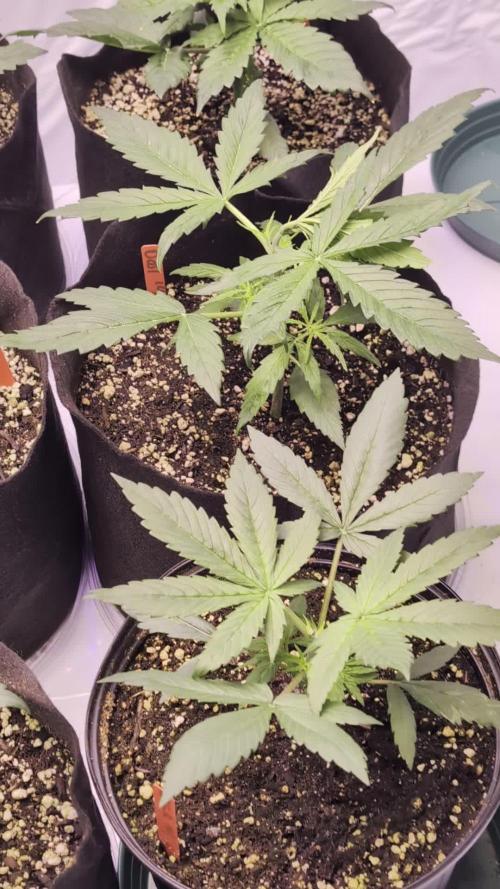
Wow the autos are taking off now that temps are stable.
still fully in veg no signs of hairs yet but everyday they are growing new leaf's.
will update next week with a hopeful big boost to the plants