Check the winners The Grow Awards 2026 🏆 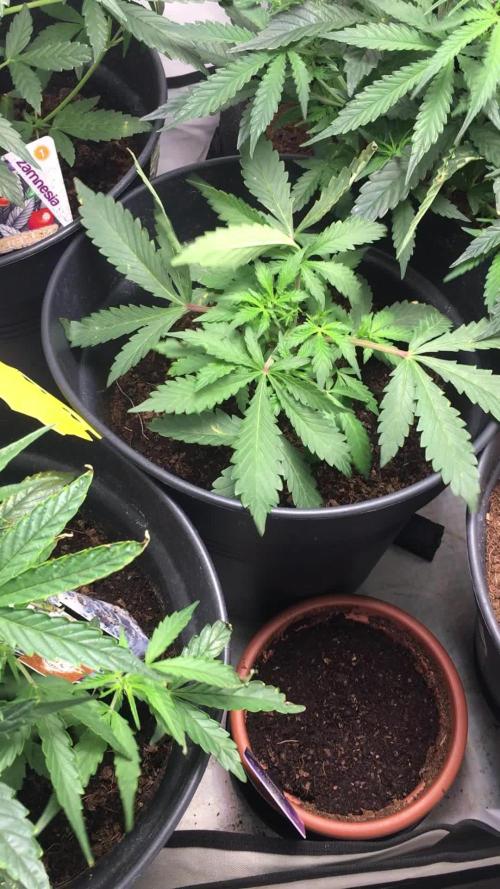













Likes
Comments
Share
@wolfvb
Follow
Our girl is doing really nice, the training was successful and now part of her is under ground and she is growing nice.
I have increased the water intake a bit more
6.01.26
Yesterday I have toped her and she took it well, and finished all training for her, she is late looking really nice and compact now.
7.01.26
Our girl is doing really well and already recovered and redirected the growth.
I have also Increased the lights to 70% and left it a bit more

Likes
28
Share
@Ultraviolet
Follow
Still got some slight burning of leaf tips more so on the right side of the tent. Otherwise, growth is good.
Stratiolaelaps scimitus are now abundant in the soil. Pretty neat.
GIBBERELLIN:
Note: As gibberellic acid is not soluble in water you need to dissolve in alcohol first,
Mixed 0.75g Gibberellic Acid 90% with 50ml of 99% Isoprponal alcohol , (Any alcohol will do but a higher % works better) also warmer alcohol helps dissolve the gibberellin.
Mixed with 1000ml =1L of distilled water, bringing the concoction to 400ppm. 2000ml = 200ppm etc
Every plant has a different threshold required to elicit a response, 400ppm is on the high end of the scale I've read to be careful with dosage as it's easy to over-apply, let's find out if it does anything like it described.
Added bunch of enzymes, aminos, 5 or so different kelp.
Can be kept for 1 week in the refrigerator.
Nutrients for the week are recipe foliar application. The speaker (containing a 3 KHz signal and nature sounds) is played at high volume with high treble and medium bass for 10 minutes before spraying the plants. The plants are then sprayed while it's playing and the sound is continued for another 20 minutes after spraying. Both sides of the leaves should be saturated. Treatment is best performed early in the morning/daylight, preferably in foggy 65+RH% dew. On cold mornings, spraying should be delayed until late afternoon if outdoors. Do not spray plants when the temperature falls below 50o F. The formula also can be administered in the regular weather supply, by drip-feeding, hydroponics, etc.. The nutrient solution should be applied once somewhere in first 4 weeks, then twice weekly thereafter.
https://biologydictionary.net/gibberellin/
Once a plant has sprouted past the surface of the soil, the endosperm is long gone. The plant must now rely on photosynthesis for food. However, the role of gibberellin does not stop at the seed. Gibberellin is responsible for many aspects of plant development. Further, plants produce many forms of gibberellin molecules, which act on different parts of the plant. In the image below, you can see the effects of a specific gibberellin applied to a plant.
In number 1, no gibberellin was applied. Plants 2 and 3 both had gibberellins applied, with plant 3 receiving the highest dose. Gibberellin here encourages the plants to increase their internode length or the length between their leaves. In many plants, the regulation of gibberellin is an important natural process that regulates their height due to this process. At the cellular level, gibberellin is influencing the balance of proteins. In doing so, it encourages cell growth and elongation in the stems and between nodes.
In some species of plants, gibberellin is involved in many more processes. These include flowering, fruiting, and senescence, or the natural death of leaves and other plant parts. Interestingly, many genes that regulate and adjust gibberellin levels are influenced by the temperature. Thus, when the temperature changes during seasonal change, the plants react to this as gibberellin levels change. This starts off many processes such as flowering and fruiting.
Gibberellin molecules are involved with and interact with other plant hormones. The auxin level, for example, is directly related to the gibberellin level, and the two complement each other. Ethylene, on the other hand, tends to degrade gibberellin levels. Plants use these hormones, which respond to different inputs, to balance and react to inputs from the environment. These inputs signal various environmental conditions, which the plant is keen to take advantage of.
Gibberellin Structure
Gibberellin molecules of different types are synthesized in many different parts of the plant. Currently, there are over 100 uniquely identifiable gibberellin molecules. These molecules are synthesized in many cells of the plant, but tend to be concentrated in the roots. This is different from auxin, which tends to concentrate at the apex.
Gibberellin is a diterpenoid, which is a familiar and highly represented molecule in biochemistry. It forms the basis of molecules like Vitamin A and Vitamin E. Seen below is Gibberellin A1, which was the first identified gibberellin.
Other gibberellins have the same basic structure, but have various side groups attached. These groups affect where and how the gibberellin acts, which is how gibberellin can have so many diverse and unique functions in different tissues

Likes
22
Share
@Green_Mountains
Follow
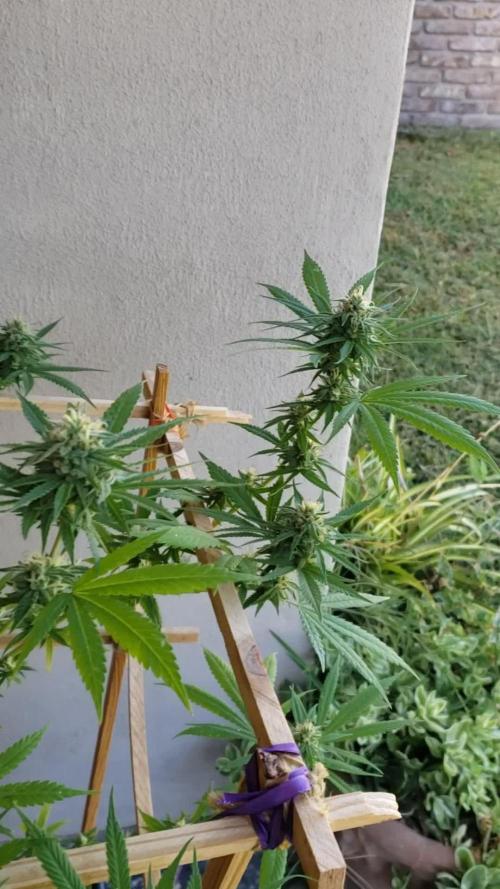
Another solid week! I decided not to do a "hard" LST with these two.... I'll do some to open them up a bit but I'm going to let another grow go more naturally!
They both grew a lot this week.... Chloe is 10 inches tall and Sofie is 8 inches tall... I watered them twice this week with 1.5 cups of water each time...
I'll be moving them into the 4X4 flowering tent during this next week... I'm about to sow 2 Fast Buds Bruce Banner seeds... This will be the third and last grow in the start of my perpetual garden... State law dictates only 6 plants at a time...
Anyways, on to another great week... cheers!!

Likes
10
Share
@The_Doctor_Green
Follow
Hola a todo el mundo!!🙌😃.
Espero que anden bien amigos!, yo ando con poco tiempo (créeme que me encantaría poder cultivar y vivir de esto😅, pero esta complicado), a lo que este diario se refiere, he aumentado dosis de fertilizantes, con un ph de 6 -6.1, aun no he vuelto a medir drenaje, las plantas vienen respondiendo bien a pesar del bloqueo que ha tenido, pero prometo en el próximo resumen cargar estos valores.
Nos vemos la próxima semana! Y si lees esto y no me sigues, en instagram, ayudarías siguiendome( es gratis seguirme😅😉).

Processing
Likes
21
Share
@Fullmeltalchemist
Follow
5.23 F60
5.27 F65 - Everything has been going well this week. The plants went through a feed cycle that should carry them through flower no problemo. Started with the AACT Tea, then a bokashi drench with Fish Shit from Fishheadfarms and plain water from here on out. They are drinking quite a bit. 1.5-2 gallons a plant every 3ish days. The terps in my tents smell out of this world. The ScrOG and 3x3 are like a candy store. Passion Berry has mango/guava citrus terps while Deadstar v2 has strawberry watermelon terps. The 4x5 is much more varied, but in general the sweet pink dominates with it's grape candy terps and the dread bread cuts through with it stanky gassy lemon while the prayer pupil smells like moth balls and a bit of GMO. Very lucky to get to experience this much variety.
5.29 F67


Processing
Likes
19
Share
@Ferenc
Follow
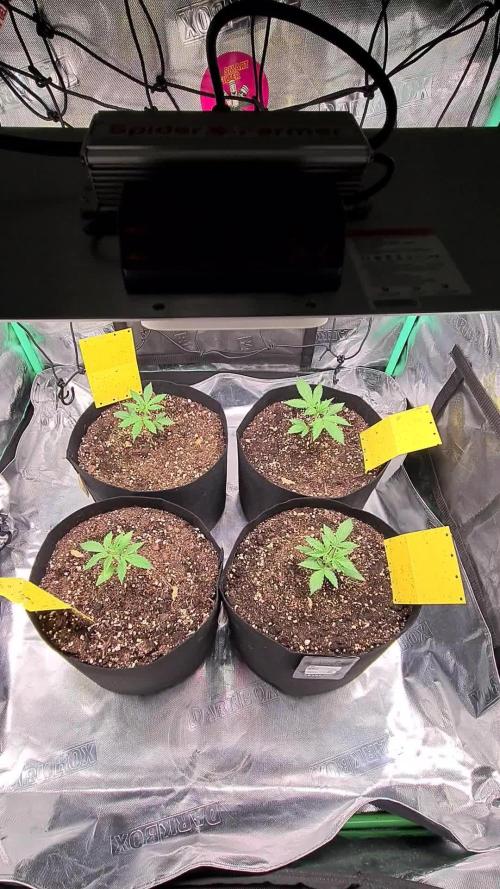
Hi there ! So from today 600W LED is placed in with 18 hours on and 6 hours off light schedule. Ventilation works at the same time as the lamp does. Watering: It will happen with 25 ml a day so 2× 12.5 ml water per plant. Fertilization starts on Tuesday, Thursday, Saturday. LST is also done as it can be seen. They don't look good this way but they just need to grow and get stronger it helps to yield more with the side branches. I will use FIM as well when they are ready I think at week 4 or 5. Day 18: OMG, I just realized I think I placed too close the lamp so I can see signs of burn of the plants. I mean some leaves get crispy in the edges. It is a brand new lamp and it was I think too close. I changed up higher. Hope it will be okay. Today was very hot outside so temperature went up as well even when the ventilation is on I saw it was 30 degrees. Too much. I opened the tent to have better air circulation and the temperature went down. Day 19: A bit hurts that I burnt them no nice but I also know that is is not a big problem. It will be gone as quickly as they grow. Anyways all fine part from this small beauty damage. Day 20: Now it clearly can be seen the damage that the LED lamp made because of me. Not nice, but it won't affect the growth. Well, I want to remove those leaves when the plants get matured to be nice. Next week I think I can do it. Everything else okay. Day 22: Haha I just actually removed the damaged leaves and now they look so pretty and healthy. I did not even have to wait until next week. All good nice girls there !!!!!


Likes
8
Share
@Caribbeangrower971
Follow
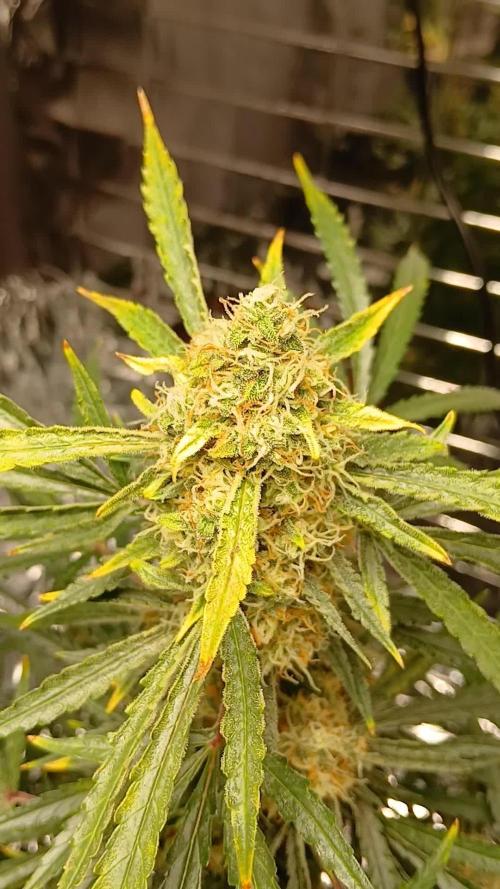
Very good strain with big yield in short time 7week bloom
Bushy with big nugs everywhere
Smell a litttle skunky and strong genetic
Made some clones with stems forgotten in a glass of water in one week
Not a lot of resin on buds like an old strain
Full of pistil cool high0
Likes
7
Share
@Damonkey
Follow
I think it was just one of those things with this plant. It maybe could have benefited with a different positioning below the light. The smell is good very strong blueberry/floral hum. I’m guessing the taste is quite similar, I’ll come back to this when it’s been tried.😬
The hash is a great smoke, a good flavour smell and a very heavy stone.
I was suffering from quite a bad toothache after smoking this sleeping wasn’t a problem, the pain was controlled very well by it.✌️

Likes
34
Share
@Northern_Ent
Follow
Don’t take flash pics of photoperiod plants unless you’re immediately using a 730 nm far red light to put them into dark mode.
Aug 24: still going strong. It’s been cool for the last few days but will warm up again here for another 5 days of high 20s C which they should all like.
Aug 25: did another lazy compost tea. Had not done one for a couple of weeks, and plants almost immediately look happier.
Aug 29: hot again at 32 C today. Still growing quickly and looking really good.

Likes
Comments
Share
@Ultraviolet_
Follow
Nirvana is interpreted as awakening from the illusion of separation and the limitations of time and space, effectively "seeing" the underlying code of existence. In Buddhism, Nirvana is described as the "unconditioned" (asankhata), a reality beyond dependent origination (cause and effect). This aligns with the concept of a fundamental, timeless "code" that exists before material manifestation. Some interpretations equate the stillness of Nirvana with the quantum vacuum, a state of "zero energy" which, however, holds unlimited potential for manifestation.
In quantum mechanics, a quantum system remains a "wave" of possibilities until observed. The "on-demand" aspect is often linked to the ability of a highly developed, enlightened consciousness (a "pure observer") to collapse this wave into a desired state, interacting directly with the underlying quantum reality. This view implies that by breaking free from the ego and mental conditioning, one gains mastery over the energetic, or vibrational, foundation of reality. The feeling of oneness in nirvana is explained through [quantum entanglement], suggesting all things are connected, and therefore, an enlightened mind can interact with any point in the universe. Traditionalists might argue that Nirvana is not about gaining control or having the power to "manifest on demand" (which can be a function of ego), but rather the total cessation of craving and the surrender of the ego, bringing an end to the desire to control reality.
The spiritual path is an evolution from being controlled by the "code" (samsara/suffering) to understanding the code and, eventually, becoming the author of one's own. With the awareness of how "code" functions, one takes full responsibility for their life, making conscious choices rather than reacting impulsively. Thoughts, words, and actions are purposefully aligned with higher values (truth, love, purpose), effectively rewriting one's destiny.
Doesn't make sense now, but it will. Wait and see, hear and know.
Clover is an exceptional component of an organic rhizosphere, offering a sustainable, self-sustaining alternative to synthetic nitrogen fertilizers produced via the energy-intensive Haber-Bosch process. By forming a symbiotic relationship with Rhizobia bacteria, clover converts atmospheric nitrogen N2 into ammonium NH4, providing a steady, slow-release nutrient source that enhances soil health and reduces environmental impacts. Red clover offers superior nitrogen fixation and biomass production compared to white or yellow clover, making it the premier choice for maximum soil vitality, particularly for improving soil structure and providing a high-volume nitrogen credit for subsequent crops.
Humidity of the air dictates the moisture in the medium, which dictates the rate of pull from the terracotta stakes, 16 in total.
Soil-Plant-Atmosphere Continuum (SPAC): An ecological concept referring to the pathway of water moving from the soil, through the plant, and into the atmosphere.
Terracotta (unglazed, low-fired clay) is highly porous, acting as a breathable, permeable membrane that transports water based on the moisture gradient between the potting medium (soil) and the surrounding air. White terracotta and brown terracotta often have different pore sizes and overall porosity, primarily driven by differences in clay composition, impurities, and firing temperatures. While both are considered porous, brown terracotta often has higher iron content and impurities that behave as fluxes, affecting how the pores form during firing, while white terracotta is generally derived from more refined clays, with smaller pores making it more suited to pure water.
This mechanism is driven by capillary action and evaporation. When the surrounding soil is dry, the terracotta acts as a wick, pulling water out of the pot and into the soil. If the soil is very saturated, the terracotta absorbs water from the soil and allows it to evaporate from its outer surface, increasing the drying rate of the soil. Terracotta tends to keep the potting mix at an optimal saturation point, wicking up more water when the outside surface evaporates water into the air. The greater the difference in moisture between the soil and the outside air, the faster the water transfers through the ceramic. In low humidity and hot weather, the evaporation rate from the terracotta surface is high, creating a rapid drying effect. Newer terracotta pots often have a denser, lighter-toned structure that is less porous than traditional, red-orange terracotta, slowing down the moisture transfer rate. Over time, dissolved salts from fertilizer or tap water build up and block the pores, reducing the permeability of the clay. No worries here, though, as water is all that is used or needed, thanks to the biochar and the massive storage bank of nutrients.
Clay pot irrigation (Ollas), an ancient farming practice, utilizes this property by burying unglazed jars in the soil, allowing water to slowly seep into the surrounding soil only when the soil dries out.

Likes
3
Share
@kdifiori_
Follow
A week full of surprises, some good, some bad. For the Pineapple, Skunk, and little Gorilla, a whole week of flushing to prepare them for two days of darkness, and then they will be harvested. I started flushing the Cheese at the end of the week, and the Bubblegum continues with nutrients for now. Cheese and Bubblegum are now tied together and continue to bend under the weight of the flowers. Unfortunately, the Skunk's head almost broke, but I managed to recover it. Not long to go now!
Likes
21
Share
@MG2009
Follow
01/01/2022
Potting up and amending with
5-2-4 to give a little kick before mid flower
#6 is first girl to show herself, also got two different males and only difference is that one is lighter green and other darker green
(also dark green one seems to drink more than lighter green) 💚. Other than that structure is very similar I wonder which is a better breeding male? I guess I might pollinate and LABEL TWO BRANCHES ON each female one for each male. and find out.🙏🏻
01/06/2022
#3 showed today, reppoted and into flowering closet, along with#6,who showed earlier this week lights at 14-10 see how they respond to that schedule, which should help use up the 5-2-4 going into week 3 should help with her stretch. Which isn't really that much I believe maybe double her current height, which I will check at lights on.Week ,#3 if I think of it I'll give a good fungal dominant tea.
Processing
Likes
11
Share
@Sctanley007
Follow
9/30/18. She still looks great. No burn and no deficiencies so far. I fed her a liter and a half . The pot is now heavy but not totally soaked. I did not water to runoff but the lower portion of the pot is wet. I don't like soaking the pots because the bottoms take ay too long to totally dry and I have had issues watering schedules.
10/5/18 Still doing perfect with minimal attention. Bumped up the amount of Grow Big last feeding with no ill effect.
Looking ahead and having weeks before the auto is done I didn't know how to face the upcoming issue of vertical space. Shes too big to LST and I did not want to top her because shes doing incredibly well and want to see what she will produce. I rigged up a scrog contained within the bucket. I did a mod years ago to a smoker which gave me the idea in the middle of the night. I might change out the screen itself since it was just what I had on hand but will see how it works.. The openings are 2.5" so it should suit my needs. I have it set at 8 inches above soil but it is fully adjustable up and down by the nuts on the threaded rod.
I plan on keeping the main stem under the screen to induce the plant to keep producing shoots and fill the area. Im pretty excited about trying this and Stay Tuned.


Likes
Comments
Share


Likes
16
Share
@Naujas
Follow
107 days!! Here is another great experience :) The girl has matured, 330 grams of wet, full of sticky, resinous shiny, pleasantly smelling flowers :) I think it will be about 90 dry :) although the girl is definitely not the biggest, but she looks great, the smell is also amazing :) I also got some sugar leaves from which I will make bubble hash, For me personally it is really beautiful and good growth, which I think will definitely be confirmed by the dried and cured flowers :) there will be a smoke review, as well as the total dry weight. good luck to everyone :).


Likes
2
Share
@OrganicsGrower
Follow
I only cut the first knot. I'll do the topping in two or three days.