Likes
Comments
Share
Moin Community! 🌱 TAG 53–62 bei unseren @ganjafarmer.seed Ladies 💚 Sie stehen im Living Soil von @white_ash_botanic bereitgestellt von @growandstyle und sind aktuell sehr ruhig und stabil unterwegs. Vor einiger Zeit hatten die Pflanzen etwas Lichtstress – davon haben sie sich inzwischen aber sichtbar gut erholt. Unter meiner @hortispectra zeigen sie jetzt wieder schöne Farben, eine gesunde Struktur und ein sehr ausgeglichenes Wachstum. ✨ Die Buds werden langsam dichter, das Volumen nimmt zu und die Harzbildung beginnt sich Schritt für Schritt aufzubauen. Kein Stress, kein Pushen – wir lassen die Ladies jetzt einfach entspannt weiterarbeiten. 🌿 🌿 Canna Community Germany 🤝 We grow together 🤝
Likes
Comments
Share

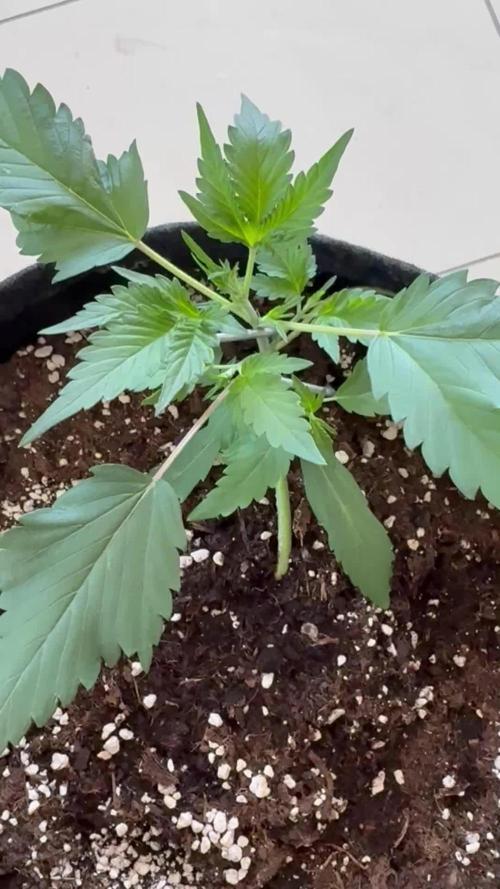
Tart Pops is powering through week 4 of veg looking strong and vibrant! ✅ I gave her a clean FIM job this week to encourage some lateral growth and bushier structure. She's bounced back well and is showing no signs of stress — nice, tight internodes and solid color throughout. Started preventive IPM routine after spotting spider mites on the Blue Cheese in flower. Spraying Neudosan and Bioneem every few days as a protective measure — so far, Tart Pops is unaffected and looking mint 🍃. The soil’s holding moisture well with good drainage thanks to the perlite mix, and the airflow and spacing are keeping the lower growth healthy too. Looking forward to training her further next week as the new tops take shape. Let’s go Tart Pops! 🚀 #VegLife #FIMSuccess #IPMSchedule #TartPops #HealthyGrowth #PreventPests
Likes
2
Share
@Dmon013
Follow
It's time to taste it. Sweet scent with a distinctive identity. You guys have to try to touch her once, I hope so. :)💚🥦
Processing
Likes
5
Share
@PETEROG
Follow
Hey everyone at week 4 know and wow have these girls grown early this week I applied some LST and all took really well to say it was my first time trying this
Likes
22
Share
@Spliffi
Follow
Week 1👍🤙👍🌱 The fear of non germination!! I gave the Trichome & Cream an extra week. Nothing happened but nature is funny like that. These seedlings are exploding. Dynomyco is the Bomb. Jon Dabs Check them out here: https://jondabs.com @jondabs Instagram The Sponsors Check them out here: Dutch Passion https://dutch-passion.com/en/ Hydroponic.co.za https://hydroponic.co.za/hydroponic/harvesting-and-growing-accessories/ Bud Juice https://www.gohydro.co.za The Best Grow https://thebestgrow.co.za Dynomyco https://www.dynomyco.com Nuclear Roots https://www.nuclearroots.co.za Photronic https://shop.photronic.net Special Thanks to Hydroponic.co.za. I buy all my products from them. Best service. Daily updates coming...
Likes
3
Share
@Chubbs
Follow
Week 6 update: What up Grow family. These testers are growing fast and strong. Where in week 6 now and the swelling and ripening of flowers are going amazing. Still feeding 500ml/16oz daily as I've found that's the sweet spot for 3gal fabric pots for these. I'd say these probably have about 2 weeks left until they'll be finished. All in all Happy Growing.
Likes
2
Share
We become aware at such times of man's wonderful ability to bring seemingly unrelated elements into harmonic balance, and receive a glimpse into a world where everything exists in conscious sympathetic attunement to everything else. When we listen to a piece of music that seems to strike a beautiful chord somewhere inside us, or view a painting that simply glows with harmonic awareness well executed, we probably do not spare much time to contemplate the wonderfully intricate combination of vibrations that our sensors make it possible for us to perceive. We tend to appreciate the relationship between the parts of something by an awareness of the harmony or dissonance of the whole. This ability enables us to say "what a beautiful house!" instead of "analysis has proven that this collection of building materials exhibits certain elements of harmonic proportion." While this ability to instinctively appreciate the beauty of true harmony has an important role to play in evolution, a more analytical understanding of the laws involved can be most useful. This is especially so if we wish to create works of art where each part exists in true harmony, not only with the other part of that particular whole, but with the universe within which the creator and the created exist. Everything vibrates. From the most dense matter to the most subtle cosmic rays, everything which our senses allow our thoughts to become aware of, can be specified in terms of wavelength or frequency of vibration. These two terms define the same thing, but from different points of view. The following are the approximate wavelengths of various energy carriers: Cosmic rays 0.000,000,001 mm Gamma rays 0.000,000,1 mm X rays 0.000,500 mm Ultraviolet rays 0.003 mm Visible light 0.006 mm Infrared 0.01 mm Sound waves 1 meter Radio waves 300 meters Violet light 400 nm to 450 nm Blue light 450 nm to 500 nm Green light 500 nm to 570 nm Yellow light 570 nm to 590 nm Orange light 590 nm to 610 nm Red light 610 to 700 nm 1 nanometer (nm) = 0.000,000,1 cm = 1/10,000,000 cm If a guitar string is plucked and we hear a sound, it is not too difficult for the human mind to associate this sound with the vibration of the guitar string. With color it is quite different. It is difficult for us to conceive that the color of a substance is not an inherent property of the substance itself, but an indication picked up by our senses of that substance's ability to absorb or reflect the light which happens to be shining on it at that moment. Neither the matter nor the light is colored. What happens is that the brain learns to differentiate between the frequencies reflected or transmitted by the substance the eyes are focused on. The same thing happens with sound. When we say "Oh! Listen, they're playing my favorite song," what we really mean is: "My brain has stored within it a particular pattern of frequencies. I have compared the new information being received with this stored pattern and have deduced the answer that the two patterns are similar within certain specified tolerances." The 'pleasure' involved could have something to do with our running the pre-recorded pattern at the same time, in 'sympathy' with the new pattern as it is received. The word sympathy describes very well our ability to appreciate color and sound. It also describes the reason behind certain elements of harmony. For instance, if a substance vibrating at 100 cycles per second (tone 1) is in the proximity of another substance vibrating at 200 cycles per second (tone 2), we could perceive, if we had the right equipment, a certain sympathetic relationship between the two. We will see from this that there is a uniform doubling of the first tone seen in the second. At various points along the waves, the two are the same in amplitude. At other points, they are at opposite poles to each other. This doubled frequency has more points of similarity to the original than any other frequency except the original itself. If the equipment we had available for measuring these two frequencies was a soundboard amplifier and a pair of ears, then we would hear what would sound to us like one tone. If we had the opportunity to hear one at a time, we would hear that although they sound the same, one is higher in pitch than the other. This characteristic of 'the same but different in pitch', musicians have called the octave. Any two tones produced where one has exactly doubled the frequency of the other is called an octave. Speaking in ratios, an octave would appear then as the ratio 2:1 or 1:2, depending on whether we are talking of an octave up or down. A single note produced by almost any instrument will contain more than one wavelength or frequency. It will have a dominant frequency, the wavelength of which we would call the note's 'fundamental' or 1st harmonic. It will also have a varying number of upper harmonics, gradually fading in intensity into infinity or silence. Natural harmonics always have the same pattern of intervals between them. The interval between the 1st and 2nd harmonic is a perfect octave; between the 2nd and 3rd a perfect fifth; between the 3rd and 4th a perfect 4th; and so on, the intervals becoming smaller and smaller until they lose any relationship with the western 12 tone scale as it exists at the moment. Just as an octave has certain elements of sympathy with its fundamental, so some intervals have been noted to be more perfectly in sympathy with the fundamental than others. The ratio of the 'perfect 5th' or interval of 7 semitones, as it occurs in the harmonic series, is 3:2 or 2:3, while that of the 'perfect fourth" is 4:3 or 3:4. All the tones in the western 12 tone scale can be expressed in terms of the ratio between the upper tone and its fundamental. This would seem to be an ideal way of generating a scale from any given fundamental and several attempts have been made to do this, the Pythagorean system being probably the most well known. Although when working with a single tone instrument playing on its own, the Pythagorean formula works wonderfully well, if we had several instruments tuned this way together and asked them to play almost any western music, we would find that at times they sounded quite out of tune to each other. The lack of flexibility of the various scale systems based on the harmonic series has led to what is known as the 'tempered' scale. This uses as its primary unit of interval the ratio of the octave or 2:1. It then proceeds to divide the interval between any fundamental and its upper octave into 12 smaller intervals by applying the ratio: two to the one-twelfth power, to one (21/12:1). This equals 1.059463094, so by multiplying any frequency by this number, we will obtain the tempered semitone next up from our fundamental. We will also find that any tone twelve semitones up from any other tone, in a scale generated in this way, will have exactly double the frequency. If we took the note middle C on a piano and halved the wavelength, we would have the note C one octave above. If we halved this, we would have the C above, and so on. However, within about 6 octaves, we would find that although a 'sound' was being produced, no human ear could perceive it. If we kept on going, halving and producing upper octaves of our fundamental C, we would proceed through the infrared band, into the visible light spectrum. If we happened to be outside during the day, we would, for one octave only, see the note C with our eyes. The next octave above would already be in the ultraviolet band, and outside the eye's sensitivity range. If we can think of color as being an indication of a substance's vibratory rate or wavelength, we may begin to see a relationship that could exist between the color and sound spectrums. The logical extension of what has so far been said is that there exists a scale in the color spectrum that corresponds exactly to the scale in the sound spectrum, each color tone being an octave of the equivalent note in the sound range. This is not the end of the story but only the beginning. If we can for the moment accept that any wavelength in one band has upper and lower octave stretching out to infinity, then the next question is 'fine, but what shall we use as our fundamental? A particular color? A particular sound frequency?' The musicians among us will probably say 'A 440'. This means that the note A should vibrate at 440 Hertz, or 440 times per second. They would tell us that this is standard pitch has been adopted by most orchestras around the world; pianos are tuned to it, instruments are constructed to formulas based on it, and so to them it would probably seem the most appropriate place to begin. Some of these musicians may know of the battle that is still raging with regards to this being the standard, but few would know why A = 440 Hz was chosen except that it worked when it was set to be a suitable compromise between the many different pitches in use at the time. 432 Hz is said to be mathematically consistent with the patterns of the universe. Studies reveal that 432 Hz tuning vibrates with the universe’s golden mean PHI and unifies the properties of light, time, space, matter, gravity, and magnetism with biology, the DNA code, and consciousness. When our atoms and DNA start to resonate in harmony with the spiraling pattern of nature, our sense of connection to nature is said to be magnified. Another interesting factor to consider is that the A=432 Hz tuning correlates with the color spectrum, while the A=440 Hz is off. Audiophiles have also stated that A = 432 Hz music seems to be non-local and can fill an entire room, whereas A=440 Hz can be perceived as directional or linear in sound propagation. Once you adopt the idea that sound (or vibration in general) can have an equalizing and harmonizing effect (as well as a disturbing effect), the science of harmony can be applied to bring greater harmony into one's life or tune to specific energies. There is a form of absolute and relative harmony. Absolute harmony can, for example, be determined by the tuning of an instrument. The ancients tuned their instruments at an A of 432 Hz instead of 440 Hz - and for a good reason. There are plenty of music examples on the internet that you can listen to in order to establish the difference for yourself. Attuning the instrument to 432 Hz results in a more relaxing sound, while 440 Hz slightly tenses up the body. This is because 440 Hz is out of tune with both macro and micro cosmos. On the contrary, 432 Hz is in tune. To give an example of how this is manifested microcosmically: our breath (0,3 Hz) and our pulse (1,2 Hz) relate to the frequency of the lower octave of an A of 432 Hz (108 Hz) as 1:360 and 1:90. It is interesting to note that 432 Hz was the standard pitch of many old instruments and that it was only recently (19th and 20th century) the standard pitch was increased. This was done in order to be able to play for bigger audiences. Bigger audiences (more bodies) absorb more of the lower frequencies, so the higher pitch was more likely to “cut through”. One of the oldest instruments of the world is the bell ensemble of Yi Zeng (dated 423 BC), tuned to a standard F4 of 345 Hz, which gives an A= 432 Hz. The frequency of 345 Hz is that of the platonic year! Similarly, many old organs are tuned in A=432 as well; for example, St. Peter’s Capella Gregoriana, St. Peter’s Capella Giulia, S. Maria Maggiore in Rome. Maria Renold’s book “Intervals Scales Tones and the Concert Pitch C=128 Hz” claims conclusive evidence that 440 Hz and raising concert pitch above scientific “C” Prime=128 Hz (Concert A=432 Hz) disassociates the connection of consciousness to the body and creates anti-social conditions in humanity. The difference between concert pitch A=440 Hz and Concert A=432 Hz is only 8 cycles per second, but it is a perceptible difference of awareness in the human consciousness experience of the dream we share called existence.
Likes
Comments
Share

Aún las tenía metidas en casa por la noche, por qué las plante en pretemporada y no quería que se congelarán.
Likes
81
Share
Hello there and welcome to week 12, or the beginning of it anyway. Week 11 is now complete so please check that out! We start the week with 5l fertigation and some nice photos. Now that Bertha is gone the tent smells Karenish. See you tomorrow! Day 78: Added several more carnivorous plants to the budding collection. Enjoy! Day 79: Fertigated 5l. She's starting to mature now. Frost developing slower, buds fattening and ripening faster. Were maybe two weeks away here. Night 80: Added tent photo and vid. Day 81 update later today. Day 81: Added a lot of media. Got a cheap digital microscope to try and get better micro shots. As you can see Karen is nowhere near yet. Day 82: Things are moving very fast, just look at the difference today. I am certain were with 2 weeks of harvest. Does anyone have advice on flushing/not watering. Fertigated 5l. Day 83: At the current rate of maturation I think the end of next week maybe be harvest time. Height 51cm Day 84: Karens smell is really strong now it washes across your face when you open the tent. End of week summary: A full week of nothing but bud swelling and maturation. I still think she needs another 2 weeks. Unfortunately my living situation has rather abruptly changed and now I have a tough choice to make: harvest/destroy or move plants. There is a strong chance I will chop Karen at the end of next week if she is ready or not.
Likes
4
Share
@Naujas
Follow
42 days into my project - "Girl on the balcony on the north side" she is already blooming :) she looks really good, knowing what conditions she has to endure, this week there was not much sun, there was a lot of wind and rain, I used a little LST for the girl, the girl drinks = every other day 1.5 liters of water 6.3 ph, every 3rd watering I give biobizz nutrients :) good luck to everyone :).
Processing
Likes
24
Share
14 días desde EASY START.(4 semillas,1 venía solo la cáscara de un lado) Maceta RQS 10L. -EASY BOST ORGANIC NUTRITION.(preparación del suelo con 50g en 10 litros de sustrato con perlita) -EASY COMBO BOOSTER PACK. -En la 2ª semana riego las 4 plantas con agua mezclada con la pastilla EASY GROW BOOSTER (la dividí en 4 trozos para la semana 2,3,4 y 5 diluyendo en 1L. de agua la mezcla). -Las 3 que están en vaso de plástico para la próxima semana le voy añadir al vaso uno granos del EASY BOOST ORGANIC que no le mezclé cuando las planté). 👌
Processing
Likes
56
Share
@Island
Follow
Week 6 - Week without surprises. No-till cycle working well, watering only with water, but note that the companion plants still grow crooked. Soon the soil still shows signs of excesses, I believe that in the next cycles these excesses will be fixed. Hugz from Brazil.
Likes
16
Share
@Andres
Follow
I would believe this variety again ... I think it could be better ... and do not make some mistakes in it ... I recommend it to all growers ...
Likes
8
Share
@Chubbs
Follow
Week 4 for these girls. They've doubled in some since last week. I took a couple of the bigger fan leafs off this week, also raised my lights up allowing some stretch. Starting to see some preflowers and pistols. So next week will be off to the flower stage. Happy Growing.
Likes
7
Share
@Mo_Powers
Follow
the race continues. at the moment both are still on a par. a good 5 cm in growth. there is currently a lot of sunshine and really good temperatures. apart from that, not much has happened yet.
Likes
15
Share
Hi Fellow Growers They are going good. The heat its stressing them. the are not drinking so much water and yellowing a bit.... Not so Nitrogen Green but i thinkthey are doing fine. Maybe some Co2 whould help them. Give me some Ideias how can a use the heat and make it become beneficial Chears BrotherHood
Likes
14
Share
@Naujas
Follow
79 days!!!!! and the harvest is already harvested :) The whole growth until week 6 went very well, then the girl got a little worse, (I think it's my mistake, which I described in previous weeks), but besides all that she managed to ripen perfectly, matured stiff flowers, full of shiny sticky trichomes with a very, very sweet aroma ;) 210 gr of wet buds, I also collected a lot of sugar leaves from which I will make bubble hash :) I can't wait to taste it :) this is my first trip with Sweetseeds Looking at the flowers I understand that I will definitely repeat it :) I will leave more feedback after the smoke review:) good luck to everyone.