


Likes
Comments
Share

@Legendaryseedthumb
Follow
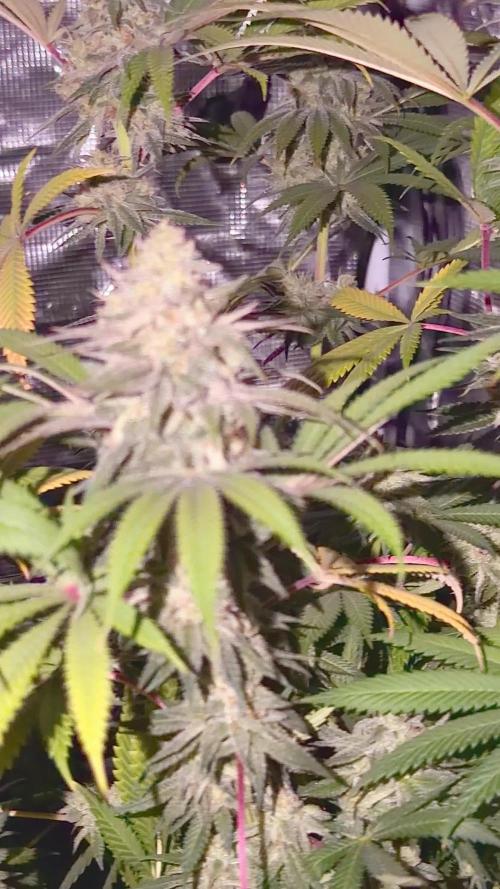
Harvest about a week early to not get any amber thricomes.
The buds look amazing so sugary don’t want them to become amber.
Will press like 70-80% into rosin. So don’t want no ambers’s.
Otherwise this strain was amazing to grow! It was super stable all the time and produced some
Sick buds for me! This shit smells like gods v*gina!

Likes
18
Share


@GreenCasual
Follow
Started flushing. Buds are getting tough, most pistils are turning brown and some trichromes are already amber.
I harvested the two bigger stems on Wednesday (because their sugar leaves were getting yellow and crispy) ; will harvest the rest of the plant on Saturday !

Likes
7
Share


@dank604
Follow
No nutes yet, just 2 full waterings (plain water ph'd 6.5) but she'll get her first feeding within the next few days. She's growing strong! A bit of LST on her side branches.

Processing
Likes
21
Share


@LittleBigTrees
Follow
Gave water at 6.5ph will feed on week 3.
I think I've had the light to close. On day 10 pictures you can see the leaves look like there burnt 🤔 or that's what I'm guessing it is. I've raised the light to 1meter it's only at around half power at the moment and showing 21000 lux.
Likes
24
Share


@FlynnRyder
Follow
Alrighty, guys and gals it's another res change and another opportunity to make mistakes haha. All in all, I actually got a lot of helpful advice through the questions forum so a big shout out to anyone that helped with those issues. Unfortunately with the rest of the canopy being somewhat the same height, I decided to leave the lights on 100%. I can't raise them any higher and I just have to better in veg when it comes to keeping the canopy even and encouraging bud sites. I'm super tempted to trim up the top big fan leaves but I honestly am not sure if it would help any at this point in time. I'm looking forward to giving the buds more time to grow though and I'm hoping a surprise myself with a great turnout. I'm still at a loss for when to harvest as far as what to look for with the buds aesthetically. I've heard the trichomes cloudy bit so many times but I guess I just cant tell if I should harvest what's larger done and cloudy then harvest the rest later etc.

Likes
30
Share


@WeWantItToGrow
Follow
Simply put I am so very pleased with the way this plant has performed my only worry is how to properly dry and cure this magnificent specimen

Likes
41
Share


@Stork
Follow
Day 120
PH 5.8
EC 0.2
PPM
DLI 6h
PPFD/
Water 18c
Day 121 Tue
PH 6.0
EC 0.2
PPM
DLI 6h
PPFD/
Water 18c
Day 123
PH 6.0
EC 0.2
PPM
DLI 6h
PPFD/
Water 18c
Day 125
PH 6.0
EC 0.2
PPM
DLI 6h
PPFD/
Water 18c


Likes
6
Share


@rvabudman
Follow
Cant take my eyes off my plant. This is my second round of growing and I am the type of person who learns through failure (not gonna upload the pics of the first round plants lol). The buds are thickening up very nicely. Hoping to get between 3-4oz , the strain is high yielding but I have a smaller tent. My auto yielded 2oz with the same space (2 plants in one tent splitting the space), but the buds definitely didn't develop as well as these buds.
Likes
5
Share


@Silvadragon
Follow
Hello everyone hope you staying cool
Cause the weather is over 100 degree and everything is drying and dying. We really need some rain! Anyone with the heat wave I trying keep this gals water up. The biggest one drink water like no tomorrow, well both of them. I give them a tea liquid compost 3.11.11 of organic fertilizers. Just to keep up with the flowering stages she using up a lot nutritions and I’m glad that I was on top of my game with these outdoors grow. Not bad for novice first timer. My family love them. I’m keep in the sun as thst will help with resins production and the bees are doing a fine job pollen them.

Likes
2
Share


@Ultraviolet_
Follow
"And God said, Let there be light, and there was light." Genesis 1:3
Inhale for 13s, Exhale for 13s,
Inhale for 8s, Exhale for 8s,
Inhale for 5s, Exhale for 5s,
Inhale for 3s, Exhale for 3s,
Inhale for 1s, Exhale for 1s,
Alignment. 1.618
More energy, more blueprint.
Electrical Conductivity refers to how easily a material or solution allows electrons or ions to flow continuously when an electrical potential is applied.
Electrochemical Reactance is the opposition to alternating current (AC) caused specifically by the temporary storage of energy in electric or magnetic fields, rather than energy being lost as heat. Reactance does not directly alter a material's intrinsic electrical conductivity. Instead, it dictates how the system stores and releases energy over time, which creates a temporary barrier to current flow in AC circuits. Together with resistance, reactance makes up total impedance. Electrical impedance (the combination of resistance and reactance) in the rhizosphere dictates how easily ions and water move into plant roots, directly impacting the Electron Transport Rate (ETR). High impedance restricts ion mobility, leading to nutrient deficiencies that decrease ETR and stunt overall plant growth.
Using copper and zinc plates in the plant medium to form a natural earth battery to assist with Electrochemical Reactance. The moist soil acts as an electrolyte, while zinc serves as the anode and copper as the cathode. Zinc is a highly reactive metal and oxidizes, losing electrons into the soil. These electrons travel through an external wire to the copper plate. The moisture and dissolved salts in your plant medium allow charged ions to move freely between the plates, completing the circuit and generating a small direct current (usually between 0.8 and 1.1 volts). This micro-current subtly alters/the Electrical Conductivity (EC), allowing more effective breaking apart of chemical bonds in the soil (electrolysis), making soil nutrients like phosphorus, calcium, and potassium more accessible to roots. Buried the zinc plate on one side of the plant’s root zone and the copper plate on the opposite side. Ran an insulated copper wire above ground to connect the zinc plate to the copper plate, creating a closed loop. Make sure your soil remains moist and contains natural mineral salts; entirely distilled water or bone-dry medium will prevent ion exchange and block the current.
Likes
60
Share


@Rezdestroyer
Follow
Okay. So she stopped packing on weight right after her first real weight gain. Bad salt build up within the soil, ph off from 6.2 to 7.2 run off. Going to add recharge or some compost tea on next grow to help with that. Also, I think I could have gotten away with giving less nutrients.
She smells amazing. Smells like trash from a far but as soon as you touch her, her aroma opens up to the fruitiest scent I have ever smelled!
Another odd thing which might have to do with genetics. Many of the buds are hanging off to the right side of the stem. Like they have grown to one side of the stem and look like they are about to fall off. Mayne this had something to do with her not getting much bigger than she has? See last few photos and video.
About a week or two left. Last feed a few days ago. Water from here on out.
Likes
13
Share


@DeepRootsGrowTrees
Follow
PABLO ESCOBAR / DIVINE SEEDS
WEEK #6 OVERALL
WEEK #5 VEG
This week she she fully recovered from being topped and has 2 new tops, additionally she has side growth on her other branches she hasn't had any issues so far. Stay Growing!!
Thank you for stopping by and taking a look it's much appreciated!!
Thank you DIVINE SEEDS!!
PABLO ESCOBAR / DIVINE SEEDS

Likes
2
Share


@Elguacho420
Follow
Buenas a tod@s... En esta tercera semana( que yo creo q sería como la primera con estas alturas y x lo q son tan pequeñas, se pasarason a tierra más de lo previsto, espeigaron y doblaron tu tamaño y se pasaron a maceta grande) justamente hoy se le agregaron nutrientes, algunos nuevos y otros q ya había usado antes... Eh mantenido al margen las medidas NPK recomendables y eh agregado algo x ahí q seguro va bien 😉 la humedad es estable generalmente, la temperatura tanbm... De momento no hay ningún problema( si quitamos q tienen tiempo de sol limitado x la casa es verdad que eh tenido otras en exterior de este tipo y bueno, es lo q hay), están fuertes y van creciendo bien, no le podemos pedir mucho a estas alturas, eso para luego... La semana q viene mejor... Buenos huemos para tod@s... ⚕️😎
🇦🇷🤝🏻🇪🇦
Likes
9
Share


@Colo420
Follow
17/12 se realiza fertiriego.
19/12 se podan los 2 primeros nudos, se hace poda apical y se transplanta de 1 a 3L con aplicacion de micorrizas


Likes
11
Share

@Northern_Ent
Follow
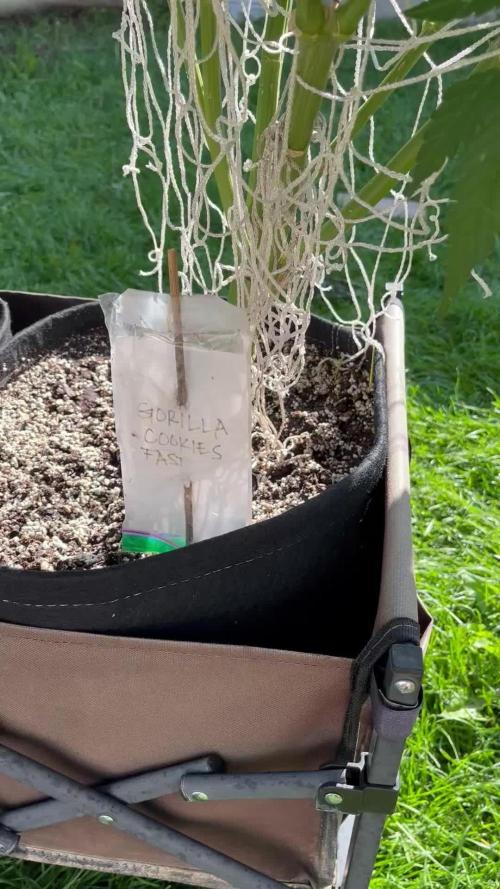
Aug 15: Gorilla Cookies Fast is looking great with a nice and even 16 cola manifold filling in with lots of buds. The Plagron nutrients seem to be working nicely.
Here at 53 N latitude we run out of strong sunlight, particularly UV light, starting in mid-August. I use UV lights from AC Infinity on days with no chance of rain. These are indoor lights so they need a bit of extra attention when using them outdoor, but it’s easy and worth the hassle.
Likes
3
Share

@Black_Widow
Follow
Привет садоводы и огородники !!!
Наступила новая неделя
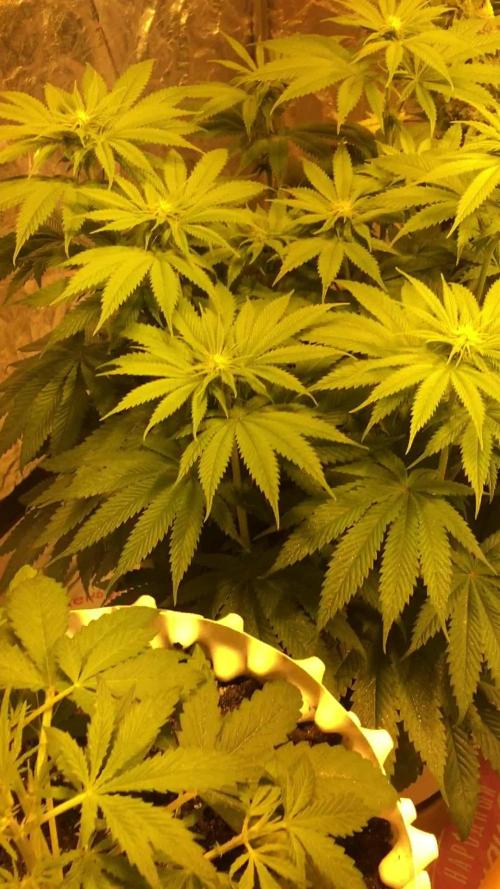
уже несколько дней подруга гидропоника как переведена на 12 часов
но кажется ей понадобится еще неделя .что-бы зацвести
выглядит она хорошо
все листья как на подбор .вот только густая очень становится
посмотрим как дальше дела пойдут . может и вырастит монстр пушистик !

Likes
12
Share


@SnarkyGoat
Follow
Day one of the 14th week was October 24th. The trichomes on the small bud leafs are still clear resin. The hairs are about 70% dark and many are receding back toward the bud. Harvest time is getting close.

Likes
8
Share


@DogDoctorOfficial
Follow
💙 Project Blue Tent – Week 7
Blue Waffle F1 – Pheno A (Folder 13A)
Welcome back everyone to another week inside Project Blue Tent! 💙🌱
If you're new here, welcome aboard.
This project is all about exploring the incredible Blue Waffle F1 genetics from Zamnesia while putting the complete growing ecosystem through its paces.
Rather than documenting four plants as a single diary, each phenotype receives its own individual journey from seed to harvest. They share the same tent, the same environment, the same nutrition, the same irrigation and the same lighting.
And yet...
They still manage to tell four completely different stories.
As I always like to say:
We're not just growing plants.
We're getting to know them.
────────────────────────
🌿 Week Seven – The Final Cleanup
This week feels like a milestone.
The SCROG has done its job.
The canopy is full.
The plants have established their structure.
And now it's time to prepare everything for the next chapter...
Flowering. 🌸
Plant A is looking absolutely beautiful at the moment.
Her foliage has developed into the rich, healthy green I've been hoping to see, and the overall structure is remarkably balanced. After several weeks of gently guiding branches underneath the SCROG, we've managed to create a canopy that is surprisingly even from one side of the tent to the other.
At approximately 60 cm, she's sitting comfortably within the space we've created for her.
And although she could certainly continue growing vegetatively, I don't want to simply keep filling the tent with more and more foliage.
At some point, you have to stop building the canopy...
...and start preparing it for what comes next.
That's exactly where we are now.
────────────────────────
🕸️ From SCROG to Flower
Over the last couple of weeks, the SCROG has completely changed the way these plants occupy the tent.
Instead of allowing individual branches to dominate vertically, we've been gently guiding them horizontally beneath the screen.
The result is exactly what we were looking for:
A broad, relatively even canopy with many developing tops sharing the available light.
SCROG isn't about forcing a plant into submission.
It's about working with its natural growth and redistributing that growth across the available space.
And looking at the tent now...
I'd say the mission has been accomplished.
The screen is filled.
The plants have claimed their territory.
Now we need to create the best possible starting point for flowering.
Which brings us to this week's main job.
────────────────────────
✂️ Defoliation – Cleaning Today for a Better Tomorrow
This week we're performing a deep, purposeful defoliation across the canopy.
For anyone unfamiliar with the technique, defoliation simply means selectively removing leaves from the plant.
But it's important to understand what defoliation isn't.
It isn't stripping a plant bare.
It isn't removing leaves just because they're in the way.
And it isn't something that should automatically be performed every week.
The purpose is to improve the structure we've already created.
After several weeks of SCROG training, there is now a tremendous amount of foliage packed into a relatively small space. While those leaves are essential during vegetative growth, too much overlapping foliage can eventually create unnecessary congestion inside the canopy.
So we're removing selected leaves that are:
• Blocking developing growth
• Creating unnecessary overlap
• Restricting airflow through the interior
• Shading lower areas that we've decided to retain
• Or simply no longer contributing enough to justify occupying that space
The goal isn't to make the plant look empty.
The goal is to make the plant efficient.
────────────────────────
🌬️ Why Defoliate Before Flower?
Timing is everything.
We're doing this now because the plants are still in vegetative growth and have time to recover before we ask them to transition into flowering.
Defoliation is a form of stress.
Even when performed carefully, removing a significant amount of foliage temporarily changes the plant's balance between its leaves, roots and growing points.
That's why I don't want to perform a major cleanup deep into flowering unless there's a very good reason.
Right now, the plants can take that short period of recovery while they're still operating under an 18/6 light schedule and actively producing new vegetative growth.
After the cleanup, we'll give them time to recover, settle and rebuild their foliage before flipping the lights.
The idea is simple:
Stress now.
Recover now.
Flower later.
Rather than asking the plant to simultaneously deal with a major transition into flowering and a significant amount of pruning, we're separating those events.
One step at a time.
That's especially important in a project like this, where I'm trying to observe the plants rather than simply push them as hard as possible.
────────────────────────
🌿 Plant A – Looking Better Than Ever
Plant A continues to impress me.
The first thing that stands out this week is the colour.
That slightly lighter appearance we saw earlier in the grow has completely disappeared. The foliage is now displaying that rich, healthy green that tells me the current nutritional strategy is working extremely well.
She's vigorous without looking excessive.
Healthy without showing signs of nutritional stress.
And most importantly...
She's balanced.
Her branches have responded beautifully to the SCROG, and the canopy has developed into a very usable structure for flowering.
This is one of those moments where you can look at the plant and realize that the weeks of small adjustments have finally come together.
The topping.
The recovery.
The daily SCROG work.
The irrigation.
The feeding.
The environmental stability.
None of those things created this canopy by themselves.
They're all pieces of the same puzzle.
────────────────────────
💧 The Drip Irrigation System
One of the things I have become particularly impressed with during this project is the automatic drip irrigation system.
It's working beautifully.
With the plants now drinking more consistently and the canopy becoming increasingly demanding, having a reliable irrigation system makes maintaining uniformity across the tent considerably easier.
Each plant is currently receiving approximately 1.2 L per 24 hours, delivered through the drip system.
And the plants are clearly enjoying the consistency.
One of the advantages of automated irrigation isn't simply saving time.
It's repeatability.
Instead of relying on every watering being manually performed at exactly the same interval and volume, the system provides a much more consistent routine for the plants.
That consistency becomes increasingly valuable as the root systems develop and the plants transition toward flowering.
So far...
The system is doing exactly what I wanted it to do.
And honestly, watching four plants respond so uniformly to the same irrigation strategy has been one of the most satisfying parts of this project.
────────────────────────
🥥 Feeding Program
The feeding recipe remains unchanged this week.
And for now, I don't see a reason to interfere with something that is clearly working.
Current nutrition:
• Plagron Hydro A — 1.9 ml/L
• Plagron Hydro B — 1.9 ml/L
• Plagron Hydro Roots — 1 ml/L
Current EC remains approximately:
1.92 mS/cm
with the solution maintained around 18°C and pH at 5.8.
The plants are showing excellent colour, strong growth and healthy leaf development, so I'm perfectly comfortable maintaining the current recipe for now.
We may increase the nutritional strength next week depending on how the plants respond after defoliation and as flowering approaches.
But that's exactly why I don't like changing several variables at once.
First, we observe.
Then we adjust.
The plants will tell us what they need.
────────────────────────
🌡️ Environmental Conditions
The Blue Tent continues to remain remarkably stable.
This week's average conditions were:
• 🌡️ Day Temperature: 28°C
• 🌙 Night Temperature: 27°C
• 💧 Relative Humidity: 65%
• 🥥 Substrate Temperature: 24°C
• 💦 Nutrient Solution: 18°C
• ⚗️ pH: 5.8
• ⚡ EC: 1.92 mS/cm
• 💨 CO₂: approximately 450 ppm
• 💡 Light Schedule: 18/6
• 💧 Irrigation: approximately 1.2 L/plant/24h
• ? Pot Size: 8 L
• 📏 Plant Height: approximately 60 cm
The plants are continuing to respond beautifully to these conditions.
The root-zone temperature remains particularly stable, irrigation is consistent, and the canopy has enough air movement to support vigorous transpiration.
As we move toward flowering, environmental management will become even more important.
The room we've created now needs to support not only vegetative growth...
...but the much denser flowering structure that is coming next.
────────────────────────
🌬️ Why the Cleanup Matters
One of my main objectives with this defoliation isn't simply aesthetics.
It's airflow.
When four vigorous plants completely fill a 100 × 100 × 200 cm tent, the amount of foliage inside that space becomes considerable.
From above, everything can look absolutely perfect.
But underneath that beautiful canopy is another story.
Leaves overlap.
Branches cross.
Interior spaces become crowded.
Air needs to move through all of that.
By selectively removing excess foliage now, we're opening those internal spaces before flowering begins.
That gives us a cleaner structure going forward and makes it much easier to inspect the plants, maintain airflow and monitor the developing flowers.
This is also one reason I'm much happier doing the major cleanup before the flip rather than waiting until the plants are deep into flowering.
Once flowering begins, the priorities change.
I want the plant concentrating its energy on developing flowers rather than repeatedly recovering from major structural work.
So we're preparing the room now.
Clean canopy.
Good airflow.
Healthy structure.
Then...
Flower.
────────────────────────
🧠 Defoliation Isn't About Removing Leaves
One of the biggest misconceptions surrounding defoliation is that more leaves automatically means a worse plant.
That's not true.
Leaves are incredibly important.
They're the plant's solar panels.
They capture light and help drive photosynthesis.
So the objective should never be:
"How many leaves can I remove?"
The better question is:
"Which leaves are no longer contributing enough to justify occupying this space?"
That's the philosophy I'm following here.
We're not trying to weaken the plant.
We're trying to improve the relationship between:
Light → canopy → airflow → growing sites.
And because we've already spent weeks creating the structure with SCROG, this cleanup is simply the final refinement of that work.
────────────────────────
🌱 Plant A's Personality
Every phenotype continues to develop its own personality, even when all four plants are living under almost identical conditions.
Plant A has consistently been one of the more balanced girls in the tent.
She doesn't appear interested in becoming the biggest plant in the room.
Instead, she seems much more interested in becoming an efficient one.
Her growth is structured.
Her canopy is balanced.
Her foliage is beautiful.
And after weeks of training, she has settled into the SCROG extremely well.
Now, after today's cleanup, she looks almost like a different plant.
Less crowded.
More open.
More organized.
And ready for the next chapter.
That's the part of growing I really enjoy.
You spend weeks slowly building something...
Then one day you step back and suddenly realize:
It all came together.
────────────────────────
👀 Looking Ahead
The next few days will be about one thing:
Recovery.
No unnecessary training.
No chasing perfection.
No constantly changing the environment.
Just observation.
The plants have been through topping.
They've been trained beneath the SCROG.
They've filled the canopy.
And now they've received their final major vegetative cleanup.
So we're going to let them breathe.
Let them recover.
Let them continue growing.
And then, assuming everything continues to look as good as it does today...
we flip the Blue Tent into flower. 🌸
This is the point where all those weeks of preparation finally start paying off.
The screen is full.
The structure is ready.
The plants are healthy.
Now we just need to let them do what plants do best.
Grow.
────────────────────────
💙 Thank You
A huge thank you to Zamnesia for making Project Blue Tent possible, from these fantastic Blue Waffle F1 genetics to the complete ecosystem surrounding this grow.
A massive thank you to Plagron for providing the Premium Growbags together with the Hydro nutrient line, which continues delivering excellent results and beautifully healthy growth.
A special thank you to Mars Hydro for the drip irrigation and automatic drainage system. After watching these plants respond to the consistency of automated irrigation week after week, I'm genuinely impressed with how well the system is performing.
Thank you as well to GrowDiaries, for giving growers around the world a place to document their journeys, exchange knowledge and learn from one another.
And finally...
Thank you to everyone following Project Blue Tent.
Every comment, every question, every bit of feedback and every person simply stopping by to see how these four phenotypes are developing means more than you probably realize.
We've spent weeks building this canopy together.
Now the really exciting part is about to begin.
The plants are cleaned.
The SCROG has been filled.
The room is ready.
Flower is next. 🌸💙
Until next week...
Growers Love, happy growing, and take care everyone! 🌱💙
Likes
5
Share

@SandMineCultivator
Follow
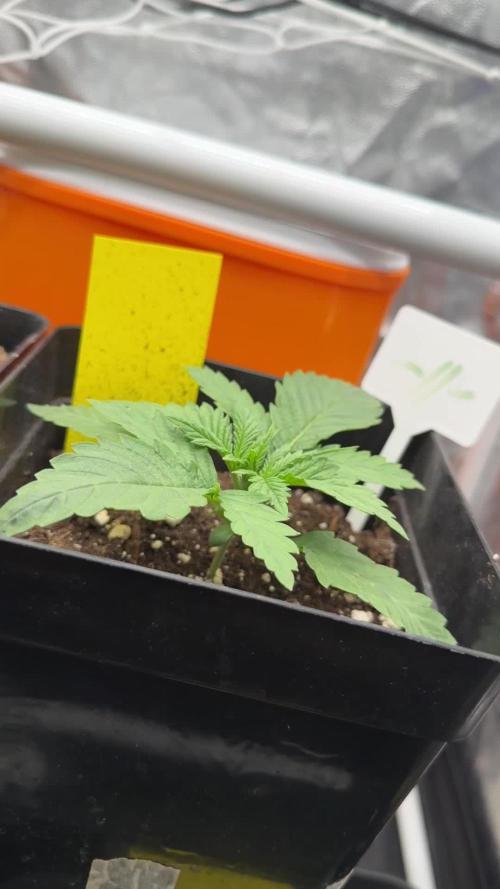
1st week was really good, now we will see in 10-14 days transplanting to final 11l pot
Likes
6
Share


@Gorey
Follow
mid next week it will be the harvest, the trichoms are very milky. the smell is excellent. on the video in order: cbg, thc then cbd
