


Likes
Comments
Share

@nonick123
Follow
Día 50 / 15 (17/11) N/A
Día 51 / 16 (18/11) N/A
Día 52 / 17 (19/11) N/A
Día 53 / 18 (20/11) N/A
Día 54 / 19 (21/11) N/A
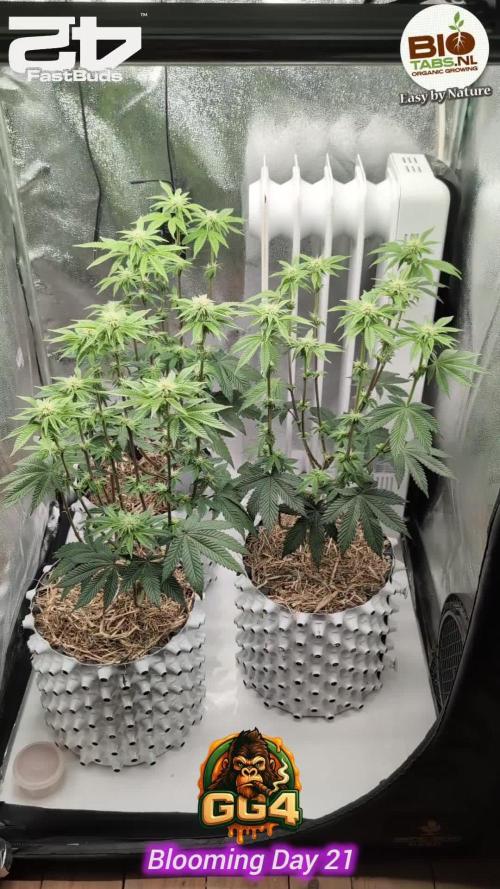
Día 55 / 20 (22/11) Preparación del PK Booster Compost Tea by BIOTABS!
Día 56 / 21 (23/11) Riego cada planta con 0,5 litros de PK Booster Compost Tea by BIOTABS! 💪 🚀 🎉
🚀 FastBuds 15% DISCOUNT code "NONICK" fastbuds.com
💦 Nutrients BioTabs 15% DISCOUNT code "GDBT420" biotabs.nl/en/shop/
🌱Substrate PRO-MIX HP BACILLUS + MYCORRHIZAE - www.pthorticulture.com/en-us/products/pro-mix-hp-biofungicide-plus-mycorrhizae

Likes
8
Share


@DogDoctorOfficial
Follow
💙 Project Blue Tent – Week 7
Blue Waffle F1 – Pheno A (Folder 13A)
Welcome back everyone to another week inside Project Blue Tent! 💙🌱
If you're new here, welcome aboard.
This project is all about exploring the incredible Blue Waffle F1 genetics from Zamnesia while putting the complete growing ecosystem through its paces.
Rather than documenting four plants as a single diary, each phenotype receives its own individual journey from seed to harvest. They share the same tent, the same environment, the same nutrition, the same irrigation and the same lighting.
And yet...
They still manage to tell four completely different stories.
As I always like to say:
We're not just growing plants.
We're getting to know them.
────────────────────────
🌿 Week Seven – The Final Cleanup
This week feels like a milestone.
The SCROG has done its job.
The canopy is full.
The plants have established their structure.
And now it's time to prepare everything for the next chapter...
Flowering. 🌸
Plant A is looking absolutely beautiful at the moment.
Her foliage has developed into the rich, healthy green I've been hoping to see, and the overall structure is remarkably balanced. After several weeks of gently guiding branches underneath the SCROG, we've managed to create a canopy that is surprisingly even from one side of the tent to the other.
At approximately 60 cm, she's sitting comfortably within the space we've created for her.
And although she could certainly continue growing vegetatively, I don't want to simply keep filling the tent with more and more foliage.
At some point, you have to stop building the canopy...
...and start preparing it for what comes next.
That's exactly where we are now.
────────────────────────
🕸️ From SCROG to Flower
Over the last couple of weeks, the SCROG has completely changed the way these plants occupy the tent.
Instead of allowing individual branches to dominate vertically, we've been gently guiding them horizontally beneath the screen.
The result is exactly what we were looking for:
A broad, relatively even canopy with many developing tops sharing the available light.
SCROG isn't about forcing a plant into submission.
It's about working with its natural growth and redistributing that growth across the available space.
And looking at the tent now...
I'd say the mission has been accomplished.
The screen is filled.
The plants have claimed their territory.
Now we need to create the best possible starting point for flowering.
Which brings us to this week's main job.
────────────────────────
✂️ Defoliation – Cleaning Today for a Better Tomorrow
This week we're performing a deep, purposeful defoliation across the canopy.
For anyone unfamiliar with the technique, defoliation simply means selectively removing leaves from the plant.
But it's important to understand what defoliation isn't.
It isn't stripping a plant bare.
It isn't removing leaves just because they're in the way.
And it isn't something that should automatically be performed every week.
The purpose is to improve the structure we've already created.
After several weeks of SCROG training, there is now a tremendous amount of foliage packed into a relatively small space. While those leaves are essential during vegetative growth, too much overlapping foliage can eventually create unnecessary congestion inside the canopy.
So we're removing selected leaves that are:
• Blocking developing growth
• Creating unnecessary overlap
• Restricting airflow through the interior
• Shading lower areas that we've decided to retain
• Or simply no longer contributing enough to justify occupying that space
The goal isn't to make the plant look empty.
The goal is to make the plant efficient.
────────────────────────
🌬️ Why Defoliate Before Flower?
Timing is everything.
We're doing this now because the plants are still in vegetative growth and have time to recover before we ask them to transition into flowering.
Defoliation is a form of stress.
Even when performed carefully, removing a significant amount of foliage temporarily changes the plant's balance between its leaves, roots and growing points.
That's why I don't want to perform a major cleanup deep into flowering unless there's a very good reason.
Right now, the plants can take that short period of recovery while they're still operating under an 18/6 light schedule and actively producing new vegetative growth.
After the cleanup, we'll give them time to recover, settle and rebuild their foliage before flipping the lights.
The idea is simple:
Stress now.
Recover now.
Flower later.
Rather than asking the plant to simultaneously deal with a major transition into flowering and a significant amount of pruning, we're separating those events.
One step at a time.
That's especially important in a project like this, where I'm trying to observe the plants rather than simply push them as hard as possible.
────────────────────────
🌿 Plant A – Looking Better Than Ever
Plant A continues to impress me.
The first thing that stands out this week is the colour.
That slightly lighter appearance we saw earlier in the grow has completely disappeared. The foliage is now displaying that rich, healthy green that tells me the current nutritional strategy is working extremely well.
She's vigorous without looking excessive.
Healthy without showing signs of nutritional stress.
And most importantly...
She's balanced.
Her branches have responded beautifully to the SCROG, and the canopy has developed into a very usable structure for flowering.
This is one of those moments where you can look at the plant and realize that the weeks of small adjustments have finally come together.
The topping.
The recovery.
The daily SCROG work.
The irrigation.
The feeding.
The environmental stability.
None of those things created this canopy by themselves.
They're all pieces of the same puzzle.
────────────────────────
💧 The Drip Irrigation System
One of the things I have become particularly impressed with during this project is the automatic drip irrigation system.
It's working beautifully.
With the plants now drinking more consistently and the canopy becoming increasingly demanding, having a reliable irrigation system makes maintaining uniformity across the tent considerably easier.
Each plant is currently receiving approximately 1.2 L per 24 hours, delivered through the drip system.
And the plants are clearly enjoying the consistency.
One of the advantages of automated irrigation isn't simply saving time.
It's repeatability.
Instead of relying on every watering being manually performed at exactly the same interval and volume, the system provides a much more consistent routine for the plants.
That consistency becomes increasingly valuable as the root systems develop and the plants transition toward flowering.
So far...
The system is doing exactly what I wanted it to do.
And honestly, watching four plants respond so uniformly to the same irrigation strategy has been one of the most satisfying parts of this project.
────────────────────────
🥥 Feeding Program
The feeding recipe remains unchanged this week.
And for now, I don't see a reason to interfere with something that is clearly working.
Current nutrition:
• Plagron Hydro A — 1.9 ml/L
• Plagron Hydro B — 1.9 ml/L
• Plagron Hydro Roots — 1 ml/L
Current EC remains approximately:
1.92 mS/cm
with the solution maintained around 18°C and pH at 5.8.
The plants are showing excellent colour, strong growth and healthy leaf development, so I'm perfectly comfortable maintaining the current recipe for now.
We may increase the nutritional strength next week depending on how the plants respond after defoliation and as flowering approaches.
But that's exactly why I don't like changing several variables at once.
First, we observe.
Then we adjust.
The plants will tell us what they need.
────────────────────────
🌡️ Environmental Conditions
The Blue Tent continues to remain remarkably stable.
This week's average conditions were:
• 🌡️ Day Temperature: 28°C
• 🌙 Night Temperature: 27°C
• 💧 Relative Humidity: 65%
• 🥥 Substrate Temperature: 24°C
• 💦 Nutrient Solution: 18°C
• ⚗️ pH: 5.8
• ⚡ EC: 1.92 mS/cm
• 💨 CO₂: approximately 450 ppm
• 💡 Light Schedule: 18/6
• 💧 Irrigation: approximately 1.2 L/plant/24h
• ? Pot Size: 8 L
• 📏 Plant Height: approximately 60 cm
The plants are continuing to respond beautifully to these conditions.
The root-zone temperature remains particularly stable, irrigation is consistent, and the canopy has enough air movement to support vigorous transpiration.
As we move toward flowering, environmental management will become even more important.
The room we've created now needs to support not only vegetative growth...
...but the much denser flowering structure that is coming next.
────────────────────────
🌬️ Why the Cleanup Matters
One of my main objectives with this defoliation isn't simply aesthetics.
It's airflow.
When four vigorous plants completely fill a 100 × 100 × 200 cm tent, the amount of foliage inside that space becomes considerable.
From above, everything can look absolutely perfect.
But underneath that beautiful canopy is another story.
Leaves overlap.
Branches cross.
Interior spaces become crowded.
Air needs to move through all of that.
By selectively removing excess foliage now, we're opening those internal spaces before flowering begins.
That gives us a cleaner structure going forward and makes it much easier to inspect the plants, maintain airflow and monitor the developing flowers.
This is also one reason I'm much happier doing the major cleanup before the flip rather than waiting until the plants are deep into flowering.
Once flowering begins, the priorities change.
I want the plant concentrating its energy on developing flowers rather than repeatedly recovering from major structural work.
So we're preparing the room now.
Clean canopy.
Good airflow.
Healthy structure.
Then...
Flower.
────────────────────────
🧠 Defoliation Isn't About Removing Leaves
One of the biggest misconceptions surrounding defoliation is that more leaves automatically means a worse plant.
That's not true.
Leaves are incredibly important.
They're the plant's solar panels.
They capture light and help drive photosynthesis.
So the objective should never be:
"How many leaves can I remove?"
The better question is:
"Which leaves are no longer contributing enough to justify occupying this space?"
That's the philosophy I'm following here.
We're not trying to weaken the plant.
We're trying to improve the relationship between:
Light → canopy → airflow → growing sites.
And because we've already spent weeks creating the structure with SCROG, this cleanup is simply the final refinement of that work.
────────────────────────
🌱 Plant A's Personality
Every phenotype continues to develop its own personality, even when all four plants are living under almost identical conditions.
Plant A has consistently been one of the more balanced girls in the tent.
She doesn't appear interested in becoming the biggest plant in the room.
Instead, she seems much more interested in becoming an efficient one.
Her growth is structured.
Her canopy is balanced.
Her foliage is beautiful.
And after weeks of training, she has settled into the SCROG extremely well.
Now, after today's cleanup, she looks almost like a different plant.
Less crowded.
More open.
More organized.
And ready for the next chapter.
That's the part of growing I really enjoy.
You spend weeks slowly building something...
Then one day you step back and suddenly realize:
It all came together.
────────────────────────
👀 Looking Ahead
The next few days will be about one thing:
Recovery.
No unnecessary training.
No chasing perfection.
No constantly changing the environment.
Just observation.
The plants have been through topping.
They've been trained beneath the SCROG.
They've filled the canopy.
And now they've received their final major vegetative cleanup.
So we're going to let them breathe.
Let them recover.
Let them continue growing.
And then, assuming everything continues to look as good as it does today...
we flip the Blue Tent into flower. 🌸
This is the point where all those weeks of preparation finally start paying off.
The screen is full.
The structure is ready.
The plants are healthy.
Now we just need to let them do what plants do best.
Grow.
────────────────────────
💙 Thank You
A huge thank you to Zamnesia for making Project Blue Tent possible, from these fantastic Blue Waffle F1 genetics to the complete ecosystem surrounding this grow.
A massive thank you to Plagron for providing the Premium Growbags together with the Hydro nutrient line, which continues delivering excellent results and beautifully healthy growth.
A special thank you to Mars Hydro for the drip irrigation and automatic drainage system. After watching these plants respond to the consistency of automated irrigation week after week, I'm genuinely impressed with how well the system is performing.
Thank you as well to GrowDiaries, for giving growers around the world a place to document their journeys, exchange knowledge and learn from one another.
And finally...
Thank you to everyone following Project Blue Tent.
Every comment, every question, every bit of feedback and every person simply stopping by to see how these four phenotypes are developing means more than you probably realize.
We've spent weeks building this canopy together.
Now the really exciting part is about to begin.
The plants are cleaned.
The SCROG has been filled.
The room is ready.
Flower is next. 🌸💙
Until next week...
Growers Love, happy growing, and take care everyone! 🌱💙



Likes
61
Share


@Natrona
Follow
Sponsored grow
***DIVINE SEEDS *****
Week 3 6/23-29
6/24 Water and feed 1ltr each
TPS1
12ml
Kelp 1/4c
Cal mag 1 tsp per gal
PH 5.6
PPM 945
Temp 73
6/27 Water and feed 1ltr each
TPS1
12ml
Kelp 1/4c
Cal mag 1 tsp per gal
PH 6.9
PPM 1130
Temp 74
6/29 Water and feed 1ltr each
TPS1
12ml
Kelp 1/4c
Cal mag 1 tsp per gal
PH 6.9
PPM 1130
Temp 74
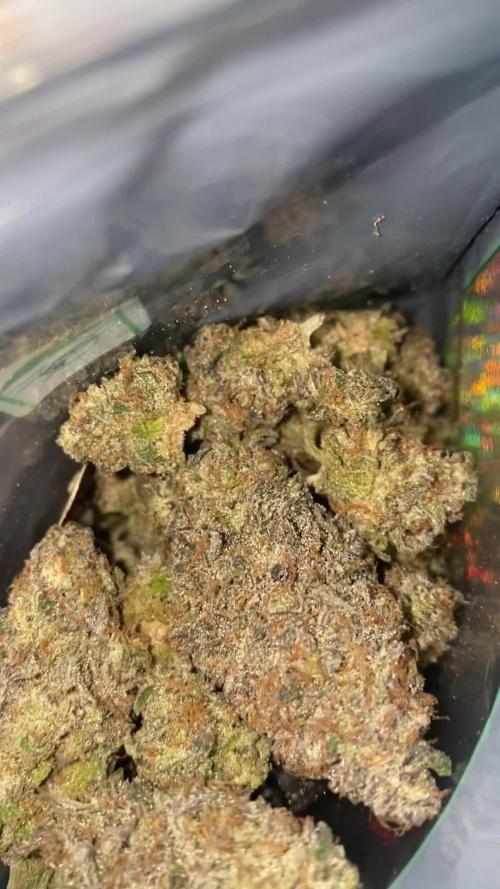
Auto Opium My inside grow is a variety of Divine seeds and Royal Queen Seeds. All are receiving the same nutrients and but slightly diluted for the autos. Both RQS Milky Way and Medusa) and Divine Seeds Opium show the same nutrient deficiency/excess in the leaves. Divine Bullet and Escobar do not reflect the nutrient issue indicating strong genetics.
Thank you @DivineSeeds for the opportunity to participate in the auto grow contest.
Thanks for the visits, likes and comments; I appreciate all the plant love💚.
Have fun & love what you grow 💚
Sending you good vibes of love, light, and healing 💫
💫Natrona 💫
DIVINE SEEDS
***AUTO OPIUM***
Harvest:1000 g/m2
Divine Seeds developed Opium as a new champion strain, unprecedently powerful and loaded with unbelievable quantities of resin. Certainly, no average genetic base could be behind such brilliant parameters! Several Afghani Indica landraces, recognized as most potent and resinous, were bred together with a mighty Brazilian Sativa which Opium inherits its bright berry taste from. Then a great deal of work followed aiming for the highest THC level and endurability as well as a branchy structure that would provide maximal yields. Now we can proudly title Opium the best Indica you could dream of growing!
Indoors these plants mostly stay mid-height (1.5 m), reaching up to 2.0 m out of doors. Depending on your height limitations, Opium flourishes universally in grow boxes, balconies, green houses and terraces. Due to its Afghani parentage, this strain can stand hot weather if provided enough water and some shadow. Responds well to any training techniques: ScroG and SoG, LST, topping and FIM, supercropping. The start of blooming is marked with a rush of growth, when plants stretch almost 1.4x. Expect heavy colas that often require additional supports. Whilst ripening, Opium gives off a pungent earthy stench with fruity and berry undertones, also a bit of pine. Ready for outdoor harvesting in October.
The stoning psychedelic impact of Opium is like being hypnotized (unless you’ve had too much, then it feels more like a blackout). Stone-lovers will appreciate every minute with Opium: its spicy taste immerses your mind into daydreaming, while the body rests flat. Recreation with this psychedelic Indica means silent tripping from one insight to another. Mighty enough to kill chronical pains, Opium is also medically efficient against insomnia, nausea, appetite disorders, muscle spasms, headaches, irritation, fatigue, panic attacks, epilepsy. Best consumed at night time, the effects keep going for up to 4 hours.
Equipment and nutrients
Pots: 5gallon Air pots
Soil Fox Farm Happy Frog Amended with worm castings, dolomite lime and mychorihiza Recharge
Seeds provided by Divine Seeds
Divine Seeds breeding company
The link to Opium Feminized Seeds
Opium - Divine Seeds breeding company

Likes
Comments
Share

@LegacyGrow
Follow
Englischversion below
Deutsch:
Tag 36 Veg:
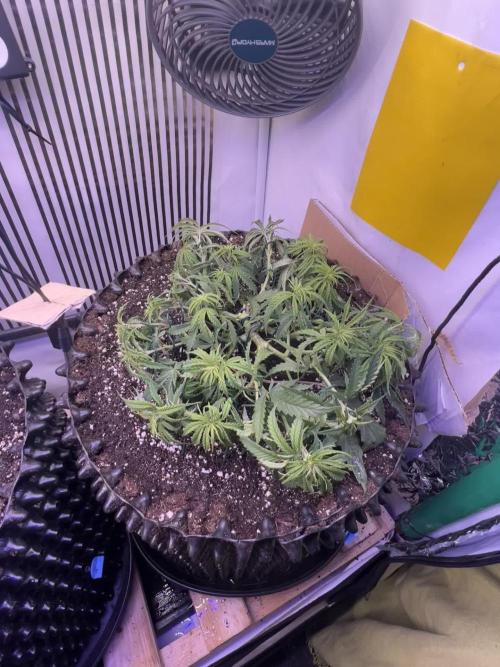
Das Umtopfen bereitet den Damen noch sichtbar Schwierigkeiten. Auch der Temperaturunterschied stresst die Damen sichtbar. Der VPD muss angepasst werden, da sich die Temperatur von im Schnitt 28,5 Grad auf im Schnitt 22,5 Grad gesenkt hat. Die Blattoberflächentemperatur liegt im Schnitt bei 20,5 wodurch die RLF% bei ca 60-65% gehalten wird.
Heute wurden die Damen auch vollständig mit ca 8,5L mit einem PH von 6,3 und 0,5 ml/L CalMag gegossen.
Ein leichtes LST hat die Fürsorge heute abgerundet. Ziel ist es mit einer wider gesunden Pflanze an den Rand des Topes zu kommen.
Tag 39 Veg:
Die Ladies erholen sich sichtbar - die Kälte über nach hat für leichte lila Verfärbungen an Blattspitzen und Stämmen geführt. Wie fast jeden 2-3 Tag wurde auch am Tag 39 LST durchgeführt. Die Temperatur ist Tagsüber zwischen 22-26 Gard und nachts 19-21 Grad.
Viel ist nicht zu tun - wir warten jetzt auf den SOG
--------------------------------------------------------------------------------------------------------------------------------------------
Day 36 – Vegetative Phase:
The transplant is still visibly causing stress to the plants. The temperature difference is also clearly stressing them. The VPD needs to be adjusted, as the average air temperature has dropped from around 28.5 °C to approximately 22.5 °C. Leaf surface temperature averages about 20.5 °C, which requires relative humidity to be maintained at roughly 60–65%.
Today, the plants were fully watered with approximately 8.5 liters per pot, adjusted to a pH of 6.3 and supplemented with 0.5 ml/L Cal-Mag.
Light LST was also applied today to round off plant care. The goal is to reach the edge of the pot again with healthy, stable plants.
Day 39 – Vegetative Phase:
The plants are visibly recovering. The cooler nighttime temperatures have led to slight purple discoloration at the leaf tips and stems. As on nearly every second to third day, LST was performed again on day 39. Daytime temperatures range between 22–26 °C, while nighttime temperatures are between 19–21 °C.
There is not much to do at this stage — we are now waiting to initiate the SOG.

Likes
10
Share


@Big_Dennis_Budz
Follow
Started flushing the two on the left side of the tent today with advanced nutrients flawless finish 19th Nov.....the other two on the right have had just overdrive today start flushing them within the next couple days, the middle baxk plant is just doing its own slow thing 😅... smell is unreal 🤤
Likes
25
Share


@BudGardener420
Follow
Currently checking daily and tying away branches/leaves to give the buds more light and watering when the soil is dry. Currently my plants drink exactly 1,5L a day. I have the feeling that the right plant is lacking a bit of potassium. I'll leave everything as it is for now because the left plant (fresh new soil) is growing well. Since the right plant is quite bushy anyway, I'll defoliate it again later and remove any lower shoots. I started adding the Bio PK booster towards the middle of the first week of flowering, 2ml per liter of water; as the pH value drops too much, I correct it upwards with Biobizz pH up - from pH 5.5 to 6.5 for 3L, I add a total of 39 drops. My water is mixed as follows: 3L osmosis water, plus 6ml CalMag, 6ml BioPK 5-8 and 39 drops of pH + BioBizz.

Likes
1
Share

@Aleks555
Follow
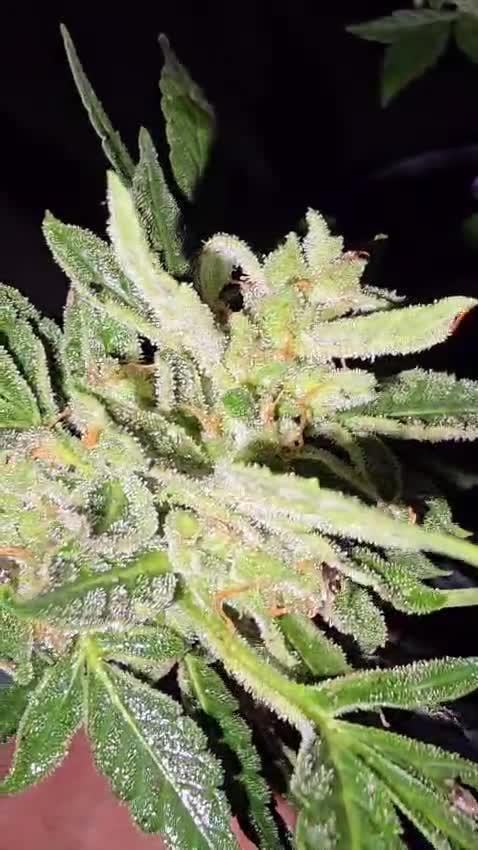
Hello friends, we are all good and we are already at the finishing stage. This beauty has been making us happy since the first day and she has not let us down, she has grown very sticky, tasty and most importantly she is very strong, the effect is just a bomb, strong and long-lasting, a very cool variety, thanks to Anesia Seeds for such cool genetics.

Likes
4
Share

@kdifiori_
Follow
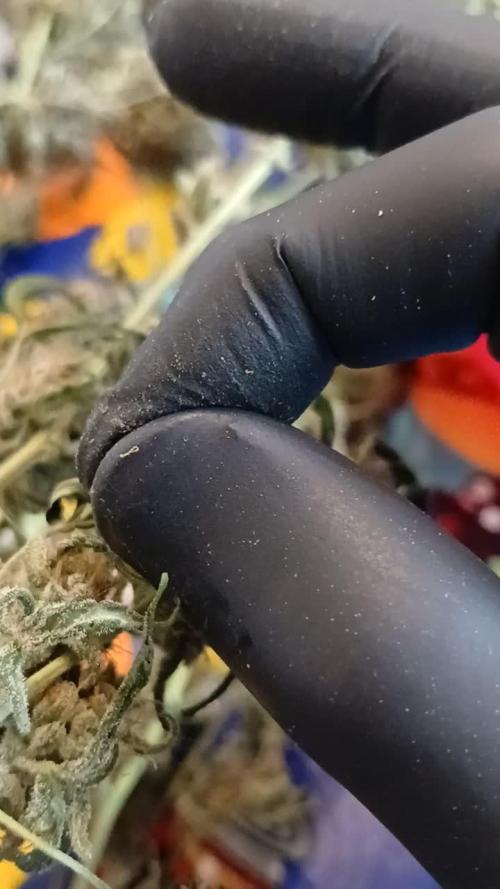
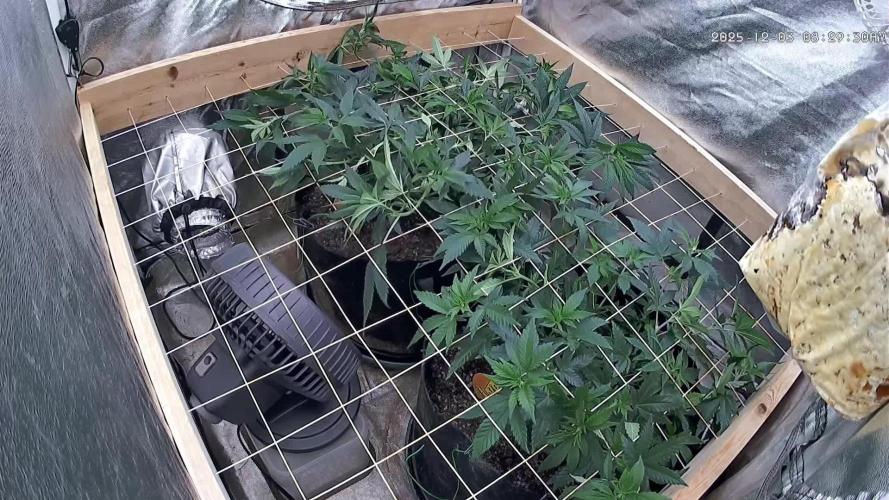
And now it's time for Cheese! A wonderful experience from start to finish. I'm really proud of the result, the plant performed excellently without any training and withstood all kinds of stress well.
Full of resin, a fantastic smell for cheese lovers and, I would say, an excellent result for an autoflowering strain!


Likes
223
Share


@HazeyBobby
Follow
So the story continues... this grow is really an experiment for me to train one plant within my 4'x2' grow space to ScrOG vertically and use the SP250 light on its side. For the majority of the vegetative stage the light will be hung normally above the plant until a week prior to flipping the light schedule and initiating flowering.
The plant passed its seedling stage and has been vigorously growing albeit showing strong signs of over-watering and calcium deficiencies. It's really a transpiration issue which I have not solved yet. Increased distance to light as the plant may be growing too fast for its root mass. From feedback at Coco for Cannabis (CFC), it is a Cal deficiency and a young plant getting used to the grow in coco - quite common and not a sign of over-watering. Measuring run-off EC at each fertigation event as I increase the feed EC to monitor what the plant is doing/feeding.
Fertigation is now maintained at twice a day (at lights on and 4hrs prior to lights off period) to maintain the target EC. Light period is during the night time to better maintain heat/humidity conditions during light off period (which happens during daytime).
-----------------------------------------------------------------------------------------------------------------------------------------------------------------------------------------------------------------------
The grow setup includes ;
- Secret Jardin DS120W tent (120cm x 60cm x 180cm) placed inside the bedroom
- Mars Hydro SP250 LED light
- extraction fan - AC Infinity Cloudline T6 (gives me great control over the environment)
- ventilation fans
- aquarium heater for nutrients solution (for winter use only)
- small oil heater (for winter use only)
- small dehumidifier
- 20L Airpots (as final pots) and 3.5L general plastic pots (for seedling stage)
- Canna Coco substrate mixed with 40% perlite
- GHE Flora Trio as base nutrients and various additives
- pH and EC/TDS meters
- 2x Govee Thermo/Hygro meters (one at canopy, the other at the roots level - these allow for external monitoring and recording)
-----------------------------------------------------------------------------------------------------------------------------------------------------------------------------------------------------------------------
Some strain info from Royal Queen Seeds ;
An amazing mix of genetics background - Its true genetics are unknown. Some say OG Kush is a mix of ChemDawg with a Lemon Thai and Pakistani Kush. Others say that it’s just a special cutting of ChemDawg from the early 90s. The most obvious trait of OG Kush is its strong, unique, very dank, slightly citrus aroma, almost like fuel or strong detergent. The flavour of OG Kush is equally as strong and dank, with a long-lasting aftertaste.
Strong mental and physical high - OG Kush is an extremely strong cannabis strain, with most experienced smokers listing it as one of their favourites. The effect is as strong physically as it is mentally. Though its effect is like an Sativa, the strain's genetics are mostly Indica. The effect is as strong and complex as the flavour. OG Kush takes around 8 weeks to flower and on average the yield is 500 grams per plant.
Big buds with lovely tones - OG Kush is known to stretch slightly during growth but soon starts to fill out during flowering. Generally, it will reach a height of 90 to 160 cm. Its buds are large and dense, lime green clusters covered with a large amount of resin.

Likes
26
Share


@MG2009
Follow
05/19/2021
Week #7 flower.
Gave her a good rinse today she was covered with pollen from nearby trees, drinking more water took 2 full two liter bottles before any runoff, soaking it up like a sponge.
Couple hours later fed her some (1-3-3-1.5)
N-P-K-calcium
I anticipate two more weeks till harvest but we will see. Just got to keep her hydrated for next couple weeks.
Apparently she is perking up! after taking a rest for a week or so. And putting on new flowers, and Tangie parentage is very identifiable in her SMELL! WOW
Enjoy the videos.🙏
Ps.
I decided to fix floppy stem, hopefully it will now put more effort into finishing flower!
Will she swell in last weeks??
Likes
2
Share


@Thomaat
Follow
As this is my first time I just followed the instructions on the box. I watered with nutrients, followed up by a watering without nutrients.

Likes
35
Share


@Pot_Portraits
Follow
Week 6, quick root flash. All going very well the nutrients are at 2.5ml/l now, vita race weekly, bacillus mix.
Plant started to flower properly and the stretch is on its way.
Water at ph 6-6.5.
I always try to keep the bottom clean so I do multiple clean ups of lower leaves and braches every week.
Also doing this focuses the energy of the plant to the top and she doesn't waste time making popcorn buds.


Likes
20
Share


@Bongman
Follow
Hi guys,
As you probably can tell I am in transition right now. I have all the photos, I just need to organize them and post them in the correct order. But by the looks of it, I had a light timer malfunction on me a few ago when I moved the ladies to the 4x8 tent. So by the looks of it, I think she is more in the second to third week of flowering. I will change it over the weekend. Thanks for checking out my grow.


Likes
20
Share

@GREENPHOENIX6262
Follow
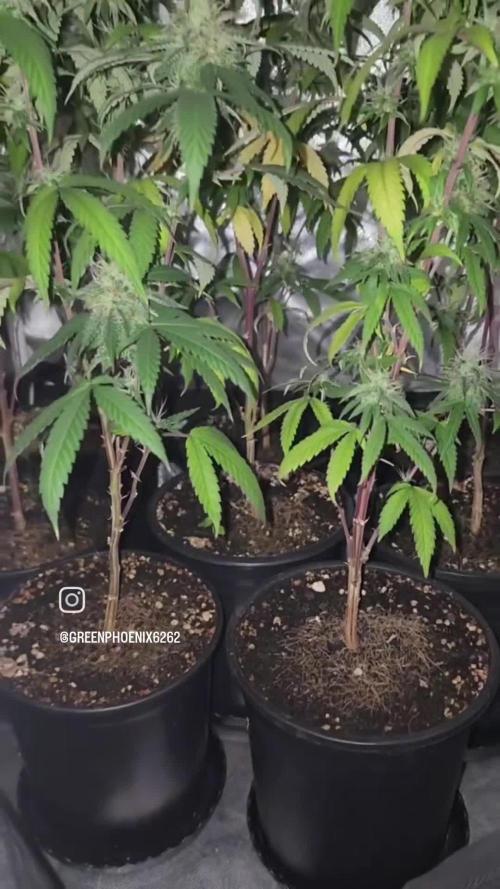
06/06 - As we get closer to harvest the prep work will begin by the end of this coming week - I will give them 1 maybe 2 more nutrient feeds then switch to clean water with Carbo flush to remove the salt build up in the clones - I have dropped the light intensity to about 25% to allow for the trichomes and terps to set under ideally conditions. They will also get the bigger leaves defoliated little by little as we approach harvest.. 😎😎😎😎
06/07 - The babies are coming along perfectly without any issues - Since increasing the Cane Molasse dosage for their feeds trichome development has increased tremendously - Dropped the light intensity by 25% - maintaining low temps and average humidity through out harvest - She will receive 1 maybe 2 more nute feeds before flushing with clean water - The cold water treatment seems to be working with positive results in terps and trichomes.
06/10 - As we near harvest I will only be applying one maybe 2 more nute feeds and that will be it - Clean water feeds after that for about a week then chopping down - The last 2 feeds will consist of heavy silica for nutrient absorption and Cane molasses for terp setting and trichome build up - currently the nuggs are dense and rich in resin - I will be trimming in 3 stages ( 1 wet trim prior to cut down and 2 after harvest both dry ). Stay tunned for final cut down updates. Peace and Bud!! 😎😎😎😎😎😎😎😎😎😎😎😎😎😎😎😎😎

Likes
4
Share


@MistaOC
Follow
***************
29.03. Day 17
***************
It's slowly starting to grow. 80g per pot was a bit much, though. Next time, I'll use only 60g.
*******************************************
01.04 Day 20
***************
Today I switched the lighting to 12/12 and already put the scrog net in place.
*******************************************
6L RO Water // ph 6,4 // 0,6ml Regulator // 1,5ml CalMag // ph- //
*******************************************
Likes
12
Share


@UnicornSparklehorn
Follow
Now flowering in week 5. She's doing really well. Almost forgot she lost a main branch. She's almost filled the 60c60 tent. I hope she's done stretching because she's almost out of room. Really looking forward to tasting her.