


Likes
Comments
Share

@DogDoctorOfficial
Follow
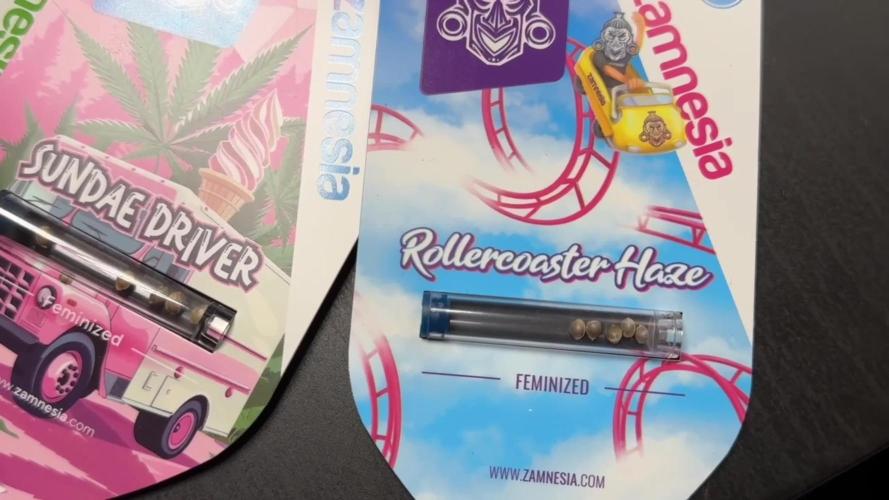
🌸 Sundae Driver — Week 9 Flower / Week 12 From Seed
When the plant decides it’s time… you listen!
Another beautiful, crazy, unforgettable week in our Sundae Driver adventure! The tent has been full of aromas, colors, and emotions — and this week brought a little surprise twist. Our Pheno #2, the bold one, the heavy one, decided she couldn’t hold her own weight anymore and literally bowed to gravity. When I arrived, half of her was on the ground, saying: “It’s time, my friend. Harvest me.”
And honestly, she was right. Perfect trichomes, perfect colors — it was exactly her moment. So, we harvested her with love, laughter, and respect. Sometimes, nature tells you what to do, and all you can do is listen.
We didn’t dry her whole as we usually do — since she broke herself in half, we had to go with a different approach this time. A reminder that every grow has its own personality and surprises. We took it as part of the adventure and had a good laugh about it — because in the end, that’s what growing is: learning, adapting, and enjoying every step.
Meanwhile, her sister Pheno #3 is still standing tall and absolutely shining. She’s thriving under the LUMATEK, with her buds swelling beautifully, trichomes sparkling like sugar dust, and her structure holding strong (for now!).
🌱 Nutrients & Environment
This week we’re keeping the mix balanced — still using the Plagron PowerBuds, Sugar Royal, Green Sensation, together with Aptus Regulator and CalMag Boost.
Our pH sits nicely around 6.1, EC around 0.7, and the soil is still rich enough to carry the girls through these final stages. Temperatures hover around 28°C, humidity slightly high at 60+, but both phenos have been adapting beautifully.
🌿 About the Harvest
For Pheno #2 — the early harvest wasn’t planned, but it turned out perfect. The trichomes were milky with just a few ambers, the aroma intense, and the density incredible. This shows that sometimes the plants truly know best. Her colas were so heavy they couldn’t stand anymore — that’s a good problem to have!
💪 Super Crop & Structure
The earlier super crop training clearly paid off — the buds on the bent tops were some of the thickest and frostiest of all. It’s beautiful to see how resilience leads to strength; those stress points turned into power centers for growth.
🧠 What to Expect & What Not to Expect
• Expect Pheno #3 to keep maturing beautifully over the next week or two — trichomes are developing wonderfully, and aromas are getting more complex by the day.
• Don’t expect her to rush. She’s taking her sweet time, and that’s perfectly fine — every flower deserves her full moment.
• Expect me to keep double-checking the branches — after what happened with #2, I’m making sure no more girls decide to “self-harvest” behind my back. 😂
💬 P.S. — About Holding the Weight
For those reading this — always support your branches properly during late flower! When the buds get heavy (and believe me, they will), the stems can only handle so much. It’s always better to tie, stake, or net them before nature makes the decision for you. Trust me, it’s a funny story after the fact… but quite the shock when you find half your plant bowing to the floor.
💬 P.P.S. — About Super Cropping & Experimentation
For anyone afraid to try new techniques — this is living proof that super cropping works beautifully and that plants are incredibly resilient. Don’t be afraid to experiment, to bend, to learn, and to adapt. Each grow is a new journey, and your plants will always reward your courage with lessons and beauty.
💚 Final Words & Gratitude
As always, I want to send a massive thank-you to everyone following this journey — the readers, growers, dreamers, learners, and friends who stop by the diary. Your presence, comments, and good vibes make this all worthwhile.
A special thanks to Zamnesia for the genetics, LUMATEK LED for the incredible light performance, Plagron and Aptus Holland for the outstanding nutrients and additives, and of course TrollMaster for helping keep everything perfectly dialed in.
And to everyone out there — whether you’re just starting or have been growing for years — remember that every plant, every week, every harvest teaches something new. Stay curious, stay passionate, and never stop growing — in the garden and in life.
📲 Don’t forget to Subscribe and follow me on Instagram and YouTube @DogDoctorOfficial for exclusive content, real-time updates, and behind-the-scenes magic. You won’t want to miss it.
• GrowDiaries Journal: https://growdiaries.com/grower/dogdoctorofficial
• Instagram: https://www.instagram.com/dogdoctorofficial/
• YouTube: https://www.youtube.com/@dogdoctorofficial
⸻
Explore the Gear that Powers My Grow
If you’re curious about the tech I’m using, check out these links:
• Genetics, gear, nutrients, and more – Zamnesia: https://www.zamnesia.com/
• Environmental control & automation – TrolMaster: https://www.trolmaster.eu/
• Advanced LED lighting – Future of Grow: https://www.futureofgrow.com/
• Root and growth nutrition – Aptus Holland: https://aptus-holland.com/
• Nutrient systems & boosters – Plagron: https://plagron.com/en/
• Soil & substrate excellence – PRO-MIX BX: https://www.pthorticulture.com/en-us/products/pro-mix-bx-mycorrhizae
• Curing and storage – Grove Bags: https://grovebags.com/
⸻
We’ve got much more coming as we move through the grow cycles. Trust me, you won’t want to miss the next steps, let’s push the boundaries of indoor horticulture together!
As always, this is shared for educational purposes, aiming to spread understanding and appreciation for this plant. Let’s celebrate it responsibly and continue to learn and grow together.
With true love comes happiness. Always believe in yourself, and always do things expecting nothing and with an open heart. Be a giver, and the universe will give back in ways you could never imagine.
💚 Growers love to all 💚


Likes
7
Share


@CreatureCreator
Follow
Not much going on yet. Added some 3d printed supports to make sure they don't start flopping over. Not sure if it's the strain, or my idiocy, but these bastards are soooo leggy. Grr. Watering daily to 15% runoff with MegaCrop 2 part in RO at 0.6EC and 5.6pH. Found Mega Crop gives very stable pH on the right range without any pH up or down needed. Took one day off (3/18) watering to water with Silica Boost at 6ml/gal concentration pHed to 5.4. PPFD 300 at canopy for DLI of 20. PPFD was about 20 for first week while I was prepping and sanitizing the grow room, which might explain the leggyness. If they don't look better after topping, I might pull them and try a different strain.
3/20 - this grow is inspired by the techniques of Bruce Bugbee (PPFD, nutrition, EC monitoring, substrate, environment, etc) and the concept of VPD control, both of which served me very well in the past. The grow room has dual PID controls in my PLC regulating the temperature and humidity to lock in the VPD based on plant age. In later veg and flower, I had CO2 injection on a PID, but that ultimately failed because I couldn't get the humidity down as it got huge. Had too many vent cycles. This year, hope to source or kludge an in-line dehumidifier so I can keep the sealed chamber where it needs to be without wasting CO2.
3/22 no more vertical growth, thank god, leaves and roots are slowly catching up. Patience. EC to 0.7

Likes
32
Share

@MrGrowDiarie
Follow
Day 107
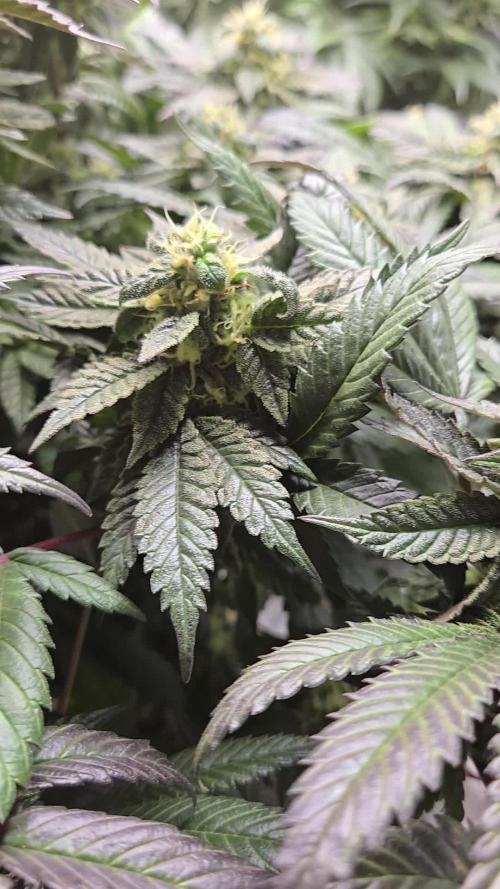
Today marks day 107 of the grow, and the plants are looking mature and well into the flowering stage. The front plant shows a stunning display of dark green to purple hues across the fan leaves, a clear sign of late flower coloration - possibly influenced by genetics and cooler night temperatures. The buds are dense and frosty, with trichomes covering nearly every surface, giving a rich, sticky appearance. The pistils are starting to darken and curl inward, indicating that the plant is approaching its final weeks before harvest.
The canopy is nicely even, suggesting that training earlier in the grow paid off well. Some lower fan leaves are showing slight discoloration and minor nutrient wear - normal at this stage as the plant redirects energy toward finishing its buds. The leaves' darker tone and slightly glossy texture suggest nutrient levels are still balanced, though it might be time to begin thinking about tapering off feeding soon and preparing for a flush.

Likes
25
Share


@Underthestairsgrowbro
Follow
Budlets have formed now on each branch, 8 days after 12/12. Its quickly grown back into a bushy bastard. I do plan to do 1 more semi heavy leaf strip sometime between now and end of week 3.
This girl has been strong. Sitting beside my Gorilla Glue which has had a small pm problem but nothing here.
Update: found pollen sacs this evening. This is a hermie 😫. Sadly i cut her down and into the trash she went. Luckily i have been flowering one of the family since the beginning of September so I will be able to finish the journal.
Also, if you peak around her on the side I have 1 of my Crocketts that i threw in here a month ago. I dont know if I should put pictures of her up on here because i dont want to confuse anything. What I can say is she is smaller but incredibly sugary for being only a month after 12/12

Likes
63
Share


@Chubbs
Follow
420Fastbuds
StrawberryGorillaAuto
Week 1 of Veg
What up grow fam. These 3 have sprouted amazing with no issues. All 3 had popped after 48hrs of being in the soil. Still misting the top soil with my sprayer to keep the soil moist but will start regular manual watering of 500ml every other day this week.
All in all Happy Growing
Likes
8
Share


@BruWeed
Follow
☘️30/11 - Empieza su segunda semana en etapa de crecimiento.
☘️Se encuentra muy fuerte y estable, creció muy rapido.
☘️Hoy esta cumpliendo 28 dias de vida desde su germinacion.
☘️Al big one lo agregue en la mezcla para regar a la planta y despues la rocíe con el mismo.
☘️Esta semana ya le agregue la red de scrog.
☘️En estos dias seguire subiendo mas imagenes de como viene.
😶🌫️🇦🇷☘️ Podes seguirme en Instagram como @bruweed_arg ☘️🇦🇷😶🌫️

Likes
7
Share


@HideAndFly420
Follow
She grows alone for one month with everything automatic cause i went in hoiliday for one month. Everything went really really good. :D
Likes
6
Share


Likes
57
Share


@Ultraviolet
Follow
The cannabis strain Grape Guava can be a purple strain, depending on its specific phenotype and genetic makeup. While not all phenotypes of Grape Guava are purple, some variations, such as the Zatix Grape Guava, are noted for their striking purple appearance due to the genetic expression of anthocyanin pigments.
Grand Cru Genetics is a cannabis seed bank that emerged in 2018 from a group of breeders in Madrid to provide a satisfactory experience to all cannabis users.
"If we do things, we do them well. Due to our experience in the sector and our taste for excellence, we know high quality and we seek it in everything we propose and do."
"We have a “cultivate without giving up” philosophy that we apply to everything we do. We do not give up, we are friends of change, and we adapt as necessary in a still restricted sector."
"We speak relaxed because we know how to relax. We are not intense or preachy; we accept everyone as they are, and we understand that farming is not for everyone. But for those who do, we are here to accompany you. We like to do it and tell it. We are experts in the field because we are the first to do it. We speak from experience and connect with others because we share the passion for cultivation."
"Cannabis has the ability to show us a world of possibilities. When you cultivate and live its growth process, you enjoy a path full of emotions and not just the final destination. At Grand Cru we find beauty in small things. We are attentive, observant, detail-oriented and aware of everyday things, and we savor them without rushing."
In a garden of green, Grape Guava gleams,
With its fruity aroma, enchanting dreams.
Clusters of grapes, guava's sweetness ignite,
A strain so divine, in purple and white.
Euphoria whispers, a lush fruity haze,
Grape Guava's embrace, a tranquil daze.
Off and away.@1400ppm. The increased CO2 allows plants to thrive at higher temperatures, which in turn necessitates higher humidity to maintain the ideal VPD for healthy growth and transpiration. 80F -5F = 75F LST with 70% RH = 0.72 kPa. Higher temperatures and humidity promote rapid growth, nutrient uptake, and photosynthesis while maintaining a lower stress level. Temperature influences the rate of enzymatic reactions involved in aerobic respiration. Enzymes, such as those involved in glycolysis, the Krebs cycle, and the electron transport chain, work most efficiently at an optimal temperature range. In low temperatures, enzymatic activity will slow down, thus reducing the rate of aerobic respiration. In high temperatures, enzymes can become denatured, thus impairing their function and stopping the process of aerobic respiration. Glucose is the primary fuel for aerobic respiration. The rate of aerobic respiration increases with the availability of glucose, as it is the starting point for glycolysis. If glucose levels are low, cells may rely on alternative energy sources such as fatty acids or amino acids , but these processes may yield less ATP or be less efficient. To determine this effect, carbon dioxide volume was measured (as carbon dioxide is an output of aerobic respiration)
18/6 with the 6 being IR. The near infrared (IR-a) borders around 700nm up to 1400nm @ photon par flux density of 1.8 instead of darkness, keeping temps overnight a neat 77F-80F.
I think of my tent as a lung. What goes in must come out. When the rate of air going out exceeds the amount of air coming in, it creates a negative pressure. Tent concaves (bends in). If set up correctly, the RH will begin to drop slowly to the desired level I set, and the extraction turns off when it reaches the desired RH. The plant, as it performs cellular respiration, will always release more water into the air; therefore, the RH% of the tent overnight will increase, as long as oxidative phosphorylation is occurring. As soon as the RH% creeps back up to 55%, the extraction turns back on, over and over. This creates a strong pressure differential, which will work wonders with mass flow. Replicating high and low-pressure fronts in nature. Critical for oxygen diffusion at the critical time of peak cellular respiratory function..
Moisture will not transfer from a saturated atmosphere to another if that air is already at or above its saturation point, meaning the air can't hold any more water vapor. Once I understood that water is produced as a by product during cellular respiration, specifically at the very end of the electron transport chain (ETC) where electrons are finally transferred to molecular oxygen, the higher the RH of the air, the more resistance there is for more moisture to be added to that environment, and effects the ease with which it does so. But none of that water comes from the pot; it's pulled from the air. If you run high daytime RH, your medium/pot is 100% reliant on transpirational root pull to move water. ZERO evaporation happens across the atmosphere if the tent air has high RH%, the medium cannot release its water through evaporation. Once a canopy develops, light no longer slowly wicks and evaporates from the topsoil. The Soil-Plant-Atmosphere Continuum (SPAC) describes the continuous pathway and process of water movement, driven by a gradient in water potential, from the soil, through the plant's roots, stem, and leaves, and finally evaporating into the atmosphere through transpiration. There is evaporation, there is transpiration, and then there is evapotranspiration; Evapotranspiration (ET) is the combined total of two processes: evaporation (water lost directly from soil and surface water into the atmosphere) and transpiration (water released from plants to the atmosphere through their leaves). Evapotranspiration represents the total amount of water that moves from the medium into the air. There is no such thing as a medium with too much water, only a medium that retains too much for too long.
The water must always flow efficiently from one atmosphere(Medium) to another(Air) in a timely manner. Moisture is a critical factor for bacterial growth and decay. Dictating how long it's allowed to sit in any one location for any given period is a key preferred control. To ensure a net reduction in a bacterial population, the rate of removal (ET) must exceed the rate of bacterial growth (decay rate), which is often modeled as a growth rate for the specific bacterium under the given conditions. By optimizing daytime VPD, we also optimize conditions for bacterial growth to explode exponentially above 77°F.. If water is allowed to sit in a medium without an escape within a timeframe, nothing good will happen. IF High RH is maintained overnight as well as during the day, placing 100% of water movement at the behest of daytime transpiration, roots can only pull where they can reach, and if soil is compressed above a certain point, moisture will become trapped in a medium with no way of moving day or night. This will begin the countdown for decay to take hold. When water stagnates in a medium, it loses oxygen, creating anaerobic conditions that foster the growth of harmful microorganisms like bacteria and fungi, which can produce toxins and disease vectors.
Thigmomorphogenesis, the process by which plants respond to mechanical stimuli like touch by altering their growth and development, results in significant morphological changes to improve survival against mechanical perturbations. This complex response involves sensing touch and initiating physiological and genetic responses, leading to changes in form and structure over days or weeks. The process is triggered by physical forces such as wind, rain, or touch. Plants adapt to these stimuli by changing their shape and structure, which may include slower growth, thickened stems, or altered leaf development. Plants possess sophisticated mechanisms to detect even subtle mechanical stimuli and initiate responses. A variety of molecules, including calcium ions, jasmonates, ethylene, and nitric oxide, are involved in signaling these mechanical inputs. Touch can induce the expression of genes that encode proteins for calcium sensing, cell wall modification, and defense mechanisms. A plant exposed to constant wind may become shorter and sturdier. A plant that is touched frequently might grow more slowly to conserve energy and develop thicker cell walls. These changes increase a plant's resilience and ability to survive in harsh environments.
Let's get Thiggy with it.


Likes
1
Share


@KannaGrowing
Follow
Ya estamos en plena floración y con las luminarias a max potencia... Evidentemente el aire acondicionado también está trabajando durante la fase de encendido.
Flowa-Bloom es la estrella de los nutrientes a incorporar, pero todos son importantes... Así que sigo la tabla de fertilización de JUJU Royal al pie de la letra.
Eso si, primero humedezco bien el sustrato con agua, para aprovechar bien la solución con los nutrientes y que no filtre por las macetas textiles.
Riego cada cuatro días.

Likes
10
Share


@Smog2012
Follow
It’s hard to notice the difference when you see it every day. However, when I look at the photos from the previous week, I think there is already a noticeable difference.
This strain is very interesting. My first Crystal Meth was completely purple. This plant only has purple stripes on the stems.
Let’s see how it will be in the future.
It also depends on the temperature.
Likes
19
Share


@NORTHWALESAUTOS
Follow
Still having issue's.. no fault but my own. I thought my problem was q ph issue but I'm now thinking it to much magnesium..
Anyway... following week I'll flush her and she how she is afterwards.

Likes
8
Share


@SkunkyDog420
Follow
Hallo zusammen 🤙.
Sie wächst sehr schön und macht keine Probleme.
Rabattcode für den BIOTABS-Webshop https://biotabs.nl/en/shop/ GDBT420, damit erhalten Sie 15 Prozent
Likes
40
Share


@bigbubsofcheese
Follow
So this is her last wk before i chop them been flushing with plain water.
Loving the colours this time around.
things i have learnt is IR/infrared at for 15min at lights out on a light cyc 14/10
screwed them last run big time.
I wouldn't recommend abusing any plant as much as i do in early stages of veg.
She so wild she has to be tamed or end up in a mess.
💪 little vid clip enjoy
on instagram bigbudsofcheese 👊

Likes
6
Share


@BLAZED
Follow
Week 8 (17-3 to 23-3)
17-3
Temps: 17.4 to 21.9 degrees
Humidity: 60% to 72%
18-3
Temps: 17.5 to 22.2 degrees
Humidity: 54% to 65%
19-3
Temps: 17.9 to 22.4 degrees
Humidity: 52% to 61%
Watering: Both 500 ml. EC: 0.4
Watering: Both 1000 ml. EC: 1.4
Defoliated both plants and attached some shoots to the rack. She got really big fan leaves!
I also supercropped some branches.
20-3
Temps: 18.2 to 22.8 degrees
Humidity: 59% to 69%
21-3
Temps: 18.5 to 23.4 degrees
Humidity: 57% to 67%
Watering: Both 1000 ml.
22-3
Temps: 19.4 to 24.1 degrees
Humidity: 55% to 67%
Watering: Both 1000 ml.
Set the strength of the light to 50%
23-3
Temps: 19.8 to 24.8 degrees
Humidity: 58% to 67%
Watering: Both 1000 ml.
As you can see, instead of removing the leaves, i tucked down all the leaves to open up the canopy.
I will see if i like this method as its the first time i try this.
I also attached some more shoots to the rack, its looking nicely spread out now :)
The #2 makes my fingers very sticky and smells really strong! I love it!


Likes
53
Share


@Roberts
Follow
She has a sweet, berry, fruity aroma. Smells great, and is loaded in trichromes. I did not get a purple color morph, but that is okay. She grew great in the small potter, and there was no major issues during the grow. Thank you again ILGM, and Medic Grow. 🤜🏻🤛🏻🌱❄️
Thank you grow diaries community for the 👇likes👇, follows, comments, and subscriptions on my YouTube channel👇.
❄️🌱🍻 Happy Growing 🌱🌱🌱
https://youtube.com/channel/UCAhN7yRzWLpcaRHhMIQ7X4g


