


Likes
Comments
Share

@BLAZED
Follow
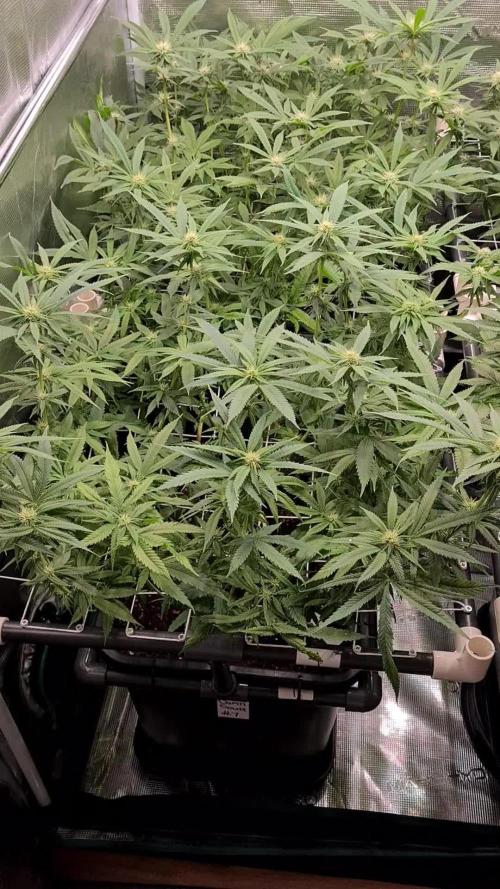
Week 12 (14-4 to 20-4)
14-4
Temps: 20.5 to 24.5 degrees
Humidity: 52% to 65%
Watering: Both 1000 ml. EC: 0.4
Did a big defoliation today.
Leaves removed #1: 165gr #2: 204gr
15-4
Temps: 20.1 to 26.1 degrees
Humidity: 57% to 64%
Watering: Both 1000 ml. EC: 1.5
16-4
Temps: 20.4 to 25 degrees
Humidity: 57% to 64%
17-4
Temps: 19 to 24.1 degrees
Humidity: 55% to 63%
18-4
Temps: 19.4 to 24.4 degrees
Humidity: 53% to 60%
Watering: Both 1000 ml. EC: 0.4
19-4
Temps: 18.4 to 23.5 degrees
Humidity: 54% to 64%
Watering: Both 1000 ml. EC: 0.4
20-4
Temps: 18.5 to 24.3 degrees
Humidity: 54% to 62%
Watering #1: 1000 ml. EC: 0.4
The light is at 60% strength with a distance of 45 cm.
I raised both White Widow plants to the same height as the 2 Damn Sour's so the canopy inside the tent is nice and even.


Processing
Likes
1
Share


@Ferenc
Follow
Day 15: From today, 600W LED is placed. Ventilation runs at the same time when the lamp is on +15min after the lamp is off. 20 hours on, 4hours off. Fertilization starts on Monday, Wednesday, Friday with Epsom salt, Tuesday, Thursday, Saturday with bat guano. Water intake 25ml per plant per day plus some triggering spray. Critical Orange is already so tall.
Day 16: They are pretty cool and like the new environment I mean ventilation and the new powerfull LED. As it can be seen in the picture one is really small. It happened because this is the 2nd Sour Orange seed that was planted after them because one seed has died the Super Skunk so I replaced with an other Sour Orange.
Day 17: I burnt Critical Ora ge Punch and Lemon Zkittle because of the triggering spray and the lamp I can see the leaves... I will stop using triggering... Not the first time.... They will survive anyways...
Day 18: Thet are stable now ventilation does not shock them that much. Lemon Zkittle and especially Critically Orange Punch burnt badly. When these get bushier and bigger I will remove those ugly parts.
Day 20: No picture was taken yesterday, they are strong enough now so the ventilation is fine. Lemon Zkittle and Critical Orange Punch still look burnt next week may be the chance to remove those leaves.


Likes
20
Share


@eldruida_lamota
Follow
Que pasa familia, vamos a añadir la segunda semana de floración de estas Apple Fritter de RoyalQueenSeeds, empezamos con la temperatura que la tenemos entre los 21/25 grados, la humedad está entorno al 50%, el ph está en 6.2 , el foco actualmente lo tengo encendido 12 horas y la potencia es al 75% de lo que da el foco.
También añado la gama de nutrientes de Agrobeta, que no falla, sin duda de la mejor alimentación que hay para tus plantas, también se ven bien verdes ya recuperaron la carencia de nitrógeno.
Veremos estas próximas semanas como avanzan y se comportan en la floración.
Mars hydro:
Code discount: EL420
https://www.mars-hydro.com/
Agrobeta:
https://www.agrobeta.com/agrobetatiendaonline/36-abonos-canamo
Hasta aquí todo, Buenos humos 💨💨💨

Likes
5
Share


@420medic
Follow
Bulking up quite a bit with these girls and the trichomes level is off the charts with both the mutant and the banana purple punch.. the stretch is over so now it's just putting on the weight.
Likes
17
Share


@Kirsten
Follow
14.1.25:
I've been readjusting the LST. I just took all the pegs out and reshaped her.
I got some new LST equipment in the mail today, have been glad to have more pegs. I got some clips too, but they don't seem to stay on 😕
I'm currently only using the pegs, I have some thicker soft wire, but I forgot I don't have pliers to cut it!
Also I'm running very low on Biobizz nutrients, so that could be bad 🤞
18.1.25:
I have done another large defoliation on PPP1 and PPP2.
Also, moderate defoliation on all other plants today. All LST ties and pegs are readjusted.
I have turned up the light to 90%. Same distance of between 24-28 inches, depending on height of specific plant.
I have increased the dosage of Biobizz Bio-Grow and Fish Mix to give an extra boost of Nitrogen as several plants were showing yellowing. They have responded very well to this. Unfortunately I ran out of my Biobizz nutrients and PH UP. I'm currently using Bicarbonate of Soda to increase the PH after the nutes PH comes out to about 4.1. Obviously, that uses a lot and I only had a 250ml bottle, which I used last run too.
This run I have 9 plants. The only thing I'm worried about is the salt build up.
Have you used it before? Or any other natural way to increase PH? Please let me know!
I've also added Biobizz Fish Mix to help with the extra Nitrogen needed.
Watering with 1ltr of dechlorinated water PH'd to 6.3 with the following nutrients;-
♡ 4ml Biobizz Fish Mix
♡ 4ml Biobizz Bio-Grow
♡ 2ml Biobizz Bloom
♡ 2ml Biobizz Top Max
♡ 2ml Cal-Mag
♡ 2ml Ecothrive Flourish.
I water with this every 3 days.
I did order some more Biobizz Bio-Grow and Bio Bloom.
I found some at a reasonable price on Amazon. I still have about 800 ml of Biobizz Fish Mix left, too.
It is fairly expensive this time as the plants are hungrier this run.
I also got a new bag of Canna coco, which I may use to add a top dress with some dry amendments.
Which hopefully will save some cash on the bottled nutrients and stretch out until the end of this run without having to buy anymore.
I have purchased a funnel to pour the water. It is difficult, due to the shape of my LST, to water precisely. I have spilt it all over the tent several times 🙄
I've also ordered a 2 litre jug. Currently, I'm mixing water for 9 plants individually in a 1 litre jug. It's tideous. Hopefully, this will solve the issues.
Cleaning the tent after watering every time isn't my idea of efficiency 😅
Thanks for checking out my diary 🍃 ✌️
Likes
2
Share

@420DeepGrow
Follow
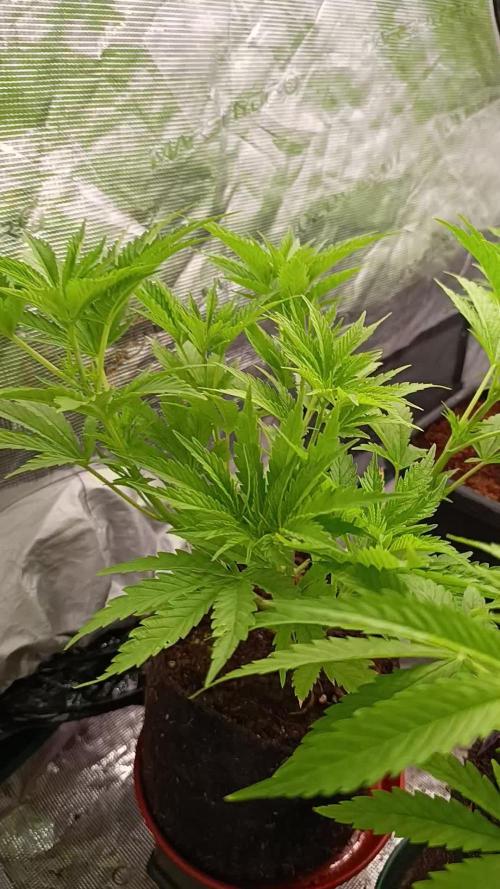
📆 Semana 2
Comienza la floración activa. Se aprecia el estiramiento controlado y la aparición clara de pistilos. La planta mantiene un verde sano y una estructura abierta y equilibrada.
Se inicia la aplicación de Sticky Finger, apoyando el arranque floral sin generar estrés. Raíz y parte aérea responden de forma estable.
Semana de transición bien encarrilada.
Seguimos creciendo fuerte 💪!
Likes
19
Share


@DrLaggis
Follow
🌱 Start: 17.07. 🌱
Hello everyone! This is my very first grow and I'm thrilled to share every step with you! 🎉 I'd appreciate any tips you might have to help me achieve the best results! 😊
Equipment:
I've geared up with an Indoor Grow Kit from MarsHydro along with some BioBizz supplements to ensure my plants get the best care. 🌿
🌼 Seeds:
I opted for Fast Buds seeds after hearing great things about them. They were delivered super fast—just two days! I’m particularly excited to test the Grapefruit strain. 🚀
I've begun soaking the seeds and setting up my space. Eagerly awaiting the transition to the next stage in a day or two! 🌱
📅 Update: 19.07.
My Grapefruit seeds sprouted 1-2 cm within just 1.5 days! 🌱 It’s often recommended that autoflowers be planted directly into their final home, so I'm following that advice.
I'm working on improving the air circulation in my tent to ensure the best environment for growth. 🌬️
I'm currently using 0.2L cups with big holes over the sprouts to maintain higher humidity during their initial two weeks. 💧
🎉 UPDATE 22.07. - THEY ARE ALIVE 🎉
My Grapefruit sprouted on 20.07., and I'm overjoyed to soon share photos and a video of my little green buddy! 📸🎥
PS: My plant enjoys 2 hours of chill jazz music every day! HAHA 🎷🎶
Likes
14
Share


@Onlygrow99
Follow
Empezamos 3ª semana de crecimiento, durante esta semana, podare los bajos y algún nudo. Tras unos días de recuperación pasaremos a floración.
Se empezaron a germinar el día 10/10/23 llevamos 27 días desde que se empezó a germinar.
Hoy día están siendo regadas con 1.5 de ec y 6.0 de ph, usando la gama de abonos orgánicos de boom nutrientes y CALMAG. Uso de sustrato el LIGHT MIX de GBNUTRIENTS.
Son frondosas con grandes hojas, nudos muy corto entre si y además están verdes. Se nota que la luminaria hace su trabajo sin calentarse y por eso la tengo cerca de las plantas evitando que se "espiguen"
**Actualización 08/11** he podado bajos de todas las plantas y alguna hoja grande que tapa las formaciones.
En pasar 2-3 días para que se recuperen, pasamos a floración.

Likes
8
Share


@GeorgeGrowss
Follow
This is officially my first grow. I have some experience with gardening and especially bonsai. Its going to be quite challenging given the limited height of my tent.

Likes
3
Share


@Dunk_Junk
Follow
This is the frostiest plant I've ever grown. She is incredible.... Got a few weeks to go though.

Likes
15
Share


@Hashy
Follow
********************************************
Week 6 Early flower (week 2 flower)
********************************************
Light cycle=12/12
Light Power=75w 31%
Extractor controller settings (during lights on).
High temp= 26c
Temp step=0c
High Rh= 58%
Rh step=0%
Speed max=10
Speed min=1
Extractor controller settings (during lights off).
High temp= 20c
Temp step=0c
High Rh= 60%
Rh step=0%
Speed max=10
Speed min=1
Smart controller settings (during lights on).
Lights on=9.00am
Radiator on= -19.0c
Radiator off=+19.5c
Smart controller settings (during lights off).
Lights off=9.00pm
Radiator on=-18.0c
Radiator off=+18.5c
VPD aim=0.9-1.3
DLI aim=30-35
EC aim=0.8-1.5
PH aim=6.0-6.5
💧💧💧💧💧💧💧💧💧💧💧💧💧💧💧💧
NPK= 10-10-20
Method= Automatic
Feed= Flower nutes
Neutralise=0.1ml/L
Katana Roots=0.2ml/L
Plagron bloom=5ml/L
Plagron Power buds=1ml/L
Easy Ph down=0ml/L
(1ml=24 drops, 1 drop=0.04ml)
Easy Ph Up=0.083ml/L
(1ml=24 drops, each drop is 0.04ml)
Ec=1.35 PH=6.4/6.3
Runs=10
Run times=3mins (0.7L/0.35L each)
Gap times= 17mins
Total runtime=30mins(7L/3.5L each)
Total flowrate= 0.233L/min(0.116L/min each)
Auto start time=10.00am
Auto stop time=1.03pm
💧💧💧💧💧💧💧💧💧💧💧💧💧💧💧💧
********************************************
********************************************
📅15/3/25 Saturday(Day 36)
📋
📅16/3/25 Sunday(Day 37)
📋 replaced batteries in wifi temp/humid sensor.
📅17/3/25 Monday(Day 38)
📋
📅18/3/25 Tuesday(Day 39)
📋 Small defoliation and leaf tuck.
💧
Automatic Flower nutes
Ec=1.35 PH=6.4/6.3
Volume=9L
Volume left=2L
Volume used=7L(ml/min)
Volume each=3.5L(ml/min)
Runoff.
Total runoff=L
Ec= PH=/
💧
📅19/3/25 Wednesday(Day 40)
📋
📅20/3/25 Thursday(Day 41)
📋
📅21/3/25 Friday(Day 42)
📋H=38cm D=26cm Dli=28.4 PPFD=657
Raised light, increased power to 100w
H=38cm D=39cm Dli=26 9 PPFD=623
********************************************
Weekly roundup.
📋 That's the 2nd week of flower finished, she hasn't really stretched that much, about 13cm during this week. She's nice and bushy, looks healthy so I'm saying this was a good week.
Back soon.
Take it easy.
********************************************

Likes
65
Share


@Roberts
Follow
I have not done much to her this week beside a solution change. Will change to flowering light schedule next update. She is in a New Level Hydro bucket, under a Spider Farmer SE5000 light at 50 percent.
Thank you New Level Hydro, Spider Farmer, and Quebec Seeds. 🌱🤜🤛🌱
Thank you grow diaries community for the 👇likes👇, follows, comments, and subscriptions on my YouTube channel👇. ❄️🌱🍻 Happy Growing 🌱🌱🌱
https://youtube.com/channel/UCAhN7yRzWLpcaRHhMIQ7X4g
SE5000
https://amzn.to/3qFpAML
Spider Farmer Official Website Links:
US&Worldwide: https://www.spider-farmer.com
UK: https://spiderfarmer.co.uk
CA: https://spiderfarmer.ca
EU: https://spiderfarmer.eu
AU: https://spiderfarmer.com.au
Coupon Code: saveurcash
Www.newlevelhydro.com
Www.hygrozyme.com

Likes
4
Share


@myketb
Follow
WK2D2 - Everything is looking very good. Start giving them some 250 ppm nutrients today and they are still bathing under light CFL of about 350 ppfd.


Likes
3
Share

@Catawbiense
Follow
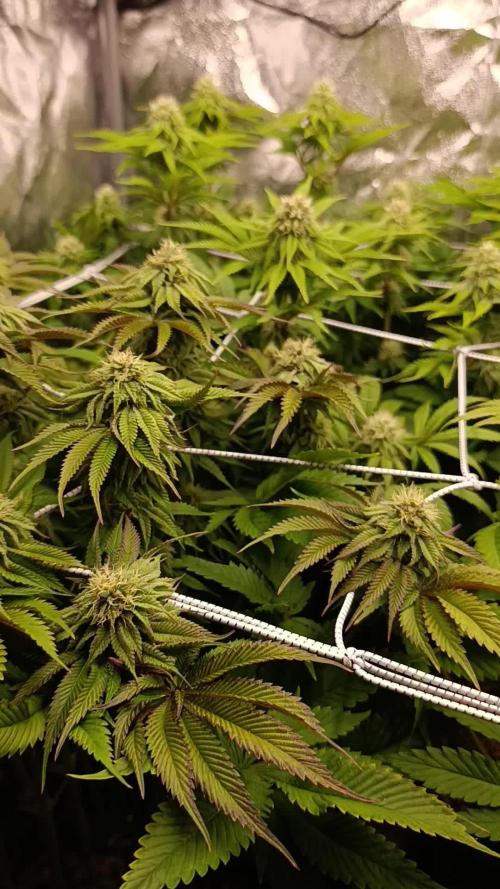
Die fünfte Blütewoche hat begonnen. Bei der letzten Bewässerung gestern habe ich 1 ml/l pk1314 verwendet. Bei der nächsten Bewässerung werde ich wieder pk 13/14 verwenden. Nächste Woche werde ich die Topmax-Dosis auf 3 ml/l erhöhen.
Die Pflanzen sehen etwas gelb aus, weil ich zu früh aufgehört habe, Biogrow zu verwenden. Aber das ist mir lieber als blättrige Blüten. Es gibt viel Harz, insbesondere ein Phänotyp ist stark verzuckert. Die Blüten werden nicht die dicksten sein, aber ich bin bisher zufrieden.

Likes
6
Share


@Huckleberry39
Follow
I am so excited to grow this Mexican Airlines from @420fast_buds. She is About twelve days out of The Dirt and is doing excellent.
But I wouldn't expect anything less from the peeps at @fast_buds. She is looking super indica early on. Can't wait to see how it goes. See you guys back here next wee for another update ( if not sooner)!!!
Peace and love
Likes
28
Share

@DerFredlFesl
Follow
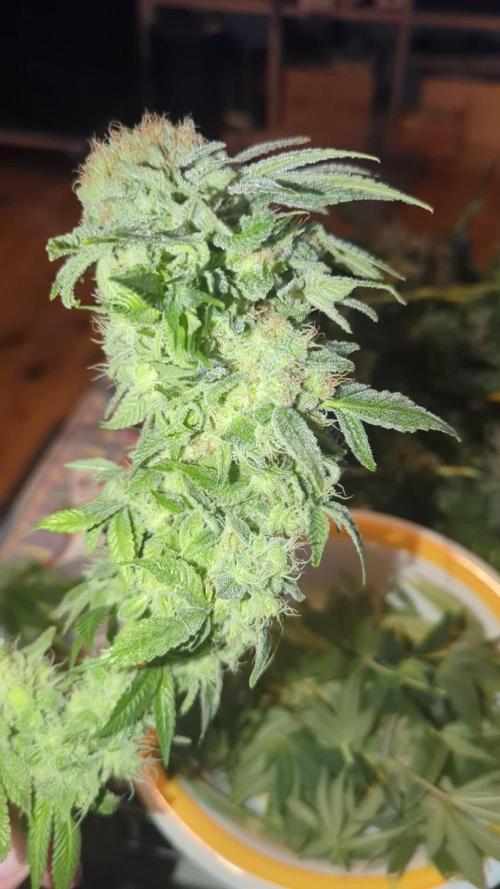
Hat alles reibungslos funktioniert. Kann das Setup mit Biotabs und Autopots nur jedem empfehlen der nicht jeden zweiten Tag gießen möchte.
Freue mich in ein paar Monaten hier den nächsten Grow zu starten.
Likes
Comments
Share

@GoodTimesOrganics
Follow
Hi liebe Community! 💚
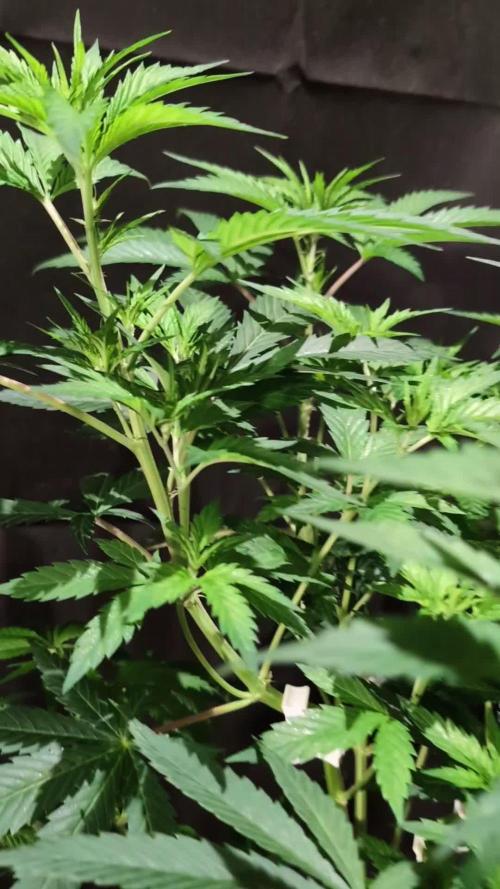
Der zweite Strain von Good Times Genetics. Entwickelt sich wunderprächtig und es sind sehr schöne große und Breitgefächerte Blätter zu erkennen. Ein schönes Wuchsbild verreint mit einer starken Indica Dominanz.
Dieser Genotyp entwickelt sich sehr homogen mit gleichmäßigen Abständen zwischen den Seitentrieben. Es ist allerdings ein starkes Blattwachstum erkennbaren, welches hoffentlich dann bei der Leaf to Bud Ratio nicht so übertrieben aus wuchert.
Wir sind mega gespannt, wie sich die Pflanzen weiter entwickeln.
Am Freitag, den 02.01.26 würde der Lichtzyklus auf 12/12 umgestellt.
Die Wachstumsbedingungen im Growzelt sind weiterhin am Optimum und Stabil:
———————
🌞 Temp: 23°C
🌚 Temp: 20 °C
💨 RH: 58%
VPD: 0,86 kPa
😎PPFD: 330 mqm
———————
Stay Tuned! 💚


