




Likes
4
Share


@KannaGrowing
Follow
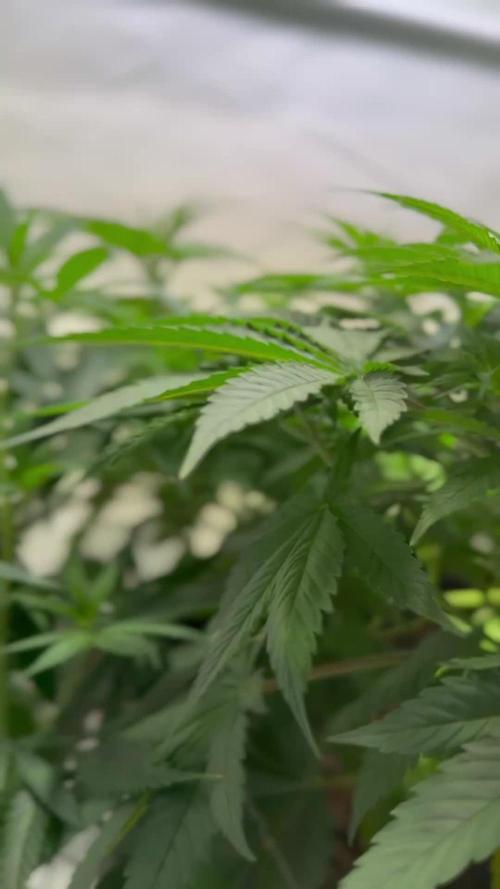
Estamos en la primera semana de vegetativo, ya que a la anterior se la conoce como semana de germinación.
Las plantas empiezan a mostrar las primeras hojas reales por encima de los cotiledones.
Cuidado con que la humedad relativa del aire, no sea demasiado baja, lo ideal sería alrededor de un 65%.
En esta etapa solo regamos suavemente con agua cada 5 días aprox.


Likes
36
Share


@Lordshiva83
Follow
Olá companheiros, mais uma semana tudo está a ir bem com as princesas, estão com bom desenvolvimento na floração, as flores estão a engordar e cheias de tricomas. Grato amigos ✌️☮️🌱


Likes
4
Share


@MasterKush714
Follow
Yooo gang updateee!!!
Soo bad news first, the small tent with the godfather og mother had sadly passed away and expired, simple put she got way to close to the light AND turns out the air discs I was using were completely swalloed and wrapped up by the roots, so that mega blows.
NOW the good news, I actually have a couple new plants in the large tent with the clones, a GDP that's about 4 weeks in on veg, and a NYC Sour Diesel which is about 2 weeks out from seed, will keep updating on what I do with those, other then that the clones from the godfather og are doing really really well will keep updating as the days and weeks go on thanks for stopping by gang!!!!

Likes
324
Share


@Teamdirtbag2
Follow
No pictures would download... I tried... videos did ❔❔❔❔ I'm confused 😔 .. I fed her some nutes.
And hose water❗she is starting to look 👀good...
She is starting to smell bad ,and alot....
She is 7'4" tall now ...
6 ' + wide ( her cage is , she is sticking through it )
4' thick
Basic flower news from General Hydro
Along with some floralicious plus , Diamond nectar , Cal Mag , flora nectar, florabloom, and a little kool bloom...❗❗❗❗😎

Likes
8
Share


@Appoldro420
Follow
Today, I spent some time tying down branches under the net again. It’s still a tricky task as the branches are quite brittle and break easily. Fortunately, the plants recover quickly, and so far, I’ve mainly noticed new growth sprouting from where the branches broke.
Watering Experiment: Too Much or Just Right?
Two days ago, I decided to give each plant an additional 2 liters of water to test the effects of what felt like overwatering. The results were interesting:
High Humidity: The relative humidity spiked to 74%, which I consider a minor downside.
Lower Temperature: Dropped to 29°C.
Explosive Growth: The plants responded with vigorous growth!
Given the humidity increase, I’ve decided to water the plants heavily only once a week. This approach should give them time to rest and prevent the growth of more mushrooms in the soil—yes, I’ve spotted a few popping up from the pot’s surface.
Monitoring pH and Nutrient Reservoir
I’ve also noticed that the pH has crept up to 6.2, indicating that the nutrient water hardness is decreasing. This suggests it might be time for a full reservoir refresh. Tonight, I plan to inspect the reservoir and clean it out. Thankfully, my hydro pump makes draining it a quick and easy process.
Observations & Next Steps
Continue training and monitoring branch recovery.
Stick to the adjusted watering schedule.
Refresh the nutrient reservoir and recalibrate the pH if needed.
The grow is progressing nicely, and the plants seem happy despite some of the challenges. Let’s keep it going! 🌱
Cheers
30/11: Added some pictures, not to much to say because I didn't look at them the last 2 days and they just went crazy..
01/01/25:
Happy New year!!
Leaving them alone is not an option... If they keep growing like this, I'll take it! This weekend, I'll do some heavy pruning. For now, I’ve snapped a few stems and tied some others to see which method gives better results. I’ve done about half so far, but I need to head to bed because of work. Tomorrow evening, I’ll tackle the other half. Also, I’ll look for some more subtle zip ties.
Likes
9
Share


@BusyBeeFarmer
Follow
Germination and Preparation
The Do-Si-Dos seeds from WeedseedExpress arrived well-packaged in a discreet envelope with bubble wrap and a branded shopping bag. The seeds look promising—large, with beautiful marbling.
I started by soaking the seeds in water with a pH of 5.8. After just a few hours, one seed already sank to the bottom, not a good initial sign. Despite this, I kept all three seeds in the germination process, and all of them developed roots. The seed that initially sank seems to be doing fine, so I’m giving it a fair chance.
The seeds are now placed in Jiffy pellets with a pH of 6.0. The temperature is maintained at around 24°C (75°F). My plan is to monitor these seedlings closely and select the most vigorous one for cultivation.
Grow Plan
I will be using the Sea of Green (SoG) technique in an 80x80 cm space. To maximize the yield and structure, I intend to extend the vegetative stage to about 6 to 8 weeks, possibly up to 10 weeks.
I’m also using organic nutrients, and the motto "Don't Panic, It's Organic" fits my grow style perfectly.
Dosidos End of Seedling Phase Report
Environmental Conditions:
Humidity: 70-80% initially, adjusted to 60-70% during hardening.
Temperature: 19°C (night), 23°C (day).
Lighting: Lamp positioned 40 cm above seedlings.
Observations & Actions:
All three seeds germinated successfully.
One seedling was removed for poor growth and exposed root.
Greenhouse lid removed on day 7 for airflow; seedlings adapted well.
By day 9, roots fully developed, signaling readiness for transplant.
Transplantation:
Transferred to 7L pots with light watering and BioBizz Root Juice to ease stress.
Performance Feedback:
The two selected seedlings show robust growth, forming a solid foundation for the planned Sea of Green setup.
dein-onlineheadshop.de/
Use my referral code 420Shop at checkout to get a discount on your purchase. By using this code, you also support me, as I receive a small reward for each use. Thank you for your support!
Likes
10
Share

@DogDoctorOfficial
Follow
💙 Project Blue Tent – Week 8
Blue Waffle F1 – Pheno A (Folder 13A)
Hello everyone, and welcome back to another chapter inside Project Blue Tent! 💙🌱
If you're new here, welcome aboard.
Project Blue Tent is our little experiment with four individual Blue Waffle F1 plants from Zamnesia, each documented separately from seed to harvest.
All four ladies share the same environment, lighting, irrigation, nutrition and general care.
And yet...
They still manage to show their own little personalities.
We're not just growing plants.
We're getting to know them.
And this week?
Well...
They're finally in flower. 🌸
────────────────────────
🌸 Week Eight – Welcome to Flower
This week feels completely different.
After seven weeks of vegetative growth, the Blue Tent has finally made the transition into flowering.
And honestly...
I think these girls were ready for it before I was.
The entire tent has been growing at an incredible pace.
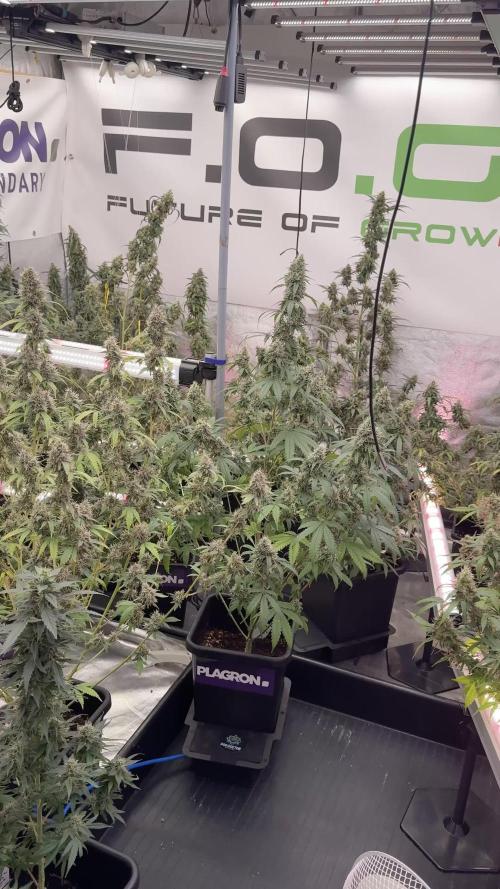
In roughly one week, some of these plants have gained close to 30 cm, while simultaneously becoming denser, producing developing flowering sites and generally accelerating in every direction.
They're not simply getting taller.
They're building.
Branches are extending.
New growth is appearing everywhere.
Flowering sites are developing rapidly.
And the whole room suddenly feels like it has shifted into another gear.
Looking back, I may have kept them in vegetation a little longer than I normally would.
Seven weeks of vegetative growth is definitely on the longer side for the way I usually run these plants.
But there's no point looking backwards now.
The canopy is established.
The plants are healthy.
The screen has done its job.
And now we're going to see what happens when these beautiful F1 ladies are finally allowed to flower.
────────────────────────
🕸️ From SCROG to Flower
The SCROG has been one of the most important parts of this entire vegetative phase.
For weeks, we weren't trying to make the plants taller.
We were trying to distribute their growth across the available space.
Branches were gently guided beneath the screen, allowing the canopy to develop horizontally rather than allowing individual tops to dominate vertically.
And looking at Plant A now...
I'd say the mission was successful.
The canopy is remarkably even.
From above, it is becoming increasingly difficult to tell where one plant ends and another begins.
That's exactly what we wanted.
A relatively uniform surface where multiple flowering sites can develop under similar conditions rather than having a few dominant tops towering over everything underneath them.
Of course, now comes the interesting part.
Flowering stretch.
And judging by what these plants have done during the last week...
I have a feeling they're not planning on staying at this height for very long.
😅
────────────────────────
🌿 Plant A – The Race Has Started
Plant A is looking absolutely beautiful.
The colour is one of the first things that catches my attention.
That rich, healthy green we've been working toward is still there, and the plant looks full of energy.
But her biggest characteristic this week is simple:
Speed.
She is moving.
Fast.
The transition into flower has clearly brought a completely different level of activity to the plant.
New growth is appearing quickly, branches are extending, and the developing flowering sites are becoming increasingly obvious.
At approximately 81 cm, she's already gained a considerable amount of height since the last report.
And that's exactly why I'm watching this flowering stretch so closely.
We have a very even canopy right now.
I'd love to keep it that way.
But with seven weeks of vegetative development behind these plants, combined with the warm and relatively similar day and night temperatures, I fully expect some stretching.
The challenge now isn't creating the canopy.
We've already done that.
The challenge is seeing how well we can maintain it while the plants transition into full flowering.
────────────────────────
💡 Starting Flower Under Strong Light
We're also entering flower with a fairly ambitious lighting strategy.
Rather than slowly easing the plants into lower light levels, we're starting flowering at approximately 800 PPFD.
The idea is straightforward:
The plants have developed a large, healthy canopy during vegetation, and now I want to see how they respond as flowering begins.
I'm particularly interested in seeing whether maintaining strong light from the beginning can help encourage compact development despite the factors that may push these plants toward additional stretch.
Will it keep them compact?
Honestly...
I'm not completely convinced.
😂
Seven weeks of vegetation.
Rapid growth.
Warm days.
Warm nights.
And now the beginning of flowering.
That's a lot of ingredients for stretch.
But that's also what makes this project so interesting.
We're not trying to predict everything perfectly.
We're watching what the plants actually do.
And Plant A is already telling us that she's ready to move.
────────────────────────
🌡️ Blue Tent – Flowering Conditions
The environmental conditions have shifted slightly with the transition into flower, while the overall stability of the room remains excellent.
This week's recorded conditions were:
• 🌡️ Day Temperature: 27°C
• 🌙 Night Temperature: 27°C
• 💧 Relative Humidity: 66%
• 🥥 Substrate Temperature: 24°C
• 💦 Nutrient Solution Temperature: 19.2°C
• ⚗️ pH: 5.81
• ⚡ EC: 2.09 mS/cm
• 💨 CO₂: approximately 666 ppm
• 💡 Light Schedule: 12/12
• 💧 Irrigation: approximately 1.4 L/plant/24h
• ? Pot Size: 8 L
• 📏 Plant Height: approximately 81 cm
One thing I'm particularly interested in during this phase is the temperature difference.
There really isn't much of one.
Day and night temperatures are currently sitting around the same level.
That's something I'm watching carefully because plants can tend to stretch more when nighttime temperatures remain relatively warm.
Combine that with the amount of vegetative growth these girls have already accumulated...
And we may have an interesting few weeks ahead.
For now, though, they're looking fantastic.
────────────────────────
🥥 Feeding Program – A Small Step Forward
With flowering officially underway, the nutrition has also moved forward slightly.
The current recipe is:
• Plagron Hydro A — 2 ml/L
• Plagron Hydro B — 2 ml/L
• Plagron Hydro Roots — 1 ml/L
• Plagron Power Buds — 1 ml/L
With pH adjustment as required.
The resulting EC is currently approximately 2.09 mS/cm.
This is a small progression from the previous vegetative recipe rather than a dramatic change.
And that's intentional.
The plants are hungry.
They're growing incredibly quickly.
They're entering flowering.
But I still prefer making measured changes and then watching how the plants respond rather than changing everything at once.
The plants have already given us some very clear feedback during this project.
Beautiful colour.
Fast growth.
Strong structure.
Healthy foliage.
So we're continuing to listen.
────────────────────────
💧 The Drip & Drainage System – Working Together
One of the things I really want to highlight this week is the irrigation system because it has become such an important part of Project Blue Tent.
The Mars Hydro drip irrigation and drainage setup isn't simply watering the plants.
The two sides of the system are working together.
The drippers deliver the nutrient solution directly into the coco.
The solution moves through the substrate, supplying the root zone before exiting as runoff.
That runoff is collected in the trays beneath the grow bags.
From there, the drainage system channels the collected solution through a pipe toward the pump.
The pump then moves the collected solution back toward the reservoir.
So what we have is effectively a recirculating system, where irrigation and drainage work together as one continuous setup.
And honestly...
It's working wonders.
The plants are drinking.
The roots are being supplied consistently.
The runoff is being removed automatically.
And the entire process happens without me having to manually carry watering cans around the room every day.
That's especially valuable now that the plants have entered flowering and their water demand is increasing.
The system is quietly doing its job in the background.
I get to spend my time watching the plants instead.
And I much prefer that.
────────────────────────
🌿 Why This Week Feels Different
There is something fascinating about watching a plant move from vegetation into flower.
Yesterday you're looking at leaves and branches.
Then suddenly...
You start seeing the plant change its priorities.
The growth becomes more pronounced.
The flowering sites begin developing.
The branches start extending.
The structure you've spent weeks building begins transforming into something completely different.
And because these plants were allowed to develop for seven weeks in vegetation, there is a lot of structure available for that transformation to work with.
Plant A has a fantastic starting point.
The canopy is even.
The branches are well distributed.
The stems are strong.
The foliage is healthy.
Now we simply have to see what she does with it.
────────────────────────
🌿 Plant A's Personality
Plant A continues to be one of those phenotypes that makes me smile whenever I open the tent.
She's vigorous.
She's responsive.
She's beautifully structured.
And apparently...
She's in a hurry. 😂
Her development throughout vegetation was impressive, but the speed at which she's now transitioning into flower is something else entirely.
There's a real sense of momentum around this plant.
At the moment, she remains remarkably similar to her sisters, which is another fascinating observation from this project.
Despite giving each phenotype its own diary, the four plants continue showing an incredible level of uniformity.
From above, they're almost becoming one giant plant.
But when you look closely...
The little differences start appearing.
And that's exactly what this project is about.
────────────────────────
🌸 The Big Question – How Much Will They Stretch?
This is probably the question I'm most curious about now.
The plants were vegetated for seven weeks.
They have grown extremely quickly during the last week.
Day and night temperatures are currently very similar.
And flowering has just begun.
All of those factors make me expect some additional vertical growth.
How much?
That's what we're about to discover.
I'm hoping the strong lighting and the structure we've created will help keep the canopy reasonably compact.
But I'm not going to pretend I know exactly what will happen.
Sometimes the plant gets the final vote.
And these girls have already demonstrated that they have plenty of energy.
So...
Let's see what they do.
────────────────────────
👀 Looking Ahead
The next couple of weeks are going to be fascinating.
The major vegetative work is finished.
The SCROG has been filled.
The canopy has been cleaned.
The plants have recovered.
And now we're officially into flowering.
Our main job from here is observation.
Watching the stretch.
Watching the developing flowers.
Watching the colour.
Watching the plants' response to the new nutritional program.
And, of course, keeping that environment as stable as possible while the room becomes increasingly dense.
Plant A has an excellent starting position.
Now nature takes over.
And considering how quickly she's been moving already...
I have a feeling the next report is going to look very different from this one.
🌸
────────────────────────
💙 Thank You
A huge thank you to Zamnesia for making Project Blue Tent possible and for giving us the opportunity to explore these beautiful Blue Waffle F1 genetics phenotype by phenotype.
A massive thank you to Plagron for the Premium Growbags and Hydro nutrient line that have supported these plants throughout their entire vegetative journey and now into flowering.
A special thank you to Zamnesia for the Phytonaut LED lighting that has helped us build this remarkably even canopy and will now be putting that flowering structure to work.
And a huge thank you to Mars Hydro for the drip irrigation and automatic drainage system.
Watching the irrigation and drainage work together throughout this project has been incredibly satisfying. The consistency, automation and recirculating setup have made managing four rapidly growing plants considerably easier.
Thank you as well to GrowDiaries for giving growers around the world a place to document their journeys, share experiences and learn from one another.
And finally...
Thank you to every single person following Project Blue Tent.
We've spent seven weeks building these plants.
Seven weeks of training.
Seven weeks of SCROG.
Seven weeks of watching them develop.
And now...
Flower has officially arrived. 🌸💙
The canopy is ready.
The plants are healthy.
The lights are on.
And the real transformation is just beginning.
Until next week...
Growers Love, happy growing, and take care everyone! 🌱💙
Likes
7
Share


@PCGrows
Follow
So after this week the out break hit. I grow for self medicine as a Crohn’s Disease sufferer and am heavily immunocomprimised. I had to relocate to a rural location to truly self isolate and the plants definitely stressed.

Processing
Likes
6
Share


Likes
3
Share

@Ninjabuds
Follow
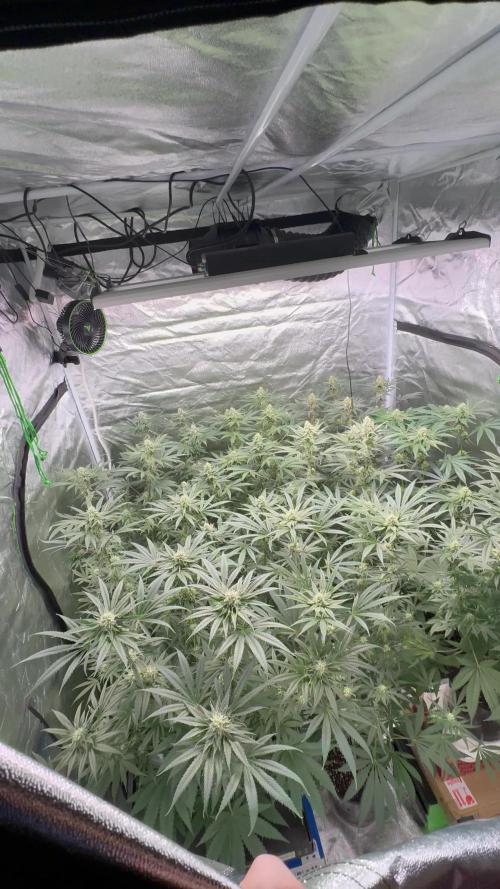
Everything is looking great for now. Busy week. Check back next week for individual photos of he plants will be starting to be pretty fat by then

Likes
29
Share


@DaddyPrime
Follow
8/25 put in closet for 48 hrs of darkness before harvest
8/28 actually did almost 3 days of darkness but started trimming and chopping. Getting ready to hang.
Day 1. 8/29: 72°F and 50% humidity. Still wet. Even the small buds
Day 2. 8/30: 70°F and 47% humidity
Day 3. 8/31: 70°F and 52% humidity. Looking more dry than id prefer after 3 days of drying. But the conditions arent exactly ideal.
Day 4. 9/1: 70°F and 49% humidity. Humidity dropped which sucks!
Day 5. 9/2: 75°F and 37 humidity. Temperatures rose and humidity dropped a lot. Buds are super crispy. Im gonna let them go another day.
Day 6. 9/3: time to jar the buds for curing.
Dry weight is 43 grams
Likes
77
Share


@TOTEM
Follow
Oh my. Last week I was talking about N deficiency, but in reality she was perfect!
The real big problem was my pH pen, that was broken, and when I thought I was giving a pH 6.5 solution to my plants, in reality the pH was a lot lower than that (maybe pH 4). That's why her leaves all started getting yellow!
Runoff PPMs right now, after the feed, are 3100 lol. I decided not to flush her, but I'll give just water until that value decreases a little. Her flowers are bigger, and smell more and more, day after day, of fruit. I LOVE HER. But what a pity for those burned tips!
I also have some updates on the clones. One of them created 1 single root, haha, but YAY, I'm so happy about it. That clone was fast! The other two are still there, but my fingers are crossed. There's a video of the clone after all the photos.

Processing
Likes
10
Share


@Reaper
Follow
start of week 4: i cut off the fanleaves to give the stems light.
a day after that there is still water drooping out of the cuts like it doesnt heal ?
weird.
it has been a bit cold at night, the humidity also swings a lot but they grow, when the lights go out leaves curl up like they are freezing.
the video here is when the lights have been on for 8hours already, when they in the dark they look dead lol

Likes
68
Share


@Ultraviolet
Follow
Inhale for 13s, Exhale for 13s,
Inhale for 8s, Exhale for 8s,
Inhale for 5s, Exhale for 5s,
Inhale for 3s, Exhale for 3s,
Inhale for 1s, Exhale for 1s,
Alignment. 1.618
More energy, more blueprint.
A plant with both standard cellular respiration (occurring throughout the plant, including leaves and stems) and adequate root respiration will have a significantly higher ATP throughput than one restricted to only general cellular respiration in a limited way.
Cellular respiration is the fundamental metabolic process that occurs in all living plant cells (roots, stems, leaves, flowers, seeds) to convert glucose into usable energy (ATP). It requires oxygen and produces carbon dioxide and water as byproducts.
Root respiration is not a separate type of respiration, but rather a specific instance of cellular respiration occurring in the roots. Roots absorb oxygen from the air spaces in the soil to fuel their energy needs.
Roots require a substantial amount of ATP for essential functions like nutrient and water absorption, as well as growth and maintenance of their tissues.
The primary form of respiration in healthy plant roots is aerobic respiration, which is highly efficient, yielding up to 30-38 ATP molecules per glucose molecule.
Anaerobic Respiration (Inefficient): If roots are deprived of oxygen (e.g., in waterlogged soil), they switch to anaerobic respiration, which is far less efficient, producing only 2 ATP molecules per glucose molecule and also generating alcohol, which can be toxic and kill the plant. Therefore, a plant with healthy, oxygenated roots performing efficient aerobic respiration in addition to the rest of the plant's cellular respiration has a much greater overall ATP production and energy capacity.
A soil without organic matter will generally have a low Cation Exchange Capacity (CEC).
Biochar is often prized for its potential to increase soil cation exchange capacity (CEC), but this effect is highly dependent on the specific properties of the biochar (feedstock and pyrolysis temperature) and the soil type to which it is applied. High-ash biochars, especially those produced at lower temperatures and applied to acidic or sandy soils, can significantly boost CEC by providing abundant binding sites for cations like calcium (Ca²⁺), magnesium (Mg²⁺), and potassium (K⁺).
Biochar is more sustainable than typical organic matter for long-term soil improvement primarily due to its high stability and resistance to microbial decomposition, allowing it to persist in the soil for hundreds to thousands of years. This longevity provides a lasting positive effect on soil properties, particularly by increasing the cation exchange capacity (CEC) over time, while regular organic matter breaks down much faster.
Biochar generally offers a much higher CEC than coco coir, though specific values vary greatly; while coco coir might sit around 40-60 cmol/kg, biochar can range from tens to over 200 cmol/kg, with sources like Acacia wood biochar or even coconut shell biochar often surpassing coco's capacity due to its porous structure, creating significantly more cation-binding sites for nutrients, making it superior for nutrient retention.
Needs to be charged similar to coco but at a much higger rate. But shhhh.. It's a secret.
Recommend a balanced ratio of key cations, particularly calcium (Ca), magnesium (Mg), and potassium (K). A widely accepted general "ideal soil" cation saturation ratio is approximately 65-85% Ca, 6-12% Mg, and 2-5% K. That's roughly what I give mine. Can even add N in its NH4+ form
Likes
119
Share


@DogDoctorOfficial
Follow
Time to give this P2000 a secont run, and in it i will run a single clone that i took from my previous run, i took one from each phenotype and from them i chose the one i like the most in terms of plant structure , terpene profile and in the end smoke test also, that one is the most important one lol and the one with the most value on my decision, saying this dont judge me on this hahahaha i kind a forget it in the corner and now its time to bring her up to her full potential.
I started by transplanting her from her tinny pot to a 25 L one , had to the soil 100g of All in one Pellets, a touch of microbial life and some Mycor to the roots and ready she is, gave them a foliar feeding with APTUS HOLLAND nutrispray and gave them a full feeding with the on the water sine the pallets will take a couple days minimum to start breaking and becoming available for the plants to take, i will let her adapt to it all for now and then i will star training her to became a tiny ginormous beautiful lady best, covered in trichomes and smelling like pines falling out of pine trees in the middle of the woods.
As for the PAR department for now i am giving them 600 PPFD and running my VIPARSPECTRA P2000 @ 69%
Looking at them an i decided that it was a good idea to start some training going on in this girl, so i gave her a new look and lets see how she goes from here, i spray them again with APTUS HOLLAND Nutrispray to help thing move faster .
And they are coming back to life , in just a couple of days i can notice that they love the fact that im giving them my love and attention
Is it just me or they are bouncing back fast af ? Not complaining at all hehehe , did some more training today, if they keep evolving like this i will be able soon to start taking leafs and selecting what to keep and what have to go.
Just recently started collaborating with APTUS HOLAND and i have to give a big shoutout to them ,Thank you Aptus Holland for believing in my love for growing , fells amazing wen you already believe and buy a product and they come and start supporting your love for it all 🙏🙏🙏💚💚💚🙌🙌🙌✊✊✊
As always thank you guys for your love , your time, your support and it all, i fell blessed and i am truly thankful 💚💚💚🙏🙏🙏🙌🙌🙌
Let the games begin hihihihi
All i grow is medicine for myself, for me and for my best friend with is me 😆 nothing to sell, so don’t even ask 😅💚💚💚
All info and full product details can be find in can find @
https://viparspectra.eu/collections/grow-lights DISCOUNT CODE 5% - DOGDOCTOR ( all store )
https://www.zamnesia.com DISCOUNT CODE 10% - GROWITGD ( just for seeds )
https://aptus-holland.com/
#aptus #aptusplantteck #aptusgang #aptusfamily #aptustrueplantscience #inbalancewithnature #trueplantscience #viparspectra #zamnesiaseeds #growerslove
With true love comes happiness 💚🙏 Always believe in your self and always do things expecting nothing and with an open heart , be a giver and the universe will give back to you in ways you could not even imagine so 💚💚💚
More info and updates @
https://growdiaries.com/grower/dogdoctor
https://instagram.com/dogdoctorofficial
https://youtube.com/channel/UCR7ta4DKLFMg2xxTMr2cpIg
💚💚💚Growers love to you all 💚💚💚


