


Processing
Likes
Comments
Share


@BigHorn
Follow
Has been doing well the past week the growth is coming along nicely. Started nutrients and a fan schedule to strengthen stock has been set. Well come back in 1 week to check growth and monitor daily temp and hummidity is key.

Likes
10
Share


@Blazeman
Follow
Auto looks done.
Pakistan Valleys look almost done.
Candy may need another couple weeks.
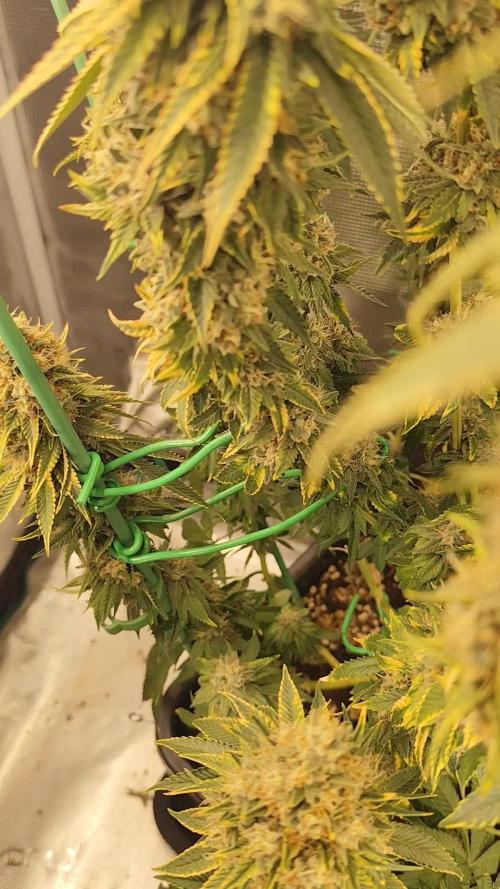
What do u think i should do guys? Should i wait and harvest all together? Or harvest the auto now, then the kush and lastly the Candy? What's the best way.
Also i had been planning to dry them all in my tent. If I do a staggered harvest, i have to build a box or empty out a closet to try and dry them in 😫




Likes
19
Share


@Kellykush420
Follow
I was worried about low humidity but both seeds popped on the third day! This is my second grow. I mixed some dried rabbit manure into my soil to release slowly. I have kept domes on the babies for now until they get a bit bigger.11/16 removed domes added a humidifier.

Processing
Likes
28
Share


@DudeGrowsWeed
Follow
Cream Cookies is getting close to harvest. I did feed her again this week with Recharge only. Next weekend I plan on starting to flush. One of the lower side branches broke accidentally when I was moving things around in the tent. There were only a couple of small buds on the branch, but I dried it out to give her a taste. I can definitely taste the cream overtones, which is very nice. And I got a nice buzz off of it too. Really looking forward to the properly harvested and cured results! 👍
Likes
88
Share


@ILoVeThiSpLaNt
Follow
Giorno 42. Peccato per una watermelon zkittlez che non sta bene. Lavo terreno e ricomincio da metà dose levando le foglie malate

Likes
9
Share


@eldruida_lamota
Follow
Vamos familia, es la cuarta semana de floración, y estás Kritical aparte de carencias que vamos a solventar ya, van progresando bastante bien, las flores ya están agarrando bien los tricomas y ya empiezan a brillar de por si.
Es una variedad bastante rápida a ver si soluciono las carencias esta semana y ya comenzamos recta final.
Agrobeta:
https://www.agrobeta.com/agrobetatiendaonline/36-abonos-canamo
Mars hydro:
Code discount: EL420
https://www.mars-hydro.com/
Las maximas de temperatura no superan los 26 grados y las mínimas no bajan 20, así que no me puedo quejar.
Los niveles de humedad también son los correctos van entre 50%/65% de humedad relativa.
Por supuesto el Ph lo estamos dejando alrededor de 6.
Hasta aquí es todo, buenos humos 💨💨💨.


Likes
52
Share


@Ultraviolet
Follow
You don't become confident by shouting affirmations in the mirror, but by having a stack of undeniable proof that you are who you say you are, outwork your self-doubt.
Nitrogen fixation is a chemical process by which molecular nitrogen (N2), which has a strong triple covalent bond, is converted into ammonia (NH3) or related nitrogenous compounds, typically in soil or aquatic systems but also in industry. The nitrogen in air is molecular dinitrogen, a relatively nonreactive molecule that is metabolically useless to all but a few microorganisms. Biological nitrogen fixation or diazotrophy is an important microbe-mediated process that converts dinitrogen (N2) gas to ammonia (NH3) using the nitrogenase protein complex (Nif).[2][3]
Nitrogen fixation is essential to life because fixed inorganic nitrogen compounds are required for the biosynthesis of all nitrogen-containing organic compounds, such as amino acids and proteins, nucleoside triphosphates and nucleic acids. As part of the nitrogen cycle, it is essential for agriculture and the manufacture of fertilizer. It is also, indirectly, relevant to the manufacture of all nitrogen chemical compounds, which include some explosives, pharmaceuticals, and dyes.
Nitrogen fixation is carried out naturally in soil by microorganisms termed diazotrophs that include bacteria, such as Azotobacter, and archaea. Some nitrogen-fixing bacteria have symbiotic relationships with plant groups, especially legumes.[4] Looser non-symbiotic relationships between diazotrophs and plants are often referred to as associative, as seen in nitrogen fixation on rice roots. Nitrogen fixation occurs between some termites and fungi.[5] It occurs naturally in the air by means of NOx production by lightning.[6][7]
All biological reactions involving the process of nitrogen fixation are catalyzed by enzymes called nitrogenases.[8] These enzymes contain iron, often with a second metal, usually molybdenum but sometimes vanadium.
Green clover (Fixation)
White clover (Fixation)
Red Clover. (Fixation)
Yellow Clover. (Fixation, deeper roots)
Sweet Thai Basil. (Terpenes)
Italian Basil. (Terpenes)
Chamomile.(Oil production)
Borage.(Pest attraction taste)
Lavender.(Pest attraction smell)
Marigold(Pest attraction visual)
Mycorrhizae are beneficial associations between mycorrhizal fungi and a plant’s root system. Mycorrhizal fungi spores germinate in the soil, creating filaments (hyphae) that penetrate the root cells, thus establishing a symbiotic relationship. This collaboration leads to the development of both intra-radical and extra-radical networks of filaments, enabling efficient exploration of the soil for enhanced access to nutrients and water. Consequently, these vital resources are transferred to the plant, resulting in numerous benefits for crop cultivation.
Various mycorrhizal products are available in diverse formulations (powder, granular, and liquid), concentrations, and qualities. Ongoing advancements in products, technologies, and research are reshaping our understanding of mycorrhizae. Despite these positive developments, certain misconceptions persist. In the following discussion, we aim to clarify the truths and dispel the myths surrounding mycorrhizae products.
MYTH #1
A HIGHER NUMBER OF MYCORRHIZAE SPECIES MEANS BETTER RESULTS.
Contrary to common belief, having a higher number of mycorrhizae species in a product does not translate to better results; in fact, it often yields the opposite outcome. A plant can sustain only one association with a particular mycorrhizal fungi species. Introducing multiple species creates competition among them, which is not advantageous for the plant. The initial colonizer does not ensure the highest success; instead, it gains precedence. It is recommended to select a product with a concentrated presence of a single mycorrhizae species known for its effective performance, rather than opting for a product with multiple species at lower concentrations.
MYTH #2
ECTOMYCORRHIZAE ARE EFFECTIVE FOR CANNABIS PLANTS.
Although ectomycorrhizae can colonize five to ten percent of plant species, cannabis is not among them. Ectomycorrhizae do not penetrate the root cells; instead, they develop around the roots and on the exterior. For cannabis plants, it is essential to seek out endomycorrhizae. Endomycorrhizae are capable of colonizing 70% to 90% of plant species, including cannabis. Unlike ectomycorrhizae, endomycorrhizae penetrate the root cells, forming structures like arbuscules for the exchange of nutrients and water with the plant.
MYTH #3
WHOLE INOCULANT (PROPAGULES) PERFORM BETTER THAN ONLY VIABLE SPORES.
The propagule count specified on most mycorrhizae products indicates the presence of spores (viable and unviable), hyphae, and root fragments. However, it is crucial to note that only viable spores, those with the capacity to germinate, can successfully colonize a plant’s root system. Spores are to mycorrhizal fungi what seeds are to cannabis plants—a fundamental component enabling fungi reproduction. Consequently, even if a mycorrhizal product boasts millions of propagules, its effectiveness hinges on the presence of viable spores. Without viable spores, the product will not contribute to plant development. Therefore, the genuine value of a mycorrhizal inoculant lies in the quantity of viable spores it contains, as only viable spores can efficiently initiate symbiosis.
MYTH #4
ALL METHODS OF APPLICATION YIELD IDENTICAL RESULTS.
To establish the symbiosis, mycorrhizal fungi spores must be close to the plant roots. The optimal recommendation is to directly apply mycorrhizal inoculant to the roots, either in powder, granular or slurry form. This method ensures maximum proximity between the spores and the roots, facilitating a rapid establishment of symbiosis. Particularly with crops like cannabis, which have a short growing cycle, employing this technique is the most effective way to obtain optimal benefits. Alternatively, techniques such as blending the inoculant with the soil are effective, but there may be a delay in the establishment of symbiosis. This is because the roots need to grow and come into contact with the dispersed spores throughout the growing media.
MYTH #5
MYCORRHIZAE CAN ONLY BE GROWN ON LIVING PLANTS.
While the predominant method for commercially producing mycorrhizae involves growing them on the root systems of living plants (in vivo production), it is not the exclusive nor the optimal technique. In fact, this production approach has notable drawbacks that the “root organ culture” method just does not have (in vitro production). In vitro production occurs in meticulously controlled, aseptic laboratory conditions, allowing for the consistent generation of products that are viable, highly concentrated, species-specific, and free from pathogens. Achieving such precision and quality is impossible when relying on the cultivation of mycorrhizal fungi on plants exposed to external conditions.
In conclusion, it is crucial to take all these factors into consideration when choosing the appropriate product for your crop to fully harness the wide array of benefits provided by a high-quality mycorrhizal product.
STRONGER PLANT – Stress resistance.
FASTER GROWTH – Improve plant structure and shorter veg time.
INCREASE YIELD – Overall more biomass.
IMPROVED QUALITY – Increase cannabinoids and terpenes content.

Likes
34
Share


@LockDownGrow
Follow
My first time making alcohol tintcure
Using the c1 ,
Hold on tight gonna be a trip

Likes
14
Share


@GanjaReaper
Follow
Day 56:
Like I said in the 2 weeks before this one, I was on vacation and a friend took care of my plants.
This is the last week he helped out, I will be taking care of them again in the upcomming week.
Well what can I say about this week;
- Weather/climate was still bad. Lots of rain and cold temps.
- They kind of failed with Low stress training, they went up and stretched without proper bending.
- One plant has already mature looking buds but still on the small size. Two/three of them are going well and one is falling behind flowering wise.
- They look nicely green tought.
Until next week.
Likes
175
Share


@the_curious_grower
Follow
disaster struck.. during a heavy storm the cage of the gorilla breath #1 which was the best looking plant collapsed. the stem didn't break but every attempt to place it back failed. i ended up using rope attached to a pole and then to the cage to make it kinda better. unfortunately due to the fact that the plant laid down on his side for a couple days, i found multiple spots of budrot.
so... the plan is to chop her down tomorrow. the trichomes aren't quite ready yet but i guess i'll have to save what's left.
the other plants are hanging more by the day as they are really bulking up, i had planned to chop down the gorilla breath's and the Sapphire scout next friday on the 11th of october. then they'll have finshed their 9th week of flowering but the gorilla breath #1 is probably going down tomorrow, what do you think? should i do it tomorrow or Just wait another week and keep checking daily

Likes
4
Share


@Flavors
Follow
🌱 Sticky Broccoli – Grow Diary 🌱
Week 6 | Vegetative Stage | Coco + Perlite
This week Sticky Broccoli was successfully transplanted into a larger pot ?
The root system had filled the previous container, making it the right time to upsize.
Transplant went smoothly with minimal disturbance to the root ball.
Fresh coco + perlite medium added to allow continued root expansion 🌱
Plant remains healthy with strong green foliage 🌿
No visible transplant shock so far.
Watered lightly after transplant to help settle the medium 💧
Environment kept stable to reduce stress.
Canopy continues to develop with strong branching.
Stem structure remains thick and supportive 💪
Next step will be topping the plant to promote additional main colas ✂️
A SCROG net will also be installed soon to begin spreading the canopy evenly 🌐
📈 Focus moving forward: allow roots to establish in the new pot, then begin topping and SCROG training for optimal canopy control 🚀
Likes
14
Share


@BoboLacetti
Follow
After I repotted the plants, they grew really well and healthily for 12 days. Now they are showing iron deficiency again... I already had the problem before repotting. The pH value of the earth has fallen again to 4.8 to 5.7. This time I used biodegradable braids to germinate. I believe that this is the reason for the PH fluctuations in the soil. Every time I water I measure the PH and adjust it to 6 - 6.5. Nevertheless, the PH value drops back to 4 to 5. I'm trying to correct the problem.
I also work with neemoil because I can't get rid of the trips


Likes
38
Share


@Danger90946
Follow
Day 86 12/05/2021- Week 5 of flower almost done hopefully by the end of the month. Went out on a trip and GoPro never turn on for the last two days bummer but will upload time lapse videos daily. Today the lady got nutrients as well.
Day 89 12/08/2021- Today the lady got water, really hoping to see buds starting to fatten up.
Day 91 12/10/2021- So today the lady got a special treat, freshly collected rain water. She is just doing her thing and making those buds. I have also finally put the spider farmer SF-2000 at 100%. Also end of another flowering week, see you guys next week.
--------Have a good one friends and stay high--------

Likes
11
Share


@BudBeezy
Follow
Welcome to week 22 of my grow diary. It rained at the beginning of the week. On Monday and Tuesday I only left the plant outside for half a day and when it rained I put it in the garage so that the buds wouldn't get wet. Unfortunately, in this weather there is a high risk that the flowers will start to mould. Most of the trichomes are now milky.
See you next week ✌️
Likes
11
Share


@Lucidgrower09
Follow
Hey everyone its the final week for this beauty.what a pleasure to grow she was and i will grow this strain again for sure. She drinks a whole lot less then before and the trychomes are turning amber and the rest are milky so she will be cut some where on the end of this week. I will update you guys and girls with the final dry weight and some pics of the dry buds. Thank you rqs for this amazing strain. See you all soon✌️
Likes
14
Share


@ApothecAries
Follow
i will invest in a proper scope for the phone to take pictures of trichomes. This week they received their last dose of indo nutrients.
Likes
105
Share


@Green_Friends_Inc
Follow
Commencing Week 14 - 6th week of flowering - Day 92 from germination - Day 42 of 12/12 on January 23rd
D.98/48 wooooooooooooooooh this Garden is super stinky right now in a good way 👃💪👍👌👏😁
The colors are changing up beautifully signaling the end of life and the beginning of a whole new level of appreciation for these beautiful flowers 💚 - 💛🧡💜❤️
I'm currently under the impression that hydroponics can speed up production, (in my experience with organic growing growth is a little slower and as well as the ripening / muturation rate) so I'm may even be able to harvest a majority of this a few days early. There is also a few tricks I might employ in order to speed this process up. It's fine by me either way I can wait so we'll see 😁
So far this has been my first successful indoor DWC grow in quite some time and I am very patiently yet very anxiously awaiting the time when I can enjoy the fruits of my labor.
at this point as long as I don't mess anything up it should be smooth sailing right up to the very end which is now what I am looking forward to the most coming up: the harvest and smoke report
To all the breeders so I put in the hard work for for me and allowed me to grow their strains thank you!
To all the fellow growers and enthusiast who have been paying attention and chiming in from time to time I especially appreciate you and thank you for your patience in dealing with my late updates. I promise my smoke report will be incredibly thorough and make up for your patience throughout the recording of this journal.
As usual if anyone has any questions about any specific techniques I use or why or nutrient lines or strain related to this grow information please feel free to ask, comment, etc

Likes
7
Share

@Suemchen
Follow
Sanlight EVO 3-60 at 80%
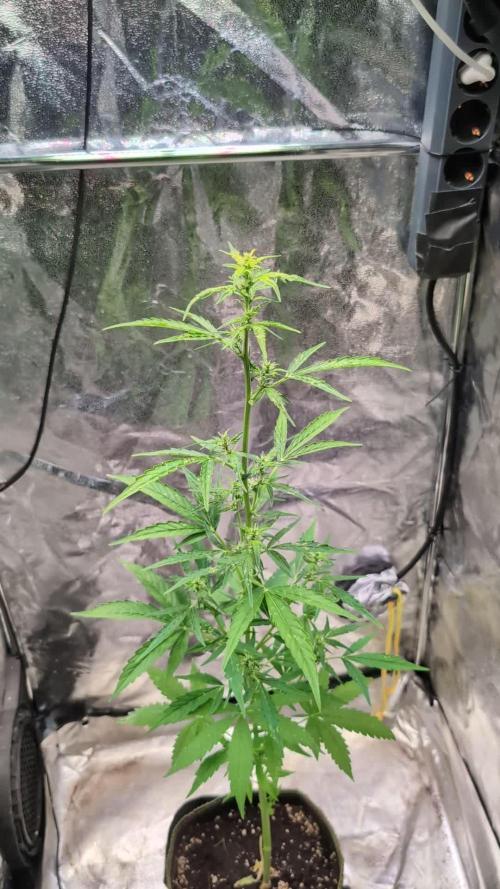
Day 43: now she's in the tent👌🏻looking good and watered again🌊. Watered with rain water and 1ml/l Powerzyme, 2 ml/l Hesi Boost, 1 ml/l Cal Mag, 1 ml/l Alg a mic, 1 ml/l root Juice, 0.5 ml/l Bloom Complex and 1 ml/l Green Sensation. EC at 1.8 and a pH of 6.4 .
Day 45: looking good 🤗 watered with out supplements 👌🏻 Just rain water 👍🏻
Day 46: watered again🌊. Watered with rain water and 1ml/l Powerzyme, 2 ml/l Hesi Boost, 1 ml/l Cal Mag, 1 ml/l Alg a mic, 1 ml/l root Juice, 1.5 ml/l Bloom Complex and 1 ml/l Green Sensation. EC at 1.8 and a pH of 6.4
Day 48: watered with out supplements 👌🏻 Just rain water 👍🏻 Defoliated a little and moved the light farther away 🌞
Looks Like light Stress ( and Bugs ?) 🤬

Likes
41
Share


@UnorthadoxDude
Follow
Hello and welcome to week 7 for Enigma. Last week is now up to date.
She was poisoned a few days ago and I'm trying to save her. Took off dead leaves today and fertigated with normal strength. Not super strength.
Day 46: I've stabilised her but she's in rough shape.
Day 48: Long video lots of detail.
Day 49: A hard hard week. Almost killed her. Unsure where she goes from here but at least she doesnt take up any space!