Likes
Comments
Share
Dear Growers , Welcome to Week 10 or Flower week 8 // Day 70-77 from WeedSeedsExpress Future #1 Auto. Whether you're a beginner or an expert, you are warmly invited to join, ask questions, and share your own experiences along the way! Project Setup & Conditions: • Brand/Manufacturer: WeedSeedsExpress • Tent: 222cmx150cmx150cm • Light: 2x 720 Watt Full Spectrum • Humidity: 50% • Soil: Narcos Organix Mix • Nutrients: Narcos Products • pH Value: 6 If you want Germinitation results like mine , check out Kannabia Seeds with my link [https://www.kannabia.com/de?ref=61966] and grab the germination device or the strains I used . Trust me – it’s worth it for sure ! Get another 20% Discount at all products using the code [GGD] at the Checkout . Stay curious and keep up Growing —we look forward to welcoming you back for the next chapter soon!
Likes
73
Share
@Roberts
Follow
Lilly x White Widow is bulking strong. Very frosty and a flowery aroma. She is growing great under the Spider Farmer G5000/UVR40 lights. I am doing my best to keep her happy for these last few weeks. Everything is going really good. Thank you Spider Farmer, Athena, and Ripper Seeds. 🤜🏻🤛🏻🌱❄️ 🌱 Thank you grow diaries community for the 👇likes👇, follows, comments, and subscriptions on my YouTube channel👇. ❄️🌱🍻 Happy Growing 🌱🌱🌱 https://youtube.com/channel/UCAhN7yRzWLpcaRHhMIQ7X4g Spider Farmer Official Website Links: US&Worldwide: https://www.spider-farmer.com CA: https://spiderfarmer.ca UK: https://spiderfarmer.co.uk EU: https://spiderfarmer.eu AU: https://spiderfarmer.com.au G5000 Light Amazon Link: amzn.to/4643esa UVR 40: https://www.amazon.com/dp/B0BR7SGTHS Discount code: saveurcash (Stackable)
Likes
3
Share
So today is day 11 of flower on my gopher glue from atlas seeds. This girl is a monster that I’ve barely been able to keep in check. The growth is mind blowing. I’ve had to defoliate almost every other day these past two weeks and she’s not slowing down. Going to have to move her into my 5x5 to let her have the room to finish and grow how she wants. Smell is lovely and starting to get noticeable if I open the tent. Stay tuned and wish me luck
Processing
Likes
12
Share
@Tazard
Follow
We have a very full tent! Taz’s jungle 😂🤣. Check out the purple purple photos from day 20!!! Everyone looks absolutely beautiful I’m hoping that the white critical will be ready in 4-5 weeks. She’s going to have some fat colas!
Likes
26
Share
Day 78 flower 54 17.04. So Leute. Die erste Main Bud liegt zum trocknen. Die anderen Grape Ape F1 .. äh explodieren gerade. Kommt mir so vor. Sind so fluffig. Sieht gut aus. Und alles wächst. Alles? Nein, nur die Knospen. Ok , das sind ca 80 % der Pflanze. 💙👏 Genießt die Photos. Ich genieße ebenfalls+ Geruch. Übrigens, 50 cm hat keine erreicht. Later: Oh ein Geschmack, EIN GESCHMACK, wie Seide legt sich der Weintraubenartige Geschmack über deinen Gaumen. Mein Kopf summt. Müde und hungrig werde ich auch... Häh ? War doch nur ein Köpfchen.. 21% THC Punkt Indica Style. 18.04. Ich glaube der Server ist in Wartung. Keine Updates mehr. Aber ist egal, denn sie schmeckt vorzüglich. 😂😂
Likes
33
Share
@burnerac
Follow
Day 57: Added one gallon of pH 6.5 water with nutrients. Day 58: Used super cropping (hope I'm saying that right) on the tallest branch to make the canopy more even. Day 59: I am not watering enough. Day 61: Sadness. I was attempting supercropping and snapped the stem of what I thought would become my largest cola. I have taped it but now feel I've topped my auto.
Likes
Comments
Share
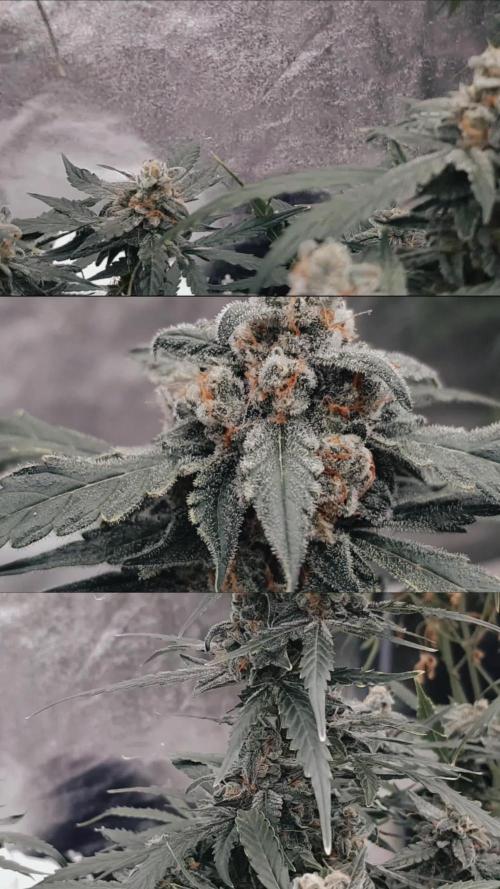
The third week of flowering has come to an end, marking the conclusion of the plants' stretch phase. Watering and feeding practices remained consistent throughout the week, and the garden continues to respond well to the established routine. Toward the end of the week, I carried out the final round of lollipopping along with a thorough defoliation. The goal was to improve airflow through the canopy and ensure that all developing bud sites receive strong, even light. With the structural work now complete, the plants are well prepared to focus their energy on flower production. I also noticed that the taller plants were beginning to show slight signs of light stress, with some leaves starting to yellow. To address this, I increased the distance between the canopy and the light to approximately 55 cm, allowing for a more balanced light intensity across the entire canopy. From this point forward, most of the hands-on work is complete. The weeks ahead will be far less demanding, with the focus shifting primarily to watering, maintaining the feeding schedule, and carrying out only light defoliation when necessary. For me, this is the most rewarding stage of the entire grow. Over the coming weeks, the flowers will begin to reveal their unique characteristics, gradually expressing their structure, colors, resin production, and aromas. Watching each cultivar develop its own personality—and experiencing their evolving fragrance day by day—is one of the most enjoyable parts of the journey. Now it's simply a matter of patience until those aromas eventually become the flavors of the final harvest.
Likes
12
Share
@thonhash
Follow
Sorprendido gratamente del resultado final tanto de producción como de sabor/efecto.
Likes
95
Share
@Roberts
Follow
Northern lights has been doing great. She has started to show maturity signs in last few days. I did the video on it for the week. She was moved into the small Spider Farmer tent I have under the SE3000. I will veg her for about a week, and let her get use to any spectrum changes. I will likely flip her to flowering next update if she has little to no issues. I feed her about once a week. She get water almost daily as she has been drinking a lot. I still have not had run off during watering. I have fed super light as more of a supplement to the soil when I have given feed. On her next feed I will aim for run off. As I wish to test it for ph and the tds. I already know I have a little salt build up, but it has not become a major issue yet with light feeds. Everything is looking great and hopefully continues. Thank you Medic Grow, Spider Farmer, Pro-mix, and Divine Seeds. 🤜🏻🤛🏻🌱🌱🌱 Thank you grow diaries community for the 👇likes👇, follows, comments, and subscriptions on my YouTube channel👇. ❄️🌱🍻 Happy Growing 🌱🌱🌱 https://youtube.com/channel/UCAhN7yRzWLpcaRHhMIQ7X4g
Processing
Likes
30
Share
I know these are not typical ways of training but then again the norm was not the norm at first :)
Likes
4
Share
Likes
8
Share
Still no nutrients! What a week! A lot of growth and the leaves get bigger and bigger. I broke the main stem on the top so topped that part because the infection will be bigger than the cut. Just put the leaves a little bit down to give space to the lower flowers.
Likes
6
Share
to view this lamp or any other marshydro product go to: https://instagram.com/marshydro_aliexpress?igshid=YmMyMTA2M2Y=
Processing
Likes
6
Share
TUESDAY 8/13: I fed them each about a half gallon with big bloom, bembe, kelp me kelp you, terpinator, and beastie bloomz. Some of them are still really stretching, but a few are just budding up. WEDNESDAY: We had a little rain last night and it was sunny today, but the temperatures are about 10 degrees cooler than usual. I see some signs of spider mites here and there, so I'll spray with trifecta crop control as soon as the humidity is lower. THURSDAY: No time for gardening at all today...😕 FRIDAY: I missed a day only to return and find problems...damnit!😖 Two of the Candy Cane x Amnesia's suddenly have what looks like a bad calcium and/or phosphorous deficiency. I sprinkled some bat guano and silicium flash onto their's and all the other plant's soil and watered it in with about a half gallon each of water including calimagic, beastie bloomz, terpinator, and bembe. I also thoroughly sprayed them with boom boom spray. I started brewing another batch of the PK booster compost tea including extra bat guano, earthworm castings, bembe, big bloom, and kelp me kelp you. It should be ready on Sunday...hang in there girls!🙏 SATURDAY: Went boating..no gardening today. SUNDAY: I gave them all about a half-gallon of compost tea today. The sick one looks like shit...will probably try transplanting her into a 5 gallon pot in the next day or two. MONDAY: I transplanted the sick one into a 5 gallon pot today and sprayed her and everybody else with boom boom spray and big bloom.
Processing
Likes
27
Share
@lMorphine
Follow
In week 8, she has been growing nicely. i think i will stay in Veg stage for 1 week further before turn to 12/12 because i want her to grow a bit more after she was stunned for a while. i also increase a ratio of nutrients for my plant and i think i will increase a bit more on next feed. if anyone has a recommendation feel free to let me know. Thank a million in advance 😁 in front of her i have a Blue Dream clone. i decided to do like a little bonsai in 1 gallon pot and turn to FLO with my Glookies 😍
Likes
17
Share
Week four of flowering, and the plant is looking amazing! 🌱 Trichomes have really started to cover the buds, giving them a nice frosty appearance. There’s a lot of resin building up, and it’s exciting to see so many trichomes at this stage. The plant itself is still in great shape, with healthy, vibrant leaves and no signs of stress. 🌿✨ I’ve adjusted to the BioBizz week 5 feeding schedule, and it seems to be working perfectly. The plant is responding well to the nutrients, and everything looks on track for a great harvest. 🌸 I’m getting more excited as the weeks go by! Can’t wait to see how the buds will continue to fill out and develop in the next few weeks. 😁🌼
Likes
47
Share
All content on this diary is for inspirational and educational purposes only. The ideas shared are not a substitute for professional advice. This diary/account is not officially affiliated with Alan Watts or his estate. All materials are used under the principles of fair use. I honor the legacy of Alan Watts by sharing his wisdom respectfully and with the intention of inspiring awareness and self-understanding. 2nd net is up. Early bud formations are promising. holding up to the extremes pretty well, some leaves taking minor damage, but overall, she is holding up, gave her 1 night at 50F see how she would react, stressful. Not advised as it messes with her metabolism, but I want to see if it triggers any anthocyanin response. Love to see her purp up but no signs yet. Remember, For every molecule of glucose produced during photosynthesis, a plant needs to split six molecules of water. This process provides the hydrogen needed for synthesizing glucose and other organic compounds, while oxygen is released as a byproduct. Homework. If Rubisco activity is impaired and it cannot properly function or regenerate its substrate, the plant's leaves are likely to turn a pale green or lime green, a condition known as chlorosis. Essentially, Rubisco activity is highly regulated and susceptible to various environmental and metabolic factors that can cause it to become inhibited, leading to an apparent failure in RuBP regeneration due to a lack of consumption. Rubisco regeneration is intrinsically linked to nitrogen supply because Rubisco is a major sink for nitrogen in plants, typically accounting for 15% to over 25% of total leaf nitrogen. The regeneration phase itself consumes nitrogen through the synthesis of the Rubisco enzyme and associated proteins (like Rubisco activase), and overall nitrogen status heavily influences the efficiency of RuBP regeneration. RuBisCO is a very large enzyme that constitutes a significant proportion (up to 50%) of leaf soluble protein and requires large investments in nitrogen. Insufficient nitrogen supply limits the plant's ability to produce adequate amounts of RuBisCO, thereby limiting the overall capacity for photosynthesis and carbon fixation. Maintaining the optimal, slightly alkaline pH is crucial for the proper function and regeneration of Rubisco. Deviations in either direction (too high or too low) disrupt the enzyme's structure, activation state, and interaction with its substrates, leading to decreased activity and impaired RuBP regeneration. (Lime/yellowing) Structural Component: Nitrogen is an essential building block for all proteins, and the sheer abundance of the Rubisco protein makes it the single largest storage of nitrogen in the leaf. Synthesis and Activity: Adequate nitrogen supply is crucial for the synthesis and maintenance of sufficient Rubisco enzyme and Rubisco activase (Rca), the regulatory protein responsible for maintaining Rubisco's active state. Nitrogen deficiency leads to a decrease in the content and activity of both Rubisco and Rca, which in turn limits the maximum carboxylation rate, Vmax, and the rate of RuBP regeneration Jmax, thus reducing overall photosynthetic capacity. Nitrogen Storage and Remobilization: Rubisco can act as a temporary nitrogen storage protein, which is degraded to remobilize nitrogen to other growing parts of the plant, especially under conditions of nitrogen deficiency or senescence. Nitrogen Use Efficiency (NUE): The allocation of nitrogen to Rubisco is a key determinant of a plant's photosynthetic nitrogen use efficiency (PNUE). In high-nitrogen conditions, plants may accumulate a surplus of Rubisco, which may not be fully activated, leading to a lower PNUE. Optimizing the amount and activity of Rubisco relative to nitrogen availability is a target for improving crop NUE. Photorespiration and Nitrogen Metabolism: Nitrogen metabolism is also linked to the photorespiration pathway (which competes with carboxylation at the Rubisco active site), particularly in the reassimilation of ammonia released during the process. To increase RuBisCO regeneration, which refers to the process of forming the CO2 acceptor molecule Ribulose-1,5-bisphosphate (RuBP) during photosynthesis, the primary methods involve optimizing the levels and activity of Rubisco activase (Rca) and enhancing the performance of other Calvin-Benson-Bassham (CBB) cycle enzymes. Biochemical and Environmental Approaches: Optimize Rubisco Activase (Rca) activity: Rca is a crucial chaperone protein that removes inhibitory sugar phosphates, such as CA1P (2-carboxy-D-arabinitol 1-phosphate), from the Rubisco active site, thus maintaining its catalytic competence. •Ensure optimal light conditions: Rca is light-activated via the chloroplast's redox status. Adequate light intensity ensures Rca can effectively maintain Rubisco in its active, carbamylated state. •Maintain optimal temperature: Rca is highly temperature-sensitive and can become unstable at moderately high temperatures (e.g., above 35°C/95F° in many C3 plants), which decreases its ability to activate Rubisco. Maintaining temperatures within the optimal range for a specific plant species is important. •Optimize Mg2+ concentration: Mg2+ is a key cofactor for both Rubisco carbamylation and Rca activity. In the light, Mg2+ concentration in the chloroplast stroma increases, promoting activation. •Manage ATP/ADP ratio: Rca activity depends on ATP hydrolysis and is inhibited by ADP. Conditions that maintain a high ATP/ADP ratio in the chloroplast stroma favor Rca activity. Enhance Calvin-Benson-Bassham (CBB) cycle enzyme activity: The overall rate of RuBP regeneration can be limited by other enzymes in the cycle. •Increase SBPase activity: Sedoheptulose-1,7-bisphosphatase (SBPase) is a key regulatory enzyme in the regeneration pathway, and increasing its activity can enhance RuBP regeneration and overall photosynthesis. •Optimize other enzymes: Overexpression of other CBB cycle enzymes such as fructose-1,6-bisphosphate aldolase (FBA) and triose phosphate isomerase (TPI) can also help to balance the metabolic flux and improve RuBP regeneration capacity. Magnesium ions, Mg2+, are specifically required for Rubisco activation because the cation plays a critical structural and chemical role in forming the active site: A specific lysine residue in the active site must be carbamylated by a CO2 molecule to activate the enzyme. The resulting negatively charged carbamyl group then facilitates the binding of the positively charged Mg2+ion. While other divalent metal ions like Mn2+ can bind to Rubisco, they alter the enzyme's substrate specificity and lead to dramatically lower activity or a higher rate of the non-productive oxygenation reaction compared to Mg2+, making them biologically unfavorable in the context of efficient carbon fixation. The concentration of Mg2+ in the chloroplast stroma naturally increases in the light due to ion potential balancing during ATP synthesis, providing a physiological mechanism to ensure the enzyme is activated when photosynthesis is possible. At the center of the porphyrin ring, nestled within its nitrogen atoms, is a Magnesium ion (Mg2+). This magnesium ion is crucial for the function of chlorophyll, and without it, the pigment cannot effectively capture and transfer light energy. Mg acts as a cofactor: Mg2+ binds to Rubisco after an activator CO2 molecule, forming a catalytically competent complex (Enzyme-CO2-Mg2+). High light + CO2) increases demand: Under high light (60 DLI is a very high intensity, potentially saturating) and high CO2, the plant's capacity for photosynthesis is high, and thus the demand for activated Rubisco and the necessary Mg2+ cofactor increases. Mg deficiency becomes limiting: If Mg2+ is deficient under these conditions, the higher levels of Rubisco and Rubisco activase produced cannot be fully activated, leading to lower photosynthetic rates and potential photo-oxidative damage. Optimal range: Studies show that adequate Mg2+ application can enhance Rubisco activation and stabilize net photosynthetic rates under stress conditions, but the required concentration is specific to the experimental setup. Monitoring is key: The most effective approach in a controlled environment is to monitor the plant's physiological responses e.g., leaf Mg2+ concentration, photosynthetic rate, Rubisco activation state, and adjust the nutrient solution/fertilizer to maintain adequate levels, rather than supplementing a fixed "extra" amount. In practice, this means ensuring that Mg2+ is not a limiting factor in the plant's standard nutrient solution when pushing the limits with high light and CO2. Applying Mg2+ through foliar spray is beneficial to Rubisco regeneration, particularly in alleviating the negative effects of magnesium (Mg) deficiency and high-temperature stress (HTS). While Mg can be leached from soil, within the plant it is considered a mobile nutrient, particularly in the phloem. Foliar-applied Mg is quickly absorbed by the leaves and can be translocate to other plant parts, including new growth and sink organs. Foliar application of: NATURES VERY OWN MgSO4 @ 15.0g L-1 in a spray bottle. For those high-intensity workouts when 1 meal a day is just not enough! Foliar sprays are often recommended as a rapid rescue measure for existing deficiencies or as a supplement during critical growth stages, when demand for Mg is high. Application in the early morning or late evening can improve absorption and prevent leaf burn. The plant was getting a little limey yellow in the centre. Shortly thereafter, she was back in business, green mostly regenerated. The starting point [of creativity] is curiosity: pondering why the default exists in the first place. We’re driven to question defaults when we experience vuja de, the opposite of déjà vu. Déjà vu occurs when we encounter something new, but it feels as if we’ve seen it before. Vuja de is the reverse—we face something familiar, but we see it with a fresh perspective that enables us to gain new insights into old problems. Confidence is evidence... nothing more. You are confident because you have driven 10,000 times, you are confident because you have spoken 10,000 times. People think confidence is a feeling, but it's not. If you want more confidence, then you need to create evidence, take more shots, collect more data, build more experiences, take more risks; fail, confidence doesn't come first; it is the reward you get for doing the work. no one else wants to do.
Likes
11
Share
Soo, I think I can start to call it the first week of flower. #2 definitely is showing a few white pistols, #1 is just starting her first set and I'm pretty sure #3 will shoot them out any day! Also seems that removing the lowest two side branches of #1 was a huge success! She basically is the same hight as the others BUT I LST her a bit to expose the smallest side branches out of the three to more light! Also, I put a little elevation for her, so they stay the same high. #3 is doing #3 things and continues to grow rapidly. Topping her was the right move I think. I'm quite new to autoflowers (I mean pretty much in general but I had one random regular seed run before this but that's it) so I hope, I didn't call it too early but I'm positive:) Also my new microscope and the Blumat drip irrigation system finally arrived. I heard it can be a bit tricky to get it running but once it runs, it should run like a charm. Very very excited for this since I'm planning on going living soil in the future, which should fit very well together. Before installing the system, I removed the first set of true leaves of #1 and buried the wounds in soil. I hope she will build roots there. With #2 I took scissors and scratched up the main stem and filled it up with soil. As well I hope for more root growth. #3 just got a little bit more soil without any extras because of the topping. After doing all that, I watered with the BioEnhancer. I took 0,5g/l and around 1,5l in total. Quite a lot of update for just one day haha. Flowerpower baby! Didn't really have the time for further updates besides pictures. I did defoliate all 3 a little bit and keep fine tuning the Blumat. I think it's working quite well so far. #3 has some little spots looking different but nothing major I feel. I'm more worried about #2. Her tips start to yellow up a little. I hope it's because she grew too fast into the lights and now where I pulled lights back up to 35cm, she will be fine again
Likes
14
Share
@BudXs
Follow
Day 69 of flower (i know, video says 67) and what a weird time to shoot out nanners. There have been zero light leaks, and no kther plant in the garden has a nanner, leading me to beleive it is not a stress induced occurrence. No other flower on the plant contains a nanner. I will collect the pollen, and i will allow the polyploid cola to see itself aturally to harvest some S1's. These will be grown out and if i get another polyploid, the gene will be backcrossed to add to my lifelong catalogue. Thanks for looking, hit me up with advice, input please