Likes
Comments
Share
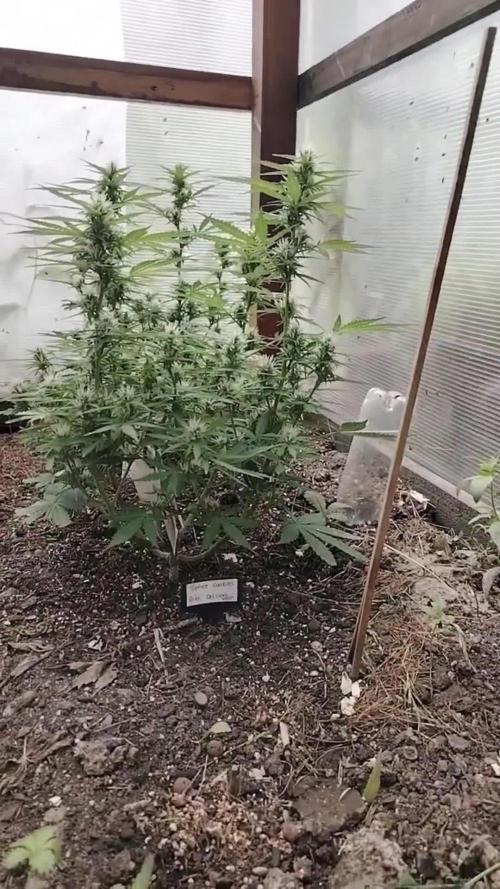
Bewässerung: 1000 ml jeden 3 Tag in der Neunten Woche pH-Wert: 6 EC-Wert: 1.2 mS/cm Temperatur: 30ºC Luftfeuchtigkeit: 50% Schädlingsbekämpfung: im Moment haben wir keine Anzeichen von befall wir haben nur mal zur Prävention etwas Sand gegen die Schnecken um die Pflanze gemacht, dies verhindert das diese sich nähern. Wir haben aber auch Raubmilben ins spiel gebracht zur vorsorge gegen Spinnmilben und andere Schädlinge 😷 PPFD: Direktes Sonnenlicht DLI: Direktes Sonnenlicht -Tag 59 auch hier sieht es nicht so besonders aus, dafür aber wird die Space Cookies #3 umso besser :) -Tag 60 Die Space Cookies #3 macht sich ganz gut, und man kann schon ihren Geruch war nehmen, sie wurde wieder mit jauche gegossen.
Likes
9
Share
@Arcadios
Follow
So I think this is the week where I started to go a bit wrong. The Dr Earth I added on week 4 fixed my nutrient problem, however, I was impatient and added a bit more. As a result, I had 2-3 crispy, yellow leaves on the Quarter Pounder in the middle. Since then, I've upped my watering a bit and it seems to be fine. This week * Lights still at 15" * Giving about a gallon of water every other day, each. At this stage, I get barely any runoff, but stop when runoff is consistent. * Top dressed w/ more FFOF with some myco mixed in. See video for a better view of the nute burn.
Likes
14
Share
@Double_Oh
Follow
Hey everyone 👋 Back again for a week 2 update. Still not much to report really. The clones all seem to be rooting nicely. A few are yellowing on the leaves. But that's to be expected with very little nutes given to them. (very very small amount to avoid stress or nute burn) Other than the few yellow leaves they are all still very perky looking so that's a definite positive. All in all things are looking on track 👌🏻 If any pros ever see me doing dumb shit with my grow feel free to point it out and give any advice. Any feedback is great. Always room to learn right!? Oh, and the music over the vid is me. I was bored last week and recorded for the first time in yrs. Figured my vids could use some original music over them 😂. Sorry if it's painful to listen to 🤣🤣 As always, I'll see U all next week ✌️🏻&💚 From the CannaChat team. SenseChats NO.1 cannabis channel Double_oh
Processing
Likes
113
Share
@Skunky
Follow
Well, today was the last day veging. I defoliated the lower 20%, switched on the red LEDs and set the timer to 12h. I activated the 2nd fan inside the box and also switched on the mini fan connected to the cooled hood. I'll leave it open until the stretch or the smell begins. As soon as there's any smell, I'll close the system by adding the glass shield. Also, I'll save the resulting temperature drop for the later weeks so... let's see... Nutrients added: about nothing. I read somewhere you should flush the plants before the switch so I just feed a normal quantity of water with only a bit of nutrients. It's around a 1/20th of the recommended dose maybe. Let the adventure begin!
Likes
11
Share
Day 45 for this beautiful lady. She’s very impressive. I’m happy with how she’s turning out. Fast buds really knocked this one out of the park. Can’t wait to watch her swell and bulk. She isn’t too stinky yet can’t wait to find out what she will smell like. She’s big and bushy which is awesome because she was just a little baby I wasn’t sure about her potential but boy oh boy she’s grown up.
Likes
8
Share
Hello Diary, The Milky Way F1 is ready to harvest soon, although the Titan F1 ripened first and is already ready, the Milky Way F1 and Apollo F1 will have to wait another week in my estimation. The Milky Way F1, as seen in the photos, is truly a sight for the eyes. The flowers started to get more and more brown pistils, but looking under the microscope, the trichomes are not all milky yet. So I'll leave her for another day. Otherwise, the flowers are full of trichomes, from which a strong fragrance spreads. Here and there a yellowish leaf appears, which I immediately remove. Watering is a little more frequent due to the high temperatures, but I stopped adding any nutrients. Here's a quick recap of the week. 26/06/2023 - Day 58. Watering. Only two days later, the plants drank all the water, so I watered them with two liters for each individual plant. 29/06/2023 - Day 61. Watering. I repeated the procedure as I did three days earlier. 01/07/2023. - Day 63. Photographing plants. That's all for this week, see you soon.
Likes
14
Share
@Mr_Dior21
Follow
Man this week has been taking forever, my theory is it will only get slower relative to harvest just because my excitement. I top dressed with about 2 inches of worm castings with an eyeballed mix of 2tbps of bone meal (3-14-0, bloom fert.), 1.5-2tbps of Gaia green all purp.(4-4-4, I don’t have an actual potassium fert. Like leingbenite So I use this), 3tbps of dr earth kelp meal (1-.05-2 has many different vitamins, amino acids, carbohydrates) and 2tbps of mykos (for microbiology inoculation and nutrient uptake/upkeep). So I every time I water I have this old 2gallon water tin that I usually fill up about a quarter to half way full. Using this amount of water and the 5 gallon bucket of my soil mix makes my watering schedule once every 3 days (on average). I do use bottle nutrients but it’s mainly for the supplementing. For feeding I use 2-3ml to half a gallon for all bottle nutrients, I have never gone over, and I have never had deficiency’s that can hinder plant development. Deficiency's: PSA: Now if anyone happens to read and actually look at my plants please do look closely and maybe let me know if you see something that I have missed since I’m still very new. I noticed my plant was having a cal mag issue so that’s why I top dressed with worm castings, I also top dressed with about 3tbps of azomite (I feel using azomite it may help with all those unnoticeable deficiency’s that a new grower might miss). I’ve been noticing on some of the leaves the very tips are showing discoloring, since the color is still so vibrant mostly I can rule out nitrogen, phosphorus, Iron, manganese, and sulphuric. It’s still very early stage so I did an extremely light foliage feeding (in the dark to prevent UV damage) of 2ml of big bud, big bloom, and tiger bloom, mixed into half a liter of water, I then emptied the spray bottle and sprayed with tap water just to make sure there’s no nute burning. Today I fed the plant through water amendments with 3ml of big bud, 3ml of bud candy, 3ml of big bloom, and 2ml of tiger bloom;(my theory is hopefully the nutrient deficiency’s will go away) My soil mix is pretty basic. 40% coco, 10% perlite, 10% well composted chicken manure, 20% black gold compost, 20% worm castings. I’m not going to put the fertilizer amendment percentage to be honest I eye ball it but there’s a rough general measurements that I do.
Likes
11
Share
Likes
21
Share
Heyókȟa I desire to study nature, and to know better the mind of God, the creator, Holy art thou, O Father. 12x12=144, A dodecahedron is a polyhedron with 12 faces, and in coordination chemistry, it refers to a geometry where ligands surround a central metal atom (in this case, Magnesium) in a specific, 8-coordinate arrangement. Dodecahedrane is a hydrocarbon, meaning it's composed solely of carbon and hydrogen atoms. The carbon atoms are arranged at the corners of a dodecahedron, a 3D shape with 12 pentagonal faces. The water molecules in the dodecahedron form hydrogen bonds that are individually slightly weaker than in either the dimer or the tetramer. However, because three-quarters of the O -H groups in the dodecahedron form hydrogen bonds, it has a more negative energy per molecule than has either the dimer or the tetramer. Magnesium (Mg2+) is the essential, central metal ion in the chlorophyll molecule, crucial for photosynthesis by enabling light absorption and energy transfer. It is chelated by four nitrogen atoms within the porphyrin (or chlorin) ring structure. Chlorophyll appears green because it reflects light in the green region of the visible spectrum, specifically between 490 and 570 nm. The main resonance electronic frequency of a neutral Magnesium (Mg) atom corresponds to the transition from the ground state to the first excited state. Resonance Line Wavelength of Mg2+: 285.1nm (UVB light). The central atom of the chlorophyll molecule is Magnesium (Mg2+), which is coordinated within a porphyrin ring. The electronic "resonance frequency" of this central atom—meaning the frequency at which its electrons absorb energy—is primarily driven by the electronic transitions (ETR) of the surrounding conjugated chlorin ring structure, rather than a discrete atomic transition of the Magnesium atom itself. The resonant electronic frequencies of the chlorophyll porphyrin (technically, a chlorin) ring are determined by the energy required to promote π-electrons within its conjugated system, primarily appearing in the blue and red regions of the visible spectrum. In standard physics, Chloryphyll b has peak absorption at 460nm (Blue). If we take the peak wavelength 460nm and a UV-B, UVR8 peak absorption wavelength 285nm Tryptophan-285 (W285) Sensing protein. 460/285=1.618 Φ, "natural harmony" and the "structure of light". The cryptochrome photoreceptor (CRY) is a UV-A/blue light receptor that shares this dual sensitivity with several other biological structures and functions, including significant sequence similarity and a common evolutionary ancestor with DNA photolyase enzymes. These are light-activated enzymes that use blue/UV-A light to repair DNA damage caused by UV-B radiation in plants. Dodecahedrane (C20H20) is a hydrocarbon with a cage-like structure where carbon atoms form 12 pentagonal faces (a regular dodecahedron). It is highly symmetric (icosahedral), contains no delocalized electrons (no aromaticity), and has minimal angle strain, but significant torsional strain. Water Dodecahedron (H2O) forms hydrogen-bonded cages. While individual hydrogen bonds in this structure are weaker than in the linear dimer or tetramer, it has a more negative total energy per molecule. This is because three-quarters (75%) of the groups are involved in hydrogen bonding, creating a very stable, closed-shell configuration. a 3D carbon hydrocarbon (C20H20) to stable water clusters in hydrate, while the Magnesium ion acts as the central activator within a conjugated ring in biological systems, with its electronic absorption dominated by the ring, not the atom itself. Effective quantum efficiency of photosystem II, often denoted as ΦPSII In horticultural lighting, adding 730 nm (far-red) LEDs alongside standard red/blue lights has been shown to increase canopy photosynthesis by 20–30% in several crops by acting synergistically with shorter wavelengths. However, the limitation is that excessive, pure IR/Far-red light (without accompanying red light) can trigger the "shade avoidance response," causing plants to grow tall, weak, and spindly rather than robust. Knowing is half the battle however, engineering or utilizing infrared light (specifically the 700-750 nm far-red range) is a viable method to boost photosynthetic efficiency. It acts as a bridge to allow PSII to utilize a broader spectrum of light, breaking the traditional 700 nm barrier. Extend, then multiply. UVR8-mediated signaling (often in conjunction with CRY proteins) triggers protective mechanisms that maintain the stability of the photosynthetic apparatus (including LHCII and reaction center proteins), thus ensuring that the efficiency of Photosystem II remains higher in UV-B-exposed plants compared to plants lacking this receptor. ΦPSII indictates the rate of electron transfer from water to plastoquinone, which drives the production of ATP and NADPH. There is a close link between ΦPSII and the true rate of CO2 fixation (Φ*co2), particularly in C4 plants. Effective quantum efficiency of photosystem II, often denoted as ΦPSII, represents the proportion of light absorbed by Photosystem II (ΦPSII) that is actually used in photosynthetic electron transport. It is a key indicator of how efficiently a plant is using light for photosynthesis, as opposed to losing it as heat or fluorescence. ΦPSII (effective quantum yield of photosystem II) functions primarily as a "multiplier" (a coefficient of efficiency) rather than an additive factor when estimating the overall photosynthetic electron transport rate (ETR). Multipliers are considered far more beneficial than additions because they generate exponential growth, leverage existing resources to their full potential, and create sustainable, self-multiplying capacity, rather than just incremental, linear increases. Humans, and most other mammals, rely on other mechanisms, such as nucleotide excision repair, to manage and repair UV-induced DNA damage. As such, humans do not have the direct, light-driven repair mechanism that photolyase offers in plants.
Likes
12
Share
The girls have survived another week ❤️ I did a light defoliation and have been monitoring the RH closely. We have had a very damp week here, and the RH kept climbing and had my fan working hard. They are starting to plump up and fill in 😋. They have also started to slow their drinking habits, instead of watering every three days, it has moved to every 4 now. Just a couple of weeks left, I think I will be harvesting these over Christmas 🎄, and will have some great bud ready for the new year! 🎉🎊🍾
Likes
76
Share
SETUP: -MIGRO 100 -Grow space 60X60X160 (Mammoth PRO 60). -Grow medium is Gold Label Special Mix Gold edition Premium, Airpot (10l). _____________________________ 29th August - Day 6 (Day 8 Beer Cup) - Gave them 50ml of 💧each. The Beer Cup one is looking like she needed more water. _____________________________ 1st September - Day 9 (Day 11 Beer Cup that's been transplanted) - I need to support both cause the tip over if not :( _____________________________ 6th September - Day 14 (Day 16 "Beer Cup") - Gave Final Pot 100ml of 💧. Nothing for "Beer Cup". Increased the LED from 1/5 of strength to 2/5 of strength.
Likes
62
Share
Hey guys welcome to week 6 and day 33 🙌🏼 The girls are getting really big now and i‘m tucking the new groth every day. It‘s pretty dificult to get good light penetration through to the lower branches but I will try to wait until day 21 of flower to cut anything off. I don’t want to stress them. For now I tug the big fan leaves down and keep the humidity as low as i can. They do transpire alot. Well, thats it for the start :) nothing else to report..
Likes
10
Share
@Andres
Follow
el resultado seco de 177 no es real debido a que yo bastante para hacer brownies. pero estoy satisfecho con los resultados y recomendable. un olor y sabor unico
Likes
13
Share
Day 14, some supercropping Day 15 .. it’s under control 😂🤣 Day 19 lights almost maxed to tent height unless I zip tie led to the top ceiling frame, last bit of monster cropping. Lost 2 top nugs to physical led burn but it’s ok. Everything is fine. Still going very hard on soluble N, and Pk along with b+, fishsh!t, microbial mass, humic acid. Carbs every day with organic booster
Likes
32
Share
All good so far, will post some divided pics later on when flowers start forming.. Orinoco and critical plus are close to being double in size since i flipped lights to 12 12, they are gonna be huge :)
Likes
8
Share
No more nutrients! Just heavy dose of resin finish plus connoisseur bloom (advised by feed chart) Ec input sitting at 0.085 Ec output sitting at 0.280 Buds starting to look more frosty and leaves still fading, will probably have to run another week and wait for my run off ec to get below 100.
Likes
2
Share
Week 8, last week of feeding. Plants look good, smell is nice, super sticky! Round 2 with this strain has been better, compare to round 1, but I still find this strain very nutrient hungry.
Likes
12
Share
@valiotoro
Follow
Hello everyone week 3 of flower has passed for this LSD-25 auto 🎢 Same feeding schedule Mars hydro FC-E6500 75% have a great day and wish you all happy growing 😎👨‍🌾🏻