


Likes
Comments
Share

@I_roll_my_own_420
Follow
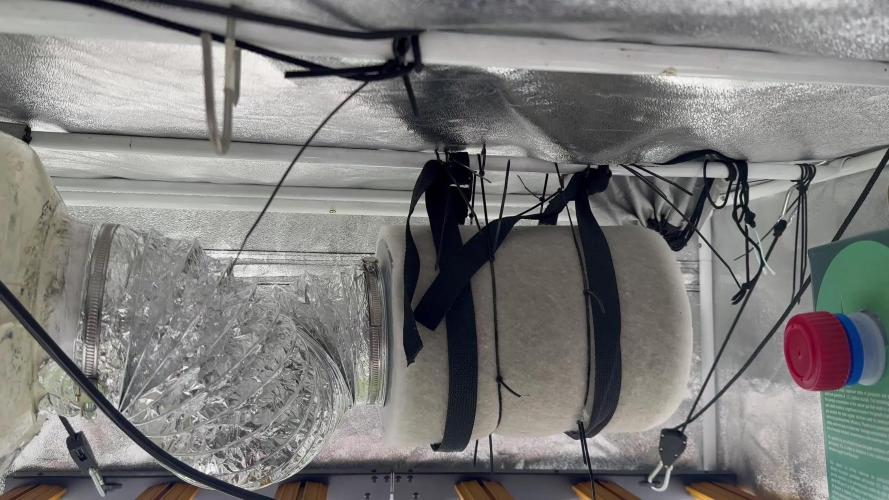
Hey. I have done first scrog training day 5 of 12/12 light schedule. Looks good. Also, I added co2 box on the bottom of tent and use fan to move it around plants.


Likes
15
Share


@Huckleberry39
Follow
This is the start of her 3rd week. I can't believe how much she has grown in the last week. She is a beaut!!

Processing
Likes
57
Share


@Silverback_Guerilla
Follow
2/1 - 2/4:
I ended up feeding the BJ's and GG's once more, and just plain water for the Zenzations.
Moved the to Zenzations into the dark on the night of 2/4 and will harvest them tomorrow (Friday).
I'll flush the others tomorrow and probably harvest them next weekend.
2/5:
Both Zenzations are having their last bit of beauty sleep before they get trimmed up, cut, washed, and hung to dry.
2/6:
Harvested both Zenzations....damn they smell wonderful and have amazing frost!
2/8:
Watered the BJ's and GG's today with LiquidSoil. Will flush them really well in a couple more days and probably harvest this weekend...time's up bitches, better put on your lipstick and get ready for the big party!

Likes
1
Share


@Sur_cannabico
Follow
Estamos en plena floración ya engordando esos buds resinosos de las Withe Widow de RQS. Subimos la dosis de nutrientes y como se puede apreciar ningún síntoma de estrés o exeso de fertilizantes
Todo muy bien recibido 🙌🏻
Vamos por mas ❗️

Likes
10
Share


@DawgHaus
Follow
Week before Harvest 💪💪
Leaves yellowing up nicely 🔥
Smells lemony/earthy in the grow area.
Happy with everything so far.

Likes
Comments
Share

@Budhunter
Follow
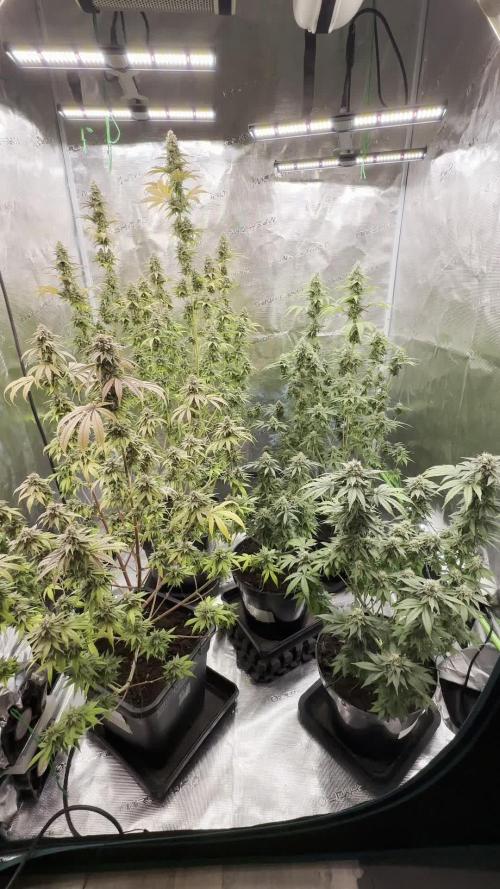
Week 7 Flower- Day 51 flw / Day 107 of cycle
Lemon cherry pie what can I say about you..
she is super frosty, that we can’t deny. But are fattening up and overall she is a beautiful plant(could be a little bigger and fatter 😅)
I am still trying to understand her smell and tasty.. by the name I would say citrus but is not that much. I fed her with fertilizers for the last time and I am going to switch to only water for yhe next 2 weeks.
Let’s go
Likes
30
Share


@ButterfliesLittleFarm
Follow
Hello Diary.
We came to the last week of vegetation, and we enter slowly into flowering.
Watermelon has grown 36 cm and looks healthy and satisfied.
This week I added a lot of nutrients when watering, I will see how they will react to that.
Her roommates, two Purple Punch outgrew her in height so I had to adjust the lights a bit to everyone at “Farm”. The lights are dimmed at 80%
The temperature in the growbox is around 25 degrees, which is ideal for me but the humidity is a bit lower than I would have liked. I'm thinking of putting on a humidifier again.
The plants started to be more thirsty so now watering is more frequent as well.
Let’s take a look at the review of the week.
10/02/2021 - Day 15.
Watering. p.H I adjusted to 6.3 with Lemon Kick and added one Easy Grow tablet to 6 liters of water. With that, I watered all three plants evenly.
Temp / Humidity on the farm - 24.5 degrees and 40% humidity.
13/02/2021 - Day 18.
Watering.p.H I regulated to 6.4 and did not add any other nutrients.
Temp / Humidity on the farm - 24.3 degrees and 40% humidity.
16/02/2021 - Day 21.
Photographing and watering. This time I added CalMg, 1.5ml / L preventively and from BoiBizz I added Bio Heaven, Bio Grow, Acti Vera and Alg-A-Mix only 2ml / L each. p.H I regulated at 6.4. Due to the low humidity, I put the humidifier back in the GrowBox.
Temp / Humidity on the farm - 24 degrees and 35% humidity.
That’s it for this week, thanks to everyone who stop by and take a look. See you soon.
Likes
11
Share


@Dreadnug
Follow
8 hours to start in a glass of water. Then transferred into paper towel. Will put into seed pod once tap root starts.
Future #1
Gorilla Glue #4 x Starfighter F2
Genetics: 50% Indica, 50% Sativa
Yield: 500g/m² • up to 700g per plant
Flowering time: 9-10 weeks
Harvest outdoors: begin of october
suitable for indoors and outdoors
Height: 110-130cm
THC: 37%
Aromas / flavors: pineapple, mango

Likes
5
Share


@Ganjagrandaddy
Follow
Day 42:Well its halfway though the flowering cycle at least now and I thought with the genetic mix of her parents that she would be a full 11 week sativa cycle. Seems I may be wrong!!!!. She is beginning to colour up nicely now as though she is headin for the finish line. By far the the most ripe of the 9 strains which is surprising as she was younger and had 2 weeks catching up to do before the flip. She is even looking more advanced than the fast flowering Tester run in here now. The Gz mother was completely done by week 9 so maybe they will follow her rather than the longer Gelato41 time. She smells very fruit sweet with a slight hint of a diesel/gas. She is really oily to touch now and even low down where the larf would normally be a little pointless , she has put out medium sized buds too. . I am very happy with her whole cycle so far and she has not been slouch at all. Seeing her overtake the race and showing off is a win for me and the Birth of GanjaGrandaddyGenetics ,GGG seeds. lol Have 2 strains of my own at harvest nearly now and the Hulklato I featured in the last update has given out a very good 6 oz with around 1oz of that being larf and small buds. Not too bad for a first seed popped. let's see if this little lady can come close to her cousin. The NFT system has made the grow the easiest "hands off " growing i have done. Only needing to top up the res and leave it till it needed it again has been a lazy affair but to see an old school system like this work so well compared to the many others I have since used , has been a surprise. I dont know why NFT dropped off the radar but for anyone who is new to growing , it is a perfect , easy to set up and use medium.
Good luck on all your grows. catch you at the next update.
Likes
54
Share


@BudXs
Follow
Plants are getting big enough to train through the fence. Im thinking a vertical scrog, but its gonna be a bitch to harvest . We will see, still dunno if they are even female.

Likes
56
Share


@JuanHaze_Arg
Follow
Esta parece ser la ultima o ante ultima semana de floración, las flores se están poniendo púrpura y las hojas grandes empezaron a desvanecerse, ya no toma mucha agua lo cual me está haciendo difícil el lavado de raíces porque intento empapar todo el pan de raíces con el detox. Los colores son realmente llamativos y hermoso.
03/06 se baja 5 cm la luz. Se riega con 3 litros de agua de osmosis +cal mag + detox de namaste, ph: 6,4 EC: 0.8 salida Ec: 1.7 aún alta

Processing
Likes
27
Share


@Hawkbo
Follow
Day late on the update, pics/vids were taken on time tho just been a crazy week of harvests and trimming and keeping up with these. I linked up with Rain Science Grow Bags on Instagram and got them to offer all my followers and friends a discount of 10% off entire order from their site with the code ' bangdang ' so if anyone is in the market for a pot upgrade use that code. I got them in the mail 3 days after I ordered. Reason I went with Rain Science is because they offer identical air flow for rapid growth as the radicle bags, just using a different material and a tighter knit so water doesnt flood out the sides during feeds and when you pick these up when the coco is dry, it wont fly all over the tent like with the radicles. They're the optimal bag for autoflowers especially. I figured out why the one stayed so short compared to the others, the base of the stem did a 360 so it's like a loop then it grew vertical.
Likes
12
Share


@gr3g4l
Follow
Finales de la pasada semana y esta lavado de raices. Agua con ácido cítrico y ácido ascórbico.
Corte de los apicales más formados y con mayor riesgo de botritys y el resto seguirá una semana 10 dias más.
Han salido diferentes fenotipos, unos de más skunk y otros de más Critical,
A los 60 dias obté por cortar los apicales y dejar el resto de las plantas para que terminaran de engordar y madurar.
Entonces volví a regar con Bloom Bud y call-Mag -
Likes
4
Share


@Jisaac904
Follow
Things moving along very nicely. Waiting on fabric pots to come in the mail so i van give them the space they need.

Likes
6
Share


@TerpyOG
Follow
This week I did a fair amount of work on my grow.
I did a bit of defoliation and spent some time tying down branches to shape the canopy.
My goal is to get buds growing wall to wall! I can't wait to see the results of my efforts.

Likes
43
Share


@OrganicRepresent
Follow
If You planning to get any led from spider farmer please support my job and buy it from this link:
https://www.spider-farmer.com/?ref=ybbzrmgk3ojh
Use code : ORGANICREPRESENT for 3% discount also.
D50 last week b4 flower. Thinking of changing time for 1 hour less per day to 12. Yesterday feed with coconuts water mixed in galon of water. And it still progressing. So happy. Also after using nementados aganist fungus gnats found 4 of them sticked to yellow traps. Good f off gnats
D51 nice progress again. I think i will use more nementadose 2morow as have time till 12th of August to use it. 6 days to switch. Cant wait.
D52 5 fungus on stickers. Tomorow another sesion with nementados.
D53 used nementados 2day morning. Get it clear of fungus 4for flowering. Hope all will be good.
D54 feed with mix of biobizz root juice x malted barley flour x comfrey concetrate extract should make girls even more happy;)
D55 flowering ready nearly, tomorrow last day on 18/6
D56 last day on veg. Hope flowering will go well. Just feeded with biobizz root juice and water 2day.

Likes
38
Share


@LittleBigTrees
Follow
Pulled a few fan leaves, had a house inspection so I had to move them all outside , they went from 26°c to -2°C for ten hours they also had their dark cycle interrupted during the course of moving them.
The smell is very strong now from all 6 pheno


Likes
26
Share


@Rangaku
Follow
The apricot is going hard on the stretch, she loved the LST and although a bit leggy she’s filling out nicely. Gave her a flush before stepping up the nutes and will look to keep spreading her out this week .
Likes
2
Share


@Ultraviolet_
Follow
We become aware at such times of man's wonderful ability to bring seemingly unrelated elements into harmonic balance, and receive a glimpse into a world where everything exists in conscious sympathetic attunement to everything else. When we listen to a piece of music that seems to strike a beautiful chord somewhere inside us, or view a painting that simply glows with harmonic awareness well executed, we probably do not spare much time to contemplate the wonderfully intricate combination of vibrations that our sensors make it possible for us to perceive. We tend to appreciate the relationship between the parts of something by an awareness of the harmony or dissonance of the whole. This ability enables us to say "what a beautiful house!" instead of "analysis has proven that this collection of building materials exhibits certain elements of harmonic proportion." While this ability to instinctively appreciate the beauty of true harmony has an important role to play in evolution, a more analytical understanding of the laws involved can be most useful. This is especially so if we wish to create works of art where each part exists in true harmony, not only with the other part of that particular whole, but with the universe within which the creator and the created exist.
Everything vibrates. From the most dense matter to the most subtle cosmic rays, everything which our senses allow our thoughts to become aware of, can be specified in terms of wavelength or frequency of vibration. These two terms define the same thing, but from different points of view.
The following are the approximate wavelengths of various energy carriers:
Cosmic rays 0.000,000,001 mm
Gamma rays 0.000,000,1 mm
X rays 0.000,500 mm
Ultraviolet rays 0.003 mm
Visible light 0.006 mm
Infrared 0.01 mm
Sound waves 1 meter
Radio waves 300 meters
Violet light 400 nm to 450 nm
Blue light 450 nm to 500 nm
Green light 500 nm to 570 nm
Yellow light 570 nm to 590 nm
Orange light 590 nm to 610 nm
Red light 610 to 700 nm
1 nanometer (nm) = 0.000,000,1 cm = 1/10,000,000 cm
If a guitar string is plucked and we hear a sound, it is not too difficult for the human mind to associate this sound with the vibration of the guitar string. With color it is quite different. It is difficult for us to conceive that the color of a substance is not an inherent property of the substance itself, but an indication picked up by our senses of that substance's ability to absorb or reflect the light which happens to be shining on it at that moment. Neither the matter nor the light is colored. What happens is that the brain learns to differentiate between the frequencies reflected or transmitted by the substance the eyes are focused on. The same thing happens with sound. When we say "Oh! Listen, they're playing my favorite song," what we really mean is: "My brain has stored within it a particular pattern of frequencies. I have compared the new information being received with this stored pattern and have deduced the answer that the two patterns are similar within certain specified tolerances." The 'pleasure' involved could have something to do with our running the pre-recorded pattern at the same time, in 'sympathy' with the new pattern as it is received.
The word sympathy describes very well our ability to appreciate color and sound. It also describes the reason behind certain elements of harmony. For instance, if a substance vibrating at 100 cycles per second (tone 1) is in the proximity of another substance vibrating at 200 cycles per second (tone 2), we could perceive, if we had the right equipment, a certain sympathetic relationship between the two.
We will see from this that there is a uniform doubling of the first tone seen in the second. At various points along the waves, the two are the same in amplitude. At other points, they are at opposite poles to each other. This doubled frequency has more points of similarity to the original than any other frequency except the original itself. If the equipment we had available for measuring these two frequencies was a soundboard amplifier and a pair of ears, then we would hear what would sound to us like one tone. If we had the opportunity to hear one at a time, we would hear that although they sound the same, one is higher in pitch than the other. This characteristic of 'the same but different in pitch', musicians have called the octave. Any two tones produced where one has exactly doubled the frequency of the other is called an octave. Speaking in ratios, an octave would appear then as the ratio 2:1 or 1:2, depending on whether we are talking of an octave up or down.
A single note produced by almost any instrument will contain more than one wavelength or frequency. It will have a dominant frequency, the wavelength of which we would call the note's 'fundamental' or 1st harmonic. It will also have a varying number of upper harmonics, gradually fading in intensity into infinity or silence.
Natural harmonics always have the same pattern of intervals between them. The interval between the 1st and 2nd harmonic is a perfect octave; between the 2nd and 3rd a perfect fifth; between the 3rd and 4th a perfect 4th; and so on, the intervals becoming smaller and smaller until they lose any relationship with the western 12 tone scale as it exists at the moment. Just as an octave has certain elements of sympathy with its fundamental, so some intervals have been noted to be more perfectly in sympathy with the fundamental than others. The ratio of the 'perfect 5th' or interval of 7 semitones, as it occurs in the harmonic series, is 3:2 or 2:3, while that of the 'perfect fourth" is 4:3 or 3:4. All the tones in the western 12 tone scale can be expressed in terms of the ratio between the upper tone and its fundamental. This would seem to be an ideal way of generating a scale from any given fundamental and several attempts have been made to do this, the Pythagorean system being probably the most well known. Although when working with a single tone instrument playing on its own, the Pythagorean formula works wonderfully well, if we had several instruments tuned this way together and asked them to play almost any western music, we would find that at times they sounded quite out of tune to each other.
The lack of flexibility of the various scale systems based on the harmonic series has led to what is known as the 'tempered' scale. This uses as its primary unit of interval the ratio of the octave or 2:1. It then proceeds to divide the interval between any fundamental and its upper octave into 12 smaller intervals by applying the ratio: two to the one-twelfth power, to one (21/12:1). This equals 1.059463094, so by multiplying any frequency by this number, we will obtain the tempered semitone next up from our fundamental. We will also find that any tone twelve semitones up from any other tone, in a scale generated in this way, will have exactly double the frequency.
If we took the note middle C on a piano and halved the wavelength, we would have the note C one octave above. If we halved this, we would have the C above, and so on. However, within about 6 octaves, we would find that although a 'sound' was being produced, no human ear could perceive it. If we kept on going, halving and producing upper octaves of our fundamental C, we would proceed through the infrared band, into the visible light spectrum. If we happened to be outside during the day, we would, for one octave only, see the note C with our eyes. The next octave above would already be in the ultraviolet band, and outside the eye's sensitivity range. If we can think of color as being an indication of a substance's vibratory rate or wavelength, we may begin to see a relationship that could exist between the color and sound spectrums.
The logical extension of what has so far been said is that there exists a scale in the color spectrum that corresponds exactly to the scale in the sound spectrum, each color tone being an octave of the equivalent note in the sound range.
This is not the end of the story but only the beginning. If we can for the moment accept that any wavelength in one band has upper and lower octave stretching out to infinity, then the next question is 'fine, but what shall we use as our fundamental? A particular color? A particular sound frequency?' The musicians among us will probably say 'A 440'. This means that the note A should vibrate at 440 Hertz, or 440 times per second. They would tell us that this is standard pitch has been adopted by most orchestras around the world; pianos are tuned to it, instruments are constructed to formulas based on it, and so to them it would probably seem the most appropriate place to begin. Some of these musicians may know of the battle that is still raging with regards to this being the standard, but few would know why A = 440 Hz was chosen except that it worked when it was set to be a suitable compromise between the many different pitches in use at the time.
432 Hz is said to be mathematically consistent with the patterns of the universe. Studies reveal that 432 Hz tuning vibrates with the universe’s golden mean PHI and unifies the properties of light, time, space, matter, gravity, and magnetism with biology, the DNA code, and consciousness. When our atoms and DNA start to resonate in harmony with the spiraling pattern of nature, our sense of connection to nature is said to be magnified.
Another interesting factor to consider is that the A=432 Hz tuning correlates with the color spectrum, while the A=440 Hz is off. Audiophiles have also stated that A = 432 Hz music seems to be non-local and can fill an entire room, whereas A=440 Hz can be perceived as directional or linear in sound propagation.
Once you adopt the idea that sound (or vibration in general) can have an equalizing and harmonizing effect (as well as a disturbing effect), the science of harmony can be applied to bring greater harmony into one's life or tune to specific energies. There is a form of absolute and relative harmony. Absolute harmony can, for example, be determined by the tuning of an instrument. The ancients tuned their instruments at an A of 432 Hz instead of 440 Hz - and for a good reason. There are plenty of music examples on the internet that you can listen to in order to establish the difference for yourself.
Attuning the instrument to 432 Hz results in a more relaxing sound, while 440 Hz slightly tenses up the body. This is because 440 Hz is out of tune with both macro and micro cosmos. On the contrary, 432 Hz is in tune. To give an example of how this is manifested microcosmically: our breath (0,3 Hz) and our pulse (1,2 Hz) relate to the frequency of the lower octave of an A of 432 Hz (108 Hz) as 1:360 and 1:90.
It is interesting to note that 432 Hz was the standard pitch of many old instruments and that it was only recently (19th and 20th century) the standard pitch was increased. This was done in order to be able to play for bigger audiences. Bigger audiences (more bodies) absorb more of the lower frequencies, so the higher pitch was more likely to “cut through”. One of the oldest instruments of the world is the bell ensemble of Yi Zeng (dated 423 BC), tuned to a standard F4 of 345 Hz, which gives an A= 432 Hz. The frequency of 345 Hz is that of the platonic year! Similarly, many old organs are tuned in A=432 as well; for example, St. Peter’s Capella Gregoriana, St. Peter’s Capella Giulia, S. Maria Maggiore in Rome.
Maria Renold’s book “Intervals Scales Tones and the Concert Pitch C=128 Hz” claims conclusive evidence that 440 Hz and raising concert pitch above scientific “C” Prime=128 Hz (Concert A=432 Hz) disassociates the connection of consciousness to the body and creates anti-social conditions in humanity.
The difference between concert pitch A=440 Hz and Concert A=432 Hz is only 8 cycles per second, but it is a perceptible difference of awareness in the human consciousness experience of the dream we share called existence.
Likes
47
Share


@Poppetnewbie
Follow
OK this was my 1st grow and I set everything up went through all my controls and away to go ...
wrong after pre flower came I couldn't understand why I wasn't getting these ladies to flip....
So I went through everything with runoff feeds Everything you can think of except my timers on the lights and this low and behold was the problem!!
where I was going to the tent at similar times everyday the light was on and the timers were set right on the clock except I didn't see the switch on the side that makes the timer work continuously or to how the clock is set....🙈😔
Found this and away to go my ladies had some well needed sleep and away to go they flipped
By now these had all bushed right out but were getting no tricomes
I now had a hell of a load of feeds and kept up the way I was feeding Water Water Feed and all 4 plants in my tent were all heading for the finish line at the same time....
And now I've cut the Northern and the jack down and from my northern lights I had 200g dry weight I didn't do a wet weight it was too hard to do in the space I had (too many colas and massive nugs along with the stragglers that were lost in amongst it all )
She was really resilient and to have come through all those weeks of no rest and only light for 24hrs continuously I'm surprised that I've got this far
Flavours and smells are great and the smoke isn't the strongest but when cure now I will see how this little lady comes on
I'm happy for my 1st and have learned so much throughout this journey I will update with more but the next diary will be of the other lady in the tent and will give a more detailed explanation of the full journey but as far as crop goes she gave and gave and gave that little more !!
Thanks all for following and I hope my next write up will be all the more detailed for u 😀
As she drys mire and more and I've got the exact weight down her figures are not really changing as I've dried her down as much as I want to ....even if this was something that I wanted to keep as a heavier product weather it was for keeping for myself which is what I will be doing rather than to try to get extra weight if I was doing this grow for resale, but this was never the case it was always a grow I've done to help lower my own smoking costs for my own gain and not resale...
So again very happy as these final weights are getting revised there will be more to add to the weight with 1 more plant on the harvest but almost double if not more than doubling what I have already put on but I will change my numbers to 2 lots p .tent and an extremely challenging massive yield OMG 😲 she has yes given given and given more beyond more !!!!
