


Likes
Comments
Share


@weedelicious
Follow
Day 64:
I've been on vacation for four days now. However, I was able to keep an eye on everything remotely using the spiderfarmer app. They look great. The Pink Cookies and the Purple Kush have grown quite a bit taller. The buds have generally grown larger and the first frost is visible. I watered all the plants with 2 liters of water mixed with fertilizer and Cal Mag. More shoots have also woven into the web.
Day 65:
Not much has changed since yesterday. The plants look healthy and happy. I lowered the light by 10 cm. I hung the fan over the lamp and set it to a faster speed. The flowers look beautiful. Since the Pink Gelato is growing taller now, I had to adjust the humidifier a bit. What varieties are you currently growing?
Day 66:
The girls are doing well! Today I defoliated the plants again. I decided to remove some of the leaves so that the top buds would grow nicely and I'd have as few popcorn buds as possible. I hope it wasn't too much. I also watered all three plants with 2 liters of water mixed with Hesi-Bio-Bloom and Cal Mag. Unfortunately, it's still quite warm in the tent. Do you have any ideas how I can get the temperature down?
Day 67:
Everything's still going well. They've taken the defoliation well so far and look healthy.
Day 68:
Today I gave them another 2 liters of water with fertilizer and cal mag. They look beautiful and have another 5-6 weeks to develop the flowers!
Day 69:
Today, all three girls received 2 liters of water with fertilizer and Cal Mag. I also raised the Purple Kush and created a raised area underneath it. I also increased the humidity to counteract the heat.
Day 70:
Today, all three girls were given 2 liters of water with fertilizer and CalMag. Otherwise, not much has happened. The buds are getting bigger and bigger. Unfortunately, it's still too hot in the tent—I hope it cools down soon!

Likes
9
Share


@Barzogrowops
Follow
Its finally time to start giving these girls a flush
HARVEST coming soon🔥⛽

Likes
8
Share


@Oldwied
Follow
Day 62
Its time to switch the light off.
The plant stay vor 72h in the dark, to reduce the chlorophyl.
And than is harvest time

Likes
22
Share


@J_diaz420
Follow
Una cepa muy estable , muy semejante entre las 4 que cultive, venía ya probando la que coseche con anterioridad y vaya que exquisita variedad muy recomendable, en las foto no está el peso de la cosechada con anterioridad pero sume sus gramos al peso final, muy contento, me gustan estos cultivos fuertes y estables 💪👌✌️🍀

Likes
7
Share


@Mrg7667
Follow
Going to be a big weekend for the babies! Getting transplanted into 5 gals and getting the scrog put in!
Getting ready for flower hopefully by next week!
Also need to grab cuttings from each baby!

Likes
15
Share


@LittleBigTrees
Follow
We're into the start of September and they've only just begin flowering. Hopefully they get to finish.
It's looking to be mid to late October!

Likes
19
Share


@Igrowneil
Follow
Hey guys and girls this run is sponsored by some brand names , VIPARSPECTRA (LED) ZAMNESIA, GHE , VITALINK and LUMI BLACK (HPS)
VIPARSPECTRA sent me out two budget lights which are on there Pro seriers , these lights to start off with put out mass amount of light for consumption of power draw only being 200watts each of the two lights . They are full spectrum Quantum boards emitting 2k , 5k , IR and deep red
I'm a great fan of this light already and I have only run it to get the room climate stable before running anything after my last run. Was running at 20oc without any hps which is pretty good I don't know over winter will they still hold there temps when it's lights off so investment into another heater wouldn't go a miss .
Total LED power draw 400watts
The soil is canna terra Pro+ soil perlite and coco coir , this soil is very light and will provide massive amount of drainage and will provide plenty of oxygen and allow soil to dry daily allow me to tailor the GHE flora range slighly more to achieve beautiful fall colours towards harvest . This is my frist time using this soil and it seems like really good for autos alot better than there regular soil. There is also some added nutes to start the plants there frist couple of weeks . I'm using GHE BIO ROOTS from seed which I will place in a cup of water mixed with bio root , I'll transfer the popped seed directly into substrate in a jiffy pot until harvest this way we don't stunn the plant will transplant is taken place . Autos are very aggressive in nature so where gonna make that trait come to light.
Started 14-11-21
Use code IGROWNEIL FOR 5% DISCOUNT ON viparspectra lights onto of other discounts
Or become an allfiate
https://www.viparspectra.com/?aff=jursrsaof8&utm_source=affiliate
Use code growitGD for 10% of ZAMNESIA products
Link to the strain grown
https://www.zamnesia.com/uk/5408-zamnesia-seeds-girl-scout-cookies-Auto-feminized.html


Likes
4
Share


@The_Projexx
Follow
Welcome to week 4 of flower!!! I expect the ladies to slow right down in the stretch and start to focus on fattening up those flower sites. The plants have been going hard since day 1 of flower and I expect they will continue to go hard until the very end!
Huge shout outs to @MarsHydroLED and Hidden Vault Genetics for their outstanding work on gear and genetics that make growing a blast!
HUGE shout outs go to all my followers and people who stop into the diary alike! Keep on giving out those positive vibes!
Follow along and stay tuned wont be long now till we got monster flowers!
-The Projexx
Day#22F Ladies continue to stretch along , MacMelonz still has some stretch time on her.
Day#23F Pictures N/A. Some of the plants are beginning to focus on thickening up their flower sites!
Day#24F Ladies are still stretching it out , some are almost 4 feet tall now!
Day#25F Banana Smoothie is throwing off the wildest Banana Cream terpenes, the other plants are starting to throw smell too but not as hard as Banana Smoothie.
Day#26F Lots of the flower tops are starting to put on mass now.
Day#27F Pictures N/A. Creamy Cereal is deff pumping milk and fruit terpenes now.
Day#28F Ladies are just cruising along and mostly starting to focus on flowers now. MacMelonz will still stretch for a week or so.
Recap: Things went really well this week , the ladies are absolutely exploding and starting to put on mass. With 6-7 weeks left it will be quite exciting to see the end results and the terpene profiles of each plant! Overall really happy and cant wait to see what next week brings!
Likes
20
Share


@a1Andrew
Follow
Love the strain. There was heat stress, and for such much light 2x2 tent would be better. After curing: Tasty as hell grape "cold" flavour, body tranqulizing high, after few hits from the bong its a good idea to chill and watch a movie. Absolutley love the smoke in the end, from bag appeal to high :)0


Likes
5
Share

@all_about_420
Follow
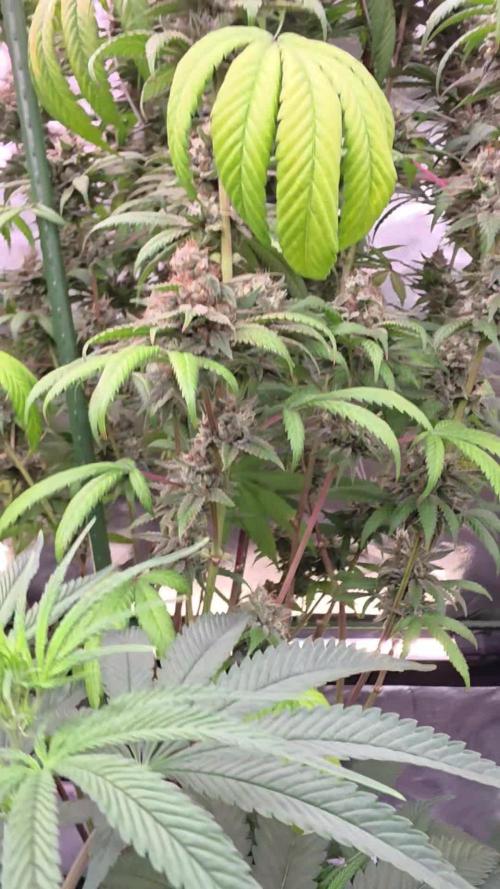
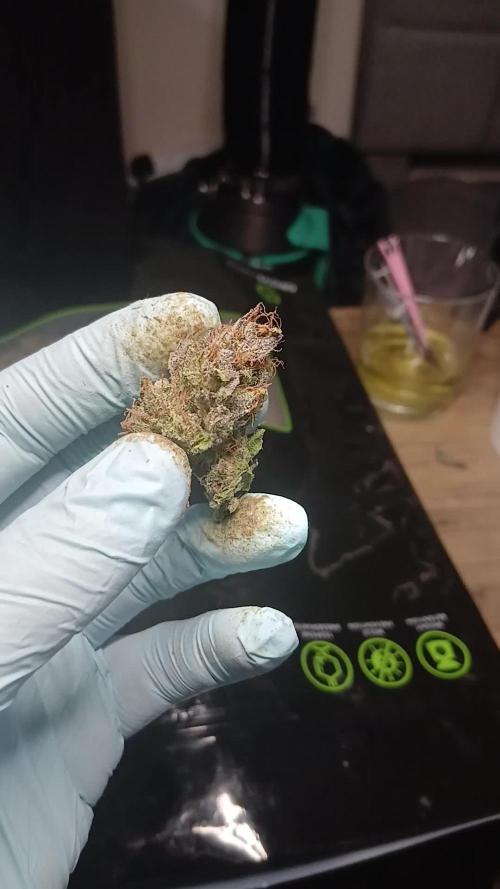
Das ist er – der finale Vorhang für diesen Durchlauf! In dieser allerletzten Woche vor der Ernte präsentiert sich die Lady von ihrer absolut besten Seite. Das herbstliche "Fade" hat die Blätter wunderschön gelb-orange eingefärbt, ein klares Zeichen dafür, dass sie komplett ausgelaugt ist und alle verbleibenden Nährstoffe in die Blüten gesteckt hat.
Die Buds dieses Phänotyps von Traphouse Genetics haben noch einmal ordentlich an Dichte zugelegt und sind vollständig von einer frostigen, dicken Harzschicht überzogen. Die langen, grazilen Blütenstränge hängen schwer in ihren Seilen, und die Struktur hat sich bis zur letzten Sekunde perfekt gehalten. Geruchlich ist das Ganze eine absolute Wucht – das stechende Permanent-Marker-Aroma hat kurz vor dem Schnitt seinen absoluten Höhepunkt erreicht. Das Spülen ist abgeschlossen, das Licht wird bald ausgeknipst, und die Schere liegt bereit. Ein extrem erfolgreicher Run geht zu Ende!

Likes
10
Share


@RivenWaters
Follow
One week removed from the greenhouse. Plants are recovering from heat stress and 4 are flowering


Likes
57
Share


@LockDownGrow
Follow
Ok so this week I did a defoliation and a tigh down too the netting , I really was not planning on doing such a big defoliation but the leafs became thick and dense and there was almost no light penitration down too the lower branches of the plant , so she is opened right up now and the humidity and temperature has dropped loads and the air is moving alot better around the leaves and branches , I will not take anything more off her now , I have also added Cal mag too the nutrients for this week only , she is well into pre flower now but the stretch has not yet started so I figured it's no or never too defoliate and tigh them down , this grill really has grown right out this week and is unrecognisable from the plant just a few days ago ,
I am very happy with them so far and being new too all this it's all very exciting ,
Thanks for looking :)
Likes
19
Share


@adam_pawloski87
Follow
Let’s Go Day 67 from seed !! So this week went real great! 2 Ogreberrys an Bruce Banner started getting flushed! The rest will follow up and start flush next week ! Today the 3 will continue getting flushed while the 3 others get there dose of nutrients, PHd at 6.5! Let’s grow lil ladies let’s grow!!! You all have an amazing productive day as well as a a great safe week !! Peace love and positive vibes to y’all Cheers 😶🌫️💨💨💨💨🤙🏻If there’s any questions please ask, I’ll be opened up to answer at best of my knowledge! Thank you all have a dank day !!

Likes
31
Share


@Mrs_Larimar
Follow
2024-08-31
Tangerine Snow F1 fast, performs like a Queen,
iam so impressed by this Strain, really the bet i have grown for long time
in and outdoors!!!
The Outdoor Girl, soaks in the Perfect weather Conditions , she loves her spotunder the Roof
in good Company.
She drinks and eats like a champ, but as you can see she needs it.
Sher performs like a Plant that sits in open Ground, but she is into ( only) 15 L Growbag.
thats awsome
The revegetating Girl
She shows sweet new Flowers already
( she was harvested weeks ago, and i let her revegetate outdoors)
so we are going to have another Harvest here.
iam super fascinated.
BREEDER INFO
Tangerine Snow F1 Fast Feminised is a 75% sativa, four-way cross of (Boost x Tangelo) with (Lavender x Power Plant).
This Fast F1 hybrid is bred from Cali genetics and boasts great citrus terps, high resin production for extracts,
high levels of THC, very good yields and excellent mould resistance.
Tangerine Snow F1 Fast can be grown indoors as well as outdoors. Indoor flowering times are between 8 - 10 weeks
while harvest time in northern latitudes is during September while in the southern hemisphere growers will be harvesting during March.
Recommended climate regions are hot, dry, humid and warm. These are tall, semi-branched plants that grow in excess of 200cm
and display a high degree of vigour with very good uniformity.
In common with many other heavily sativa-dominant strains, Tangerine Snow F1 Fast offers excellent resistance to mould
as well as to plant pests and diseases. The combination of citrus terps and plenty of resin makes thi
a very good extract strain with the 'washing' method delivering very good yields of hash.
The citrus terpene profile is reminiscent of mandarins and tangerines and also has sweet candy notes.
THC production has been lab-verified at a strong 24% while CBD is low. The effect is uplifting and energising,
perfect for use during the day and early evening.

Processing
Likes
5
Share


@Bombtofu
Follow
I need to get my l.s.t. done. Plan to this weekend. Have been alternating waterings between regular water and water with 2.5ml of fox farm grow big. Have watered all times with 200ml of water and the solution water mix. Been keeping the humidity at about 45% temp around 68. Can tell a huge difference in sizes of the plants and their container sizes. Will be going with at least 3gal pots next grow. Still using a 25w light as well. Will be upgrading that asap. Thanks for the view. And as always, stay safe.

Likes
6
Share


@colla69
Follow
Coming to the finish line.
Not sure if the plant really got better after the lockout, it is running without nitrogen so yellowing/losing leafs is to be expected anyway.
Planning to chop in exactly 10 days.
Likes
5
Share


@Bruno_The_Stoner
Follow
The best taste under the sun, great color of buds, unforgettable gorillas for me;) After quite a long fight with high temperatures and lack of support in the form of boosters, I am happy with the final result.
