Check the winners The Grow Awards 2026 🏆
Likes
Comments
Share
@CalGonJim
Follow
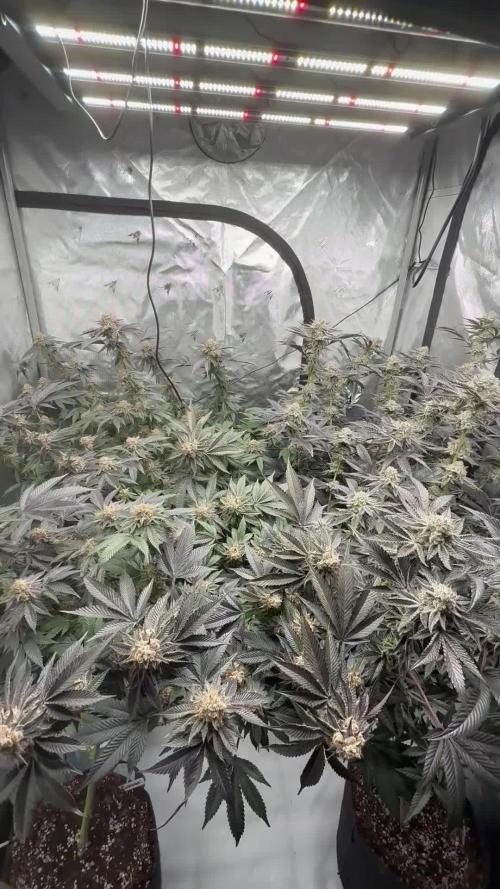
6/ 16 MONDAY 2am dis MESSA TAKEN CLONES....... 530am clone happy... maybe new diary with clones dont know. 11am 4 GGas F1 clones and 3 Ricky's in flower! 3 Bubbles 4pm 6/17 took off the red supports only needed for one day. I put GGF1, BPP, GCAuto and Bubbles Blueberry from parallel grow to 12/12!!! The rest need to veg longer. Im not getting the Veg right!!! Spindly branches... I may not be drying long enough between waterings or too low light wattage. dont know yet. 1158pm Almost new years eve again. cut the top off of GC so she wouldn't hit the lights 6/22 10am Now its into the cat stroller and out on the town!!!! I made a mobile mamajuana unit.
Likes
26
Share
Harvest 2 of 3 plants and everything was very good. I will updated soon with pics of the 3rd I harvest later than the two. Thanks to Barney’s Farm and Advanced Nutirents, to the love of the plant first of all and to all growers here and in the world. 🙏🏻💚 Updated: harvest all 3 plants for 100g/plant 💪🏻
Likes
45
Share
The cannabis strain Grape Guava can be a purple strain, depending on its specific phenotype and genetic makeup. While not all phenotypes of Grape Guava are purple, some variations, such as the Zatix Grape Guava, are noted for their striking purple appearance due to the genetic expression of anthocyanin pigments. https://www.youtube.com/watch?v=cKdVmdoKJ5k In a garden of green, Grape Guava gleams, With its fruity aroma, enchanting dreams. Clusters of grapes, guava's sweetness ignite, A strain so divine, in purple and white. Euphoria whispers, a lush fruity haze, Grape Guava's embrace, a tranquil daze. Off and away.@1400ppm. The increased CO2 allows plants to thrive at higher temperatures, which in turn necessitates higher humidity to maintain the ideal VPD for healthy growth and transpiration. 80F -5F = 75F LST with 70% RH = 0.72 kPa. Higher temperatures and humidity promote rapid growth, nutrient uptake, and photosynthesis while maintaining a lower stress level. Temperature influences the rate of enzymatic reactions involved in aerobic respiration. Enzymes, such as those involved in glycolysis, the Krebs cycle, and the electron transport chain, work most efficiently at an optimal temperature range. In low temperatures, enzymatic activity will slow down, thus reducing the rate of aerobic respiration. In high temperatures, enzymes can become denatured, thus impairing their function and stopping the process of aerobic respiration. Glucose is the primary fuel for aerobic respiration. The rate of aerobic respiration increases with the availability of glucose, as it is the starting point for glycolysis. If glucose levels are low, cells may rely on alternative energy sources such as fatty acids or amino acids , but these processes may yield less ATP or be less efficient. To determine this effect, carbon dioxide volume was measured (as carbon dioxide is an output of aerobic respiration) 18/6 with the 6 being IR. The near infrared (IR-a) borders around 700nm up to 1400nm @ photon par flux density of 1.8 instead of darkness, keeping temps overnight a neat 77F-80F. Think of my tent as a lung. What goes in must come out. When the rate of air going out exceeds the amount of air coming in, it creates a negative pressure. Tent concaves (bends in). If set up correctly, your RH will begin to drop slowly to the desired level you set, and the extraction turns off when it reaches 50% RH. The plant, as it performs cellular respiration, will always be releasing more water into the air, so the RH% of the tent overnight will always increase, so long as oxidative phosphorylation is occurring. As soon as the RH% creeps back up to 55%, the extraction turns back on, over and over. This creates a strong pressure differential which will work wonders on your grow. Replicating high and low-pressure fronts in nature. Critical for oxygen diffusion at the critical time of peak cellular respiratory function.. Moisture will not transfer from a saturated atmosphere to another if that air is already at or above its saturation point, meaning the air can't hold any more water vapor. Once I understood that water is produced as a by product during cellular respiration, specifically at the very end of the electron transport chain (ETC) where electrons are finally transferred to molecular oxygen, the higher the RH of the air, the more resistance there is for more moisture to be added to that environment, and effects the ease with which it does so. But none of that water comes from the pot; it's pulled from the air. If you run high daytime RH, your medium/pot is 100% reliant on transpirational root pull to move water. ZERO evaporation happens across the atmosphere if the tent air has high RH%, the medium cannot release its water through evaporation. Once a canopy develops, light no longer slowly wicks and evaporates from the topsoil. The Soil-Plant-Atmosphere Continuum (SPAC) describes the continuous pathway and process of water movement, driven by a gradient in water potential, from the soil, through the plant's roots, stem, and leaves, and finally evaporating into the atmosphere through transpiration. There is evaporation, there is transpiration, and then there is evapotranspiration; Evapotranspiration (ET) is the combined total of two processes: evaporation (water lost directly from soil and surface water into the atmosphere) and transpiration (water released from plants to the atmosphere through their leaves). Evapotranspiration represents the total amount of water that moves from the medium into the air. There is no such thing as a medium with too much water, only a medium that retains too much for too long. The water must always flow efficiently from one atmosphere(Medium) to another(Air) in a timely manner. Moisture is a critical factor for bacterial growth and decay. Dictating how long it's allowed to sit in any one location for any given period is a key preferred control. To ensure a net reduction in a bacterial population, the rate of removal (ET) must exceed the rate of bacterial growth (decay rate), which is often modeled as a growth rate for the specific bacterium under the given conditions. By optimizing daytime VPD, we also optimize conditions for bacterial growth to explode exponentially above 77°F.. If water is allowed to sit in a medium without an escape within a timeframe, nothing good will happen. IF High RH is maintained overnight as well as during the day, placing 100% of water movement at the behest of daytime transpiration, roots can only pull where they can reach, and if soil is compressed above a certain point, moisture will become trapped in a medium with no way of moving day or night. This will begin the countdown for decay to take hold. When water stagnates in a medium, it loses oxygen, creating anaerobic conditions that foster the growth of harmful microorganisms like bacteria and fungi, which can produce toxins and disease vectors. Thigmomorphogenesis, the process by which plants respond to mechanical stimuli like touch by altering their growth and development, results in significant morphological changes to improve survival against mechanical perturbations. This complex response involves sensing touch and initiating physiological and genetic responses, leading to changes in form and structure over days or weeks. The process is triggered by physical forces such as wind, rain, or touch. Plants adapt to these stimuli by changing their shape and structure, which may include slower growth, thickened stems, or altered leaf development. Plants possess sophisticated mechanisms to detect even subtle mechanical stimuli and initiate responses. A variety of molecules, including calcium ions, jasmonates, ethylene, and nitric oxide, are involved in signaling these mechanical inputs. Touch can induce the expression of genes that encode proteins for calcium sensing, cell wall modification, and defense mechanisms. A plant exposed to constant wind may become shorter and sturdier. A plant that is touched frequently might grow more slowly to conserve energy and develop thicker cell walls. These changes increase a plant's resilience and ability to survive in harsh environments. Let's get Thiggy with it.
Likes
16
Share
This week is pretty good! Temp was a bit low but resolved this now. This is my 2rd attempt but I only have a 1×.5 space so im playing around a little!
Likes
18
Share
@Sti_Cazz
Follow
So Flowering has started, I defoliated a bit and started giving some Bloom and flower...the humidity is starting to stress me out because its super humid outside and getting some crazy RH (70/80%) I need to fix this before it becomes an issue. So I moved my clip on fan to the bottom to see if I could move the canopy a bit better. it lacks power though.
Likes
17
Share
Day 7. Mutant 3 leaf plant. Looks healthy tho. We'll see how she does. Day 13. Never had a plant like this before. Pretty cool.
Likes
10
Share
@Zengrower
Follow
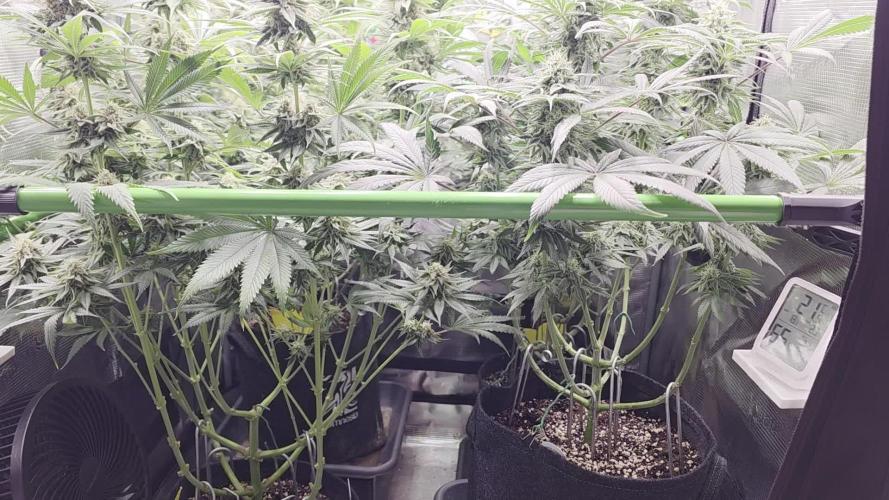
Week six is where things really start to accelerate. The buds are now developing rapidly, and you can almost see them gaining size day by day. What stood out before as “early formation” has now clearly shifted into real bud growth. These ladies are not holding back. At the same time, the differences between the two phenotypes are becoming even more pronounced — not just in structure, but now also in aroma. The smaller pheno on the right is developing a surprisingly sweet and unique scent. It’s a mix of raspberry and something slightly rubbery — an unusual combination, but very intriguing. The larger pheno on the left leans more towards a sweet citrus profile, layered with earthy undertones. A completely different expression, and exactly why growing from seed can be so rewarding. This week also called for some intervention. The plants were already getting dangerously close to the top of the G-tools cabinet, so defoliation became necessary to open things up and improve airflow. On top of that, I had to supercrop a few of the tallest shoots to keep the canopy under control. What really impressed me is how resilient these plants are. Compared to the Erdbeer I grew last winter — which showed light stress fairly quickly — these ladies seem to say: “bring it on.” They’re absorbing the light as if it can’t be intense enough. And it shows. The buds are stacking at an above-average pace and are already getting quite thick — and we’re still a few weeks away from the finish line. If they continue like this, this is going to be a very interesting run 🌿🔥
Likes
19
Share
@PakkaFarm
Follow
Harvest day 76. Dry in 50-60% humidity, totally night and ventilation maxed 🔥🍊💨 I'm filled with pain as happy for the end of our adventure together. Dry Day 1-2: humidity level 55-60 Dry Day 3-4 : 52-58 Dry Day 5-6-7 : 50-55 Manicure day 3 and 6 of dry ✂️ Use Ice-O-Lator to make Orange Sherbet bubble hash My density note : 8/10 Speed : Really fast, some LST, defoliation, toping. She really looks good ever time!
Likes
1
Share
@BearBuds
Follow
These girls are really starting to go nuts! We have come to the end of week 5 and they are already starting to pack on the bulk. I had a little issue with nute burn earlier in the week. I think it was because I was allowing them to dry out to much. I backed it down from 975 PPM to 700 PPM for 4 days and now I am back up to 800 again and they seem to be happy. I also think that my light is just a few inches to close. Its at about 16 right now and the leaves at the top are just not looking their best. It's a 340W light so backing it up a few inches shouldn't be to big of a deal. I moved it back to 20 inches from the canopy. Hoping this helps a little. The humidity here has been absolutely WILD! Tent fluctuates between 55% and 65% and I can't make it budge without the dehumidifier which raises the temp way to high. Outside the humidity hasn't dipped below 70% in over a week. Very strange, hoping that I can keep the room clean and keep enough air moving through the tent to avoid bud rot. FINGERS CROSSED
Likes
30
Share
week intel: it was the time to prune the cover crops this week i chopped them - no problem all good stresses : just a little E.C stress around 1.4 once a week feeding: i feed them 3 times this week with this order : day 1 : i feed them heavy with silicate +base nutrients(calcium & micros + Bloom) about 707 ppm - 1.4 e.c to cause a little stress. day 3 : i feed them low dose of Feeding Booster around 275 ppm - 0.57 e.c to let them recover a little but not fully recover still a little stress will caused. day 5 : i feed them with normal dose of Top-Max + B-52 around 213 ppm - 0.42 e.c to let them recover the stresses to get ready for another stress next week. guide of the week : autos do so so so much better with 20 hours light per day pls dont run autos near femenized 1 of them must get sacrificed
Likes
23
Share
@Joni2017
Follow
Day 66, she continues the very healthy flowering 🙌 size 80 cm👏🏻👏🏻 temperature 24º C ☀️, humidity 60% 💧 watering 750 ml alternating one day with nutrients and another without nutrients with osmotized water 💦💦 Session 45 min. of binaural sounds for growth and healing 🎼 and music 😉👍
Likes
49
Share
@Wastent91
Follow
Ehi ragazzi come va tutto bene? A me benone! Cosa posso dire, questa settimana ho raccolto la purple ed ora sta seccando, invece questa ragazza ha un odore speziato davvero intenso, appena mi avvicino e la sfioro l odore mi rimane impregnato e tutti in casa sanno che sono andato a prendermi cura delle mie bambine! Sembra che i fiori si stiano ingrossando abbastanza bene, sono proprio distribuite come delle pigne su un albero, il loro peso sta iniziando a farla piegare a destra e sinistra, per ora ho solo tentato di legare la cima principale in modo che nn si ribalti del tutto..😼 Ha davvero delle cime dense e mi aspetto grandi cose da questa nuova genetica premiata della Fastbuds, che sforna come sempre dei prodotti impressionanti!! 🤩 Devo ricordare che tutto questo non sarebbe possibile se non avessi una luce davvero pazzesca della Mars hydro che come sempre è grazie a lei che le ragazze danno il meglio di loro! Andate e compratela subito ve la consiglio caldamente ma perché davvero da dei risultati impressionanti, basta vedere i miei ultimi diari la differenza con quelli precedenti si nota! Grazie di tutto e buon 420 a tutti! Spero che i miei contenuti vi piacciano e continuate a seguirmi! 😼🙏😆🌱🌿🌲😻😻
Likes
4
Share
9weeks and 4 days seed to harvest, 125g dry weight👊🏻 Banging straight after a dry 💯 white ash, gonna be killa when had a good cure😎😤
Likes
11
Share
Such a great week! I’ve never seen such a fast growth before. Since they were ready the girls got transferred in their final pots, 5l pot + 2l extra from the self watering grow box. The soil is ca. 50% coco, 50% soil … well there’s probably about 15% perlite in there as well. They soil mix is amended with ca. 1,5g/l green house feed biogrow. Plus ca. 6g/pot Aktivator. And from now on they will stay in the greenhouse.
Likes
7
Share
Week 4 - Sometimes You Got To Lose To Gain Phase 2 - I took off the fan leaves so that the plant would redirect its energy into the stem and branches rather than the leaves. I also cut of the top heads so that the energy would go into the development of the 2 heads below.
Likes
4
Share
This week she’s getting closer to harvest, took a video that’s shaky af but still shows a close up a little better then the pictures.
Likes
8
Share
@Raffitsch
Follow
I think it fits after what they went through ^^ I'm currently discovering all the things you can do with my beloved plants. I hope I'm on the right track to escaping into my own world ^^ hehehe
Likes
10
Share
What’s good everyone, this is the start of week 11 and the first week of flower. Yesterday I let the, sit in darkness for a whole day to jump start them and by the sight of it, they sure did jump a bit. MXOP is amazing she takes to what every you toss at her, she is hard to stress out. But after growing this cultivar a few times now I can say they don’t require much nitrogen as one would think they CRAVE calcium and possibly a bit of magnesium but from what I have seen they ALWAYS want more calcium weird might be the soil I have been using. This is the fun part, can’t wait to update you all next week FLOWER TIME BABY WOOOOOOO! Until next time growmies take it easy ✌️ 08/07/23
Likes
19
Share
@MistaOC
Follow
25.01. F23 The stretch is now completely finished, with the plants standing at around 82 cm. Bud development is progressing well, with clear improvements in structure and density. Unfortunately, powdery mildew remains an issue. Affected leaves are removed daily to limit further spread. In addition, the plants are treated twice per week with Purolyt to keep spore pressure as low as possible.
Likes
7
Share
@cwgrows
Follow
Fimming was a success! 3+ main branches on each lady now. Crazy seeing how fast they respond to this type of treatment. The nutrients in the soil have likely run out by now so I am started to feed using the Fox Farms trio at half strength every other watering.